|
|
Home | Switchboard | Unix Administration | Red Hat | TCP/IP Networks | Neoliberalism | Toxic Managers |
| (slightly skeptical) Educational society promoting "Back to basics" movement against IT overcomplexity and bastardization of classic Unix | |||||||
The invasive dominance of monetarism in macroeconomics has been total ever since central bankers, led by Alan Greenspan, who from 1987 to 2006 was chairman of the Board of Governors of US Federal Reserve - the head of the global central banking snake by virtue of dollar hegemony - embraced the counterfactual conclusion of Milton Friedman that monetarist measures by the central bank can perpetuate the boom phase of the business cycle indefinitely, banishing the bust phase from finance capitalism altogether.
|
|
Switchboard | ||||
| Latest | |||||
| Past week | |||||
| Past month | |||||
 |
 |
 |
Aug 22, 2020 | www.unz.com
Franz , says: August 21, 2020 at 7:25 am GMT
@ThreeCranes trol -- China had already agreed to play ball, but was still gathering the infrastructure. S. Korea and a few other nations took the work in the meantime.Meantime, as Sam Francis (RIP) noted in the early nineties, Main Street USA turned into dollar stores and flea markets and retail dumps and fast food pits.
Yes, nations that make things control the future. They also develop consumer economies. Thus in a few more years stuff made in China be beyond the price range of the average American.
Milton and Chile: https://www.theguardian.com/commentisfree/cifamerica/2010/mar/03/chile-earthquake
|
|
|
Jan 15, 2017 | economistsview.typepad.com
Peter K. : January 14, 2017 at 08:15 AM , 2017 at 08:15 AMA while back Thoma linked to a Basil Halperin blog post on economics. Someone emailed the link to Scott Sumner who really liked it.Jerry Brown -> Peter K.... , -1http://www.themoneyillusion.com/?p=32250
Basil Halperin on the logic behind NGDP targeting
by Scott SumnerJan. 13, 2017
James Alexander directed me to a recent post by Basil Halperin, which is one of the best blog posts that I have read in years. (I was actually sent this material before Christmas, but it sort of fell between the cracks.)
Basil starts off discussing a program for distributing excess food production from manufacturers to food banks.
The problem was one of distributed versus centralized knowledge. While Feeding America had very good knowledge of poverty rates around the country, and thus could measure need in different areas, it was not as good at dealing with idiosyncratic local issues.
Food banks in Idaho don't need a truckload of potatoes, for example, and Feeding America might fail to take this into account. Or maybe the Chicago regional food bank just this week received a large direct donation of peanut butter from a local food drive, and then Feeding America comes along and says that it has two tons of peanut butter that it is sending to Chicago.
To an economist, this problem screams of the Hayekian knowledge problem. Even a benevolent central planner will be hard-pressed to efficiently allocate resources in a society since it is simply too difficult for a centralized system to collect information on all local variation in needs, preferences, and abilities.
One option would simply be to arbitrarily distribute the food according to some sort of central planning criterion. But there is a better way:
This knowledge problem leads to option two: market capitalism. Unlike poorly informed central planners, the decentralized price system – i.e., the free market – can (often but not always) do an extremely good job of aggregating local information to efficiently allocate scarce resources. This result is known as the First Welfare Theorem.
Such a system was created for Feeding America with the help of four Chicago Booth economists in 2005. Instead of centralized allocation, food banks were given fake money – with needier food banks being given more – and allowed to bid for different types of food in online auctions. Prices are thus determined by supply and demand. . . .
By all accounts, the system has worked brilliantly. Food banks are happier with their allocations; donations have gone up as donors have more confidence that their donations will actually be used. Chalk one up for economic theory.
Basil points out that while that solves one problem, there is still the issue of determining "monetary policy", i.e. how much fake money should be distributed each day?
Here's the problem for Feeding America when thinking about optimal monetary policy. Feeding America wants to ensure that changes in prices are informative for food banks when they bid. In the words of one of the Booth economists who helped design the system:
"Suppose I am a small food bank; I really want a truckload of cereal. I haven't bid on cereal for, like, a year and a half, so I'm not really sure I should be paying for it. But what you can do on the website, you basically click a link and when you click that link it says: This is what the history of prices is for cereal over the last 5 years. And what we wanted to do is set up a system whereby by observing that history of prices, it gave you a reasonable instinct for what you should be bidding."
That is, food banks face information frictions: individual food banks are not completely aware of economic conditions and only occasionally update their knowledge of the state of the world. This is because obtaining such information is time-consuming and costly.
Relating this to our question of optimal monetary policy for the food bank economy: How should the fake money supply be set, taking into consideration this friction?
Obviously, if Feeding America were to randomly double the supply of (fake) money, then all prices would double, and this would be confusing for food banks. A food bank might go online to bid for peanut butter, see that the price has doubled, and mistakenly think that demand specifically for peanut butter has surged.
This "monetary misperception" would distort decision making: the food bank wants peanut butter, but might bid for a cheaper good like chicken noodle soup, thinking that peanut butter is really scarce at the moment.
Clearly, random variation in the money supply is not a good idea. More generally, how should Feeding America set the money supply?
One natural idea is to copy what real-world central banks do: target inflation.
Basil then explains why NGDP targeting is likely to be superior to inflation targeting, using a Lucas-type monetary misperceptions model.
III. Monetary misperceptions
I demonstrate the following argument rigorously in a formal mathematical model in a paper, "Monetary Misperceptions: Optimal Monetary Policy under Incomplete Information," using a microfounded Lucas Islands model. The intuition for why inflation targeting is problematic is as follows.Suppose the total quantity of all donations doubles.
You're a food bank and go to bid on cheerios, and find that there are twice as many boxes of cheerios available today as yesterday. You're going to want to bid at a price something like half as much as yesterday.
Every other food bank looking at every other item will have the same thought. Aggregate inflation thus would be something like -50%, as all prices would drop by half.
As a result, under inflation targeting, the money supply would simultaneously have to double to keep inflation at zero. But this would be confusing: Seeing the quantity of cheerios double but the price remain the same, you won't be able to tell if the price has remained the same because
(a) The central bank has doubled the money supply
or
(b) Demand specifically for cheerios has jumped up quite a bitIt's a signal extraction problem, and rationally you're going to put some weight on both of these possibilities. However, only the first possibility actually occurred.
This problem leads to all sorts of monetary misperceptions, as money supply growth creates confusions, hence the title of my paper.
Inflation targeting, in this case, is very suboptimal. Price level variation provides useful information to agents.
IV. Optimal monetary policy
As I work out formally in the paper, optimal policy is instead something close to a nominal income (NGDP) target. Under log utility, it is exactly a nominal income target. (I've written about nominal income targeting before more critically here.). . . Feeding America, by the way, does not target constant inflation. They instead target "zero inflation for a given good if demand and supply conditions are unchanged." This alternative is a move in the direction of a nominal income target.
V. Real-world macroeconomic implications
I want to claim that the information frictions facing food banks also apply to the real economy, and as a result, the Federal Reserve and other central banks should consider adopting a nominal income target. Let me tell a story to illustrate the point.Consider the owner of an isolated bakery. Suppose one day, all of the customers seen by the baker spend twice as much money as the customers from the day before.
The baker has two options. She can interpret this increased demand as customers having come to appreciate the superior quality of her baked goods, and thus increase her production to match the new demand. Alternatively, she could interpret this increased spending as evidence that there is simply more money in the economy as a whole, and that she should merely increase her prices proportionally to account for inflation.
Economic agents confounding these two effects is the source of economic booms and busts, according to this model. This is exactly analogous to the problem faced by food banks trying to decide how much to bid at auction.
To the extent that these frictions are quantitatively important in the real world, central banks like the Fed and ECB should consider moving away from their inflation targeting regimes and toward something like a nominal income target, as Feeding America has.
The paper he links to contains a rigorous mathematical model that shows the advantages of NGDP targeting. He doesn't claim NGDP targeting is always optimal, but any paper that did would actually be less persuasive, as it would mean the model was explicitly constructed to generate that result. Instead the result flows naturally from the Lucas-style archipelago model, where each trader is on their own little island observing local demand conditions before aggregate (NGDP conditions). This is the sort of approach I used in my first NGDP futures targeting paper, where futures markets aggregated all of this local demand (i.e. velocity) information. However Basil's paper is light years ahead of where I was in 1989.
I can't recommend him highly enough. I'm told he recently got a BA from Chicago, which suggests he may be another Soltas, Wang or Rognlie, one of those people who makes a mark at a very young age. He seems to combine George Selgin-type economic intuition (even citing a lovely Selgin metaphor at the end of his post) with the sort of highly technical skills required in modern macroeconomics.
Commenters often ask (taunt?) me with the question, "Where is the rigorous model for market monetarism". I don't believe any single model can incorporate all of the insights from any half decent school of thought, but Basil's model certainly provides the sort of rigorous explanation of NGDP targeting that people seem to demand.
Basil has lots of other excellent posts, and over the next few weeks and months I will have more posts responding to some of the points he makes (which to his credit, include criticism of NGDP targeting–he's no ideologue.)
I like Scott Sumner's blog The Money Illusion and think his idea of NGDP level targeting is a good idea as far as monetary policy. I don't share his supreme confidence in the ability of monetary policy by itself to solve problems in deficient aggregate demand. But he is always interesting to read.
|
|
|
Jan 14, 2017 | economistsview.typepad.com
jonny bakho: January 13, 2017 at 03:23 AMWhat Friedman got wrong is not including current income.pgl -> jonny bakho... , January 13, 2017 at 05:59 AM
People with high income spend a fraction of that income and save the rest.
Their demand is met, so the additional income mostly goes to savings.
People with low income spend everything and still have unmet demands
Additional income for them will go to meet those unmet demands (like fixing a toothache or replacing bald tires).Friedman was biased against fiscal intervention in an economy and sought evidence to argue against such policies
Our model for funding infrastructure is broken. Federal funding means project that are most needed by cities can be overlooked while projects that would destroy cities are funded. Federal infrastructure funding destroyed city neighborhoods leaving the neighboring areas degraded. Meanwhile, necessary projects such as a new subway tunnel from NJ to Manhattan are blocked by States who are ok if the city fails and growth moves to their side of the river. Money should go directly to the cities. Infrastructure should be build to serve the people who live, walk and work there, not to allow cars to drive through at high speeds as the engineers propose. This infrastructure harms cities and becomes a future tax liability that cannot be met if the built infrastructure it encourages is not valuable enough to support maintenance. We are discovering that unlike our cities where structures can increase in value, strip malls decline in value, often to worthlessness. Road building is increasingly mechanized and provides less employment per project than in the past. Projects such as replacing leaking water pipes require more labor.
"Friedman was biased against fiscal intervention in an economy and sought evidence to argue against such policies". You get this from his permanent income hypothesis??? It is the same basic idea as Modligiani's life cycle model who certainly was not biased against fiscal interventions.jonny bakho -> pgl... , January 13, 2017 at 06:20 AMNo, from the whole of Friedman's work.pgl -> jonny bakho... , January 13, 2017 at 06:31 AM
Finding alternatives to fiscal tools for economic management is a central theme.
His permanent income hypothesis was used as a bludgeon against fiscal policy use.
Economic management by monetary policy has hit its limits."Economic management by monetary policy has hit its limits."jonny bakho -> pgl... , January 13, 2017 at 08:44 AMIf you want to bring up his entire body of work - you might note what he said about Japan's period at the zero lower bound. Same thing Krugman has said. So are you going to tell us Krugman opposed the use of fiscal stimulus?
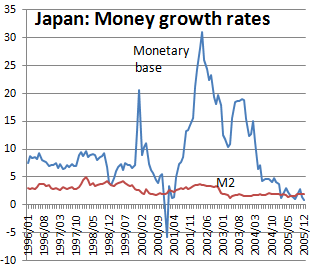
From PK:New Deal democrat said in reply to pgl... , January 13, 2017 at 05:15 AM"I had some graphics problems with my previous post on this subject - it turns out that what looks like a permanent link at the BOJ website isn't; plus I had some more to say about the subject.
So: David Wessel quoted what Milton Friedman said about Japan in 1998, and interpreted it as meaning that Friedman would favor quantitative easing now. I think that's right. And just to be clear, I also favor QE - largely because it might help some, and seems to be just about the only policy lever still available in the face of political reality.
But I think it's also important to note that Friedman was all wrong about Japan - and that you can argue that he was also wrong about the Great Depression, for the same reason.
For what Friedman argued, both for Japan in the 1990s and America in the 1930s, was that all the central bank needed to do was more - push out those reserves into the banking system. This would raise the money supply, and a higher money supply would have the usual effects.
But the Bank of Japan tried that - and found that pushing more reserves into the banks didn't even lead to rapid growth in the money supply, let alone end the problem of deflation."
http://krugman.blogs.nytimes.com/2010/10/29/more-on-friedmanjapan/
A central bank can make matters worse by tightening. But they cannot fight fiscal austerity at the ZLB. Fiscal and monetary policy need to be pushing in the same direction.
I thought Noah Smith's article was excellent, for once. Clearly and concisely lays out the data and its implications for theory. Even if I accept that your criticism that he doesn't accurately state the underlying theory is valid.pgl -> New Deal democrat... , January 13, 2017 at 05:41 AMWe will now see if the adage about Econ vs. physics is true ("when data contradicts theory, physics throws out the theory. Econ throws out the data.")
I think the data can be explained by taking regency and hedging one's bets into account. People on average tend to spend what they think is sustainable (they budget!) but they hedge their bets against being wrong. Either a positive or negative shock will not just change the ability to spend short-term, but may also effect how they calculate long term sustainability.
Thus - in hindsight - people may overreact to a short term shock. James Hamilton has found this with regard to sudden changes in gas prices. The report Smith discusses finds it with regard to both unemployment and the termination of unemployment insurances. When the shock hits, you don't know if it is permanent or not. So you recalibrate. Btw, this also works for positive shocks. People don't spend gas price savings until about a year into lower prices, when they begin to believe the windfall might be more long-lasting.
Everything Noah said there was noted in a 1980 lecture by James Tobin that I had the pleasure of attending. In a word - nothing new.New Deal democrat said in reply to pgl... , January 13, 2017 at 06:00 AMI.e., the adage about econ vs. physics has already been shown to be true.jonny bakho said in reply to pgl... , January 13, 2017 at 06:22 AMMaybe nothing new, but plainly much that has been forgotten or no longer taught.pgl -> jonny bakho... , January 13, 2017 at 06:32 AMI grant some people teach Ricardian Equivalence as if it were gospel but most economists do talk about borrowing constrained households.kthomas -> pgl... , January 13, 2017 at 06:46 AMMilton is almost as controversial as Marx. Marx had a more realistic, a more grounded world-view. Marx knew damn-well that his ideals were just that. That we should all share in the fruits of our combined labor was to Marx, a way of achieving perfection. Pure idealism and he knew.point -> pgl... , January 13, 2017 at 07:10 AMFriedman largely believed his own BS, and turned a blind eye to most moral arguments. This, to me, is the heartless neoliberal that some our fellow posters are so oft to mention.
I have no data and no theory to offer against Friedman's hypothesis, but it sure feels like there is good reason to doubt it.JohnH -> pgl... , January 13, 2017 at 07:37 AMThe reason I say so is that this mental behavior of converting income and expense streams into present value sums, making long term assets and liabilities on the current personal balance sheet, is extremely rare in my experience.
I'm not talking about just among regular working Joe's either. I'm talking about people with plenty of excess income: fund managers and CEOs. If anyone should be able to habitually do the math it should be these guys. But let me assert, if you want to rub elbows in that crowd, a nearly certain way to distinguish yourself is to walk into the room with these PVs at your fingertips. You may be totally alone.
The idea that less endowed people will do it is just giggles.
Further, it does not take much thought in this direction to analyze the expected net worth position of people along the existing income distribution. It would appear the income level at which one may be able to expect to fund lifetime liabilities is near the 80th percentile. That people below that level may be able to smooth their required consumption though temporary borrowing is just more giggles.
What's curious here is that while Friedman (and many policymakers) may assume that most people's consumption isn't affected by how much they earn, they are totally convinced that their spending levels are immediately and dramatically affected by changes in their wealth!pgl : , January 13, 2017 at 01:37 AMThe wealth effect is one of the pillars of trickle down monetary policy. Proponents claim that lower interest rates drive asset prices up, making the wealthy FEEL wealthier again...and presto they start consuming again, igniting economic growth.
It would be very interesting to chart the course of wealthy people's spending in response to changes in income and wealth. The results may prove Friedman right at the upper end of the income scale--the wealthy, having more than they know what to do with, may well ride out stormy periods by maintaining their consumption via borrowing and sale of some assets.
If Friedman's theory does apply to wealthy people, it would undermine a fundamental justification for trickle down monetary policy and help explain why the economic recovery has been so anemic---policy decisions where targeted at the wrong end of the income scale...at people who wouldn't boost consumption (the wealthy) instead of at those who would boost consumption.
Once again, it would appear that deeply entrenched economic 'theories' are designed to help the wealthy...without much empirical evidence.
Simon Wren Lewis leaves open the possibility that an increase in aggregate demand can increase real GDP as we may not be at full employment (I'd change that from "may not be" to "are not") but still comes out against tax cuts for the rich with this:New Deal democrat said in reply to pgl... , January 13, 2017 at 05:19 AM"There is a very strong case for more public sector investment on numerous grounds. But that investment should go to where it is most needed and where it will be of most social benefit"
Exactly but alas Team Trump ain't listening.
A little off topic, but I've taken a further look at whether and by how much a decline in the unemployment rate coaxes people back into the labor force. I think we can make a good back of the envelope estimate. Also: further evidence of the importance of the cost of daycare. I will probably post next week.pgl -> New Deal democrat... , January 13, 2017 at 05:43 AMYep. As the economy gets stronger, it does seem the labor force participation rate goes up. This is why I focus more on the employment to population ratio and less on the unemployment rate.John Williams -> New Deal democrat... , January 13, 2017 at 08:23 AMIsn't there a scale issue here? The unemployment rate is an attribute of populations, but the unemployed mostly look for work locally, and for work they think they can do. That is, they respond more at the level of individual opportunityNew Deal democrat -> John Williams... , -1When I put up my posts I will link to them here. That will probably give you a better feel for questions to ask.
|
|
|
Jan 13, 2017 | economistsview.typepad.com
sanjait : , January 13, 2017 at 01:09 AMI just read through the Zingales, Schiller, Smith and Wren-Lewis pieces.pgl -> sanjait... , January 13, 2017 at 02:07 AMThey all make what I would consider to be obvious points, though all are arguably worth repeating, as they are widely not accepted.
Let's see. Zingales does not like crony capitalism whereas Schiller praises LBJ's Great Society. I think most progressives agree with both.Libezkova -> sanjait... , January 13, 2017 at 04:37 AMThere is nothing common between articles of Zingales and Schiller.pgl : , January 13, 2017 at 01:32 AMMy impression is that Schiller might lost his calling: he might achieve even greater success as a diplomat, if he took this career. He managed to tell something important about incompatibility of [the slogan] "Make America Great Again" with neoliberalism without offending anybody. Which is a pretty difficult thing to do.
Zingalles is just another Friedman-style market fundamentalist. Nothing new and nothing interesting.
Noah Smith is wrong here: "This idea is important because it meant that we shouldn't expect fiscal stimulus to have much of an effect. Government checks are a temporary form of income, so Friedman's theory predicts that it won't change spending patterns, as advocates such as John Maynard Keynes believed."jonny bakho -> pgl... , January 13, 2017 at 03:23 AMFriedman's view about consumption demand is the same as the Life Cycle Model (Ando and Modligiani). OK - these models do predict that tax rebates should not affect consumption. And yes there are households who are borrower constrained so these rebates do impact their consumption.
But this is not the only form of fiscal stimulus. Infrastructure investment would increase aggregate demand even under the Friedman view of consumption. This would hold even under the Barro-Ricardian version of this theory. OK - John Cochrane is too stupid to know this. And I see Noah in his rush to bash Milton Friedman has made the same mistake as Cochrane.
What Friedman got wrong is not including current income. People with high income spend a fraction of that income and save the rest. Their demand is met, so the additional income mostly goes to savings.pgl : , January 13, 2017 at 01:37 AMPeople with low income spend everything and still have unmet demands. Additional income for them will go to meet those unmet demands (like fixing a toothache or replacing bald tires).
Friedman was biased against fiscal intervention in an economy and sought evidence to argue against such policies
Our model for funding infrastructure is broken. Federal funding means project that are most needed by cities can be overlooked while projects that would destroy cities are funded.
Federal infrastructure funding destroyed city neighborhoods leaving the neighboring areas degraded. Meanwhile, necessary projects such as a new subway tunnel from NJ to Manhattan are blocked by States who are ok if the city fails and growth moves to their side of the river.
Money should go directly to the cities. Infrastructure should be build to serve the people who live, walk and work there, not to allow cars to drive through at high speeds as the engineers propose. This infrastructure harms cities and becomes a future tax liability that cannot be met if the built infrastructure it encourages is not valuable enough to support maintenance.
We are discovering that unlike our cities where structures can increase in value, strip malls decline in value, often to worthlessness. Road building is increasingly mechanized and provides less employment per project than in the past. Projects such as replacing leaking water pipes require more labor.
Simon Wren Lewis leaves open the possibility that an increase in aggregate demand can increase real GDP as we may not be at full employment (I'd change that from "may not be" to "are not") but still comes out against tax cuts for the rich with this:Libezkova : January 13, 2017 at 03:45 AM"There is a very strong case for more public sector investment on numerous grounds. But that investment should go to where it is most needed and where it will be of most social benefit"
Exactly but alas Team Trump ain't listening.
Re: Milton Friedman's Cherished Theory Is Laid to Rest - Bloomberg ViewJulio -> Libezkova...Friedman was not simply wrong. The key for understanding Friedman is that he was a political hack, not a scientist.
His main achievement was creation (partially for money invested in him and Mont Pelerin Society by financial oligarchy) of what is now called "neoliberal rationality": a pervert view of the world, economics and social processes that now still dominates in the USA and most of Western Europe. It is also a new mode of "govermentability".
Governmentality is distinguished from earlier forms of rule, in which national wealth is measured as the size of territory or the personal fortune of the sovereign, by the recognition that national economic well-being is tied to the rational management of the national population. Foucault defined governmentality as:
"the ensemble formed by the institutions, procedures, analyses, and reflections, the calculations and tactics that allow the exercise of this very specific albeit complex form of power, which has as its target population, as its principle form of knowledge political economy and as its technical means, apparatuses of security"
Here is Wendy Brown analysis of "neoliberal rationality": http://lchc.ucsd.edu/cogn_150/Readings/brown.pdf
== quote ===
A liberal political order may harbor either liberal or Keynesian economic policies -- it may lean in the direction of maximizing liberty (its politically "conservative" tilt) or of maximizing equality (its politically "liberal" tilt), but in contemporary political parlance, it is no more or less a liberal democracy because of one leaning or the other.
Indeed, the American convention of referring to advocates of the welfare state as political liberals is especially peculiar, given that American conservatives generally hew more closely to both the classical economic and the political doctrines of liberalism -- it turns the meaning of liberalism in the direction of liberality rather than liberty.
For our purposes, what is crucial is that the liberalism in what has come to be called neoliberalism refers to liberalism's economic variant, recuperating selected pre-Keynesian assumptions about the generation of wealth and its distribution, rather than to liberalism as a political doctrine, as a set of political institutions, or as political practices. The neo in neoliberalism, however, establishes these principles on a significantly different analytic basis from those set forth by Adam Smith, as will become clear below. Moreover, neoliberalism is not simply a set of economic policies; it is not only about facilitating free trade, maximizing corporate profits, and challenging welfarism.
Rather, neoliberalism carries a social analysis that, when deployed as a form of governmentality, reaches from the soul of the citizen-subject to education policy to practices of empire. Neoliberal rationality, while foregrounding the market, is not only or even primarily focused on the economy; it involves extending and disseminating market values to all institutions and social action, even as the market itself remains a distinctive player.
... ... ...
1. The political sphere, along with every other dimension of contemporary existence, is submitted to an economic rationality; or, put the other way around, not only is the human being configured exhaustively as homo economicus, but all dimensions of human life are cast in terms of a market rationality. While this entails submitting every action and policy to considerations of profitability, equally important is the production of all human and institutional action as rational entrepreneurial action, conducted according to a calculus of utility, benefit, or satisfaction against a microeconomic grid of scarcity, supply and demand, and moral value-neutrality. Neoliberalism does not simply assume that all aspects of social, cultural, and political life can be reduced to such a calculus; rather, it develops institutional practices and rewards for enacting this vision. That is, through discourse and policy promulgating its criteria, neoliberalism produces rational actors and imposes a market rationale for decision making in all spheres.
Importantly, then, neoliberalism involves a normative rather than ontological claim about the pervasiveness of economic rationality and it advocates the institution building, policies, and discourse development appropriate to such a claim. Neoliberalism is a constructivist project: it does not presume the ontological givenness of a thoroughgoing economic rationality for all domains of society but rather takes as its task the development, dissemination, and institutionalization of such a rationality. This point is further developed in (2) below.
2. In contrast with the notorious laissez-faire and human propensity to "truck and barter" stressed by classical economic liberalism, neoliberalism does not conceive of either the market itself or rational economic behavior as purely natural. Both are constructed-organized by law and political institutions, and requiring political intervention and orchestration. Far from flourishing when left alone, the economy must be directed, buttressed, and protected by law and policy as well as by the dissemination of social norms designed to facilitate competition, free trade, and rational economic action on the part of every member and institution of society.
In Lemke's account, "In the Ordo-liberal scheme, the market does not amount to a natural economic reality, with intrinsic laws that the art of government must bear in mind and respect; instead, the market can be constituted and kept alive only by dint of political interventions. . . . [C]ompetition, too, is not a natural fact. . . . [T]his fundamental economic mechanism can function only if support is forthcoming to bolster a series of conditions, and adherence to the latter must consistently be guaranteed by legal measures" (193).
The neoliberal formulation of the state and especially of specific legal arrangements and decisions as the precondition and ongoing condition of the market does not mean that the market is controlled by the state but precisely the opposite. The market is the organizing and regulative principle of the state and society, along three different lines:
- The state openly responds to needs of the market, whether through monetary and fiscal policy, immigration policy, the treatment of criminals, or the structure of public education. In so doing, the state is no longer encumbered by the danger of incurring the legitimation deficits predicted by 1970s social theorists and political economists such as Nicos Poulantzas, Jürgen Habermas, and James O'Connor.6 Rather, neoliberal rationality extended to the state itself indexes the state's success according to its ability to sustain and foster the market and ties state legitimacy to such success. This is a new form of legitimation, one that "founds a state," according to Lemke, and contrasts with the Hegelian and French revolutionary notion of the constitutional state as the emergent universal representative of the people. As Lemke describes Foucault's account of Ordo-liberal thinking, "economic liberty produces the legitimacy for a form of sovereignty limited to guaranteeing economic activity . . . a state that was no longer defined in terms of an historical mission but legitimated itself with reference to economic growth" (196).
- The state itself is enfolded and animated by market rationality: that is, not simply profitability but a generalized calculation of cost and benefit becomes the measure of all state practices. Political discourse on all matters is framed in entrepreneurial terms; the state must not simply concern itself with the market but think and behave like a market actor across all of its functions, including law. 7
- Putting (a) and (b) together, the health and growth of the economy is the basis of state legitimacy, both because the state is forthrightly responsible for the health of the economy and because of the economic rationality to which state practices have been submitted. Thus, "It's the economy, stupid" becomes more than a campaign slogan; rather, it expresses the principle of the state's legitimacy and the basis for state action-from constitutional adjudication and campaign finance reform to welfare and education policy to foreign policy, including warfare and the organization of "homeland security."
3. The extension of economic rationality to formerly noneconomic domains and institutions reaches individual conduct, or, more precisely, prescribes the citizen-subject of a neoliberal order. Whereas classical liberalism articulated a distinction, and at times even a tension, among the criteria for individual moral, associational, and economic actions (hence the striking differences in tone, subject matter, and even prescriptions between Adam Smith's Wealth of Nations and his Theory of Moral Sentiments), neoliberalism normatively constructs and interpellates individuals as entrepreneurial actors in every sphere of life.
It figures individuals as rational, calculating creatures whose moral autonomy is measured by their capacity for "self-care"-the ability to provide for their own needs and service their own ambitions. In making the individual fully responsible for her- or himself, neoliberalism equates moral responsibility with rational action; it erases the discrepancy between economic and moral behavior by configuring morality entirely as a matter of rational deliberation about costs, benefits, and consequences.
But in so doing, it carries responsibility for the self to new heights: the rationally calculating individual bears full responsibility for the consequences of his or her action no matter how severe the constraints on this action-for example, lack of skills, education, and child care in a period of high unemployment and limited welfare benefits.
Correspondingly, a "mismanaged life," the neoliberal appellation for failure to navigate impediments to prosperity, becomes a new mode of depoliticizing social and economic powers and at the same time reduces political citizenship to an unprecedented degree of passivity and political complacency.
The model neoliberal citizen is one who strategizes for her- or himself among various social, political, and economic options, not one who strives with others to alter or organize these options. A fully realized neoliberal citizenry would be the opposite of public-minded; indeed, it would barely exist as a public. The body politic ceases to be a body but is rather a group of individual entrepreneurs and consumers . . . which is, of course, exactly how voters are addressed in most American campaign discourse.8
Other evidence for progress in the development of such a citizenry is not far from hand: consider the market rationality permeating universities today, from admissions and recruiting to the relentless consumer mentality of students as they consider university brand names, courses, and services, from faculty raiding and pay scales to promotion criteria. 9
Or consider the way in which consequential moral lapses (of a sexual or criminal nature) by politicians, business executives, or church and university administrators are so often apologized for as "mistakes in judgment," implying that it was the calculation that was wrong, not the act, actor, or rationale.
The state is not without a project in the making of the neoliberal subject. It attempts to construct prudent subjects through policies that organize such prudence: this is the basis of a range of welfare reforms such as workfare and single-parent penalties, changes in the criminal code such as the "three strikes law," and educational voucher schemes.
Because neoliberalism casts rational action as a norm rather than an ontology, social policy is the means by which the state produces subjects whose compass is set entirely by their rational assessment of the costs and benefits of certain acts, whether those acts pertain to teen pregnancy, tax fraud, or retirement planning. The neoliberal citizen is calculating rather than rule abiding, a Benthamite rather than a Hobbesian.
The state is one of many sites framing the calculations leading to social behaviors that keep costs low and productivity high. This mode of governmentality (techniques of governing that exceed express state action and orchestrate the subject's conduct toward himor herself) convenes a "free" subject who rationally deliberates about alternative courses of action, makes choices, and bears responsibility for the consequences of these choices. In this way, Lemke argues, "the state leads and controls subjects without being responsible for them"; as individual "entrepreneurs" in every aspect of life, subjects become wholly responsible for their well-being and citizenship is reduced to success in this entrepreneurship (201).
Neoliberal subjects are controlled through their freedom-not simply, as thinkers from the Frankfurt School through Foucault have argued, because freedom within an order of domination can be an instrument of that domination, but because of neoliberalism's moralization of the consequences of this freedom. Such control also means that the withdrawal of the state from certain domains, followed by the privatization of certain state functions, does not amount to a dismantling of government but rather constitutes a technique of governing; indeed, it is the signature technique of neoliberal governance, in which rational economic action suffused throughout society replaces express state rule or provision.
Neoliberalism shifts "the regulatory competence of the state onto 'responsible,' 'rational' individuals [with the aim of] encourag[ing] individuals to give their lives a specific entrepreneurial form" (Lemke, 202).
4. Finally, the suffusion of both the state and the subject with economic rationality has the effect of radically transforming and narrowing the criteria for good social policy vis-à-vis classical liberal democracy. Not only must social policy meet profitability tests, incite and unblock competition, and produce rational subjects, it obeys the entrepreneurial principle of "equal inequality for all" as it "multiples and expands entrepreneurial forms with the body social" (Lemke, 195). This is the principle that links the neoliberal governmentalization of the state with that of the social and the subject.
Taken together, the extension of economic rationality to all aspects of thought and activity, the placement of the state in forthright and direct service to the economy, the rendering of the state tout court as an enterprise organized by market rationality, the production of the moral subject as an entrepreneurial subject, and the construction of social policy according to these criteria might appear as a more intensive rather than fundamentally new form of the saturation of social and political realms by capital. That is, the political rationality of neoliberalism might be read as issuing from a stage of capitalism that simply underscores Marx's argument that capital penetrates and transforms every aspect of life-remaking everything in its image and reducing every value and activity to its cold rationale.
All that would be new here is the flagrant and relentless submission of the state and the individual, the church and the university, morality, sex, marriage, and leisure practices to this rationale. Or better, the only novelty would be the recently achieved hegemony of rational choice theory in the human sciences, self-represented as an independent and objective branch of knowledge rather than an expression of the dominance of capital. Another reading that would figure neoliberalism as continuous with the past would theorize it through Weber's rationalization thesis rather than Marx's argument about capital.
The extension of market rationality to every sphere, and especially the reduction of moral and political judgment to a cost-benefit calculus, would represent precisely the evisceration of substantive values by instrumental rationality that Weber predicted as the future of a disenchanted world. Thinking and judging are reduced to instrumental calculation in Weber's "polar night of icy darkness"-there is no morality, no faith, no heroism, indeed no meaning outside the market.
I agree with this. But I think it's extraordinarily wordy, and fails to emphasize the deification of private property which is at the root of it.
anne -> Libezkova... January 13, 2017 at 05:10 AM
Chris G :http://lchc.ucsd.edu/cogn_150/Readings/brown.pdf
January, 2003
Neoliberalism and the End of Liberal Democracy
By Wendy BrownLibezkova -> anne... January 13, 2017 at 05:43 AMBrown - who I haven't read much of but like what I have - sounds a lot like Lasch.
Brown:
"The extension of market rationality to every sphere, and especially the reduction of moral and political judgment to a cost-benefit calculus, would represent precisely the evisceration of substantive values by instrumental rationality that Weber predicted as the future of a disenchanted world. Thinking and judging are reduced to instrumental calculation in Weber's "polar night of icy darkness"-there is no morality, no faith, no heroism, indeed no meaning outside the market."
Lasch in Revolt of the Elites:
"... Individuals cannot learn to speak for themselves at all, much less come to an intelligent understanding of their happiness and well-being, in a world in which there are no values except those of the market.... The market tends to universalize itself. It does not easily coexist with institutions that operate according to principles that are antithetical to itself: schools and universities, newspapers and magazines, charities, families. Sooner or later the market tends to absorb them all. It puts an almost irresistible pressure on every activity to justify itself in the only terms it recognizes: to become a business proposition, to pay its own way, to show black ink on the bottom line. It turns news into entertainment, scholarship into professional careerism, social work into the scientific management of poverty. Inexorably it remodels every institution in its own image."
The Revolt of the Elites and the Betrayal of Democracy Paperback – January 17, 1996anne -> anne...by Christopher Lasch
https://www.amazon.com/Revolt-Elites-Betrayal-Democracy/dp/0393313719
Correcting:May, 1992
Communitarianism or Populism? The Ethic of Compassion and the Ethic of Respect
By Christopher Lasch
|
|
|
Jan 13, 2017 | economistsview.typepad.com
kthomas -> pgl... January 13, 2017 at 06:46 AM , 2017 at 06:46 AM
Milton is almost as controversial as Marx. Marx had a more realistic, a more grounded world-view. Marx knew damn-well that his ideals were just that. That we should all share in the fruits of our combined labor was to Marx, a way of achieving perfection. Pure idealism and he knew.point -> pgl... , January 13, 2017 at 07:10 AM
Friedman largely believed his own BS, and turned a blind eye to most moral arguments. This, to me, is the heartless neoliberal that some our fellow posters are so oft to mention.I have no data and no theory to offer against Friedman's hypothesis, but it sure feels like there is good reason to doubt it.JohnH -> pgl... , January 13, 2017 at 07:37 AMThe reason I say so is that this mental behavior of converting income and expense streams into present value sums, making long term assets and liabilities on the current personal balance sheet, is extremely rare in my experience.
I'm not talking about just among regular working Joe's either. I'm talking about people with plenty of excess income: fund managers and CEOs. If anyone should be able to habitually do the math it should be these guys. But let me assert, if you want to rub elbows in that crowd, a nearly certain way to distinguish yourself is to walk into the room with these PVs at your fingertips. You may be totally alone.
The idea that less endowed people will do it is just giggles.
Further, it does not take much thought in this direction to analyze the expected net worth position of people along the existing income distribution. It would appear the income level at which one may be able to expect to fund lifetime liabilities is near the 80th percentile. That people below that level may be able to smooth their required consumption though temporary borrowing is just more giggles.
What's curious here is that while Friedman (and many policymakers) may assume that most people's consumption isn't affected by how much they earn, they are totally convinced that their spending levels are immediately and dramatically affected by changes in their wealth!Julio -> JohnH... , -1The wealth effect is one of the pillars of trickle down monetary policy. Proponents claim that lower interest rates drive asset prices up, making the wealthy FEEL wealthier again...and presto they start consuming again, igniting economic growth.
It would be very interesting to chart the course of wealthy people's spending in response to changes in income and wealth. The results may prove Friedman right at the upper end of the income scale--the wealthy, having more than they know what to do with, may well ride out stormy periods by maintaining their consumption via borrowing and sale of some assets.
If Friedman's theory does apply to wealthy people, it would undermine a fundamental justification for trickle down monetary policy and help explain why the economic recovery has been so anemic---policy decisions where targeted at the wrong end of the income scale...at people who wouldn't boost consumption (the wealthy) instead of at those who would boost consumption.
Once again, it would appear that deeply entrenched economic 'theories' are designed to help the wealthy...without much empirical evidence.
I think the fundamental pillar of such "thinking" is:JohnH -> JohnH... , January 13, 2017 at 10:00 AM- Poor people are motivated to work and be virtuous by their lack of money, so they must be kept hungry;
- Rich people are motivated to work and be virtuous by money, so they must be kept rich."The idea of a wealth effect doesn't stand up to economic data. The stock market boom in the late 1990s helped increase the wealth of Americans, but it didn't produce a significant change in consumption, according to David Backus, a professor of economics and finance at New York University. Before the stock market reversed itself, "you didn't see a big increase in consumption," says Backus. "And when it did reverse itself, you didn't see a big decrease."JohnH -> Sanjait... , January 13, 2017 at 12:13 PM
http://www.slate.com/articles/news_and_politics/hey_wait_a_minute/2008/06/debunking_the_wealth_effect.htmlYet that didn't stop Bernanke from citing the Wealth Effect as one of the justifications for trickle down monetary policy: "higher stock prices will boost consumer wealth and help increase confidence, which can also spur spending. Increased spending will lead to higher incomes and profits that, in a virtuous circle, will further support economic expansion."
https://www.federalreserve.gov/newsevents/other/o_bernanke20101105a.htmThe 'wealth effect' is just more poppycock, neoliberal theory designed to enrich the wealthy and deprive others of prosperity. Yet pgl subscribes to the theory!
As expected, promoters of trickle down monetary policy defend the debunked wealth effect as an primary tool for stimulating economic growth...but reject Noah Smith's point that poor people reduce consumption during recessions, making them a more reasonable policy target for restoring consumption during demand deficient times.
|
|
|
Jan 13, 2017 | economistsview.typepad.com
Friedman largely believed his own BS, and turned a blind eye to most moral arguments. This, to me, is the heartless neoliberal that some our fellow posters are so oft to mention.kthomas -> pgl... January 13, 2017 at 06:46 AM , 2017 at 06:46 AM
Milton is almost as controversial as Marx. Marx had a more realistic, a more grounded world-view. Marx knew damn-well that his ideals were just that. That we should all share in the fruits of our combined labor was to Marx, a way of achieving perfection. Pure idealism and he knew.point -> pgl... , January 13, 2017 at 07:10 AM
Friedman largely believed his own BS, and turned a blind eye to most moral arguments. This, to me, is the heartless neoliberal that some our fellow posters are so oft to mention.I have no data and no theory to offer against Friedman's hypothesis, but it sure feels like there is good reason to doubt it.JohnH -> pgl... , January 13, 2017 at 07:37 AMThe reason I say so is that this mental behavior of converting income and expense streams into present value sums, making long term assets and liabilities on the current personal balance sheet, is extremely rare in my experience.
I'm not talking about just among regular working Joe's either. I'm talking about people with plenty of excess income: fund managers and CEOs. If anyone should be able to habitually do the math it should be these guys. But let me assert, if you want to rub elbows in that crowd, a nearly certain way to distinguish yourself is to walk into the room with these PVs at your fingertips. You may be totally alone.
The idea that less endowed people will do it is just giggles.
Further, it does not take much thought in this direction to analyze the expected net worth position of people along the existing income distribution. It would appear the income level at which one may be able to expect to fund lifetime liabilities is near the 80th percentile. That people below that level may be able to smooth their required consumption though temporary borrowing is just more giggles.
What's curious here is that while Friedman (and many policymakers) may assume that most people's consumption isn't affected by how much they earn, they are totally convinced that their spending levels are immediately and dramatically affected by changes in their wealth!Julio -> JohnH... , -1The wealth effect is one of the pillars of trickle down monetary policy. Proponents claim that lower interest rates drive asset prices up, making the wealthy FEEL wealthier again...and presto they start consuming again, igniting economic growth.
It would be very interesting to chart the course of wealthy people's spending in response to changes in income and wealth. The results may prove Friedman right at the upper end of the income scale--the wealthy, having more than they know what to do with, may well ride out stormy periods by maintaining their consumption via borrowing and sale of some assets.
If Friedman's theory does apply to wealthy people, it would undermine a fundamental justification for trickle down monetary policy and help explain why the economic recovery has been so anemic---policy decisions where targeted at the wrong end of the income scale...at people who wouldn't boost consumption (the wealthy) instead of at those who would boost consumption.
Once again, it would appear that deeply entrenched economic 'theories' are designed to help the wealthy...without much empirical evidence.
I think the fundamental pillar of such "thinking" is:JohnH -> JohnH... , January 13, 2017 at 10:00 AM- Poor people are motivated to work and be virtuous by their lack of money, so they must be kept hungry;
- Rich people are motivated to work and be virtuous by money, so they must be kept rich."The idea of a wealth effect doesn't stand up to economic data. The stock market boom in the late 1990s helped increase the wealth of Americans, but it didn't produce a significant change in consumption, according to David Backus, a professor of economics and finance at New York University. Before the stock market reversed itself, "you didn't see a big increase in consumption," says Backus. "And when it did reverse itself, you didn't see a big decrease."JohnH -> Sanjait... , January 13, 2017 at 12:13 PM
http://www.slate.com/articles/news_and_politics/hey_wait_a_minute/2008/06/debunking_the_wealth_effect.htmlYet that didn't stop Bernanke from citing the Wealth Effect as one of the justifications for trickle down monetary policy: "higher stock prices will boost consumer wealth and help increase confidence, which can also spur spending. Increased spending will lead to higher incomes and profits that, in a virtuous circle, will further support economic expansion."
https://www.federalreserve.gov/newsevents/other/o_bernanke20101105a.htmThe 'wealth effect' is just more poppycock, neoliberal theory designed to enrich the wealthy and deprive others of prosperity. Yet pgl subscribes to the theory!
As expected, promoters of trickle down monetary policy defend the debunked wealth effect as an primary tool for stimulating economic growth...but reject Noah Smith's point that poor people reduce consumption during recessions, making them a more reasonable policy target for restoring consumption during demand deficient times.
|
|
|
Jan 02, 2017 | economistsview.typepad.com
anne : January 01, 2017 at 01:54 AMhttp://krugman.blogs.nytimes.com/2013/08/08/milton-friedman-unperson/anne -> anne... , January 01, 2017 at 01:56 AMAugust 8, 2013
Milton Friedman, Unperson
By Paul KrugmanDavid Glasner * has been making a series of posts on the legacy of Milton Friedman, some of them in response to Scott Sumner; they're interesting if you want to delve into the intellectual history. I'm not personally big on such things - in general, what people thought Keynes or Friedman meant ends up being more important than what they turn out, on close reading, to (maybe, possibly) actually have meant. For what it's worth, I think Glasner makes a good case that Friedman was indeed more or less a Keynesian, or maybe Hicksian - certainly that was the message everyone took from his "Monetary Framework," which was disappointingly conventional. And Friedman's attempts to claim that Keynes added little that wasn't already in a Chicago oral tradition don't hold up well either.
But never mind. What I think is really interesting is the way Friedman has virtually vanished from policy discourse. Keynes is very much back, even if that fact drives some economists crazy; Hayek is back in some sense, even if one has the suspicion that many self-proclaimed Austrians bring little to the table but the notion that fiat money is the root of all evil - a deeply anti-Friedmanian position. But Friedman is pretty much absent.
This is hardly what you would have expected not that long ago, when Friedman's reputation bestrode the economic world like a colossus, when Greg Mankiw ** declared Friedman, not Keynes, the greatest economist of the 20th century, when Ben Bernanke concluded a speech praising Friedman *** with the famous line,
"Let me end my talk by abusing slightly my status as an official representative of the Federal Reserve. I would like to say to Milton and Anna: Regarding the Great Depression. You're right, we did it. We're very sorry. But thanks to you, we won't do it again.
"Best wishes for your next ninety years."
So what happened to Milton Friedman?
Part of the answer is that at this point both of Friedman's key contributions to macroeconomics look hard to defend.
First, on monetary policy: Even if you give him a pass on the 3 percent growth in M2 thing, which was abandoned by almost everyone long ago, Friedman was still very much associated with the notion that the Fed can control the money supply, and controlling the money supply is all you need to stabilize the economy. In the wake of the 2008 crisis, this looks wrong from soup to nuts: the Fed can't even control broad money, because it can add to bank reserves and they just sit there; and money in turn bears little relationship to GDP. And in retrospect the same was true in the 1930s, so that Friedman's claim that the Fed could easily have prevented the Great Depression now looks highly dubious.
Second, on inflation and unemployment: Friedman's success, with Phelps, in predicting stagflation was what really pushed his influence over the top; his notion of a natural rate of unemployment, of a vertical Phillips curve in the long run, became part of every textbook exposition. But it's now very clear that at low rates of inflation the Phillips curve isn't vertical at all, that there's an underlying downward nominal rigidity to wages and perhaps many prices too that makes the natural rate hypothesis a very bad guide under depression conditions.
So Friedman's economic analysis has taken a serious hit. But that's not the whole story behind his disappearance; after all, all those economists who have been predicting runaway inflation still have a constituency after being wrong year after year.
Friedman's larger problem, I'd argue, is that he was, when all is said and done, a man trying to straddle two competing world views - and our political environment no longer has room for that kind of straddle.
Think of it this way: Friedman was an avid free-market advocate, who insisted that the market, left to itself, could solve almost any problem. Yet he was also a macroeconomic realist, who recognized that the market definitely did not solve the problem of recessions and depressions. So he tried to wall off macroeconomics from everything else, and make it as inoffensive to laissez-faire sensibilities as possible. Yes, he in effect admitted, we do need stabilization policy - but we can minimize the government's role by relying only on monetary policy, none of that nasty fiscal stuff, and then not even allowing the monetary authority any discretion.
At a fundamental level, however, this was an inconsistent position: if markets can go so wrong that they cause Great Depressions, how can you be a free-market true believer on everything except macro? And as American conservatism moved ever further right, it had no room for any kind of interventionism, not even the sterilized, clean-room interventionism of Friedman's monetarism.
So Friedman has vanished from the policy scene - so much so that I suspect that a few decades from now, historians of economic thought will regard him as little more than an extended footnote.
* http://uneasy money.com/2013/08/05/second-thoughts-on-friedman/
** http://gregmankiw.blogspot.com/2006/11/milton-friedman.html
*** http://www.federalreserve.gov/BOARDDOCS/SPEECHES/2002/20021108/
"Uneasymoney" can only be linked to directly by separating "uneasy" and "money."anne :http://krugman.blogs.nytimes.com/2013/08/09/more-on-the-disappearance-of-milton-friedman/Jay : , January 01, 2017 at 08:31 AMAugust 9, 2013
More On the Disappearance Of Milton Friedman
By Paul Krugman
It seems that many people misunderstood my post * on Milton Friedman. It was not intended as Friedman-bashing, as a claim that MF was a bad economist; in fact, I'm on record ** declaring Friedman a "great economists' economist". His work aimed primarily at a professional audience - the permanent income theory of consumption, the case for flexible exchange rates, the natural rate (even if it does break down at low inflation), the optimum quantity of money - was often, maybe even usually, brilliant, and will live on.
What isn't living on, however, is Friedman's role as a guiding light for conservative economic policy.
Think about Paul Ryan, who is, like it or not, the leading economic intellectual of the modern GOP. Ryan sometimes drops Friedman's name - but when he does, it's to cite "Capitalism and Freedom," not "A Monetary History of the United States." When it comes to monetary policy, Ryan has said that his views are based on fictional characters in "Atlas Shrugged." No, really.
Or think about the economics rap video of "Keynes versus Hayek" everyone had fun with. Never mind that back in the 30s nobody except Hayek would have considered his views a serious rival to those of Keynes; the real shock should be, what happened to Friedman?
Partly this disappearance reflects real problems with Friedman's analysis. His views on the omnipotence of monetary policy,let alone the adequacy of a simple quantity-of-money rule, haven't withstood the test of time. As far as stabilization policy is concerned, he was indeed, as Brad DeLong archly puts it, a minor post-Hicksian. ***
But the bigger issue, I'd argue, is that modern conservatives can't accept the things Friedman was right about. Take, in particular, his essay on flexible exchange rates, in which he argued that a country that finds its wages and prices out of line should devalue its currency rather than rely on unemployment to push wages down, "until the deflation has run its sorry course." Contrast this with Ryan's declaration that "There is nothing more insidious that a country can do to its citizens than debase its currency."
The point is that Friedman was, when all is said and done, a pragmatist; he leaned right ideologically, but was willing to make room for awkward realities. And these days reality has a well-known liberal bias. Hence, Friedman has become an unperson.
* http://krugman.blogs.nytimes.com/2013/08/08/milton-friedman-unperson/
** http://www.nybooks.com/articles/archives/2007/feb/15/who-was-milton-friedman/?pagination=false
"What's odd about Friedman's absolutism on the virtues of markets and the vices of government is that in his work as an economist's economist he was actually a model of restraint."pgl -> Jay... , January 01, 2017 at 12:21 PMWhat's ironic is if you read Krugman pre-2000 his work as an economist was actually a model of restraint. Then BDS (Bush Derangement Syndrome) kicked in and he turned into a political "science" crank.
2000 was when George W. Bush lied his way into office. Krugman called out Bush's lies and was tagged as the Shrill One. Over time - a lot of progressives began to wear being shrill as a badge of honor.Jay -> pgl... , January 01, 2017 at 02:52 PMKind of like Obama, Clinton and the likes lied to intervene in Libya? They hate us for our freedom? No they hate us because we fight proxy wars in their territory and kill innocent civilians. As long as Assad is around Obama can drone bomb innocent people in Yemen and Proggers hail him as a saint.Chris Herbert : , January 01, 2017 at 08:31 AMDoes anyone have any comments about the constitutional monopoly over the money supply awarded to the Treasury? I don't understand what an economist means when he uses the word 'monetarist' to describe a set of ideas, but I do understand what it would mean if the Treasury (or a national Central Bank) stopped issuing debt for net government spending. Why we do issue this debt is beyond my comprehension. It's incredibly expensive, and there are no guidelines that make any sense to me when it comes to what is paid for by deficit spending. That we have piled up $17 trillion or whatever amount of debt when most of it was unnecessary is astonishing.Paul Mathis -> Chris Herbert... , January 01, 2017 at 09:01 AM"the constitutional monopoly over the money supply awarded to the Treasury"RGC -> Chris Herbert... , January 01, 2017 at 09:04 AMYou have heard of bitcoin, right?
Why doesn't the Federal Reserve just buy Treasury securities directly from the U.S. Treasury?RGC -> RGC... , January 01, 2017 at 09:24 AMThe Federal Reserve Act specifies that the Federal Reserve may buy and sell Treasury securities only in the "open market."
https://www.federalreserve.gov/faqs/money_12851.htm
.................
Direct Purchases of U.S. Treasury Securities by Federal Reserve BanksKenneth D. Garbade Federal Reserve Bank of New York
Abstract
Until 1935, Federal Reserve Banks from time to time purchased short-term securities directly from the United States Treasury to facilitate Treasury cash management operations. The authority to undertake such purchases provided a robust safety net that ensured Treasury could meet its obligations even in the event of an unforeseen depletion of its cash balances. Congress prohibited direct purchases in 1935, but subsequently provided a limited wartime exemption in 1942. The exemption was renewed from time to time following the conclusion of the war but ultimately was allowed to expire in 1981. This paper addresses three questions: 1) Why did Congress prohibit direct purchases in 1935 after they had been utilized without incident for eighteen years, 2) why did Congress provide a limited exemption in 1942 instead of simply removing the prohibition, and 3) why did Congress allow the exemption to expire in 1981?
https://www.newyorkfed.org/medialibrary/media/research/staff_reports/sr684.pdf
Paul KrugmanDeDude -> RGC... , January 01, 2017 at 12:17 PM
Be Ready To Mint That Coin
January 7, 2013 9:05 am
.....................
For those new to this, here's the story. First of all, we have the weird and destructive institution of the debt ceiling; this lets Congress approve tax and spending bills that imply a large budget deficit - tax and spending bills the president is legally required to implement - and then lets Congress refuse to grant the president authority to borrow, preventing him from carrying out his legal duties and provoking a possibly catastrophic default.And Republicans are openly threatening to use that potential for catastrophe to blackmail the president into implementing policies they can't pass through normal constitutional processes.
Enter the platinum coin. There's a legal loophole allowing the Treasury to mint platinum coins in any denomination the secretary chooses. Yes, it was intended to allow commemorative collector's items - but that's not what the letter of the law says. And by minting a $1 trillion coin, then depositing it at the Fed, the Treasury could acquire enough cash to sidestep the debt ceiling - while doing no economic harm at all.
So why not?
http://krugman.blogs.nytimes.com/2013/01/07/be-ready-to-mint-that-coin/?_r=1
If the Fed were to buy treasuries directly, then Wall Street would be losing a big fat paycheck for the horrendous work of two keystrokes. That is why Wall Streets little sock puppets in Congress has not done anything.anne -> RGC... , January 01, 2017 at 05:05 PMBy the way, I have been wondering about "demonetization" in India and what that might mean but I have read no convincing analysis so far:DeDude : , January 01, 2017 at 09:38 AMhttps://en.wikipedia.org/wiki/2016_Indian_banknote_demonetisation
Rule number one for a populist (popular) communicator of complicated issues is that you lose any and all doubt or granularity. The peeps will immediately lose interest in you and think you know nothing, if you fail to say things with great certainty and great simplicity.RC AKA Darryl, Ron -> DeDude... , January 01, 2017 at 10:28 AMThis is the exact opposite of how you communicate in an academic environment. If a scientist give a talk and fail to acknowledge the weaknesses in the narrative they present; the scientists listening will dismiss him/her as ignorant or a BS artist (and confront them with those weaknesses).
Academics at least theoretically seek to discourage group think while politicians seek to cultivate group think. Nonetheless, peer review processes instill group think in academics regardless of intentions. Elite groups only think that they are better when in fact they are hardly any different in essential and existential ways, just in customs, habits, and aesthetics. Individual results may vary though in the general population and among elites.RC AKA Darryl, Ron -> RC AKA Darryl, Ron... , January 01, 2017 at 10:34 AMIn a democratically electoral republic if the mainstream or status quo is the result of majority opinion then how can the opposition be characterized as populist?DeDude -> RC AKA Darryl, Ron... , January 01, 2017 at 12:06 PM"Elite groups only think that they are better when in fact they are hardly any different"RC AKA Darryl, Ron -> DeDude... , January 01, 2017 at 01:08 PMA case of false equivalency. There is a huge difference between a process that is constructed to reach a correct conclusion (but fails when inappropriately applied) and a process that has less of a chance of reaching the correct conclusion than a random number pick. Yes there are many examples where the scientific process has failed to reach the correct conclusion (and we know that because eventually it cleansed itself of those conclusions). However there are many more times when the scientific process got things right. That is in contrast to the FoxBot blowhards who seems almost incapable of getting anything right.
Intellectual conclusions only matter when they influence real world policy decisions. Real world policy decisions are not governed by science regardless of political control and economics is not deterministic science and often is not even probabilistic science. Of course that is why real world policy decisions are not governed by science. The political influence of wealth, custom and habit, heuristic guidelines obtained from the random walk of history, and popular memes all have more influence over public policy decisions than science.RC AKA Darryl, Ron -> RC AKA Darryl, Ron... , January 01, 2017 at 02:50 PMQuasi-science makes for fun social clubs though.
When we pursue technocrats, elitists, and oligarchs to advance the cause of socialism we do not get social democracy, but we may get liberal policy aimed at quelling discontent when necessary to prevent a popular uprising. That was the catch-22 omitted from Schumpeter's "Capitalism, Socialism and Democracy". Corporatism does not naturally lead to socialism in republican governments as Joseph Schumpeter said that it would. If we want social democracy then we must start by pursuing the electorate to advance the cause of democracy first.DeDude -> RC AKA Darryl, Ron... , -1"Real world policy decisions are not governed by science regardless of political control"pgl -> DeDude... , January 01, 2017 at 12:24 PMAnother false equivalency...
The real world is not yes/no, black/white. Just because science sometimes get corrupted doesn't mean it always is corrupted. Just because one of our main parties have become addicted to refusing facts and evidence against their narratives doesn't mean that everybody all the time refuse to listen to facts and evidence. I know that the corruption narrative is what keeps you alive and thinking you got it all figured out, but it also is what leads you astray on a regular basis.
Milton Friedman once tried to explain to doctors why their precious cartel known as the AMA was a bad idea. One would have thought the doctors would have shot him on the spot. But no - Friedman pitched this as a way to keep away "socialism" aka things like Medicare. The doctors loved it. Of course I thought this was one of his lower moments. BTW - never tell a doctor we should have Medicare for all unless you want to endure a tirade of why they don't make all that much.DeDude -> pgl... , January 01, 2017 at 06:51 PMYes, you got to give Friedman that he was a good salesman. Scientist and economists: mediocre - just to easily addicted to his own narratives. But he was a brilliant salesman.jonny bakho : , January 01, 2017 at 11:15 AMMF proposal to manage economies with monetary policy only and to sideline fiscal and regulatory policy found favors with free market conservatives.pgl -> jonny bakho... , January 01, 2017 at 12:26 PMFree market rules mean that the greedy are free to market their get rich quick scams to the harm of the rest of us and their own personal enrichment.
Monetary policies such as Volcker's job killing interest rates in 1980 are praised. Fiscal and regulatory policies such as the CAFE standards and subsidies to move away from oil created the Great Moderation, yet are dismissed or worse vilified.
Monetary policy is not saving us from climate change. Fiscal incentives for clean energy and regulation of carbon emissions are the tools that can be applied effectively.
The reformation we need is Post-Monetary with a strong emphasis on the fiscal and regulatory...
The free markets do hate fiscal policy or almost anything else that is sensible policy. But if they ever really understood what Friedman was saying about monetary policy - they would turn on him as being some of sort of communist.RC AKA Darryl, Ron -> pgl... , January 01, 2017 at 01:12 PMThen the free markets (sic) do not really understand some of sort of communist either.RC AKA Darryl, Ron -> RC AKA Darryl, Ron... , January 01, 2017 at 01:16 PM[If pgl would learn to type then I could copy from his comments without getting sic.]Larry : , January 01, 2017 at 04:27 PMCORRECTION: "...they would turn on him as being some of [sic] sort of communist."
"But there's a good case for arguing that Friedmanism, in the end, went too far, both as a doctrine and in its practical applications."Chris Herbert : , January 01, 2017 at 06:12 PMMarvelous irony how well this applies to its author.
Still, nothing regarding the monopoly over the money supply. Not addressed. Ignored. That the Treasury can inject debt free money into the money supply, is ignored! That we could have a job guaranteed program is ignored. That we never needed to produce debt for deficit financing is ignored. What the hell!anne -> Chris Herbert... , -1Monopolization of the money supply: I have been wondering about "demonetization" in India and what that might mean but I have read no convincing analysis so far:https://en.wikipedia.org/wiki/2016_Indian_banknote_demonetisation
|
|
|
I've was making this argument long before the crisis hit, I was among the first to say that monetary policy would not be enough to solve our problems, aggressive fiscal policy would also be needed, and nothing that's happened during the recession has changed my mind. I eventually tired of the debate and assumed everyone was tired of hearing me say we needed more fiscal stimulus -- arguing with monetarists won't change any minds anyway and policymakers weren't about to do more fiscal stimulus - - so I moved on to other things (mostly talking about the need for job creation through more aggressive policy of any type):
Monetarism Falls Short: ... Sorry, guys, but as a practical matter the Fed – while it should be doing more – can't make up for contractionary fiscal policy in the face of a depressed economy.
|
|
|
As I've noted before, one thing I've learned from this recession is that it's not as easy to increase the money supply as I thought. It's easy to create additional bank reserves and increase the monetary base, but if the new reserves simply pile up in the banking system, then they don't have much of an effect on the supply of money:More On Friedman/Japan, by Paul Krugman: ...So: David Wessel quoted what Milton Friedman said about Japan in 1998, and interpreted it as meaning that Friedman would favor quantitative easing now. I think that's right. And just to be clear, I also favor QE - largely because it might help some, and seems to be just about the only policy lever still available in the face of political reality.
But I think it's also important to note that Friedman was all wrong about Japan - and that you can argue that he was also wrong about the Great Depression, for the same reason.
For what Friedman argued, both for Japan in the 1990s and America in the 1930s, was that all the central bank needed to do was more - push out those reserves into the banking system. This would raise the money supply, and a higher money supply would have the usual effects.
But the Bank of Japan tried that - and found that pushing more reserves into the banks didn't even lead to rapid growth in the money supply, let alone end the problem of deflation. Here's a chart of growth rates of the monetary base and of M2, Friedman's preferred monetary aggregate:
Bank of JapanSo, after 2000 the Bank of Japan engineered a huge increase in the monetary base; this was the original quantitative easing. And it didn't even translate into a surge in the money supply! This is why I'm so skeptical of people who say that all the Fed has to do is target higher nominal GDP growth - in liquidity trap conditions, the Fed doesn't even control money, so how can you blithely assume that it controls GDP?
And this also calls very much into question Friedman's famous claim that the Fed could easily have prevented the Depression, which gradually got transmuted into the claim that the Fed caused the Depression. Yes, M2 fell - but why should we believe that the Fed had any more control over M2 in the 30s than the BOJ had over M2 more recently?
Again, that doesn't mean that I oppose having the Fed engage in unconventional asset purchases. I'm just trying to be realistic about the likely results. We really, really need expansionary fiscal policy along with Fed policy; and we're not going to get it.
|
|
|
THE WEEK
After World War II, laissez-faire economists had a big intellectual problem: the Great Depression. How could you argue for dismantling the post-WW II social insurance states and returning to the small-government laissez-faire of the past when that past contained the Great Depression? Some argued that the real problem was that the laissez of the past had not been faire enough: that everyone since Lord Salisbury and William McKinley had been too pinko and too interventionist, and thus the Great Depression was in no way the fault of believers in the free-market economy. This was not terribly convincing. So advocates of a smaller government sector needed another, more convincing argument.
It was provided by Milton Friedman.
Friedman proposed that with one minor, technocratic adjustment a largely unregulated free-market would work just fine. That adjustment? The government had to control the "money supply" and keep it growing at a steady, constant rate--no matter what. Since money was what people used to pay for their spending, a smoothly-growing money supply meant a smoothly-growing flow of spending and, hence, no depressions, Great or otherwise. In Friedman's view, if the task of monetary stabilization could be accomplished via technocratic manipulations by a non-political central bank, there would be no need for much of the apparatus of the post-World War II social insurance state.
In the 1950s Friedman's doctrines were considered way out there. But his Keynesian adversaries overreached, and claimed that clever governments could maintain price stability and a high-pressure economy with "full" (rather than merely "normal") employment. By the 1970s, it was clear they were wrong. Since then, advocates of expanded social democracy have been on the retreat more often than on the advance. By the 1990s, even left-of-center politicians had come to respect central bankers' mastery of the money supply, giving them a wide berth.
The power of Friedman's theory was, in part, rhetorical. "Keep the money supply growing smoothly" sounds like it means to keep the presses in the Bureau of Engraving and Printing rolling at a constant pace, printing out a steady flow of pictures of George Washington. But that is not how "money supply" actually works. In economic reality, "money supply" means not just cash money but also credit entries the Federal Reserve has made in commercial banks' accounts at the Fed; plus all the credit entries commercial banks have made in households' and businesses' checking accounts; plus savings account balances; plus (usually) money market mutual-fund balances; plus (sometimes) trade credit and the ceilings between credit card limits and consumers' current balances.
No central banker controls all these vast and varied sluices of the money supply – at least not in economic reality. When banks and businesses and households get scared and cautious and feel poor, they take steps to shrink the economic reality that is the "money supply." Businesses extend less trade credit. Credit card companies cut off cards and reduce ceilings. Banks call in loans and then take no steps to replace the deposits extinguished by the loan pay-downs. Without a single bureaucrat making a single decision to slow down a single printing press, the money supply shrinks-disastrously in episodes like the Great Depression. Thus in emergencies, to say that all the central bank has to do is to keep the money supply growing smoothly is very like saying that all the captain of the Titanic has to do is to keep the deck of the ship level.
For the past eighteen months the collective central banks of the world have been trying as hard as they can to keep the deck of the ship level. Traditionally, central banks boost the money supply by buying government bonds from the Treasury for cash. Buying government bonds for cash cuts the supply of bonds the private sector can acquire, boosting their price while lowering interest rates, making businesses more eager to spend to expand and making asset holders feel richer and thus more eager to spend to consume.
The central banks and finance ministries of the world have purchased so many government bonds for cash that they have pushed the prices of short-term government bonds up as high as they can possibly go. With interest rates practically zero, there is no extra interest return to be gained in the short run from bonds. Yet it has not been enough.
So increasingly over the past year, the central ministries of the globe have taken extra measures: they have guaranteed debts, they have partially or completely nationalized banks, they have forced weak institutions to merge with stronger ones, they have expanded their balance sheets to an extraordinary extent. And yet this, too, has not been enough.
So now the central bankers have thrown up their hands, and asked for help to stimulate spending through tax cuts and government expenditures. Because they have run out of means to "keep the money supply growing smoothly."
Today, we have reached the end of the line for the Chicago view of financial deregulation. Friedman thought (a) that the central bank could exercise enough influence over the money supply to effectively control it, and (b) that banks and other financial intermediaries would be regulated tightly enough that what is now happening would be impossible. But he never resolved the tension between his view that banks need controls and the Chicago view that business must be unfettered.
Monetarism may well make a comeback -- as a doctrine that is good enough for normal times. For in normal times "keep the money supply growing smoothly" does appear to be a relatively easy task, a minor adjustment to laissez-faire that can be performed by a small number of qualified technocrats. Unfortunately, not all times are normal.
BRAD DELONG is a professor in the Department of Economics at U.C. Berkeley; chair of its Political Economy major; a research associate at the National Bureau of Economic Research; and from 1993 to 1995 he worked for the U.S. Treasury as a deputy assistant secretary for economic policy. He has written on, among other topics, the evolution and functioning of the U.S. and other nations' stock markets, the course and determinants of long-run economic growth, the making of economic policy, the changing nature of the American business cycle, and the history of economic thought.
|
|
|
The invasive dominance of monetarism in macroeconomics has been total ever since central bankers, led by Alan Greenspan, who from 1987 to 2006 was chairman of the Board of Governors of US Federal Reserve - the head of the global central banking snake by virtue of dollar hegemony - embraced the counterfactual conclusion of Milton Friedman that monetarist measures by the central bank can perpetuate the boom phase of the business cycle indefinitely, banishing the bust phase from finance capitalism altogether.
Going beyond Friedman, Greenspan asserted that a good central bank could perform a monetary miracle simply by adding liquidity to maintain a booming financial market by easing at the slightest hint of market correction. This ignored the fundamental law of finance that if liquidity is exploited to manipulated excess debt as phantom equity on a global scale, liquidity can act as a flammable agent to turn a simple localized credit crunch into a systemic fire storm.
Ben Bernanke, Greenspan's successor at the Fed since February 1, 2006, also believes that a "good" central banker can make all the difference in banishing depressions forever, arguing on record in 2000 that, as Friedman claimed, the 1929 stock market crash could have been avoided if the Fed had not dropped the monetary ball. That belief had been a doctrinal prerequisite for any candidate up for consideration for the post of top central banker by President George W Bush. Yet all the Greenspan era proved was that mainstream monetary economists have been reading the same books and buying the same counterfactual conclusion. Friedman's "Only money matters" turned out to be a very dangerous slogan.
Both Greenspan and Bernanke had been seduced by the convenience of easy money and fell into an addiction to it by forgetting that, even according to Friedman, the role of central banking is to maintain the value of money to ensure steady, sustainable economic growth, and to moderate cycles of boom and bust by avoiding destructively big swings in money supply. Friedman called for a steady increase of the money supply at an annual rate of 3% to achieve a non-accelerating inflation rate of unemployment (NAIRU) as a solution to stagflation, when inflation itself causes high unemployment.
Stagflation is a de facto invalidation of the Phillips Curve, which shows a negative correlation between the rate of unemployment and the rate of inflation. There is of course irrefutable logic within the workings of a capitalistic labor market in support of the concept of structural unemployment. Yet the conceptual flaw in NAIRU is its acceptance of a natural rate of unemployment as a justification to abandon the social goal of full employment. When unemployment of 6% of willing workers is accepted as structural in an economic system, the fault is with the system, just as if a hospital accepts an annual mortality rate of 6% of its curable patients as structural, the hospital's operation needs to be reexamined. The fundamental flaw in market capitalism is its inherent failure to deliver full employment as a social goal.
Monetary easing should only be tolerated in times of real systemic financial distress in the economy. It should never be administered as a convenient anesthetic to forestall market corrections. Instead, Greenspan in his 18 years at the Fed repeatedly treated every cyclical market downturn as a potential systemic crisis that justified massive liquidity injection by the central bank, only to create larger and larger serial price bubbles as new phantom cycles of growth to defy financial gravity.
Yet while the laws of finance can sometimes be violated with delayed penalty, they cannot be permanently overturned. The fact remains that central banks cannot repeatedly use easy money to fund serial economic bubbles without cumulative consequence. Undetectable debt can be disguised by structured finance as phantom equity, but it remains as liabilities at the end of the day. Risk can be spread globally system-wide but it cannot be eliminated. The result will be a global financial meltdown when this massive Ponzi scheme on the part of central banks is finally exposed.
Greenspan, by his cavalier application of massive liquidity to sustain phantom serial monetary booms, has driven the narrow validity of monetarism into policy bankruptcy. Bernanke, by his blind faith in the power of misguided monetarist measures to deal with a global credit crisis created by decades of runaway monetary indulgence, has unwittingly neutralized even the antibiotic power of Keynesian fiscal countermeasures against demand deficiency in a monetary bust from excessive debt. Deficit financing in a recession does not work without a reservoir of fiscal surplus from a previous boom.
The Fed under Greenspan and Bernanke violated the basic rules of both monetarism (money supply management) and Keynesianism (demand management). Fed monetary policy created false prosperity with excess money supply to fund debt manipulation and simultaneously to support income disparity as a source for capital formation to exacerbate overcapacity amid demand weakness.
Illusory economic growth
The Greenspan Fed repeatedly provided easy money on a massive scale to fund serial asset-price bubbles that were passed off as economic growth. Deregulated finance globalization endorsed enthusiastically by Greenspan led to wide income disparity in the entire global economy. Thus income in every economy eventually failed to support rising asset prices pushed up by debt to unsustainable levels. This forced the excess phantom capital in the global economy to seek growth from manipulation of debt collateralized by a price bubble that was destined to collapse from inadequate cash flow.
Structured finance allows general risk in all debts to be unbundled into tranches in a hierarchy of credit rating, allowing even the most conservative to participate in the debt bubble by holding the supposing safe low-risk tranches. But the safety of these low-risk tranches is merely derived from an expected low default rate of the riskier tranches. As the default rate of the high-risk tranches rises, the safety of the supposedly low-risk tranches vanishes. With runaway "supply-side" voodoo economics keeping wage income in check during the boom phase in corporate profits, the resultant overcapacity from demand lag resulting from low wages shuts off investment opportunities for productive expansion and forces the excess money supply into speculative manipulation of debt, giving birth to restructured finance and sophisticated, circular hedging of risk.
A decade of excess money produced a credit overcapacity, which was solved by a systemic under-pricing of risk and a lowering of credit standards for so-called subprime borrowers. While subprime mortgages were at first mostly a housing sector problem, the derivative effects of the subprime failure quickly infested the entire global financial system. The interconnected factors that fueled the spectacular process of serial bubble formation at an unprecedented rate and on an unprecedented scale to support the false claim of neoliberal finance capitalism as the most effective and efficient economic system in history turned out to be the same factors that brought the entire global capitalist financial system built on debt crashing down in July 2007.
Since Greenspan left the Fed in 2006, a year before the global crash, when mainstream analysts were still praising him as a god-sent savior of debt-propelled finance capitalism, it was left to Bernanke to continue the Greenspan magic and keep the good times rolling perpetually. Not unexpectedly, when the liquidity-fed debt tsunami hit the financial sector in July 2007, Bernanke confidently assumed that the Greenspan "put" would again save the financial system from another collapse of the latest of Greenspan's serial bubbles.
When pressed by Congresswoman Rosa DeLauro (D-Conn) during a hearing whether the economy was in a recession, Bernanke dismissed the question with the professorial hubris reserved for a college freshman that "recession" is only a technical description of economic conditions. "Whether it's called a recession or not is of no consequence," declared the former Princeton professor. Still, as there was even at the time general consensus that market confidence had emerged as a major issue, whether a slowdown is classified officially as a recession has serious consequences in market attitude.
Bernanke's arrogant brush-off to a perfectly valid commonsense question from a concerned legislator presumed to be unwashed in economics theory showed how disconnected the elitist high priest central banker was to earthly reality.
Confident, complacent and wrong
Bernanke was complacently confident he could stop the wave of massive financial destruction caused by decades of abuse of liquidity excess by again adding more liquidity through massive creation of new money. The Fed under Bernanke, instead of saving the economy from the cancer of debt, actually continues to be part of the problem by feeding the spreading cancer. (See US government throws oil on fire, Asia Times Online, October 23, 2008.)
Eight years earlier, Bernanke had declared his faith in aggressive monetarism when he wrote in the September/October 2000 Issue of Foreign Policy an article entitled "A Crash Course for Central Bankers":
A collapse in US stock prices certainly would cause a lot of white knuckles on Wall Street. But what effect would it have on the broader US economy? If Wall Street crashes, does Main Street follow? Not necessarily. Consider three famous episodes: the US stock market crash of 1929, Japan's crash of 1990-1991, and the US crash of 1987.Bernanke follows old routeThe 1929 US crash and the sharp decline in Japanese stock prices were both followed by decade-long economic slumps in each country. (The Japanese depression, despite much whistling in the dark by the country's policymakers, still lingers.) By contrast, the macroeconomic fallout from the 1987 tumble on Wall Street was minimal. Why the difference?
A closer look reveals that the economic repercussions of a stock market crash depend less on the severity of the crash itself than on the response of economic policymakers, particularly central bankers. After the 1929 crash, the Federal Reserve mistakenly focused its policies on preserving the gold value of the dollar rather than on stabilizing the domestic economy. By raising interest rates to protect the dollar, policymakers contributed to soaring unemployment and severe price deflation. The US central bank only compounded its mistake by failing to counter the collapse of the country's banking system in the early 1930s; bank failures both intensified the monetary squeeze (since bank deposits were liquidated) and sparked a credit crunch that hurt consumers and small firms in particular. Without these policy blunders by the Federal Reserve, there is little reason to believe that the 1929 crash would have been followed by more than a moderate dip in US economic activity.
The downturn following the collapse of Japan's so-called bubble economy of the 1980s was not as severe as the Great Depression. However, in some crucial aspects, Japan in the 1990s was a slow-motion replay of the US experience 60 years earlier. After effectively precipitating the crash in stock and real estate prices through sharp increases in interest rates (in much the same way that the Fed triggered the crash of 1929), the Bank of Japan seemed in no hurry to ease monetary policy and did not cut rates significantly until 1994. As a result, prices in Japan have fallen about 1% annually since 1992.
And much like US officials during the 1930s, Japanese policymakers were unconscionably slow in tackling the severe banking crisis that impaired the economy's ability to function normally.
Central bankers got it right in the United States in 1987 when they avoided deflationary pressures as well as serious trouble in the banking system. In the days immediately following the October 19th crash, Federal Reserve Chairman Alan Greenspan - in office a mere two months - focused his efforts on maintaining financial stability. For instance, he persuaded banks to extend credit to struggling brokerage houses, thus ensuring that the stock exchanges and futures markets would continue operating normally. (US banks, which unlike their Japanese counterparts do not own stock, were never in any serious danger from the crash.) Subsequently, the Fed's attention shifted from financial to macroeconomic stability, with the central bank cutting interest rates to offset any deflationary effects of declining stock prices. Reassured by policymakers' determination to protect the economy, the markets calmed and economic growth resumed with barely a blip.
There's no denying that a collapse in stock prices today would pose serious macroeconomic challenges for the United States. Consumer spending would slow, and the US economy would become less of a magnet for foreign investors. Economic growth, which in any case has recently been at unsustainable levels, would decline somewhat. History proves, however, that a smart central bank can protect the economy and the financial sector from the nastier side effects of a stock market collapse.
In his 2000 article of faith, Bernanke was openly endorsing the "Greenspan put", the monetary stance from late 1980s on during which, whenever the economy slowed, the Fed would come to its rescue by radically lowering the Fed funds rate target even to the point of negative real yields as measured against inflation, and kept it there until a new boom bubble was solidly formed. The Greenspan put repeatedly pumped liquidity into the market to avert the price correction consequences of speculative excesses that caused the 1987 crash, then the geo-economic consequences of the First Gulf War in 1991, then the contagion effects from the Mexican peso crisis of 1994, then the Asian financial crisis of 1997 and the Russian default that caused the collapse of Long-Term Capital Management in 1998, then the phantom Y2K digital threat, then the bursting of the Internet dot.com bubble in 2000 and then the market panic from the 2001 9/11 terrorist attacks to launch the subprime housing bubble that burst in July 2007.
Accordingly, Bernanke was complacently confident that another application of the Greenspan put could again handle the housing bubble burst in July 2007. He appeared to have no inkling that the economy had been drawn closer each time since 1978 into a perfect storm of structured finance run amok.
On May 17, 2007, three months before the credit crisis broke out, Bernanke said in a speech on the subprime mortgage market at the Federal Reserve Bank of Chicago's 43rd Annual Conference on Bank Structure and Competition:
... given the fundamental factors in place that should support the demand for housing, we believe the effect of the troubles in the subprime sector on the broader housing market will likely be limited, and we do not expect significant spillovers from the subprime market to the rest of the economy or to the financial system. The vast majority of mortgages, including even subprime mortgages, continue to perform well. Past gains in house prices have left most homeowners with significant amounts of home equity, and growth in jobs and incomes should help keep the financial obligations of most households manageable.The top US central banker did not see what Greenspan later called "the crisis of a century" coming at him at full speed to hit him in the face in four weeks. Even on August 31, 2007, six weeks after the credit crisis broke out in mid July, Bernake still spoke with surprising calm confidence in a speech on "Housing, Housing Finance, and Monetary Policy", delivered at the Federal dependent on conditions in short-term money markets, where the central bank operates most directly.Most estimates suggest that, because of the reduced sensitivity of housing to short-term interest rates, the response of the economy to a given change in the federal funds rate is modestly smaller and more balanced across sectors than in the past. These results are embodied in the Federal Reserve's large econometric model of the economy, which implies that only about 14% of the overall response of output to monetary policy is now attributable to movements in residential investment, in contrast to the model's estimate of 25% or so under what I have called the New Deal system.
The econometric findings seem consistent with the reduced synchronization of the housing cycle and the business cycle during the present decade. In all but one recession during the period from 1960 to 1999, declines in residential investment accounted for at least 40% of the decline in overall real GDP, and the sole exception - the 1970 recession - was preceded by a substantial decline in housing activity before the official start of the downturn.
In contrast, residential investment boosted overall real GDP growth during the 2001 recession. More recently, the sharp slowdown in housing has been accompanied, at least thus far, by relatively good performance in other sectors. That said, the current episode demonstrates that pronounced housing cycles are not a thing of the past.
My discussion so far has focused primarily on the role of variations in housing finance and residential construction in monetary transmission. But, of course, housing may have indirect effects on economic activity, most notably by influencing consumer spending. With regard to household consumption, perhaps the most significant effect of recent developments in mortgage finance is that home equity, which was once a highly illiquid asset, has become instead quite liquid, the result of the development of home equity lines of credit and the relatively low cost of cash-out refinancing.
Economic theory suggests that the greater liquidity of home equity should allow households to better smooth consumption over time. This smoothing in turn should reduce the dependence of their spending on current income, which, by limiting the power of conventional multiplier effects, should tend to increase macroeconomic stability and reduce the effects of a given change in the short-term interest rate. These inferences are supported by some empirical evidence.
Bernanke was still twiddling his theoretical thumb in the comfort of his institutional bunker while the whole financial world was falling under a credit fire storm. With the awesome data collection capability at his disposal, the Fed chairman's radar apparently totally missed the possibility of systemic collapse of the non-bank credit market on structured finance from chain-reaction effects of rising subprime mortgage default.
Wealth effect reversed
As the housing bubble burst, home equity loans collateralized by inflated home prices were putting most home mortgages under water and an increasingly large number of home equity borrowers in default. The sudden reversal of the wealth effect was about to destroy the global economy, albeit with a time lag, as Bernanke gave his reassuring speech based on faulty economic theory.
Before the credit crisis developed in July 2007, institutional clients of global money center banks had a range of non-bank options to access funds. Such options included the US$1.2 trillion short-term commercial paper market collateralized by solid asset price and cash flow prospects. Interest rates for commercial paper were normally lower than bank credit rates. Borrowers used banks credit mostly as a temporary backup in the unlikely event that a rollover of maturing commercial paper debt faced unforeseen temporary difficulties.
The credit market went into shock when the commercial paper market abruptly and effectively seized and stayed frozen to all borrowers in mid July. Banks suddenly had to rely solely on inter-bank funding to provide promised credit to clients at a time when cash supply was expected to be squeezed by the usual year-end liquidity shortage. Banks all over the world whose costs of borrowing are based on the London interbank offered rate (LIBOR) market found LIBOR jumping to 202 basis points (2.02 percentage points) above US Treasuries in the third quarter of 2007.
Only after the commercial paper seizure hit LIBOR did the Federal Reserve belatedly realize that the credit market was not clearing efficiently. Half of the world's outstanding finance of $150 trillion, which includes financing for derivative trades, is routinely tied to LIBOR rates. The risk of global recession from widespread toxic infection of the entire credit market caused by rising defaults of US subprime loans was creating panic in the market. The Fed and the Treasury, official guardians of a stable financial market, were the last parties to know that a systemic crisis was about to implode and had only hours to act from their offices in New York when government officials were told by the management of major US financial institutions that they would be unable to meet their global obligations when markets opened in Asia.
Again, an injection of liquidity to forestall an imminent financial crisis was administered by the Fed, notwithstanding that the crisis was in essence an insolvency problem of too much debt with insufficient revenue. Illiquidity was merely the outcome, not the cause. Corporate profit, as measured by the US Commerce Department, fell $19.3 billion in the third quarter 2007, as domestic earnings dropped to $41.2 billion. Yet the drag from sagging US sales and huge financial write-downs from credit losses were offset by still robust earnings abroad, amplified by a weakening US dollar.
Operating profits for SP 500 companies fell 2.5% in the third quarter, the first drop in more than five bubble years. Much of the damage was initially concentrated in the financial sector, where operating earnings fell 25%, as banks and brokerage houses suffered losses from subprime mortgages holdings and related investments.
The credit crisis that imploded in July 2007 was not a Black Swan event that could not be predicted. It actually began in late 2006 when inevitable residential subprime defaults that had been warned of by a few lonely analysts' voices years earlier were finally being reported in the general print media and popular TV programs on finance. The general consensus continued to claim the economy to be fundamentally sound. Pundits at the Wall Street Journal, CNBC and Bloomberg told the clueless public to take advantage of buying opportunities as the market headed south.
By the end of the first quarter of 2007, speculative institutional buyers of investment properties at overblown prices began having problem accessing easy credit to close their overpriced deals. Nervous investors in high-yield fixed income debt began redirecting their funds towards risk-free Treasury notes and bills, driving prices up and interest rates down. Balance sheet loans (cash generated from operations) from banks and insurance companies were still available but at far more conservative credit terms and higher rates. Still, mainstream analysts were insisting the sky was not falling.
The pace of securitization, including commercial mortgage-backed securities (CMBS) issuances, slowed moderately during 2006 and 2007 from the fast pace set between 2002 and 2005, especially for high-leverage private sector issuers. The trend was hailed as a successful soft landing by mainstream pundits while in reality any slight loss of upward price momentum is lethal for a debt bubble.
The stock and bond markets reacted to the rising rate of delinquencies among subprime residential borrowers as the housing bubble deflated. Investors lost confidence in even the top-rated tranches of the securitized subprime loans and all asset-backed securities became illiquid. Hedge funds managed by Lehman, Bear Stearns, Merrill Lynch, Goldman Sachs and others that had purchased subprime asset-backed securities (ABS) reported huge losses as their portfolios were marked to market. Globally, off-shore hedge funds and major banks in Germany and France that invested in subprime ABS also reported significant losses. Investors seeking to increase returns had leveraged their
ABS holdings which, when applied to a market decline, exponentially drove prices even lower losses as of the end of 2007. The trough, of which no one had any reliable estimate, remained in the unknown future despite the Federal Reserve's frantic rate reductions, which by December 2008 has reached near zero. The impact of the subprime defaults had been magnified as firms purchased for a fee slices of these original-rated pools and repackaged the assets a second time, rated them a second time, and later sold them as lower-tiered units at higher yields to investors with a bigger risk appetite. The impact has been global, as most international money center banks have offices in all major financial centers around the world. (See the three-part Pathology of Debt, Asia Times Online, November 27-29, 2007.)
Going forward, the credit crisis will bring down the retail and office real-estate sectors in all economies as a global re-pricing of risk alters the viability of maturing medium-term loans coming due in coming years. From early mid-2004 to mid-2007, real-estate developers, lenders and property owners used a menu of complex financial instruments to gain access to low-cost funds and shift risk off their balance sheets to the investing public. Easy access to credit had driven capitalization rates way down and debt-financed deal volumes up to new record levels every year since 2002. Institutional-grade assets had been priced using exponents in future cash-flow assumptions in an upward-bending positive parabolic curve. It is inescapable that when global credit markets turn sour, the effect is an equally downward-bending negative parabolic curve.
To be fair, Bernanke was in good company among establishment experts of equally unjustified complacency. Brookings Policy Brief Series #164 dated October 2007, three months after the credit crisis imploded, used as headline - "Credit Crisis: The Sky is not Falling". The brief by Anthony Downs, who describes himself on his website as the "World's Leading Authority" on real estate and urban affairs, asserts that " … the facts hardly indicate a credit crisis. As of mid-2007, data show that prices of existing homes are not collapsing. Despite large declines in new home production and existing home sales, home prices are only slightly falling overall but are still rising in many markets. Default rates are rising on subprime mortgages, but these mortgages - which offer loans to borrowers with poor credit at higher interest rates - form a relatively small part of all mortgage originations. About 87 percent of residential mortgages are not subprime loans, according to the Mortgage Bankers Association's delinquency studies. Subprime delinquency rates will most likely rise more in 2008 as mortgages are reset to higher levels as interest-only periods end or adjustable rates are driven upward. Unless the US economy dips dramatically, however, the vast majority of subprime mortgages will be paid. And, because there is no basic shortage of money, investors still have a tremendous amount of financial capital they must put to work somewhere."
However, while this complacent view was widely held in the financial establishment, not everybody was drinking the Cool-Aid. Instead of "tremendous amount of financial capital", the entire financial sector was seriously undercapitalized as distressed debts added up losses. Warnings had been publicly aired months before the credit crisis imploded in July 2007 by a few lonely voices that the subprime mortgage bubble would burst and its effect would spread globally, granted that such warnings had been summarily dismissed by the establishment media. (See Why the sub-prime mortgage bust will spread, Asia Times Online, March 17, 2007.)
Bernanke exposed
By December 2008, 18 months after the credit crisis broke out in July 2007, events have conclusively proved that Bernanke's faith in the magic of the Greenspan put had been misplaced. Decades of misapplication of Friedmanesque monetarism had driven the doctrine into theoretical bankruptcy. Monetarist measures not only fail to revive an economy caught in a global debt tsunami; there is also clear evidence that the liquidity cure devised by Greenspan has eventually run out of ammunition after the serial bubbles got bigger each time to paper over the previous one. The Greenspan put does not work for a stalled economy facing a liquidity trap of absolute preference for cash. It only adds more water to a raging flood of debt to threaten even the shrinking remaining high ground.
The flaw in his faith in self-regulating monetarism that Greenspan openly confessed before Congress apparently did not get through to Bernanke, who continues to apply the Greenspan put. Bernanke's futile monetary moves to save wayward financial institutions have managed only to increase the immunity of the deeply wounded economy against any Keynesian fiscal cure attempted by the next occupant of the White House and his economic team.
Bernanke made the same mistake of obstinate denial in the early phases of the economic meltdown from a debt crisis even after his acceptance eight years earlier of Friedman's counterfactual conclusion that the Fed in 1930 failed to act in time to respond effectively to the oncoming disaster with bold monetary countermeasures. Again, the world missed another opportunity to test if preemptive Keynesian fiscal cures would work.
More fundamentally, president Herbert Clark Hoover (1929–1933) should have applied Keynesian demand management through fiscal spending to maintain full employment immediately after the 1929 crash, if not before, rather than a timely monetary cure as proposed by Friedman in hindsight. No recovery from speculative excess can be expected without a policy-induced rise in employment and wage income to catch up with an asset price bubble. It was true in 1929; and it is true today.
Unfortunately, the rescue approach by the George W Bush administration led by Treasury Secretary Henry Paulson and the Bernanke Fed has been focused on saving distressed financial institutions by providing taxpayers' money to restructuring bad debts and de-leveraging overblown balance sheets. This approach inevitably pushes already stagnant wage income further down, with more layoffs and ruthless renegotiation of already draconian labor contracts, to cut operating cost. All this does is to reinforce the downward market spiral by transferring financial pain to innocent workers while not helping the economy with a needed revival of consumer demand.
Trillions of dollars of good taxpayer money are being thrown after bad debts concocted by unprincipled financiers into a crisis black hole. This money will have to be repaid in coming years by taxpayers while supply-siders are clamoring for tax cuts for corporations, on capital gains and for high-income earners. This means the future tax bill to pay for the Greenspan put will be borne by low- and middle-income wage earners. Thus far in this financial crisis, the Bernanke Fed has sown the seeds not for a quick recovery but for a decade or more of stagflation for the US and the global economy.
NEXT: Central banking practices monetarism at the expense of the economy
Henry C K Liu is chairman of a New York-based private investment group. His website is at http://www.henryckliu.com.
(Copyright 2009 Asia Times Online (Holdings) Ltd. All rights reserved. Please contact us about sales, syndication and republishing.)
Recommended Links
Google matched content
Softpanorama Recommended
Top articles
Sites
...
Etc
Society
Groupthink : Two Party System as Polyarchy : Corruption of Regulators : Bureaucracies : Understanding Micromanagers and Control Freaks : Toxic Managers : Harvard Mafia : Diplomatic Communication : Surviving a Bad Performance Review : Insufficient Retirement Funds as Immanent Problem of Neoliberal Regime : PseudoScience : Who Rules America : Neoliberalism : The Iron Law of Oligarchy : Libertarian Philosophy
Quotes
War and Peace : Skeptical Finance : John Kenneth Galbraith :Talleyrand : Oscar Wilde : Otto Von Bismarck : Keynes : George Carlin : Skeptics : Propaganda : SE quotes : Language Design and Programming Quotes : Random IT-related quotes : Somerset Maugham : Marcus Aurelius : Kurt Vonnegut : Eric Hoffer : Winston Churchill : Napoleon Bonaparte : Ambrose Bierce : Bernard Shaw : Mark Twain Quotes
Bulletin:
Vol 25, No.12 (December, 2013) Rational Fools vs. Efficient Crooks The efficient markets hypothesis : Political Skeptic Bulletin, 2013 : Unemployment Bulletin, 2010 : Vol 23, No.10 (October, 2011) An observation about corporate security departments : Slightly Skeptical Euromaydan Chronicles, June 2014 : Greenspan legacy bulletin, 2008 : Vol 25, No.10 (October, 2013) Cryptolocker Trojan (Win32/Crilock.A) : Vol 25, No.08 (August, 2013) Cloud providers as intelligence collection hubs : Financial Humor Bulletin, 2010 : Inequality Bulletin, 2009 : Financial Humor Bulletin, 2008 : Copyleft Problems Bulletin, 2004 : Financial Humor Bulletin, 2011 : Energy Bulletin, 2010 : Malware Protection Bulletin, 2010 : Vol 26, No.1 (January, 2013) Object-Oriented Cult : Political Skeptic Bulletin, 2011 : Vol 23, No.11 (November, 2011) Softpanorama classification of sysadmin horror stories : Vol 25, No.05 (May, 2013) Corporate bullshit as a communication method : Vol 25, No.06 (June, 2013) A Note on the Relationship of Brooks Law and Conway Law
History:
Fifty glorious years (1950-2000): the triumph of the US computer engineering : Donald Knuth : TAoCP and its Influence of Computer Science : Richard Stallman : Linus Torvalds : Larry Wall : John K. Ousterhout : CTSS : Multix OS Unix History : Unix shell history : VI editor : History of pipes concept : Solaris : MS DOS : Programming Languages History : PL/1 : Simula 67 : C : History of GCC development : Scripting Languages : Perl history : OS History : Mail : DNS : SSH : CPU Instruction Sets : SPARC systems 1987-2006 : Norton Commander : Norton Utilities : Norton Ghost : Frontpage history : Malware Defense History : GNU Screen : OSS early history
Classic books:
The Peter Principle : Parkinson Law : 1984 : The Mythical Man-Month : How to Solve It by George Polya : The Art of Computer Programming : The Elements of Programming Style : The Unix Hater’s Handbook : The Jargon file : The True Believer : Programming Pearls : The Good Soldier Svejk : The Power Elite
Most popular humor pages:
Manifest of the Softpanorama IT Slacker Society : Ten Commandments of the IT Slackers Society : Computer Humor Collection : BSD Logo Story : The Cuckoo's Egg : IT Slang : C++ Humor : ARE YOU A BBS ADDICT? : The Perl Purity Test : Object oriented programmers of all nations : Financial Humor : Financial Humor Bulletin, 2008 : Financial Humor Bulletin, 2010 : The Most Comprehensive Collection of Editor-related Humor : Programming Language Humor : Goldman Sachs related humor : Greenspan humor : C Humor : Scripting Humor : Real Programmers Humor : Web Humor : GPL-related Humor : OFM Humor : Politically Incorrect Humor : IDS Humor : "Linux Sucks" Humor : Russian Musical Humor : Best Russian Programmer Humor : Microsoft plans to buy Catholic Church : Richard Stallman Related Humor : Admin Humor : Perl-related Humor : Linus Torvalds Related humor : PseudoScience Related Humor : Networking Humor : Shell Humor : Financial Humor Bulletin, 2011 : Financial Humor Bulletin, 2012 : Financial Humor Bulletin, 2013 : Java Humor : Software Engineering Humor : Sun Solaris Related Humor : Education Humor : IBM Humor : Assembler-related Humor : VIM Humor : Computer Viruses Humor : Bright tomorrow is rescheduled to a day after tomorrow : Classic Computer Humor
The Last but not Least Technology is dominated by two types of people: those who understand what they do not manage and those who manage what they do not understand ~Archibald Putt. Ph.D
Copyright © 1996-2021 by Softpanorama Society. www.softpanorama.org was initially created as a service to the (now defunct) UN Sustainable Development Networking Programme (SDNP) without any remuneration. This document is an industrial compilation designed and created exclusively for educational use and is distributed under the Softpanorama Content License. Original materials copyright belong to respective owners. Quotes are made for educational purposes only in compliance with the fair use doctrine.
FAIR USE NOTICE This site contains copyrighted material the use of which has not always been specifically authorized by the copyright owner. We are making such material available to advance understanding of computer science, IT technology, economic, scientific, and social issues. We believe this constitutes a 'fair use' of any such copyrighted material as provided by section 107 of the US Copyright Law according to which such material can be distributed without profit exclusively for research and educational purposes.
This is a Spartan WHYFF (We Help You For Free) site written by people for whom English is not a native language. Grammar and spelling errors should be expected. The site contain some broken links as it develops like a living tree...

You can use PayPal to to buy a cup of coffee for authors of this site Disclaimer:
The statements, views and opinions presented on this web page are those of the author (or referenced source) and are not endorsed by, nor do they necessarily reflect, the opinions of the Softpanorama society. We do not warrant the correctness of the information provided or its fitness for any purpose. The site uses AdSense so you need to be aware of Google privacy policy. You you do not want to be tracked by Google please disable Javascript for this site. This site is perfectly usable without Javascript.
Last modified: March 03, 2020