Like most things that are worth owning, Computers are an American
invention. Look at any modern computer and you will see that the whole thing
is the product of American brilliance.
For example, this rugged IBM laptop I am using was designed and built by an
American company. It runs software built by Microsoft, one of America's most
productive organizations. My computer does everything I could possibly want:
I can do my work, submit my taxes and even search the Bible.
Like all the greatest American engineering, it's an example of innovation that
makes a growing group of European and Chinese hackers jealous. They hate our
lead in computing technology and will stop at nothing until they have control
of all of our computers.
I'm talking about a project called 'Linux', something you may not have encountered,
but might do some day.
It's a computer program that was initially developed in Finland as a means of
circumventing valuable copyrights and patents owned by an American company called
SCO Group.
Unlike Windows, which is a mature commercial product which is normally included
with every new computer, Linux is given away. Now it may not sound like much
of a problem, after all there is very little profit in merely giving a product
away.
This would be certainly true were in not for the Linux project's seductive Marxist
ideology and the effect that it has on 'Blue-State' liberals. Indeed, Linux
is so pervasive amongst the blue states and many liberal universities that a
leading computer expert Steve Balmer (from Microsoft) described Linux as cancer.
The American software industry is worth more than $7 Billion; Introducing a
foreign product like Linux which is often copied for free could threaten that
entire industry. A generation of computer users might get use to accepting foreign
software hand-outs rather than paying for a superior American products. If only
the danger were just to our economy:
These days computers control everything from TV stations to battleships; Our
crucial information and defense infrastructure is built on computer technology.
If we allow this cancer into our networks, there is no knowing what the effect
might be on our infrastructure, but that is just what liberals are trying to
do.
Imagine if the State of the Union address were hacked because the TV station
decided to save money by using Linux? Imagine if a stealth-bomber crashed because
it's software was written by anonymous Chinese or European hackers. It would
make as much sense as inviting the French to come over and take over the White-House.
And guess what software Osama Bin Laden uses on his laptop?
If you guessed it was Linux you would be 100% right. Osama uses Linux because
he knows designed to counterfit DVDs, curcumventing the Digital Millenium Copyright
Act, and defraud companies like Disney.
Next time somebody asks you how Al Queda agents pay for their rifles and rocket
launchers, you can tell them that foreign hackers make software called Linux
which helps them steal from Americans.
This Linux problem is a growing issue, and one that conservative Americans cannot
afford to ignore. Fortunately Microsoft have prepared a great deal of information
to help computer users get away from this menace. But there is something you
can do to help keep American #1 in the computer business:
If one of your friends is using Linux or may be tempted to try it show them
this article. Explain that Linux is a genuine threat and that by using it they
may be opening their computer to Chinese hackers.
If you see a company using Linux, it may be that they have not paid for this
software. Report them to the Business Software Alliance who have the legal authority
to inspect any company's computers for illegal programs like Linux.
Finally, remember to include Linux users in your prayers tonight. As individuals
we may not be able to change people's minds, but the Bible teaches that God
can make any sinner repent.
Tristan
[Apr 1, 2006] Celebration of a decade of the publishing of classic
genre of "Linux will become dominant on the desktop the next year" articles
produced a surprise new winner.
This landmark event traditionally celebrated on April
1 ( with March 31 as the deadlines for the publication) did not bring much celebrities
like Linus Torvalds or Cmd Taco. This year it went almost unnoticed: only several
ten thousand blogs and Website predicted eventual demise of Microsoft Windows
in 2005. While this is a significant increase from 1996 when the number of such
sites was below one hundred it lags general increase in the number of Web site
by several orders of magnitude. The surprise
winner of this year contest managed to beat such venerable competitors as ZDNet
and Slashdot and produced a really slick presentation
of the favorite theme:
"With Microsoft pushing the release of Vista back yet again, there is
a tremendous opportunity for a new sheriff to come to town.
We are confident that mass shift to Linux could happen this time. The
math is simple: There are millions of PCs out there that are running Windows
XP and are now approaching the end of their service life..."
read more
[Apr 1, 2006] [Microsoft Press Release] Bill
Gates to help open source developers.
For an undisclosed sum Microsoft bought Open Source
Office and Mozilla, two leading open-source desktop projects. In personal note
to open source developers involved in the projects Bill Gates noted that he
"was sick and tired' of seeing very decent programmers earning nothing for the
code they produce and many having health problems while Mozilla foundation officials
and Sun executives are flush with money". Microsoft will established a flat
salary of $50K per year for key developers and will provide discounted health
insurance for those who are located in the USA.
The projects will form a part of a growing list
of Microsoft acquisitions in open source area and will operated as independent
subsidiaries of Microsoft Research. In his interview to London Telegraph Bill
Gates stresses that his goal is to help talented programmers to survive all
over the globe and get the remuneration they and their families definitly deserve.
" I think that personal charity of Richard Stallman is bad enough and cases
of inhuman exploitation of free labor and human talent should be stopped," Bill
Gates said. "If Stallman really wants to be fair he should abolish this money
laundering scheme and go work to McDonalds, that's his personal choice." He
also noted that the initial meaning of the word "talent" was a currency unit
somewhere in Mesopotamia and that the fact that such a name was used as a synonym
for high human intelligence is not without the reason.
[Jan 12, 2006]
WashingtonPost.com: Microsoft A la Hollywood Nice parody. I especially like
the statement "here is one segment of American society that can't be bought
and will not be silenced. That is Hollywood." Is open source another Hollywood,
"winner takes all" society of "star"millionatires, who outsmarted a
lot of open source statists ? ...
"...Thank goodness there is one segment of American society
that can't be bought and will not be silenced. That is Hollywood. The great
cause for which "Antitrust" sacrifices the lives of brilliant young software
developers is open-source code. Open-source crusaders believe that software
should not be copyrighted. They believe that universal freedom to use and tinker
with existing programs is the best way to promote future innovations. But more
than that: They believe the very concept of intellectual property rights --
legal ownership of information in any form -- is downright immoral."
"As young Milo declares in the last line of the movie, as
the music swells (and if you're in any actual doubt about how this plot comes
out, stop reading here -- if you can read), "Human knowledge belongs to the
world!"
LAS VEGAS -- Described as the world's first "pornographic
operating system," a new Linux distribution called LinuXXX was unveiled earlier
today at a press conference in the lobby of a Las Vegas hotel. Sales of the
distro have been... well, hot.
"Why didn't I think of this?" said a Linux groupie
who waited in line to purchase a limited edition LinuXXX boxed set (with discreet
brown paper bag) for $69.95. "This will be the perfect addition to my bachelor
pad of doom."
The co-creator of LinuXXX, Eric Hefner, said
that the inspiration for the all-porn OS came from the Ubuntu Linux distribution.
"When Ubuntu revealed their original cleavage-enhanced splash screen, I knew
the world was ready for a Triple-X operating system."
But LinuXXX contains much more than scandalous
splash screens and desktop wallpaper...
Tux dictionary
-
Arm-Waving: When people take
fluffy, subjective information and treat it as fact, to justify a viewpoint
. . . that they want to justify.
-
BubbleTuxians: Individuals
who believe in the perpetual youth of Linux. Usually call it upstart and revolutionaty
OS
-
Bubblenews:
Slashdot, Linux Today, etc.
-
Linux Casino: Another name
for the particular part of stock market inhabited by two and a half companis,
at least for the period when the dipsters and bubbleonians were in force.
-
Dead fish: Also known as cheerleaders.
Sell-side analysts whose idea of research is to talk to Linux company management
before issuing a "buy" rating (or to downgrade a stock to "accumulate" after
it implodes).
-
Red Rat -- one particular user-friendly
Linux company
The First Law:
Always and inevitably
everyone underestimates the number of stupid individuals in circulation.
The Second Law:
The probability that a certain person
be stupid is independent of any other characteristic of that person.
The Third Law:
A stupid person is a person who causes
losses to another person or to a group of persons while himself deriving
no gain and even possibly incurring losses.
The Forth Law:
Non-stupid people always underestimate
the damaging power of stupid individuals. In particular non-stupid people
constantly forget that at all times and places and under any circumstances
to deal and/or associate with stupid people always turns out to be a costly
mistake.
The Fifth Law:
A stupid person is the most dangerous
type of person.
The corollary of the Law is that:
A stupid person is more dangerous than
a bandit.
"Every church faces challenges. Ours is growth.
Thanks to a donation of 19 computers, we now have more computers than church
members. Like church members who simply keep the pews warm, some of these machines
need refurbishing. Several do work rather nicely, however. So when I tell you
that one of our most active church members is a friendly little penguin who
manages our church's data, I'm being quite honest. We call him Saint Tux.
"Why should churches let penguins into the Pastor's
study? That's a fair question. We considered our options rather carefully. Cost,
choice, freedom, ease of use and ability to customize the software were our
main issues..."
Alan Cox
...Listen Linus to the warning I'll say,
Don't you see that I just want them to pay,
It's a hacker's OS,
Have you forgotten our low market share, oooh!

I am frightened by this mess,
For we are getting too much press,
And they'll crush us in the end-user desktop!

Helsinki, your famous son
Should have stayed a great unknown...
Eric Raymond
...Don't you know
You'll all get rich, yes
You'll all be rich,

And the code is really, really good
For every business in your neighborhood...
Investors
I don't know how to profit
I can't see what to charge for
It's all free
Seems strange to me...
comp.os.linux.misc
ignorance
n: the lack of knowledge or education
-WordNet ® 1.6, © 1997 Princeton University
zealot
n: a fervent and even militant proponent of something
-WordNet ® 1.6, © 1997 Princeton University
(can you imagine the damage that can ensue when
the above two words decide to get together...)
Over the years there has been much written about
the rather, shall we say...enthusiastic nature of the Open Source Zealot. Hopefully
i will be able to contribute something original to literature...
Open source software is like anything else on
the goddamn planet. Some of it is good, and some of it just sucks. I see no
difference between this and any other kind of software. However, I am fascinated
(and always amused) by the people who are so utterly engrossed with this staff.
They really are a breed apart.
First off, what many people don't know is that
there are actually several different kinds of Open Source Zealots. While not
being comprehensive, I thought we'd go over a few of the more prominent subspecies
(there is also plenty of overlapping):
The Guru
Kind, sagely, wise...these are the guys that are usually the most prominent
and visible of the Open Source Zealots. they also feel the need to be the self-appointed
"voice of the community."
Personally, i think any community would be pretty suspect if one of their own
self-appointed gurus can't even get his
printer working. In addition to apparently having problems with their computer
peripherals, they feel the need to spew and pontificate by writing books that
have such grand titles as
The Art of Unix Programming and the
The Cathedral and the Bazaar.
BTW have you ever even been to a bazaar? They are dirty, noisy, full of shady
characters, and anybody selling anything is just out to screw you out of your
money. This is going to be the software development model of the future?
You're kidding me, right? Where to do these self-aggrandizing analogies come
from? Another very important aspect of The Guru is to frame all this dorkness
into a zen like semi-spiritual framework (and thereby unknowingly given even
more credence to the term zealot).
This approach has several advantages to The Guru,
because any logical, rational, or valid argument against his tenets can easily
be brushed aside with stock phrases such as, "you just don't understand the
spirit of it.", or a particular favorite, "you're not grokking
it." These pseudo-philosophical dodges of any contrary viewpoint are just
some of the standard techniques employed by the Guru. They also provide a sugar-coating
for hiding the real subversive nature of their underlying message which almost
always is something along the lines of, "how can you not obviously see
how much we are better than them?" Another annoying technique
the Guru uses is the Aunt Tilly metaphor. This is the euphemism used
to describe the "unwashed masses" who are not part of the techgeek/wank/dork
elite, who do not "grok it."
... ... ...
The Guru uses to create a system between those who are part of the cult, and
those worthless imbeciles who for whatever reason STILL don't see the
One True Way. Ok, now that The Guru has revealed his new clothes, why
don't we move right along with the...
The Moralist
(aka The Anti-Microsoft Bigot)
Unlike The Guru, The Moralist doesn't necessarily need to have any (supposedly)
advanced technical skills. (which actually makes them more dangerous.) These
suckers acquire their zealotry through good ol' fundamentalist ignorance.
It's amazing that anything these people say is being listened to on any level.
It usually covers the same tired, ceaselessly beaten to death ideas:
- Microsoft is the root of all evil
- Bill Gates is the anti-Christ
- Microsoft makes shitty software
- Microsoft software is not secure
First off, if you think Microsoft is the root
of all evil... I know, I know...you also hold them responsible for world hunger,
the plight of the third world country, the increase in reality TV programming,
Janet Jackson's superbowl stunt, and the increase of aids in the porno industry.
Maybe Microsoft is involved in a nefarious plot that all 55,000 of it's employees,
millions of people who use their products, and a tremendous amount of businesses
all over the world are just ignorant of.
Next, as far as Bill Gates is concerned, he has
on a personal level AND as part of a corporation done more for computing
and humanity than you ever will....
Microsoft makes xxxx software...and
guess what, that is your opinion. I have no problems with opinions, but don't
confuse your ignorant, misinformed, half-baked opinions with actual facts. That
is truly the realm of the close minded (which fits you to a T).
Finally, Microsoft products are insecure...and
your point is?? So is every other operating system out there. It doesn't
take one iota of intelligence to realize that since Microsoft products are the
most deployed in the world, that they are going to hit up against the most scrutiny.
However, I've always found it so convenient that when any open source products
are found to have security holes, the entire community pretends that nothing
is there. I guess you must have some secret clandestine deal with Ziff Davis
media and Slashdot to just keep quiet in these circumstances. You can generally
spot these guys a mile away because every time they spell Microsoft they replace
the 's' with a '$'. yeah, real clever... Like we haven't seen that before,
you paragon of originality. Listen, nobody gives a dime that you think that
Microsoft "broke the law." actually, nobody gives a dime about what you think,
period. get a life! you mean you don't have anything better to do than spread
your moral stance on corporations and "big business?" what makes this all worth
while is that when I calmly ask, "well...what exactly has Microsoft done to
you?" the only thing that comes out of that hypocrisy is, "oh, well ah...hmmm......ah..."
exactly. Ok, let's move on, or I'll really start ranting...
The Slashkiddie
These pre-pubescent, acne ridden, illiterate, kids are generally the most harmless
of the bunch. I mean, how dangerous can somebody be, if all they do all day
is hope that their latest masterpiece of exquisitely written prose called a
comment on whatever bullshit pseudowank story gets modded to the fabled
"+5 insightful" level. .... They also have a herd mentality with The Guru
as the sheepdog providing guidance and telling them just what to do next. You
can also tell that your dealing with one of these suckers because of their incredibly
gifted spelling skills. spelling words with z instead of s (as
in their favorite phrase "mad skillz"), using abbreviations like r instead
of are or u instead of you. in addition to having world
class spelling skills, they also seem to have a uncanny mastery of the rules
of capitalization. however i have noticed a slight dyslexic tendency to confuse
the number 3 with the capital letter E. they also like to use
these incredible skills to give themselves really cool names like
haXXor, aZZmaZt3r, and cod3mast3r.. When push comes to shove,
once you take their computer and anonymity away from them, they become nothing
more than any other pimply-faced teen...
Aside from these three there is also The Hacker,
The Cheap Bastard, and The Crusader (aka The Preacher).
Fortunately enough for them, they aren't visible enough to merit their own sections.
There is also a little bit of The SourceForge Enthusiast in all of them
By the way,
Rory Blythe wrote up
a hilarious
post after having a run in with his very own Open Source Zealot (it's actually
better and funnier than anything i can write as well...definitely check it out!)
I had logged myself into the computer-generated bar room as a little, furry,
harmless dog.
I didn't want trouble. I needed to read
the Gnome manual, so I came to the bar and asked Ratz at the bar to fix the
documentation in liquid form for me. It made a bitter, painful drink,
but it was better than spending days turning pages in realspace.
Ratz put a bucket of glasses in front of me. "I wanted a glass of Gnome
docs, Ratz. What the hell is this?" I barked.
"Gnome don't fit in a glass anymore," he barked back.
I looked at the liquid. It was totally opaque to me.
Re: Open Source,
posted 22 Jul 2004 by
tk
"
(Journeyer)
Free software is...
- The freedom to associate Linux with
(anarcho-)socialism.
- The freedom to claim that "free software"
is clearer than "open source".
- The freedom of RMS, and no one else,
to change his interpretation of freedoms as he sees fit.
- The freedom to ask people to abandon
proprietary software in favour of inane, broken clones of the same.
Open source is...
- The freedom to associate Linux with
anarcho-capitalism.
- The freedom to claim that "open source"
is clearer than "free software".
- The freedom of ESR, and no one else,
to claim to speak for "our tribe".
- The freedom to lambast RMS for talking
about abstract ideals, then turn around and extol the imaginary virtues
of anti-gun control.
> Free as in Freedom
>we offer GNU Culture T-shirt!
> http://store.freewares.cn/gnu.shtml
Free as in spam you mean
spectre is haunting the world -- the spectre of the Linux zealot.
What the Linux zealot is will appear evident to whoever has experienced or
came in contact with the discussions which daily rage the Web disguised as news,
e-mails, reference material, etc. The Linux zealot, is nothing but an animal
wandering unceasingly in virtual and true reality (which moreover he treats
in the same way) claiming to be an authority on the Linux operating system,
an out-and-out guarantor for everyone's freedom, opposed to any safeguard of
intellectual works (for a Linux zealot, the expression "copyright" is tantamount
to sin against the Holy Spirit: there is no kind of expiation); in fact, he
champions software freedom as a fundamental point for world evolution.
But first and foremost, the Linux zealot is a deeply dangerous being as he
claims to be the guardian of truth, and sees with suspicion (when it goes off
well) or scorn (for the rest of cases, i.e. most of them) those people who simply
think differently from him.
But what's Linux? A Linux zealot will never give an authentic answer to this
kind of question. He won't, not because he doesn't want to (even if this is
the case), but because this question has been answered already, somewhere else
by someone else. Linux is nothing but an operating system. The Linux zealot
will claim that it is a different operating system from all others. But this
is not the case. Because an OS is an OS, its main function is to manage the
resources of a machine we will call "computer" from now on, for comfort of description.
By the term "computer" we mean what is commonly meant by this expression, i.
e. the system of hardware resources which are fixed to a certain purpose, be
it home use, business use, or server management. Linux is an operating system.
Like Windows, MS-DOS, OS/2, etc. There is no difference, in this sense, between
Linux and other operating systems. Linux manages a computer, no more, no less.
So do MS-DOS, Windows and OS/2.
What the Linux zealot self-importantly and arrogantly highlights, is the
fact that Linux is a free operating system, i.e., it is made available free
of charge to the end user. This of course isn't true at all, but the Linux Zealot
believes it. Linux is freely distributable, not free of charge. This means that
the kernel and everything included in the operating system's minimal requirements
can be freely distributed, not that they must be distributed free of charge.
This is the first great misapprehension of the Linux zealots, who find their
claim challenged by facts: if the essential parts which make the operating system,
and some additional software, are freely distributable, they should explain
the reason of the costs -- not prohibitive but certainly notable -- of the most
popular Linux distributions, Red Hat and SuSE foremost. And most of all, they
should explain the fact that companies like Red Hat are regularly listed on
the stock exchange, and Mr. Linux Torvalds enjoys a rather high standard of
living. These benefactors of mankind, these software alternatives, these computer
non-conformists (so much non-conformist as to be terribly conformist in their
non-conformism) naturally justify the distributing companies' profits with excuses
like "but there's a printed manual", "but the bundled software is qualitatively
and numerically superior compared to the most popular distribution". "but it
is easier to install" and other unspeakable nonsense. "On the other hand" they
say "if someone wants Linux, they can just as easily download it from the Internet".
Sure. Download it from the Internet.
But how long must you stay connected, if you regularly pay an Internet bill,
to complete the download of an updated version of a decent distribution of an
operating system? So what? Is Linux free? No. Linux is not free, same as nothing
downloaded from the Internet is free, unless you have access to an University
server or can in whatever way scrounge a connection. If you ask a Linux zealot
to burn the material you are interested in, he will do so with great disappointment,
and at least he will ask the money for the CD back, or will invite you to make
a donation to the GNU project, another sublime decoy produced by the zealots'
ingenuity.
Why don't Linux zealots explain what Linux is and how it works? Simply because
it is characteristic of the Linux zealot to be self-sufficient, to be content
with what he himself (as a single person or as a representative of the collective
entity of this operating system's users) makes. In this, the Linux zealot is
wholly equivalent to modern religious cults like the Jehovah's Witnesses, or
ones of the last century, like the Mormons. The Linux zealot never asks anything
outside of what the Linux world makes inside itself: in fact, he gets all the
angrier everytime he has to deal with news, questions and inquisitiveness from
the outside world. In this case, one cannot say that the Linux zealot be on
par with his co-religionists of the Kingdom Hall. In fact, when Jehovah's Witnesses
are asked questions by an external person, they are glad, they try to explain,
they're inclined to a dialogue, and they bring themselves into question. If
they don't have a sure answer on the question of the Trinity, they say: "Sorry,
I can't answer you now, but I'll of course think about it, perhaps we'll meet
in a few days and I'll give you an answer which is based on something firmer
than my personal hypotheses". It's a fair attitude. Saying "I don't know" when
someone asks us something is a good start. You stop, you collect informations,
you work out, and then you go on. Instead the Linux zealot doesn't do so, he
refers you to his literature, and that's it.
Hence, to the question "What's Linux?", which can be replaced by an appropriate
number of other questions on the subject, according to the interlocutor's interest,
the Linux zealot will always answer referring you to something others wrote
for him, showing not only unparalleled pride and haughtyness, but especially
a clear inability to reason for himself, seeing his stubbornness to persist
putting forward solutions which are found inside documentation or manuals written
by someone else. If moreover you approach the Linux world through the gateway
of the so-called "external" (e.g. manuals bought in a bookstore, books or publications
which aim to explain the Linux operating system and phenomenon to "people"),
you will be looked upon with scorn, because for a Linux zealot, anything dealing
with Linux which was not produced inside the Linux official channels does not
merit consideration. If, for instance, you are looking for a manual and you
find one of these books (absolutely useless in most cases, one must admit) which
cost at least $ 50, containing step-by-step instructions for Linux installation
and usage, possibly with an obsolete CD attached, and decide to pick it up,
the true Linux zealot will give you his usual scornful look, and will say you
were ripped off, as there are some wonderful tools on the Internet, which are
called "Linux Documentation Project" a lunatic who had the wonderful idea to
gather up a ponderous work where, of course, you won't find any answer to your
questions, and in addition, it's free. Do you have a SuSE distribution and don't
know how to install it? Don't be frightened: you won't find a solution in the
Linux Documentation Project. Never mind though; the work is ponderous, someone
got the brilliant idea of making it available free of charge (and hitherto it's
entirely their own business), but it's not necessarily valid. Should you try
printing it, what with the paper and the ink cartridge -- not to talk of the
printer itself, which may well be a write-off in the end -- you will spend a
lot more that the dead tree book and CD you had set yourself to buy.
One cannot see why the Linux zealot has to look up and down anyone who commits
the crime of not applying to the usual informative circuit of truth distribution.
It's as if the mafia got angry at a drug addict who took detoxification instead
of applying to his usual dealer for his daily supply of illegal drugs. In the
Linux world, everything which is approved is legal. In this sense, the Linux
zealot has no differences whatsoever with the Holy Inquisition or with the Imprimatur
Commission of the Holiest Romanest Apostolicest Churchest.
Because what one does verify, is that Linux is a hard-to-use operating system,
at least in the install phase. Especially if one wants to make it cohabit, at
the start, with another OS with better-known features, waiting until one is
more familiar with it, one must know what a partition is, how to create one,
how two operating systems can safely coexist, and so on. But the Linux zealot
doesn't explain this, he doesn't want to. "There are loads of explanations and
publications; if one doesn't know what to do, he should refer to these and he'll
find the solution to his question. If he doesn't, it's a sign that he hasn't
understood some basic concepts, and he must go a step backwards before carrying
on". It's a very peaceful and logic wiewpoint on the surface. On the contrary,
it's extremely violent and disrespectful. It's violent because one quietly calls
the user an idiot without taking direct liability for what one says. It's disrespectful,
because every user is different, and everyone has different requirements from
time to time, from machine to machine.
What the Linux zealot never understood and will never understand, is that
it's the user who chooses the available resources he needs, out of how he needs
them, and out of how he can use them, there are no ready-made solutions which
fit everyone. This is why the Linux philosophy is losing and will never gain
ground, because it's not respectful, it's angry, it's gloomly and worryingly
contentious, it demands others to adapt without being content with adapting
to others' requirements. The Linux zealot doesn't proselytize those who are
interested in using Linux, even if just to see how it works; the Linux zealot
crusades against all other operating systems, especially Microsoft's. If someone
doesn't agree with the way Microsoft work, distribute, and sell their software,
or with their already unchallenged domination over the market, it's fair that
he should create his own alternative channels, but it isn't at all fair that
he demand others to comply. If a Windows user asks a Linux user about a malfunction
he found in his operating system (Windows, not Linux), at the very least he
will be answered that Windows is an OS that doesn't work, that it can't be OK,
that Bill Gates sells his products and that these products are paid even if
they're included with a computer. Among the Linux zealots there are the mysterious
figures of the Microsoft conscientious objectors, i.e. those who buy a computer,
demand a bare machine, and ask for the operating system money back, pointing
out that they're free to install whatever they want on their computer. With
the result that the storekeeper understands he has a PITA in front of him, and
sells the computer to someone else who doesn't make such a fuss, or sells the
bare thing to him, making however a profit on the sale of the operating system
he retains to himself, and will sell underhand to someone else. This is the
great illusion: the Linux zealots think they've put a "system" under check,
but the system keeps working even without them, or rather better, because from
the business point of view, the less headaches the better. The saying of the
Linux zealot is not "people have the right to do what they want" (in which case
one cannot see why he gets so angry on those who use Microsoft products, as
they also are doing what they want!), it is "I do what I want and the world
must see and must know". Indeed. But one doesn't see why. One doesn't see why
the world ought to know that a Linuz zealot uses Linux, same as one doesn't
see why it should know that Linux exists and is free. If someone chooses to
buy an OS which costs money, but allows him to do stuff more intuitively, one
doesn't see why he could not. It's exactly like people who can't ski, and instead
of plunging on the slope and snowploughing, they pay for the lessons of an instructor
on the beginners' slope. The idiocy of the Linux philosophy appears particularly
in the claim of free circulation of the OS and software in question. It's not
by chance that Linux is a very common operating system in anarchoid environments.
And when one speaks of anarchoid environments, one means precisely "anarchoid",
not "anarchist". These who respect freedom do not force their truth on others'
choices.
Windows crashes on you? First of all, you must reformat your hard drive and
install Linux. Can't use an operating system without a GUI? Don't be afraid,
Linux has an extremely heavy-to-load ugly-as-hell user-friendly interface, which
will solve every problem for you, by shamelessly copying Windows. So then, we
might just as well keep using Windows, which at least we know, and has a more
pleasing look. You know, Linux zealots are especially angry by nature, and they
object to this remark that there's no reason whatsoever to use Windows. If they
need a word processor or a spreadsheet, there are free ones for Linux, without
need for Office: in conclusion, Linux has everything you need to manage anything,
so why insist on using something you must pay for when there are other applications
which are free? The answer is simple: because it's not their own business. But
they don't know this, or rather, so they pretend. Choices are no longer personal:
everyone can use what he wants, as long as he uses what they want.
One of the objections which most frequently are made to the Linux zealot
is that Linux is a hard to learn OS, that one must be a programmer, or anyway,
know a lot about programming, to modify the source codes of freely distributed
programs. Linux zealots use to answer, with the snooty self-importance which
sets them apart, that Linux is a software made exactly for these in the know.
So why on earth do they want Linux to be accessible to the humblest of users?
If one can't program, if one can't use Linux, why should he be forced to use
it? The answer is very simple again: because otherwise Linux zealots get angry
and take it as a personal offence. Same as the fact that there are some people
who develop software for whichever OS and sell it making a profit from their
work is a personal offence. Again, the solution is only too simple, one doesn't
need to bother Dr. Watson to find it: as copying software without permission
is a crime in most countries, instead of attacking the law, they attack these
who profit from it. These people clearly have never bought a newspaper in their
life, when they go to the bookstore, they walk up to the pay desk with provocative
and know-all attitude, and start saying: "A book cannot be intellectual property
of the author, but of the people who read it".
For them, the intellectual work does not exist as such, but as a collective
work. They wanted to make a free OS? Indeed, and they even want us to thank
them. We can. Provided that they leave us, at last, in peace. Laughing.
Why binary drivers will be allowed in Linux ;-)
[ Date:  Sometime in the near future. ]

[ Scene:  Exterior of a Federal courthouse in a large city in the US.  Among
the cars parked in the lot are several dozen stretch limos, a Saab 9000
Turbo with a penguin bobble-head doll on the dashboard, and a '67 VW van
covered with "peace" symbols and sporting a bumper sticker that reads "Code
free or die!" ]

[ Scene:  Interior of said courthouse.  Seated at the plaintiff's table are
a gaggle of expensive-looking lawyers in expensive-looking suits.  Seated at
the defendant's table are Linus T, Alan C, Jeff G, Andrew M, David M, Al V,
Richard S, plus a host of other people whose names we might recognize.  And
one very nervous-looking, pimply-faced young lawyer who looks like he might
have graduated from law school sometime last week. ]

[ Lawyer for NVidia: ]  "... And in conclusion, Your Honor, we have
established that for many years our company sold graphics cards to users of
the Windows, Mac, and Linux operating systems, in each case providing a
binary graphics driver to make our card work with that OS. Then, without
warning, the defendants" [ angrily points his finger at the defendant's
table ] "conspired to arrange so that our drivers would no longer work with
the Linux OS. We have already demonstrated that, around the same time, our
company's revenues began to decline, caused in large part, we believe, by
the defendants' actions.  We ask for $1 billion in damages."

[ Judge - banging gavel: ]  "You've convinced me.  I order a summary
judgement for the amount requested, plus $2 billion punitive damages."

[ Cut to:  Bedroom of a comfortable house in the suburbs.  Nighttime. ]

[ Linus - suddenly sits bolt upright in the bed, a horrified expression on
his face: ]  "AAAAiiiiiiieeeeeeeeaaaaaaarrrrrrgggggghhhhhh!!!!"

[ Wife - shaking Linus' shoulder: ]  "Honey, wake up, wake up!  I think
you're having that horrible nightmare again!"

And that is why binary drivers will always be allowed under Linux.

-p
Google Groups View Thread Linux GPL and binary module exception clause
The first thing I'm going to do after I build my time machine
is go visit Finland and say "Use the LGPL, Linus".
Linux Cults (Adaptation for software cults of the original paper from Dribbleglass.com):
I don't know much about you dear reader, but I'm inviting you to join Linux
cult. It seems like everybody has one these days, and I don't want to miss out.
A cult has been defined as "a group of people following the teachings of
an unshaven white guy with a blank stare or shaven white guy in sandals and
red socks and a propensity for saying things that sound profound, but when you
examine them later they make you laugh so hard you're likely to double over
and wrench your groin."
The benefits of starting your own software cult are pretty obvious:
1) New friends. Through your association with a cult, you will
soon meet and bond with new people, many of whom can later became your wives.
2) Prosperity. You will amass great wealth as members of your
cult sell their homes, belongings and gold fillings and/or gladly turn other
assets over to you. But you should be warned that starting a cult should
not be viewed as a get-rich-quick scheme. Overhead can be substantial in
a new cult. Expenditures might include such things as:
- developing a new kernel
- developing a compiler and lisp-based editor.
- salaries for public relations consultants hired to put a positive
spin on the occasional missteps like drinking binges, consumption of
pot, or to deal with the negative publicity generated by those pesky
television networks and their irksome investigative reporters.
3) Tax benefits. Many cult leaders even go so far as to write
off sacrificed chickens, semiautomatic guns and hand grenades as business
expenses. It's all completely legal! Isn't America grand?
4) Great outfits. Black goes with just about anything. Need I
say more? If so, how about sandals and red socks; or just red socks without
sandals?
Aside from a few small start-up costs, you really don't need much to initiate
a cult of your own. There is no test, no license needed, no PhD requirement.
You just need a few basics skills and a lot of charisma and you can be
well on your way to really feeling a part of something important.
The first thing you need to start your cult is Internet. The more news groups
and web sites the better. Web sites are necessary for cults because they provide
positive feedback loop for their members. Try to get some Slashdot staff if
you can. They may be expensive but they worth your money.
Next, you must pick an evil. The signs should be clear an unambitious. Microsoft
is already taken. IBM or Oracle still can be used. In choosing a evil and predicting
the future doomsday scenarios, don't worry that your prediction might be wrong.
Cults are flexible in this area. Your predictions can come and go as long as
you make sure to preface your announcement with some kind of disclaimer that
you "heard it directly from a Higher Power." You don't even have to specify
which Higher Power. After all, there are no rulebooks for cults. You can do
just about anything you want. Try it.
"Henceforth, green shall be known as red. And more complex shall be known
as more simple. Those who complain that your beloved software crash should be
immediately excommunicated. The Department of Alcohol, Tobacco and Firearms
is always wrong, especially when they try to take away our semiautomatic guns,
which were a gift unto us from the Higher Power."
Now you begin to see the appeal of cult ownership.
The next thing you'll need if you want your cult to be a success is a group
of dedicated followers. There are plenty of them to go around. What kind of
people join cults? Well, contrary to popular belief, cult followers are highly
intelligent, honest and hard-working people. They have strong convictions, sensible
values and a great deal of integrity. They are also good judges of character,
and keenly aware of what is true and what is not.
Trust me. If you believed even a word in the last paragraph, you are a fine
candidate to become the newest member of a friendly software cult. You may,
in the days to come, wish to look into what you might be able to get for your
fillings.
In truth, your typical cult member exhibits all the judgment and intelligence
of a dust mite. Most highly enthusiastic members belong to the selected group
of people that are capable of locking themselves out of a tent. Cult members
are highly impressionable, lost souls looking for guidance and something to
believe in. The main competition you will have for followers will be:
- militias
- other commercial cult organizations-such as Amway and Herbalife
It is of utmost importance that you choose a name for your cult. When weighing
possible names, remember that the name should meet both of the following criteria-first,
it should sound as much like the name of a rock band as possible; second, it
should look impressive on the cover page of a summons. Here are some suggestions:
The Eminent Software Freedom, Free Virtual Humana, Order of the Software Temple,
The Free for All Software.
So, what are you waiting for? Money, power, security. All are for the taking.
Or, if you prefer, you can just sit back and watch other people start their
cults. That has a certain entertainment value, too. Just take care not to
wrench your groin.
Of course you can't... (Score:5, Funny)
by costas (38724)
on Monday October 22, @04:25PM (#2461995)
(http://malamas.com/)
|
| I mean, how can anybody argue with the notion that a Cathedral is
somehow inferior to a Bazaar? We all know Bazaars where it's at, that's
what people look at these days, and travel to Paris and Rome and places
to see and marvel at. Hardly anybody stops by the Notre Damme.
It's also pretty clear that anarchy by design and design by anarchy
work well. After all, open source has brought some exceptionally innovative
technologies to IT consumers in the past few years. We now can finally
parse flat text files with greater speeds and more flexibility than
ever before! And we keep bug-compatibility to programs written for 1960s
computers that can be outperformed by a wristwatch! Now, that's what
I call technology! Object orientation? component programming? that's
for wussies who can't code in C, sh, or perl!
Finally, how can traditional software businesses compete with the multi-level
marketing scheme of proselytizing users that become testers and developers
and finally evangelists? It's obvious that all great engineering and
scientific endeavours have been benefited by active recruitment and
by popular opinion, not some arrogant dude's idea of what 'right' is.
After all, software is tantamount to *speech*, not machinery. It should
be spoken and transmitted freely, not designed and crafted like some
piece of steel.
Oh, yeah, there was something else, but I am sure the replies to this
will fill you in... something about advocacy or something... |
The Bug Count
Also Rises by John Browne (Imitation Hemingway Contest Winner)
In the fall of that year the rains fell
as usual and washed the leaves of the dust and dripped from the leaves onto
the ground. The shuttles drove through the rainy streets and took the people
to meetings, then later brought them back, their tires spraying the mist into
the air.
Many days he stood for a long time and watched the rain
and the shuttles and drank his double-tall mochas. With the mochas he was strong.
Hernando who worked down the hall and who was large with
Linux came to him and told him that the ship day was upon them but the bugs
were not yet out. The bugs which were always there even when you were in Cafes
late at night sipping a Redhook or a double-tall mocha and you thought you were
safe but they were there and although Enrico kept the floor swept clean and
the mochas were hot the bugs were there and they ate at you.
When Hernando told him this he asked how many bugs. "The
RAID is huge with bugs," Hernando said. "The bugs are infinite."
"Why do you ask me? You know I cannot do this thing anymore
with the bugs."
"Once you were great with the bugs," Hernando said. "No
one was greater," he said again. "Even Prado."
"Prado? What of Prado? Let Prado fix the bugs."
Hernando shrugged. "Prado is finished. He spend too much
time with kernel. All he does now is drink herb tea and play with his screensavers."
"Herb tea?"
"It is true, my friend." Hernando shrugged again. Later
he went to his office and sat in the dark for a long time. Then he sent e-mail
to Michaels.
Michaels came to him while he was sipping a mocha. They
sat silently for awhile, then he asked Michaels, "I need you to triage for me."
Michaels looked down. "I don't do that anymore," he said.
"This is different. The bugs are enormous. There are an
infinity of Linux bugs."
"I'm finished with that," Michaels said again. "Hell with
open source. I just want to live quietly."
"Have you heard Prado is finished? He was badly gored.
Now he can only drink herb tea."
"Herb tea?" Michaels said.
"It is true," he said sorrowfully.
Michaels stood up. "Then I will do it, my friend," he
said formally. "I will do it for Prado, who was once great with sqaching Linux
kernel bugs. I will do it for the time we filled Prado's office with bouncy
balls, and for the time Prado worked all nighters for the glory of Linux. I
will do it for all the pizza we ate and the bottles of Coke we drank."
Together they walked slowly back, knowing it would be
good. As they walked the rain dripped softly from the leaves, and the shuttles
carried the bodies back from the meeting
The most outrageous act of Stallmanism is trying to usurp the key that God
intended for backspace to make it into a help key.
But wait...
(Score:5, Funny)
by gillbates
(106458) on Wednesday June 02, @05:12PM (#9319250)
(http://www.angelfire.com/il/macroman
| Last Journal:
Thursday
September 18, @01:31PM)
|
| Wasn't this the very thing that open
source was supposed to avoid?
You don't like backspace key or the way
the copy and paste works? Fine - you've got the source code, so just
change the key codes and recompile.... right?
After a few frustrating hours of digging
through source code, you finally find the keybindings. You change them,
do a make.... and make crashes. So then you debug the make script and
realize that you _ALSO_ need the source code to an obscure set of libraries.
So you Google it, download the source, and it ALSO won't compile, because
you've got the wrong compiler version.
So you figure, what the heck, it's time
to upgrade gcc anyway. You download the sources, compile it, only to
find that you also need to download the sources for the shared libraries
as well. Tomorrow, you'll resume.
Well the weekend is coming up, and you've
finally got the compiler and all its dependent sources together, and
you start the compile. It actually compiles and installs just fine...
And then you try to compile those obscure libraries and the compiler
crashes. Turns out there's a kernel bug which means the new version
of the compiler won't work with older kernels. You think, well heck,
I'll just upgrade my kernel, and you ftp the sources.
So you configure your kernel and then
type 'make clean; make dep; make install'
and kick off the process; it dies - once again, your compiler segfaults.
So now you've got an older kernel with no way to compile the new one...
So next weekend you decide that you're
just going back to the old compiler. You rpm -i the compiler, and start
the kernel compile process again... but the new kernel won't compile
with the older compiler, and the newer compiler won't run on an older
kernel....
You take a walk. It's nice to see the
sunshine, and feel the breeze for a change.
It's Tuesday and you've figured out that
you can apply a few patches to your current compiler source, compile
that, and then you'll be able to compile the most recent version of
the compiler. So you do that. After you've built your intermediate version,
you install it, build your kernel, and then recompile the newest compiler
sources. After a reboot, you're able to successfully compile those obscure
shared libraries, and rebuild your application.
Then you fire up your modified ctrl-c,
ctrl-v enhanced software....
It segfaults. For no apparent reason.
So you Google the newsgroups, and lo
and behold, someone else is having the same problem! But they don't
know what the problem is.
Next week, your newsgroup buddy has found
the problem. It turns out that a change in the way gcc handles memory
allocation causes your obscure libraries to crash when compiled with
the newer versions. They recommend using an older version of the compiler
to build the software.
So you go back to the intermediate version,
recompile, and finally, everything works great. For a few days, you've
been enjoying the benefits of ctrl-c ctrl-v copy and paste. Life is
good.
And then, you notice that KDE starts
crashing at random for some unknown reason...
|
BBspot
- Student Suspended Over Suspected Use of PHP By
Brian Briggs
Topeka, KS - High school sophomore Brett Tyson
was suspended today after teachers learned he may be using PHP.
"A teacher overheard him say that he was using
PHP, and as part of our Zero-Tolerance policy against drug use, he was immediately
suspended. No questions asked," said Principal Clyde Thurlow. "We're
not quite sure what PHP is, but we suspect it may be a derivative of PCP, or
maybe a new designer drug like GHB."
Parents are frightened by the discovery of this
new menace in their children's school, and are demanding the school do something.
"We heard that he found out about PHP at school on the internet. There
may even be a PHP web ring operating on school grounds," said irate parent Carol
Blessing. "School is supposed to be teaching our kids how to read and
write. Not about dangerous drugs like PHP."
In response to parental demands the school has
reconfigured its internet WatchDog software to block access to all internet
sites mentioning PHP. Officials say this should prevent any other students
from falling prey like Brett Tyson did. They have also stepped up locker
searches and brought in drug sniffing dogs.
Interviews with students suggested that PHP use
is wide spread around the school, but is particularly concentrated in the geeky
nerd population. When contacted by BBspot.com, Brett Tyson said, "I don't
know what the hell is going on dude, but this suspension gives me more time
for fraggin'. Yee haw!"
PHP is a hypertext preprocessor, which sounds
very dangerous. It is believed that many users started by using Perl and
moved on to the more powerful PHP. For more information on how to recognize
if your child may be using PHP please visit
http://www.php.net.
[Feb 20, 2004] GPL religion revisited ;-)
GPL non-GPL compliant?
(Score:5, Funny)
by G3ckoG33k
(647276) on Wednesday February 18, @04:14PM (#8319784)
|
| What's next? The current GPL, version
2, will not be GPL version 3 compliant? |
Re:gpl like religion
? (Score:2, Funny)
by Notre97 (245681)
on Wednesday February 18, @05:13PM (#8320456)
(http://slashdot.org/) |
Repeat after me:
"There is no license but GPL, and RMS is it's prohet" |
gpl like religion
? (Score:4, Funny)
by ehack (115197)
on Wednesday February 18, @04:13PM (#8319765)
(Last Journal:
Saturday
October 26, @07:42PM) |
| Is the gpl a text that says "if you
change a word of this text you shall be excommunciated from the religion
of Free Software, Stallman prophet ?" |
Re:gpl like religion
? (Score:4, Funny)
by GigsVT (208848)
on Wednesday February 18, @04:21PM (#8319908)
(Last Journal:
Monday
February 02, @11:48AM) |
| Actually, here are some proposed additions
for GPL Version 3:
For I testify unto every man that heareth the words of the license of
this code, If any man shall add unto these things, RMS shall add unto
him the plagues that are written in this license.
And if any man shall take away from the words of the license of this
code, RMS shall take away his part out of the license to this code,
and out of the open bazaar, and from the things which are written in
this license. |
What if Stallman
bitched about licensing (Score:5, Funny)
by Gothmolly
(148874) on Wednesday February 18, @04:27PM (#8319977)
|
And nobody cared?
Is this the beginning of market forces affecting the open source movement?
Practical realities asserting themselves over floating abstractions?
|
[Feb 16, 2004]Slashdot
Microsoft Source Follow-Up
"With the open source community, there are a large percentage of tinkers
and 'ankle biters' who are trying their hand at hacking. Some are even communicating
with each other. So it only takes one or two of these groups sharing information
to be able to pull something off. When you have this type of passion, it's hard
to fight because these people are like virtual suicide car bombers."
The CADT Model
New Software Development Paradigm by
Jamie Zawinski
<[email protected]>
In February 2003, a bunch of the outstanding
bugs I'd reported against various GNOME programs over the previous couple of
years were all closed as follows:
Because of the release of GNOME 2.0
and 2.2, and the lack of interest in maintainership of GNOME 1.4, the
gnome-core product is being closed. If you feel your bug is still of
relevance to GNOME 2, please reopen it and refile it against a more
appropriate component. Thanks...
This is, I think, the most common way for my
bug reports to open source software projects to ever become closed. I report
bugs; they go unread for a year, sometimes two; and then (surprise!)
that module is rewritten from scratch -- and the new maintainer
can't be bothered to check whether his new version has actually solved any of
the known problems that existed in the previous version.
I'm so totally impressed at this Way New Development
Paradigm. Let's call it the "Cascade of Attention-Deficit Teenagers"
model, or "CADT" for short.
Stallman On Free Software and GNU's 20th birthday
curious quote and
comparison
by randyest
(589159) <[email protected]>
on Monday January 05, @11:21AM (#7881480)
(http://randyrandy.net/) |
| Stallman says:
The most effective way to strengthen our community for the future
is to spread understanding of the value of freedom--to teach more people
to recognize the moral unacceptability of non-free software. People
who value freedom are, in the long term, its best and essential defense.
The current U.S. administration says (my paraphrasing):
The most effective way to strengthen the world
for the future is to spread understanding of the value of freedom--to
teach more people to recognize the moral unacceptability of non-free
peoples. People who value freedom are, in the long term, its best and
essential defense.
|
First line...
by
jdreed1024 (443938) on Monday January 05, @11:21AM (#7881476)
|
| The first line reads: "It was
twenty years ago today that I quit my job at MIT to begin developing
a free software operating system, GNU."
Did anyone else start thinking
up new lyrics to Sgt. Pepper's Lonely Hearts Club Band when
they read that first sentence? Perhaps a new Free Software Song
is in the making....
|
Re:First
line... (Score:2)
by
Thurn und Taxis (411165) on Monday January 05, @02:02PM
(#7883020)
(http://slashdot.org/
| Last Journal:
Friday June 14, @11:21PM) |
Okay, I can't resist (my apologies
in advance for slant rhymes):
It was twenty years ago
today
Richard Stallman quit M-I-Tay
He's been working on the code for Hurd
And growing one hellacious beard
So let me introduce to you
The father of all things GNU
Richard Stallman's libre-software band!
|
Re:First
line... (Score:5, Funny)
by TeknoHog
(164938) on Monday January 05, @02:26PM (#7883284)
(http://www.iki.fi/teknohog/) |
Hmm, I guess this would go better
with the 2.4.24 release.
It was thirteen years
ago today
Col. Torvalds let the source away.
We've been going in and out of drives
but we guarantee to raise uptimes.
So may I introduce to you
the hack we've known for all these years
Col. Torvalds' Linux slash GNU band!
We're Col. Torvalds' Linux slash GNU band,
we hope you will enjoy the code.
Col. Torvalds' Linux slash GNU band,
just hack and let the evening go!
Col. Torvalds' Linux
Col. Torvalds' Linux
Col. Torvalds' Linux slash GNU band!
It's wonderful to post here,
it's certainly no troll.
You're such a lovely userbase,
we'd like to merge your code with us,
we'd love to take you
/home.
I don't really want to freeze the code,
but I thought you might like to know
this release is going to fix the root
and we want you all to patch for good.
So let me introduce to you
the one and only Billy's fear
Col. Torvalds' Linux slash GNU band!
|
|
How come all OSS "leaders" are wierd? (Score:1)
by wsb on Wednesday December 29, @12:17AM (#1437095)
(User
#91803 Info | http://gnulix.org)
|
| Just look at the facts: RMS A beared ubergeek that plays the
flute to his Amiga and carries around plastic bags filled with god knows
what mind altering herbal substances!
ESR A gun toting maniac who threatens the lifes of all those that
have a contrary opinion. And he writes tons of communistic propaganda, claiming
it is in actuality a capitalistic manifesto. Yeah, right, and J Edgar Hoover
didn't wear big pink undies...
Linus Torvalds A big, fat, finnish penguine dude that rulez the
kernel development with an iron fist. What ever he doesn't understand (and
there is a lot of it) he vetos against for the main kernel tree without
any explaination what so ever.
Miguel de Icaza Instead of putting out a competent desktop he
spend all his time spreading FUD about all other efforts. All the while
Gnome looks like it is using a pre Macintosh GUI (no matter how you theme
it). This guy is about as weak as a tortilla in a washing machine.
|
Fake News written by
Ann Oneemuss on April 22, 2003
from the enntel-ennside dept.
SILLYCON VALLEY, CA -- In a major coup for the Linux community,
Enntel Corporation has agreed to give $20 million worth of grants over the next
three years to various open source projects that rely heavily on CPU power.
"Right now there's little incentive for people to rush out and buy computers
with faster CPUs," explained CEO John Enntel. "But if bloated, CPU-intensive,
eye-candy-enhanced projects like Mozilla or GNOME become popular, then our CPU
sales will skyrocket. This $20 million is not an act of altruism -- it's an
investment."
John Enntel came up with the idea after talking with his mother one day.
"She keeps telling me that her 200 Mhz Enntium I machine works just fine for
running Word or playing Solitaire," he explained. "Last month she told me, 'The
only thing good about an expensive three gigawhatever machine is that it crashes
more quickly!'"
"I had nightmares every night the following week," Enntel admitted. "What
if millions of mothers and grandmothers were thinking the same thing? What if
they refused to buy new computers with our state-of-the-art Enntium IV and Qualeron
I? Oh the horror!"
Investing in open source, however, neatly solves the problem. "You try to
run Mozilla on a vintage EnntiumSX processor from 1997 and it's going to run
about as quickly as molasses on Pluto. Even an Enntel Ennside Pro chip from
'99 struggles to run GNOME at a reasonable speed..."
A spokesperson for the Mozilla project was ecstatic about the news. "For
years people told us that Mozilla was too bloated. 'Who needs a fscking chat
client in a web browser?' critics would scream. Well, now that bloat is paying
off. Our efforts have helped to spur demand for faster hardware, and that in
turn is helping the economy. The din of a million keyboards can't be wrong."
It's not clear how the money will be distributed, although John Enntel points
out that he doesn't really want it to be used for optimizing code. "The last
thing I want is for GNOME to hire some genius that is able to speed up the whole
system by 30% by inserting a single line of code. That would defeat the whole
purpose. Instead, I want more bloat, more eye candy, more kitchen sinks, more...
everything."
I propose a new unit of ego: The ESR. As in case of Farad more practical units
would be PicoESR. Anyway, this he is still living in his
"absurdly
rich" "open source" dreamland:
At one point, Thill asks Raymond, "Is there a
way that Microsoft could coexist with the open source movement?"
Raymond answers, "It's hard to see how because
they're used to a level of pricing and a level of profits that can really only
be sustained if you have monopoly lockout. So in that sense I don't really
see how they could survive."
... ... ...
Warning to readers: this is mildly offensive,
however it's not particularly obscene, for most values of
obscene. On a flame-o-riffic
scale of one to ten, it rates about a seventy-three.
When I contemplate how the GNOME and KDE desktops
are developed, here is what I imagine:
KDE
A big room somewhere in Europe with lots of chrome
and glass and a great big whiteboard in the front with lots of tiny, neat writing
on it. There are about 50 desks, each with headphones and pristine workstations,
also with a lot of chrome and glass. The faint sound of classical music permeates
the room, accompanying the clicky-click of 50 programmers typing or quietly
talking in one of the appropriately assigned meeting areas. (Which of course
consist of elegant contemporary white pine coffee tables surrounded by contemporary
white pine and fine leather meeting chairs.) Coffee, tea, mineral water and
fruit juices are available in the break area.
At the end of the day, *everyone* checks in their
code and the project leader does a "make" just to make sure it all compiles
cleanly, but it's mostly only done from tradition anymore since it always compiles
cleanly and works flawlessly. When all milestones have been met, and everything
has been QA'd, (usually within a day or two of the roadmap that was written
up 18 months previous) a new KDE release is packaged up and released to the
mirror sites with the appropriate 24-hour delay for distribution before being
announced.
... ... ... ...
GNOME
An abandoned warehouse in San Francisco, kitted
up as for a rave, electronica playing at 15db louder than "my ears are bleeding
and I'm developing an aneurism" volumes and the windows all painted over black
so that the strobe and spotlights and lasers can be seen better. Computers,
mainly made of whatever stuff has been exchanged for crack or scavenged from
dumpsters behind dot-bombs, are scattered around on whatever furniture is available,
which also consists of whatever stuff has been exchanged for crack or scavenged
from dumpsters behind dot-bombs. There's no break area, but you may be able
to bum a beer (or more likely something harder) off of one of the developers
hanging around, and they will probably be too jacked up on X, coke, acid, heroin,
ether or all of the above to notice that you've taken anything.
... ... .... ...
"Making a bid for a piece of the emerging desktop
Linux market, Mattel, Inc. announced the immediate availability of downloadable
beta ISOs for BarbieOS 0.99, and said it hoped the final 1.0 retail version
would be on store shelves in time for Christmas. The new OS was created by Mattel
to power the upcoming revision of its popular B-Book line of laptops for girls
between the ages of four and eleven. The original B-Book laptop, which ran a
modified version of PalmOS, was a huge hit with consumers last holiday season,
so much so that many stores had trouble keeping them in stock. This year, Mattel
is upping the ante by making the B-Book into a full-fledged desktop replacement
targeted specifically at toddler through preteen girls who are currently Windows
users but may be seeking alternatives, possibly due to increasing licensing
fees or out of a desire to break free of vendor lock-in.
"BarbieOS, based on Debian Linux, had been in
private beta for more than six months prior to yesterday's public release. Initial
reaction to the company's announcement has been mixed, as some analysts have
claimed that the desktop Linuxmarket is already over-saturated given its current
size, as other major players such as Lycoris Desktop/LX, Xandros Linux, and
LindowsOS are already competing for the rather small percentage of home desktop
users willing to try a non-Microsoft OS. Still, Mattel says it is confident
of the potential of BarbieOS 1.0 to find a niche market of young girls under
thirteen who are dissatisfied with current Microsoft offerings and are looking
toward maybe asking mom and dad for a full-powered Linux laptop running BarbieOS
this Christmas..."
[Sept 1, 2003]
NewsForge The Online Newspaper of Record for Linux and Open Source In
a surprise announcement this morning, Linux creator Linus Torvalds says he will
enter the race to be the governor of California.
In a surprise announcement this morning, Linux creator Linus Torvalds says
he will enter the race to be the governor of California.
Linus' announcement came in the form of a message to the Linux Kernel Mailing
List (lkml). Linus says he believes none of the California leadership race's
135 existing candidates can bring real change and improvement to the economy
in the state, but that he does have a solution.
"There is a good state here, and it can use some improvement," Linus wrote
in his announcement, "but I'd like to try creating my own. This race is a great
opportunity to try."
As part of his governing strategy, Linus promised to open the government
to contributions from anyone who wishes to contribute, and he will accept or
reject those contributions by the people based on their merit and applicability
to the situation at hand. "In this way," he wrote, "every citizen of California
will have an accessible government. We will work together to develop and maintain
a government capable of keeping up with the times which is always willing to
try new things."
Governor Gray Davis, upon hearing the news late this morning, was overheard
by a reporter telling an associate that Linus had no hope of winning the recall
election because proprietary governments were much better than open governments.
"No government that listened to changes proposed by an average citizen has ever
succeeded," Mr. Davis said. "Ideas have to be developed in-house and sold to
the public when they are complete. Public discussion of public policy is merely
an illusion. The government passes laws and the people abide by them, whether
or not they like them."
Linus knows that people can't win elections without substantial financial
backing, he assured his supporters in the Linux community. Prior to his announcement
he had already secured more than $3 million toward his campaign from various
Linux and Open Source companies, which he has been in touch with over the last
few weeks.
One of the hurdles facing Linus' campaign is that the nomination period for
candidates has ended. Linus hopes to get around this problem by encouraging
fans of freedom and openness looking for a new way of governing to write in
his name on the ballot. "California election law allows write-in ballots," he
said. "Use them for all they are worth."
With the tens of thousands of Linux developers and the millions of users
of Linux around the world likely willing to help his campaign, Linus says he
believes he can win the election. "California will be an open society and a
wonderful place to live on my watch."
Slashdot Linus Moves To OSDL, Will Work On Kernel Full-Time
Changing jobs...
by TheShadow
(76709) on Tuesday June 17, @08:42AM (#6221479)
|
| While we are posting stories about people
changing jobs...
Just last week I started a new job after a long and tedious four and
a half year tenure at my former job. In this new job I'll finally get
to work on things other than fighting fires. I'm very excited. Just
thought everyone would like to know. |
Let's see what happens
in a year
by
Call Me Black Cloud (616282) on Tuesday June 17, @09:44AM (#6221978)
|
| Transmeta has always been very
good at letting me spend even an inordinate amount of time on Linux,
but as a result I've been feeling a little guilty at just how little
"real work" I got done lately.
Just a little guilty? Boy, what a crappy employee. Really. It's one
thing to work on projects in your spare time but to leech off your employer
to do so is not right. I'm sure this will encourage other employers
to support their employees' work on open source projects. I guess Transmeta
didn't want the bad press associated with firing Torvalds...let's see
if he goes back in a year. Will Transmeta even notice he's gone (except
for part where they save money on his salary)? |
Wired article
by OS390 (626227)
on Tuesday June 17, @09:55AM (#6222072)
|
| I was reading wired and they were talking
about how after people leave their jobs after being interviewed in Wired.
Barry Diller left Vivendi right after he was interviewed, and some other
that I can remember because I left the issue at home. This was in the
letters to the editor section for anyone that has a copy. One of the
editors guessed that since Linus was getting interviewed in this months
article, he was going to leave. He said something to the point of "
anyone looking for a decent Unix programmer" in reference to Linus.
Somebody should have the damn article. |
[Dec 26, 2002]
Slashdot XPde Cloning the XP Interface
Everybody quit the crying…
- by codepunk
If the guys want to build a XP interface for teir linux systems then by all
means have at it. Most of you idiots don't even write code and have no place
to be crying about it anyhow. If the itch exists then by all means scratch it.
Open Source programmers do what we want so just get over it.
Humorix/Open Source Developers Threaten To Strike
"We've had a enough of this crap," said one of
the 511 coders that have banded together to form the Union of Professional Software
Developers Producing Amateur Half-Finished Open Source Programs. "Unless we
get some satisfaction, I hope to take a nice long vacation away from my terminal
-- well, at least for a few days until my Quake addiction strikes back."
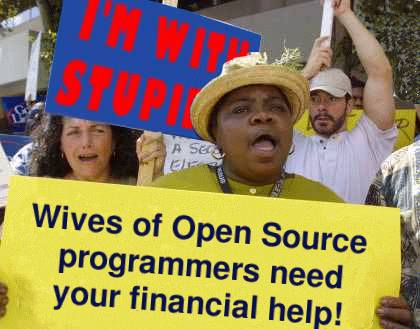
Earlier today, several protestors protested in
front of the Free Software Foundation in Boston, holding signs and chanting,
"Hell no we won't code/Mr. Stallman, hit the road!" and "What's the matter with
GNU? Everything!"
Of course, the group -- composed entirely of
programmers without a single public relations flack -- had difficulty getting
their message out. It wasn't until this reporter did some actual legwork (instead
of merely regurgitating press releases) that it finally became clear what the
hackers were threatening to strike over.
They want Richard M. Stallman to stop insisting
that everybody call everybody's favorite operating system by the name "GNU/Linux".
"Here we are, slaving over hot computer terminals
for hours on end, and what happens when we go to a Linux User Group meeting?"
asked 'BurritoGuy', the head of the union. "RMS comes in and starts roasting
us for saying Linux instead of GNU/Linux. I'm sick and tired of this insanity
and I'm not going to take it any more!"
RMS has refused to budge from his position. The
two camps have not attempted negotiations, which makes the chance of averting
a strike.
One union member has drafted a compromise proposal
in which Open Source developers would agree to use the name "GNU/Linux" once
for every five uses of plain "Linux". "This acknowledges the contributions of
the GNU Project without making us say a mouthful all the time," the member said.
ESR yet another Halloween document. -- Eric seems to have a maniacal preoccupation
with the "Leaked Microsoft Strategy Documents" for years now. Funny how even losing
99% of your paper wealth cannot make ESR more humble ;-)
Society
Groupthink :
Two Party System
as Polyarchy :
Corruption of Regulators :
Bureaucracies :
Understanding Micromanagers
and Control Freaks : Toxic Managers :
Harvard Mafia :
Diplomatic Communication
: Surviving a Bad Performance
Review : Insufficient Retirement Funds as
Immanent Problem of Neoliberal Regime : PseudoScience :
Who Rules America :
Neoliberalism
: The Iron
Law of Oligarchy :
Libertarian Philosophy
Quotes
War and Peace
: Skeptical
Finance : John
Kenneth Galbraith :Talleyrand :
Oscar Wilde :
Otto Von Bismarck :
Keynes :
George Carlin :
Skeptics :
Propaganda : SE
quotes : Language Design and Programming Quotes :
Random IT-related quotes :
Somerset Maugham :
Marcus Aurelius :
Kurt Vonnegut :
Eric Hoffer :
Winston Churchill :
Napoleon Bonaparte :
Ambrose Bierce :
Bernard Shaw :
Mark Twain Quotes
Bulletin:
Vol 25, No.12 (December, 2013) Rational Fools vs. Efficient Crooks The efficient
markets hypothesis :
Political Skeptic Bulletin, 2013 :
Unemployment Bulletin, 2010 :
Vol 23, No.10
(October, 2011) An observation about corporate security departments :
Slightly Skeptical Euromaydan Chronicles, June 2014 :
Greenspan legacy bulletin, 2008 :
Vol 25, No.10 (October, 2013) Cryptolocker Trojan
(Win32/Crilock.A) :
Vol 25, No.08 (August, 2013) Cloud providers
as intelligence collection hubs :
Financial Humor Bulletin, 2010 :
Inequality Bulletin, 2009 :
Financial Humor Bulletin, 2008 :
Copyleft Problems
Bulletin, 2004 :
Financial Humor Bulletin, 2011 :
Energy Bulletin, 2010 :
Malware Protection Bulletin, 2010 : Vol 26,
No.1 (January, 2013) Object-Oriented Cult :
Political Skeptic Bulletin, 2011 :
Vol 23, No.11 (November, 2011) Softpanorama classification
of sysadmin horror stories : Vol 25, No.05
(May, 2013) Corporate bullshit as a communication method :
Vol 25, No.06 (June, 2013) A Note on the Relationship of Brooks Law and Conway Law
History:
Fifty glorious years (1950-2000):
the triumph of the US computer engineering :
Donald Knuth : TAoCP
and its Influence of Computer Science : Richard Stallman
: Linus Torvalds :
Larry Wall :
John K. Ousterhout :
CTSS : Multix OS Unix
History : Unix shell history :
VI editor :
History of pipes concept :
Solaris : MS DOS
: Programming Languages History :
PL/1 : Simula 67 :
C :
History of GCC development :
Scripting Languages :
Perl history :
OS History : Mail :
DNS : SSH
: CPU Instruction Sets :
SPARC systems 1987-2006 :
Norton Commander :
Norton Utilities :
Norton Ghost :
Frontpage history :
Malware Defense History :
GNU Screen :
OSS early history
Classic books:
The Peter
Principle : Parkinson
Law : 1984 :
The Mythical Man-Month :
How to Solve It by George Polya :
The Art of Computer Programming :
The Elements of Programming Style :
The Unix Hater’s Handbook :
The Jargon file :
The True Believer :
Programming Pearls :
The Good Soldier Svejk :
The Power Elite
Most popular humor pages:
Manifest of the Softpanorama IT Slacker Society :
Ten Commandments
of the IT Slackers Society : Computer Humor Collection
: BSD Logo Story :
The Cuckoo's Egg :
IT Slang : C++ Humor
: ARE YOU A BBS ADDICT? :
The Perl Purity Test :
Object oriented programmers of all nations
: Financial Humor :
Financial Humor Bulletin,
2008 : Financial
Humor Bulletin, 2010 : The Most Comprehensive Collection of Editor-related
Humor : Programming Language Humor :
Goldman Sachs related humor :
Greenspan humor : C Humor :
Scripting Humor :
Real Programmers Humor :
Web Humor : GPL-related Humor
: OFM Humor :
Politically Incorrect Humor :
IDS Humor :
"Linux Sucks" Humor : Russian
Musical Humor : Best Russian Programmer
Humor : Microsoft plans to buy Catholic Church
: Richard Stallman Related Humor :
Admin Humor : Perl-related
Humor : Linus Torvalds Related
humor : PseudoScience Related Humor :
Networking Humor :
Shell Humor :
Financial Humor Bulletin,
2011 : Financial
Humor Bulletin, 2012 :
Financial Humor Bulletin,
2013 : Java Humor : Software
Engineering Humor : Sun Solaris Related Humor :
Education Humor : IBM
Humor : Assembler-related Humor :
VIM Humor : Computer
Viruses Humor : Bright tomorrow is rescheduled
to a day after tomorrow : Classic Computer
Humor
The Last but not Least Technology is dominated by
two types of people: those who understand what they do not manage and those who manage what they do not understand ~Archibald Putt.
Ph.D
Copyright © 1996-2021 by Softpanorama Society. www.softpanorama.org
was initially created as a service to the (now defunct) UN Sustainable Development Networking Programme (SDNP)
without any remuneration. This document is an industrial compilation designed and created exclusively
for educational use and is distributed under the Softpanorama Content License.
Original materials copyright belong
to respective owners. Quotes are made for educational purposes only
in compliance with the fair use doctrine.
FAIR USE NOTICE This site contains
copyrighted material the use of which has not always been specifically
authorized by the copyright owner. We are making such material available
to advance understanding of computer science, IT technology, economic, scientific, and social
issues. We believe this constitutes a 'fair use' of any such
copyrighted material as provided by section 107 of the US Copyright Law according to which
such material can be distributed without profit exclusively for research and educational purposes.
This is a Spartan WHYFF (We Help You For Free)
site written by people for whom English is not a native language. Grammar and spelling errors should
be expected. The site contain some broken links as it develops like a living tree...
Disclaimer:
The statements, views and opinions presented on this web page are those of the author (or
referenced source) and are
not endorsed by, nor do they necessarily reflect, the opinions of the Softpanorama society. We do not warrant the correctness
of the information provided or its fitness for any purpose. The site uses AdSense so you need to be aware of Google privacy policy. You you do not want to be
tracked by Google please disable Javascript for this site. This site is perfectly usable without
Javascript.
RMS -vs- Doctor, on the evils of Natalism
Date: Sun, 21 Feb 93 15:14:50 -0500
From: [email protected] (Richard Stallman)
To: [email protected]
Cc: [email protected]
Subject: Another mcuddy..
Could people please not use this list to announce
information of no particular interest to the people on the list? Hundreds of
thousands of babies are born every day. While the whole phenomenon is menacing,
one of them by itself is not newsworthy. Nor is it a difficult achievement--even
some fish can do it. (Now, if you were a seahorse, it would be more interesting,
since it would be the male that gave birth.)
Following your example, I might send the list
an announcement whenever a new GNU program is written. That happens less often
than babies are born, it does the world a lot more good, it reflects more conscious
creativity and hard work, and some of the readers might actually find the information
useful. Even so, I think most of the readers would consider this outside the
scope and purpose of the list. Clearly that goes double for babies.
Of course, we have another place for announcements
of new GNU programs. If some people like to read birth announcements, perhaps
you should set up a suitable list or newsgroup. Perhaps rec.births? (While you're
at it, start rec.deaths for obituaries--they're usually more interesting to
read.)
These birth announcements also spread the myth
that having a baby is something to be proud of, which fuels natalist pressure,
which leads to pollution, extinction of wildlife, poverty, and ultimately mass
starvation.
Perhaps the people who have decided to have no
children should start making proud announcements, so as to set a better example.
I could start. I'm sure everyone on this list will be glad to know I don't plan
to reproduce myself.
October 23, 2009 |
ComputerworldUK
Harry stretched his legs at his workstation under the stairs. He had been
there for the entire night debugging the latest iteration of Ubuntu Owl mail.
It was vital that he delivered a message to the old wizard Stallmandore.
The forces of darkness felt closer than ever and Harry's scar throbbed as it
always did when proprietary software vendors were close by.
Now it throbbed so much that Harry was sure it was not the thirteen cups
of coffee he'd drank that night nor the utter brokenness of Owl_mail2.3. No
this meant only one thing, Ballmermort must be abroad again. Harry must warn
everyone! But first he needed a wee.
Harry was forbidden to do Open Source wizardry outside of the office. He
was too young, but he had no choice, he had to risk it. Returning from the bathroom
with a look of grim determination on his face he sat down and, as soon as he
had stopped that cube spinning round out of control, he pressed SEND.
At once he was blinded by a green light bursting from the 22" LCD panel.
The noise was like a thousand horsemen charging through the heavens... and then
it was over, silence. Blinking Harry looked up. On the screen was a message:
'terminated at Line 2004, no such dependency or module owl.2.3_mod'. "Bugger,"
said Harry under his breath, "I'll have to risk G-mail."
Stallmandore sat in his study surrounded by magical creatures of antiquity.
He was deep in thought contemplating the arcane and dark mysteries of GPL 3,
a tome of such complexity that only Aurors of the First Order could understand.
He was frowning deeply as his Phoenix announced dreamily "You Have Mail Master".
Wading through the three thousand or so spam-mails from trolls selling pills
to increase the potency of his spells he saw Harry's message: "Ballmermort is
abroad he has regained human form and is heading for the World Open Source Conference".
Stallmandore's eyes widened a fraction. "The Conference," he mused, "How
bold he has become. There will be all of the great FOSS wizards there."
Later ....
The Conference was in happy mood. All of the speeches had been clapped with
vigour and an orange-robed python code-monkey had whizzed around the hall on
in his sky-skates shedding colourful stars over everyone and randomly reprogramming
the wireless interface so that it rarely worked. But no-one really minded.
Suddenly all went silent and a sinister soul-sucking chill filled the air.
On stage was a new speaker. He was dressed like a wizard and was talking of
the virtues of Open Spells and Open Standards but no-one was fooled. It was
Ballmermort!
Kabuki-West Replies:
In summary:
- Richard: Fuck off. -Eliot Lear
- Fuck you. -Paul Traina
- No, thanks. I don't want to have children.
-RMS
- Fuck you, Richard. -Brent Chapman
- Boy, I really am getting popular. I
haven't had so many offers before in just one day. -RMS
- You mean that you are in no danger
of getting laid. -Elaine Richards
- Richard, You appear to be unclear on the
concept. -Joe Buck
- Richard, what Paul and Brent so succinctly
expressed is quite approprate. ... To sum up: Fuck you. -David Muir Sharnoff
- Please send your "fucks" via personal mail
and refrain from using Kabuki-west for such messages. -Lile Elam
- It appears that the problem of natalism
is even worse than I thought. -RMS
- Perhaps some people took my message as an
expression of personal hostility. It was not based on hostility, just annoyance
at a general practice on the occasion of one instance. If anyone felt bad
because of misunderstanding this, I regret the unintended result, and I
hope this message corrects the matter. -RMS
- Wow, I think yall who sent "fucks" to the
mailing list need to go back and re read RMS's msg. Has breeding become
such a religion that the mere mention of a an oposing view ignites a fury
of vile replies? If those people who sent "fucks" really want to feel strongly
about something, maybe they should move to Iran and start worshiping Kholmeni
or something. -Edjik
- You people just have no sense of humor.
I thought the original message was pretty funny and made a few good points
(if it didn't, nobody would have been offended). I guess it's a shock for
smug self-righteous breeders to learn that not everybody in the world thinks
babies are cute and special. -Wayne A. Christopher
- Finally, someone read the message as
it was intended to be read. -RMS
- No, I think you are correct about the purpose
of the list, but parents seem to be so flushed with hormones after they
have managed to accomplish the same act that single celled life does, that
they revert to the brain level of that afore-mentioned life. I appreciate
your choice, the same one that I and my partner have made. -Doug Faunt
- I'm somewhat surprised by the idea that
a mere message from me could torpedo the happiness of parents. I'd think
it wouldn't even come close to doing that. Not that I wanted to do that.
The most I thought it could do was to discourage the posting birth announcements.
-RMS
The GPL is not Compatible with itself Posted by
Shlomi Fish on Monday April 01,
@07:29AM from the love-them-or-hate-them dept.
A recent press conference of the
Free Software Foundation confirmed
the rumours that the
GNU General Public
License was found to be incompatible with itself. This newly discovered
fact may actually cause a lot of disorder in the free software world in which
most programs and libraries are licensed under this license.
Richard Stallman, chairman of the FSF, called
upon developers to immediately exempt GPL-licensed software from the GPL, as
far as linking them with GPL programs is concerned. "We have already made sure
all GNU software and every other software that is licensed to the Free Software
Foundation would be ad-hoc compatible with itself. However we need other developers
to do the same for their software", Stallman said.
Eben Moglen, the FSF's attorney outlined the
subsequent steps that his organization will take to overcome this crisis. The
first step would be releasing a Modified General Public License (or MGPL for
short) that will be compatible with the GPL and with itself as well as with
all other licenses that the GPL is already compatible with. It will be labeled
the GPL version 2.1, thus allowing developers to convert their software to it.
He noted that care would be taken to make sure the upcoming GPL version 3.0
will be compatible with itself, as well as the MGPL.
For the time being, though, there is an explosion
of commentary, confusion and otherwise bad temper about the newly formed situation.
Eric S. Raymond, the famous Open Source Guru notes: "This is one of the greatest
blows to the Open Source world, I have yet encountered. I have already exempted
all of my own software from the GPL in this regard, but there is a lot of other
software out there, and many of its authors are not very communicative.
Bill Gates, Microsoft's co-founder, on the other
hand, seems to find the situation very amusing: "I said times and again, that
viral licenses such as the GPL are a bad idea, and many open-source advocates
disagreed. Now they see that even making sure one's license is compatible with
itself, is hard to do when you open that can of worms."
The integrity of many software projects whose
license is the GPL and yet contain works licensed by several developers is in
jeopardy. The Linux kernel is a prominent example of such a case. In a post
to its mailing list, Linus Torvalds commented that, in their case, it was not
an issue. "My interpretation of the GPL is already quite unusual, so I'll simply
rule that I also interpret the GPL as compatible with itself."
[Apr 1, 2002]
Linux needs new leadership.
Linus Torvalds ([email protected])
Mon, 01 Apr 2002 00:00:00 -0700 (PDT)
Fellow hackers,
For some time I have felt unappreciated by some members of
the Linux community. Far too many of you like to whine and cry, saying "My patches
aren't being accepted by Linus, but they are by Alan or Michael!" It seems that
some of you are too stupid to follow the simple instructions that I have made
clear on more than one occasion. This, combined with the fact that today is
my last day at Transmeta, has prompted me to consider rediscovering that balance
I had in my life before you all took my hobby and made it into a mass movement.
I have not decided who should take over maintenance of the kernel myself, for
I believe that this decision should be made in a quasi-democratic fashion. While
democracy has not worked well with this group of people before, I am willing
to give it one last chance.
However, I do have some opinions on who should succeed me
as leader of kernel development. I will provide my opinions below as I am entitled
to do so. Below is an alphabetical list of my nominations. I include a brief
explanation of why I nominated them and any concerns I may have. You all should
do the same for your nominations.
- Alan Cox: Alan has done a spectacular job of maintaining
the 2.2 branch ever since I embarked on the development branch. He would
have been an automatic choice for this job, except for his childish refusal
to travel to the US, where all the real kernel hackers hang out. Marcello
has proven to me, however, that you do not need to live in a technology-rich
country such as the US to be a leader of kernel development.
- Matt Dillon: Whenever someone moans about the
2.4 VM fiasco, I think to myself, "I wish Matt hadn't left the Linux kernel
development for FreeBSD!" I believe that if Matt were to be chosen as leader,
we would have had a sane and working VM on par with FreeBSD's months ago.
While he has little leadership experience, he is a member of FreeBSD-core,
a position which certainly demands respect.
- Eric S. Raymond: Being leader of kernel development
involves fielding a significant amount of media attention. ESR has shown
on many occasions that he can talk shit and still sound just as convincing
as anyone on this list, all the time being completely oblivious to any contrasting
viewpoints. While his kernel-configuration-adventure-game contribution to
Linux just screams out "worthless bloat", I must admit to having enjoyed
many a lonely night playing the game. If he could lay a similar interface
over gdb, I'm sure that more kernel hackers would actually debug their work
before submitting it.
- Richard M. Stallman: RMS has an exceptional track
record in the open-source field, being largely responsible for my favorite
text editor, compiler, and debugger. No other open-source hacker has come
as close as he has to replicating the integration available with Microsoft
Visual C++ 6 years ago. I fully endorse him as a candidate, assuming he's
willing to drop his puerile "GNU/Linux" ego stroking.
- Theo de Raadt: Theo is an exceptional candidate.
Not only is he a more than adequate hacker; he attracts exactly the type
of people to OpenBSD that he wants, and will jettison those who are not
up to the task. While purging out all the less-than-adequate hackers in
the Linux project will inevitably attract negative publicity from Slashdot
and other "community" sites where these feeble hackers hang out, it will
no doubt strengthen Linux in the future. Just look at what Theo's strong
leadership has done for OpenBSD! He turned around the worthless "research
project" that was NetBSD and made it an enterprise-class firewall system.
I can only imagine the effect his Midas touch could have on the Linux kernel.
You have until the end of April 1, 23:59 Pacific Time to submit
your nominations to the list. The most nominated person will become the leader
of kernel development. I will examine the list of nominations and, assuming
that the winner wants the job, I will hand full control over to them. I know
that this is short notice, but knowing how obsessively most of you check your
inboxes, I figure you should have more than adequate time to submit your recommendations.
The decision will be final and no discussion will be considered after it has
been made, so choose carefully.
Thank you.
Linus
FSF Reaches Goal, Shuts Down (modified for April 1 2002 issue from the letter
send to the Editor; the original author is not known):
April 1, 2002 Boston,
Massachusetts.
After 18 years of striving, FSF finally reached its long-stated goal to create
free computer environment and Monday April 1, 2002 promptly ceased operations.
"We achieved all our goals," founder Richard Stallman (RMS) said. "Back when
I started GNU project and FSF, I vowed that I would not rest until we create
a completely free Unix-like programming environment. Well, today such an environment
is here. Thank you for your support of the GNU project. Bye."
When he launched the GNU
project and FSF in 1983, RMS drew up a lengthy list of long-term goals. These
included writing free C compiler, Free Unix-like operating system and free Emacs
editor. "There were a lot of goals I wanted to accomplish, but those three were
probably the biggest," said RMS, clearing out his office at MIT and packing
things to be moved into his new expensive house in Florida. "Done, done, and
done." Now I can play golf, drink beer and enjoy the company of beautiful women.
Eric Raymond a famous open
source evangelist said that RMS made the right decision to shut down FSF after
getting 800 million price from Japanese Midory foundation; The fact that
Linus Torvalds resolved his long-standing problem with Linux scheduler also
played a role in this decision. "I was at it the same conference room with Linus,
discussing the future of the Linux kernel development, when we were informed
about this RMS's decision" Eric Raymond said. "You should have seen the smile
on Linus face."
The Linux Forecaster, February 16, 2000
Another day, another portal opens. Today's
latest get-rich-quick portal is called "LinuxForecast.com". Operated by a former
meterologist, this site uses complex models to predict trends in the Linux world.
"We can predict short-term weather events pretty well," he said, "So why can't
we forecast the next Linux vs. FreeBSD flame war on Usenet or predict the duration
and intensity of the dreaded Slashdot Effect?"
As the founder of LinuxForecast.com, Eric "Stormy"
Jones is living out the American Geek dream: he just built his very own Beowulf
cluster. "After getting 'The Letter' from Red Hat and VA Linux, I made
enough money to buy my own Beowulf cluster," he boasted. "My old co-workers
at the National Weather Service are so jealous; my cluster rivals those new
supercomputers they just installed. They'll have trouble keeping up with this
Jones."
Eric's cluster certainly is impressive.
It accurately forecasted a coupe of Slashdot Effect cases 24 hours in advance,
allowing Eric to send this warning email to the victim before the storm hit:
NOTICE: LinuxForecast.com has issued a Slashdot
Effect Watch for your domain effective for the next 48 hours. Forecast models
indicate that Taco Boy is planning on posting an article about your "Penguin
Porn" site. The models disagree on the timing or duration of the storm,
although we can say that a moderate risk of server crashes, excess bandwidth
usage, and increased website hosting bills are possible.
Please take appropriate action by mirroring
your site. It might be too late now, but you might also want to consider
purchasing Denial Of Service insurance.
Eric Jones hopes to expand his portal website
so that Slashdot Effect advisories are automatically issued. "It's a public
service," he explained.
... ... ...
Jones also made some dire predictions for Linux
portals. "There's just too many of them. The daily amount of new open
source code written will drop by 22% next month as people stop hacking and start
working on Linux websites, hoping to get-rich-quick by selling out to Andover
and VA Linux. In years past start-up companies dreamed of being acquired
by Microsoft; now everybody wants to be acquired by VA Linux or Red Hat."
"The bubble will burst," he continued, before
I could get a word in edgewise reminding him that his own site is a get-rich-quick
sellout-bound portal site. "Take, for example, the new LinuxBeacon.com
portal. The site runs Microsoft IIS 5.0 and Windows 2000!
****
THE MARTYRDOM
OF SAINT IGNUCIUS [May 22, 2001]
Here's the Authorised Version of the Free Software
story. In the Sixties, software was created free, out in the high temples of
Western technological academia: MIT, Stanford, enlightened corners of Bell Labs.
The Internet was created here, they say, as were the purer artifacts of the
programming art: LISP, and C, and UNIX. The future was dedicated to the dissemination
of uncorruptable knowledge, passed on and improved through the frictionless
channels of the fledgling Net.
But then (thunderclap on soundtrack, please)
the software hoarding begins. Graduates sell out to companies, who retail their
code without sharing the knowledge behind it. Software that, when bought, could
not be changed, or fixed, or improved. Frozen forever - imprisoned by the greed
of its owner, who did not want his secrets revealed, or his product redistributed
to the needy.
Horrified, but isolated, Richard M. Stallman,
at MIT's AI Lab, makes a stand. In 1984, he dedicates his life to preserving
the ideals of Free Software: he forms the Free Software Foundation, and begins
building the tools that will allow, one day, a computer to be used without having
to purchase any hoarded, proprietary software at all. Free Software - but not
just free as in for nothing, but free as in free to be distributed, modified,
improved; fixed by anyone who has a different plan from the blinkered view of
the binary-pushing corporations.
Stallman is viewed as a saint by many in the
Free Software movement. And, if you ask him, he'll dress like one. He has a
costume. He is called St. Ignucius.
This fact has not passed unnoticed by profile
writers.
[May 22, 2001]
THE MESSIAH
In 1991, Linus Torvalds, a Swedish-speaking Finn at Helsinki
University,
mentions
a project he's working on to comp.os.minix. As an aside, at the bottom of
the message is a request to test another program of his, a hack of the Unix
"finger" program that most half-decent Unix programmers could rustle up in their
sleep. The first project is a plan to write his own, UNIX-like operating system.
The disparity between this minor achievement and his aims couldn't be more stark.
Years later, industry pundits will hail this as a seminal
moment in the history of computing. Thomas Scoville,
writing in Salon Magazine, will describe in terms of Luther hammering his
demands onto the doors of Castle Church, and smashing the Papacy of Bill Gates
(Scoville also designed the Silicon Valley Tarot pack, which includes cards
like The Hacker, the Salesman of Networks, and the Four of Cubicles).
But if the religion has a leader, where are the followers to come from?
On USENET, in comp.os.linux.advocacy, Stephen Edwards writes (http://www.dejanews.com/=dnt_lk/getdoc.xp?AN=410219167)
> Oh, how fugging pathetic. Next thing you know, people
will be wearing
> "L"s on gold chains around their necks, and praising
Linus Torvald's
> sacrifices and teachings.
Linus replies:
What the h*ll? They don't already?
Grumble.
Linus
[May 28, 2001] From the letter from female Linux enthusiast: "I
love Linus and he's doing a good enough job IMO. Sure he rejects a few too many
patches -- but he's just one (sexy) guy. It's not his fault."
[May 23, 2001] Notes on improving Linux kernel usability (adapted
from slashdot post (#437)
;-)
- Stop refering to "Linux", it just makes most users feel insecure. How about
"Penguinix".
- Make XFree part of the Kernel, eliminate text mode. You still can get a
terminal by typing "CTRL-ALT-SHIFT-TAB"
- Rename ls to dir
- Introduce a wizard, the Singing Penguin to help users to navigate GUI.
- Instead of saying, "Core dumped", say, "Oops, there was an error! Exiting
Program!", and display a little icon of a penguin falling over.
- And instead of "core", name the core "dump.tmp" (the geeks will know what
it is)
**** Amazon.co.uk[Apr
25, 2001] has refused to pull reviews of Red Hat Linux 7.0 Deluxe edition
by Bill Gates and Linus Torvalds off its site because they are not offensive.The
Register
Reviewer: Linus Torvalds from Finland
Despite fifteen years using Linux (most of those with Red Hat) I would recommend
people to actually go out and use Windows. You see the actual Linux OS is not
too good, the kernel (core functions) is really bad and the GUI elements feel
like they've been stuck on with glue. Red Hat is really the worst of the distros
and after ten minutes of using it, you'll be reaching for the Windows CD!
[Apr 22, 2001]
BBspot
- Real or Fake Linux Distributions
... ... ... ... ...
**** BBspot
- Linux Bashing Now Considered a Hate Crime Linuxoids as " openly using
Linux people" a new kind of harmless perverts that need to be protected
by the statute ? [Apr 22, 2001]
It is commonly believed that 10% of the population are Linux
users. Linux users often hide their use from friends and family members.
Meeting other users in Linux only bars or IRC channels. Openly Linux using
people often face extreme prejudice and discrimination from co-workers and IT
departments but say that this bigotry must be confronted. "I've never
been beaten because of my open sourceness, but I get a lot of 'Linux sucks'
comments," said Jared Yttrium, "I'm glad the statute is there to protect me."
[Apr 1, 2001]
Linux Today - MySmell.com Linus laid off!
"With so much news of layoffs in recent weeks, it probably
shouldn't come as any surprise that chipmaker Transmeta is also feeling the
bite. But the real shocker for Linux fans is that
kernel master Linus Torvalds is among those who will be let go on Monday...."
"Like Eazel and Zero Knowledge -- other open source companies
who recently laid off staff after having just announced apparently good news
-- Transmeta was in the headlines recently for having been chosen to supply
chips for Microsoft Tablet PCs. This has led some in the Linux community to
question if there is any connection between the Microsoft contract and the layoffs.
Was laying off Open Source's favorite son a condition of the Microsoft contract?"
"Most emphatically not, according to Transmeta Communications
Manager Phillip Bergman. 'It was actually the logo for Midori Linux which we
found really inexcusable,' he said. 'We thought that since he is from Europe,
he'd have better taste than to choose something like that.'"
"Bergman added, 'Plus, he's just not as funny as he used to
be.'"
***** Microsoft adopts
Linux as a new BIOS. Linus Torvalds joins Microsoft [Apr 1, 2001]
April 1, 2001. LINUS TORVALDS, the creator of upstart operating system Linux,
will head a new division within Microsoft to develop a version of Linux to replace
old PC BIOS. Information contained in a Microsoft memo
leaked to the British publication Yellow Register indicated that Windows
XP is the last old-fashioned version of Microsoft OS and that the next version
of Microsoft Windows will be able to fully utilize the new BIOS.
Microsoft also plans to reorganize the hardware group into several divisions
with one being headed by Linux and the other concentrating on the providing
help all major PC manufacturer to switch to new technology, possibly by
the end of the year.
Torvalds, who has been working for Transmeta -- the company that has close
ties with Microsoft with Microsoft co-founder Paul Allen as a major stockholder
, will join newly created Linux BIOS group. He also has reportedly also been
paid $US100 million in stock and cash for the rights to use the Linux trademark. Microsoft officials would not comment on Torvalds' salary
and duties.
A Microsoft source, speaking on condition of anonymity, said the company
decided that Linux kernel will be perfect replacement for the old PC BIOS. He
said Microsoft President Steve Ballmer had stresses that such an approach
represent the philosophy ``if you can't beat `em, join `em approach'',
similar to the one ``we used when we embraced the Internet''. There are many
overlapping functions that are performed by both NT and Linux and moving some
of them to the BIOS level makes perfect sense. PCs just outgrow old IBM BIOS
and really need a new one. He stresses that Linux kernel already supports FAT32
filesystem perfectly well and that Microsoft is working on improving support
for its flagship NTFS filesystem.
Torvalds was tight-lipped when contacted, but said Microsoft had ``he always
respected Microsoft technical achievements in applications area and that they
made him an offer he can't refuse''.
``Anyway, it's time to make some dough from this open source thing. With
Linux companies stocks in the trash bin I cannot buy a Ferrari for myself and
new BMW for my wife. And I have three growing daughters that soon will need
decent cars too. Currently I cannot even think about personal yacht. Where's
the justice in that?'' Torvalds said. ``Microsoft isn't
all that bad and it really cares about its employees. And the new
BIOS will be definitely better than they have before. And it remains open sourced''
Open source advocates contacted by Yellow Register expressed shock at Torvalds
sudden change of heart. ``I can't believe it. I'm really
shocked,'' a Melbourne Linux developer said. ``Don't do
it, Linus,'' another urged. ``First it was (Open Source
evangelist) Eric Raymond and now Linus. Who next, (Free Software Foundation
founder) Richard Stallman?'' ``I knew it as soon as I
heard he (Torvalds) had gone to work for (Paul Allen's company) Transmeta,''
a poster to alt.microsoft.sucks said. ``They couldn't
develop it, so they're going to buy it, just like they did with DOS.''
International Data Corporation Advanced Technology Markets
program director, Travesty Lowlife, said it was a classic example
of a smart business decision that turns the tables for IBM and Sun. ``Both
IBM and Sun wanted to play Linux card against Microsoft, but Microsoft again
proved that they are just smarter than the competition '' he said. Other observers
stressed that the timing is perfect that kernel 2.4 is mature enough to
replace old BIOS. That also might help to bury the US Government case
against the company. ``By embracing Linux as a new
BIOS, Gates effectively short circuits the (Department of Justice) case against
Microsoft, rendering it obsolete. ``This strategic move
will serve Microsoft well in the new Millennium. Now I am pretty confident that
Microsoft will remain the dominant player in PC operating systems area for many
years to come."
[10/07/2000] THE LICENSE AGREEMENT (Red Hat business model)
The other day I was sitting in a
bar when the guy next to me asked for a light. I thought to myself, Hey, there
is a market here. I just need to figure out how to exploit it. So I said to
the guy, "I can't give you a light without some compensation for my time and
effort, not to mention my flint, my steel and my lighter fluid. So, I will,
for $0.25, licence to you the right to burn one of your cigarettes."
The guy was a little drunk and probably thought that I was too, so he gave me
a quarter and I lit his cigarette. As I was pocketing the quarter, to my horror
and dismay, this guy's buddy took the cigarette I had just lit and used it to
light his own cigarette, in clear violation of the licence agreement! This person
had stolen my fire!
AND, before I could point out the violation to this thief, he passed the lit
cigarette on to other patrons of the bar. Soon everyone in the bar was benefiting
from my fire. I had no recourse but to try to enforce the contract, but as I
was going from patron to patron trying to explain that they had stolen from
me and that they owed me 25 cents each, the bouncer threw me out of the bar
and suggested that I insert my lighter in a place that I consider anatomically
difficult if not impossible. I guess that there will always be thieves.
At least you and I have the pleasure of ranting about them.
Frank Ross
Ode to GPL by Kurt Gavor - [sing
along] ( Sep 7, 2000)
The License Police, as dogmatic as they can get...
The License Police, they'll come and judge your code
Oh nooooooo......
Well I can't write code 'cause they're lookin' at me...
And when I fall asleep bet they're griping 'bout me...
(tonight...TONIGHT!)
'Cause they're yelling at me, unbundling me...
...GEE..PEE..ELLL!
They're driiivin' me insane.....
...Those men at Deb-i-annnn....
(with apologies to Cheap Trick)
Linux should be set free (Humor)
by Anonymous Coward on Monday October 18, @09:40AM EDT (#18)
We must let Linux permutate by itself without anybody in control
of it. There should be no Monster Dictator on top that demands what should go
in and what should not. We do not want another Stalin amongst our comrades.
We peasants should take control, not let any power hungry man on top tell us
how kernel lock synchronization should be implemented.
With this way, all variations would grow, with the lackluster ones dying off.
There is no other way to evolve in our commune. We have to follow the example
of the human species in the world, in which we come to dominate the mammal universe
not because of our brute strength, but because of our superior intelligence.
If we blow each other up, that is the way it is, since the survivors would be
go on to build a better race(whatever that would be.)
So all comrades, rise to arm and pick out your mouse. We must topple anyone
with power within our group as they are the perpetrators to our progress toward
Utopia. Suppression of our freedom to do it anyway we want to shall not be a
rule of the game anymore.
! Central control is the true way of evolving.
ZZZ
[Aug 23, 2000]
Byte.com:
The Great Penguin Hoax Letter from Alan Cox
All in all, Linux is a waste of time, and its devotees can't see the forest
for the trees. Any advantages Linux may have as an operating system is more
than canceled out by the lack of uniformity, lack of documentation, and lack
of hardware support. Unless one is willing to invest a great deal of time and
money in Linux, don't bother. Win 9x, Win NT, and Win 2K may be bloatware and
may be overpriced, but just like back in 1976 when I bought MS-Basic on papertape,
it works and the documentation is accurate and clear.
Now I'm going fishing.
Hired
Magazine interviews Good Software Group founder -- RMS under the fire
;-)
The following is an interview by Hired Magazine, the
monthly magazine devoted to commerce and trade, with Gilbert Oram Dawson, the
founder of the Good Software Group.
| Hired: |
Gilbert, it's been fifteen years since you single-handedly
created the Good Software movement and its spokesman and umbrella organization,
the Good Software Group. How does it feel to be sitting in the catbird
seat, now that Good Software is all the rage? |
| Dawson: |
It's a great feeling to see just about everyone either
using or else wanting to use Good Software. It proves that I am the
visionary I always told you I was. But I'll tell you this: it hurts
me that most people don't realize that without the Good Software Group,
they probably wouldn't even have any Good Software. In fact,
most people who use Good Software have barely even heard of the GSG.
It really wounds me to be so under-appreciated, even after all the Good
Software that I've personally created for the world. |
... ... ... ... ...
| Hired: |
Do you feel that the Good Software Group is neglected
when the New York Times or the Wall Street Journal mentions E-commerce
but doesn't talk about how important Good Software and the GSG in particular
have been to it? |
| Dawson: |
I don't care for the word `E-commerce', and you've
put your finger on exactly why. It disrespects how important we are.
Don't you realize that without Good Software, the E-conomy would be
nowhere? It's the very foundation of the entire system! Oh, there isn't
always a lot of our stuff there, but we were the guiding light behind
it all. That's why I insist upon the term `Good/E-commerce' instead.
However, if you really find that difficult, I shall permit you to use
the term `E/Good-Commerce' in my presence as a tolerable but not a preferable
alternative. The reason I don't care for it as much is that you've placed
the Good part too far back, even though I really started it all. At
least you give the GSG some credit that way, though. |
| Hired: |
I'm sorry - I'll try to more careful from now on.
I'd like to thank you for this interview. I'm sure that this will clarify
for our readers your role in the goodware movement-- |
| Dawson: |
Stop right there! I am not now nor have I ever been
a member of the so-called `goodware' movement. I am the founding father
of `Good Software' movement, which is completely different. `Goodware'
is the despicable term used by a sham libertarian outfit who's trying
to reach out to the not-for-profit community. When they say `goodware',
they just mean software that's not bad. Can you believe it? Do you realize
that they actually support letting people take what was originally Good
Software and convert it into something that will never be used for one
single good or service? That no longer will money change hands? Why,
if everyone did that, our whole country would fall apart! That's not
Good Software, and I shall have nothing to do with them. Fortunately,
the GPL prohibits them from doing that with GPL'd software, which is
why I strongly advocate slapping the GPL on every bit of software you
can. It's the only way to keep those gun-toting libertarians off our
backs and to keep our nation's E-conomy strong! By using the GPL to
make Permanently Good Software! |
32BitsOnline.com - An exclusive interview with Linus 'Linux' Torvalds and Alan 'Kernel
Hacker' Cox [Feature Articles-Interview]
(C) Clifford: So. What kinds of userland changes you referred
to a minute ago in the car, uh - what kinds of enhancements have you made for
the upcoming release?
(LT) Linus Torvalds: Well. We talked a lot about - em - Alan
and I talked a lot about the things that were keeping Linux from really taking
over the desktop - not the things he and I usually talk about - in the kernel
space - but in the actual user functionality, and we decided to go back to the
beginning, as it were - back to the earliest utilities that were available for
the majority of the computer users out there.
(AC)Alan Cox: (To the waitress) I had the bangers - the sausage,
uh - and......you know, this doesn't taste like beer much. You got any Guinness
?
(W)Waitress: Well, honey, we have some of that Red Hook, if
you don't like the Bud....
(AC) All right, I'll try it. You know, for all the genius
in the States you people really never got the hang of beer.....
(W) Most folks around here think it's just right. Where you
from? New York?
(AC) No..... England, actually. But I lived in North Carolina
for a couple of years...
(W) Uh-Huh.
(LT) ...er, as I was saying, the user space that most of the
people in the world were comfortable with, before the Windows user space, and
the command line...
(AC) Mostly we were tired of getting all the crap in the press
about how difficult Linux was to use and customize - hey, mum, that was good,
can I have another?? And we thought since there was such an incredible user
base among people who had used DOS for such a long time that we could....
(LT) ...That we could really capitalize on this specific group
- people old enough to really make decisions in the companies that they work
for - IT executives, VP's in charge of purchasing...and...
(AC) And "the media" just like you, Cliffie...
... ... ...
[June 08, 2000]
The evil Linux empire is complete Slashdot reader joke on VA Linux
acquisition of Andover.net
"The merger *will* be completed on schedule, my Master."
"You have done well, Lord Taco... and now I sense you wish to continue your
search for young Hemos."
"Yes, my Master..."
With the recent merger of VA systems and Andover.net, Slashdot
has gained an unreasonable degree of dominance over the web discussion market,
claimed the Justice Department Wednesday. Negotiations are continuing between
Andover lawyers and government officials, but a current plan would break Slashdot
up into a number of competing operations, each in charge of one of its flagship
products:
Slash: News for nerds
Dot: Stuff that matters
org: Hot Grits
A press release from CmdrTaco claims that they are cooperating with the Justice
Department, but do not feel that criticism of their business as monopolistic
is warranted. As competition in each of their major areas, Taco cited
Kuro5hin, the
American Civil Liberties Union,
and the work of
Jesustussinheadface.
[April 1, 2000] OpenBSD to merge with RedHat
(Press Release)
A nice parody on the opportunism of Bob Yong:
The new merged operating system will also be released under
the Rad Hat Community Source License. Young was quick to point that the new
15 page source license still means business as usual for developersand users.
"Whatever you could do with the source code before, you can still
do under the new license", said Young. "It's just that corporate buyers didn't
take us seriously with the GPL or the BSD licenses.
Now that they have to spend serious cash on lawyers to interpret this thing for
them, they view us as a real software vendor.
[Mar.17, 2000]
OPEN SOURCE
OPEN SOURCE (PART I)
Posted to Slashdot by Anonymous Coward on Thursday
March 16, 2000. Nice parody on Start Wars as one Slashdot reader put it "a great take-off/rip
on return of the jedi (for what THAT movie was worth)"
Slashdot deprivation
(Score:2)
by 348 on Friday February 11, @07:59PM EST (#48)
(User
Info)
|
The ability of the brain to function following Slashdot
deprivation appears to vary with the task at hand, and in some cases
the brain attempts to compensate for the adverse effects caused by lack
of Slashdot, according to a study published in the Feb. 10 issue of
Flamebait.
A team of researchers from the UCSD School of Medicine
and the Zelot Affairs Healthcare System, San Diego used functional magnetic
resonance imaging (fMRI) technology to monitor activity in the brains
of Slashdot-deprived subjects performing simple verbal learning tasks.
They were somewhat surprised to learn that regions
of the brain's prefrontal cortex (PFC) displayed more activity in direct
correlation with the subject's sense of Slashdotness; the Slashdotier
the subject, the more active the PFC.
Furthermore, the temporal lobe, a brain region involved
in language processing, was activated during flaming previous posts
in troll subjects but not in Slashdot deprived subjects. Additionally,
a region of the brain called the parietal lobes, not activated in troll
subjects during the posting exercise, was more active when the subjects
were deprived of Slashdot. The parietal region normally performs somewhat
different functions in the learning process than the temporal region.
Although subjects' memory performance was less efficient with Slashdot
deprivation, greater activity in the parietal region was associated
with better memory.
"Only in recent years have we begun to realize the
prevalence and severity of Slashdot deprivation in our population, with
a significant number of people doing first posts work, suffering from
karma lag and so forth," said J. Natalie Portman, M.D., professor of
psychiatry at the UCSD and the San Diego VAMC, and an author of the
Flamebait paper. "Yet, we don't know very much about how Slashdot deprivation
impairs sexual performance, and how precisely the brain reacts to lack
of Slashdot. These findings are just a beginning, and as we learn more,
perhaps will be able to devise interventions to alleviate the behavioral
impairments associated with lack of Slashdot."
Never knock on Death's door:
Ring the doorbell and run (he hates that).
|
[Feb 8, 2000] Ode to greed
Ode to Greed
(Score:0)
by Anonymous Coward on Wednesday February 09, @09:48AM EST (#137)
|
There once was a man from Andover
Who asked Slashdot to bendover
He bribed them it seems
And fulfilled all their dreams
But slashdot as we knew it is over
|
The final destruction of what used to be a charming little
OS scene arrived today, Monday, December 13, 1999.
linuxtoday is spewing forth "me-use-linux-too-IPO-open-sore-Linus-open-ebiz-ASP-solutions"
press releases from every backwater, buzzless Joe Q. Corp with a hotmail account...
OS figureheads are being courted for interviews with a veracity that is usually
reserved only for pathological child molesters and internet CEOS, and sometimes
both.
Forty thousand "Embedded Internet eSolution Firewall Privacy Biz Remote" solutions
are being deeply discounted to the five people who care enough to add one more
yeahd00ditssecure.pl script to their boxes...
2-bit players are buying half-bit companies without a dime to their names just
to get at the word linux in their press releases...
[Jan 9, 2000]
osOpinion: A Letter from Bill GPL as Gate's Public License - not bad ;-)
Let's give that poor Finn some relief. You've leaned on him
too long. Besides, he
works for my buddy, Paul. Let's help Paul to get his undivided attention for
a while.
[Jan. 7, 2000] ESR
parody
fat-time waddled down the sidewalk with his lubricating midget
rapid fire pellet gun tucked firmly under arm. ahead, he noticed a well-dressed
man leaning against a building reading a paper.
"howdy sir, " fat-time nodded.
"hello friend."
"whatcha readin' there, sir?"
"i'm reading about this evil tool of the devil, my friend. they call it open-source
software. it's a new software development paradigm brought over here by the
communisses."
fat-time reddened with fury, "bastard communisses!"
"yes, friend. the communisses are a blight upon our democratic way!"
the rapid fire pellet gun began to grow impatient, "come on, fat-time, i want
some cheese!"
[Jan. 5, 2000] Finnux redux
Having resolved in a national referendum that it was high
time that the country of Finland should be known for something more than saunas
and the world's highest per-capita cell phone use, the Finns will declare an
open-source country. Citizenship will be open to anybody who writes any portion
of the new constitution. The Finnish parliament, the
Eduskunta,
will be replaced by a high-powered array of computers that will be responsible
for key political decisions such as the appropriate length of time for streetlights
to stay yellow. Linux creator and open-source demigod Linus Torvalds, however,
will be left out of the decision-making process because of widespread confusion
about whether he is a Finn or a penguin.
Humorix 1998: Church
of Linux Established
SAN JOSE, CA -- The first sanctuary for the new Church of
Linux opened today in Silicon Valley. Church founders celebrated by passing
out Linux CDs to bystanders and by roasting Windows 98 CDs on a portable BBQ
grill. "This is a milestone in computing history," one observer noted.
The Church of Linux has received official non-profit status from the State
of California. It is now a recognized religion. "We founded the CoL because,
well, we think Linus Torvalds is God," a CoL members said. "Who else could write
such heavenly code? We are currently writing an official Bible; right now we
are endorsing 'The Cathedral and the Bazaar' as an interrim manifesto."
When asked what beliefs the CoL represented, one member wearing a t-shirt
with a large penguin logo said: "Simple. Linus is God. Bill is Satan. Writing
closed source software is a sin. Any questions?"
Some industry analysts are skeptical about the Church of Linux. Jessie Burst,
Ziff-Slavis writer, wrote in today's AnchorTable column: "These [Linux] people
are nuts. Everyone knows that the only true path to salvation is through One
Microsoft Way..." John Snorvak, PC Weak columnist added, "A religion based on
an OS? Here I've been thinking Amiga users were the strange ones. Shows how
little I know."
... ... ...
Transmeta:
Front for Illegal Immigration
SANTA CLARA, CA -- The INS has reported raiding
the headquarters of Transmeta, Inc. to uncover a secret Finn smuggling operation.
Over the past few months, Transmeta has been secretly bringing "Finnbacks",
as they are called, into this country to work in their chip design sweatshop.
... ... ...
Three rules for aspiring Linux Zealots (adapted from
Pros,
Priests and Zealots The Three Faces of Linux):
- Attack first. If you kill the messenger, you can always apologize later.
- If someone disagrees with you, that person must be a crook.
- End justifies means: attacking, lying or bullying is only bad if someone
on the other side does it.
Society
Groupthink :
Two Party System
as Polyarchy :
Corruption of Regulators :
Bureaucracies :
Understanding Micromanagers
and Control Freaks : Toxic Managers :
Harvard Mafia :
Diplomatic Communication
: Surviving a Bad Performance
Review : Insufficient Retirement Funds as
Immanent Problem of Neoliberal Regime : PseudoScience :
Who Rules America :
Neoliberalism
: The Iron
Law of Oligarchy :
Libertarian Philosophy
Quotes
War and Peace
: Skeptical
Finance : John
Kenneth Galbraith :Talleyrand :
Oscar Wilde :
Otto Von Bismarck :
Keynes :
George Carlin :
Skeptics :
Propaganda : SE
quotes : Language Design and Programming Quotes :
Random IT-related quotes :
Somerset Maugham :
Marcus Aurelius :
Kurt Vonnegut :
Eric Hoffer :
Winston Churchill :
Napoleon Bonaparte :
Ambrose Bierce :
Bernard Shaw :
Mark Twain Quotes
Bulletin:
Vol 25, No.12 (December, 2013) Rational Fools vs. Efficient Crooks The efficient
markets hypothesis :
Political Skeptic Bulletin, 2013 :
Unemployment Bulletin, 2010 :
Vol 23, No.10
(October, 2011) An observation about corporate security departments :
Slightly Skeptical Euromaydan Chronicles, June 2014 :
Greenspan legacy bulletin, 2008 :
Vol 25, No.10 (October, 2013) Cryptolocker Trojan
(Win32/Crilock.A) :
Vol 25, No.08 (August, 2013) Cloud providers
as intelligence collection hubs :
Financial Humor Bulletin, 2010 :
Inequality Bulletin, 2009 :
Financial Humor Bulletin, 2008 :
Copyleft Problems
Bulletin, 2004 :
Financial Humor Bulletin, 2011 :
Energy Bulletin, 2010 :
Malware Protection Bulletin, 2010 : Vol 26,
No.1 (January, 2013) Object-Oriented Cult :
Political Skeptic Bulletin, 2011 :
Vol 23, No.11 (November, 2011) Softpanorama classification
of sysadmin horror stories : Vol 25, No.05
(May, 2013) Corporate bullshit as a communication method :
Vol 25, No.06 (June, 2013) A Note on the Relationship of Brooks Law and Conway Law
History:
Fifty glorious years (1950-2000):
the triumph of the US computer engineering :
Donald Knuth : TAoCP
and its Influence of Computer Science : Richard Stallman
: Linus Torvalds :
Larry Wall :
John K. Ousterhout :
CTSS : Multix OS Unix
History : Unix shell history :
VI editor :
History of pipes concept :
Solaris : MS DOS
: Programming Languages History :
PL/1 : Simula 67 :
C :
History of GCC development :
Scripting Languages :
Perl history :
OS History : Mail :
DNS : SSH
: CPU Instruction Sets :
SPARC systems 1987-2006 :
Norton Commander :
Norton Utilities :
Norton Ghost :
Frontpage history :
Malware Defense History :
GNU Screen :
OSS early history
Classic books:
The Peter
Principle : Parkinson
Law : 1984 :
The Mythical Man-Month :
How to Solve It by George Polya :
The Art of Computer Programming :
The Elements of Programming Style :
The Unix Hater’s Handbook :
The Jargon file :
The True Believer :
Programming Pearls :
The Good Soldier Svejk :
The Power Elite
Most popular humor pages:
Manifest of the Softpanorama IT Slacker Society :
Ten Commandments
of the IT Slackers Society : Computer Humor Collection
: BSD Logo Story :
The Cuckoo's Egg :
IT Slang : C++ Humor
: ARE YOU A BBS ADDICT? :
The Perl Purity Test :
Object oriented programmers of all nations
: Financial Humor :
Financial Humor Bulletin,
2008 : Financial
Humor Bulletin, 2010 : The Most Comprehensive Collection of Editor-related
Humor : Programming Language Humor :
Goldman Sachs related humor :
Greenspan humor : C Humor :
Scripting Humor :
Real Programmers Humor :
Web Humor : GPL-related Humor
: OFM Humor :
Politically Incorrect Humor :
IDS Humor :
"Linux Sucks" Humor : Russian
Musical Humor : Best Russian Programmer
Humor : Microsoft plans to buy Catholic Church
: Richard Stallman Related Humor :
Admin Humor : Perl-related
Humor : Linus Torvalds Related
humor : PseudoScience Related Humor :
Networking Humor :
Shell Humor :
Financial Humor Bulletin,
2011 : Financial
Humor Bulletin, 2012 :
Financial Humor Bulletin,
2013 : Java Humor : Software
Engineering Humor : Sun Solaris Related Humor :
Education Humor : IBM
Humor : Assembler-related Humor :
VIM Humor : Computer
Viruses Humor : Bright tomorrow is rescheduled
to a day after tomorrow : Classic Computer
Humor
The Last but not Least Technology is dominated by
two types of people: those who understand what they do not manage and those who manage what they do not understand ~Archibald Putt.
Ph.D
Copyright © 1996-2021 by Softpanorama Society. www.softpanorama.org
was initially created as a service to the (now defunct) UN Sustainable Development Networking Programme (SDNP)
without any remuneration. This document is an industrial compilation designed and created exclusively
for educational use and is distributed under the Softpanorama Content License.
Original materials copyright belong
to respective owners. Quotes are made for educational purposes only
in compliance with the fair use doctrine.
FAIR USE NOTICE This site contains
copyrighted material the use of which has not always been specifically
authorized by the copyright owner. We are making such material available
to advance understanding of computer science, IT technology, economic, scientific, and social
issues. We believe this constitutes a 'fair use' of any such
copyrighted material as provided by section 107 of the US Copyright Law according to which
such material can be distributed without profit exclusively for research and educational purposes.
This is a Spartan WHYFF (We Help You For Free)
site written by people for whom English is not a native language. Grammar and spelling errors should
be expected. The site contain some broken links as it develops like a living tree...
Disclaimer:
The statements, views and opinions presented on this web page are those of the author (or
referenced source) and are
not endorsed by, nor do they necessarily reflect, the opinions of the Softpanorama society. We do not warrant the correctness
of the information provided or its fitness for any purpose. The site uses AdSense so you need to be aware of Google privacy policy. You you do not want to be
tracked by Google please disable Javascript for this site. This site is perfectly usable without
Javascript.
Last modified:
March 12, 2019



Merry Christmas
(Score:2)by MrZaius (321037) on Monday December 04, @05:43PM (#17105756)
(http://192.168.0.1/) Wonderful timing, with the layoffs.