|
|
Home | Switchboard | Unix Administration | Red Hat | TCP/IP Networks | Neoliberalism | Toxic Managers |
| (slightly skeptical) Educational society promoting "Back to basics" movement against IT overcomplexity and bastardization of classic Unix | |||||||
Nikolai Bezroukov. Portraits of Open Source Pioneers
For readers with high sensitivity to grammar errors access to this page is not recommended :-)
| "Free software'' is a matter of liberty, not price. To understand the concept, you should think of "free speech'', not "free beer.'' |
|
"Free" as in lunch ;-) |
|
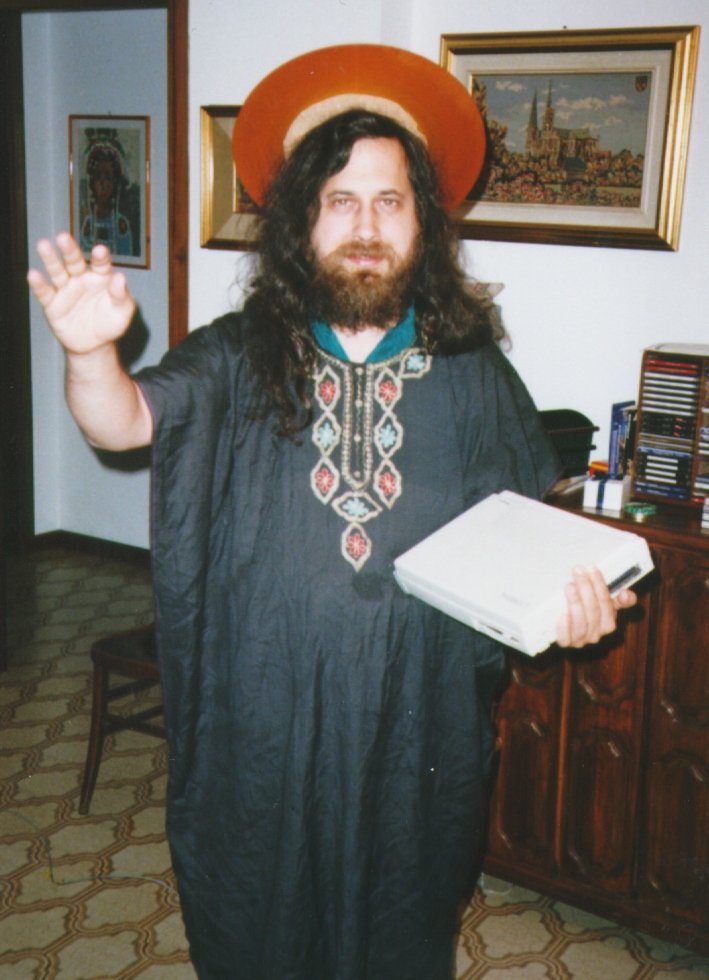
Richard Stallman |
Microsoft slogan posted at OSCON 2003, where Microsoft was sponsoring lunches for attendants |
version 0.98
| Without naming himself an anarchist, Leo Tolstoy, like his predecessors in the popular
religious movements of the fifteenth and sixteenth centuries, Chojecki, Denk and many others, took the anarchist position as regards
the state and property rights, deducing his conclusions from the general spirit of the teachings of the Christ and from the necessary
dictates of reason. With all the might of his talent he made (especially in The Kingdom of God in Yourselves) a powerful criticism
of the church, the state and law altogether, and especially of the present property laws. He describes the state as the domination
of the wicked ones, supported by brutal force. Robbers, he says, are far less dangerous than a well-organized government. He makes
a searching criticism of the prejudices which are current now concerning the benefits conferred upon men by the church, the state
and the existing distribution of property, and from the teachings of the Christ he deduces the rule of non-resistance and the
absolute condemnation of all wars. His religious arguments are, however, so well combined with arguments borrowed from a dispassionate
observation of the present evils, that the anarchist portions of his works appeal to the religious and the non-religious reader
alike.
From Prince Kropotkin's paper on Anarchism Software is ideas. Information. It's different from people, places, and things; it's infinitely reduplicable like fire, at almost no cost. This is a truism, even a cliché. But it seems that there are particular consequences that aren't well-explored. Kragen Sitaker People places things and ideas |
|
|
Prophet: Building Free Software Temple and the Emergence of Stallmanism as a Software Cult
FSF: a very closed organization that promoted free/open software
Linux schism -- commercially sold GPLed software undermined GNU project and FSF
New Name for Free Software and the growth of RMS' appetite for interpreting GPL License
Radicalization as a proven method of destruction of good will
SCO puts an interesting stance on IBM adoption of GPLed Linux
Supplements:
|
|
Emacs period
Start of GNU project: the Opening Shot in the War of Software Clones
GCC period
GPL period
Political activism period. Development stalled, OS kernel development stalled and Linux took the lead.
| "When I use a word," Humpty Dumpty said, in rather a scornful tone, "it means just what I choose
it to mean-neither more nor less."
Lewis Carroll, Through the Looking-Glass |
Richard M. Stallman "The King of Software Cloning", "The High Priest Of Free Software", the originator of "The Great Free License War" or simply RMS is (first and foremost) a founder of the GNU project: the first project explicitly oriented on creation of existing commercial software clones and first of all Unix OS. approximately in 1998.
Since mid-90th GNU project was by-and-large superseded by Linux project and movement but still has its own historical place and importance.
RMS also is the main contributor to the redefinition of the word "free" in the English language. From now on the meaning of "free" is enriched by a special dimension of "GNU-free" or "GPL-free" which is essentially a freedom to work for Stallman's private charity or even simply "approved by RMS" (see below KDE jihad story). And to receive in return (in most, but not all cases, see the chapter devoted to Linus Torvalds, who managed to beat RMS in this poker) just appreciation of one's efforts. This new, "free as in GNU" meaning of the word used to be quite popular in most university campuses in 90th of the last century. Stallman also happened to be an original and influential Utopian philosopher and the leader of the first organized (and partially successful) software cult.
In this part of the book I am mainly interested in the dynamic of his evolution as a "true believer" and parallel evolution of the "GNU-free software" movement that he created, and that he, for some time represented ,until it was absorbed into the newer "open source" movement at the end of the last century, the transformation that led to rejection of RMS as well as moving on the forefront of the movement of new leaders. The irony of all forms of extremism is that they inevitably lead to results that are completely unanticipated by the originators and often are in conflict with their initial goals.
That happened to almost all Stallman's projects : GPL, GCC and even Emacs.
Among the questions that are of interest to me are:
How "GNU-free software" movement managed to obtain the critical mass ?
How Stallman attracts followers? What kind of people "GNU church" has appeal to?
How does RMS as the leader of a mass pseudo-religious (or techno-religion, if you wish) movement keep his followers in the fold?
How "The Great Free License War" was started and became the root case of FSF disintegration and demise?
Stallman's doctrine (Stallmanism) is another interesting point of exploration. One obvious problem with Stallman's doctrine is his approach to authors. The church of GNU denounces copyright doctrine as an evil plot, unless it is useful to fend off attacks on the legality of GPL. See for example his article "Science must 'push copyright aside'" published in Nature in 1991 [Stallman1991].
| The church of GNU denounces copyright doctrine as an evil plot, unless it is useful to fend off attacks on the legality of GPL. |
Of course Stallman views drifted with the time, but still this denunciation of copyright can be considered as an immanent part of Stallmanism. That's why outside of his its anti-American (or, more correctly, software anarchism) stance it never has strong following in Europe and produced a very mixed level of enthusiasm (if at all) in Eastern Europe. For Eastern Europe analogy with one particular political doctrine was especially transparent, and thus the level of skepticism was much higher that say in the USA or France.
European tradition presuppose that the author's creativity and effort in bringing about his creative work creates a claim that must be recognized because it is only just to do so. Thus the author has some immanent rights for his creation. Although it is a more European than American law notion, it is not completely foreign to the American law. For example in the US, artists' moral rights have been invoked to prevent the destruction of artistic works. But the assumption of the creator moral rights creates a very serious problem for RMS. Without moral rights, it's much easier to say "copyright is bad, freedom is good".
Only if copyright is an economic bargain favoring the privileged few, it has no intrinsic, independent value. If we assume that copyright has some intrinsic ethical value, this hypothesis alone instantly undermines the foundation of GPL. In best traditions of revolutionaries that threat was sometimes taken RMS too emotionally and the problem is made more acute by Stallman's attempts to denounce alternative approaches. Yet, despite all RMS rumblings, the actual trend in copyright law has been in the other direction: extending it to new areas (like it was extended from books to films and then to software), and it is not clear where it will end.
| Only if copyright is an economic bargain favoring the privileged few, it has no intrinsic, independent value. |
It is important to understand that Stallman played an important part is launching of "Great Free License War" that has pretty destructive influence on the community. While naive or crooked authors often point to the fact that, say, 80% of Freshmeat-listed software project use GPL they conveniently forget to note that 80% of Freshmeat projects are dead wood, an attempt to create another useless program or clone of the known program "because I just can do so". If we talk about the projects that reached critical mass (let's say top 10% of open source projects"), here the picture is different and GPL is just one of the many licenses. Developers who are involved in such projects understand pretty well that GPL incompatibility with most other licenses creates serious obstacles to code sharing, and make contributions from corporate developers much less likely.
"The Great Free License War" was first unleashed as a GPL crusade and initial shots were fired by RMS himself by releasing to the unsuspecting world his newer "completely incompatible" with every other license GNU 2.0 license. But it soon become a global war with multiple mutually incompatible licenses participating in it instead of countries. This "license separatism" movement that RMS created and the most prominent figure of which he was from the very beginning is probably the most controversial part of RMS heritage.
Another interesting issue with Stallmanism is his Romantic ideology of software authorship: an individual genius (possibly working part time in McDonalds to support himself) creates entirely original work, has no debt of gratitude to anyone, no obligations to any organization, and at the same time has no moral rights to all his work and are obliged to bestow them to the public charity (that is accidentally supervised by RMS) getting nothing but respect in return. This idea of sacrifice make Stallmanism very close to fundamentalist religious sect. There are two major similarities between fundamentalist religious sects and Stallmanism:
Also RMS essentially concealed the main idea of the movement under the "freedom rulez" propaganda: the idea was not to write, but to rewrite popular commercial products, using as a launch pad existing free implementations and to became "The Republic of Free Software Clones" with his own private charity as Central Committee of the Party. In a way the idea was an institutionalized plagiarism because he wants to re-implement and absorb even the projects that were already created by other people for free use and with source freely available but under different licenses, especially BSD license. Actually destructive role of RMS played for BSD project and the level of hypocrisy that he demonstrated in treating BSD developers is the subject of separate discussion and research.
The idea behind software cloning is to write a new piece of software that duplicates the appearance and functionality of the original (usually commercial) software as closely as possible. "GNU-style" software cloning involves the case when source code for the original software is not available and somebody wants to recreate the same software with source code available. Software cloning does not imply source code copying. However, software cloning goes way beyond simply implementing a similar user interface. The goal in cloning is to create a new software program that duplicates all of the functionality of the original software in the same way as the original software, and presents that functionality in a nearly identical package with the identical or very close interface.
Also RMS emphasis on contribution of free software by individuals from all over the Usenet (later Internet) was somewhat suspect from the very beginning: while individual contribution is the name of the game in software, individual genius phase in software development is over if it ever existed.
Computers from the beginning were quite an expensive toys and only those who were under umbrella of some rich organization were able to write programs for them and only privileged few has the access to the underling free development communication infrastructure (including Usenet and Internet connections). But this is a fair game as long as their activity is not undermining the very products that permits the company to provide this infrastructure. Unfortunately a lot of people who create software clones "just for the fun of it" or because they are for some reason are frustrated with the their current situation in the organization (which is pretty typical for large organizations) do not seem to realize that their actions undermine the very organization that is providing the infrastructure for their projects.
Most large software projects are done by teams working for organizations with multi-million budgets and it is not clear whether such a project can be accomplished without financial incentives and strict discipline imposed on developers by such an environment and professional managers (not all managers are Dilbert's PHB-style suckers, they can be extremely talented themselves, as was the case with Brooks, who supervised the development of OS/360, or, say, Bell Labs managers who supervised the development of Unix).
The individual geniuses or even loosely coupled network of individual geniuses are the most important asset of any project and the prerequisite of it being successful, but clearly the level of satisfaction of talented people with their working place vary dramatically. Still in no way the real or imaginable dissatisfaction with the current workplace situation should be used to funnel their creative energy in a way that helps to destroy the organization that provides them a place to work (wonderful or not).
Universities are completely another game in town. Here creation of free software is just another way to be engaged in academic life. Still the selection of license is an important issue. One important requirement is attribution in case of reuse, the cornerstone of academic ethics. That's why GPL was not very popular in universities and for many years BSD licensed software was the most prominent; only huge infusions of money into GPLed software projects during the Linux gold rush changed the balance. The second less evident issue is discrimination against reuse of developed software by private companies, if only because such companies are important contributors to the university funds.
Also it is important to understand that large software projects are pretty harmful for the health of people involved (note the Stallman himself can no longer program, supposedly because of repetitive stress injury to one of his hands) and are extremely exhausting and even dangerous for the mental health. You need to be driven and really work on it day and night. And unlike academic projects which, even if they are of substantial size, are mostly proof of the new concept type, any large project require a lot of maintenance and after a couple of years is usually far from being fun. So the issue of compensation is far from being moot. In this regard software development is not unlike chemical industry. Would anybody like to work for free in the chemical industry ? Inhale fumes just for the fun of it ?
Like many revolutionaries before him, Stallman became quite a rich man as the result of his free software crusade. Although exact figures are difficult to obtain, his personal worth can be estimated as more then $500K. That's much less then, say, Linus Torvalds' personal wealth but enough for a pretty comfortable living of a single man in his 50th. Not all participants in free software movement that suffered health problem because of their excessive zeal in free software projects earlier in life find themselves in this situation in their 50th.
|
|
Switchboard | ||||
| Latest | |||||
| Past week | |||||
| Past month | |||||
 |
 |
 |
Mar 30, 2021 | www.zdnet.com
Free Software Foundation leaders and supporters desert sinking ship
Major corporate supporters abandon the FSF, while board members and leaders resign from the organization, as the outrage over Richard M. Stallman being allowed back on the board continues to grow.
|
|
|
Oct 22, 2019 | news.slashdot.org
Posted by EditorDavid on Saturday October 12, 2019 @01:34PM from the GNUisances dept. "27 GNU project maintainers and developers have signed on to a joint statement asking for Richard Stallman to be removed from his leadership role at GNU," writes Slashdot reader twocows .
The statement argues that "Stallman's behavior over the years has undermined a core value of the GNU project : The empowerment of all computer users. GNU is not fulfilling its mission when the behavior of its leader alienates a large part of those we want to reach out to."
The Register reports: The GNU maintainer memo follows a statement issued by the Free Software Foundation on Sunday. The FSF said that because Stallman founded the GNU Project and the FSF, and until recently had led both, the relationship between the two organizations remains in flux . "Since RMS resigned as president of the FSF, but not as head of GNU, the FSF is now working with GNU leadership on a shared understanding of the relationship for the future," the FSF said.
Matt Lee, a free and open-source software developer and one of the 18 [now 27] signatories of the joint statement, said that the two organizations have been intertwined for so long -- the FSF provides GNU with financial, technical, and promotional assistance -- that their relationship is confusing. "For example, the GNU GPL is published by the FSF, not GNU," Lee said. "Key infrastructure that GNU relies on is owned by the FSF, and used by GNU and non-GNU projects alike."
ZDNet reports : Stallman's only comment on this situation so far has been : "As head of the GNU Project, I will be working with the FSF on how to structure the GNU Project's relationship with the FSF in the future."
LWN.net notes that the next day Stallman issued an additional statement: As Chief GNUisance, I'd like to reassure the community that there won't be any radical changes in the GNU Project's goals, principles and policies.
I would like to make incremental changes in how some decisions are made, because I won't be here forever and we need to ready others to make GNU Project decisions when I can no longer do so. But these won't lead to unbounded or radical changes.
But the Register notes that Stallman's personal web site has also changed the first headline across the top of its page.
It used to promote the Free Software Foundation's giving guide , saying "If you participate in the commercial ritual of end-of-the-year presents, please avoid the digital products that would mistreat the people you give them to."
It nows says: I continue to be the Chief GNUisance of the GNU Project.I do not intend to stop any time soon.
Google matched content |
| Prev | Up | Contents | Next |
Society
Groupthink : Two Party System as Polyarchy : Corruption of Regulators : Bureaucracies : Understanding Micromanagers and Control Freaks : Toxic Managers : Harvard Mafia : Diplomatic Communication : Surviving a Bad Performance Review : Insufficient Retirement Funds as Immanent Problem of Neoliberal Regime : PseudoScience : Who Rules America : Neoliberalism : The Iron Law of Oligarchy : Libertarian Philosophy
Quotes
War and Peace : Skeptical Finance : John Kenneth Galbraith :Talleyrand : Oscar Wilde : Otto Von Bismarck : Keynes : George Carlin : Skeptics : Propaganda : SE quotes : Language Design and Programming Quotes : Random IT-related quotes : Somerset Maugham : Marcus Aurelius : Kurt Vonnegut : Eric Hoffer : Winston Churchill : Napoleon Bonaparte : Ambrose Bierce : Bernard Shaw : Mark Twain Quotes
Bulletin:
Vol 25, No.12 (December, 2013) Rational Fools vs. Efficient Crooks The efficient markets hypothesis : Political Skeptic Bulletin, 2013 : Unemployment Bulletin, 2010 : Vol 23, No.10 (October, 2011) An observation about corporate security departments : Slightly Skeptical Euromaydan Chronicles, June 2014 : Greenspan legacy bulletin, 2008 : Vol 25, No.10 (October, 2013) Cryptolocker Trojan (Win32/Crilock.A) : Vol 25, No.08 (August, 2013) Cloud providers as intelligence collection hubs : Financial Humor Bulletin, 2010 : Inequality Bulletin, 2009 : Financial Humor Bulletin, 2008 : Copyleft Problems Bulletin, 2004 : Financial Humor Bulletin, 2011 : Energy Bulletin, 2010 : Malware Protection Bulletin, 2010 : Vol 26, No.1 (January, 2013) Object-Oriented Cult : Political Skeptic Bulletin, 2011 : Vol 23, No.11 (November, 2011) Softpanorama classification of sysadmin horror stories : Vol 25, No.05 (May, 2013) Corporate bullshit as a communication method : Vol 25, No.06 (June, 2013) A Note on the Relationship of Brooks Law and Conway Law
History:
Fifty glorious years (1950-2000): the triumph of the US computer engineering : Donald Knuth : TAoCP and its Influence of Computer Science : Richard Stallman : Linus Torvalds : Larry Wall : John K. Ousterhout : CTSS : Multix OS Unix History : Unix shell history : VI editor : History of pipes concept : Solaris : MS DOS : Programming Languages History : PL/1 : Simula 67 : C : History of GCC development : Scripting Languages : Perl history : OS History : Mail : DNS : SSH : CPU Instruction Sets : SPARC systems 1987-2006 : Norton Commander : Norton Utilities : Norton Ghost : Frontpage history : Malware Defense History : GNU Screen : OSS early history
Classic books:
The Peter Principle : Parkinson Law : 1984 : The Mythical Man-Month : How to Solve It by George Polya : The Art of Computer Programming : The Elements of Programming Style : The Unix Hater’s Handbook : The Jargon file : The True Believer : Programming Pearls : The Good Soldier Svejk : The Power Elite
Most popular humor pages:
Manifest of the Softpanorama IT Slacker Society : Ten Commandments of the IT Slackers Society : Computer Humor Collection : BSD Logo Story : The Cuckoo's Egg : IT Slang : C++ Humor : ARE YOU A BBS ADDICT? : The Perl Purity Test : Object oriented programmers of all nations : Financial Humor : Financial Humor Bulletin, 2008 : Financial Humor Bulletin, 2010 : The Most Comprehensive Collection of Editor-related Humor : Programming Language Humor : Goldman Sachs related humor : Greenspan humor : C Humor : Scripting Humor : Real Programmers Humor : Web Humor : GPL-related Humor : OFM Humor : Politically Incorrect Humor : IDS Humor : "Linux Sucks" Humor : Russian Musical Humor : Best Russian Programmer Humor : Microsoft plans to buy Catholic Church : Richard Stallman Related Humor : Admin Humor : Perl-related Humor : Linus Torvalds Related humor : PseudoScience Related Humor : Networking Humor : Shell Humor : Financial Humor Bulletin, 2011 : Financial Humor Bulletin, 2012 : Financial Humor Bulletin, 2013 : Java Humor : Software Engineering Humor : Sun Solaris Related Humor : Education Humor : IBM Humor : Assembler-related Humor : VIM Humor : Computer Viruses Humor : Bright tomorrow is rescheduled to a day after tomorrow : Classic Computer Humor
The Last but not Least Technology is dominated by two types of people: those who understand what they do not manage and those who manage what they do not understand ~Archibald Putt. Ph.D
Copyright © 1996-2021 by Softpanorama Society. www.softpanorama.org was initially created as a service to the (now defunct) UN Sustainable Development Networking Programme (SDNP) without any remuneration. This document is an industrial compilation designed and created exclusively for educational use and is distributed under the Softpanorama Content License. Original materials copyright belong to respective owners. Quotes are made for educational purposes only in compliance with the fair use doctrine.
FAIR USE NOTICE This site contains copyrighted material the use of which has not always been specifically authorized by the copyright owner. We are making such material available to advance understanding of computer science, IT technology, economic, scientific, and social issues. We believe this constitutes a 'fair use' of any such copyrighted material as provided by section 107 of the US Copyright Law according to which such material can be distributed without profit exclusively for research and educational purposes.
This is a Spartan WHYFF (We Help You For Free) site written by people for whom English is not a native language. Grammar and spelling errors should be expected. The site contain some broken links as it develops like a living tree...
|
|
You can use PayPal to to buy a cup of coffee for authors of this site |
Disclaimer:
The statements, views and opinions presented on this web page are those of the author (or referenced source) and are not endorsed by, nor do they necessarily reflect, the opinions of the Softpanorama society. We do not warrant the correctness of the information provided or its fitness for any purpose. The site uses AdSense so you need to be aware of Google privacy policy. You you do not want to be tracked by Google please disable Javascript for this site. This site is perfectly usable without Javascript.
Last Modified: November 02, 2019