|
|
Home | Switchboard | Unix Administration | Red Hat | TCP/IP Networks | Neoliberalism | Toxic Managers |
| (slightly skeptical) Educational society promoting "Back to basics" movement against IT overcomplexity and bastardization of classic Unix | |||||||
Bernanke "supported flawed policies when Alan Greenspan pushed the federal funds rate...too low for too long and failed to monitor mortgage lending properly, thus creating the housing and credit and mortgage bubbles"; "kept arguing that the housing recession would bottom out soon"; "argued that the subprime problem was a contained problem when in fact it was a symptom of the biggest leverage and credit bubble in American history"; "argued that the collapse in the housing market would not lead to a recession"; "argued that monetary policy should not be used to control asset bubbles"' and "attributed the large United States current account deficits to a savings glut in China and emerging markets, understating the role that excessive fiscal deficits and debt accumulation by American households and the financial systems played." These mistakes are surprising, since Bernanke is the leading economics student of the Great Depression of the 1930s. Nouriel Roubini |
|
| ...the regulator who almost burned the house down was lauded for knowing how to use a fire hose. Bernanke “saved the world,” the Fed Chairman’s most enthusiastic boosters declare. Never mind that he saved it from the leverage-loving pyromaniacs (i.e. short-sighted greedy bankers) that were supposed to be under his watch in the first place. | |
|
Gentle Ben, a reactionary Republican, has been re-appointed Fed Chairman and treated, in conventional wisdom at the technocratic hero-of-the-crisis. Objectively, he was one of the principal architects of the crisis, and he chose and implemented a remedy, that has condemned the country to stagnation and the continued debilitating skim of a predatory financial system, but, hey . . . he's soft-spoken and hired PK at Princeton, so he's a great guy, and really knowledgeable, even if he is wrong about most everything. How somebody could "say" (in central banker speak, "say" means testify under oath to congress) in June of 2008 that subprime will be contained, then come back three months later and say they need $700 billion dollars or marshall law will be required, and then keep their job is beyond my limited comprehension. But he was able to do it. |
|
|
Many view Bernanke as a typical academic careerist (only people without spine could survive in Greenspan's FED) who tried to climb to the top, principles be damned. A corrupt academician who make his career licking butts of Milton Friedman's pseudo-theories who then was picked up by Maestro Greenspan as a useful tool for justifying Fed policies. As a member of Fed he lacked the foresight and courage to resist the most reckless tendencies of the era of financial excess. Or more precisely, he was concerned with "other, more important, things", such as his career. Economics is one of the few professions where groupthink is royally rewarded. Especially if it is applied to increase the power of financial oligarchy. And as speaking and consulting fees grow accordingly, to provide the reinforcement of any pre-existing sycophantic tendencies.
|
|
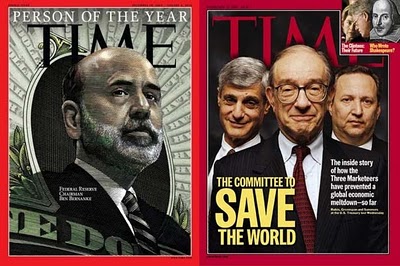
In reality Bernanke problem (in a slightly hyperbolized way) can be classified along the line of the psychological phenomenon called "brainwashing", "indoctrination" or, even "beliefs induced idiocy" ( see, for example, discussion of malicious animal magnetism in The psychology of conviction: a study of beliefs and attitudes). Despite his high IQ he behaved and still behaves more like a brainwashed lemming moving with the crowd off the cliff, then as an independent thinker, capable of challenging the establishment view and critisize the detached from the reality economic orthodoxy. He is just one of Wall Street financialization apparatchiks. A regular member of financial Politburo. Much like Greenspan, Rubin and Summers, financial apparatchiks troika which graced Time cover some time before Dr. Bernanke. Much like members of Politburo graced Soviet magazines.
Worshipping and lionizing central bankers became a popular activity in sycophantic mainstream media such as NYT and WashPost, and lately politicians. I can state that there is even some co-dependence exists between the POTUS and the head of the FED. Without his political credentials, a central banker like Ben Bernanke is just a pretty mediocre college professor, who tried to make his carrier on the coattails of Milton Freidman bizarre theories and never understood the real reasons and the real dynamic of Great Depression, precisely because for him those studies were just a test for the level of brainwashing that allow to enter the high academic cycles. He passed the test with flying colors.
At the same time like any member of FED Bernanke is not so much an academic as he is a politician. And he proved to be a pretty slick, capable politician. The growing political power of central bankers since the 1970s is undisputable (with Greenspan exacerbating this tendency due to his personality faults). While FED was always a political not purely financial institution, now it became more like a shadow government. And unfortunately the issue of central-bank accountability is not a hot topic. A fundamental reality of central banking is its intimate relationship to politics despite pretensions of independence. Moreover, the global bureaucracy of central bankers operates across national boundaries, exercising huge authority over both fiscal and monetary policy of nations, while deftly avoiding explicit political responsibility.
The Fed is a now the second most powerful, but unaccountable political institution in the USA, much like Politburo was in the USSR. And it was Nixon who allowed the Fed to escape from “the surly bonds of earth” in a fiscal and political sense. Officially abandoning of the limited equivalence of the dollar and gold set at Bretton Woods in a couple of decades made FED a hugely influential political institution. Simultaneously financization of the US economy reached unknown before levels and financial oligarchy became the primary political player (king maker) in the US political system. It is not surprising that indirect Washington’s subsidy for the U.S. banking system has grown to hundreds of billions more annually, far more than the industry reports in profits. The Bernanke Fed has been distinguished by greater openness and transparency than previous regimes, but this does not necessarily mean greater understanding on the part of the public about what central bankers do, and whom central bankers support.
Personally Bernanke is a typical neo-classical economist and as such has really limited (if any) understanding of externalities that financialization brought into the US economy and political life. His treatment of such complex and multi-layered as the Great Depression in pretty much mediocre, if not worse. Most of his works were written with co-authors. But critique of his academic achievements is almost non-existent: Bernanke is popularly portrayed as an expert on the Great Depression — the person whose intimate knowledge of what went wrong in the 1930s and thus capable of saving us from the a similar fate after 2008. The task that he successfully failed in 2008. “We came very, very close to a depression,” Bernanke warns. “The markets were in anaphylactic shock.” He conveniently forgot his role in the creation of housing bubble. This sort of charlatan logic is used frequently by Fed officials to justify virtually all of their actions from 2008 onward.
In reality actions of Bernanke were not out of line with "supply side economics" which probably is the most absurd form of Economic Lysenkoism. Encouraging private investment through depressing interest rates rather than any true bona fide government intervention to directly create jobs is just a different type of supply side economics in sheep’s clothing in which the Fed is using its resources to fuel crony capitalism and corporate welfare.
| Encouraging private investment through depressing interest rates rather than any true government intervention to directly create jobs is just a different type of supply side economics in sheep’s clothing in which the Fed is using its resources to fuel crony capitalism and corporate welfare. |
Other countries including those without reserve currency managed to escape meltdown like the USA or even fared better, despite absence of a "great Depression scholar" at the helm. Respectful references are made to Bernanke’s studies of the Great Depression, especially his conclusion that allowing large firms to fail is bad. But the only lesson learned by the former Princeton economics lecturer seems to be that bailouts and unlimited money printing is the best course. In a way he proved to be one trick pony. Moreover Bernanke views on Great Depression are naive and sycophantic:
attempter:
Those who think “Heckuva job” Bennie is well qualified to lead through the crisis are those who simply want more of the same, since it’s clear he learned nothing and forgot nothing.
The hype that Bernanke is an “expert” on the Great Depression is just one of those lies that the media sound machine repeats ad nauseum to the point that everyone is supposed to assimilate its truthiness rather than examine whether or not it is in fact true.
But a little examination reveals how he’s simply a monetarist flat earther. The dogma that the economy was basically sound, had a hiccup, and just needed liquidity easing, is a lie meant to obscure the fundamental contradiction of useless, concentrated wealth stolen from a putative consumer base no longer wealthy enough to consume.
And today the black magic of infinite exponential debt is supposed to keep that going. I guess Bernanke hopes we’ll soon make contact with extraterrestrials who are heavy savers with an economy based on cheap exports. Who else will be able to perform the miracle he and his colleagues propose, of somehow levitating this utterly destroyed consumer debt market?
He’s the same Wall Street financialization apparatchik he was from day one, and his only idea is to look for new bubbles to reflate to enable further top-down looting. The whole thing, bubbles, Bailout, and the same going forward, is history’s biggest police riot.
Someone I read put it very well–the Fed is like the World War I generals who couldn’t bring themselves to believe that the nature of warfare had changed and the machine gun and improved artillery had made the close-formation bayonet charge obsolete. For four years Haig, Joffre, et al. (and also some in the German high command) continued to maintain their image of a great calvary charge that would break through the enemy lines and bring the war to an end. Bernancke, the lickspittle, and the scholastic Fed economists are still waiting for that magical interest rate cut to “reignite” the economy, and they’ll do their best to frustrate any attempts at solutions which undermine their ability to remain in “command” of monetary policy.
Clemenceau said, “War is too important to be left to the generals.” Monetary policy is too important to be left in the hands of a Bernanke Fed.
Bernanke approach to Great Depression served him well to enhance his academic career, but proved to be much less useful for the country, when this relentless careerist became the Chairman of Fed. Here is one review of his book Essays on the Great Depression by Harry Eagar (compare Bernanke opus with Richard C. Koo The Holy Grail of Macroeconomics Lessons from Japan's Great Recession, John Kenneth Galbraith's The Great Crash 1929 and The Pecora Report: The 1934 Report on the Practices of Stock Exchanges from the "Pecora Commission". ):"
Trees counted, forest missed,
January 8, 2011 This book is a wonderful exercise in counting trees but missing the forest.
I should state out front that I do not believe that complex systems subject to stochastic shocks can be modeled. Ben Bernanke and his collaborators at least do not attempt the economic equivalent of the climate doommongers' general circulation models, that foolishly imagine they can model an entire complex system. Each essay is an attempt to slice out an organ of economic activity and conduct a pathological examination of it.
Some essays are more persuasive than others.
The early papers, in which Bernanke tried to extend the proposals of Barry Eichengreen from just the USA to the industrialized world of the `30s, are more persuasive. Eichengreen proposed that the deflation was made infectious across borders by the gold standard.
Bernanke shows that leaving the gold standard allowed guiders of monetary policy to inflate currency, which, in turn, helped debtors to get back on their feet, put themselves back to work and hire others. But it was, obviously, far from a complete solution to the problem of persistent falling output.
At the time, Bernanke says, going off gold was criticized as a "beggar-thy-neighbor" policy, but we now see that inflation was a good thing. There is nothing new to the idea. Rexford Tugwell and the Columbia agricultural economists made the argument in the `20s, before the Depression, which they foresaw. Bernanke does not mention them.
What Bernanke and the macroeconometricians have done is quantify the Brain Trusters' insights. The quantification is only moderately impressive.
I studied economics through economic history, and when you read those papers you get a lively sense of how inadequate economic data are. Bernanke's elaborate equations are based on shaky inputs.
Furthermore, as many footnotes reveal, leaving out a parameter often has no "substantial" effect on the results. This is a frequent feature of climate modeling, too. It is often used to suggest that the results are "robust" to the parameters that do affect results, but it probably is more generally to be interpreted as a strong signal that the theory has substantial defects.
When you get the same outputs no matter what the inputs are, time to rethink the theory.
To their credit, Bernanke and his students do rethink the theory. When it comes to labor, though, not enough.
While the view that gold is bad for trade seems solidly established, Bernanke has it acting almost in a vacuum. In particular, you would never guess from these essays that there was a speculative bubble in the late `20s, or that it might have had something to do with the Depression. Of course, Bernanke's interest is in why the Depression persisted, not in how it began.
The second set of essays is much less impressive, in which Bernanke attempts to learn why wages were "sticky," that is, why real wages went up (for those who had any income at all). In theory, wages should have gone down until workers got so little that they would be worth hiring again. Bernanke shows, persuasively, that real wages did stay high during the Depression, even setting aside the fact that money bought more as currency deflated.
He spends much more time on the supply side: why didn't workers offer to work for less?; and much less on the demand side, why didn't employers want to hire? Sound familiar? Yes, it's the same problem today.
As Bernanke notes, large corporations entered the Depression with enough liquid assets that they were not directly affected by banking crises. They could have hired, just as today (January 2011), US corporations are sitting on $2 trillion in cash equivalents and could hire if they wanted to. High taxes, contrary to what Tea Partiers, Republicans and other economic illiterates will tell you, have nothing to do with it.
Then, as now, employers would not hire -- they would not even take free labor -- if they didn't have a potential supply of buyers.
Here is where Bernanke goes off the rails. It is clear why manufacturers didn't see big opportunities, then and now: The consuming class had been wiped out.
For American farmers -- who along with those closely connected to them in a business sense made up about two-fifths of the population -- the Great Depression began in 1922 and lasted until 1940. Tens of millions of them simply dropped out of the money economy. Milton Friedman and Anna Schwartz can't analyze them, because they didn't use money.
An excellent description of how a large family, with substantial assets (over a thousand acres of debt-free fat farmland in eastern Iowa), lived for two decades without spending money is available in "Little Heathens" by Mildred Kalish.
One of Bernanke's eight industries on which he runs his regressions was leather and tanning. It was an industry in decline, even before the Crash of `29, and behaves somewhat as an outlier in his equations. But you don't need equations to understand why leather firms didn't hire more, even as leather workers earned less. All you have to do is read Kalish's book and find out how she went barefoot, and multiply by 40 million.
"Essays on the Great Depression" has an extraordinarily large number of typographical errors. It was published in 2000 (the essays were first published as early as 1982) and is used as a textbook in many colleges. My copy is a ninth printing. I assume, from the uncorrected typos, that I am one of the few people to have actually read it.
Even before the foreclosure crisis, the housing boom--part of Greenspan's strategy for sopping up financial balance sheets -- involved a scale of wasted resources usually associated in our imagination with Communist countries. Berlanke was a willing participant of this strategy. Later he tried to deny the responsibility:
The evidence that I’ve seen and that we’ve done within the Fed suggests that monetary policy did not play an important role in raising house prices during the upswing.
~ Ben Bernanke, Chair of FOMC
And later:
Wage and price controls distort markets…prices are prices…We’re not going to monetize US debt.
~ Ben Bernanke, FOMC
The Great Recession is not about excess inventory. It is more about excess debt which is quite a different animal from a typical recession. That means that the great economic adjustment we are experiencing will necessary entail a structural adjustment (including gradual and very painful dismantling of hypertrophied FIRE sector), adjustments that like in Great Depression will cause a great deal of pain. Quite simply too much Credit Money has been created and needs to be destroyed. Over the years fractional reserve banking system has been hacked into a virtual Ponzi scheme. As Professor Steve Keen noted in his the-economic-case-against-Bernanke:
In fact, his ignorance of the factors that really caused the Great Depression is a major reason why the Global Financial Crisis occurred in the first place.
The best contemporary explanation of the Great Depression was given by the US economist Irving Fisher in his 1933 paper “The Debt-Deflation Theory of Great Depressions”. Fisher had previously been a cheerleader for the Stock Market bubble of the 1930s, and he is unfortunately famous for the prediction, mere days before the 1929 Crash:
Stock prices have reached what looks like a permanently high plateau. I do not feel that there will soon, if ever, be a fifty or sixty point break below present levels, such as Mr. Babson has predicted. I expect to see the stock market a good deal higher than it is today within a few months. (Irving Fisher, New York Times, October 15 1929)
When events proved this prediction to be spectacularly wrong, Fisher to his credit tried to find an explanation. The analysis he developed completely inverted the economic model on which he had previously relied.
His pre-Great Depression model treated finance as just like any other market, with supply and demand setting an equilibrium price. However, in building his models, he made two assumptions to handle the fact that, unlike the market for say, apples, transactions in finance markets involved receiving something now (a loan) in return for payments made in the future. Fisher assumed
- (A) The market must be cleared—and cleared with respect to every interval of time.
- (B) The debts must be paid. (Fisher 1930, The Theory of Interest, p. 495)
I don’t need to point out how absurd those assumptions are, and how wrong they proved to be when the Great Depression hit—Fisher himself was one of the many whose fortunes were wiped out by margin calls they were unable to meet. After this experience, he realized that his previous assumption of equilibrium blinded him to the forces that led to the Great Depression. The real action in an economy occurs in disequilibrium:
We may tentatively assume that, ordinarily and within wide limits, all, or almost all, economic variables tend, in a general way, toward a stable equilibrium… But the exact equilibrium thus sought is seldom reached and never long maintained. New disturbances are, humanly speaking, sure to occur, so that, in actual fact, any variable is almost always above or below the ideal equilibrium…
It is as absurd to assume that, for any long period of time, the variables in the economic organization, or any part of them, will “stay put,” in perfect equilibrium, as to assume that the Atlantic Ocean can ever be without a wave. (Fisher 1933, p. 339)
A disequilibrium-based analysis was therefore needed, and that is what Fisher provided. He had to identify the key variables whose disequilibrium levels led to a Depression, and here he argued that the two key factors were “over-indebtedness to start with and deflation following soon after”. He ruled out other factors—such as mere overconfidence—in a very poignant passage, given what ultimately happened to his own highly leveraged personal financial position:
I fancy that over-confidence seldom does any great harm except when, as, and if, it beguiles its victims into debt. (p. 341)
Fisher then argued that a starting position of over-indebtedness and low inflation in the 1920s led to a chain reaction that caused the Great Depression:
- Debt liquidation leads to distress selling and to
- Contraction of deposit currency, as bank loans are paid off, and to a slowing down of velocity of circulation. This contraction of deposits and of their velocity, precipitated by distress selling, causes
- A fall in the level of prices, in other words, a swelling of the dollar. Assuming, as above stated, that this fall of prices is not interfered with by reflation or otherwise, there must be
- A still greater fall in the net worths of business, precipitating bankruptcies and
- A like fall in profits, which in a “capitalistic,” that is, a private-profit society, leads the concerns which are running at a loss to make
- A reduction in output, in trade and in employment of labor. These losses, bankruptcies, and unemployment, lead to
- Pessimism and loss of confidence, which in turn lead to
- Hoarding and slowing down still more the velocity of circulation. The above eight changes cause
- Complicated disturbances in the rates of interest, in particular, a fall in the nominal, or money, rates and a rise in the real, or commodity, rates of interest. (p. 342)
Fisher confidently and sensibly concluded that “Evidently debt and deflation go far toward explaining a great mass of phenomena in a very simple logical way”.
So what did Ben Bernanke, the alleged modern expert on the Great Depression, make of Fisher’s argument? In a nutshell, he barely even considered it.
Bernanke is a leading member of the “neoclassical” school of economic thought that dominates the academic economics profession, and that school continued Fisher’s pre-Great Depression tradition of analysing the economy as if it is always in equilibrium.
With his neoclassical orientation, Bernanke completely ignored Fisher’s insistence that an equilibrium-oriented analysis was completely useless for analysing the economy. His summary of Fisher’s theory (in his Essays on the Great Depression) is a barely recognisable parody of Fisher’s clear arguments above:
Fisher envisioned a dynamic process in which falling asset and commodity prices created pressure on nominal debtors, forcing them into distress sales of assets, which in turn led to further price declines and financial difficulties. His diagnosis led him to urge President Roosevelt to subordinate exchange-rate considerations to the need for reflation, advice that (ultimately) FDR followed. (Bernanke 2000, Essays on the Great Depression, p. 24)
This “summary” begins with falling prices, not with excessive debt, and though he uses the word “dynamic”, any idea of a disequilibrium process is lost. His very next paragraph explains why. The neoclassical school ignored Fisher’s disequilibrium foundations, and instead considered debt-deflation in an equilibrium framework in which Fisher’s analysis made no sense:
Fisher’ s idea was less influential in academic circles, though, because of the counterargument that debt-deflation represented no more than a redistribution from one group (debtors) to another (creditors). Absent implausibly large differences in marginal spending propensities among the groups, it was suggested, pure redistributions should have no significant macroeconomic effects. (p. 24)
If the world were in equilibrium, with debtors carrying the equilibrium level of debt, all markets clearing, and all debts being repaid, this neoclassical conclusion would be true. But in the real world, when debtors have taken on excessive debt, where the market doesn’t clear as it falls, and where numerous debtors default, a debt-deflation isn’t merely “a redistribution from one group (debtors) to another (creditors)”, but a huge shock to aggregate demand.
Crucially, even though Bernanke notes at the beginning of his book that “the premise of this essay is that declines in aggregate demand were the dominant factor in the onset of the Depression” (p. ix), his equilibrium perspective made it impossible for him to see the obvious cause of the decline: the change from rising debt boosting aggregate demand to falling debt reducing it.
In equilibrium, aggregate demand equals aggregate supply (GDP), and deflation simply transfers some demand from debtors to creditors (since the real rate of interest is higher when prices are falling). But in disequilibrium, aggregate demand is the sum of GDP plus the change in debt. Rising debt thus augments demand during a boom; but falling debt substracts from it during a slump.
In the 1920s, private debt reached unprecedented levels, and this rising debt was a large part of the apparent prosperity of the Roaring Twenties: debt was the fuel that made the Stock Market soar. But when the Stock Market Crash hit, debt reduction took the place of debt expansion, and reduction in debt was the source of the fall in aggregate demand that caused the Great Depression.
Classical and neoclassical economic theory are based upon incredibly simplistic, reductionist assumptions. in It is hardly surprising that in complex situations his reactions were intellectually inadequate. For someone like Bernanke, thoroughly indoctrinated in classical and neoclassical doctrines such thinks tend to happen despite high level of IQ and considerable political skills.
Of cause the characterization of Bernanke as a typical academic careerist has elements of satire, but such characterization does put known facts about Bernanke is a conceptual framework that make it far easier to understand his actions and behavior. Moreover, this framework has some predictive capacities. In a crisis, Bernanke tends to do "more of the same". This is similar to approach Johathan Andews argued was used by eighteen-century satirists (Images of idiocy):
armed themselves to stigmatize all of those members of society, from poets and literary hacks to clergymen and politicians, whom they conceived to be claiming insight and talents beyond their natural capacities, or failing to rain in their passions by exercising their judgment"
But at the same time, "an academic careerist" view, has more serious implications. Thomas Kuhn in his influential book The Structure of Scientific Revolutions argued that scientists work within a conceptual paradigm that strongly influences the way in which they see data. And after paradigm is internalized, scientists will go to great length to defend it. Changing a paradigm is difficult, as it requires an individual scientist to break with his or her peers and inflict huge damage on his self-esteem. The defining point of Bernanke biography probably was that, either sincerely or as a career-enhancing move he had found a convenient prophet in Friedman and became his disciple in a new religion in monetary policy, despite solid evidence that most of the dogmas of monetarism are empirically false. Monetarism aside, Bernanke is a typical laissez-faire market fundamentalist cut from the same cloth as his objectivist predecessor Greenspan. At the same time it looks like Bernanke too early linked his boat to Milton Friedman, and while it served well him in his career this linkage proved to be much less useful, and more limiting/damaging when he became a Fed chairman. It's one thing to try to put events of Great Depression into Friedman monetarist framework and the other to deal with a real crisis.
Neo-classical economics is a paradigm, which in a way is similar to Lysenkoism and while it marginally useful as a perverse reaction to the excesses of Keynesianism, it quickly outlived its usefulness and became a new "religious economic" or in a less flattering way "masturbation using mathematical symbols".
If we assume the view of Bernanke as indoctrinated personality, "a Chicago School functionary" one should not be surprised that some Bernanke's reactions to events were absurd. This is the same problem of theory that does not correspond to reality that faced Bolshevism. So in a way, Bernanke can be characterized as "neoclassical Bolshevik". In Marx words "History repeats itself, first as tragedy, second as farce."
While absurdity of Ann Rand doctrine exceed the absurdity of monetarism, extremes meet. Like Friedman and Greenspan, Bernanke is a conservative economist who promoted the view that markets are rational and self regulating. The fact that during economic collapse of 2008 he was printing money as fast as he can in no way indicates that he shares anything philosophical with Keynes. Keynes was astute observer of market behavior, hugely successful as an investor. Bernanke was never successful as investor (and never could be due to his indoctrination). Moreover he was as bad as Greenspan as economic forecaster, which is achievement in itself, Please don't forget that Greeenspan's forecasting acumen was universally despised by Wall Street sharks.
How somebody could "say" (in central banker speak, "say" means testify under oath to congress) in June of 2008 that subprime will be contained, then come back three months later and say they need $700 billion dollars or marshall law will be required, and then keep their job is beyond my limited comprehension. But he was able to do it.
Several of his bad judgments raise questions about Bernanke's "feel for the market" — his understanding of market psychology (hugely important) as well as his ability to interpret market signals. Both are key to Fed policymaking, unlike his academic credentials which are not so important especially if we can legitimately suspect that most of his academic base was bogus economic Lysenkoism. So its probably not accidental that he, unlike, say, Michael Hudson, did not see the train wreck coming.
Like Greenspan Bernanke is subservient to the powers that be and like his mentor he is much more accomplished politician then economist. One minor difference is that Greenspan did not have any academic credentials and often lloked like W Bush in Fed (Fed staffers used to laugh at his mis-usage of economic terminology at the beginning of his career). He make his way to Fed via Republican party nomenclature and his very questionable (most probably mostly career enhancing) association with Ann Rand and positivism.
This is not the case with Bernanke who did not played an active role in the Republican Party. He was a part of Rubin cycle. As noted in The Institutional Risk Analyst A Global House of Cards Interview with Josh Rosner:
... Bernanke seems completely co-opted by Paulson and the Goldman Sachs mafia that runs the Treasury. Both Bernanke and Geithner seem so weak and lacking in market experience that is almost sad to watch them testify next to banksters like Steel and Paulson.
Like Bush, Paulson, Geithner and Summers he have been playing the game long enough to become cynical opportunist. This is another common trait with Bolshevik leaders that Bernanke possesses.
The key metaphor that is applicable to people like Bernanke, Greenspan, Rubin and line is probably "the firefighter arsonist" metaphor. With the slight difference that the firefighter arsonist is intentionally causing an evil in order to participate in the form of a good. People like Bernanke just serve the unrealistic and destructive for society doctrine for personal benefit. Jeremy Grantham make the following observation in his Nov 2009 letter to investors (Just Desserts and Markets Being Silly Again The Big Picture):
Bernanke, the most passionate cheerleader of Greenspan's follies, is picked as his replacement, partly, it seems, for his belief that U.S. house prices would never decline and that at their peak in late 2005 they largely just reflected the unusual strength of the U.S. economy. As well as missing on his very own this 3-sigma (100-year) event in housing, he was completely clueless as to the potential disastrous interactions among lower house prices, new opaque financial instruments, heroically increased mortgages, lower lending standards, and internationally networked distribution. For these accumulated benefits to society, he was reappointed! So, yes, after the fashion of his mentor, he was lavish with help as the bubble burst. And how can we so quickly forget the very painful consequences of the previous lavishing after the 2000 bubble?
Rewarding Bernanke is like reappointing the Titanic's captain for facilitating an orderly disembarkation of the sinking ship (let's pretend that happened) while ignoring the fact that he had charged recklessly through dark and dangerous waters.
Here is couple of comments that reflect this view taken from Bernanke and Regulation of the Financial Sector:
lavy:
Ben Bernanke is a small town schmuch who has agreed to be the boy. That is the only way that an American youth rises. It surely has not been on the strength of his ideas. Come on, " savings glut". I know that Brad De Long and our host support this idea (at least they used too).
At the end of the day, this man is a tool of the Plantation Capitalist movement that has little or nothing to do with the crap they are teaching at the University.
Uncle Billy Cunctator:
Don't forget Dr. Bernanke's academic pedigree. His thesis advisor was Stanley Fischer. IMF, World Bank, Citibank, Governor of Bank of Israel, Group of 30 (PK, you never answered my question about the Group of 30's direct affiliations with Bellagio. Are there any currently?)
Fischer's other doctoral student (per mildly imperfect Wikipedia) was the entertaining Mankiw (who it seems is so tainted by the stink of the Bush administration that his ideas just don't manage to launch). Fischer authored a textbook on macroeconomics with Rüdiger Dornbusch, who apparently leave a glowing economic legacy.
Who was Fischer's academic papa? Franklin Fisher, who has taught at MIT for many years. According to Wikipedia,: "He has served as an expert witness in matters involving antitrust, contract disputes, valuation, damages, and trademark infringement for many years. Expert witness. Sort of an... opinion for hire? He's been a director of NBER for a very long time too, that organization that channels most of the funding to economists for their "independent" research.
Finally, just as we wondered at how the country's number one expert on flight safety procedures happened to be at the controls of the plane that glided to a safe landing on the Hudson, don't we marvel again and again how the number one scholar on the great depression (one of?) came to be sitting at the controls of the Fed as we headed into a greater depression? Well some of us did, that well-spun phrase "soft landing" tickling our ear.
Herr Professor, did they suck you in too with membership in a secret club and promises of building a better world?
IdahoSpud:
What is pathetic is that the esteemed Mr. Bernanke (an economist?) was seemingly unable to perceive the epic collapse of housing in real-time when he had all the data at his fingertips.
I find THAT very disturbing. Roach, Ritholtz, Hamilton, and Roubini had all pointed to the building imbalances while Bernanke clung to his "savings glut" theory.
It's difficult to conclude anything other than he is myopic or disingenuous. Neither trait inspires confidence.
In this sense reappointment of Bernanke is troubling: he was/is too closely identified with Fed policies that landed the global economy in its current sorry state. I don't know if replacing Bernanke makes any difference, but I want this guy gone. His recommendation to the Congress (which actually is outside of Fed mandate) to take money from the poor and elderly and give it to the banks is disgusting. Kevin Phillips noted that Bernanke was the chairman of George Bush’s Council of Economic Advisers and added:
“Imagine if FDR had retained Herbert Hoover’s chief economic advisor and loyal Republican Fed Chairman in 1933….To think that the pussycat Fed (would become) a saber-toothed tiger is a deception.” Worse still, ruinous economic policies “could prove fatal” if White House policies favor “Wall Street but not the national economy or American people” — the very direction they’ve now taken.
Academically Bernanke's writings are suffering from troubling oversimplifications and Milton Freidman's influence. He proved to be extremely bad forecaster (in this respect very similar to Greenspan, who was just a joke in the eyes of his Wall street colleagues like Jim Rogers):
As Fed Governor Bernanke supported the flawed policies of Alan Greenspan - he never recognized the housing bubble or the lack of oversight - and there is no question, as Fed Chairman, Bernanke was slow to understand the credit and housing problems. And I'd prefer someone with better forecasting skills.
However once Bernanke started to understand the problem, he was very effective at providing liquidity for the markets. The financial system faced both a liquidity and a solvency crisis, and it is the Fed's role to provide appropriate liquidity. Bernanke met that challenge, and I think he is a solid choice for a 2nd term (not my first choice, but solid).
The thrust of his academic writings was development of Friedman idea that the Depression was a pure "financial event" that supposedly could have been avoided if the Fed had flooded the economy with money (by bond purchases) to prevent a banking crash. While naive, the theory of enthusiastic about monetary policy Friedman has some merits. Monetary expansion along with cutting rates to zero is a really powerful weapon but not without other elements of government intervention, especially direct job creation program.
Pure monetary response neglects important aspects of what caused Great Depression: combination of overleveraged financial sector and industrial over-capacity created by the 1920s bubble, so similar to today but without huge external debt hanging over and with a dynamic manufacturing sector, the envy of other nations. Also the dramatic slowing down of the velocity of money makes injections far less useful.
In any case the current situation is immensely more complex not only because of the deterioration of manufacturing base under Reaganimics (which pushed financization and riding on the back of the dollar as world reserve currency instead of rebuilding manufacturing base). That makes the USA more like Great Britain in 30th, then the USA of that time. Additional similarity with Great Britain in 30th is that foreigners own 40% of US Treasury debt and have a partial veto on the monetary policy. Overt attempts to "monetize" US debt (aka unleashing printing press) might cause the policy to short-circuit. Foreign investors could simply dump US bonds, destroying the dollar. As Mark Twain put it: "It aren't what you don't know that gets you into trouble. It's what you know for sure that just aren't so."
Some people may argue that Bernanke’s situation is much closer to that of The Magician’s Apprentice. He’s playing with a system far more complicated, chaotic and reflexive than he with his broken Friedman mental model can possibly hope to understand, model or control. Clearly Bernanke used to have Friedman inspired "libertarian sympathies" until the moment of truth after Lehman bankruptcy cured him, at least temporary from his folly. His failures are an apt manifestation of the failure of a broader class of neoclassical economists: serving the powerful financial interests, a lack of humility in the face of the complexity of the economic world coupled with an aggressive, quasi-platonic "free market" economic messianism.
less is better says...Bernanke is the last choice possible. The best description in the looting of the American people should be "unindicted co-conspirator." Bernanke first decides what is right for his friends, what is right for the Reserve and what is right for his family. The American public is the last thing he thinks of and never has cared a dime about ruining their lives.
Bernanke stubbornly refuses to drop the insane propaganda put out by the economists that totally disregards nepotism, favors, friends' influence, pure bribes and that an enormous amount of money is not able to be accounted for and screams for "unregulated markets." which time after time after time have been shown to be unadulterated horseshit. Somalia has "unregulated markets." Perhaps sending Bernanke on a fact finding tour there would end the problem of the Federal Reserve.
The highest that I would like to see Bernanke is to make him the money washer for the Harlem mob. They would kill him for what he does to the American public every stinking day.
Link to comment | Aug 13, 2009 at 04:13 PM
The role of Goldman & Sachs that was depicted in a brilliant Matt Taibbi article Inside The Great American Bubble Machine Rolling Stone is fully applicable to Bernanke. He is just another self-serving "financial parasite": If America is circling the drain, Bernanke and his friends has found a way to benefit from this misfortune helping financial capital to exploit an unfortunate loophole in the system of Western democratic capitalism: in a society governed passively by free markets and free elections, organized greed always defeats disorganized democracy. As Simon Johnson noted:
Matt Taibbi has rightly directed our attention towards the talent, organization, and power that together produce damaging (for us) yet profitable (for a few) bubbles. Most of Taibbi’s best points are about market microstructure – not the technological variety usually studied in mainstream finance, but more the politics of how you construct a multi-billion dollar opportunity so that you can get in, pull others after you, and then get out before it all collapses. (This is also, by the way, how things work in Pakistan.)
In addition, of course, all good bubble-blowing needs ideology. Someone needs to persuade policymakers and the investing public that we are looking at a change in fundamentals, rather than an unsustainable and dangerous surge in the price of some assets.
It used to be that the Federal Reserve was the bubble-maker-in-chief. In the Big Housing Boom/Bust, Alan Greenspan was ably assisted by Ben Bernanke – culminating in the latter’s argument to cut interest rates to zero in August 2003 and to state that interest rates would be held low for “a considerable period”. (David Wessel’s new book is very good on this period and the Bernanke-Greenspan relationship.)
In this particular respect Bernanke is yet another a "Smooth Criminal" as some call him who has no empathy for the victims of the financial crisis. Bernanke Channels Willie Sutton In Assault On Social Security 'That's Where The Money Is':
Ben Bernanke has overseen the greatest expansion of the Federal Reserve's balance sheet in its history, pouring trillions of dollars into Wall Street firms at roughly zero interest rates.
His generosity, however, has a limit.
In testimony before the Senate Banking Committee today, where he's seeking re-appointment as the Fed's chairman, Bernanke called for cutbacks in Medicare and Social Security even as unemployment rises and the middle class is endangered.
Citing legendary bank robber Willie Sutton, Bernanke said of the retirement and health care funds that are the legacy of the New Deal: "That's where the money is."
Sen. Bob Bennett (R-Utah) sympathized with Bernanke, saying that, because of entitlement spending, "you're going to be looking at a situation where the Congress will be unable to provide any kind of fiscal discipline because of the mandatory spending. That puts an enormous burden on your plate."
"Well, Senator, I was about to address entitlements," Bernanke replied. "I think you can't tackle the problem in the medium term without doing something about getting entitlements under control and reducing the costs, particularly of health care."
Bernanke reminded Congress that it has the power to repeal Social Security and Medicare.
"It's only mandatory until Congress says it's not mandatory. And we have no option but to address those costs at some point or else we will have an unsustainable situation," said Bernanke.
Yet despite being a die-hard Greenspan school market fundamentalist, he managed to do something useful during the crisis, the feat which was not possible if he continued with the standard right-wing "f*ck off and die" mentality toward the government intervention. This was the moment when an arsonist turned into firefighter:
June 26, 2009 Ben Bernanke: "Smooth Criminal"
I know this isn't a universally held opinion, but to me there is a simple reality. Between September and December we were facing a significant chance of another Great Depression. Beyond that, we were potentially looking at a financial disaster from which the United States would never recover.
Today, it looks like we are merely facing a very bad recession.
Who deserves credit? Certainly not Hank Paulson and the Bush administration. They choose philosophy over pragmatism every chance they got. They gave in to the moronic "moral hazard" bullshit argument. They stuck to their right-wing "fuck off and die" mentality toward the banking system. That worked out great didn't it? Then when they had the chance to use the TARP right, they failed miserably. Again, they gave into the moral hazard wing of the Republican party and instead of buying up bad securities, they initiated the Capital Assistance Program. No moral hazard there!
Before becoming Fed chairman he was one of the key promoter of Greenspan's reckless policies. As Roubini noted in his generally "pro-Bernanke" oped in NYT (The Great Preventer, July 25, 2009) :
Mr. Bernanke, a Fed governor in the early part of this decade, supported flawed policies when Alan Greenspan pushed the federal funds rate (the policy rate set by the Fed as its main tool of monetary policy) too low for too long and failed to monitor mortgage lending properly, thus creating the housing and credit and mortgage bubbles.
He and the Fed made three major mistakes when the subprime mortgage crisis began.
- First, he kept arguing that the housing recession would bottom out soon (it has not bottomed out even three years later).
- Second, he argued that the subprime problem was a contained problem when in reality it was a symptom of the biggest leverage and credit bubble in American history.
- Third, he argued that the collapse in the housing market would not lead to a recession, even though about one-third of jobs created in the latest economic recovery were directly or indirectly related to housing. Mr. Bernanke’s analysis was mistaken in several other important ways. He argued that monetary policy should not be used to control asset bubbles. He attributed the large United States current account deficits to a savings glut in China and emerging markets, understating the role that excessive fiscal deficits and debt accumulation by American households and the financial system played.
Bernanke came to office with great fanfare based on his life-long study of the Great Depression and his theories for warding off a recurrence. In this regard, fighting deflation was a topic he had spoken about at length. On November 21, 2002, in his speech titled "Deflation: Making Sure "It" Doesn't Happen Here", Bernanke made reference to a "helicopter drop" of money into the economy.
Despite often being quoted out of context, the nickname Helicopter Ben stuck. True to the name, he has dropped a record-breaking amount of cash into the economy as he steers the United States through its worst period since the Great Depression.
The approximately $4 trillion in loans from the Fed to help struggling financial firms, insurers, automakers and other firms has been credited with keeping the economy afloat. Bernanke's knowledge of the Depression and his theories of how to prevent its return have not been effective, to put it mildly. Apart from stopping the run on the banks, none of his policies of that time actually worked.
Helicopter Ben statement that government always has a tool to fight deflation: it is called printing press is disingenuous in the situation when foreigners hold two trillion of US debt. Here the exact quote:
Like gold, U.S. dollars have value only to the extent that they are strictly limited in supply. But the U.S. government has a technology, called a printing press (or, today, its electronic equivalent), that allows it to produce as many U.S. dollars as it wishes at essentially no cost. By increasing the number of U.S. dollars in circulation, or even by credibly threatening to do so, the U.S. government can also reduce the value of a dollar in terms of goods and services, which is equivalent to raising the prices in dollars of those goods and services. We conclude that, under a paper-money system, a determined government can always generate higher spending and hence positive inflation.
I think that one of the most insightful analysis of Helicopter Ben was done by Stephen Roach in his essay : The case against Bernanke:
August 25 2009
Barack Obama has rendered one of his most important post-crisis verdicts: Ben Bernanke will be nominated for a second term as chairman of the Federal Reserve. This is a very shortsighted decision. While America’s head central banker deserves credit for being creative and courageous in orchestrating an unusually aggressive monetary easing programme, it is important to remember that his pre-crisis actions played an equally critical role in setting the stage for the most wrenching recession since the 1930s. It is as if a doctor guilty of malpractice is being given credit for inventing a miracle cure. Maybe the patient needs a new doctor.
Mr. Bernanke made three critical mistakes in his pre-Lehman incarnation:
- First, and foremost, he was deeply wedded to the philosophical conviction that central banks should be agnostic when it comes to asset bubbles. On this count, he stood with his predecessor – serial bubble-blowing Alan Greenspan – who argued that monetary authorities are best positioned to clean up the mess after the bursting of asset bubbles rather than to pre-empt the damage. As a corollary to this approach, both Mr. Bernanke and Mr. Greenspan drew the wrong conclusions from post-bubble strategies earlier in this decade put in place after the bursting of the equity bubble in 2000. In retrospect, the Fed’s injection of excess liquidity in 2001-2003, which Mr. Bernanke endorsed with fervor, played a key role in setting the stage for the lethal mix of property and credit bubbles.
- Second, Mr. Bernanke was the intellectual champion of the “global saving glut” defense that exonerated the US from its bubble-prone tendencies and pinned the blame on surplus savers in Asia. While there is no denying the demand for dollar assets by foreign creditors, it is absurd to blame overseas lenders for reckless behavior by Americans that a US central bank should have contained. Asia’s surplus savers had nothing to do with America’s irresponsible penchant for leveraging a housing bubble and using the proceeds to fund consumption. Mr. Bernanke’s saving glut argument was at the core of a deep-seated US denial that failed to look in the mirror and pinned blame on others.
- Third, Mr. Bernanke is cut from the same market libertarian cloth that got the Fed into this mess. Steeped in the Greenspan credo that markets know better than regulators, Mr. Bernanke was aligned with the prevailing Fed mindset that abrogated its regulatory authority in the era of excess. The derivatives’ explosion, extreme leverage of regulated and shadow banks and excesses of mortgage lending were all flagrant abuses that both Mr. Bernanke and Mr. Greenspan could have said no to. But they did not. As a result, a complex and unstable system veered dangerously out of control.
Notwithstanding these mistakes, Mr. Obama may be premature in giving Mr. Bernanke credit for the great cure. No one knows for certain as to whether the Fed’s strategy will ultimately be successful. The worst of the US recession appears to have been arrested for now – a fairly typical, but temporary, outgrowth of the time-honored inventory cycle. But the sustainability of any post-bubble recovery is always dubious. Just ask Japan 20 years after the bursting of its bubbles.
While financial markets are giddy with hopes of economic revival – in part inspired by Mr. Bernanke’s cheerleading at the Fed’s annual Jackson Hole gathering – there is still good reason to believe that the US recovery will be anemic and fragile. US consumers are in the early stages of a multi-year retrenchment as they cut debt and rebuild retirement saving. The unusual breadth and synchronicity of the global recession will restrain US export demand from becoming a new growth engine.
It would be the height of folly to reward Mr. Bernanke for the recovery that never stuck. Yet Mr. Bernanke’s apparent reward is, unfortunately, typical of the snap judgments that guide Washington decision-making. In this same vein, it is hard to forget Mr. Greenspan’s mission-accomplished speech in 2004 that claimed “our strategy of addressing the bubble’s consequences rather than the bubble itself has been successful”. Eager to declare the crisis over, the Obama verdict may be equally premature.
The Bernanke reappointment is a welcome chance for a broader debate over the conduct and role of US monetary policy. Mr. Obama has made sweeping proposals that give the Fed broad new powers in managing systemic risks. I argued in the Financial Times 10 months ago that the Fed should not be granted these powers without greater accountability as required by a “financial stability mandate” – in effect, forcing the Fed to shape monetary policy with an aim towards avoiding asset bubbles and imbalances. Without a revamped policy mandate, it is conceivable that we could face another destabilizing crisis.
Ultimately, these decisions boil down to the person – in this case, Mr. Bernanke – who is being charged with the awesome responsibility as America’s chief economic policymaker. As a student of the Great Depression, he should have known better. Yes, he reacted strongly after the fact in taking actions to avoid the pitfalls highlighted by his own research. But he lacked the foresight and courage to resist the most reckless tendencies of the era of excess. The world needs central bankers who avoid problems, not those who specialize in post-crisis damage control. For that reason, alone, he should not be reappointed. Let the debate begin.
The writer is chairman of Morgan Stanley Asia and author of The Next Asia to be published next month
| 2009 | 2008 | 2007 | 2006 | 2005 | 2004 | 2003 | 2002 | 2001 | 2000 |
| 1999 | 1998 | 1997 | 1996 | 1995 | 1994 | 1993 | 1992 | 1991 | 1990 |
| "Deriviatives are in the well-capitalized hands of sophisticated investors" "Sub-prime is contained" "The GSEs are satisfactorially capitalized" Ben Bernanke |
 |
 |
 |
Medium
When I heard that Ben Bernanke was taking a second advisory role, at PIMCO, as well as his first job out of the Fed, at Citadel, I kind of nearly dropped my morning latte in surprise. If I was PIMCO, I would not be wanting an advisor to Citadel to be coming within a hundred yards of my trading floor.
Why not? Well, the way that PIMCO works, as Felix Salmon explained a few years ago, is very dependent on their ability to execute changes in their view in a very, very efficient manner - quickly, and without too much impact on the market price. Given that, if I was PIMCO, I would be super super paranoid about allowing anyone near me who was also going to be talking to one of the world's sharpest and most aggressive hedge funds.
Obviously, Bernanke is a) a man of pretty unquestioned integrity, b) aware of the clear potential for conflict of interest and c) neither a spring chicken nor a pushover. He will be aware of the danger of having one of his two clients out-traded by the other. So, although I doubt that will stop the Citadel traders trying, he will already be pretty resistant to questions of the following kind:
"So, what do they think up in Newport?"
"What's Andrew Balls saying?"
"Do your other guys like the ten year linked?"
"What's PIMCO holding? Come on, tell me, what have they got? What are we f**king paying you for anyway? Come, you bearded f**k, tell me? No, f**k your Chinese Wall, I've got Ken on my ass here. What are they holding? What are they holding? What are they f**king …" (repeat ad infinitum, some of them can be very persistent and/or aggressive).
In any case, it's unlikely that Bernanke, as an outside consultant, will be reviewing portfolios or directly advising on trades. It's more likely that he'll be a sounding board for general discussions, and/or a brand ambassador, meeting clients of PIMCO for pitch or review meetings. That sounds like less of a problem of conflict of interest, except …
Except that if anything, information about client attitudes to PIMCO is more valuable to a competitor than information about PIMCO's attitude to the market. After all, PIMCO's positions are generally well-known - they're too big and too public for it to be otherwise. But if you ever got a hint that they had received a big redemption or gained a big mandate - well, that would be very useful information indeed because you would know them to be potentially forced buyers or sellers.
At a lower level, traders are always sniffing for information about possible changes of view - whether the holders of a security are confident in their decision and happy to add more, or whether they're doubting themselves and thinking about changing their minds. A fly on the wall at a general sounding board for PIMCO PMs could learn all sorts of useful information simply by being aware of what they were thinking about.
And furthermore, hedge fund traders are in the business of extracting "soft" information and understanding its implications. Being a human antenna for other people's sentiment toward the market is what they do. The best ones - and Citadel doesn't employ many lemons - can make a guess about your positioning and recent performance from the way you say "Good morning". That's why so many of them are poker players, and particularly why they often do well in the big face-to-face tournaments. So the questions that Bernanke really needs to look out for are things like:
"How's California, my man? Still sunny?"
"Jeez, another tour of Asia? Working you pretty hard aren't they?"
"What do you mean you can't do the 15th? Frankfurt *again*?"
"Lighten up, Ben! Looks like someone's been giving you a hard time?"
"Tell me, if we wanted to shift a big block trade in[security] who do we call at PIMCO?"
"Seen the Journal? Brutal. Rather have my performance numbers than PIMCO's huh?"
Even with the best will (and the best poker face) in the world, this dual role looks to me like a possible conduit of information. Bernanke is experienced in keeping his mouth shut, but he's going into a whole new world now, and he's doing so without the benefit of a staff and a press office to protect him. If I was PIMCO, I wouldn't have taken this risk.
Dan Davies is Senior Research Advisor at Frontline Analysts
|
|
|
December 23, 2013 | theguardian.com
Comment is free Jump to comments (40)
Bernanke tried to boost demand, but he leaves behind high unemployment and stronger-than-ever Wall Street behemothsOutgoing Federal Reserve charmain Ben Bernanke before the United States Senate Committee on Banking, Housing, and Urban Affairs. Photograph: Ron Sachs/CNP/Corbis Federal Reserve Board Chairman Ben Bernanke gave his last press conference as chair and already the retrospectives have begun. One item that should be corrected off the top, Bernanke did not just inherit an economic disaster from Alan Greenspan.
Bernanke did not go directly from being a Princeton economics professor to being Fed chair. He got there by being a member of the Board of Governors of the Fed from 2002 to 2005, and then was chair of President Bush's Council of Economic Advisers from the spring of 2005 until he took over as Fed chair in January of 2006. In other words, Bernanke held top policy posts during the period when the housing bubble was growing to ever more dangerous levels, driven by a flood of junk mortgages.
While Greenspan certainly deserves the most blame for the economic disaster following the burst of he housing bubble, there were few people better positioned than Bernanke to try to slow the growth of that bubble. There is no evidence that he ever suggested any concern about the risks posed by the bubble and the reckless lending that drove it. (He explicitly dismissed such concerns in a session of the American Economics Association in 2004.) So we have to understand that Bernanke was cleaning up a mess that he helped create.
In this role his performance was at best mixed. The pundits routinely give Bernanke credit for heading off a second Great Depression, but this is mostly because they heard someone else say it, not because they have any idea what it actually means.
The Great Depression was not just the result of an inadequate response to a financial crisis; we had a prolonged period of double digit unemployment due to inadequate fiscal policy over the next decade. The massive stimulus provided by the second world war, which eventually lifted us out of the depression, could have come just as easily in 1931 as 1941. The problem was one of political will, not some intrinsic law of economics.
In the same vein, had the Fed and the Treasury not stepped in to stop the cascade of failing financial institutions in the fall of 2008, there is no way this would have condemned the country to a decade of double digit unemployment. If we did experience a prolonged period of high unemployment following such a crash, it would be the result of the deficit hawks insisting that their infatuation with low budget deficits would have to take priority over jobs and growth.
That is not impossible as a political outcome, but it is important to understand the nature of the argument. The argument was that the country could face another Great Depression because the deficit hawks are so powerful that they could even willingly impose a decade of double digit unemployment to satisfy their deficit fixations.
From this vantage point, the argument about saving Wall Street is essentially a question of hostage taking. If Bernanke did not bail out the Wall Street banks, then the deficit hawks would have made the country endure a decade of double-digit unemployment as punishment.
Bernanke certainly did everything he could to sell the bailouts. He insisted on the urgency of Tarp, telling Congress that the commercial paper market, an essential funding line for most major companies, was shutting down. Bernanke never mentioned the fact that he unilaterally possessed the ability to support the market, waiting until the weekend after Tarp passed to announce the creation of a special lending facility for this purpose.
Bernanke also tried to shield the identity of the banks who opted to take advantage of the Fed's special lending facilities, getting access to credit at below market rates in the middle of the crisis. He only released aggregate lending data, until Congress included a provision in Dodd-Frank requiring that the Fed disclose information on the terms of the loans from its special lending facilities.
Bernanke could have used his post to call attention to the fact that the big Wall Street banks were essentially bankrupt and that Congress could force restructuring as a condition of survival. Instead Bernanke worked to conceal the extent of the problem, leaving the industry more concentrated than ever in the wake of the crisis.
While Bernanke deserves considerable blame for allowing Wall Street to escape little changed from the crisis, he does deserve credit for his aggressive efforts to try to boost the economy. His quantitative easing (QE) policy is an innovative way to try to spur growth in a context where the federal funds rate is already at zero and can't go any lower.
Bernanke has taken considerable heat from the right for his expansionary monetary policy, with the governor of Texas even going so far as to suggest that the Fed chair would be in physical danger if he visited the state. There were near frantic screams that QE would set off a burst of hyperinflation – the screams only got louder the longer inflation remained low.
Bernanke deserves credit for sticking to his guns through this ordeal and taking the limited steps available to the Fed for boosting demand. He also deserves credit for criticizing the fiscal contraction of the last three years for slowing the economy. These are big plusses, but given that the economy is still far below full employment, and that we are likely to be haunted by the bigger than ever Wall Street behemoths long into the future, it is hard see Bernanke's tenure as net positive.
zolotoy
Dear Mr. Baker: Bernanke was riotously successful -- just not for the American people, but rather for the clientele he really serves: the big banks.
Greatgungholio
'Helicopter Ben' and this predecessors have had the luxury of being able to print and endless stream of green toilet paper at the expense of the rest of the world and fixed salary workers (via inflation). They can do this because the dollar became like any other fiat currency in the 1970's when Nixon closed the window on the fixed exchangeability of dollars to gold. Now we reap the 'rewards' - higher house prices, stagnant wages, higher fuel, rampant inflation.
Americas only export these days is freshly printed money backed by their fascist military - both need each other to survive and thankfully the dollars time as a reserve currency is nearly up - and so goes the empire!
greensox
First do no harm. My father was a doctor, when most people came to him he would listen to their symptoms sympathetically and in almost every case prescribe aspirin normally disguised as some expensive brand name but available free on the NHS.
We are 6 years in to a recession and the employment figures are improving just as they would have naturally but all this time we have had
greensoxApologies for the split post..... But on reflection this article gets about everything it is possible to get wrong wrong.
The money centre banks, some of them, were insolvent not bankrupt in 2008 and at least two of them were neither. Bernanke on his own could not restructure or Nationalise them, he did not have that sort of power. TARP was as much about saving Detroit and AIG as saving some of the banks and it was the banks who got out of TARP as quickly as they could three of them having no need of it at all paid back the money the first day they were allowed to.
Given that the seizing up of the money markets was all about confidence Bernanke allowed the banks to go to the window anonymously so as not to start runs on banks who used the facility, a very sensible if forced move. In the immediate crisis Bernanke did well it is what came next that he gave in.
QE has resulted in a large transfer of wealth to the very rich, asset prices are at all time highs in many cases while many people are still trapped in negative equity or in low paying jobs. Those who got to borrow at zero interest rates were those who had no need to, they have taken the free money and bought stocks and bonds and have made out like bandits, the poor in work have no access to credit and the poor approaching retirement are getting zero on their savings, they can't risk having money in the asset classes that have done well out of QE.
So Sir you have praised him for the disastrous redistribution carried out over five years and condemned him for his prompt if not perfect actions in a time of crisis. QE leads nowhere to higher employment and better wages it leads to the Koch Brothers trebling their wealth.
NOTaREALmerican
What did you expect, he WORKS FOR the "Wall Street behemoths".
"The Fed" is a private bank, period - end of story.
BrianHarry
"So we have to understand that Bernanke was cleaning up the mess he helped to create"
And Bernanke was made Time Magazine's "Man of the Year" Lol. Almost as bad as Henry Kissinger getting a Nobel Peace Prize(and Obama for that matter)
One thing needs to be understood. Bernanke, in spending $3 Trillion, which was used to buy "mortgage backed securities"(translates as, Banks bad debts), but ONLY from the European and American Banks that OWN THE FED.
So he wasn't saving the American economy.(Hundreds of smaller regional US Banks went bust, without 1 cent help from the FED). He was saving the FED's position(and its owners) thereby retaining the FED's position as the Master of the US economy.
So, the guys captaining the ship, saved themselves first, which then helped a very slow, prolonged American recovery.
Ch8ishall
I believe that the income tax code had more affect on creating the primary home bubble than the Federal Reserve. The long term zero capital gains tax rate on up to $ 500,00.00 capital gains, and the interest and the property tax deduction all contributed to high appreciation/inflation rates of primary home prices. Rental housing, or rents did not experience as high appreciation rates as primary homes did, even though owners of housing rental property has many tax advantages. It was the deregulation of the financial sector, and the possibility of receiving tax free money that started the increases in sales and purchases of primary homes, financed by a more than willing financial sector, and guided by commissioned realtors, debt rating companies and financial advisors
The Fed cannot change the income tax code. The Fed's primary tool is the raising, or lowering of interest rates to control inflation, and the creation of economic bubbles, which is very damaging to a capitalist economy. Google the title "Tax Policies Need Changes Before The Fed Changes Monetary Policy" for more information.
|
|
|
Asia Times
The Federal Reserve shocked the markets Wednesday with its decision to furlough QE "tapering". The Ben Bernanke Fed, having for years prioritized a clear communications strategy, threw unsettled global markets for a loop.
Much has been written the past few days addressing the Fed's change of heart. I'll provide my own take, noting first and foremost my belief that Wednesday's decision likely marks a critical inflection point. A marketplace that had been willing to ignore shortcomings and give the Federal Reserve the benefit of the doubt must now reevaluate. After all the fun and games, the markets will have to come to terms with a divided and confused Fed that has lost its bearings. As much as the Bernanke Fed was committed to the notion of market-pleasing transparency, it had kind of come to the end of the rope and was forced to just throw up its hands.
I'll make an attempt to place the Fed and markets' predicament in some context - at least in the context of my analytical framework. This requires some background rehash.
Credit is inherently unstable. When credit is expanding briskly, the underlying expansion of credit works to validate the optimistic view (spurring borrowing, spending, investing, speculating and rising asset prices) - which tends to stimulate added self-reinforcing credit expansion. When credit contracts, asset prices and economic output tend to retreat, which works against confidence in system credit and the financial institutions exposed to deteriorating credit, asset prices and economic conditions. One can say credit is "recursive".
And with credit and asset markets feeding upon each another, I'll paraphrase George Soros' Theory of Reflexivity: perceptions tend to create their own reality. Credit cycles have been around for a very, very long time. We're in the midst of a historic one.
Credit fundamentally changed in the nineties, with the proliferation of market-based credit (securitizations, the government-sponsored enterprises, derivatives, "repos", hedge funds and "Wall Street finance"). Unbeknownst at the time - perhaps to this day - marketable securities-based credit created additional layers of instability compared to traditional (bank loan-centric) credit.
These new instabilities and attendant fragilities should have been recognized with the bursting of a speculative Bubble in bonds/mortgage-backed securities/derivatives (along with the Mexican collapse) back in 1994/5. Fatefully, policy measures moved in the direction of bailouts, market interventions and backstops. Credit and speculative excesses were accommodated, ensuring a protracted period of serial booms, busts and policy reflations.
Monetary policy fundamentally changed to meet the demands of this New Age marketable securities-based, highly-leveraged and speculation-rife credit apparatus. The Greenspan Fed adopted its "asymmetric" policy approach, ensuring the most timid "tightening" measures in the face of excess and the most aggressive market interventions when speculative Bubbles inevitably faltered.
Greenspan adopted a strategy of "pegging" short-term rates and telegraphing the future course of policymaking. This was apparently to help stabilize the markets. In reality, these measures were instrumental in a historic expansion of credit, financial leveraging and speculation. The Fed has been fighting ever bigger battles - with increasingly experimental measures - to sustain this inflating monster ever since.
I am a strong proponent of "free market capitalism". I just don't believe financial market pricing mechanisms function effectively within a backdrop of unconstrained credit, unlimited liquidity and government backstops. I believe this ongoing period of unconstrained global credit is unique in history.
Indeed, this is an open-ended experiment in electronic/digitalized "money" and credit. This experiment has necessitated an experiment in "activist" monetary management and inflationism. At the same time, these experiments have accommodated an experimental global economic structure. The US economy is an experiment in a services and consumption-based structure with perpetual trade and current account deficits. The global economy is an experiment in unmatched - and persistent - financial and economic imbalances.
US and global economies are at this point dependent upon ongoing rampant credit expansion. Highly interrelated global financial markets have grown dependent upon the rapid expansion of credit and marketplace liquidity. The Fed and global central banks have for some time now been desperately trying about everything to spur ongoing credit expansion (to inflate credit). Curiously, they avoid discussing the topic and frame the issues much differently.
The Fed pushed short-term rates down to 3% to spur credit inflation during the early-'90s. Rates were forced all the way down to 1% - and the Fed resorted to talk of the "government printing press" and "helicopter money" in desperate measures to spur sufficient reflationary credit growth after the bursting of the "technology" bubble. Even zero rates were insufficient to incite private credit expansion after the collapse of the mortgage finance bubble.
With this New Age (experimental) marketable credit infrastructure crumbling, the Bernanke Fed resorted to a massive inflation of the Fed's balance sheet - an unprecedented monetization of government debt and mortgage-backed securities. What unfolded was a historic reflation of global securities prices, along with further massive issuance of marketable debt securities.
In spite of all the "deleveraging" talk, the growth of outstanding global debt securities went parabolic. Central bank holdings of these securities grew exponentially. Instrumental to the credit boom, Fed policy spurred trillions to leave the safety of "money" for long-term US fixed income, international securities and the emerging markets (EM).
It is unknown how many trillions of leveraged speculative positions were incentivized by global central bankers. The combination of an unprecedented policy-induced inflation of prices across securities markets and a low tolerance for investor/speculator losses creates a very serious and ongoing dilemma for the Fed and its global central bank cohorts.
Over the years, I've chronicled monetary management descending down the proverbial slippery slope. Actually, monetary history is rather clear on the matter: loose money and monetary inflations just don't bring out the best in people, policymakers or markets. I definitely don't believe a massive bubble in marketable debt and equity securities is conducive to policymaker veracity. I don't believe a multi-trillion dollar pool of leveraged speculative finance - that can position bullishly leveraged long or abruptly sell and go short - promotes policy candor. Actually, let me suggest that a global credit and speculative Bubble naturally promotes obfuscation and malfeasance. Invariably, it regresses into a grand confidence game with all the inherent compromises such an endeavor implies.
I titled a February 2011 Credit Bubble Bulletin "No Exits". This was in response to the details of the Fed's plan for normalizing its balance sheet after it had bloated to $2.4 trillion (from $875 billion in June of '08). There was simply no way the Fed was going to be able to sell hundreds of billions of securities into the marketplace without inciting risk aversion and de-leveraging. I assumed the Fed's balance sheet would continue to inflate, though never did I contemplate the Fed resorting to $85 billion monthly QE in a non-crisis environment.
I speculated a year ago that the Fed had told "a little white lie". The Fed was responding to rapidly escalating global risks - right along with the Mario Draghi European Central Bank, the Bank of Japan, the Chinese and others. Open-ended QE was, I believe, wrapped in a veil of an American unemployment problem for political expediency.Meanwhile, the Fed has pushed forward with "transparency" believing it gave them only more control over market prices. And, at the end of the day, the $85 billion monthly QE, the unemployment rate target, and long-term (zero rate) "forward guidance" provided a securities market pricing transmission mechanism that must have made former Fed chairman Alan Greenspan envious.
The bottom line is that the $160 billion (Fed and Bank of Japan) experiment in ongoing monthly QE (along with Draghi's backstop) only worked to exacerbate global fragilities that were surfacing last summer. I believe increasingly conspicuous signs of excess had the Fed wanting to begin pulling back. Yet just the mention of a most timid reduction of QE had global markets in a tizzy. After backing away from an exit strategy, the Fed has for now backtracked on tapering. It seems I am on an almost weekly basis now restating how once aggressive monetary inflation is commenced it becomes almost impossible to stop.
|
|
|
Asia Times
I have long suspected that the primary motivation for Bernanke to begin the taper was the L-word. No, not what you are thinking, but LEGACY. Despite being a mediocre economist with no real-world knowledge but who somehow managed to climb the corridors of power to the stratospheric heights of the Fed chairman Bernanke probably had enough personal humility to appreciate that his monetary policies had been a complete failure for their intended use - to improve economic growth - while creating longer-term risks.
Not wanting to face the same criticism as his predecessor Alan Greenspan did when he opened the flood gates of liquidity to counter September 11, thereby sowing the seeds of the financial crisis, Bernanke figured out that a gentle withdrawal of the QE would be his best legacy. Sure, stunning growth in the markets would stop, and the economy would probably slow, but he would have had the satisfaction of leaving the job with a legacy of low inflation, moderate growth and reasonable economic confidence.
At least, that was the plan.
... ... ...
That then is the worst part of Bernanke's legacy - not only did he fail to do his job, and instead imposed significant economic and financial risks, in the end he wasn't able to get his way within the Federal Reserve, being outmaneuvered by his putative successor.
I have never been a fan of Ben Bernanke - see Forget Spitzer, fire Bernanke, Asia Times Online, March 15, 2008 - but even with my low expectations, it must be admitted that Bernanke failed on all measures as Fed chairman.
|
|
|
The National Interest
WORSHIPPING AND lionizing central bankers is an increasingly popular activity. This veneration holds appeal not only for investors but also for politicians and the media. Indeed, a strong codependence exists between politicians and central bankers. Without the political class, a central banker like Ben Bernanke is just a college professor.
At the same time, politicians often find central bankers to be useful foils for political rhetoric around election time.Although the growing power of central bankers since the 1970s is largely a political phenomenon, it has been scantly discussed in political discourse. Outside the grim ghettos of financial media, the issue of central-bank accountability is not a hot topic. The global bureaucracy of central bankers operates across national boundaries, exercising huge authority over both fiscal and monetary policy while avoiding explicit political responsibility. The Fed is all-powerful, for example, yet largely unaccountable.
In his classic 1995 book Confidence Game, Steven Solomon described how economic change in the 1980s and 1990s created a political vacuum in terms of policy mechanisms to address global currency and capital flows-and how that void was effectively filled by central bankers. Global capital mobility caused governments' sovereign control over national savings and national monetary policy to slip away-or, more specifically, to be pooled. According to Solomon, George Shultz characterizes the new era as one in which
the "court of the allocation of world savings" every day judges the economic policies of governments, rewarding those it favored with investment and strong currencies and punishing others by withholding capital and weak currencies. . . . Capital was free to pursue its innate profit-expansive logic regardless of geographic boundary or political consequences.
In his new book The Alchemists: Three Central Bankers and a World on Fire, Neil Irwin picks up the policy and personal narrative of this global central-bank priesthood. Like other journalists turned authors such as Solomon, William Greider and Martin Mayer, Irwin brings to the task his personal experience with the people at central banks. Irwin, who has covered the Fed and economic issues for the Washington Post for over a decade, is now a Post columnist and the economics editor of Wonkblog.
Irwin explains the evolution of the global fraternity of central bankers through the actions and deliberations of three key figures: Ben Bernanke, chairman of the U.S. Federal Reserve; Jean-Claude Trichet, president of the European Central Bank (ECB) from 2003 to 2011; and Mervyn King, governor of the Bank of England and chairman of its Monetary Policy Committee. He starts right off with a blunt assessment of the role of the central banker in Western democracies:
Central bankers uphold one end of a grand bargain that has evolved over the past 350 years. Democracies grant these secretive technocrats control over their nations' economies; in exchange, they ask only for a stable currency and sustained prosperity (something that is easier said than achieved). Central bankers determine whether people can get jobs, whether their savings are secure, and, ultimately, whether their nation prospers or fails.
Regrettably, this is an accurate assessment of the political situation with respect to central bankers generally and the U.S. Federal Reserve System in particular. They have been given a very wide economic portfolio. But it wasn't always thus. A little history provides a context for Irwin's tale. In the 1970s and 1980s, the chief concern of central bankers and their political patrons was inflation, an economic concept well understood by Americans. Experience with soaring living costs, scarcity of jobs and price controls going back to World War I meant Americans generally supported efforts by the government to curb inflation, even if jobs were also a big concern. Even in colonial times, inflation and bad money had chastened the common man against paper currency issued by unscrupulous bankers. This was one reason why the United States did not have a central bank for eighty years prior to World War I. This sentiment was well articulated by President Andrew Jackson when he killed, through his veto, the reauthorization of the Second Bank of the United States:
Every monopoly and all exclusive privileges are granted at the expense of the public, which ought to receive a fair equivalent. The many millions which this act proposes to bestow on the stockholders of the existing bank must come directly or indirectly out of the earnings of the American people. It is due to them, therefore, if their Government sell monopolies and exclusive privileges, that they should at least exact for them as much as they are worth in open market. The value of the monopoly in this case may be correctly ascertained. The twenty-eight millions of stock would probably be at an advance of 50 per cent, and command in market at least $42,000,000, subject to the payment of the present bonus. The present value of the monopoly, therefore, is $17,000,000, and this the act proposes to sell for three millions, payable in fifteen annual installments of $200,000 each.
|
|
|
May 10, 2013
Should we worry about bond and/or stock bubbles?
Bernanke, Blower of Bubbles?, by Paul Krugman, Commentary, NY Times: Bubbles can be bad for your financial health - and bad for the health of the economy, too. .... So when people talk about bubbles, you should ... evaluate their claims - not scornfully dismiss them, which was the way many self-proclaimed experts reacted to warnings about housing.And there's a lot of bubble talk out there right now. Much of it is about an alleged bond bubble.... But the rising Dow has raised fears of a stock bubble, too.So do we have a major bond and/or stock bubble? On bonds, I'd say definitely not. On stocks, probably not, although I'm not as certain. ....Why, then, all the talk of a bond bubble? Partly it reflects the correct observation that interest rates are very low by historical standards. What you need to bear in mind, however, is that the economy is also in especially terrible shape... The usual rules about what constitutes a reasonable level of interest rates don't apply.There's also, one has to say, an element of wishful thinking here. For whatever reason, many people in the financial industry have developed a deep hatred for Ben Bernanke... As it turns out, however, dislike for bearded Princeton professors is not a good basis for investment strategy. ...O.K., what about stocks? Major stock indexes are now higher than they were at the end of the 1990s, which can sound ominous. It sounds a lot less ominous, however, when you learn that corporate profits ... are more than two-and-a-half times higher than they were when the 1990s bubble burst. Also, with bond yields so low, you would expect investors to move into stocks, driving their prices higher.All in all, the case for significant bubbles in stocks or, especially, bonds is weak. And that conclusion matters for policy as well as investment.For one important subtext of all the recent bubble rhetoric is the demand that Mr. Bernanke and his colleagues stop trying to fight mass unemployment, that they must cease and desist their efforts to boost the economy or dire consequences will follow. In fact, however, there isn't any case for believing that we face any broad bubble problem, let alone that worrying about hypothetical bubbles should take precedence over the task of getting Americans back to work. Mr. Bernanke should brush aside the babbling barons of bubbleism, and get on with doing his job.
|
|
|
Where is inflation? This is the question floated by the media based on US consumer price statistics, which show that the Federal Reserve's trillions of dollars in money injection and near-zero interest rates have not triggered the feared inflation. Some media put it as "the dog that did not bark".
As core inflation has remained at the magical 1% for the past decade, media pundits have suggested that the Fed could step its quantitative easing until core inflation exceeds the target of 2.5% per year. In fact, the question of "where is inflation?" is similar to looking for an object among an infinity of objects.
Austrian economist Ludwig von Mises pointed out that there are millions of goods and services in the economy which are exchanged for money, out of which one can make millions of different price indices; each interest group chooses the inflation indicator that best fits its cause.
If a policy maker wants to boast price stability, then he cites core inflation, which excludes core food and energy products; this has been maintained at 1% per year in the past decade; if one wants to trigger inflation alarm, then one may cite housing and stock price inflation, which have been at a two-digit annual rate of 20% since early 2012.
Very low core inflation at around 1% per year did not prevent the financial collapse of 2008 and the drawn out economic recession that followed. Similarly, very low consumer price inflation in 1926-29 did not prevent the 1929 crash and the ensuing Great Depression. In 1929 as well as in 2008, asset price inflation was lethal and flared up in the context of very low consumer price inflation.
Some actions are basically wrong and one should not wait for disaster to happen to renounce them. For instance, smoking two packs of cigarettes per day is not recommended; one should not wait for cancer to spread to reduce smoking. Likewise addiction to drugs is not recommended; one should not force higher doses until brain damage occurs. Massive money printing is basically wrong, creates inflationary pressure, and is conducive to economic disorders.
Many economists have dismissed inflation as an indicator for prudent money policy. The so-called textbook Taylor rule (a guideline for interest rate manipulation) has long been repudiated by many economists including late professor and Nobel Prize winner Milton Friedman. Very low inflation is not an indicator of banking stability nor is very high inflation an indicator of bank fragility. Panics and bank runs may hit one bank and spread to the whole banking system in the context of very low inflation or even deflation.
The failure of the banking system causes loss of wealth to depositors, loss of financial capital, and therefore economic dislocation. In some countries, inflation may be very high because of monetization of large fiscal debt by the central bank; however, the private banking remains very safe because the interest rate and credit structure is not corrupted by distorted central bank policies.
The late Professor Charles Kindleberger described episodes of high asset price inflation and stable or declining wholesale and consumer prices indices in the US for 1927-1929, Japan 1985-89, and Sweden 1985-89. He noted that central banks failed to intervene to arrest asset price inflation, essentially for two reasons: central banks never undermine a stock market boom, and they are concerned only with consumer price inflation.
He pointed out that the consequences of asset price inflation were financial crises and economic turmoil. He wrote,
"When speculation threatens substantial rises in asset prices, with possible collapse in asset markets later and harm to the financial system, monetary authorities confront a dilemma calling for judgment, not cookbook rules of the game."
When we address the question "where is inflation?" as "the dog which did not bark", we are bewildered by the traditional controversy about inflation, its measurement, and its political objective. As Mises pointed out in many of his writings, there are millions of prices and consequently millions of price indices; each price index will serve the cause a party stands for. Moreover, there are many definitions of money aggregates; each aggregate affects differently inflation.
We should note that the quantity theory of money is a long-run relationship, that holds tightly over a long period, between money aggregates and general levels of prices. It is an empirical fact that "inflation dogs" do not bark instantaneously when thieves sneak into the property; some dogs bark after some delay - with the thieves already leaving or having departed with the spoils; others may bark with an even longer delay.
While consumer price inflation measurement was less controversial in the '60s and '70s and led to price controls under the Richard Nixon administration, this concept was stripped and limited to core inflation; moreover, the notion of substitution has been introduced among groups of products. For instance, if the price of leather shoes increases then the statistician assumes consumers will buy plastic shoes whose price has dropped. Apprehending price increases may be elusive; for instance, bus fares remain the same; however, passengers are no longer issued transfer passes for other bus lines. In this case, is the price increase zero percent or is it 100%?
Undeniably, the question of where is inflation depends on which inflation one is looking for and the time span for measuring it. If one considers airfares cross the Atlantic, then prices have risen by more than 100% since 2011. If one is interested in the same airfares during the past three months, then the rate of increase is very small.
Likewise, if one is interested in crude oil prices since early 2009, then the overall increase is 133%; if one is interested in the rate of increase of crude oil prices for the past year, then it is 16%. Similarly, if one is interested in the price of soybeans since early 2009, then it is 72%; for the past year, it is 9.3%. For corn, the overall price increase since 2009 is 66%, and 9% for the past year.
If we omit groupings and use money, which buys every product and service, as a measure of inflation, then the rate of growth of US M1 money supply has been 12% in the past year.
Where is growth? The answer is totally disappointing. Trillions of dollars in new money and near-zero interest rates combined with trillions of dollars in fiscal deficits failed to bring about economic growth. Average real growth in the US during 2009-2012 was 0.8% per year; in the euro-zone a negative 0.4% per year; and in Japan 0.15% per year.
The spectacular stock market boom underway is fueled purely by the Fed's massive money printing and has no connect to the real economy; the average return on stocks at about 20% a year is pure redistribution of wealth as it far exceeds the real return of the economy at about 0.8% a year.
The dismal growth performance shows the deep inefficiencies of the Fed's policies. A simple truth is growth and employment need real capital; Fed's money printing and near-zero interest rates have not made real capital more abundant. Will the fall in real per capita income be reversed through more of the Fed's money creation? This is what is promised by the Fed. Money creation is a panacea to all diseases and is the path to economic prosperity, says the US Federal Reserve. So then must be looting and counterfeiting.
A central banker can be as arrogant as they come and as obstinate as an ass. The Fed will keep printing trillions of dollars and forcing near-zero interest rates till the end of the world. The question of "where is inflation?" will have the usual answer: there is none.
Undeclared inflation will encourage borrowers to step up their borrowing. Borrowers are favored by near-zero interest rates, high true inflation, and by defaulting as usual on monumental loans. It is a free for all: grab as much as you can. As has become fully admitted, the Fed will buy all failing loans. It is wealth redistribution via the Fed's money printing.
Noureddine Krichene is an economist with a PhD from UCLA.
|
|
|
Economist's View
Matt Young
So he had done his homework. His decisive and innovative actions at the Fed saved our economy from free fall with a possibly catastrophic end. ...
---------------Solow is kidding? We did crash, sorry to break the news. Our current 10 year yield is 1.75%, about as low as it can get. We just went through a quarter of .5% growth. It is now six years after the crash. By 1935 we were already out of the depths; yet here we are, still at bottom.
So, why bother making this stuff up, Mr. Solow, making stuff up just ruins your reputation.
river
You are being a little wishy washy, and it is not a good thing. Not being an economist, I wished that Bernanke was sent packing in 2009 at the end of his first term. How somebody could "say" (in central banker speak, "say" means testify under oath to congress) in June of 2008 that subprime will be contained, then come back three months later and say they need $700 billion dollars or marshall law will be required, and then keep their job is beyond my limited comprehension. But he was able to do it.
Now, this week, I read this:
and it seems that Brad DeLong is saying that Bernanke is the worst Fed Chairman since the Great Depression. At the very least, he is strongly implying it in a way that will let him backtrack later if need be.
Now, I read what you say above and that you need to "qualify" your praise of the man. Again, more of this passive, wordy discussion that doesn't offend anybody and can be looked at five years from now and be claimed to be spot on when either this second great depression leads to world war III or some miracle energy technological breakthrough happens and solves the economics problem for us.
Dan Kervick said...
"He touches on it only obliquely in these lectures, but Bernanke has lingering worries that the size, the complexity, and the interconnectedness of today's financial system strain the capacity of even improved risk-management techniques to protect the system against its inherent vulnerabilities. ..."
Here's the problem. It's not just capacity that is at issue, but the role of power and concentration of wealth and economic importance. How do we know that the next sharp regulator, no matter how canny and insightful her analysis, and no matter how sound her regulatory judgment, and no matter how much capacity she and her department have, won't receive one of those calls from the White House saying "I've got 13 bankers here telling me that if you don't back off, you will wreck the economy!"
Once financial institutions are humongous, the systemic risks and institutional opposition from an significant new regulatory step are so great that the default will be to err on the side of doing nothing.
The institutions have to be smaller. And their operations need to be insulated from one another even if that decreases efficiency. It doesn't matter whether the system consists of 200 major institutions rather than 20, if the system made up of those 200 institutions are so integrated that they might as well be one institution.
Peter K. said in reply to Dan Kervick...
You over at Slate:
"I think you meant to say "reduce IOER" right? Raising IOER increases reserves, it doesn't reduce them. Whenever the Fed decides it is time to reverse course it will take steps to drain reserves. "
As part of an exit strategy, the Fed doesn't want to reduce the IOER (interest rates on excess reserves). If it did the banks would pull their reserves more quickly and push more loans and higher inflation.
Cynthia said in reply to Dan Kervick...
When you have a segment of the investing population levered to the hilt going 'all in', whether its with stocks, levered loans, Greek sovereign debt or rehypothecated derivatives, you should become scared shitless because many of these same entities were the same ones that benefited from 'socialized losses' in the last great financial earthquake. One wonders whether the 'rational expectation' is one where the Fed 'has the back of the banksters' again, or that there's an alternative reality brewing that will render the Fed powerless this next time around.
When one sees (yet again) that the Fed all along has been the Great Enabler of careless behavior in our global financial system -- yet still holds steadfastly to the belief that they are fostering "real wealth" creating policies by creating mountains of credit out of nowhere -- the gap between the rational and irrational just keeps getting wider.
That's where things get very dangerous.
anne said in reply to Cynthia...
http://papers.ssrn.com/sol3/papers.cfm?abstract_id=2136785Barkley Rosser said...Rehypothecation is the practice where a derivatives dealer reuses collateral posted from its end user in over-the-counter (OTC) derivatives markets. Although rehypothecation benefits the end user through cost reduction of derivative trades, it also creates additional counterparty credit risk since the end user may not receive the collateral back when the dealer suddenly defaults....
[ When possible do explain argon. ]
The claim that Bernanke is wonderful rests largely on the Fed's response to the Minsky Moment in Sept. 2008, although from what I have heard, it was Dudley and the gang at the NY Fed who had been working on all those out of the box alternative vehicles that mostly saved the day.
OTOH, the really big move was the decision to prop up the ECB and save the euro by buying up $600 billion or so in eurojunk, which was then quietly unloaded over the next half year to year or so, to be replaced by US MBSs.
Bernanke was probably the key to that crucial, if still largely unpublicized and unknown, decision.
On the regulatory front, the push from the Reptards in Congress seems to be to reduce regulation and neuter Dodd-Frank. The idea of increasing regs is probably dead, and unclear if this sort of systemic reg that BB supports will survive either.
[Dec 23, 2010] Did Bernanke Pull a Fast One Last Night?
On December 6, 2010, in Economy, by Tim
Of all the memorable moments in last night's 60 Minutes interview with Fed Chief Ben Bernanke, two have remained with me over the last 12 hours – his claim that what the central bank is doing is not printing money and his 100 percent confidence that, should whatever it is they're doing lead to sharply rising prices, they will be able to nip it in the bud, that bud being right at about two percent.
For the full interview, refer to this YouTube clip posted here last night (and you can avoid the minute-long commercial that the CBS website makes you suffer to view it there) and skip directly to about the six minute mark.
There, you'll hear host Scott Pelley ask about the recently announced plan to buy an additional $600 billion in Treasuries in addition to $1.5 trillion in other assets they've purchased over the last year or so, these measures aimed at giving both the economy and the stock market a boost.
Q: Many people believe that could be highly inflationary. That it's dangerous to try.
A: Well, this fear of inflation, I think is way overstated. We've looked at it very, very carefully. We've analyzed it every which way. One myth that's out there is that what we're doing is printing money. We're not printing money. The amount of currency in circulation is not changing. The money supply is not changing in any significant way. What we're doing is lowering interest rates by buying treasury securities. And by lowering interest rates, we hope to stimulate the economy to grow faster. So, the trick is to find the appropriate moment when to begin to unwind this policy. And that's what we're going to do.
Naturally, this money printing denial is mostly a semantics issue, but the nature in which it was answered speaks volumes about how Bernanke views the world and that view is clearly at odds with the vast majority of the general public.
New York Fed Chief (and former managing director at Goldman Sachs) William Dudley offered this same defense against the money printing charge in a CNBC interview not long ago, fleshing out a few of the details that Bernanke quickly skipped over as he moved the conversation directly to the Fed's ability to undo whatever it does without causing any harm.
Dudley said:
What we're doing is, when we buy Treasury securities, we are increasing the amount of reserves in the banking system. For those reserves to actually create money, the banks actually have to lend those reserves out.
Now, while it might help central bank officials to sleep better at night by viewing "money" as currency in circulation that is far, far removed from the hundreds of billions of dollars of "bank reserves" they are creating, just as the word "printing" is used quite loosely, when most people hear the word "money" that word too has a rather broad definition.
The fact is that the Fed is buying something quite tangible – Treasury securities – with something that they create with the simple press of a key and, while this may not have been such a big deal over the many decades that it took to buy the first $800 billion in U.S. debt, the thought of continuing to do this to raise their total holdings to over $3 trillion in a stretch of a little over two years is what really has people freaked out.
No, this won't cause high rates of inflation unless it gets out into the economy, but it could, and that brings us to the second reason why this tends to make people uneasy – the way the Fed measures inflation. Central bank economists tend to ignore important consumer items like food and energy, focusing instead on what they call "core" inflation where falling home prices that account for upwards of 40 percent of this index will insure that we won't see much "inflation" there for some time.
So, we could have gasoline prices back at $4 a gallon and food prices rising rapidly, but we could still have "core" inflation rounding to 2 percent.
That's what it was during the summer of 2008!
And that brings me to the second disturbing aspect of the interview, the cock-sureness that, should inflation become a problem, the Fed has both the tools and the gumption to take action.
Q: Can you act quickly enough to prevent inflation from getting out of control?
A: We could raise interest rates in 15 minutes if we have to. So, there really is no problem with raising rates, tightening monetary policy, slowing the economy, reducing inflation, at the appropriate time. Now, that time is not now.
Q: You have what degree of confidence in your ability to control this?
A: One hundred percent.
This strikes me as a massive "pulling the wool over America's eyes" sort of promise where, particularly with the economy still weak and employment still high, there is huge leeway for the Fed to claim they are still meeting their inflation mandate (or are close enough to it), while most Americans will have a completely different perception about consumer prices.
I think Ben Bernanke just pulled a fast one on the American public
3 Responses to "Did Bernanke Pull a Fast One Last Night?"
SteveC: December 6, 2010 at 11:07 AM
Unfortunately, because our government is owned by Wall Street, we were not able to go with the Swedish model, whereby bondholders take a big haircut and shareholders are wiped out. We are going the bailout route, which involves recapitalizing the banks slowly over the next 10 years. The hard part is that this leaves the Fed with no good options. Do nothing and unemployment will continue to climb to 20 or 30%, and the next thing will be riots. Or pump cash in and watch food and fuel prices continue to rise, essentially a hidden tax on everyone. Either way, the bankers get off Scot-free.
ReplyFrank says: So now, even Big Helicopter Ben says what most already knew.
The economic-monetary model of the U.S.A. is privatized profit and socialized loss. For the most elites of society. The American aristocracy.
What millions didn't know is this model of elite-socialism has been in operation for many decades, hidden from view by the elites. Now they know they have been fooled, complete utter fools. Just like the Bernie Madoff victims.
Greenspan, Bernanke are the Bernie Madoffs, licensed by law. They operate to ensure the aristocrats continue to run the country. Run the empire. In fact, empire finance trumps domestic finance. What do you think a trillion-dollar military is for?
And so this is, and has been, the nature of American capitalism. One set of rules for the aristocrats, one for the rest of the miserable proletariate. A quick check on Wikipedia about this polito-economic model returns – Communism.
No wonder China's state-directed capitalism have won out!!!
Reply
- bbypy says:
Our model is not communism but fascism, in the sense of extreme corporatism.
Of all the possible solutions, ending the Fed and repealing legal tender are by far the simplest and most effective. This would bust the banking cartel. Power would shift back to savers and profitable businesses (that don't need govt help). Insolvent banks and GSEs would fail. Govts would be forced to rein in spending as large deficits would be impossible without much higher taxes. It would become very difficult to fund wars.
[Dec 13, 2010] Honesty is the best policy - even for central bankers
Mr Bernanke has recently claimed that the Fed's current policy should not be described as "quantitative easing", a claim I disputed in this earlier post. Over the weekend, he defended the Fed on the grounds that the central bank was not printing money, which has been the accusation levelled at him by many of his Republican critics. Is Mr Bernanke's claim accurate?
If it is accurate at all, it is only so in a strictly literal sense. The Fed's bond purchases do not seem to have resulted in much of an increase in the stock of notes and coins held by the public in the US. But it has resulted in a huge increase in the stock of commercial bank reserves held at the central bank. This can easily be turned into physical money. And, to the extent that the bonds are purchased from the non-bank sector, it will increase the private sector's holdings of bank deposits as well. This, too, is virtually equivalent to physical money.
In any modern economy, the provision of notes and coins is entirely demand determined. The private sector can turn their bank deposits into currency whenever they like, and without any limit. Therefore the only reason why the Fed's activities have not resulted in the physical printing of money is that the private sector has preferred to hold its liquidity in electronic forms, which is surely not meaningfully different.
[Dec 12, 2010] Jon Stewart Busts Fed Chair Ben Bernanke On 'Printing Money' It's All Politics NPR
Federal Reserve Chairman Ben Bernanke is so busted.
Comedy Central host Jon Stewart added his voice to others who caught the central banker contradicting himself over whether or not the Fed is "printing money" through its actions to bolster the economy.
On 60 Minutes this week, when asked by reporter Scott Pelley about the Fed's $600 billion purchase of Treasury bonds that is meant to lower interest rates further, the Fed chair said:
The Daily Show With Jon Stewart Mon - Thurs 11p / 10c The Big Bank Theory
Daily Show Full Episodes Political Humor The Daily Show on Facebook Twenty-one months earlier on the same program and to the same reporter, Bernanke said something quite different:BERNANKE: Well, this fear of inflation, I think is way overstated. We've looked at it very, very carefully. We've analyzed it every which way. One myth that's out there is that what we're doing is printing money. We're not printing money. The amount of currency in circulation is not changing. The money supply is not changing in any significant way
Asked if it's tax money the Fed is spending, Bernanke said, "It's not tax money. The banks have accounts with the Fed, much the same way that you have an account in a commercial bank. So, to lend to a bank, we simply use the computer to mark up the size of the account that they have with the Fed. It's much more akin to printing money than it is to borrowing."
"You've been printing money?" Pelley asked.
"Well, effectively," Bernanke said. "And we need to do that, because our economy is very weak and inflation is very low. When the economy begins to recover, that will be the time that we need to unwind those programs, raise interest rates, reduce the money supply, and make sure that we have a recovery that does not involve inflation."
It appears Bernanke won't have to look far to figure out how this myth got legs
Amazon.com Loyd E. Eskildson Pr...'s review of Aftershock The Next Economy and America's...
September 28, 2010 Loyd E. Eskildson "Pragmatist" Former Labor Secretary Robert Reich (Clinton Administration) contends that the recent 'Great Recession' was an outgrowth of an increasingly distorted distribution of income in which the richest 1% garnered 23.5% of all income in 2007 - the highest imbalance since 1928, and nearly 3X the 9% share of 1975. "Aftershock" does a good job covering how incomes have stagnated, families have adjusted, and why China is extremely unlikely to help the U.S. reduce its trade deficit. Reich believes that if only we had met this downturn with strengthening safety nets, empowering unions, bolstering education and job training, our current situation would be much better. Unfortunately, the logic supporting his diagnosis and recommendations is blinded by political ideology and would never pass a test for simplicity.
Reich says automation and outsourcing flattened average hourly compensation starting in 1977. In 2007 the median inflation-adjusted male wage was less than it was 30 years earlier; middle-class family incomes were only slightly better - undoubtedly because of greater workforce participation by mothers with young children (20% in 1966, 60% in the late 1990s) and greater work hours (up 500 hours/year increase for the average family from 1979 to the 2000s). Middle-incomers also coped by reducing savings (from 9% in the Nixon years to 2.6% in 2008), and increased borrowing (average household debt rose form 50-55% to 128% of after-tax income during the same period. However, Reich does not mention that much more outsourcing is likely - a number of economists predict that absent change, outsourcing will dramatically expand into our service sector and further undermine our economy.
Reich believes that high levels of inequality harm the economy because the very rich cannot possibly spend all that money. However, Reich offers no counter in "Aftershock" to those who contend that stock market and other investments by those with high incomes are essential to spurring innovation and expansion in the economy.
Reich's recommendations include: 1)Expanding the Earned Income Tax Credit (EITC) program ($15,000 given households earning $25,000) and reducing taxes for most lower-income individuals, 2)Implementing a carbon tax to reduce global warming and fund investment in reduced emissions, 3)Increased taxes on the wealthy, 4)Wage insurance to temporarily maintain income at 90% of former income after a job loss, 5)School vouchers available to all, priced proportionately to income, 6)College loans with payback linked to a student's future income, 7)Taking money out of politics, 8)Medicare-type health care for all (30% administrative overhead for private insurance vs. 2% for Medicare and 11% for Medicare Advantage plans), and 9)Massive public-spending on infrastructure. Reich does not recommend trade measures against China (eg. a 40% tariff to offset its alleged currency manipulation) because of concern that China would retaliate by ceasing to buy massive amounts of increasing American debt, thereby throwing our economy into turmoil.
Unfortunately, some of Reich's recommendations, statements, and omissions strain credulity. 'Empowering unions,' for example - despite their history of bringing constant turmoil to industry in the 1960s, bankrupting G.M., Chrysler, the legacy airlines, and others, threatening to do the same for innumerable cities and school districts today, and creating much of the original impetus for outsourcing. 'More education' - despite our having already wasted trillions by tripling inflation-adjusted per-pupil spending since the 1970s, for very little or no improvement - those monies would be better used to build successful international firms (per Laura Tyson). Reich's ignoring the negative impact on employment and wage/benefit earnings of American citizens from tens of millions of illegal aliens, while likely political, is inexcusable. Increasing public spending on infrastructure would also boost deficits and the need for China and others to fund them. As for expanding the EITC and unemployment insurance, that would create never-ending pressure for future increases and extensions, acerbate inflation, increase deficits, and undermine self-initiative for millions.
Conversely, a carbon tax would be a very good thing for the environment - however, its impact on the economy is probably much less than Mr. Reich envisions. Thanks to decades of our increasing manufacturing outsourcing (including high technology) and lack of industrial policies that help nascent industries quickly achieve scale and learning-curve economies, Japan, South Korea, and especially China are already close to or far ahead of us in areas such as nuclear reactor manufacturing experience and capability (we're now building the first since 1977, they're currently adding at least 30), high-speed and high-altitude rail operation (thousands of miles, vs. none in the U.S.) and manufacturing, maglev operation, solar PV and wind-power production, and planned 2011 hybrid and all-electric vehicle production about 6X that of the U.S. Another problem - much of our R&D has already moved to Asia.
Finally, Reich also fails, again probably for ideological reasons, to recognize the need for reducing overheads and deficit contributors that impede our international competitiveness and generate the need for foreign funding of our deficits. The most important is the need to restructure American health care (17.3% of GDP) to to levels comparable to our competitors - 6+% of GDP in Taiwan, 4% in China. This would save $1.6 - 1.9 trillion/year, as well as reduce unfunded health care liabilities (mostly Medicare) by about $35 trillion. Similarly we could cut defense + Homeland Security at least 50% to reach economically competitive levels and save about $500 billion/year, and directly force K-12 and colleges to reduce costs by about 50% (another $500 billion/year) as requisites for participation in student loan programs and other assistance programs.
Bottom-Line: A number of Reich's recommendations would be very beneficial and should be implemented ASAP - eg. converting to Medicare-type health care for all (save about $200 billion/year), taking money out of politics, making college loans contingent on students' future income, increased taxes on the wealthy, implementing a carbon tax, and increased support for R&D involving green energy. Increased spending on infrastructure should also be implemented as soon as we eliminate budget deficits. Eliminating those deficits would best be addressed by reducing health care, defense, and education spending to prior inflation-adjusted levels that more closely match those of our Asian competitors. Cutting just $1.5 trillion/year in spending could eliminate the need for China's funding our deficit, mitigate Reich's concern over directly confronting our trade deficit/offshoring job losses, and help restore the American Dream.
[Oct 20, 2010] Guest Post Don't Bother with Comparisons to the 1970s... They're Useless zero hedge
Sancho Panza :
Thought experiment: if inflation rises to 10% per year, and the Fed keeps interest rates near zero, how long will it take before the crack-up boom?
If I could have a conversation with Bernanke, it would be this: Mr. Bernanke, I would like to share two observations with you and then ask you a very pointed question. First, my grandparents lived through the depression and spoke of their sacrifice. It built their character. They learned to work hard and save. Second, the hyperinflation of 1923 Germany ruined their society. Lifetimes worth of savings were wiped out by a printing press. People learned the wrong lessons. History knows this led to Hitler's horror. Mr. Bernanke, here is my question: why do you think the risk of hyperinflation is preferable to a depression?"
Justaman:
Since he ONLY studied the first great depression and as we all have heard is a great historian of it, this academic hack may have no idea what hyperinflation means.
buzzsaw99:
don't waste your breath, bernanke is a puppet.
Justaman:
(sarcasm definitely on) But he looks so smart with that beard and diploma hanging in his office...
[Sep 24, 2010] Bernanke Implications of the Financial Crisis for Economics
What a self-centered creep: ""We do not have many convincing models that explain when and why bubbles start."11 I would add that we also don't know very much about how bubbles stop either, and better understanding this process--and its implications for the household, business, and financial sectors--would be very helpful in the design of monetary and regulatory policies. "
Economist's View
Implications of the Financial Crisis for Economics, by Ben Bernanke, FRB
Thank you for giving me this opportunity to return to Princeton. ...
The financial crisis that began more than three years ago has indeed proved to be among the most difficult challenges for economic policymakers since the Great Depression. The policy response to this challenge has included important successes, most notably the concerted international effort to stabilize the global financial system after the crisis reached its worst point in the fall of 2008. ...
Despite these and other policy successes, the episode as a whole has not been kind to the reputation of economic and economists, and understandably so. Almost universally, economists failed to predict the nature, timing, or severity of the crisis; and those few who issued early warnings generally identified only isolated weaknesses in the system, not anything approaching the full set of complex linkages and mechanisms that amplified the initial shocks and ultimately resulted in a devastating global crisis and recession. Moreover, although financial markets are for the most part functioning normally now, a concerted policy effort has so far not produced an economic recovery of sufficient vigor to significantly reduce the high level of unemployment. As a result of these developments, some observers have suggested the need for an overhaul of economics as a discipline, arguing that much of the research in macroeconomics and finance in recent decades has been of little value or even counterproductive.
Although economists have much to learn from this crisis, as I will discuss, I think that calls for a radical reworking of the field go too far. In particular, it seems to me that current critiques of economics sometimes conflate three overlapping yet separate enterprises, which, for the purposes of my remarks today, I will call economic science, economic engineering, and economic management.
- Economic science concerns itself primarily with theoretical and empirical generalizations about the behavior of individuals, institutions, markets, and national economies. Most academic research falls in this category.
- Economic engineering is about the design and analysis of frameworks for achieving specific economic objectives. Examples of such frameworks are the risk-management systems of financial institutions and the financial regulatory systems of the United States and other countries.
- Economic management involves the operation of economic frameworks in real time--for example, in the private sector, the management of complex financial institutions or, in the public sector, the day-to-day supervision of those institutions.
Winslow R.:
While this doesn't have a 'Mission Accomplished' sign it is too much a victory walk for my taste.
There is still too much bitterness that the financial industry's primary purpose remains to privatize gains and socialize losses. Just because we haven't said it for a while doesn't mean we don't remember what happened. My only hope is Elizabeth Warren does a thorough job.
While it should be the last thing Ben is worried about right now, if inflation does emerge big time and the government must raise long-term interest rates (because they choose to), more banks will fail.
Banks are currently purchasing large quantities of long-term treasury securities and are again going after what could be short-term profits. He needs to insure these profits won't be privatized but instead will be used to repair banks balance sheets. If long-term rates rise, banks will need to have enough assets to cover the losses.
Another point, Ben doesn't even address the fact that he hasn't been able to get people to borrow again/ banks to lend. The only increase in lending is bank purchase of government guaranteed securities.
http://www.federalreserve.gov/releases/h8/current/default.htm
Until the Fed focuses on repairing mainstreet, this crisis isn't over.
Goldilocksisableachblonde said...
Bernanke is totally unconvincing here , except to himself and similarly indoctrinated colleagues. My takeaway is that Bagehot's 150 year-old insights were somewhat useful , but beyond that any group of reasonably intelligent people , from any technical field , would have come to the same generalized conclusions he and other economic gurus have gleaned from this episode.
The idea that the era since the '80's is a triumph because of its demonstrated low inflation and macroeconomic stability is ludicrous. Bad shit happened during that time from which nothing was learned and the current crisis is mostly just a bigger pile of it , and today we rest on a very creaky economic foundation because of the economic RE-engineering that was done on a damn sturdy earlier foundation.
Send that man packing before he learns something new. We won't survive the next breakthrough in economic theory.
WmT:
Penguin behavior, risk and reward: As I mused on Bernanke's exposition I'm reminded of penguin behavior.
Picture a rookery of penguins on snow/ice next to the water swimming with fish, but they are afraid to jump in due to the recent passing of a predator (whale or seal). Eventually, after waiting, one penguin will jump in and enjoy a good meal. Others will timidly follow. With no predator evident, eventually the whole rookery will jump in ... until the next predator appears.
The cycle is repeated, with a few casualties each time.
Rewards frequently follow appropriate risk. The rewards are recognized by others, who follow suit. When larger numbers begin to take the risk ... a predator appears (say, once every 80 years ...).
Economic models seldom recognize the point at which crowd behavior has reached the stage of excessive risk.
[Sep 21, 2010] Getting Lehman Profoundly Wrong By Vincent R. Reinhart
September 21, 2010 | The American
The bankruptcy of Lehman Brothers is widely misunderstood: We have inverted a morality tale about individual recklessness to become one about collective culpability through inaction.
This month marks the second anniversary of a colossal failure that has shaped financial officials' response to the ongoing global crisis, legislators' attitudes toward reform, and the public's perception of fairness. The failure is the fundamental misunderstanding of the events surrounding the bankruptcy of Lehman Brothers. We have inverted a morality tale about individual recklessness to become one about collective culpability through inaction.
Lehman failed as it should have failed. That we have ex post made it the fulcrum of the financial crisis misrepresents events in three material ways.
First, while it is hard to remember, prior to March 2008, no one really believed that the Federal Reserve would lend to an investment bank, in part because it had not done so in sixty years. We still do not know why the Fed lent to Bear Stearns. Were there alternatives short of lending to a nondepository? Fed officials have never explained why they twisted its discount window away from its original purpose. The Fed's lending facility, which was designed to deal with illiquidity, became an equity-acquisition vehicle to cope with insolvency. This was the first step of a journey in which the nation's central bank would undertake fiscal policy-that is, put taxpayer funds at risk. It was also the first of several missteps caused by treating a solvency problem as one of illiquidity.
Fed officials have never explained why they twisted its discount window away from its original purpose.Lending to Bear Stearns put a spark to the notion that many institutions were too big or too interconnected to fail. Therein lies the second problem with stories that put all their weight on Lehman. As the crisis wore on and the bailout tab got bigger, appointed officials recognized the need to get the approval of Congress. Since the political system does not get into gear easily, that required saying no to someone, sometime. The Fed drew the line at Lehman. They might have been able to let the process run a few weeks more and let the tab get bigger, but ultimately they would have to stop. And when they did, expectations would be dashed and markets would adjust. If Lehman had been saved, someone else would have been left to fail. The only consequence two years later would be when we commemorate the anniversary of the crisis, not that there would be a crisis.
Third, not helping Lehman shifted market participants' perception about the perimeter of the safety net. Within the week, government officials would act in a way that elevated uncertainty about the form of intervention. In the putative resolution of Wachovia, regulators arranged that debtors would be kept whole. At the same time, different regulators required haircuts for the facilitated takeover of Washington Mutual. Those actions, well within the regulated sphere, were as consequential as Lehman's failure for the interbank market. Moreover, subsequent official comments to justify their actions and to build support for congressional legislation to fund a bailout seriously damaged confidence.
Government officials acted in a way that elevated uncertainty about the form of intervention.But we like neat stories and a tight timeline. We also are at the mercy of event studies. If stock prices go down, we need to trace our path back for a trigger. But Lehman's failure was a mistake of our own making that marked the culmination of a process involving decisions by unelected officials. And it was not an isolated policy misstep.
There has been another casualty caught in the wreckage of Lehman Brothers over the past two years: Financial authorities have surrendered some of their credibility. As a case in point, Federal Reserve Chairman Ben Bernanke has offered three different descriptions of the rationale for not extending unusual support to the investment bank. He first told a congressional committee in the immediate aftermath that "counterparties had had time to take precautionary measures." Inaction was described a year later in another congressional appearance as an unavoidable calamity, in which "The Federal Reserve fully understood that the failure of Lehman would shake the financial system and the economy. However, the only tool available to the Federal Reserve to address the situation was its ability to provide short-term liquidity against adequate collateral." That is, the government had an inadequate range of tools to the circumstances. In the past month, however, the Financial Crisis Inquiry Commission was told by the Fed chairman that "any attempt to lend to Lehman would be futile and would only result in a loss of cash." Evidently, it was not that markets were prepared or that nothing could legally be done. Now we have been told that nothing would work.
Recognize that this is not a Rashomon effect, the same events remembered in different ways by different people. Nor is this a refined understanding brought about by unearthed information. This is the same person, at different points in time, characterizing policy makers' thought processes in mid-September 2008. By default, it must be that convenience dictated this sequence of "needn't, couldn't, and shouldn't." This sequence, unfortunately, is informative of the reliability of future public disclosure.
Selected comments (from Getting Lehman Profoundly Wrong (Right) The Big Picture)
d4winds: September 21st, 2010 at 11:57 am
Petey Wheatstraw:Reinhart's entire essay is outstanding & well worth the very short read. He is among the seeming few pundits (BR is another) to correctly see the 2008 financial crisis as one of solvency not of liquidity. As he notes, the bail-out process started before Bear Stearns' well-cushioned fall with the Fed opening the discount window to investment banks (& subsequently with the dodgiest of "collateral") and continued with FDIC full/partial guarantees to bondholders of Wachovia/WaMU. He justly eviscerates Bernanke for his contradictory (ergo, mendacious) ex post justifications for the same events. It's a good read
"We have inverted a morality tale about individual recklessness" into something entirely different "about collective culpability through inaction."Yeah, there's that, if you want to keep it shallow by framing it as an issue of morality and shared culpability.
It's not a morality tale. It's a complete and total acceptance of institutionalized moral turpitude of the highest degree and most dangerous form: Organized crime.
In reality, it should read like this: We have abandoned the rule of law, and allowed individuals (natural and corporate "persons") continue to profit from their massive, ongoing, and blatant criminality. While we, the general public, aren't culpable for the crimes directly, we never raised a hand to stop them from victimizing us (we're strong enough, but alas, too stupid), and, in that sense, we get what we deserve.
Most of what ails us is, always has been, and will continue to be, situations best dealt with by law enforcement. Too bad we don't have anyone enforcing the law. Who is running the FBI nowadays? That used to be a high-profile position. Treasury and Justice Depts. and their agents/lawyers have already been captured by the Corporatists.
There is no such thing as individual recklessness when you can hide behind a corporate shield.
Mark E Hoffer::
Petey,
nice point, though, remember, no matter how "Big" the "Picture, there are, always, Frames.. ~~
and, here:
"Reinhart's entire essay is outstanding & well worth the very short read. He is among the seeming few pundits (BR is another) to correctly see the 2008 financial crisis as one of solvency not of liquidity. As he notes, the bail-out process started before Bear Stearns' well-cushioned fall with the Fed opening the discount window to investment banks (& subsequently with the dodgiest of "collateral") and continued with FDIC full/partial guarantees to bondholders of Wachovia/WaMU. He justly eviscerates Bernanke for his contradictory (ergo, mendacious) ex post justifications for the same events. It's a good read."
–d4winds
some things should be re-read..
b_thunder:
Vincent Reinhart says that he still doesn't know why Bear Sterns was saved by the Fed.
So, since we've figured out that Lehman's (disorderly) liquidation was the right thing to do, what about Bear? Or was it *really* about saving Bear, or about saving JPM????
And isn't it a fact that unlike Bear/JPM, Lehman's collapse only removed another competitor of GS?
Econbrowser Is the U.S. heading toward another recession
"I think we never left recession back in 2003. We learned to count inflation as productivity."
September 16, 2010
DSRemove total gov't spending as a share of nominal GDP, and the private sector effectively never recovered, i.e., remains in contraction.
It's like standing on a train track with your back to an oncoming train perceiving that the danger of being hit by a train is unlikely because you are watching the back of the train that just passed moving away in the distance.
A so-called double dip for the housing and associated sectors, along with the onset of the Boomers' phase of life of net drawdown of financial assets and on gov't social transfers, ensures that the private sector will further decelerate hereafter into the implied demographics-induced lows in '16-'18 to as late as the early '20s.
All gov't borrowing and spending can accomplish is to prevent reported nominal GDP from contracting too much, while incrementally keeping the checks perpetually flowing for unemployment, food stamps, Social Security, Medicare/Medicaid, and the imperial war machine.
In the meantime unreal estate and stock prices will continue to decline from high unemployment/underemployment, debt burdens, Boomer drawdowns, causing more mortgage debtors to become underwater, walk away, or squat; defined-contribution plans will become 201(K)'s, then 101(K)'s, and finally NO WAY(OK?!)'s, coinciding with a wholesale exodus from the scam market and mutual frauds by tens of millions of Americans; and pension returns falling to 0% or negative, requiring trillions in benefit cuts over the next two decades.
We will eventually see 5-year ARM rates at 2.25-2.5% (as in Japan), and housing will still be moribund, with half or more of houses with negative equity, and the risk that residential house values will fall to estimated replacement value (fall another 18-20%), effectively removing any incentive for banks to make unreal estate loans hereafter.
No, there will be no double-dip recession, because the private sector never recovered from the onset of the debt-deflationary secular bear market and depression, i.e., the Greater Depression.
... ... ...don, and the exports are from US supranational firms shipping capital goods to their subsidiaries in China-Asia for intra-Asian market "trade" of components and intermediate and finished goods to be "exported" from Asia back to the US as "imports".
And guess where the bulk of the inventories come from? Right, those same "imports" (US firms' subsidiaries' "exports") from Asia to flood the Dollar Tree and Wally-Mart shelves for the holiday season (which now starts after Labor Day).
And Obummer wants to double "exports" in 5 years, which he perhaps he doesn't realize (or probably does and is paid not to) means providing gov't giveaways so US firms can more cheaply send their capital goods to themselves in Asia.
IOW, our "export policy" is really a stimulus for investment, production, and employment in China by US supranational firms' subsidiaries and their contract producers.
Ain't Anglo-American empire great?!
Nemisis,What is the source for your statement that minus government spending the private sector never recovered? What I've been reading is that private sector employment growth has been positive for most of this year. It has just been offset by layoffs of government workers at the state level and layoff of census workers at the federal level.
Your statement on exports is interesting, but again, what's the source for your statement?
< DS, go to the Fed's FRED and the NBER databases and perform the necessary analysis.AnonymousUS gov't officials, the rentier Power Elite, and large supranational firms do not want the public to know that we have a neo-imperial/neo-colonial "trade" regime requiring oil imports of 60-65% of consumption and growing (China's net imports of liquid fossil fuel imports recently exceeded 50% of consumption), as well as spending 10-11% of private GDP on imperial wars to secure oil supplies and shipping lanes.
Canada is an energy colony for Anglo-American oil empire. Mexico and Central America are colonial/imperial slave wage colonies for agribusiness, food processing, construction, hoteliers, and restaurateurs; and China, Vietnam, and Malaysia serve a similar purpose for US and Japanese manufacturing firms in Asia.
If we had to rely solely on our own resources and related productive capital accumulation and domestic production, and we will eventually, our economy would be half its size in per-capita terms.
The Anglo-American, militarist-imperialist rentier-capitalist "trade" regime, i.e., "globalization", and thus what we refer to as "capitalism", cannot continue with Peak Oil, falling net energy, and China and India competing with the US and EU for oil at global peak production; most of us just don't know it yet, including e-CON-omists, and our political officials, corporate leaders, and Wall St. do not want us to know it.
Nemesis: I don't know what series you used, but if you construct GDP from the FRED component data and then look at total GDP vs GDP net of government it's clear that both series trend up after 2009Q2, though total GDP levels out first and net GDP looks slightly softer as of September.
Anonymous, look at the growth of NOMINAL private GDP (forget the dubious hedonic deflators for real GDP) since the most recent peak, and then compare the average trend rate from '00 and '07 to the long-term pre-'00 rate. We will be lucky by the mid- to late '10s to have 1% average trend nominal private GDP growth.Moreover, go the the BEA site and look at personal income. Note private wages vs. gov't + personal transfers + rentier income, and look at the growth rates. How can the private sector grow with gov't wages, transfers, and public and private debt service growing at those rates to private wages and proprietors' income?
Also, post-'00 trend nominal private GDP is averaging less than 3%, whereas total nominal gov't at 36% of nominal GDP is growing at 6% (10% monthly annualized as of May-June to date with the fiscal year coming to a close). How long can that continue before we break out the sake and ouzo and toast to our inner Japanese and Greek? Answer: At the differential trend rate of gov't to private nominal GDP since '00, gov't spending to total nominal GDP will reach 50% by '20-'21. Is that worthy of a toast, or what?
Send me your address and I'll buy a case of ouzo and send it to you so you can be ready to party.
Yes, Robert, I am biased . . . by the facts.
Robert, this one's for you (at least $16 trillion of gross public debt baked into the fiscal cake for '13 or no less than 100% of GDP guaranteed, and probably more; and $23-$24 trillion of unserviceable public debt by '20):
David Stockman prescribes the bitter medicine of debt deflation and austerity.
No, the politicians, financial media hotties, academic e-CON-omists, Wall St. parasites, nor corporate plunderers will tell you the truth. Why should they?
Hold your nose, open wide, and prepare to swallow hard.
The economy is still in recovery mode. And it's a big ship to quickly turn around to negative again.
That said, poor results in the November elections where government ability to put its considerable shoulder to the commerce wheel is stopped, will probably be enough to, at minimum, stall out the ship.
Every professional knows the drill. Cut portfolio exposure dramatically to almost all asset classes. Short them if you're nimble and bold. But ratchet up cash, if nothing else.
Whatever the market reaction after the elections, if Republicans do manage to take over the House, raise cash and step aside. The recovery will stall domestically. And the export business isn't nearly big enough to pull the ship forward.
[Sep 08, 2010] The Frugal are Losers Too
Stagflationary Mark:
The United States must increase its national saving rate." - Ben Bernanke, October 19, 2009
""Admittedly, just as increasing private saving in the United States is challenging, promoting consumption in a high-saving country is not necessarily straightforward." - Ben Bernanke, October 19, 2009
burnside:
multiple personality disorder?
[Sep 06, 2010] Bernanke, Bubble Denier The Greatest Fed Tool of All zero hedge
CulturalEngineer:
chrisina :The Bernanke testimony... short version:
"We've determined that the Fed's welfare system for the elite political and financial sectors is essentially working fine. The decimation of the American middle-class and destruction of the rest of the economy is unfortunate but completely unrelated. However, its critical to note that we do feel bad and wish you all the best."
You can try to grow the fiat money supply at 3%, or in line with economic gowth, or whatever, but it won't change the simple fact that in today's world (not the dream world of monetarists), credit money is growing much faster than fiat money supply.
Under fiat fractional banking, money supply should always equal credit supply plus cash in reserve. Reality is that total credit money is $52 trillion and broad fiat money supply is only $8.5 trillion.
Reality is that we live in a pure credit money system and not a fiat money system. As long as Bernanke and his monetarists friends have not understood that simple fact, we're going to have complete inept morons in charge of piloting the financial system.
Far more important than constraining the growth of the fiat money supply we need to find a way to control the growth of the credit money supply so that it stays at a more or less constant credit/GDP ratio.
Today banks are allowed to create as much credit money as they want, creating the deposits when they extend the loans, and don't wait passively for the deposits to come in order to create loans. Then they look for the reserves later. The whole system is completely the reverse from what Bernanke and his monetarist friends believe.
Required reading for Bernanke should be "The Endogenous Money Stock" by Basil Moore, Journal of Post Keynesian Economics, 1979, Volume 2, pp. 49-70.
ViewfromUnderth:
You nailed it.
And...(deep breath)... Bernanke is right where he says supervison and regulatory response is the better control mechanism for "bubbles"....but he was strangely quiet at the time. Property bubbles require abundant lending, first and preferably lax lending criteria. Those are the two key elements. Lowering interest rates helps but if credit is restricted, no bubble.
Kayman:
Have Bernanke and Greenspan no shame? Without the careless and profligate expansion of money and credit, this economy would not have collapsed.
They either believe their own bullshit (which I doubt) or they shamelessly lie to protect their puppet masters.
They remain oblivious to the lives and families they have destroyed to protect the chattering classes.
It is "let them eat cake" time. You are not hungry, you are not unemployed, you have not lost your home and your credit.
America has now become the world's largest welfare state- subsidizing the very criminals that destroyed the country through extortion of the middle class.
First, control the message. The classic Fascist move. Insulate yourselves by repeating the same lies. And always remember to blame your victims- hey, kid, ya shoulda known we was gonna f..k you, so stop crying.
And always reward yourself for your clever crimes. Bonuses all around gentlemen, Bonuses all around...
Ah... Goebels would have admired Bernanke's lies, delivered without blushing.
Robert J Moran:
CE:
"We've determined that the Fed's welfare system for the elite political and financial sectors is essentially working fine. The decimation of the American middle-class and destruction of the rest of the economy is unfortunate but completely unrelated. However, its critical to note that we do feel bad and wish you all the best."
A brilliant distillation of the high priest/baffle them with bullshit/central bank doublespeak! Good luck going from the 'favored financial ruling class' model to a more sustainable, equitable socioeconomic construct!
[Aug 27, 2010] Fed Watch: Driving Me Crazy
Tim Duy is puzzled by Ben Bernanke's reasons for keeping the Fed on hold:
Min:Driving Me Crazy, by Tim Duy: No time for a long post this afternoon, just a short comment.
Today's speech by Federal Reserve Chairman Ben Bernanke contains one of those little inconsistencies that drives me nuts. In his assessment of economy:
The prospect of high unemployment for a long period of time remains a central concern of policy. Not only does high unemployment, particularly long-term unemployment, impose heavy costs on the unemployed and their families and on society, but it also poses risks to the sustainability of the recovery itself through its effects on households' incomes and confidence.
I was already beginning to view this as a throw away line, something that Bernanke feels he has to say but doesn't really intend to worry much about. That sense was reinforced later in his speech:
Second, regardless of the risks of deflation, the FOMC will do all that it can to ensure continuation of the economic recovery. Consistent with our mandate, the Federal Reserve is committed to promoting growth in employment and reducing resource slack more generally. Because a further significant weakening in the economic outlook would likely be associated with further disinflation, in the current environment there is little or no potential conflict between the goals of supporting growth and employment and of maintaining price stability.
If in the current environment - note that traditionally "current" means "right now" - there is already disinflation and little or no conflict between the dual mandates, then why, why, WHY do we need to wait until conditions deteriorate and risk additional disinflation before monetary policymakers turn to the problem of high unemployment that Bernanke claims distresses him?
If there is no conflict, then there is room to maneuver. Not later, now. So either Bernanke actually believes there is a conflict, or his concern about unemployment is disingenuous. I still don't know which.
Tim Duy: "So either Bernanke actually believes there is a conflict, or his concern about unemployment is disingenuous. I still don't know which."Here is a clue. During his recent confirmation hearing, Bernanke was asked about the Fed mandate. He neglected to mention employment.
lark:
Our whole political establishment, including the Federal Reserve, is the product of a previous era, that of the 'Great American Job Machine'. All their habits, and habitual calculations, assume that Machine is humming and producing American jobs.
In fact, they have taken it for granted to such an extent that the policies they've pushed for corporate profit have destroyed it. That is, free trade, globalization, outsourcing, union busting, enabling Chinese mercantilism, and more, have yanked the job machine overseas. Jobs happen - elsewhere.
American jobs are so over.
(That is why Geithner and Summers were such a mistake. This reality is beyond their imagining and their policies.)
The end of the Great American Jobs Machine will cause a tsunami. It has yet to hit Washington, the Federal Reserve, Congress, and the rest. When it does, there will be wreckage, breakdown, and insanity.
[Jul 23, 2010] Fed Watch: Bernanke Post Mortem
Economist's View
Tim Duy looks at the Fed's likely course of action:
Bernanke Post Mortem, by Tim Duy: Federal Reserve Chairman Ben Bernanke's Congressional testimony should leave little doubt about the stance of monetary policymakers. Swift reaction came from Mark Thoma, Paul Krugman, Scott Sumner, and Joe Gagnon. Simply put, an incipient second half slowdown and fears of an outright double dip are insufficient to prod additional action on the part of the Federal Reserve. Policymakers are comfortable with the idea that neither objective of the dual mandate will be met in the foreseeable future. And even should the economy deteriorate such that they are forced into additional action, the likely policy candidates are woefully insufficient to meaningfully change the path of economic activity.
For all intents and purposes, the Fed is done. To be sure, the Fed would roll out its new set of lending facilities in response to another financial crisis. But setting the possibility of crisis aside, it is not clear what data flow short of a significant drop in activity would prompt a change of heart at the Fed.
Market participants set themselves up for disappointment. The set up began back with the Washington Post article suggesting that policymakers were actively considering the next set of policy options in light of recent data. I suggested the threshold for such actions was actually quite high, but the story fed upon itself until it became rumored that Bernanke would signal an end to providing interest on reserves. As Neil Irwin and Ryan Avent pointed out, the Fed Chair was simply not going to make a major policy announcement of that sort in Congressional testimony.
Worse, Bernanke did not appear overly concerned with the incipient second half slowdown. To be sure, he acknowledged the relatively weak data flow, but incoming information has only made the outlook "somewhat weaker," implying very little real shift in the fundamental view that the recovery is self-sustaining and sufficient to consume excess capacity over time and thus provides little reason to consider new policy options. Indeed, a substantive portion of the prepared remarks were devoted to tightening mechanisms, with the notion of additional easing left to the throwaway lines:
Of course, even as the Federal Reserve continues prudent planning for the ultimate withdrawal of extraordinary monetary policy accommodation, we also recognize that the economic outlook remains unusually uncertain. We will continue to carefully assess ongoing financial and economic developments, and we remain prepared to take further policy actions as needed to foster a return to full utilization of our nation's productive potential in a context of price stability.
Participants may also have been rattled by Bernanke's seemingly nonchalant attitude regarding additional easing options. From the Q&A:
[Jul 22, 2010] Young Ben Bernanke, Economist
July 17, 2010 | EconoSpeak
In 1983, Ben Bernanke published an interesting article in which he proposed that the real service that banks perform is the development of long-term working relationships, which give them the informational wherewithal to allocate capital efficiently.
Bernanke, Ben S. 1983. "Nonmonetary Effects of the Financial Crisis in the Propagation of the Great Depression" American Economic Review, 73: 3 (June): pp. 257-76.
He elaborated on this idea in:
Bernanke, Ben. 1993. "Credit in the Macroeconomy." Federal Reserve Bank of New York Quarterly Review, 18: 1 (Spring): pp. 50-70.
Surprising, then that today Bernanke is so protective of a banking system dominated by firms that rely on fees and trading profits rather than the traditional function of banks, which was to take in deposits, which they supposedly doled out to the businesses that were potentially the most efficient users of that money based on their accumulated information.
Since then, banks have changed and so has Bernanke. This new generation of banks perform no such service. Instead, they mostly dominate a zero-sum game in which come at the expense of others, who lack the same access to information and economies of scale.
Obviously, these large banks perform some services, which are of use. I have two questions. Is it possible that another kind of financial provider could offer the same services with less risk? Even more broadly, is it possible that these large banks in fact the economy was so much risk, that whatever services they may provide does not offset the damage is that they create?
[Jul 19, 2010] The low-interest-rate trap " naked capitalism
High IQ is not a guarantee of ability to produce innovative ideas or deep understanding of the situation. The post low argues that on both counts Bernanke fell behind...
Cross-posted from VoxEU
By Francesco Giavazzi, Professor of Economics at Bocconi University and author (with Alberto Alesina) of "The Future of Europe: Reform or Decline", and Alberto Giovannini, Chief Executive Officer, Unifortune SGR SpA and Principal Policy Advisor of the European Commission's Clearing and Settlement Advisory and Monitoring Group (CESAME)Should the crisis spur central banks to change how they conduct monetary policy? This column argues that strict inflation targeting, which ignores financial fragility, can produce interest rates that push the economy into a "low-interest-rate trap" and increase the likelihood of a financial crisis.
There is a fundamental flaw in the way central banks set official interest rates. This flaw has created what might be called the "low-interest-rate trap". Low rates induce excessive risk taking, which increases the probability of crises, which in turn, requires low interest rates to keep the financial system alive. The flaw behind all this is the failure of central banks to take account of the probability of financial crises when setting interest rates.
Liquidity crises
By its very nature, every modern financial system is continually stalked by financial crises. The essence of a financial crisis is the breakdown of the process of "liquidity transformation". Such breakdowns occur whenever providers of the short-term funds fear that their ability to access their money at short notice may be impaired by the behavior of other market participants trying to do the same. This makes liquidity needs correlated, even in the absence of significant outside disturbances. This source of fragility has long been recognized. Indeed, the Federal Reserve System was conceived precisely as an institution capable to dealing with liquidity crises more effectively.
Liquidity crises are a disruptive and self-magnifying phenomenon especially in the present-day financial system characterized by:
- Multiple layers of markets and intermediaries (which magnify information asymmetries);
- Capital-saving trading techniques like dynamic hedging, and;
- Gigantic development in the use of securities and derivatives, which have multiplied counterparty risk and the risk of contagion.
Central banks have fallen behind market developments
Central banks have not kept sufficiently in touch with many of these developments. The liquidity crises of yesterday hit banks – institutions that central banks knew well. But developments in securities markets mean that central banks have lost the ability to obtain the information they need to map out systemic risks among regulated banks and also beyond them. This is a problem because liquidity breakdowns produce spikes in the demand for means of payments and riskless stores of value – assets that only central banks can provide.
The need for a monetary policy "re-think"
Has the crisis taught us anything about how central banks should set monetary policy? There was not much that we did not know about how central bankers should behave once a crisis has developed; central bankers should be flexible in a financial crisis. And indeed in this crisis flexibility has been critical at avoiding a financial meltdown and an even deeper recession. But what about monetary policy in "normal times"? Has the crisis dented central banks' recent faith in inflation targeting'?
Apparently not, according to a number of recent speeches given by Fed Chairman Ben Bernanke. While acknowledging the importance of monetary-policy transmission channels that work through financial markets, Bernanke has argued that central banks continue to pursue price stabilizing policies (without prejudice to economic activity). The mainstream view in the central banking community is that the pursuit of price stability remains their main task, and that financial stability is something for regulators – not central banks – to deal with. Regulators, after all, have more appropriate tools, such as policies aimed at discouraging leverage (through high capital requirements) and decreasing aggregate risks, for example with rules on derivatives trading.
We understand this view. It is the product of an important intellectual and institutional evolution that has brought about the independence of central banks, as well as the technique of inflation targeting. A narrow mandate, coupled with independence, safeguards central bankers from undue influences from special interests, making them more effective. These developments deserve credit for the long period of low inflation and high growth experienced in the advanced economies before the crisis.
But the crisis has taught us that central banks, when they set interest rates, should also be concerned about the fragility of the financial system. Interest rates should reflect the value of liquidity, and this should take into account the fact that crises are spikes in the value of liquidity. If they fail to do so, central bankers run the risk keeping interest rates too low – specifically, keeping them below the shadow price of liquidity – which is the value of liquidity when you take into account the probability of spikes that come with crisis-linked liquidity shortfalls. Underpricing liquidity in this way makes crises more likely.
In other words, since in the event of a crisis the price of liquidity goes up, central bankers should keep policy rates higher than those they would set with the sole objective of price stability. Such a deviation from simple inflation targeting would have the important effect of signaling to all financial market participants that liquidity is not as abundant as they perceive in normal times, but can dry out unexpectedly and dramatically. By charging the "true" price of liquidity (i.e. its shadow price), central banks will help dampen excessive risk taking.
The low-interest-rate trap
Strict adherence to inflation targeting can produce interest rates that are too low, pushing the economy into a "low-interest-rate trap." Low interest rates induce too much risk taking and thus increase the probability of crises. Crises, in turn, require low interest rates to prop up the financial system. In a weakened financial system raising rates becomes extremely difficult, so central banks remain stuck in a low-interest-rate equilibrium, which in turn induces excessive risk taking.
What we have experienced in the past few years closely resemble this paradigm. A more resilient financial system requires better regulation, but it also requires some fresh thinking on the way central banks set interest rates.
[Feb 04, 2010] Alford "Why Bernanke Should Resign" " By Richard Alford
February 4, 2010 | naked capitalism
By Richard Alford, a former economist at the New York Fed. Since then, he has worked in the financial industry as a trading floor economist and strategist on both the sell side and the buy side.
There was a long period of time during which I believed that Mr. Bernanke should have resigned the Chairmanship of the Board of Governors of the Federal Reserve System. Subsequently, I came to believe that he would not be nominated for a second term as Chairman -- a satisfactory outcome from my perspective. However, he was nominated for a second term. For a while, it appeared possible that the Senate (post the Massachusetts election) would not confirm him for a second term- an unsatisfactory outcome from my perspective. Now, Bernanke has been confirmed by the Senate-albeit with a record number of Senators voting nay. And I am back to my original position -- I believe that Bernanke should resign. In fact, the arguments for a resignation are more compelling than ever.
The reasons that I believe Bernanke should resign and the reasons behind my "I was for a Bernanke departure, before I was against it and now I am for it again" position are straightforward.
The Chairman of the Board of Governors of the Federal Reserve System must be able to function as a leader. Not only must he be a leader of the Board of Governors and the FOMC, he also must be able to use his position to influence the financial markets, the real side of the economy, the course of regulation and supervision of financial institutions, and insulate the Fed from election- cycle-political pressures. Unfortunately, Mr. Bernanke has abdicated any claim to leadership.
The Bernanke Fed has time and again stressed the importance of talk as a policy instrument to be used to influence expectations and the course of the economy. However, given his forecasting record and policy stances, it is unlikely that Mr. Bernanke will have the influence and stature that the Chairman ought to possess. The markets will not have confidence in someone who denied the existence of the housing bubble and then said the aftermath of the housing bubble would be well contained. He also has stated the obvious: the worst recession since the Great Depression took him by surprise. It will be difficult for Mr. Bernanke to influence market expectations of inflation and growth, given that he failed to see the underlying financial and economic imbalances that so many others saw.
Furthermore, a significant number of mainstream economists (as well as market participants) are now of the belief that interest rates were too low for too long. Given that Mr. Bernanke does not acknowledge even the possibility that this is true, it will make it difficult for many in the market to believe that Mr. Bernanke will commence the as yet undefined exit strategy at the appropriate time.
Also given the recent record of the Fed on bank regulatory matters and the animus towards Bernanke in the Congress, it will be difficult for him to influence the course of regulatory reform. This is unfortunate as most of the world is leaning towards regulatory systems with some role for the central bank as a bank or systemic regulator. This is complicated by the absence of any evidence that Mr. Bernanke attached any weight to regulatory concerns prior to the crisis.
From a Federal Reserve perspective, given the animosity towards Mr. Bernanke by many in the Congress (especially since the revelation about the AIG bailout), it is unlikely that Bernanke will be an effective spokesman for a Fed independent of election cycle politics. This is especially true since he went hat in hand to the Hill asking Senators for their support as parts of his efforts to win reconfirmation.
Defenders of Mr. Bernanke argue that he was and is uniquely qualified to head the central bank during this period of financial stress. However, it seems with the possible exception of Iceland that every country has found someone capable of stabilizing their financial system short of total collapse.
Furthermore, none of the policy prescriptions undertaken by the Fed are unique or outside those recommended by mainstream economists. The most salient aspect of Mr. Bernanke's uniqueness is that he has become a lightning rod for all the criticism that the Congress can offer.
All that said, it would have been counterproductive to have had Bernanke's nomination rejected in the politically charged aftermath of the election in Massachusetts. Ever since Greenspan assumed the Chairmanship, the Fed has become progressively more involved in issues that are properly left to the Congress and the Executive Branch. If the president had decided against nominating Mr. Bernanke, it would have been in keeping with a pre-determined calendar and entirely appropriate. If prior to Scott Brown's election, a majority of the Senate had been publicly opposed to a Bernanke renomination, then I would have supported the Senate denying Bernanke the reappointment. However, given the appearance of the flight from Bernanke based primarily on short-term political expediency, I had to step back. Under those conditions, denying Bernanke the appointment would have dragged the Fed further into the political quagmire. The odds of the Fed becoming the next Fannie or Freddie are already too high.
A Bernanke resignation would allow for (but not guarantee) an effective leader; diffused much of the criticism directed at the Fed; and allowed for the perception that Fed policymakers are responsible for major policy mistakes without turning the Fed into a political football.
The country, the economy, the financial markets and the Fed itself deserve a Chairman who can marshal the support of Main Street and Wall Street and artfully deal with the Hill. Bernanke cannot do it. It would be best if at some point in the near future Mr. Bernanke steps aside. To aide in the process, a draft press release announcing Mr. Bernanke's resignation is provided below:
After pondering deeply the general trends in the financial markets and the actual conditions obtaining in our economy today, I have resorted to another extraordinary measure.
To strive for price stability, the common prosperity and happiness of all as well as the security and well-being of our financial markets is the solemn obligation implied by the Fed's mandate.
Indeed, I declared war on inflation and deflation out of a sincere desire to insure sustained growth at full employment and the stabilization of the price level, it being far from my thought either to compromise financial stability or to inflate a housing bubble.
But now we are faced with prolonged financial and economic dislocations. Despite the best that has been done by everyone–the efforts of the economists at the Federal Reserve, the diligence and assiduity of the Treasury Department and the efforts of the Congress and the President-the TARP and stimulus package–the economic and financial situation has developed not necessarily to America's advantage.
This is the reason why I have take the step necessary to allow the President to appoint a new Chairman.
attempter:
Those who think "Heckuva job" Bennie is well qualified to lead through the crisis are those who simply want more of the same, since it's clear he learned nothing and forgot nothing.
The hype that Bernanke is an "expert" on the Great Depression is just one of those lies that the media sound machine repeats ad nauseum to the point that everyone is supposed to assimilate its truthiness rather than examine whether or not it is in fact true.
But a little examination reveals how he's simply a monetarist flat earther. The dogma that the economy was basically sound, had a hiccup, and just needed liquidity easing, is a lie meant to obscure the fundamental contradiction of useless, concentrated wealth stolen from a putative consumer base no longer wealthy enough to consume.
And today the black magic of infinite exponential debt is supposed to keep that going. I guess Bernanke hopes we'll soon make contact with extraterrestrials who are heavy savers with an economy based on cheap exports. Who else will be able to perform the miracle he and his colleagues propose, of somehow levitating this utterly destroyed consumer debt market?
He's the same Wall Street financialization apparatchik he was from day one, and his only idea is to look for new bubbles to reflate to enable further top-down looting. The whole thing, bubbles, Bailout, and the same going forward, is history's biggest police riot.
Glen:
We all know that Bernskanky should never have been reappointed let alone elected to the position in the first place but he's there and getting all cut up about it isn't going to change anything. Until someone can produce a conclusive piece of hard evidence (even when it was it didn't do much) then all the conjecture in the world will not dislodge him from office. Keep up the rage but we're going to have to work a lot smarter.
stevenstevo:
"However, it seems with the possible exception of Iceland that every country has found someone capable of stabilizing their financial system short of total collapse."
Huh? What about Greece? And Portugal? And that little thing we call Europe? Nearly every country in the world is in a recession just as bad as ours is -- many countries are worse off than we are actually. The ones that have fared well never suffered much in the first place.
And our financial system is stable, very stable actually. And we never experienced total collapse. The Lehman bankruptcy froze our capital markets for a week or so, but we recovered. Did Bernanke not stabilize the markets, just short of collapse?
Richard Smith:
"Huh" straight back at you stevenstevo.
Try again when you've grasped the difference between a financial system collapse and a recession.
stevenstevo:
"He also has stated the obvious: the worst recession since the Great Depression took him by surprise. It will be difficult for Mr. Bernanke to influence market expectations of inflation and growth, given that he failed to see the underlying financial and economic imbalances that so many others saw."
Anyone who doubts Bernanke because he failed to predict the worst recession in 80 years, then they are stupid.
Not sure who the "so many others are" that Who are these people? I can only think of a couple. Literally. That's it, which is absolutely nothing compared to the millions of investors, homeowners, journalists, economists, etc. who did not see it coming. Merely looking back in hindsight, through 20/20 eyeglasses, and realizing that there were signs does not mean you should have seen it coming. Unless you shorted the hell out of the market ala John Paulson, then you cannot say you saw the recession coming.
In addition, these signs did not show up until right before the financial crisis. At that point, the only thing Bernanke could do was keep rates low.
And what is this exit plan? TARP is being repaid rapidly. Surely this is not implying interest rates should be raised. It's far too early for that. And no one has a clue whether we will have problems with inflation several years from now, or even sooner. Bernanke's actions in the future will be largely dictated by the direction of our economy. The plan is obvious: once the economy starts picking up, with improvements in employment, GDP, etc., Bernanke will raise rates. If inflation starts showing warning signs, he will raise rates even more.
The future of our economy occurs in the future. Embedded in life and in the future is an element of what's commonly referred to as randomness. No one can predict the future. Period.
Yves Smith:
You have just revealed you are not very well read. There was a very large cohort that decried the global credit bubble and said it would end VERY badly.
The FT from late 2006 onward, daily, was saying how extremely overvalued all asset markets were. Jeremy Grantham declared every asset class to be a bubble. Marc Faber and Jim Rogers saw this coming. Bob Shiller, Raghuram Rajan, and William White all warned the Fed and were ignored. I can add 20 names to this list without thinking very hard.
If you want to keep putting your foot in your mouth and chewing, I must tell you it is not a pretty spectacle.
Mannwich:
Steve-O revealed a lot of things in his post, in addition to "not being well read".
Clampit:
"No one can predict the future. Period."
Well after jumping from the plane sans parachute…your future is reasonably assured.
Hugh:
I admit I came to the housing bubble late. I first became aware of it in late 2005. (The housing bubble blew up on August 9, 2007 with the freeze of the BNP Paribas funds and the subsequent panic.)
I started writing about price manipulations in oil in 2006-2007. I suppose you could say I was late on this as well since such speculation had been going on since 2004. (Oil prices spiked to $140/bbl in June 2008.)
Oh, I did say back in the late summer of 2007 that the economy was going to go into recession. (The NBER places the beginning of the recession in December 2007.)
In 2008, I and others sat around trying to predict which were the next shoes to fall and wondering when the whole house of cards would go. (The meltdown hit on September 15, 2008.)
I said last fall that the stock market represented a fully mature bubble and could go at any time. I would have expected it to go this winter, but I underestimated the effect of Bernanke's low interest rates in propping it up. Even so, it has been going sideways the last while and will go at some point.
I consistently discounted all the talk of greenshoots and recovery. I suppose I am different from others in that I don't see this as a double dip recession. I thought we would hit a plateau or a period of slower fall before further descent.
I said that no second stimulus was likely this year, but since 2010 is an election year I predicted a lot of piecemeal efforts to keep things together and give the appearance of action to get incumbents through November. I thought this would keep the economy, if not the Democrats, from collapse through November.
I have written repeatedly about how our elites are incapable of either real reform or effective action. 2011 continues to look like a horror show to me in economic terms.
When I started out on this, I had no background and little interest in economics. I never had any special access to technical data. What I did get is freely available to anyone on the internet. The one advantage I have I suppose is that I have a better understanding of the intersection of politics and economics than most pure economists or market followers. And, of course, I did not have the ideological baggage of most contemporary economists.
My opinion may be overly harsh but I think the only people in the markets who didn't see this coming are A) lying, B) stupid, or C) were blinded by their own greed.
craazyman:
Could be "all of the above" Hugh.Fed Up:
I recommend this article titled "No One Saw This Coming": Understanding Financial Crisis Through Accounting Models"
http://mpra.ub.uni-muenchen.de/15892/1/MPRA_paper_15892.pdf
See page 9 of the article/page 10 of the .pdf. I believe the person has added to the list.
I would like to know more about bernanke's mortgage because if he can't do personal finance, he'll never get debt deflation/defaults.
APM:
The extent to which the US Government and the Fed have been captured by the Financial Industry (and several other Industries too) is truly appalling. Any pretense of independence is gone. There are no precedents in history for a system in such a state of crisis and with such a level of corruption to have reformed itself without a major exogenous shock such as a revolution or a war. This time will be no different, the question is only when: in 3 years, in 10 years, … In the meantime it will be more of the same intertwined by timid efforts to reform the system that will be rendered mostly void by the stakeholders that have the most to lose. Other regions of the world such as Europe and Japan are facing similar economic and social challenges but at least they are facing a lower level of Government capture by Business (that does not mean it will end necessarily well though as there are so many other things that could go wrong).
justaslakker:
I repeat my comment of Jan 25 when there was talk of Bernanke not being confirmed: Bernanke is going to be shoved down our throats whether we like it or not.
The financial predators are much more entrenched than we realize. They control the white house, the congress, the military, the media, face it the entire country (as well as others). Their strategy is deception. As is illustrated in this one commentary, one player Bernanke is a complete fraud.
As for war and revolution, we are already at war. It will simply be continually expanded and shifted to other areas of the world (Iran).
Revolution? The politico's would like nothing better than riots in the streets. They can then declare martial law and bring the troops home to fight Americans on their home turf.
Paulson tipped his hand when he blackmailed Congress into giving him complete authority to bail out the banks.There is a solution, but it does not fit present economic theory, and would be ridiculed by academia, and I dare say everyone one this blog. The solution is to replace our debt based money with debt free money. It is an idea that gained popularity during the last great depression and has been ridiculed and ignored ever since it was introduced. That simply tells you that it is a sound idea that would effectively break the bankers strangle hold on our society.
Fed Up:
"There is a solution, but it does not fit present economic theory, and would be ridiculed by academia, and I dare say everyone one this blog. The solution is to replace our debt based money with debt free money. It is an idea that gained popularity during the last great depression and has been ridiculed and ignored ever since it was introduced. That simply tells you that it is a sound idea that would effectively break the bankers strangle hold on our society."
Actually, I agree. Maybe present economic theory is bunk or just "works" for the spoiled and rich under supply constrained conditions.
asphaltjesus:
That "who really owns America" link is disjointed declarations strung together to create a bogeyman.
I believe American economic and political power is concentrated. I just don't think it's as fantastical as writers like that make it out to be.
Simon:
LOL, this is like the wimp coming up with some great comeback lines at home in bed after the bully belittled him on the school playground.
But What Do I Know?:
Someone I read put it very well–the Fed is like the World War I generals who couldn't bring themselves to believe that the nature of warfare had changed and the machine gun and improved artillery had made the close-formation bayonet charge obsolete. For four years Haig, Joffre, et al. (and also some in the German high command) continued to maintain their image of a great calvary charge that would break through the enemy lines and bring the war to an end. Bernancke, the lickspittle, and the scholastic Fed economists are still waiting for that magical interest rate cut to "reignite" the economy, and they'll do their best to frustrate any attempts at solutions which undermine their ability to remain in "command" of monetary policy.
Clemenceau said, "War is too important to be left to the generals." Monetary policy is too important to be left in the hands of a Bernancke Fed.
Hugh:
Re Bernanke, I think financial players are perfectly happy with him. They fully expect Helicopter Ben to keep interest rates low so they can keep their bubbles in stocks and commodities inflated. As for meaningful regulation, they already feel comfortable they can kill any on their own. They certainly know Bernanke is going to propose, let alone enforce any.
jdmckay:
I think financial players are perfectly happy with him.
Yes, me too. Actually, I think the underlying point of author's article here is that he, Geithner and Summers are one w/those guys… or more directly, the reason we got a bailout instead of a long overdue financial system fix.
re: "financial players perfectly happy w/him", one of my more enduring memories along the way of this debacle was (from memory) around Spring '09: a time when those paying attention (even including most in financial crowd who didn't see it coming) knew that the "crisis" was on it's way, but that it hadn't quite bit the general public in a big way yet. Dow had lost thousands, home values were dropping, but pain hadn't hit hard yet and retirement funds and such hadn't realized their losses.
I was watching CNBC one evening, they had a panel of derivative fund managers. These guys all had lost massive amounts, mostly tied to various mortgage bond incarnations. They were all dressed to perfection, relaxed, smiling, looked confident.
They were the "markets are god" crowd, the guys who demanded regulation inhibited financial "innovation" etc.
To a man, each of these dudes said not to worry, everything's going to be fine, because we still have a deep untapped source of capital that will carry us through: THE US TAXPAYER.
And, that's exactly how it played out.
RebelEconomist :
It is possible that Bernanke genuinely did not see the danger of a bust; a less charitable but probably more realistic suggestion is that he did, but that he preferred not to be a party pooper. Ditto Greenspan. The truth is that rigorous central bankers have been more valued in theory than in practice. Even Volcker, with success to show for his hawkishness, was dispensed with once he had served his purpose.
Eric L. Prentis:
President Obusha the blah blah is the problem, Ben and Barack are two peas in a pod, both Wall Street shills.
scharfy:
Even if Bernanke got axed, nothing would change.
What would replace him? Would he have a DEEP and understanding of the great depression? Deeper? PhD in inflation? Doctorate in deflation? Would he be the biggest supergenius on the planet? Straight A's from birth? As smart as Obama? Smarter?
As long as monetary policy is run by technocrats, plutocrats, or other -crats, expect further turbulence passengers…
I am in favor of returning the power to regulate money, and the value thereof, back to congress. This is in our constitution, until it was amended in 1913, delegating it to the Fed.
This is too awesome a responsibility for 12 men, never mind the moral implications.
kievite:
While Bernanke is definitely not a saint but as attempter aptly put it "Wall Street financialization apparatchik" the key here is to understand that it is the ideology of "free market fundamentalism" that drove the economics of the country off the cliff.
It's like case against Soviet Politburo. It's naive to thing that the General Secretary of Politburo is the source of all evil but other members and the ideology behind the organization are minor factors. In reality it was ideology that was the main factor and that helped to drive those, often pretty capable men to commit crimes and stupidities that they did.
So far the carrier of the ideology like a carrier of the virus is the large part of Republican party ("the wrecking crew" of Bushists and neocons as a core) and "Wall Street affiliated" wing of Democratic party.
So in this chess game Bernanke is just one of figures, and probably not the most important. He was moved into this position by forces beyond his control just by virtue of being an active promoter of the ideology in question. His sycophantic admiration of Milton Friedman probably served him well.
Actually great Russian Anarchist Duke Kropotkin one said "People are better then institutions".
So attack on Bernanke is to certain extent is like witch hunt: burning the sick person in case of epidemics instead of eliminating the source of infection and creating hygienic measures preventing its spread.
[Feb 3, 2010] Rosner "Has the New York Fed been serving the public trust Has Geithner"
naked capitalism
By Joshua Rosner, a managing director of an independent financial services research firm who writes for New Deal 2.0
In Geithner's AIG testimony before the House Oversight Committee, the Secretary again tried to sell the notion that 'if we didn't act then, millions more would have lost their jobs and thousands of factories would have closed'. Even if this were true, why did they have to pay these counterparties one hundred cents on the dollar? The answer may be because, as President of the New York Fed, the counterparties you paid out on AIG owned your company.
To simply say "we had to" is an oversimplification and a partial story. Those of us who saw the crisis coming and recognized the fragility of the system before the Fed or Treasury disagree with the "we had to act" line, but the story is actually larger than that, and predates the unfolding of the crisis. The full story puts Tim Geithner and Larry Summers dead center in creating the environment that drove us to crisis.
Secretary Geithner can keep repeating his assertion he has worked in public service his whole life. Never mind that this calls into question his tangible market experience, this claim begs the question: How does he define working in the public service?
Geithner's last job, as the President of the New York Fed highlights that question. The NY Fed's most important jobs, arguably, are safety and soundness supervision and capital market supervision. Success in carrying out those responsibilities should be the basic litmus test for the measuring how well the NY Fed is serving the public trust. In these roles it is supposed to examine, regulate and oversee the Federal Reserve regulated bank holding companies in the NY Fed's region, the largest bank holding companies in the country, many of which were AIG's counterparties.
The New York Fed is not government-owned. Most people fail to recognize this fact. Simply, the Federal Reserve Board (responsible for monetary policy, with a dual mandate of full employment and price stability) is an independent part of the federal government, while the New York Fed is a shareholder-owned or private corporation. In other words, where the Federal Reserve Board is www.frb.gov, the District Bank is www.newyorkfed.org. Historically, the New York Fed has been among the most profitable shareholder-owned corporations in the world. Yet it keeps the details of its shareholders' ownership information private. What we do know is that its owners include precisely those institutions it is tasked to regulate and supervise and those is has obviously failed to adequately supervise. Unlike the other District Banks of the Federal Reserve system, which have overseen their banks quite well, the New York Fed's concentration of the largest banks, coupled with its unique role of managing the market operations of the entire Fed system, has built a culture where it sees itself as a market participant and peer to those firms it regulates.
The President of the NY Fed is chosen by, paid by and reports to the private shareholders of that private institution. Only three of the nine Directors of the Board of the New York Fed are chosen by the Federal Reserve Board and, until this year, the NY Fed's Chair - chosen by the Federal Reserve Board in Washington - was a former Chairman of Goldman Sachs who still sits on Goldman's Board.
We do not know the full roster of shareholders, but the list of the NY Fed's Board and management group is particularly interesting, reading like a Who's Who of sell-side financial corporations that the taxpayer has bailed out and whose systemic riskiness Washington would rather take indirect and half measures to address rather than take a head-on approach of resolving.
In truth, Geithner's ineffectiveness in his role at NY Fed President and his current political posturing - without any policy substance to directly address too-big-to-fail or the Fed's flawed powers to bailout firms - seems to have resulted from design rather than accident. After all, in a previous "public service" role, Geithner was the lead negotiator for the WTO's General Agreement on Tarrifs and Trade for financial services. In this role, Geithner reported to Larry Summers, who in turn reported to Secretary of Treasury Robert Rubin. In 1998, this team won the banks EVERYTHING they requested from that treaty. From open access to new markets to unrestricted growth in equity and credit derivatives, they opened the door to rapid and deregulated growth of the large multinational banks, allowing them to become "too big to fail". Moreover, the terms of the agreement has made it almost impossible to put the "too big to fail" genie back in the bottle without running afoul of rules of this international agreement. That was the work of Geithner as "public servant".
It appears that his reward for this work was nomination to run the privately owned NY Fed. The nomination was orchestrated by many of those same banks that own the NY Fed and for whom he delivered on that GATT (General Agreement on Tariffs and Trade) "Understanding on Commitments in Financial Service" (an international agreement, won by arm-twisting, that led to global deregulation of the fnancial services industry and encouraged the largest firms to enter new business lines and new financialmarkets without resistance).
I expect documents to come to light that will show that Geithner and Summers did the WTO negotiations on behalf of the industry and viewed the completion as a 'deliverable' to their financial constituents. How can Obama say, while Summers and Geithner are his team, "if the banks want a fight, I am ready to fight them"?
Geithner's comment from January 1998 demonstrates that he was working on behalf of the industry and not necessarily the public:
Second, we, I think, established - I hope you agree, Bob - very effective cooperation with the U.S. financial community, both in defining priorities, and more importantly in some ways… mobilizing a coordinated approach with other globally active financial institutions in other jurisdictions…Fourth, we worked very closely with the international financial institutions so that they made a very strong, compelling analytical case for the benefits of liberalization, so that they built specific conditions into programs where that was appropriate, and so that they provided technical support and technical assistance to countries who were trying to find the right path of liberalization in an environment of considerable financial stress… the agreement establishes quite substantial new opportunities for access to these rapidly growing markets, with substantial increases in the equity thresholds open to foreign firms… the agreement provides protection for the substantial existing presence of U.S. financial institutions from the threat of future discrimination or future protection. And this is not a static commitment. It means that they can participate fully in the growth of these markets as they evolve further.
I expect more damning statements of Geithner and Summers using the office of the Treasury to work on behalf of the bankers.
So how did this WTO process to liberalize the global financial regulatory structure begin? Well, according to the "Financial Services and the GATS 2000 Round" report:
In 1975 Pan American, which was still there, and American International Group (AIG) took a shot at trade in services. In 1979, I was in New York with the American Express Company and was in charge of strategic planning and acquisitions. We were having problems, which we now call market access problems (we did not have this kind of terminology at that time), in thirty or forty countries. We had no remedy under the trade laws or under the General Agreement on Tariffs and Trade (GATT), which only covered goods.
To make a long story short, we decided that we would have to change that, which meant starting a new round of trade negotiations including services. My boss, Jim Robinson, chief executive officer (CEO) of American Express, asked me to start a new trade round as soon as possible. He asked, 'How long will it take?' I said, 'I don't know, ten years maybe. I don't know. I have never done it. I am just reading this book by Ken Dam called the GATT.' He said, 'Well, do it as soon as you can.' I said, 'I need some money.' He said, 'Don't worry about money. This is so important, you will have an unlimited budget." If there was one phrase that really pushed trade and services, that was it. We put a person in Brussels, a person in Tokyo, two or three people in Washington, three people in New York, and so forth.
We enlisted the aid, which was really important, of Citicorp and also AIG. John Reed came along a few years later as CEO. We had an alliance in which Jim Robinson of American Express, John Reed, and Hank Greenberg of AIG were working together. I was the go-between. Having those three men with a lot of staff was the key. We went from zero probability of success to having a chance…One of the things that distinguish the American private sector from the rest of the world again is its relationship to the media, which is very good. All kinds of events are held with the U.S. media and sometimes the foreign media in attendance. This is very, very important. We do not see this any- where else in the world.
Finally, in 1998 Geithner and Summers delivered. What did they deliver? What are the realities of the "Understanding on Commitments in Financial Services" in the GATT agreement that were thrust on the global sovereign world? Well, as two small examples from the document:
Notwithstanding Article XIII of the Agreement, each Member shall ensure that financial service suppliers of any other Member established in its territory are accorded most-favoured-nation treatment and national treatment as regards the purchase or acquisition of financial services by public entities of the Member in its territory.
And:
A Member shall permit financial service suppliers of any other Member established in its territory to offer in its territory any new financial service.
If being a public servant is funneling unreasonable amounts of taxpayer capital, without market discipline, to the largest and most poorly managed banks, then Geithner's selection as Secretary of Treasury makes sense. The same logic that allows senior officers of Lehman, Pepsi, Pfizer, GE, and Loews to be selected as 'Class B Directors' of the New York Fed, chosen as "representatives of the public" makes Geithner the perfect "public servant" to oversee those instutions these largest banks have successfully robbed. To be fair, it is also the same twisted logic that seated the last Treasury Secretary, a man who is being publically whitewashed in the media today - even though, as Chairman of Goldman, he single handedly convinced the SEC to allow Goldman and other investment banks to lever-up so wrecklessley that they would need to be bailed out as AIG counterparties.
- It's Britain's Fault… And We Want Our Money Back (Investment U, 2/3/10)
- Geithner to make like Kashkari and cash in? (The Mess That Greenspan Made, 1/26/10)
- Damage Control Team Arrives to Save Geithner (Fund my Mutual Fund, 1/7/10)
gruntled:
Josh:Rosner's article is highly revealing. And depressing. There really is an incestuous relationship between the Wall Street and the White House, with the New York Fed serving as a facilitator of sorts.
I had to look at the status of the FRB versus the individual regional banks in the last few years, and came away surprised with the result.
There is one thing to add though. There are court decisions out there that construe the individual regional banks as quasi-governmental when they are deemed to act as agents/instruments of the government. Its a bit arcane, and our research was not extensive, but the dichotomy between the governmental FRB and the privately-held individual banks is there as described in Rosner's article. The article does a great job explaining who Geithner was working for at the time.
[Jan 27, 2010] Bernanke Part 2 of 2: Leaders Lead, or Just Say No by Ken Houghton
1/26/2010 | Angry Bear
The world would be a much better place if people had listened to Tom last August:
Now some elite opinion favors Ben Bernanke's reappointment, but politicians are irritated over Fed stonewalling of bailout oversight and others (e.g. Dean Baker) point out that Ben Bernanke who put the Fed throttles to the firewall to save the world is also the Ben Bernanke who carried over Greenspan policy until it was too late. [links in original]
Not a strong enough source for you? How about the Internet's Chief Bernanke Apologist? Brad DeLong last August:
I am surprised that he is being reappointed. I would have thought that the combination of people angry because he has given too much public money to the banks and people angry because he didn't stop the recession would together make him damaged and that Obama would want to bring in a fresh face--never mind that Bernanke had no way to try to lessen the recession save by policy steps that inevitably involve giving money to the banks.
Tom also dealt with that:
To which the obvious response is, duh, who says it has to be one or the other? A reality-based critique of the bailouts allows them to be both effective at saving the world and unconscionable screw-jobs that kept an array of bad actors from paying for their greed and incompetence. (The latter clearly feeds a lot of the underlying sentiment of the tea partiers, even if it's ultimately the greedy and incompetent who are marshalling it.) However, considering Team Obama's political tone-deafness, it'll be a pleasant but major surprise if they let Bernanke go back to Princeton for some R&R.
And DeLong himself (today)moves the goalpostsnotes where the problem is centered:
[Bernanke] is no longer the academic intellectual who advocates inflation targetting. He is, instead, the voice for the consensus of the Federal Open Market Committee–and a member of that committee who can, by his own internal arguments, move that consensus at the margin. So he is going to reflect that consensus....[A] Fed chair who doesn't reflect the consensus in public has less power to move the consensus in private. From my perspective, I don't think that there's anything wrong with Ben Bernanke's (private, intellectual, academic) analysis of the current situation. What is wrong is that the FOMC consensus is wrong-and Bernanke's public statements reflect that wrong consensus. So here I tend to blame Obama more than I blame Bernanke for the recent character of Bernanke's public statements–for the fact that Fed policy and rhetoric right now is not more Gagnonesque, because Obama could have done things over the past year to move the FOMC consensus that he has not done. [emphases mine]
This is a true statement-but it is no less true now than it was in August, and Ben Bernanke has been the ostensible leader of the FRB since then-and, indeed, since 2.5 years before then, as the crisis was unfolding.In the past four years, Bernanke has "led" the Federal Reserve. And even those who are not sympathetic to Steve Keen's interpretation of Bernanke's flaws (h/t Yves and Naked Capitalism, who printed it themselves as well) would have to agree that the sounds coming from the Fishers* and Hoenigs, not to mention Bernanke himself, are more reminiscent of Morgenthau than Volcker.
Which should have been the death knell for his renomination. To turn Brad DeLong's statement on its side: Ben Bernanke has been unable to lead and change the consensus of the Federal Reserve Board, even marginally, to be more in line with what Ben Bernanke, the skilled economist, knows would be a better policy.
Leaders lead. Ben Bernanke hasn't and doesn't.* For that alone, he should be replaced, and Janet Yellen nominated to replace him.
*This one was reprinted, without several of the cronyism acknowledgements, in the WSJ comics section today. I prefer the original.**The similarity to the Canadian Liberal Party's selection of
CelineStephane Dion as their leader should not be overlooked. That they had the good sense to replace him after one term is a sign of sanity the Obama Administration would have been wise to consider. (That they compounded the mistake by replacing him with a pro-torture American conservative is a mistake from which one would expect the Obama Administration could and presumably will learn.)
[Jan 27, 2010] Observations On Bernanke by Invictus
"I think there will be much regret over reappointing Gentle Ben when the details of the AIG bailout and other secretive events are pried free"
January 26, 2010 | The Big Picture
Like Paul Krugman, I am torn over the issue of Bernanke's confirmation. Certainly, he was instrumental in bringing us back from the brink. Regrettably, he was also instrumental in getting us there in the first place. Here are some of my observations about Dr. Bernanke over the past several years.
On August 9, 2005, Bernanke, then chairman of president George W. Bush's Council of Economic Advisors, met with the president and subsequently fielded questions from the media. I recall the question below as if it were only yesterday. (Director Hubbard is Al Hubbard, then Director of the National Economic Council.)
Q Did the housing bubble come up at your meeting? And how concerned are you about it?
DIRECTOR HUBBARD: Let me let Ben answer that question.
CHAIRMAN BERNANKE: We talked some about housing. There's a lot of good news on housing. The rate of homeownership is at a record level, affordability still pretty good. The issue of the housing bubble is one that people have - whether there is a housing bubble is one that people have raised. Housing prices certainly have come up quite a bit. But I think it's important to point out that house prices are being supported in very large part by very strong fundamentals.
And particularly, we have a strong economy, we have lots of jobs, employment, high incomes, very low mortgage rates, growing population, and shortages of land and housing in many areas. And those supply-and-demand factors are a big reason for why housing prices have risen as much as they have.
I think over a period of time, the housing prices are likely to stabilize. I don't expect them to keep rising at this rate indefinitely; I don't think anybody really does. But, again, I do think that the bulk of the increases are associated with strong economic fundamentals.
Bernanke's position on housing would soon begin to evolve, and continue to do so over the next couple of years, as economist David Rosenberg - then plying his trade for Merrill Lynch – chronicled beautifully in August 2007:
"Low mortgage rates, together with expanding payrolls and incomes and the need to rebuild after the hurricanes, should continue to support the housing market. Thus, at this point, a leveling out or a modest softening of housing activity seems more likely than a sharp contraction, although significant uncertainty attends the outlook for home prices and construction. In any case, the Federal Reserve will continue to monitor this sector closely." (15 February 2006).
"At this point, the available data on the housing market, together with ongoing support for housing demand from factors such as strong job creation and still-low mortgage rates, suggest that this sector will most likely experience a gradual cooling rather than a sharp slowdown." (27 April 2006).
"Home prices, which have climbed at double-digit rates in recent years, still appear to be rising for the nation as a whole, though significantly less rapidly than before. These developments in the housing market are not particularly surprising, as the sustained run-up in housing prices, together with some increase in mortgage rates, has reduced affordability and thus the demand for new homes." (9 July 2006).
"Although residential construction continues to sag, some indications suggest that the rate of home purchase may be stabilizing, perhaps in response to modest declines in mortgage interest rates over the past few months and lower prices in some markets." (28 November 2006).
"Some tentative signs of stabilization have recently appeared in the housing market: New and existing home sales have flattened out in recent months, mortgage applications have picked up, and some surveys find that homebuyers' sentiment has improved. However, even if housing demand falls no further, weakness in residential investment is likely to continue to weigh on economic growth over the next few quarters as homebuilders seek to reduce their inventories of unsold homes to more-comfortable levels … Despite the ongoing adjustments in the housing sector, overall economic prospects for households remain good. Household finances appear generally solid, and delinquency rates on most types of consumer loans and residential mortgages remain low." (14 February 2007).
"Although the turmoil in the subprime mortgage market has created severe financial problems for many individuals and families, the implications of these developments for the housing market as a whole are less clear. The ongoing tightening of lending standards, although an appropriate market response, will reduce somewhat the effective demand for housing, and foreclosed properties will add to the inventories of unsold homes. At this juncture, however, the impact on the broader economy and financial markets of the problems in the subprime market seems likely to be contained. In particular, mortgages to prime borrowers and fixed-rate mortgages to all classes of borrowers continue to perform well, with low rates of delinquency. We will continue to monitor this situation closely." (28 March 2007).
"The rise in subprime mortgage lending likely boosted home sales somewhat, and curbs on this lending are expected to be a source of some restraint on home purchases and residential investment in coming quarters. Moreover, we are likely to see further increases in delinquencies and foreclosures this year and next as many adjustable-rate loans face interest-rate resets. All that said, given the fundamental factors in place that should support the demand for housing, we believe the effect of the troubles in the subprime sector on the broader housing market will likely be limited, and we do not expect significant spillovers from the subprime market to the rest of the economy or to the financial system. The vast majority of mortgages, including even subprime mortgages, continue to perform well. Past gains in house prices have left most homeowners with significant amounts of home equity, and growth in jobs and incomes should help keep the financial obligations of most households manageable". (17 May 2007).
"Of course, the adjustment in the housing sector is still ongoing, and the slowdown in residential construction now appears likely to remain a drag on economic growth for somewhat longer than previously expected. Thus far, however, we have not seen major spillovers from housing onto other sectors of the economy … However, fundamental factors–including solid growth in incomes and relatively low mortgage rates–should ultimately support the demand for housing, and at this point, the troubles in the subprime sector seem unlikely to seriously spill over to the broader economy or the financial system." (5 June 2007).
"Rising delinquencies and foreclosures are creating personal, economic, and social distress for many homeowners and communities - problems that likely will get worse before they get better … even if demand stabilizes as we expect, the pace of construction will probably fall somewhat further as builders work down stocks of unsold new homes. Thus, declines in residential construction will likely continue to weigh on economic growth over coming quarters, although the magnitude of the drag on growth should diminish over time." (17 July 2007).
Now let's get back to Bernanke's August 2005 presser. The fundamentals were anything but strong, as Rosenberg had pointed out in this prescient piece (a true gem of research) he penned in August of 2004, which I wrote up over at Blah3.com after the bubble had popped.
In response to Bernanke's affordability comment at the press conference, I dropped him a note through then Chief of Staff Gary Blank:
Dear Mr. Blank:
On August 9, Dr. Bernanke participated in a press briefing during which he fielded questions about his meeting with the president.
Among the questions Dr. Bernanke was asked was this one:
Did the housing bubble come up at your meeting? And how concerned are you about it?
Dr. Bernanke's answer, in part, follows [emphasis mine]:
We talked some about housing. There's a lot of good news on housing. The rate of home ownership is at a record level, affordability still pretty good.
I have reproduced below two charts created by brokerage firm Merrill Lynch using data compiled from the National Association of Realtors.
The charts speak for themselves: First-time buyer affordability has collapsed to a 16-year low, and overall homeowner affordability has plunged to a 14-year low.
So, Mr. Blank, my question is simply this: Given the hard data, on what basis did Dr. Bernanke make the claim that housing affordability is "still pretty good"?
Below is an updated chart of the National Association of Realtors Monthly Housing Affordability Index, one of two I'd included in my letter. At the time Dr. Bernanke spoke (solid line), the fact of the matter is that housing affordability was already at about a 14-year low - hardly "still pretty good." (The dotted line is where it's gone since, which actually is "pretty good.")
[Source: National Association of Realtors]
I never did get a response. Fancy that.
Regardless, unlike Calculated Risk, I'm not sure we should be looking for a better steward for the Fed at this time. I believe the economy is still way too fragile and the risks of new Fed leadership at this time are too great. Personally, I'm with the "Don't Block Ben" crowd. If Bernanke's confirmation is not to be, however, my preference would be to see San Fran Fed president Janet Yellen get the job.
[Jan 26, 2010] Steve Keen: The Economic Case Against Bernanke
By Steve Keen, Associate Professor of Economics & Finance at the University of Western Sydney and author of Debunking Economics: The Naked Emperor of the Social Sciences
The US Senate should not reappoint Ben Bernanke. As Obama's reaction to the loss of Ted Kennedy's old seat showed, real change in policy only occurs after political scalps have been taken. An economic scalp of this scale might finally shake America from the unsustainable path that reckless and feckless Federal Reserve behavior set it on over 20 years ago.
Some may think this would be an unfair outcome for Bernanke. It is not. There are solid economic reasons why Bernanke should pay the ultimate political price.
Haste is necessary, since Senator Reid's proposal to hold a cloture vote could result in a decision as early as this Wednesday, and with only 51 votes being needed for his reappointment rather than 60 as at present. This document will therefore consider only the most fundamental reason not to reappoint him, and leave additional reasons for a later update.
Misunderstanding the Great Depression
Bernanke is popularly portrayed as an expert on the Great Depression-the person whose intimate knowledge of what went wrong in the 1930s saved us from a similar fate in 2009.
In fact, his ignorance of the factors that really caused the Great Depression is a major reason why the Global Financial Crisis occurred in the first place.
The best contemporary explanation of the Great Depression was given by the US economist Irving Fisher in his 1933 paper "The Debt-Deflation Theory of Great Depressions". Fisher had previously been a cheerleader for the Stock Market bubble of the 1930s, and he is unfortunately famous for the prediction, mere days before the 1929 Crash:
Stock prices have reached what looks like a permanently high plateau. I do not feel that there will soon, if ever, be a fifty or sixty point break below present levels, such as Mr. Babson has predicted. I expect to see the stock market a good deal higher than it is today within a few months. (Irving Fisher, New York Times, October 15 1929)
When events proved this prediction to be spectacularly wrong, Fisher to his credit tried to find an explanation. The analysis he developed completely inverted the economic model on which he had previously relied.
His pre-Great Depression model treated finance as just like any other market, with supply and demand setting an equilibrium price. However, in building his models, he made two assumptions to handle the fact that, unlike the market for say, apples, transactions in finance markets involved receiving something now (a loan) in return for payments made in the future. Fisher assumed
(A) The market must be cleared-and cleared with respect to every interval of time.
(B) The debts must be paid. (Fisher 1930, The Theory of Interest, p. 495)
I don't need to point out how absurd those assumptions are, and how wrong they proved to be when the Great Depression hit-Fisher himself was one of the many whose fortunes were wiped out by margin calls they were unable to meet. After this experience, he realized that his previous assumption of equilibrium blinded him to the forces that led to the Great Depression. The real action in an economy occurs in disequilibrium:
We may tentatively assume that, ordinarily and within wide limits, all, or almost all, economic variables tend, in a general way, toward a stable equilibrium… But the exact equilibrium thus sought is seldom reached and never long maintained. New disturbances are, humanly speaking, sure to occur, so that, in actual fact, any variable is almost always above or below the ideal equilibrium…
It is as absurd to assume that, for any long period of time, the variables in the economic organization, or any part of them, will "stay put," in perfect equilibrium, as to assume that the Atlantic Ocean can ever be without a wave. (Fisher 1933, p. 339)
A disequilibrium-based analysis was therefore needed, and that is what Fisher provided. He had to identify the key variables whose disequilibrium levels led to a Depression, and here he argued that the two key factors were "over-indebtedness to start with and deflation following soon after". He ruled out other factors-such as mere overconfidence-in a very poignant passage, given what ultimately happened to his own highly leveraged personal financial position:
I fancy that over-confidence seldom does any great harm except when, as, and if, it beguiles its victims into debt. (p. 341)
Fisher then argued that a starting position of over-indebtedness and low inflation in the 1920s led to a chain reaction that caused the Great Depression:
(1) Debt liquidation leads to distress selling and to
(2) Contraction of deposit currency, as bank loans are paid off, and to a slowing down of velocity of circulation. This contraction of deposits and of their velocity, precipitated by distress selling, causes
(3) A fall in the level of prices, in other words, a swelling of the dollar. Assuming, as above stated, that this fall of prices is not interfered with by reflation or otherwise, there must be
(4) A still greater fall in the net worths of business, precipitating bankruptcies and
(5) A like fall in profits, which in a "capitalistic," that is, a private-profit society, leads the concerns which are running at a loss to make
(6) A reduction in output, in trade and in employment of labor. These losses, bankruptcies, and unemployment, lead to
(7) Pessimism and loss of confidence, which in turn lead to
(8) Hoarding and slowing down still more the velocity of circulation. The above eight changes cause
(9) Complicated disturbances in the rates of interest, in particular, a fall in the nominal, or money, rates and a rise in the real, or commodity, rates of interest. (p. 342)
Fisher confidently and sensibly concluded that "Evidently debt and deflation go far toward explaining a great mass of phenomena in a very simple logical way".
So what did Ben Bernanke, the alleged modern expert on the Great Depression, make of Fisher's argument? In a nutshell, he barely even considered it.
Bernanke is a leading member of the "neoclassical" school of economic thought that dominates the academic economics profession, and that school continued Fisher's pre-Great Depression tradition of analysing the economy as if it is always in equilibrium.
With his neoclassical orientation, Bernanke completely ignored Fisher's insistence that an equilibrium-oriented analysis was completely useless for analysing the economy. His summary of Fisher's theory (in his Essays on the Great Depression) is a barely recognisable parody of Fisher's clear arguments above:
Fisher envisioned a dynamic process in which falling asset and commodity prices created pressure on nominal debtors, forcing them into distress sales of assets, which in turn led to further price declines and financial difficulties. His diagnosis led him to urge President Roosevelt to subordinate exchange-rate considerations to the need for reflation, advice that (ultimately) FDR followed. (Bernanke 2000, Essays on the Great Depression, p. 24)
This "summary" begins with falling prices, not with excessive debt, and though he uses the word "dynamic", any idea of a disequilibrium process is lost. His very next paragraph explains why. The neoclassical school ignored Fisher's disequilibrium foundations, and instead considered debt-deflation in an equilibrium framework in which Fisher's analysis made no sense:
Fisher' s idea was less influential in academic circles, though, because of the counterargument that debt-deflation represented no more than a redistribution from one group (debtors) to another (creditors). Absent implausibly large differences in marginal spending propensities among the groups, it was suggested, pure redistributions should have no significant macroeconomic effects. (p. 24)
If the world were in equilibrium, with debtors carrying the equilibrium level of debt, all markets clearing, and all debts being repaid, this neoclassical conclusion would be true. But in the real world, when debtors have taken on excessive debt, where the market doesn't clear as it falls, and where numerous debtors default, a debt-deflation isn't merely "a redistribution from one group (debtors) to another (creditors)", but a huge shock to aggregate demand.
Crucially, even though Bernanke notes at the beginning of his book that "the premise of this essay is that declines in aggregate demand were the dominant factor in the onset of the Depression" (p. ix), his equilibrium perspective made it impossible for him to see the obvious cause of the decline: the change from rising debt boosting aggregate demand to falling debt reducing it.
In equilibrium, aggregate demand equals aggregate supply (GDP), and deflation simply transfers some demand from debtors to creditors (since the real rate of interest is higher when prices are falling). But in disequilibrium, aggregate demand is the sum of GDP plus the change in debt. Rising debt thus augments demand during a boom; but falling debt substracts from it during a slump.
In the 1920s, private debt reached unprecedented levels, and this rising debt was a large part of the apparent prosperity of the Roaring Twenties: debt was the fuel that made the Stock Market soar. But when the Stock Market Crash hit, debt reduction took the place of debt expansion, and reduction in debt was the source of the fall in aggregate demand that caused the Great Depression.
Figure 1 shows the scale of debt during the 1920s and 1930s, versus the level of nominal GDP.
Figure 1: Debt and GDP 1920-1940
Figure 2 shows the annual change in private debt and GDP, and aggregate demand (which is the sum of the two). Note how much higher aggregate demand was than GDP during the late 1920s, and how aggregate demand fell well below GDP during the worst years of the Great Depression.
Figure 2: Change in Debt and Aggregate Demand 1920-1940
Figure 3 shows how much the change in debt contributed to aggregate demand-which I define as GDP plus the change in debt (the formula behind this graph is "The Change in Debt, divided by the Sum of GDP plus the Change in Debt").
Figure 3: Debt contribution to Aggregate Demand 1920-1940
So during the 1920s boom, the change in debt was responsible for up to 10 percent of aggregate demand in the 1920s. But when deleveraging began, the change in debt reduced aggregate demand by up to 25 percent. That was the real cause of the Great Depression.
That is not a chart that you will find anywhere in Bernanke's Essays on the Great Depression. The real cause of the Great Depression lay outside his view, because with his neoclassical eyes, he couldn't even see the role that debt plays in the real world.
Bernanke's failure
If this were just about the interpretation of history, then it would be no big deal. But because they ignored the obvious role of debt in causing the Great Depression, neoclassical economists have stood by while debt has risen to far higher levels than even during the Roaring Twenties.
Worse still, Bernanke and his predecessor Alan Greenspan operated as virtual cheerleaders for rising debt levels, justifying every new debt instrument that the finance sector invented, and every new target for lending that it identified, as improving the functioning of markets and democratizing access to credit.
The next three charts show what that dereliction of regulatory duty has led to. Firstly, the level of debt has once again risen to levels far above that of GDP (Figure 4).
Figure 4: Debt and GDP 1990-2010
Secondly the annual change in debt contributed far more to demand during the 1990s and early 2000s than it ever had during the Roaring Twenties. Demand was running well above GDP ever since the early 1990s (Figure 5). The annual increase in debt accounted for 20 percent or more of aggregate demand on various occasions in the last 15 years, twice as much as it had ever contributed during the Roaring Twenties.
Figure 5: Change in Debt and Aggregate Demand 1990-2010
Thirdly, now that the debt party is over, the attempt by the private sector to reduce its gearing has taken a huge slice out of aggregate demand. The reduction in aggregate demand to date hasn't reached the levels we experienced in the Great Depression-a mere 10% reduction, versus the over 20 percent reduction during the dark days of 1931-33. But since debt today is so much larger (relative to GDP) than it was at the start of the Great Depression, the dangers are either that the fall in demand could be steeper, or that the decline could be much more drawn out than in the 1930s.
Figure 6: Debt contribution to Aggregate Demand 1990-2010
Conclusion
Bernanke, as the neoclassical economist most responsible for burying Fisher's accurate explanation of why the Great Depression occurred, is therefore an eminently suitable target for the political sacrifice that America today desperately needs. His extreme actions once the crisis hit have helped reduce the immediate impact of the crisis, but without the ignorance he helped spread about the real cause of the Great Depression, there would not have been a crisis in the first place. As I will also document in an update in early February, some of his advice has made America's recovery less effective than it could have been.
Obama came to office promising change you can believe in. If the Senate votes against Bernanke's reappointment, that change might finally start to arrive.
Professor Steve Keen
www.debtdeflation.com/blogs
More on Bernanke
Bernanke reappointment would implicitly confirm that Obama administration is in bed with banksters and does not work any real reform. That can lead to devastating results of November election for Dems, who are now viewed as just another wing of Republican Party.
1/23/2010 | CalculatedRisk
From Jim Hamilton at Econbrowser: Why Bernanke should be reconfirmed
I asked a senior Fed staff economist in 2008 how Bernanke was holding up personally under all the pressure. He used an expression I hadn't heard before, but seems very apt. He said he was extremely impressed by Bernanke's "intellectual stamina," by which he meant a tireless energy to continually re-evaluate, receive new input, assess the consequences of what has happened so far, and decide what to do next. That is an extremely rare quality. Most of us can be very defensive about the decisions we've made, and our emotional tie to those can prevent us from objectively processing new information. On the recent occasions I've seen Bernanke personally, that's certainly what I observed as well. Even with all he's been through, the man retains a remarkable openness to hear what others may have to say.From Brad DeLong: Don't Block Ben!Please permit me to suggest that intellectual stamina is the most important quality we need in the Federal Reserve Chair right now.
I think Bernanke is one of the best in the world for this job--I cannot think of anyone clearly better.From Paul Krugman: The Bernanke ConundrumAs I see it, the two things that worry me about Bernanke stem from the same cause: to a greater degree than I had hoped, he has been assimilated by the banking Borg. In 2005, respectable central bankers dismissed worries about a housing bubble, ignoring the evidence; in the winter of 2009-2010, respectable central bankers are worried about nonexistent inflation rather than actually existing unemployment. And Bernanke, alas, has become too much of a respectable central banker.Krugman suggests we need someone with the "intellectual chops for the job", but who hasn't been assimilated by the "banking Borg" - and someone who would also be effective in leading the FOMC. I agree that Bernanke meets the first and last qualifications. And I think he is a far better Fed Chairman than Greenspan.That said, however, what is the alternative? Calculated Risk says we can do better. But can we, really?
It's not that hard to think of people who have the intellectual chops for the job of Fed chair but aren't fully part of the Borg. But it's very hard to think of people with those qualities who have any chance of actually being confirmed, or of carrying the FOMC with them even if named as chairman (which is one reason why this suggestion is crazy). Does it make sense to deny Bernanke reappointment simply in order to appoint someone who would follow the same policies?
And yet, the Fed really needs to be shaken out of its complacency.
As I said, I'm agonizing.
However I'd also prefer someone who expressed concerns about the asset bubbles fairly early on. Perhaps it is premature to name a specific person, but I think San Francisco Fed President Janet Yellen comes close to meeting all of the criteria.
[Jan 6, 2010] Still No To Bernanke " The Baseline Scenario By Simon Johnson
We first expressed our opposition to the reconfirmation of Ben Bernanke as chairman of the Fed on December 24th and again here on Sunday. Since then a wide range of smart economists have argued – at the American Economic Association meetings in Atlanta - that Bernanke should be allowed to stay on.
I've heard at least six distinct points. None of them are convincing.
- Bernanke is a great academic. True, but not relevant to the question at hand.
- Bernanke ran an inspired rescue operation for the US financial system from September 2008. Also true, but this is not now the issue we face. We're looking for someone who can clean up and reform the system – not someone to bail it out further.
- Bernanke was not really responsible for the failures of the Fed under Alan Greenspan. This is a stretch, as he was at the Fed 2002-05, then chair of the Council of Economic Advisers, June 2005-January 2006. Bernanke took over as Fed chair in February 2006, when tightening (or even enforcing) regulation could still have made a difference. He had plenty of time to leave a mark and, in a very real sense, he did.
- Bernanke understands the folly of the Fed's old bubble-building ways and is determined to reform them. This is wishful thinking. There was nothing in his remarks this weekend (or at any time recently) to support such an assessment.
- Bernanke will be tough on banks when needed. Again, there is not a shred of evidence that would support such a view – the markets like him because they see him as a soft touch and that's great, except that it encourages further reckless risktaking by banks considered Too Big To Fail and leads to another financial meltdown.
- Dropping Bernanke would disrupt the process of economic recovery. This is perhaps the strangest assertion – we're in a global rebound phase, fueled by near zero US short-term interest rates. Official forecasts will soon go through a set of upward revisions and calls for further worldwide stimulus will start to sound distinctly odd. Now is the perfect time to change the chair of the Fed.
If Fed Missed That Bubble, How Will It See a New One? by David Leonhardt
1/05/2010 | Calculated RiskSo why did Mr. Greenspan and Mr. Bernanke get it wrong?Bernanke continues to dodge the key questions: what went wrong with regulation, and how will the new regulatory structure catch a bubble the next time?The answer seems to be more psychological than economic. They got trapped in an echo chamber of conventional wisdom. Real estate agents, home builders, Wall Street executives, many economists and millions of homeowners were all saying that home prices would not drop, and the typically sober-minded officials at the Fed persuaded themselves that it was true. "We've never had a decline in house prices on a nationwide basis," Mr. Bernanke said on CNBC in 2005.
He and his colleagues fell victim to the same weakness that bedeviled the engineers of the Challenger space shuttle, the planners of the Vietnam and Iraq Wars, and the airline pilots who have made tragic cockpit errors. They didn't adequately question their own assumptions. It's an entirely human mistake.
Which is why it is likely to happen again.
What's missing from the debate over financial re-regulation is a serious discussion of how to reduce the odds that the Fed - however much authority it has - will listen to the echo chamber when the next bubble comes along. A simple first step would be for Mr. Bernanke to discuss the Fed's recent failures, in detail. If he doesn't volunteer such an accounting, Congress could request one.
Suggesting "better and smarter" execution just doesn't cut it.
Plantagenet (profile) wrote on Tue, 1/5/2010 - 6:56 pm I dispute every premise of this piece. Bernanke wasn't wrong because some theory went wrong.
Theory is not used at all. The Fed just does was the Oligarchs want. The pseudo-academic conversations are just a front to distract the audience while their pockets are being picked. You could substitute alchemy for the Fed's models, and nothing would change. Or Feng Shui. Or Three's Company.
People who try to read the Fed's tea leaves just fall for their trap.
[Jan 04, 2010] Ben Bernanke Looks In Mirror, Sees Barney Frank
"No one directly responsible for this mess (Frank, Dodd and Benny among them) have been jailed. "
Fed chairman Ben Bernanke is back at it again, pointing the crisis finger at everyone but himself. To be sure there are plenty of congressional clowns deserving of a Babe Ruth style "big point", but the biggest point belongs straight at himself.
brad:
Hmmm, I wonder if Ben left Princeton to work for the Fed because it was an opportunity that he just couldn't turn down. Or perhaps was it because Princeton was almost ready to ride him out of town on a rail (tar and feathers being gathered)?
JustSomeDude:
Mish predicted before that when a crisis occurs the Fed will fingerpoint and attempt a power grab. Does Bernanke think the Fed needs more power? Yes. So what is the best way to get more power? If there is a crisis. Who caused the crisis? The Fed. Why? Because they were all stupid or is it because they wanted more power? Bernanke isn't stupid. People like Bernanke don't get into places of such high power because they are stupid.
This tactic of causing a problem and blaming it on someone else to get more power is a tactic that has been used throughout history. Now, are we going to be stupid ourselves and believe that it is out of stupidity that those in power caused this problem? Or are we smart enough to recognize that some of them, maybe not all of them, and maybe not even a majority of them, but some of them knew what was happening?
Mark in SF:
Bear in mind it is absolutely impossible to have too much savings."
Hmmm.... Savings are just the flip side of debt, since all savings are backed by debt. So it's impossible to have too much debt? That seems to fly in the face of your earlier posts.
Borgonomics:
No ... because there is not just one dollar of debt for one dollar of savings but multiple dollars of debt for a dollar of savings. If it were linked 1:1 then you´d be right. ;-)
civil-disobedience:
Why is Karl Denninger ranting about the possibility of taxpayers having to pay for mortgages that are underwater and have to be crammed down?
Doesn't Karl realize that the Fed has already purchased $1.25 Trillion of MBS, and $175 Billion of agency debt? Fannie, Freddie, & the Fed own this problem. Taxpayers now own this problem. The act has already been done. Fannie/Freddie have unlimited support from "taxpayers". The Fed is now working overtime to figure out how to hide this. The whole mess is going to be monetized. The banks are totally off the hook. Amazing. The only thing left for them to do is explain it to the taxpayers, who do not seem to be concerned until they see their taxes go up, and their purchasing power collapse.
Civil knows Karl is very well aware of this. He has written brilliantly & repeatedly about it. The evil deed has already been done. And few people are aware or upset about it. Except Karl.
"Yes, I'm well-aware that the "unlimited" credit line for Fannie and Freddie that was passed in the dead of night on Christmas Eve could, indeed, be used to allow banks to dump all their principal forgiveness into the government AND FORCE YOU TO PAY FOR IT without an appropriation of Congress."
"IF that happens the proper response is for the people of this nation to rise up and demand that Obama and Geithner be immediately IMPEACHED."
"No, the correct solution to this mess is the same as it was in 2007, when I began writing on the topic. It is in fact to withdraw all of this support and allow housing prices to collapse back to reasonable and affordable levels. "
Dr Evil:
Mish it's not a matter of Frank or Benny learning anything...............all is going to a pre-planned script. All the regulations against fraud has existed for eons. The deliberate failuer to enforce basic law should tell you that the whole system has been comprimised. No one directly responsible for this mess (Frank, Dodd and Benny among them) have been jailed. This fact should concern all of us more than the cause of the economic collapse currently under way
[Jan 04, 2010] What Bernanke Didn't Say
Jan 03, 2010 CalculatedRisk
Note: Here is weekly summary and a look ahead.
From Fed Chairman Ben Bernanke: Monetary Policy and the Housing Bubble
And reports on the speech:
From the WSJ: Bernanke Says Rate Increases Must Be an Option
From the NY Times: Bernanke Blames Weak Regulation for Financial CrisisDr. Bernanke said that monetary policy (a low Fed Funds rate) was probably not to blame for the housing bubble, and he used data from other countries to make this argument: "the relationship between the stance of monetary policy and house price appreciation across countries is quite weak".
He suggested the primary cause was the lack of effective regulation associated with non-traditional mortgage products.
I noted earlier that the most important source of lower initial monthly payments, which allowed more people to enter the housing market and bid for properties, was not the general level of short-term interest rates, but the increasing use of more exotic types of mortgages and the associated decline of underwriting standards. That conclusion suggests that the best response to the housing bubble would have been regulatory, not monetary. Stronger regulation and supervision aimed at problems with underwriting practices and lenders' risk management would have been a more effective and surgical approach to constraining the housing bubble than a general increase in interest rates. Moreover, regulators, supervisors, and the private sector could have more effectively addressed building risk concentrations and inadequate risk-management practices without necessarily having had to make a judgment about the sustainability of house price increases.Here are his two slides about exotic mortgages:
emphasis added
Click on graph for larger image in new window.
Slide 7 also shows initial monthly payments for some alternative types of variable-rate mortgages, including interest-only ARMs, long-amortization ARMs, negative amortization ARMs (in which the initial payment does not even cover interest costs), and pay-option ARMs (which give the borrower considerable flexibility regarding the size of monthly payments in the early stages of the contract). These more exotic mortgages show much more significant reductions in the initial monthly payment than could be obtained through a standard ARM. Clearly, for lenders and borrowers focused on minimizing the initial payment, the choice of mortgage type was far more important than the level of short-term interest rates.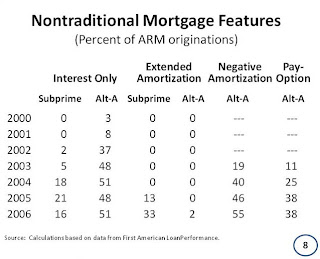 The availability of these alternative mortgage products proved to be quite important and, as many have recognized, is likely a key explanation of the housing bubble. Slide 8 shows the percentage of variable-rate mortgages originated with various exotic features, beginning in 2000. As you can see, the use of these nonstandard features increased rapidly from early in the decade through 2005 or 2006. Because such features are presumably not appropriate for many borrowers, Slide 8 is evidence of a protracted deterioration in mortgage underwriting standards, which was further exacerbated by practices such as the use of no-documentation loans. The picture that emerges is consistent with many accounts of the period: At some point, both lenders and borrowers became convinced that house prices would only go up. Borrowers chose, and were extended, mortgages that they could not be expected to service in the longer term. They were provided these loans on the expectation that accumulating home equity would soon allow refinancing into more sustainable mortgages.But it seems Bernanke left out a couple key points.
Bernanke used data from other countries to suggest monetary policy was not a huge contributor to the bubble ... however, Bernanke didn't discuss if non-traditional mortgage products contributed to housing bubbles in other countries. This would seem like a key missing part of the speech.
Bernanke didn't discuss how the current regulatory structure missed this "protracted deterioration in mortgage underwriting standards" (even though many people were pointing it out in real time). And Bernanke didn't discuss specifically how the new regulatory structure would catch this deterioration in standards. How about some specific example of how the previous regulatory structure missed underwriting problems, and how the new structure would have caught the problem? I'm more interested in what Dr. Bernanke didn't say.
Economist's View Bernanke Monetary Policy and the Housing Bubble
Ben Bernanke says Federal Reserve interest rate policy after the dot.com bubble burst did not cause the housing bubble, and he delivers a strong rebuttal to John Taylor on that point. He argues the problem was with the regulation of these markets, not the low interest rates after the dot.com crash, and based upon this reading of the causes of the crisis, he believes regulation is the key to preventing bubbles. But he also acknowledges that if regulation fails to get the job done, then the Fed must step in and pop bubbles before they get too large by raising interest rates (though doubts are expressed about whether increasing interest rates would have done much to stop the bubble, hence the strong preference for regulatory solutions).
This is a big step forward relative to the Greenspan years. Greenspan argued that the Fed could not identify bubbles as they are inflating with sufficient clarity to allow policy to do much about them, he thought the Fed was as likely to do harm from raising interest rates based upon false bubble alarms as it was to prevent problems. And in any case, he believed that cleaning up after bubbles popped would be enough to avoid large downturns like we are experiencing. The best that the Fed could do given the difficulty in identifying bubbles ex-ante is to clean up after they self-identify by popping, but that would be more than enough to keep the economy from experiencing big crashes.
Greenspan's view that cleaning up ex-post would be sufficient to insulate the economy from large shocks turned out to be incorrect. He also resisted and actively dismissed regulatory interventions intended to keep the financial sector stable and keep bubbles from inflating in the first place, and this, too, was a mistake. In the past, Bernanke and other members of the Fed have also been resistant to using interest rate policy (as opposed to regulation) to prevent bubbles, so this is an evolution in the Fed's view of its role in preventing asset price bubbles from threatening the stability of the broader economy.
The Fed still strongly prefers regulatory solutions, the main problem with interest solutions are that bubbles are hard to identify, and even if you do identify them, interest rate increases affect all industries, not just the one experiencing the bubble, so the policy inflicts collateral damage (though perhaps less collateral damage than if the bubble actually pops). In this regard, I wish Bernanke would have talked about how the Fed might find better measures of growing financial market imbalances, measures that would allow it to better identify bubbles a priori. We can use interest rate and regulatory policy to fight bubbles much better and target policy more precisely if we have more certainty about the existence of bubbles as they are inflating, but that will require the Fed to develop much better measures of financial market fragility than it now has. (This is an alternative to incorporating asset prices into the index the Fed targets through its implicit Taylor rule, something that automatically raises interest rates when asset prices increase substantially and something that I've advocated in the past. Incorporating asset prices into the inflation index the Fed stabilizes is a very broad-brushed approach to the problem of fighting bubbles, so more targeted approaches are preferable). I realize that we have models saying it isn't possible to identify bubbles as they are inflating, but models aren't reality - they aren't always correct - and we won't really know until we try:
Monetary Policy and the Housing Bubble, Ben S. Bernanke, Chair, FRB: The financial crisis that began in August 2007 has been the most severe of the post-World War II era and, very possibly--once one takes into account the global scope of the crisis, its broad effects on a range of markets and institutions, and the number of systemically critical financial institutions that failed or came close to failure--the worst in modern history. Although forceful responses by policymakers around the world avoided an utter collapse of the global financial system in the fall of 2008, the crisis was nevertheless sufficiently intense to spark a deep global recession from which we are only now beginning to recover.Even as we continue working to stabilize our financial system and reinvigorate our economy, it is essential that we learn the lessons of the crisis so that we can prevent it from happening again. Because the crisis was so complex, its lessons are many, and they are not always straightforward. Surely, both the private sector and financial regulators must improve their ability to monitor and control risk-taking. The crisis revealed not only weaknesses in regulators' oversight of financial institutions, but also, more fundamentally, important gaps in the architecture of financial regulation around the world. For our part, the Federal Reserve has been working hard to identify problems and to improve and strengthen our supervisory policies and practices, and we have advocated substantial legislative and regulatory reforms to address problems exposed by the crisis.As with regulatory policy, we must discern the lessons of the crisis for monetary policy. However, the nature of those lessons is controversial. Some observers have assigned monetary policy a central role in the crisis. Specifically, they claim that excessively easy monetary policy by the Federal Reserve in the first half of the decade helped cause a bubble in house prices in the United States, a bubble whose inevitable collapse proved a major source of the financial and economic stresses of the past two years. Proponents of this view typically argue for a substantially greater role for monetary policy in preventing and controlling bubbles in the prices of housing and other assets. In contrast, others have taken the position that policy was appropriate for the macroeconomic conditions that prevailed, and that it was neither a principal cause of the housing bubble nor the right tool for controlling the increase in house prices. Obviously, in light of the economic damage inflicted by the collapses of two asset price bubbles over the past decade, a great deal more than historical accuracy rides on the resolution of this debate.The goal of my remarks today is to shed some light on these questions. I will first review U.S. monetary policy in the aftermath of the 2001 recession and assess whether the policy was appropriate, given the state of the economy at that time and the information that was available to policymakers. I will then discuss some evidence on the sources of the U.S. housing bubble, including the role of monetary policy. Finally, I will draw some lessons for future monetary and regulatory policies.1
[Dec 24, 2009] Should Ben Bernanke Be Reconfirmed by Simon Johnson
December 24, 2009 | Baseline Scenario
Ben Bernanke's nomination to be reconfirmed as chairman of the Federal Reserve Board passed out of the Senate Banking Committee and will next be taken up by the full Senate.But, despite being named Time's Person of the Year for his efforts during the financial crisis, the Bernanke nomination has run into strong pushback – both in terms of tough questions from the committee and in the form of a "hold" on the nomination, placed by Senator Bernie Sanders of Vermont.
The conventional wisdom among economists is that political control over an independent central bank is regrettable and should be resisted. We like to think of the Federal Reserve as a bastion of technocracy, with monetary policy steering a course between recession and inflation just on the basis of "objective evidence" regarding the relative balance of risks (i.e., if monetary policy stays too loose for too long, we'll get inflation, but if interest rates are tightened prematurely, the economic recovery will stall.)
But the fact of the matter is that, in any well-functioning democracy, independence is earned based on credible and ultimately successful actions - not granted for all time and without conditions. The questions raised about Mr. Bernanke's performance in office and his likely future actions are almost entirely appropriate – and focus attention on a major weakness in the case for his reappointment.
The issue is what economists like to call "time inconsistency," but which everyone else just regards as common sense: If I swear up and down that I won't bail out your firm in a future crisis, will I really keep this promise when the crisis hits and the consequences of "no bailout" look absolutely awful? And if you know that, most likely, the bailout will be there irrespective of how you behave, for example because your firm is so big relative to the economy – why should you be more careful or take less risk?
Bernanke's problem is that he says he won't help big banks when they next get into trouble. But is this plausible?
To be fair, Bernanke does not refuse to talk about the problem that is widely known now as "Too Big To Fail" or the repeated boom-bust-bailout cycle that is increasingly referred to in official circles as the "doom loop." But, when asked what will break this loop, his answer is weak:
"A new regulatory structure should address this problem. In particular, a stronger financial regulatory structure would include: a consolidated supervisory framework for all financial institutions that may pose significant risk to the financial system; consideration in this framework of the risks that an entity may pose, either through its own actions or through interactions with other firms or markets, to the broader financial system; a systemic risk oversight council to identify, and coordinate responses to, emerging risks to financial stability; and a new special resolution process that would allow the government to wind down in an orderly way a failing systemically important nonbank financial institution (the disorderly failure of which would otherwise threaten the entire financial system), while also imposing losses on the firm's shareholders and creditors. The imposition of losses would reduce the costs to taxpayers should a failure occur."
In other words, "if big banks should fail in the future, we'll take them over and impose meaningful losses on creditors."
But this is simply not plausible – and don't take our word for it, look at the probability of default implied by the Credit Default Swap (CDS) spreads for Bank of America. The market view is that Bank of America, despite all its problems and a risky balance sheet, is only slightly more likely to default than is the United States government (which, despite recent rhetoric, is still one of the most reliable borrowers in the world). The market view for all other major US banks is essentially the same.
In other words, Mr. Bernanke's key audiences – in financial markets – do not find him credible on the central issue of the day, presumably because he is unwilling to condone measures that would ensure today's massive banks become "small enough to fail." If potential creditors do not fear losses, they will provide funds on easy terms to our big banks and we will re-run some version of our previous bubble. This is how our financial system works.
The Senate will decide soon, but Mr. Bernanke has made his case and the market has already voted.
Given his testimony, his written response to Senators' questions, and the market reaction, we recommend that Mr. Bernanke not be reconfirmed.
By Peter Boone and Simon Johnson
A slightly edited version of this material appeared on NYT.com's Economix this morning; it is used here with permission. If you would like to reproduce the entire post, please contact the New York Times.
Posted in Commentary
." Whence the Deficit?Salespeople and Programmers ".31 Responses
Subscribe to comments with RSS.Uncle Billy Cunctator
Simple answer: it doesn't matter.
Further reading, pgs 5-13, here:
http://ia341238.us.archive.org/0/items/TragedyAndHope/TH.pdf
monday1929
Why doesn't Congress simply ask Ben what he is doing about JPM's 80 Trillion in notional derivatives?
Steve
As I asked the people at Core Economics when they gave their reasons for replacing Mr. Bernanke, whom would you like to see in his place?
RueTheDay
"I would like to see it be someone who can tell me how the current crisis could have been avoided by early detection."
The answer is that it could not have been. The notion, that during a boom, somehow a regulator can detect when the economy has departed from sustainable growth and entered into bubble territory, and then somehow turn a few knobs to tighten the reigns and lead the economy back into the sustainable growth range, is patently absurd.
The ONLY answer is STRUCTURAL reform. Re-instate an updated version of Glass-Steagall to build a firewall between banks proper and everything else. Place explicit size restrictions on financial institutions, either directly by force of law or indirectly through steeply increasing capital regulations tied to size. Change compensation practices to tie compensation to long term performance. Finally, as Bernanke notes, create a permanent resolution mechanism for large financial firms that do fail. But dispense with the nonsensical idea that regulators can somehow see it coming, and through better discretionary action, can prevent it.
SDProg
It is unlikely, but not all that absurd. It would certainly take a brave Fed Chairman, but Greenspan probably could have prevented or at least curtailed the crisis if he had listened to some of those who directly warned him. Over the long term, yes, structural reform is the answer, but there were economists and financial analysts who did spot the bubble and they likely would have done a better job than Bernanke.
Beth
Here is the roll call vote out of the Committee:
Democrats:
Christopher J. Dodd Chairman (D-CT) Aye
Tim Johnson (D-SD) Aye
Jack Reed (D-RI) Aye
Charles E. Schumer (D-NY) Aye
Evan Bayh (D-IN) Aye
Robert Menendez (D-NJ) Aye
Daniel K. Akaka (D-HI) Aye
Sherrod Brown (D-OH) Aye
Jon Tester (D-MT) Aye
Herb Kohl (D-WI) Aye
Mark Warner (D-VA) Aye
Jeff Merkley (D-OR) No
Michael Bennet (D-CO) AyeRepublicans:
Richard C. Shelby Ranking Member (R-AL) No
Robert F. Bennett (R-UT) No
Jim Bunning (R-KY) No
Mike Crapo (R-ID) No
Bob Corker (R-TN) Aye
Jim DeMint (R-SC) No
David Vitter (R-LA) No
Mike Johanns (R-NE) Aye
Kay Bailey Hutchison (R-TX) No
Judd Gregg (R-NH) AyeI don't believe Mr. Bernanke is totally oblivious to the issues you have raised in your various writings but it seems as though his preference is to error on the side of caution and conservative management. Mr. Bernanke's continued argument for the Fed's independence (from Congressional oversight) really means-–less transparency and accountability.
What about auditing the Reserve as often suggested by Ron Paul? If President Obama, as well, would only apply some of the wisdom you (guys) have dispensed in numerous economic writings and media appearances…and (sorry to ask) but Simon, is that only yellow neck tie there is….?
Mark G.
"Mr. Bernanke, an academic who has never worked a single day in his life. He will take anything off a cliff: a business, a McDonald's stand, the Federal Reserve. And I have to say I have a certain sympathy for him as a character. He's ok, but completely useless. I would not even hire him as my butler…Mr Bernanke is a madman, a destroyer of the value of money. And he is a wealth destroyer and an economic criminal. It is the duty of a central bank to keep the value of money. I believe today for ninety percent of Americans life is harder than it was in 1999. Basically I think they are a bunch of crooks."
Marc Faber on King World News
DCB
I barely know where to begin with this one, but I will tell you that in the next election cycle my entire focus will be About getting out every single person who voted for this traitor. I know the words are harsh, but I only state the truth by analysis.
Strangely, the republicans are working against the man but I'm sure it's theater because industry wants him in there.
Of course the markets have voted. What a surprise. I'd vote for someone who gave me everything and anythig I wanted, who didn't distrupt the puch bowl, etc. In fact I'd argue that the markets are much better served by a Fed that doesn't telegraph what it does. That way the risk of sudden tail events should be priced in.
I want an independent Fed, the problem is that the Fed isn't independent enough. Everyone screams about political influence, but the overwhelming amount of industry influence is what has destroyed the institution. It no longer functions.
Hello, don't people realize they are poorer than 25 years ago and more in debt. While the super wealthy are the only folks whose wages keep up with inflation. That this effect is a direct outgrowth of our credit driven society where real people get paid based on ROA and the wealthy get paid based on ROE (meaning the wealthy make get paid based on the effects of leverage, real people don't). That the overleveraging of society is a dorect resulf of Fed policy and that it is unstable. You can't have credit growth beyond gdp growth and maintain stability. Real incomes then can't support the growth of credit. Even worse is the Fed has allowed those who make bad credit decisions to off load the risk to sociery (securitization)while they keep the bonus money. Not to see it can only be a policy of deliberate ignorance. Only a traitor would have allowed something so clearly destblizing to happen. These people have great minds and a high schooler could figure this one out it's so simple
As I go though the crisis the past 10 years the only thing that keeps going through my brain is 1984. Meaning that the state/media/oligarchy creates a truth narative that has no basis in reality to maintain control. From Bush WMD in Iraq, to the venertion of Bernanke (the man who has done more damage to this country that Osama). I see the media reporting something from officials that have no basis in reality like it is news because an official person says it. Honestly I see very little difference between what is going on and what the old soviet union did.
I feel like I'm in North Korea and the media keeps telling me the dear leader is god and we live in a workers paradise yet people are starving of hunger. Strangely many believe it. Is something being put in the water.
Just like in 1984 where the TV had devices to watch the populace the government is monitoring internet content and social networking sites. Peaceful protestors get gassed sitting in a park during the G20. The right wing screams crazy stuff that gets many people to vote agains their own economic interests, and the left wing is happy to water down any reform and keep the oney flowing. At the same time they can claim victory agains the "hardliners" when they have given corporate interests eveyrthing they could ask for. It has become a scripted theater that keeps happening over and over again. HELP I AM IN THE TWILIGHT ZONE
Econ
Brilliant -- We are in the twilight of democracy. Just as Glen Grunwald's blog of today on U.S. torture as described by NY Times and other media. This is truly 1984.
Michael M Thomas
Bernanke needs to have looked away from his charts and graphs and read more history: to wit, I was looking up something in Chernow's big book on Morgan and found on pp.354-55 this great exchange in the summer of 1932 (before the election) between Leffingwell of Morgan and FDR:
"…You and I know," (wrote Leffingwell,) "that we cannot we cannot cure the present deflation and depression by punishing the villains, real or imaginary, of the first post war decade, and that when it comes down to the day of reckoning nobody gets very far with all this prohibition and regulation stuff." To which FDR replied: "I wish we could get from the bankers themselves an admission that in the 1927 to 1929 period there were grave abuses and that the bankers themselves now support wholeheartedly methods to prevent recurrence there of. Can't bankers see their own advantage in such a course?" And then Leffingwell again: "The bankers were not in fact responsible for 1927-29 and the politicians were. Why then should the bankers make a false confession?"
John
So the obvious problem is that the special interests of the finance industry captured the regulator, The Fed. To some degree, it does not matter who the chairperson is.
What is more important is regulatory reform and transparency. The regulatory reforms that Elizabeth Warren, Sheila Bair, Paul Volcker, BaselineSenario.com, and others have proposed is correct and would be in society's best interest. Transparency is extremely necessary as Johnson stated, "independence is earned based on credible and ultimately successful actions." Auditing the FED is not a fringe movement. True Ron Paul brought fourth this regulation, but it has turned into a well-supported bi-partisan bill. The Fed has acted questionable at best and has a ballooning balance sheet of $2 trillion + it is entirely appropriate to audit them.
Still a great post by Johnson, Ben Bernanke's reconfirmation should not be a forgone conclusion. In a well functioning democracy, there should be an open debate on Bernanke's reconfirmation. True Bernanke got us out of the crisis without another great depression, but he is also one of the policy makers who got us into the crisis.
Should we put the gambling regulators in charge of our economy? With Dean Baker ~ http://www.youtube.com/watch?v=-XgV5lam-Bw
Seasons Greetings!
Patrice Ayme
The very notion that money creation should be "independent" of democracy is far fetched.
Demo-cracy is People-rule. Now, for millennia, the State has ruled over the money used in the State. But now money creation is "independent" of the State, it is not ruled by the State anymore? So, what, or whom, is ruling money creation? If People is not ruling, who is? Money? Is it then Money-rule? That is, is it Pluto-cracy?
The Demos has to regain the rule of money. Money creation has to be ruled by the People again. Time to get going. auditing the central banks ought to be a good start.
lambert stretherThe Fed is "political" now, and has been since its inception. It's only a question of on whose behalf.
Tom Hickey
Reasons for not confirming Bernanke:
1. Presided over the crisis and not only missed the causal buildup but dismissed it when warned.
2. Doesn't understand how the monetary system works. Thinks that banks lend reserves. They do not. Thinks there is a money multiplier. There is not.
3. Botched the rescue and did nothing to tie bailout funds to reform. The oligarchs have emerged more powerful than ever.
4. Remains under the illusion of inflation expectations theory while disregarding unemployment as a relevant parameter.
Ergo, Ben Bernanke is not fit to be Fed chair.
Lavrenti Beria
Marshall Auerbach summarizes:
http://neweconomicperspectives.blogspot.com/2009/12/why-bernanke-must-go.html
Hugh MD
Thank you Simon for another of your reasoned persuasive posts and thanks to some good comments esp DCB who hit the center of the nail. And if any of you missed Geithner's interview on NPR, go to the site for the transcript. Shockingly clueless would be my polite and conservative assessment.
JerryJ
Tom Hickey summarizes the essentials against the system. BB could hardly argue the facts about Reserves, particularly the enormous demand deposits of the banks held by the Federal Reserve Banks where virtually none in comparison existed before September 2008.
Under the circumstances of a crisis, a panic, what else might BB have done to stop the panic except prevaricate? What happened was by nature a total surprise . What really set off the panic? I mean what was the specific causal event?
I have my own suspicions about some stupid reactions to Bush foreign policy moves in the two months or so preceding September 2008. A move or moves that backfired beyond possibilities considered. What caused the bank runs immediately before the Lehman bankruptcy? There was an initiating event that snowballed after a couple years of great uncertainties.
Then, why on Earth would Ben Bernanke even want to continue to be Fed chairman? Is he being altruistic? Getting on with Hank Paulson must have been vexing in the extreme. Getting on with President Obama and Rahm Emanuel in particular must also be quite vexing. Why would he need the grief? This is a nation long in political crisis with a Congress that simply has and deserves little respect. Congress wants to run things , so let them.
BB made his Bones long ago and could easily settle in at his university again. In government he answers to a moribund governmental state system with a broken commonwealth of factions. So broken in fact that differences are irreconcilable.
I doubt any Fed Chairman will ever be effective again. Perhaps , this is Ben Bernanke's greatest blindness?
Viking
BB was appointed by a republican and confirmed by a republican congress. He frequently speaks in coherent sentences and does not pander to Congress like the last guy.
Everyone in the lynch mob was hiding under the bed praying to Jesus when the banks ground to a halt. Not one of them provided a solution or a press release suggesting they had a solution. The lynch mob is pandering to the Tea Party crowd so they can provide a convenient villain and re-direct the attention from their own crooked deals.
As to the destruction of the US wealth and US currency, that was going on long before BB got in. He just got left holding the burning bag of dog pooh on the front porch.
Bottom line: Saudia Arabia takes US dollars for a barrel of oil and they take less than they did 18 months ago. China loves our currency so much they refuse to devalue it by floating their exchange rate. He ain't perfect but the banks are still open 6 days a week unlike 1932.
Observer
Is Mr. Bernanke helping Mr. Blankfein to do God's work?
Interesting article in the NYTimes.
http://www.nytimes.com/2009/12/24/business/24trading.html?_r=1&hp
"But Goldman and other firms eventually used the C.D.O.'s to place unusually large negative bets that were not mainly for hedging purposes, and investors and industry experts say that put the firms at odds with their own clients' interests."
"The simultaneous selling of securities to customers and shorting them because they believed they were going to default is the most cynical use of credit information that I have ever seen," said Sylvain R. Raynes, an expert in structured finance at R & R Consulting in New York. "When you buy protection against an event that you have a hand in causing, you are buying fire insurance on someone else's house and then committing arson."
Uncle Billy Cunctator
Once again we are reminded of Jamie Dimon's smirking comment that you get a much better deal when the house is on fire.
JKH
Why on earth would you conclude from current CDS spreads that the market believes Bernanke won't institute a revised resolution process for the future? That's completely illogical. Obviously, the future resolution process will apply to next cycle; not this one. He's already made it clear nobody big is going down in this cycle, precisely because no feasible resolution process is currently in place
PatR
The essential point made here by Simon Johnson and Peter Boone is that Mr Bernanke has not broken the US TBTF model for banking.
This is an important point, and perhaps enough to disqualify a person from leading the US's monetary policy for another 4 years.
Even more disturbing to me is Mr Bernanke's behavior prior to the crisis. He was repeatedly shown evidence of a bubble, and waved it all off with flippant or vapid comments, as in the colloquy with Dekaser of National City in 2005. "They have been saying that about California since I bought my first house in 1979." In his personal life, he purchased a very expensive home with a very low 10% downpayment, using an ARM. This is not a criminal act, or negligence or anything, but it is yet more evidence that Mr Bernanke had no idea that house prices were in a debt-induced bubble. A man this unaware of basic economic and monetary trends and forces should be following, not leading.
Bayard
After watching the 60 Minutes piece on Bernanke a few months ago, I was enchanted and felt a great deal of faith in his capabilities AND his integrity. I actually still like him on a personal level. I, however, don't believe that he is the right man for the job on a continuing basis. It has partly to do with his natural fear of the potential consequences of making a hard choice to break up our financial oligarchs, the behemoths of our present economy. He is afraid that things could go very wrong, but at this point the risk is low relative to the future gains in economic stability. Interestingly, my favorite Senator, Bernie Sanders, has stepped in to put a hold on his nomination (http://sanders.senate.gov/newsroom/media/view/?id=14ca1a8c-752c-4f41-87bc-7900785ec9f5)
with the understanding that his continued engineering of the financial community truly threatens our long term national prosperity.Thus far, the messages, as indicated in your post, which BB has sent to the world at large and the financial community specifically can be read to mean that he will continue to support them as necessary ad infinitum. There seems to be little question, and, his obfuscation is related directly to the enactment of financial reform geared to taking him and the FED of the hook relating to the control of these TBTF institutions.
It is odd that the Republicans on the committee all voted to remove him, considering that he is a Republican appointee and that he supports their economic view.
[Dec 22, 2009] Fed's approach to regulation left banks exposed to crisis By Binyamin Appelbaum and David Cho
Dec 21, 2009 | washingtonpost.com
In January 2005, National City's chief economist had delivered a prescient warning to the Fed's board of governors: An increasingly overvalued housing market posed a threat to the broader economy, not to mention his own bank and others deeply involved in writing mortgages.
The message wasn't well received. One board member expressed particular skepticism -- Ben Bernanke.
"Where do you think it will be the worst?" Bernanke asked, according to people who attended the meeting, one in a series of sessions the Fed holds with economists.
"I would have to say California," said the economist, Richard Dekaser.
"They have been saying that about California since I bought my first house in 1979," Bernanke replied.
This time the warnings were correct, and the collapse of the California real estate market would bring down the nation's fourth-largest bank, the largest casualty of the financial crisis.
Dekaser and Bernanke declined to comment on the exchange.
[Dec 17, 2009] No change at the Fed, or is there? By Tim Iacono
December 16, 2009 | The Big Picture
This has got to be one of those "Bizarro World" days for Fed chief Ben Bernanke, what with the Time Magazine "Person of the Year" award, word of growing distrust among the general population, and, just in the last hour or so, a major twist in his Senate confirmation process where Senator Jeff Merkley (D-OR) said he will vote against Bernanke when the Senate Banking Committee meets tomorrow.
This latest news is significant because Merkley is the first Democrat on the committee to announce his opposition to Bernanke and, while it is all but certain that the group will forward his nomination to the full Senate for a vote in January, a lot can happen over the next month.
In a statement, Merkley's objections were squarely based on Bernanke's failure as a regulator, noting,
"For too many years, federal regulators turned a blind eye to signs of an impending financial crisis. Dr. Bernanke supported each of these decisions, failing to take the necessary precautionary steps that could have averted or mitigated financial collapse."
[Dec 17, 2009] Bernanke's Saving's Glut Hypothesis. Contradiction Number One.
EconoSpeak
In March 2005 the Governor of the Federal Reserve in the US, Ben Bernanke, gave a talk on the reasons for the emergence of a global savings glut during the period beginning from the mid 1990s.[1]He made specific note of the increasing value of the US dollar in the period from 1996 to early 2000. He ascribed this change to "The development and adoption of new technologies and rising productivity in the United States together with the country's long-standing advantages such as low political risk, strong property rights, and a good regulatory environment. These factors, he said, made the U.S. economy exceptionally attractive to international investors during that period.
"Consequently, capital flowed rapidly into the United States, helping to fuel large appreciations in stock prices and in the value of the dollar."However, economist Robert Brenner, draws attention to the G-3 economies' deliberate manipulations of global currency markets in 1995."With the so-called Reverse Plaza Accord of spring-summer 1995, the G-3 economies did a complete about face. By way of the Plaza Accord of 1985, the leading capitalist powers had agreed to drive up the mark and the yen to reverse the devastation of a US manufacturing sector ravaged by the high dollar. Ten years later, they did the opposite, agreeing to push down the mark and yen to revive German and Japanese manufacturing sectors that had been driven into crisis by the low dollar." [2]So the US dollar was set artificially lower (relative to the Yen and the German mark) in 1985 in order to aid the ailing US domestic manufacturers, according to Robert Brenner. US producers were suffering (with low global demand for their products) as a result of an equally artificial high value of the US dollar that prevailed in the years before 1985.[Some history: Between 1972 and 1981 the global price of oil increased nine-fold; fueling stagflation. In 1979 Paul Volker from the US Federal Reserve increased global interest rates in order to prop up a resultant ailing US dollar. That's also when the US-dominated World Bank moved to a commitment to global trade liberalization and abandoned its support for public enterprises.]
In summary, Bernanke's rationale for the strong US dollar from the years 1996 - 2000 doesn't appear to stand up to historical evidence. If the US benefited from such a profitable investment environment then why didn't that result in a boom in US manufacturing and a resolution of that nation's trade deficit in those years? The opposite, in fact, occurred.
===
[1] Remarks by Governor Ben S. Bernanke at the Sandridge Lecture, Virginia Association of Economics, Richmond, Virginia
Governor Bernanke presented similar remarks with updated data at the Homer Jones Lecture, St. Louis, Missouri, on April 14, 2005.
March 10, 2005
The Global Saving Glut and the U.S. Current Account Deficit
http://www.federalreserve.gov/boarddocs/speeches/2005/200503102/[2] STOCK MARKET KEYNESIANISM ….
WHAT IS GOOD FOR GOLDMAN SACHS IS GOOD FOR AMERICA - THE ORIGINS OF THE CURRENT CRISIS. Robert Brenner, Center for Social Theory and Comparative History, UCLA
18 April 2009
This text appears as the Prologue to the Spanish translation of the author's Economics of Global Turbulence (Verso, 2006) which was published by Akal in May 2009.Starving Economist:
I am not sure why you think the trade deficit would decrease if the U.S. enjoyed a good investment environment.
In fact, we should expect the opposite.
Suppose that the rest of the world suddenly realized in 1995 that the U.S. was a great place to invest in. In order to invest in U.S. businesses, foreign citizens would want to purchase U.S. stocks and bonds. To do that, they need dollars, so they purchase them on the foreign exchange market. This bids the dollar up relative to other currencies, which makes foreign goods less expensive to U.S. consumers.
As a result, we will see the current account move further into deficit (as U.S. imports increase) and the capital account moves further into surplus (as the rest of world purchases U.S. stocks and bonds instead of U.S. goods).
Bernanke's story fits all the facts your presented. If you really believe Bernanke is incorrect, you will have to do much much more to demonstrate your point.
[Dec 16, 2009] "Wake Up, Gentlemen"
The guiding myth underpinning the reconstruction of our dangerous banking system is: Financial innovation as-we-know-it is valuable and must be preserved. Anyone opposed to this approach is a populist, with or without a pitchfork.
Single-handedly, Paul Volcker has exploded this myth. Responding to a Wall Street insiders' Future of Finance "report", he was quoted in the WSJ yesterday as saying: "Wake up gentlemen. I can only say that your response is inadequate."
Volcker has three main points, with which we whole-heartedly agree:
and most important:
- "[Financial engineering] moves around the rents in the financial system, but not only this, as it seems to have vastly increased them."
- "I have found very little evidence that vast amounts of innovation in financial markets in recent years have had a visible effect on the productivity of the economy"
3. "I am probably going to win in the end".
Volcker wants tough constraints on banks and their activities, separating the payments system – which must be protected and therefore tightly regulated – from other "extraneous" functions, which includes trading and managing money.
This is entirely reasonable – although we can surely argue about details, including whethreduced, yesterday, to asking the banks nicely to lend more to small business – against which Jamie Dimon will presumably respond that such firms either (a) are not creditworthy (so give us a subsidy if you want such loans) or (b) don't want to borrow (so give them a subsidy). (Some of the bankers, it seems, didn't even try hard to attend – they just called it in.)
The reason for Volcker's confidence in his victory is simple - he is moving the consensus. It's not radicals against reasonable bankers. It's the dean of American banking, with a bigger and better reputation than any other economic policymaker alive – and with a lot of people at his back – saying, very simply: Enough.
He says it plainly, he increasingly says it publicly, and he now says it often. He waited, on the sidelines, for his moment. And this is it.
Paul Volcker wants to stop the financial system before it blows up again. And when he persuades you – and people like you – he will win. You can help – tell everyone you know to read what Paul Volcker is saying and to pass it on.
By Simon Johnson
[Dec 16, 2009] Bernanke Named Time's 'Person of the Year'
George W. Bush made it twice… Was not George Bush an economic suicide bomber ?
The Big Pictureseneca:
wally:Note that the 1938 Time's then "Man of the Year" was, you'll pardon the expression, Adolf Hitler. Time's "Person of the Year" isn't an honorific. It's the person who most influenced events that year, for good or ill. Bernake certainly fills the bill, although Bernie Madoff I'm sure gave him a run for the money, so to speak.
I guess you could argue that he was the most prominent figure in government this year. The FED has arguably become the fourth branch of government (if that is allowed to stand) and the one that most clearly represents money rather than people or territory.flipspiceland:
... Who else do we recall was feted as a magnificando financial guru? I believe it was Greenspan, he of the low interest rate mentality that he and Rubin 'thought' was such a fabulous idea. (Greensan has since made some kind of puny apoogy for being an idiot).Person of Year? Maybe. We should have some idea if he deserves that award some time down the road.
Meanwhile, those who know what he did in giving his friends and neighbors and Goldman Sucks a temporary window to rip off even more money from the people will await the final tally.
Giving him an award for what is essentially a game that is only partially played is more a ploy by well-connected partisans, a CNBC babal, of positive thinkers that attended one too many Anthony Robbins lectures.
km4
Nassim Taleb: Not at all. Central bankers have no clue. In the first place, the financial crisis was not a black swan. It was perfectly predictable. They ignored the phenomenal buildup in leverage since 1980. We still have too much debt, too many big banks, too much state sponsorship of risk-taking. And now we have six million more Americans who are unemployed – a lot more than that if you count hidden unemployment. Ben Bernanke saved nothing. He shouldn't be allowed in Washington. He's like a doctor who misses the metastatic tumour and says the patient is doing very well.
[Dec 15, 2009] Final Thoughts on the Bernanke Nomination and AIG By Chris Whalen
December 14, 2009
We posted a new item today that contains our final thoughts on the nomination of Ben Bernanke for another terms as Fed governor. We also feature an interview with Mike Krimminger of the FDIC on that agency's impending draft rule regarding bank securitizations. The text of the Fed rant is below and you can read the Krimminger interview on our web site: http://us1.institutionalriskanalytics.com/pub/IRAMain.asp
The Institutional Risk Analyst
Final Thoughts on the Bernanke Nomination and AIG
December 14, 2009Last week after we published his comment on auditing the Fed, our friend Martin Mayer reminded us of a couple of more reasons for the Senate to oppose the Bernanke confirmation. Top among them, according to Mayer, is Bernanke's appointment of Patrick Parkinson to be head of the Fed's division of supervision & regulation, a post Parkinson comes to by way of the central bank's division of research & statistics. Says Mayer:
"An even bigger reason to resist the reappointment of Bernanke is his appointment of Pat Parkinson to be the new head of supervision. Parkinson was Greenspan's guru on derivatives. Of course, the great benefit of customization of derivatives is the elimination of margin, which is safe enough as long as the Fed will contribute taxpayer money whenever anything goes wrong. The Fed does not protect customers, or the safety and soundness of the institutions, or the taxpayer. Nothing MUST be protected except permission for the institutions the Fed allegedly supervises to keep their freedom to avoid the standardization that might make possible the creation of an honest market from the ruins of what Parkinson defends."
Suffice to say that many of Parkison's views on OTC derivatives, which you may see for youself on the Fed's web site, are seemingly identical to the views of the lobbyists for the large OTC dealer banks. Perhaps we are missing something, but to us Parkinson seems to typify the term "regulatory capture" and specifically the tendency of the Fed's Washington staff to serve as advocates for the large NY dealer banks, rather than serving the broad public interest. For this reason alone, we think Bernanke deserves to go back to Princeton.
Of note, on Saturday the Wall Street Journal's Serena Ng and Carrick Mollenkamp published an important contribution to the bailout knowledge base, reporting how Goldman Sachs (GS) used OTC credit default swaps to cause the failure of American International Group (AIG). Entitled "Goldman Fueled AIG Gambles." the article confirms our long held view that AIG could not have come up with the trading strategies that caused its failure without a little help from GS and several other dealers. Customers just don't come up with stupid ideas like this on their own. And interesting that the Murdoch-owned WSJ published the revealing piece on a Saturday...
Phill Swagel contacted us last week and said that we were wrong in our characterization of how Fed personnel viewed his Brookings Institution paper, wherein he described the events at Treasury around the time of the AIG bailout. "I can assure you that folks at FRB are not mad about what I wrote. After all, my paper is 50+ pages of defending Fed and Treasury," says Swagel. True enough, but we stand by our comment.
We think Swagel is too modest. His paper suggests to us at least that Treasury repeatedly abdicated its responsibility to the financial system and the country as it sought to avoid or postpone difficult political battles with the Congress. Swagel concludes that the Treasury and authorities were always behind market developments and were "reactive." This admission of the Treasury being behind the curve is ironic when juxtaposed with Swagel's opening revelation that a year before the crisis in the Summer of 2006 Paulson told Treasury staff that it was time to prepare for a financial system challenge.
Did the former GS CEO Hank Paulson already perceive the political issues involving a rescue of a non-bank firm before the failure of Bear, Lehman and AIG? Swagel notes in his paper the narrow role the Paulson Treasury envisioned for itself prior to Bear:
"Treasury had urged institutions to raise capital to provide a buffer against possible losses, but had not contemplated fiscal actions aimed directly at the financial sector. Instead, the main policy levers were seen as being the purview of the Fed, which had cut rates and developed new lending facilities in the face of events."
We think all observers of the crumbling US financial system owe Phill Swagel a debt of gratitude for describing the events which occurred during his tenure at the Treasury. Too much of the history of Washington is unwritten, just as agencies like the Fed do not seem to be able to follow the law even when it is written down for them. We think every member of the Senate should read Phill Swagel's paper before voting on the Bernanke nomination.
To us, the Swagel paper illustrates just how badly the Fed mishandled its legal responsibilities during the crisis, a key oversight issue for Congress. The bone of contention we have with Chairman Bernanke, former FRBNY President Tim Geithner, members of the FRBNY board and the Board of Governors in Washington, is governance. When the markets started to come undone in 2008, officials at the Fed did not know their place, legally or politically, and the central bank as well as American democracy suffered as a result. Like we said last week, so much for central bank independence.
Using Bernanke's own version of events, when the decision was made by Treasury Secretary Paulson to rescue AIG (and his former colleagues and clients at Goldman Sachs and other large bank derivatives dealers), Bernanke and Geithner should have expressed their support – but then only to offer to lend Treasury the cash to accomplish the AIG rescue by the Treasury. Of note, we are working with several media organizations to get a hold of the minutes of the Federal Financing Bank (FFB) for this period. The FFB is the Treasury's vehicle in all fiscal operations involving private counterparties.
From the perspective of Fed independence, the first failure of Bernanke, Geithner et al in dealing with Treasury Secretary Paulson was not forcing the Secretary to take political responsibility for the bailouts of AIG and even Bear, Stearns. As Martin Mayer reminded us last week, the Fed is subservient to the Congress, not the Executive Branch. The Chairman of the Fed is not supposed to be a "team player," in the parlance of the political economists who populate the Obama Administration. Saying no to the White House is what central bank independence is really about.
The proper thing for the Fed to have done in the circumstances was to offer financial support to the Treasury to rescue AIG, even without Paulson seeking enabling legislation by the Congress, but force Paulson and President George Bush to take political responsibility for this extraordinary fiscal operation. The Fed, by stepping in front of the Treasury, committed an act of political intervention as well as intervening in the financial markets. Bernanke neatly allowed President Bush and Secretary Paulson to escape political responsibility for the AIG takeover - and left the problem for President Obama. Senate Democrats should think about that when they vote on Bernanke.
Since the rescue of AIG, the Fed under Bernanke has compounded the problem, using the central bank's balance sheet to absorb $2 trillion in MBS, Treasuries and other toxic detritus that Wall Street cannot finance. Bernake even suggested last week that the Fed does not intend to sell its hoard, meaning that he is now using Open Market operations to directly subsidize the banks and the public markets generally. Who cares about executive bonuses when such sums of money are involved in direct corporate subsidies? As we noted in the IRA Advisory Service last week:
"First, zero interest rate policy and Fed purchases of all sorts of collateral have essentially taken the risk and duration out of the fixed income markets, forcing investors into equities of all stripes. Not only have Fed purchases so far of $1.8 trillion in Treasury, agency and MBS obligations taken duration out of the markets, according to several colleagues in the Herbert Gold Society, but by not sterilizing this duration in the options markets (as the GSEs do routinely with their purchases of collateral and MBS), the central bank has greatly reduced visible market volatility."
Marcus Aurelius:
". . . he is now using Open Market operations to directly subsidize the banks and the public markets generally."
______________The Fed has taken over the economy, and with it, the Federal Government. Congress no longer controls the purse strings. Does anyone need more proof than this?
Marc P:
Quote from the article: "Parkinson seems to typify the term "regulatory capture" and specifically the tendency of the Fed's Washington staff to serve as advocates for the large NY dealer banks, rather than serving the broad public interest."
Wait…who owns the Fed? Why is it shocking that a private company would serve its shareholders?
The journalism community should create an informal rule that all articles about the Fed should point out that the Fed is a private company owned and wholly controlled by its bank shareholders.
PatR:
Saying that the Fed legally answers to Congress, not the Administration, and should act accordingly, completely misses the mark. Congress pursues populist monetary policies. That means maximum monetary expansion, until the consequences are too dire to continue. Hardly a prescription for good stewardship of our money supply.
Also, complaining about what was done in the depths of the crisis because of who will take the most political blame for what goes wrong betrays an inside baseball view. Those who see the management of our economy mostly as an opportunity to score political points have already had too much influence.
Should the govt have rescued AIG? If you think it should, then the Fed got the big decision right, and whether the Fed should have executed the rescue directly or indirectly is of secondary importance. If you think it shouldn't have rescued AIG, then the Fed committed a grave error of judgment. But base your criticism on the poor judgment that led to that very important decision to bailing AIG, not on the (perhaps) poor judgment that led to the less important decision on how exactly the bailout was going to be executed.
Moss:
"Nothing MUST be protected except permission for the institutions the Fed allegedly supervises to keep their freedom to avoid the standardization that might make possible the creation of an honest market from the ruins of what Parkinson defends."
Pretty much sums it up. Unfortunately this statement can be applied to numerous entities that allegedly 'supervise'.
[Dec 12, 2009] Economist's View Paul Krugman Bernanke's Unfinished Mission
bakho:There are some policies that come in between monetary and fiscal policy, It matters HOW money is loaned, who and how much rent is collected.
Ways to stimulate the economy by taking more money out of the hands of the wealthy bankers and into the hands of those who spend every dime.
1. Take the banksters out of the student loan business. Set up a program to loan direct to students at lower interest rates and government quits paying the subsidy to the loan sharks.
2. More money for direct SBA loans. The banksters are not lending anyway, so let the government make the higher risk loans necessary to float small business in the short run. These loans can be unwound at a future date by selling bonds.
3. Mortgage cram downs. Put more money into FreddieFannie for houses purchased at non-bubble prices. Replace mortgages at unaffordable interest rates with lower rates of interest. Pay for part of the program by making some or all of the interest non-tax deductible.
4. If the Feds cannot "give" money to the states, create a fund to purchase state bonds to be paid back from future state revenue. Have the Federal government cover a greater percentage of Medicaid and unemployment compensation.
5. Set up an office to loan money to high tech startups. The loans could be paid back in the future once the startups make money. This is the same way college student loans are supposed to work.
Just dumping a lot more cash onto an already dysfunctional system is a bad idea and will not do anything for employment. Unless and until the unemployment rate drops substantially, the economy will continue to be at risk.
kharris said in reply to bakho...
bakho,
Not to disagree, but just to think through the likely consequences and objections...
If banks aren't lending, then directing government lending programs around them would improve the chances of getting credit where we want to do, without hurting current bank operations. However, to the extent that the outlook for bank profitability affects current equity values and bank balance sheets, the health of banks is hurt to the extent that directing federal lending operations outside the banking system hurts banks' prospects.
Much of the government's short-term effort has been aimed at preventing further trouble for banks and then getting them on a path to health. A policy which is likely to hurt banks current stance has little chance of adoption. What that means is that, in the face of an obvious need to subordinate finance to the rest of the economy in the medium and long term, we are instead dealing only with the scary prospect that harming banks in the short term could also harm the economy. The logic of this choice can become really costly in very short order. The notion that we should make the most of a crisis has been spouted from the beginning, but it is a notion that is well on its way to being ignored in practice. We ought to be imposing a very large cost on the finance sector for all the assistance it has received. Instead, it looks like we are on our way to window dress regulation, and little more.
PCLE:
Isn't it time for the government to act as employer of last resort ? There have been some proposals for a job guarantee scheme for example by Minsky and Randall Wray. We need something along the lines of the works schemes of the Great Depression. Minsky felt it was immoral to pay people to do nothing...far better to get them working again. Money is not an issue here. The US is a sovereign issuer of its own currency and can never run out of funds. There is certainly not a problem of inflation in an economy with such a massive surplus of labor.
julio said in reply to Lafayette...
Lafayette,
The wikipedia article also says this:
"Some European countries have abandoned this kind of tax in the recent years: Austria, Denmark, Germany (1997), Sweden (2007), and Spain (2008). On January 2006, wealth tax was abolished in Finland, Iceland and Luxembourg."
Do you know why?
As for a referendum on for a wealth tax, the closest I've seen is California voting just the opposite with Prop. 13.
You may be right that by now, having seen the effects, people would vote differently; but no one thinks there is enough support for a repeal of 13.
It may be a case of Mencken's dictum, "No one ever went broke underestimating the intelligence of the American public", especially when it comes to politics.
anne:
http://krugman.blogs.nytimes.com/2008/11/28/was-the-great-depression-a-monetary-phenomenon/November 28, 2008
Was the Great Depression a Monetary Phenomenon?
By Paul Krugman[Depression chart] Sins of omission?
Has anyone else noticed that the current crisis sheds light on one of the great controversies of economic history?
A central theme of Keynes's "General Theory" was the impotence of monetary policy in depression-type conditions. But Milton Friedman and Anna Schwartz, in their magisterial monetary history of the United States, * claimed that the Fed could have prevented the Great Depression - a claim that in later, popular writings, including those of Friedman himself, was transmuted into the claim that the Fed caused the Depression.
Now, what the Fed really controlled was the monetary base - currency plus bank reserves. As the figure shows, the base actually rose during the great slump, which is why it's hard to make the case that the Fed caused the Depression. But arguably the Depression could have been prevented if the Fed had done more - if it had expanded the monetary base faster and done more to rescue banks in trouble.
So here we are, facing a new crisis reminiscent of the 1930s. And this time the Fed has been spectacularly aggressive about expanding the monetary base:
[Contemporary chart] Ben goes for broke.
And guess what - it doesn't seem to be working.
I think the thesis of the "Monetary History" has just taken a hit.
* 1963
A Monetary History of the United States, 1867-1960
By Milton Friedman and Anna J. SchwartzMark A. Sadowski said in reply to anne...
The Fed's hands were largely tied by Eichengreen's "golden fetters" during the Great Depression. It's not really a surprise that the economy started to recover almost to the day that FDR started to debase the dollar. I'd have to go research this but I believe that even Friedman acknowledged this at some point.
The huge current expansion of the monetary base is very deceptive for the following reason: the Fed has been paying interest on reserves since October 6th 2008. This is a deflationary policy that for some mystery no one seems to be talking about.
Monetary policy has not been exhausted. The Fed is just strangely passive.
paine said in reply to Mark A. Sadowski...
"This is a deflationary policy that for some mystery no one seems to be talking about"
it indeed would be if the free reserves would otherwise be loaned out. i doubt even much would at the margin
i see tis as just more money to rebalance the bank books
Mark A. Sadowski said in reply to paine...
"i see tis as just more money to rebalance the bank books"
I agree but whereas the fed apparently thinks what is good for Citi is good for America I actually happen to think that what is good for America is good for America. But what do I know.
kharris said in reply to anne...
The Friedman/Schwartz view that stabilizing growth in monetary aggregates will stabilize growth in economic activity relies on stable monetary velocity. Friedman, after seeing velocity destabilize over a significant period, recognized that his view was not workable. If Friedman can see that, when others in his position (Mundell?) might just defend their early work till the end, perhaps Friedman's followers need to get a clue.
Euton said...
We need to start with the understanding that things are they way they are for a reason. Bernanke/Geithner(Summers) are just relief pitchers for the starting team of Greenspan/Rubin. These Wall Street tools have had their way for a couple of decades now. We now see the results of their "brilliance".
I'm not impressed, but I can understand why economists are.
RW said...
Indirectly Krugman limns what I have considered a core problem since Nixon and Burns: A poisoned political environment that prevents rational fiscal decisions forces monetary technocrats to compensate and eventually overreach.
Analyzed on that level, Greenspan's low interest-rate policy was an entirely rational response to funding the programs of a series of government regimes* who refused to support their policies with taxes.
If you have to borrow then keep costs low; this has the added benefit of distracting elites with bright, shiny bubbles.
*That many members of these regimes continue to act and talk as if increased public debt were 'a bad thing' rather than an inevitable outcome of their own philosophy, such as it is, suggests at least one of the toxins involved in poisoning national politics may have had hallucinogenic properties.
Reno Dino said...
They are forcing the young into the military. Part of the plan needed to drive the war machine.
psychohistorian said...
The economic cabal in power has no intention of creating more jobs in the US. They are aiming us for a shock doctrine moment when they will kill all entitlements to keep our war machine going.
Lafayette said in reply to psychohistorian...
If voters ever get wind of what's going on, "they" will stand this tidy little world of plutocrats on its end.
Regrettably, by dumbing down Americans with meaningless platitudes, that National Epiphany will not occur in my lifetime.
Terry said...
The fact that the Fed has not yet BEGUN to address employment per Krugman above is sufficient condemnation of Ben Bernanke that he should not be reconfirmed by the US Senate.
I'm ready to bring back Paul Volcker in a heartbeat, if he'd have the job.
kharris said in reply to Terry...
Monetary policy is asymmetrical because of the zero bound. Volcker knew that he could kill inflation with higher rates, because there was no upper bound. I don't know that he would be more effective than Bernanke, facing the same limit on the effectiveness of policy. Bernanke's inclination to leave monetary accommodation in place for a long time is just about the best we can hope for from any central banker in this situation. That is more or less Krugman's point. Fed officials would be fools to admit it, but they are out of ammo.
[Dec 11, 2009] Three Strikes on Ben Bernanke: AIG, Goldman Sachs & BAC/TARP
December 7, 2009 | Institutional Risk Analytics
Coming together with the friends of Mark Pittman ended a grim week. Many of us in the financial community were wading hip-deep through barnyard debris as we watched Federal Reserve Chairman Bernanke dodge and weave in front of the television cameras during his Senate confirmation hearing. We have to believe that Mark would have been pleased as Senators on both sides of the aisle asked questions that came directly from some of his reporting -- and a few of our own suggestions.
To us, the confirmation hearings last week before the Senate Banking Committee only reaffirm in our minds that Benjamin Shalom Bernanke does not deserve a second term as Chairman of the Board of Governors of the Federal Reserve System. Including our comments on Bank of America (BAC) featured by Alan Abelson this week in Barron's, we have three reasons for this view:
First is the law. The bailout of American International Group (AIG) was clearly a violation of the Federal Reserve Act, both in terms of the "loans" made to the insolvent insurer and the hideous process whereby the loans were approved, after the fact, by Chairman Bernanke and the Fed Board. The loans were not adequately collateralized. This is publicly evidenced by the fact that the Fed of New York (FRBNY) exchanged debt claims on AIG itself for equity stakes in two insolvent insurance underwriting units. What more need be said?
As we've noted in The IRA previously, we think the AIG insurance operations are more problematic than the infamous financial products unit where the credit default swaps pyramid scheme resided. And we doubt that any diligence was performed by Geither and/or the FRBNY staff on AIG prior to the decision taken by Tim Geithner to make the loan. We'll be talking further about AIG in a future comment.
Of interest, members of the Senate Banking Committee who want more background on the AIG fiasco, particularly who did what and when, need to read the paper by Phillip Swagel, "The Financial Crisis: An Inside View," Brookings Papers on Economic Activity, Spring 2009, The Brookings Institution.
We hear in the channel that Fed officials were furious when Swagel, who served at the US Treasury with former Secretary Hank Paulson, published his all-to-detailed apology. We understand that several prominent members of the trial bar also are interested in the Swagel document.Last week the Senate Banking Committee spent a lot of time talking with Chairman Bernanke about why payouts were made to AIG counterparties like Goldman Sachs (GS) and Deutsche Bank (DB), but the real issue is why Tim Geithner and the GS-controlled board of directors of the FRBNY were permitted to make the supposed "loans" to AIG in the first place. The primary legal duty of the Fed Board is to supervise the activities of the Reserve Banks. In this case, Chairman Bernanke and the rest of the Board seemingly got rolled by Tim Geithner and GS, to the detriment of the Fed's reputation, the financial interests of all taxpayers and due process of law.
Martin Mayer reminded us last week that the Fed is meant to be "independent" from the White House, not the Congress from which its legal authority comes by way of the Constitution. Nor does Fed independence mean that the officers of the Federal Reserve Banks or the Board are allowed to make laws. None of the officials of the Fed are officers of the United States. No Fed official has any power to make commitments on behalf of the Treasury, unless and except when directed by the Secretary. Given the losses to the Treasury due to the Fed's own losses, this is an important point that members of the Senate need to investigate further.
The FRBNY not only used but abused the Fed's power's under Section 13(3) of the Federal Reserve Act. In AIG, the FRBNY under Tim Geithner invoked the "unusual and exigent" clause again and again, but there is a serious legal question whether the then-FRBNY President and the FRBNY's board had the right to commit trillions without any due diligence process or deliberate, prior approval of the Fed Board in Washington, as required by law. The financial commitments to GS and other dealers regarding AIG were made always on a weekend with Geithner "negotiating" alone in New York, while Chairman Bernanke, Vice Chairman Donald Kohn and the rest of the BOG were sitting in DC without any real financial understanding of the substance of the transactions or the relationships between the people involved in the negotiations.
Was Tim Geithner technically qualified or legally empowered to "make deals' without the prior consent of the Fed Board? We don't think so. Shouldn't there have been financial fairness opinions re: the transactions? Yes.
We understand that the first order of business in any Fed audit sought by members of the Senate opposed to Chairman Bernanke's re-appointment is to review the internal Fed legal memoranda and FRBNY board minutes supporting the AIG bailout. These documents, if they exist at all, should be provided to the Senate before a vote on the Bernanke nomination. Indeed, if the panel established to review the AIG bailout and related events investigates the issue of how and when certain commitments were made by the FRBNY, we wouldn't be surprised if they find that Geithner acted illegally and that Bernanke and the Fed Board were negligent in not stopping this looting of the national patrimony by Geithjner, acting as de facto agent for the largest dealer banks in New York and London.
The second strike against Chairman Bernanke is leadership. In an exchange with SBC Chairman Christopher Dodd (D-CT), Bernanke said that he could not force the counterparties of AIG to take a haircuts on their CDS positions because he had "no leverage." Again, this goes back to the issue of why the loan to AIG was made at all.
Having made the first error, Bernanke and other Fed officials seek to use it as justification for further acts of idiocy. Chairman Dodd look incredulous and replied "you are the Chairman of the Federal Reserve," to which Bernanke replied that he did not want to abuse his "supervisory powers." Dodd replied "apparently not" in seeming disgust.We have been privileged to know Fed chairmen going back to Arthur Burns. Regardless of their politics or views on economic policies, Fed Chairmen like Burns, Paul Volcker and even Alan Greenspan all knew that the Fed's power is as much about moral suasion as explicit legal authority. After all, the Chairman of the Fed is essentially the Treasury's investment banker. In the financial markets, there are times when Fed Chairmen have to exercise leadership and, yes, occasionally raise their voices and intimidate bank executives in the name of the greater public good. AIG was such as test and Chairman Bernanke failed, in our view.
Chairman Bernanke does not seem to understand that leadership is a basic part of the Fed Chairman's job description and the wellspring from which independence comes. The handling of AIG by Chairman Bernanke and the Fed Board seems to us proof, again, that Washington needs to stop populating the Fed's board with academic economists who have no real world leadership skills, nor operational or financial experience. Just as we need to end the de facto political control of the banksters over America's central bank, we need also to end the institutional tyranny of the academic economists at the Federal Reserve Board.
The third reason that the Senate should vote no on Chairman Bernanke's second four-year term as Fed Chairman is independence. While Bernanke publicly frets about the Fed losing its political independence as a result of greater congressional scrutiny of its operations, the central bank shows no independence or ability to supervise the largest banks for which it has legal responsibility. And Chairman Bernanke has the unmitigated gall to ask the Congress to increase the Fed's supervisory responsibilities. As we wrote in The IRA Advisory Service last week:
"Indeed, if you want a very tangible example of why the Fed should be taken out of the business of bank supervision, it is precisely the TARP repayment by Bank of America (BAC). The responsible position for the Fed and OCC to take in this transaction is to make BAC raise more capital now, when the equity markets are receptive, but wait on TARP repayment until we are through Q2 2010 and have a better idea on loss severity for on balance sheet and OBS exposures, HELOCs and second lien mortgages, to name a few issues. Apparently allowing outgoing CEO Ken Lewis to take a victory lap via TARP repayment is more important to the Fed than ensuring the safety and soundness of BAC."
One close observer of the mortgage channel, who we hope to interview soon in The IRA, says that given the recent deterioration of mortgage credit, it is impossible that BAC has not gotten its pari passu portion of the losses which are hitting the FHA. The same source says that using conservative math, FHA has another $75 billion in losses to take, with zero left in the FHA insurance fund. Worst case for FHA is double that number, we're told. How could the Fed believe that BAC, which is the biggest owner of mortgages and HELOCs, is immune from this approaching storm? Because the Fed is cooking the books of the largest banks.
The observer confirms our view that trading gains on the books of banks such as BAC are due to the Fed's open market purchases, which drove up prices for MBS and other types of toxic waste. In effect, the Fed's manipulation of the prices of various toxic securities is giving the largest US banks and their auditors a "pass" on accounting write-downs in Q4 2009 and for the full year - assuming that MBS prices do not drop sharply before the end of the month.
Question: Is not the Fed's manipulation of securities prices and the window-dressing of bank financial statements not a vioatlion of securities laws and SEC regulations?
Of note, in her column on Sunday about the widely overlooked issue of second lien mortgages, "Why Treasury Needs a Plan B for Mortgages," Gretchen Morgenson of The New York Times writes that "Unfortunately, there is a $442 billion reason that wiping out second liens is not high on the government's agenda: that is the amount of second mortgages and home equity lines of credit on the balance sheets of Bank of America, Wells Fargo, JPMorgan Chase and Citigroup. These banks - the very same companies the Treasury is urging to modify loans that they service - have zero interest in writing down second liens they hold because it would mean further damage to their balance sheets."
Thus the Fed is not only allowing insolvent zombie banks to repay TARP funds before the worst of the credit crisis is past, but the "independent" central bank is engaged in a massive act of accounting fraud to prop up prices for illiquid securities and thereby help banks avoid another round of year-end write downs, the banks the Fed supposedly regulates. This act of deliberate market manipulation suggests that the Fed's bank stress tests were a complete fabrication. Only by artificially propping up prices for illiquid securities can the Fed make the banks look good enough to close their books in 2009 and, most important, attract private equity investors back to the table.
Of note, the perversion of accounting rules in the name of helping the largest global banks is also well-underway in the EU. Our friends at CFO Zone published a comment on same last week that deserves your attention: "International Accounting Standards Board has 'disgraced itself,' says critic"
What is really funny, to us at least, is that we hear in the channel that BAC is ultimately going to give the CEO slot to a BAC insider, consumer banking head Brian Moynihan, who testified before Congress on the Merrill Lynch transaction in November. Just imagine how the Fed Board, Chairman Bernanke and the Fed's Division of Supervision & Regulation are going to look when, after all the hand wringing about aiding BAC's CEO search by allowing the TARP repayment, the post is finally given to an insider!
Former colleagues describe Moynihan as a close associate of Ken Lewis. If the objective of forcing Lewis' departure was change in the culture in the CSUITE at BAC, installing one of his trusted henchmen, in this case left over from the Fleet Bank acquisition, seems a retrograde step.
All we can say about the treatment of the BAC TARP repayment issue and the Fed's handling of the supervision of large banks generally is that it is high time for the Congress to revisit the McFadden Act of 1927. In particular, we need to look again at making further changes to the Fed to ensure that it is entirely subordinate to the public interest and that never again will private financial institutions such as GS or BAC be in a position to dictate terms to the central bank. Whether you are talking about the loans to AIG or the mishandling of BAC's TARP repayments, the Fed under Chairman Bernanke seems to have acted irresponsibly and contrary to the law.
For all of the above reasons, we think that the Senate should reject the re-nomination of Ben Bernanke and ask the President to nominate a new candidate as Chairman and also nominate two additional candidates for Fed governor to fill the other two long vacant seats.
[Dec 10, 2009 Money Supply A windfall tax in the US#comments
December 10, 2009 | FT.com
Michael Pomerleano:
that the leadership that was part of the problem now wants to be part of the s solution. The first step toward credible solutions is credible leadership. Leadership untainted and with a clean slate.
I believe that a compelling case was made by Institutional risk analyticsThree Strikes on Ben Bernanke: AIG, Goldman Sachs & BAC/TARP
[Dec 10, 2009] ec121009
As I have written previously, Bernanke's haFed, not his prior service as one of Greenspan's lieutenants. Should we not judge a Fed chairman's performance only on the things over which he has authority? It seemed to me that some of the criticism being directed at Bernanke should have more properly been directed at his predecessor. Moreover, some of the criticism would more appropriately been directed at his very inquisitors.
It was interesting that the senator I saw grilling Bernanke on the Fed's lack of regulatory discipline was also a senator who voted for the Gramm-Leach-Bliley Act of 1999, legislation that, among other things, repealed the Glass-Steagall Act of 1933. You remember the rationale of Gramm-Leach-Bliley, don't you? Innovation in our financial system was being stifled by too much regulation, such as Glass-Steagall. Senator, he who has not "sinned," shall cast the first stone.
Another senator harangued Bernanke about federal government entitlement spending. Admittedly, I have not read the Federal Reserve Act, but my suspicion is that nowhere in it does the Fed have any authority with regard to entitlement spending. So, why use a hearing for the confirmation of a Fed chairman to read him the riot act over runaway entitlement spending. I was curious to see if the senator who was so worked about entitlement spending had voted in favor of the last big increase in such spending – Medicare Part D. You guessed it – he had. Senator, heal thy own entitlement profligacy!
[Dec 7, 2009] Bernanke Rethinks Bubbles But Still Gets It Wrong; Sign The Petition To Dump Him
Dec 6, 2009 | Mish's Global Economic Trend Analysis
Bernanke keeps piling on proof of how inept he really is. After arguing for years that it is best to leave bubbles alone then take care of them after they pop, he now thinks that "maybe" he was wrong. He was then and still is because he does not even know what causes bubbles.
Please consider Fed Debates New Role: Bubble Fighter
Fed officials used to think there was little they could or should do to prevent bubbles from inflating. For one thing, identifying bubbles with any certainty was deemed to be too difficult. And even if they could be accurately pinpointed, pricking them might do more harm than good. Raising interest rates to stop a bubble, for instance, could slow growth in other parts of the economy that were otherwise healthy.Bernanke Amazingly IneptThe Fed's main strategy instead was to mop up after a bubble burst with lower interest rates to cushion the blow to the economy and restart growth. That strategy was a key conclusion of Mr. Bernanke's writings on the subject of bubbles when he was a Princeton professor, and again when he first came to the Fed as a governor in 2002. It was an approach embraced by his predecessor Alan Greenspan.
Now, Fed officials admit the stance didn't work. They're groping for alternatives. Of the two methods to prevent bubbles -- using regulations to protect the financial system from excess and changing monetary policy by raising interest rates -- Mr. Bernanke falls on the side of greater regulation, an idea he has advocated in the past.
"The best approach here if at all possible is to use supervisory and regulatory methods to restrain undue risk-taking and to make sure the system is resilient in case an asset price bubble bursts in the future," Mr. Bernanke said in answer to a question after a speech in New York last month.
Playing the interest-rate card, in contrast, is considered by many to be a more aggressive and risky move. On Tuesday, Philadelphia Fed President Charles Plosser said interest rates were "a very blunt instrument" to thwart a possible bubble. He said raising rates could "affect all other asset prices at the same time."
Bernanke keeps proving over and over again how inept he is. The only source of bubbles is the Fed in conjunction with fractional reserve lending.
Logic would dictate that it is only possible to stop bubbles with regulation if regulation is the source of the bubble. Pray tell exactly what regulation (other than getting rid of the Fed and FRL) would have stopped the dot-com bubble?
I suppose in theory enough regulation might have stopped a housing bubble (I doubt it in practice), but even if it did, the excess credit stemming from too loose monetary policy would simply have found another home and another bubble.
Bernanke is trapped in academic wonderland. He is immune to both logic and real world practical experience and instead relies on beliefs and formulas already proven to have failed at every chance.
The problem then is the same as the problem now: monetary printing and too cheap money. The only regulation that makes any sense as a cure is to get rid of the Fed and its bubble blowing tactics.
The Inept Want More Power
Instead, like all failed regulators, and in strict accord with the Fed Uncertainty Principle the Fed is angling for more power to cleanup the mess it made
Corollary Number Two: The government/quasi-government body most responsible for creating this mess (the Fed), will attempt a big power grab, purportedly to fix whatever problems it creates. The bigger the mess it creates, the more power it will attempt to grab. Over time this leads to dangerously concentrated power into the hands of those who have already proven they do not know what they are doing.Sign the Petition.This is unlikely to help, but it sure cannot hurt. Bernie Sanders says We Need a Change at the Federal Reserve
Mr. Bernanke did not prevent the buildup of as massive speculative bubble which dragged this nation, and the world, into the deepest recession since the 1930s. Since Mr. Bernanke took over as Fed chairman in 2006, unemployment has more than doubled and, today, 17.5 percent of the American workforce is either unemployed or underemployed.Please click on the previous link and sign the petition to get rid of Bernanke.Not since the Great Depression has the financial system been as unsafe, unsound, and unstable as it has been during Mr. Bernanke's tenure.
We believe it is time for a new Chair at the Federal Reserve Bank. Mr. Bernanke should not be appointed to another term as Chair.
Mike "Mish" Shedlock
http://globaleconomicanalysis.blogspot.com
[Dec 7, 2009] Bernie v. Bernanke - Laurie Essig - Class Warfare - True-Slant
In this week's Bernie Unfiltered, Senator Sanders explains his reasons for trying to block Bernanke's reappointment:
1. Where was Bernanke when Wall Street was making all these risky investments and extracting wealth from working and middle-class Americans resulting in the worst financial meltdown since the Great Depression? Why wasn't he regulating the banking industry and looking out for ordinary Americans?
2. Where's the money that the government gave to banks? Senator Sanders asked Chairman Bernanke which institutions received these zero interest loans for billions and billions of dollars and Bernanke refused to tell him. This lack of transparency is ridiculous. It's OUR money. It didn't come out of Bernanke's pockets, but US taxpayers'. We deserve to know which institutions got the money.
3. Where's the regulation since the collapse of the banking system? Why didn't Bernanke limit the amount of interest banks could charge ordinary Americans at say 15% (which is what credit unions charge) instead of still letting them charge 30%? Why weren't executive compensation packages regulated? Why were the interests of large financial institutions put before the interests of ordinary Americans?
4. Why are these "too big to fail" institutions still around? Why hasn't Bernanke broken them up? If a financial institution is so big it can bring down the economy, then it shouldn't exist.
Most importantly, Bernanke has been wrong over and over again: he predicted there would be no collapse of the housing bubble, that the subprime mortgage crisis would not have a huge effect on the rest of the economy and that employment would expand. Okay, okay, we cannot expect anyone to predict the future, but he made these statements fairly late in the game, when many economists were already talking about the housing bubble and the subprime mortgages as creating a crisis. This is not a person who thinks outside of the box of Neoliberal economic theory- give money to the banks and the rich and prosperity will follow for all
[Dec 7, 2009] Three Strikes on Ben Bernanke: AIG, Goldman Sachs & BAC/TARP
December 7, 2009 | Institutional Risk Analytics
First is the law. The bailout of American International Group (AIG) was clearly a violation of the Federal Reserve Act, both in terms of the "loans" made to the insolvent insurer and the hideous process whereby the loans were approved, after the fact, by Chairman Bernanke and the Fed Board. The loans were not adequately collateralized. This is publicly evidenced by the fact that the Fed of New York (FRBNY) exchanged debt claims on AIG itself for equity stakes in two insolvent insurance underwriting units. What more need be said?
As we've noted in The IRA previously, we think the AIG insurance operations are more problematic than the infamous financial products unit where the credit default swaps pyramid scheme resided. And we doubt that any diligence was performed by Geither and/or the FRBNY staff on AIG prior to the decision taken by Tim Geithner to make the loan. We'll be talking further about AIG in a future comment.
Of interest, members of the Senate Banking Committee who want more background on the AIG fiasco, particularly who did what and when, need to read the paper by Phillip Swagel, "The Financial Crisis: An Inside View," Brookings Papers on Economic Activity, Spring 2009, The Brookings Institution.
We hear in the channel that Fed officials were furious when Swagel, who served at the US Treasury with former Secretary Hank Paulson, published his all-to-detailed apology. We understand that several prominent members of the trial bar also are interested in the Swagel document.Last week the Senate Banking Committee spent a lot of time talking with Chairman Bernanke about why payouts were made to AIG counterparties like Goldman Sachs (GS) and Deutsche Bank (DB), but the real issue is why Tim Geithner and the GS-controlled board of directors of the FRBNY were permitted to make the supposed "loans" to AIG in the first place. The primary legal duty of the Fed Board is to supervise the activities of the Reserve Banks. In this case, Chairman Bernanke and the rest of the Board seemingly got rolled by Tim Geithner and GS, to the detriment of the Fed's reputation, the financial interests of all taxpayers and due process of law.
Martin Mayer reminded us last week that the Fed is meant to be "independent" from the White House, not the Congress from which its legal authority comes by way of the Constitution. Nor does Fed independence mean that the officers of the Federal Reserve Banks or the Board are allowed to make laws. None of the officials of the Fed are officers of the United States. No Fed official has any power to make commitments on behalf of the Treasury, unless and except when directed by the Secretary. Given the losses to the Treasury due to the Fed's own losses, this is an important point that members of the Senate need to investigate further.
The FRBNY not only used but abused the Fed's power's under Section 13(3) of the Federal Reserve Act. In AIG, the FRBNY under Tim Geithner invoked the "unusual and exigent" clause again and again, but there is a serious legal question whether the then-FRBNY President and the FRBNY's board had the right to commit trillions without any due diligence process or deliberate, prior approval of the Fed Board in Washington, as required by law. The financial commitments to GS and other dealers regarding AIG were made always on a weekend with Geithner "negotiating" alone in New York, while Chairman Bernanke, Vice Chairman Donald Kohn and the rest of the BOG were sitting in DC without any real financial understanding of the substance of the transactions or the relationships between the people involved in the negotiations.
Was Tim Geithner technically qualified or legally empowered to "make deals' without the prior consent of the Fed Board? We don't think so. Shouldn't there have been financial fairness opinions re: the transactions? Yes.
We understand that the first order of business in any Fed audit sought by members of the Senate opposed to Chairman Bernanke's re-appointment is to review the internal Fed legal memoranda and FRBNY board minutes supporting the AIG bailout. These documents, if they exist at all, should be provided to the Senate before a vote on the Bernanke nomination. Indeed, if the panel established to review the AIG bailout and related events investigates the issue of how and when certain commitments were made by the FRBNY, we wouldn't be surprised if they find that Geithner acted illegally and that Bernanke and the Fed Board were negligent in not stopping this looting of the national patrimony by Geithjner, acting as de facto agent for the largest dealer banks in New York and London.
The second strike against Chairman Bernanke is leadership. In an exchange with SBC Chairman Christopher Dodd (D-CT), Bernanke said that he could not force the counterparties of AIG to take a haircuts on their CDS positions because he had "no leverage." Again, this goes back to the issue of why the loan to AIG was made at all.
Having made the first error,Bernanke and other Fed officials seek to use it as justification for further acts of idiocy. Chairman Dodd look incredulous and replied "you are the Chairman of the Federal Reserve," to which Bernanke replied that he did not want to abuse his "supervisory powers." Dodd replied "apparently not" in seeming disgust.We have been privileged to know Fed chairmen going back to Arthur Burns. Regardless of their politics or views on economic policies, Fed Chairmen like Burns, Paul Volcker and even Alan Greenspan all knew that the Fed's power is as much about moral suasion as explicit legal authority. After all, the Chairman of the Fed is essentially the Treasury's investment banker. In the financial markets, there are times when Fed Chairmen have to exercise leadership and, yes, occasionally raise their voices and intimidate bank executives in the name of the greater public good. AIG was such as test and Chairman Bernanke failed, in our view.
Chairman Bernanke does not seem to understand that leadership is a basic part of the Fed Chairman's job description and the wellspring from which independence comes. The handling of AIG by Chairman Bernanke and the Fed Board seems to us proof, again, that Washington needs to stop populating the Fed's board with academic economists who have no real world leadership skills, nor operational or financial experience. Just as we need to end the de facto political control of the banksters over America's central bank, we need also to end the institutional tyranny of the academic economists at the Federal Reserve Board.
The third reason that the Senate should vote no on Chairman Bernanke's second four-year term as Fed Chairman is independence. While Bernanke publicly frets about the Fed losing its political independence as a result of greater congressional scrutiny of its operations, the central bank shows no independence or ability to supervise the largest banks for which it has legal responsibility. And Chairman Bernanke has the unmitigated gall to ask the Congress to increase the Fed's supervisory responsibilities. As we wrote in The IRA Advisory Service last week:
"Indeed, if you want a very tangible example of why the Fed should be taken out of the business of bank supervision, it is precisely the TARP repayment by Bank of America (BAC). The responsible position for the Fed and OCC to take in this transaction is to make BAC raise more capital now, when the equity markets are receptive, but wait on TARP repayment until we are through Q2 2010 and have a better idea on loss severity for on balance sheet and OBS exposures, HELOCs and second lien mortgages, to name a few issues. Apparently allowing outgoing CEO Ken Lewis to take a victory lap via TARP repayment is more important to the Fed than ensuring the safety and soundness of BAC."
One close observer of the mortgage channel, who we hope to interview soon in The IRA, says that given the recent deterioration of mortgage credit, it is impossible that BAC has not gotten its pari passu portion of the losses which are hitting the FHA. The same source says that using conservative math, FHA has another $75 billion in losses to take, with zero left in the FHA insurance fund. Worst case for FHA is double that number, we're told. How could the Fed believe that BAC, which is the biggest owner of mortgages and HELOCs, is immune from this approaching storm? Because the Fed is cooking the books of the largest banks.
The observer confirms our view that trading gains on the books of banks such as BAC are due to the Fed's open market purchases, which drove up prices for MBS and other types of toxic waste. In effect, the Fed's manipulation of the prices of various toxic securities is giving the largest US banks and their auditors a "pass" on accounting write-downs in Q4 2009 and for the full year - asf The New York Times writes that "Unfortunately, there is a $442 billion reason that wiping out second liens is not high on the government's agenda: that is the amount of second mortgages and home equity lines of credit on the balance sheets of Bank of America, Wells Fargo, JPMorgan Chase and Citigroup. These banks - the very same companies the Treasury is urging to modify loans that they service - have zero interest in writing down second liens they hold because it would mean further damage to their balance sheets."
Thus the Fed is not only allowing insolvent zombie banks to repay TARP funds before the worst of the credit crisis is past, but the "independent" central bank is engaged in a massive act of accounting fraud to prop up prices for illiquid securities and thereby help banks avoid another round of year-end write downs, the banks the Fed supposedly regulates. This act of deliberate market manipulation suggests that the Fed's bank stress tests were a complete fabrication. Only by artificially propping up prices for illiquid securities can the Fed make the banks look good enough to close their books in 2009 and, most important, attract private equity investors back to the table.
Of note, the perversion of accounting rules in the name of helping the largest global banks is also well-underway in the EU. Our friends at CFO Zone published a comment on same last week that deserves your attention: "International Accounting Standards Board has 'disgraced itself,' says critic"
What is really funny, to us at least, is that we hear in the channel that BAC is ultimately going to give the CEO slot to a BAC insider, consumer banking head Brian Moynihan, who testified before Congress on the Merrill Lynch transaction in November. Just imagine how the Fed Board, Chairman Bernanke and the Fed's Division of Supervision & Regulation are going to look when, after all the hand wringing about aiding BAC's CEO search by allowing the TARP repayment, the post is finally given to an insider!
Former colleagues describe Moynihan as a close associate of Ken Lewis. If the objective of forcing Lewis' departure was change in the culture in the CSUITE at BAC, installing one of his trusted henchmen, in this case left over from the Fleet Bank acquisition, seems a retrograde step.
All we can say about the treatment of the BAC TARP repayment issue and the Fed's handling of the supervision of large banks generally is that it is high time for the Congress to revisit the McFadden Act of 1927. In particular, we need to look again at making further changes to the Fed to ensure that it is entirely subordinate to the public interest and that never again will private financial institutions such as GS or BAC be in a position to dictate terms to the central bank. Whether you are talking about the loans to AIG or the mishandling of BAC's TARP repayments, the Fed under Chairman Bernanke seems to have acted irresponsibly and contrary to the law.
For all of the above reasons, we think that the Senate should reject the re-nomination of Ben Bernanke and ask the President to nominate a new candidate as Chairman and also nominate two additional candidates for Fed governor to fill the other two long vacant seats.
[Dec 6, 2009] An impressive "Greenspan mess" sighting
Dec 5, 2009 | The Mess That Greenspan Made
Following on the heels of yesterday's stellar performance by Sen. Jim Bunning (R-KY) who mentioned the former Fed chairman's name 12 times in his prepared remarks during current Fed chairman Ben Bernanke's confirmation hearing (and not in a good way) comes the spotting of this op-ed in the Wall Street Journal that qualifies as one of the most impressive "Greenspan mess" sightings I've come across.
He supplied ample liquidity when it was most needed last autumn, and he has certainly been willing to pull out every last page of the central banker playbook. If some of those decisions were mistakes, the conditions the Fed faced were extraordinary. Anyone at the helm would have made calls that in hindsight he'd regret.The real problem is Mr. Bernanke's record before the panic, with its troubling implications for a second four years. When George W. Bush nominated the Princeton economist four years ago, we offered the backhanded compliment that at least he'd have to clean up the mess that the Alan Greenspan Fed had made. That mess turned out to be bigger than even we thought, but we also didn't know then how complicit Mr. Bernanke was in Mr. Greenspan's monetary decisions.
Now we do, thanks to the release of the Federal Open Market Committee transcripts from 2003. They show (see "Bernanke at the Creation," June 23, 2009) that Mr. Bernanke was the intellectual architect of the decision to keep monetary policy exceptionally easy for far too long as the economy grew rapidly from 2003-2005. He imagined a "deflation" that never occurred, ignored the asset bubbles in commodities and housing, dismissed concerns about dollar weakness, and in the process stoked the credit mania that led to the financial panic.
Obviously, the Journal is not in favor of another Bernanke term, recommending instead a "hard money" chairman to clean up what will, in the fullness of time, most likely be referred to someday as "The Mess That Bernanke Made".
Progress on "No on Bernanke," Including Sanders Putting Hold on Confirmation
The efforts to block Bernanke's confirmation are getting some traction.
First, Bernie Sanders of Vermont said he is putting a hold on Bernanke's confirmation. A hold (in lay terms) is a threat to filibuster. This is actually pretty serious and seldom done. It takes 60 votes to beat one back, and there are enough procedural roadblocks that a filibustering Senator can throw so that it holds up Senate business for a few days, even if it is ultimately unsuccessful. And by current tallies, there are a few Senators on the right who are also vehemently opposed to Bernanke and would support this move.
Now so far, this is merely an obstacle to reappointment, but this is still much more serious opposition than anyone would have expected even a week ago.
Second, a Rasmussen poll (hat tip reader Andrew) released today found that only 21% of Americans favor Bernanke's reappointment. This is significant not simply due to the lousy results, but that Rasmussen bothered to run the poll at all. This was not a client sponsored poll; Rasmussen thought this was newsworthy enough to run this on its own. Admittedly, a large proportion are undecided, but twice as many oppose a Bernanke reappointment as support it.
This says that the calls to Senators are making a difference. Remember, hardly anyone ever bothers voice opposition to this sort of confirmation. And it's important to recognize that the symbolism extends beyond the question of Bernanke's continued tenure. This is a shot across the bow as far as Wall Street friendly policies are concerned. It puts the Congress and Administration on notice that the public is aware of how badly they have been had and are continuing to be bled on the financial front and sees the conduct of economic policy as important.
call me ahab:AnonymousMonetarist:I think the poll may clue a few Senators in that a vote against BB is the wise choice-
why renominate the very person "in charge" who did not see the financial crisis coming-
you know- "sub-prime is contained"
from what i read Taleb is going into seclusion if BB is renominated-
how that helps I don't know- but it sure shows there is a bit of revulsion to a BB renomination
nowhereman:That'll be all, Senator Sanders
SANDERS
You had Geithner sign a phony asset transfer
order–GREGG
Senator–SANDERS
You doctored the repos.JOHNSON
Damnit Sanders!!SANDERS
I'll ask for the fourth time. You ordered–BERNANKE
You want answers?SANDERS
I think I'm entitled to them.BERNANKE
You want answers?!SANDERS
I want the truth.BERNANKE
You can't handle the truth!(And nobody moves.)
BERNANKE
(continuing)
Son, we live in a world that has markets.
And those markets have to be guarded by banksters
with money. Who's gonna do it? You? You,
Senator Bunning? I have a greater
responsibility than you can possibly
fathom. You weep for capitalism and you
curse the banksters. You have that luxury.
You have the luxury of not knowing what I
know: That capitalism's death, while tragic,
probably saved jobs. And my existence,
while grotesque and incomprehensible to
you, saves jobs.You don't want the truth. Because deep
down, in places you don't talk about at
parties, you want me at the wheel.
You need me there …
We use words like 'growth','stability',
'profits'…we use these words as the
backbone to a life spent defending
something. You use 'em as a punchline.I have neither the time nor the
inclination to audit myself for a man who
rises and sleeps under the blanket of the
very guarantees I provide, then questions the
manner in which I provide it. I'd prefer
you just said thank you and went on your
way. Otherwise, I suggest you pick up a
private sector job and stand a post. Either way, I
don't give a damn what you think you're
entitled to.SANDERS
(quietly)
Did you doctor the repos?BERNANKE
I did the job you sent me to do.SANDERS
Did you doctor the repos?BERNANKE
(pause)
You're goddamn right I did.alex:That's a movie that needs to be made.
Yay! I'm sure that after reading my email Sen. Schumer decided he definitely won't vote to re-confirm.
All kidding aside, this is good news. Yves deserves credit for her part in stirring up grass roots opposition.
Now I gotta move to Vermont so I can vote for Bernie (hey, he started out as a New Yorker too).
psychohistorian:
Doug Terpstra:I both emailed and called Senator Jeff Merkely of Oregon. After doing that I remembered his and the rest of congress's response to the TARP bailout request which the public wholeheartedly was against. It is not like they really listen to and uphold the ethics of the public at large.
I am already against the next war on what or whomever it is focused on…..
Someday the evolution is going to come.
Justicia:Excellent news. It makes no sense at all to renew the license of a guy who ran the bus into a ditch and won't submit to an exam (audit). Sentor Sanders is a champion of the people. Here's a link to send thanks and support.
Three cheers for the Socialist! At least someone inside the beltway is looking out for the taxpayers.
alex:
I know Sanders calls himself a socialist, but in reality he's being more of a capitalist than the supposed capitalists. Times are strange, but thank heavens for Bernie (regardless of what he calls himself).
Srini:
I have written to Both of my senator Kay Hagan and Richar Burr of North Carolina. I also wrote to Senator Sanders thanking him for putting a hold. Hopefully, this all makes some difference.
Lilguy:
jdmckay:Wonder if Congress can recall ALL the Fed governors? That would send a message.
FWIW–I sent an email to Sen. Warner, VA, who is my Senator on the Senate Banking & Financial Services Committee opposing Ben Bernanke's reconfirmation.
bob:Wonder if Congress can recall ALL the Fed governors?
T'heehee…
I read last week, for 1st time (can't find link @ the moment), just how these guys are selected… which I didn't know. (from memory) There are supposed to be 3 categories of regional feds on each board. 1 of those is supposed to represent the taxpayers (or general public?).
This category, as well as other 2 (1 represents banks, the other I don't recall) are appointed by… BANKERS!!!
Read to me like having ACLU lawyers staffed by Federalist Society.
Just saying…
Dimon is waiting in the wings.
Amit Chokshi:
What does this accomplish at any rate. Bernanke is just a figure head at this point for the broader ideology. If he gets turned down, the next head of the Fed would be brought up by Obama and would likely be Larry Summers. Seriously, is there a difference between Summers or Bernanke? And since Larry is a "genius" to most and would be relatively new and unknown to the broad public, the Senate and Congress who are largely bought and paid for by the financial industry will back him and we'll be back to square one. We're screwed as it is, doesn't matter who is doing it to us if they're doing it just the same.
jdmckay:
What does this accomplish at any rate. (…) If he gets turned down, the next head of the Fed would be brought up by Obama and would likely be Larry Summers.
BO's approval ratings way down. Certainly he knows this, and certainly (particulary given his econ advisers he's ignored… SIC Volker) certainly he knows why there's pushback now.
And certainly he knows that, if they're rejecting Bernacke then it's unlikely a clone will get the votes.
It's way late, but better late then never.
I think this accomplishes a lot. I only lament fact that our lawmakers did not have the where-with-all to see this coming earlier this year.
Moopheus:
Really, are we being played? Is Ben being thrown under the bus so someone even worse can get the job? Is Congress so stupid to think that if people are mad enough to object to Bernanke, they'll be okay with real Wall Street insiders like Dimon or Summers? Well, yes, obviously.
I think I'm going to feel ill now.
Yves Smith:
Dimon is not a candidate, they'd want a Real Economist. He's being noised about as Treasury Sec if Geithner gets the heave-ho. I have not heard anyone suggest him as a possible Fed secretary.
I don't see Larry as a candidate either. Larry really wanted the job, Really really really really badly too. The fact that Obama decided to nominate Bernanke (a Bush appointee, remember) says he thought Larry had too much baggage (Andrei Shleiffer, DE Shaw, all those speeches and fees from Wall Street firms). That was before the scrutiny of Bernanke, which is part of a backlash against Wall Street friendly policies. If the Senate gives Bernanke, who is clean on a personal level, a hard time, they'd rake Summers over the coals.
And some very bad press came out in the last week re Summers and how he was responsible for the huge losses at Harvard. He basically overrode the loud objections of two heads of Harvard Fund Management and took way too much risk.
Amit Chokshi:I don't see that there are many others that Obama and others would consider. His inner circle is Summers and his lackey Geithner. He marginalized Volcker, the best of his finance crew and one that questions the current system the most, so he's more likely to go with what Summers and Tim tell him. I don't see Congress and the Senate raelly caring about who is next, they just want a head on a pike and Bernanke is convenient.
Summers is teflon, despite the HFM issues and ignoring the warnings on the risk of HFM and deep sixing his critic, despite the problems he had with the African American studies prof at Harvard, and various comments he's made re women/science/math, this guy gets puff (puke) pieces in big magazines. Think you even linked to one a month or so ago.
Would Obama go with any Fed govs, like say Janet Yellen? I don't see that because it's not just Bernanke but the Fed "brand" as being radioactive. Then with markets a little more buoyant and the economy experiencing an anemic recovery, those for status quo would say we can't have change, what will happen to the recovery.
also, politic dynamics make it hard to find anyone that would be a legit replacement that represented a change from the ideology followed by Bernanke and Summers.
The Repukes only want to can Bernanke for political reasons to hammer Obama and stir up their tea bagging constituents but these guys are so idiotic and think inflation is a real risk. They would be confusing monetary policy with budget issues and be crowing for a guy that shows "fiscal discipline" and would raise rates now.
The Dems are bought and paid for (as of course the right is) by the fins and only want Bernake's head for the same political good will but they want to keep their funding source happy so that means can Bernanke but get a Bernanke clone – as in Summers. Even with all of the Summers baggage, Summers would probably sleepwalk through a hearing. I don't see this guy getting rattled anywhere near Geithner seems to. In fact, I can see summers drinking his diet coke, throwing a few jokes out and "charming" most people.
You'll get the occasional Sanders or Grayson or Kucinich or Feingolds or Franken to complain and as awesome as they are, they can't change anything.
Yves Smith:
I read this differently than you do.
Obama did not marginalize Volcker. Timmy and Larry did. They are in DC, Volcker is not, Timmy is a Cabinet member and has ready access. Timmy and Larry work fist in glove and Larry is a bully to boot. Obama has never been interested in economics, he delegated it and this is how the dogfight came out.
But Volcker is too old, meethinks.
But Geithner is already getting heat, which redounds to Larry, the two are identified with each other. Team Obama assumed Bernanke was safe (he's an academic, no personal dirty laundry, unlike Timmy and Larry, big time, comes off well on camera). The fact that he is getting any pushback is a huge wake-up call for the Obama camp, it means their economic policies are backfiring politically in a much bigger way than they thought. If the dump Bernanke movement gets any traction, Timmy and Larry are weakened.
Amit Chokshi:Yeah I agree with all of that in terms of Timmy being Larry's "protege" or errand boy and the two being looked at together. I don;t think Volcker should be a replacement either, it was more to stress that one of the guys that made the most sense and didn't buy in with the wall st crowd didn't seem to get a lot of traction/respect overall. Same with Warren, she's awesome but is more of the populist heroine where she gets her dylan ratigan appearances and that's about it. I agree with Marinus in the comments, doesn't seem like there are any "right people" for the job and if they are, Obama won't find or appoint them.
Get rid of Bernanke, the short list includes William Dudley or something like that. Oh well, we'll see what unfolds.
jdmckay:
Obama did not marginalize Volcker. Timmy and Larry did.
I respectfully disagree. BO's the decider. Volcker was advising him prior to election, as were others from Volcker's schools.
Timmy is a Cabinet member and has ready access.
He wasn't a cabinet member before BO made him one… just another face in Barack's pool of advisers.
Obama has never been interested in economics,
sheesh… now you tell me.
(…) he delegated it and this is how the dogfight came out.
he delegated being the operative phrase. What top dog anywhere gets a pass for delegating matters of this significance to folks identifiable by their ideology (and in this case track record under Shrubbie)… particularly when their ideology played out as expected?
No… I disagree completely. I think you're making excuses for BO. And as I've said elsewhere, I took months off work to work around the clock here to get BO elected.
I think he deceived me, frankly…
But Volcker is too old, meethinks.
I think he's made good sense in what I've heard from him since election. Based on that, I'll take risk of his age over the rest of BO's econ crew.
Fair Economist:
There are always people to appoint with the desired political/economic views. They'll just appoint some Fed governor without a pro-bubble track record – or a Republican economist for "bipartisanship".
jdmckay:
(…) so he's more likely to go with what Summers and Tim tell him.
Maybe, maybe not. AFAIC depends on whether 'da prez grows a spine. Tim is getting congressional pushback similar to big Ben.
nowhereman:I sent an email to Sanders thanking him. I really don't believe that Dimon has a chance should Bernanke be refused. I believe the Admin is running scared. If Ben goes, so does Geitner and Summers and we will see Volker and Warren take prominence, else the faith of the electorate is completely lost.
DownSouth:Thank you for your optimism, nowhereman.
The amount of defeatism and nihilism expressed on this thread boggles the mind.
Reinhold Niebuhr wrote an essay on this sort of thing. He called it "The children of light and the children of darkness." The defeatism and nihilism he believed emanated from either the children of darkness or from confused children of light.
Martin Luther King also wrote and spoke extensively on this subject.
And for a secular version of the dangers of defeatism there's Hannah Arendt.
Kyo Gisors:Bernanke is a nice helpless scapegoat, but his immolation is not necessary for reform, and not sufficient. During the crisis, Bernanke was the lipstick on Paulson's Senor-Wences fist. Now he's got Goldman Sachs' hand up his shirt. He's so far over his head in that snakepit, so infinitely malleable, politically and organizationally, that with a strong Treasury Secretary you could make anything out of him. He's putty in competent hands. But instead of competent hands you've got Geithner, brought up to be the banker's perfect butler. So whether or not Bernanke is spared, you just move on to Geithner. The GOP would love to help destroy him, anything to weaken their enemies. Draw Geithner's replacement from the ranks of hedge fund stars, they hate the banks they came from just like everybody else. Let them have regulatory forbearance in return for hardnosed resolution of zombie banks and sector structure rules that let them grow a little more.
bob:BB is the perfect central banker. He is exactly what you want, someone who will never Balk. The same reason for which Yves claims he is medicated is the reason for his sucess. He does not blink.
In this reguard, he is a prefect banker. There are never any problems, just things to be worked on. Panic prone and banker don't mix.
In his capactity as a regulator he is a complete failure.
This brings us back to the same problem, we still don't have any fucking cops. Replacing BB will not change this.
I really have to go with the devil I (and the rest of the world) know, then to have to get another candidate qualified. I can only imagine the choices, and the process, with the markets being tossed from side to side in the process.
I assume the majority of the senate are in the same place.
Bernie rocks. For those not familiar with VT politics, it borders on schizophrenia. None of them want to be seen or associated with anyone else. They are independent to the extreme, which will probably in the end, prove to be Bernie's downfall.
If Phil Gramm were still around he would hijack the campaign from Bernie to kill it. The new bank bagman may make himself known now, pay attention. There may be a fight to see who gets golden chair.
The banks just bought the regulatory reform process. Do you really want to see how much more of our money they are willing to spend to buy the fed chair?
jdmckay:This brings us back to the same problem, we still don't have any fucking cops.
BINGO!!!
spectator:Many here seem ignorant of recent Fed history. Bernanke, even more than Greenspan, was the architect of the Great Moderation, savings glut, and other cheerleading of the credit bubble that led to this crisis. There's a reason he was called Helicopter Ben.
Bernanke's hand in this disaster cannot be overstated. Greenspan may have been at the helm, but Bernanke is the intellectual architect of the financial crisis.
How can anyone justify keeping him in charge of anything?
MarinusWA:I have to say, even if Bernake bites the dusts, who's to say that his replacement won't be more of the same? It should be clear by now that getting the right people on these positions is all but impossible for Obama's team.
Are there even right people for this job?
Amit Chokshi:Grassley is a lying piece of scum, a guy that complains aobut big gov't while big gov't supported his pathetic farms. had to have an 80 y/o lady correct him on his death panels, etc comments. and obviously, if there's one thing you can be right about is if beck and grassley are both concerned about it (hyperinflation), it's of zero concern to the real players. listen to a guy like gross that barreled into treasuries or these scumbags?
andrew:Senator Grassley on bloomberg: hasn't masde up his mind. Main concern is return of 70's style "hyperinflation" (his use of the term, not mine). Won't vote for Bernanke unless he clearly explains how he will mop up the liquidity).
Sasher:Just sent this letter to Senator Sanders:
Dear Senator Sanders:
I want to send you my heartiest congratulations for your bold threat to vote against Mr. Bernanke in his reconfirmation as Chairman. I can't think of a more courageous stand by a public official throughout this crisis. Please know that I stand by your decision and will do whatever I can to help out in your re-election. Though I am from New Jersey, I already feel a kind of kinship with the people of Vermont and the fresh breath of freedom that you all breathe there vs. the putrid stench of corruption that I smell here in Midtown. Three Cheers to you and keep doing the good work. Mr. Bernanke should not be re-appointed and if he had any sense of shame he would withdraw his nomination. We need you to explore all options to make this eventuality a reality.
Thanks again,
Ina Pickle:
SasherActually, Yves, they put holds on nominations/reappointments at all levels very often. The question is whether they PUBLICIZE that fact. It is a frequent maneuver, and is used to make the administration return your phone calls on issues related to the appointment (or unrelated if you are feeling really nasty/put out). Procedurally, there are a tremendous number of tools at a Senator's disposal.
Publicizing it, on the other hand, is a different matter. I'm glad that Bernie decided to stand up and behave like a socialist! It's about time. He's at his best lobbing bombs from the back bench, and has been a little slow adjusting to the Senate's different atmosphere. I'm thrilled that he's getting the hang of it, and hope that he will be increasingly vocal and effective.
alex:"I'm glad that Bernie decided to stand up and behave like a socialist!"
Act like a socialist? You could make just as good an argument that he's acting like a capitalist. Whatever "ist" you want to call it by though, I commend him.
The Bernanke school is crony capitalism, which is more like feudalism than true capitalism. The secret to success is to curry favor with the Court and get a Royal Monopoly. Lord Blankfein and Lord Dimon have succeeded. And like any responsible feudal lord, they spread some of the wealth to their lesser vassals.
EmilianoZ:The Atlantic Wire on that subject:
Fred Beloit:I really didn't have a position on BB until I read that a Communist Senator from Communist Vermont was against BB. Now I'm for BB, this must be the correct answer. BB for life term.
DownSouth:Wow!
I'm watching the confirmation hearings on CNN.com
Sen. Jim Bunning, Republican Kentucky, lambasted Bernanke!
"You are the definition of moral hazard!" he fired.
After listening to Bernanke's comments there remains little doubt what the agenda is, and that is to curtail entitlements. He is complicit in painting a big, red target on social security and medicare.
It Is Actually More Amazing That 21% Of Americans Know Who Ben Bernanke Is " Around The Sphere:[...] Naked Capitalism: Second, a Rasmussen poll (hat tip reader Andrew) released today found that only 21% of Americans favor Bernanke's reappointment. This is significant not simply due to the lousy results, but that Rasmussen bothered to run the poll at all. This was not a client sponsored poll; Rasmussen thought this was newsworthy enough to run this on its own. Admittedly, a large proportion are undecided, but twice as many oppose a Bernanke reappointment as support it. [...]
andrew:I haven't seen this publicly anywhere, but a staffer at te Dallas office of Senator Hutchinson said she would be voting against Bernanke.
[Dec 2, 2009] The Institutional Risk Analyst Martin Mayer Audit the Fed! Ben Bernanke Beneath the Banksters
Economists like to brag about their study of the Great Depression, as though merely going through the mainstream descriptions of the economic meltdown of the 1930s is sufficient qualification to be, say, Chairman of the Federal Reserve Board or head the Council of Economic Advisers. But judging by the performance of the current cast of characters in Washington, one wonders if our public servants so much studied the Depression years as they are merely imitating it, following a well worn political path of duplicity and stupidity all too typical in American financial history.
In those days, as today, JPMorgan and the other New York banks mostly called the shots in Washington and caused members of Congress to jump through hoops of fire like trained dogs. Alan Greenspan finds a close political analog in Dick Crissinger, a banker and home town friend of former newspaper publisher Warren Harding who thought, like former Fed Chairman Greenspan and now Chairman Bernanke, that bankers were the perfect mechanisms to carry our public policy.
Paul Warburg, the partner of Kuhn, Loeb & Co who was the crucial member of the small group of Americans which crafted the political compromise that was the Federal Reserve System, was replaced by Crissinger on the Fed's Board. He and other Republican appointees then proceeded to move away from merely discounting bank notes and to the use of open market operations to feed the banks liquidity, as today. Crissinger and his cohorts delivered the Fed and the nation's financial policy entirely into the hands of Wall Street, turning the decentralized central bank into a tool of the big banks and, today, of their political cronies in Washington. So much for central bank independence!
In his classic 1933 book, The Mirrors of Wall Street, Clinton Gilbert noted that while the first Board of Governors of the Fed was comprised of people "distinguished by ability and character," by the time that Harding succeeded Wilson in the White House, the New York bankers led by the House of Morgan had captured the Federal Reserve Board.
Benjamin Strong left the Bankers Trust Company in 1914 to preside as Governor of the Federal Reserve Bank of New York and dominated the Fed's decentralized, "independent" Board. By the time WW I ended, the slogan "Return to Normalcy" succeeded the cries of war and the nation was, once again, more interested in ways to "turn the wheels of commerce and accelerate the movements of trade," wrote Gilbert, an apt parallel to the housing bubble of the past decade.
When members of Congress such as Rep. Barney Frank (D-MA) and Senator Chris Dodd (D-CT) kowtow to JPMorgan Chairman Jamie Dimon, and they do grovel so shamelessly, they are merely repeating the political dance performed by members of both parties for more than a century. When the public reacts in anger at the spectacle of the Congress bailing out the banksters, with the Treasury buying bank stock with public funds, and borrowed money at that, the initial reaction of Washington's criminal class is indifference.
It is only when the public mind is sufficiently focused on the comfortable and corrupt relationship between Washington and the banksters who run Wall Street, events like Enron and WorldCom, that change becomes possible. Such an opportunity presents itself with the nomination of Fed Chairman Ben Bernanke, whose rejection by the Senate would send a strong message to the White House and the electorate. But the single party state that is Washington would convulse with horror at such a deviation from the prepared script. We now are all "team players," you understand...
... ... ...
The policy of extend and pretend championed by Ben Bernanke is a recipe for a lost decade a la the 1990s, only far worse. Whether you talk about bank loans or trade credit or vendor finance, there is none and the real economy is starving to death as a result. Chairman Bernanke and the banksters say that the way out of the crisis is slow healing, muddle along and let time salve the wounds that the large banks inflicted on us all. Using the tough medicine of restructuring and management change would help revive lending and the real economy sooner, but that would be inconvenient for the captains of the New York banks, who plan of playing record bonuses this winter as millions of Americans are without work.
There are a combination of internal and external factors working against a US economic recovery, but none are more pressing than the fact that most sources of credit for the real economy are sharply curtailed. Far from needing the help of the Congress to make the big banks get smaller, as some legislation now proposes, next year the question will be how to keep the US banking system from shrinking further in terms of assets and revenue. That is why we need a replacement for Ben Bernanke at the Fed.
But if we let the large banks continue to call the shots at the Fed and in Washington more generally, the only thing that is sure is that the US economy will at best stagnate in 2010 and beyond, and at worst continue to contract in terms of bank balance sheets, credit and employment. We need credible leadership at the Fed to lead the restructuring of the US banking system. Congress should reject the confirmation of Ben Bernanke and ask President Obama for a new candidate, a candidate with financial accumen rather than credentials as an economist. If the President fails this test of character and political judgment, then come 2012, Barrack Obama may be looking for work as well.
[Dec 2, 2009] WHAT IS GOOD FOR GOLDMAN SACHS IS GOOD FOR AMERICA THE ORIGINS OF THE CURRENT CRISIS by Robert Brenner
October 2009
their borrowing and deficit spending by making them wealthier (at least on paper) by encouraging speculation in equities-what might be called "asset price Keynesianism".STOCK MARKET KEYNESIANISM
From the start of 1995, US equity prices exploded upwards, with the S&P500 index rising 62 per cent by the end of 1996. By the end of 1994, the stock market had already experienced a remarkable twelve year ascent, during which equities had surged by 200 per cent, despite the plunge of 1987 and the mini-crash of 1989. But that spectacular climb in asset values had been more or less justified, and indeed driven, by a corresponding rise in corporate profits, the same revival of the rate of return that had brought the US economy by this juncture to the brink of a new take off. There can be no doubt that the long bull run of the stock market predisposed investors to continue to buy shares. But what actually drove equities to take flight was, almost certainly, a sudden sharp fall in the cost of borrowing, both short and long term. To help insure stability in the wake of the Mexican Peso and Southern American Tequila crises, the Fed abruptly discontinued its campaign to raise short term interest rates of the previous year and reduced the cost of short term borrowing, from 6.05 per cent in April 1995 to 5.2 per cent in January 1996, not to increase it again until 1999 (except for a lone quarter point increase in 1999). Meanwhile, to implement the Reverse Plaza Accord and bring down the yen, Japan cut its discount rate and, along with other governments in East Asia aiming to keep down their own currencies, unleashed a huge wave of purchases of dollar denominated assets, especially treasury bonds. The reduction in the cost of borrowing in Japan had the effect of pumping up the global supply of credit, as international financiers fabricated a very profitable carry trade, borrowing yen at low rates of interest, converting them into dollars, and using the proceeds to invest around the world, not least in the US stock market. The buying up of US government debt by the East Asians appears to have been the main factor in bringing about a stunning twenty-three per cent decline in the long term cost of borrowing over the course of 1995. As is usually the case with asset price run-ups, it was the sudden major easing of credit that catalyzed the new rise of the stock market. But, by now, with the dollar ascending, the material foundations of the long term profitability recovery and associated rise in equity prices were crumbling. The stock market was climbing skyward without a ladder.
This is where Alan Greenspan and the Fed enter the picture.
At the 24 September 1996 meeting of the Federal Open Market Committee, the body that sets short term interest rates for the US economy, Federal Reserve Governor Lawrence Lindsey expressed his worry that runaway increases in share prices were far exceeding the potential growth of corporate profits, and that a distorting bubble, which could not but make for a vast misallocation of capital and eventually a destructive bust, was in the offing. Fed Chair Greenspan did not for a moment deny Lindsay's observation. "I recognize that there is a stock market bubble problem at this point, and I agree with Governor Lindsey that this is a problem that we should keep an eye on." Greenspan acknowledged, moreover, that the Fed had ample means at its disposal to deflate the bubble, if it so chose. "We do have the possibility of raising major concerns by increasing margin requirements. I guarantee that if you want to get rid of the bubble, whatever it is, that will do it. My concern is that I am not sure what else it will do."7 In fact, as 7 FOMC Minutes, 24 September 1996, pp.23-25, 30-31 Fed Reserve web site; William A. Fleckenstein, Greenspan's Bubbles. The Age of Ignorance at the Federal Reserve, New York, 2008, p.135. Greenspan made crystal clear at this meeting and subsequently, he had no interest in combating the bubble by any method whatsoever. The economy did seem to be gathering steam, but he was not sure that the expansion had fully taken hold, and he was reluctant to consider raising interest rates, let alone risk directly undermining the equity markets by raising margin requirements, unless and until he was certain it had.8At the next FOMC meeting, on 13 November 1996, Governor Lindsey, supported by several others, re-stated his concern about over-valued share prices, as well as the threat of inflation, and recommended a significant interest rate increase. But Greenspan preferred standing pat and, as always, he won the day.9 A few weeks later, on December 1996, Greenspan did give his famous warning about "irrational exuberance" in the equity markets. Yet not only did share vpes continue to rocket into the heavens, but the Fed did absolutely nothing about it. Greenspan not only failed to raise interest rates in the normal way as the economic expansion extended itself, increasing the Federal Funds rate on just one solitary occasion in the years 1995-1999, and that by just onequarter of a percentage point. He also brought down the cost of borrowing at every point at which the stock market experienced the slightest tremor of fear, a fact not lost on equity investors, who soon came to take for granted the infamous "Greenspan put."
Still, there was a method to Greenspan's madness. The Fed chair well understood the downward pressure on the economy that was resulting from the rise of the dollar, the disappearance of the Federal deficit, and the declining capacity of the rest of the world to power its own expansion, let alone pull the US economy forward. With traditional Keynesianism off the agenda, he had to find an alternative way to insure that the growth of demand would be sustained. Although Greenspan did not explicitly refer to this, he was well aware that, during the previous decade, the Japanese had implemented a novel form of economic stimulus. In 1985-1986, following the Plaza Accord, Japan had faced a situation rather similar to that of the US in 1995-1996. A fast rising yen had put a sudden end to Japan's manufacturing-centered, export-led expansion of the previous half decade, was placing harsh downward pressure on prices and profits, and was driving the economy into recession. To counter the incipient cyclical downturn, the Bank of Japan radically reduced interest rates, and saw to it that banks and brokerages channeled the resulting flood of easy credit to stock and land markets. The historic run-ups of equity and land prices that ensued during the second half of the decade provided the increase in paper wealth that was required to enable both corporations and households to step up their borrowing, raise investment and consumption, and keep the economy expanding. The great Japanese boom-and accompanying bubbles--of the second half of the 1980s was the outcome.
Greenspan followed the Japanese example. By nursing instead of limiting the ascent of equity prices, he created the conditions under which firms and households could borrow easily, invest in the stock market, and push up share values. As companies' stock market valuations rose, their net worth increased and they were enabled to raise money with consummate ease--either by borrowing against the increased collateral represented by their enhanced capital market valuations or by selling their overvalued equities--and, on that basis, to step up investment. As wealthy households' net worth inflated, they could reduce saving, borrow more, and increase consumption. Instead of supporting growth by increasing its own borrowing and deficit spending--as with traditional Keynesianism--the government would thus stimulate expansion by enabling corporations and rich households to increase
The "wealth effect" of rising asset prices would, in this way, underwrite a boom for which the underlying fundamentals were lacking -- notably, the prospect of sufficient rate of return on investment. Greenspan's stimulus program was a dream come true for corporations and the wealthy, as well as for banks and other financiers, who could hardly fail to profit on lending, by way of the Fed's unspoken commitment to moderate short term interest rates and to reduce them whenever this was necessary to prevent equity prices from plunging. Its implementation is incomprehensible apart from an accelerating shift to the right in the polity as a whole and ushered in what has been rightly termed the New Gilded Age. Nevertheless, it invited not only the blowing up, but also the bursting, of momentous asset price bubbles.
Much as in Japan, the Fed's buttressing of the stock market called forth a share price ascent of historic proportions, and one witnessed still another re-enactment of the classic drama of asset price run-ups familiar throughout history. The basic enabling condition was, as usual, low-cost access to credit, both long term-initially bequeathed by the Japanese and East Asians by way of their massive purchases of US treasury bonds in connection with the reverse Plaza Accord -- and short term - provided, and seemingly assured, by the Fed. With credit made so cheap, and profit-making on lending rendered so easy, banks and non-bank financial institutions could not resist opening the floodgates and advancing funds without limit. Stepped up borrowing made possible jumped up investment in stocks, which drove up share values, thus households' wealth and firms' market capitalization. The resulting decrease in the ratio of debt to equity for stock market investors, as well as for corporations, made those investors and corporations more credit worthy, at least in appearance. Financiers could therefore justify to themselves, as they have always tended to do in such situations, further increases in lending for further purchases of financial assets, as well as for plant and equipment, paving the way for more speculation, higher asset prices, and of course still more lending -- a self-perpetuating upward spiral.
Bernanke's Bad Teachers By Gerald Friedman
"If insanity consists of doing the same thing over and over again and expecting different results, then the Federal Reserve went insane after the summer of 2007... Guided by Friedman and Schwartz, Bernanke has provided nearly unlimited aid to the Wall Street bankers and financiers responsible for our current economic collapse. And he has starved the real economy-businesses, workers, and homeowners-to avoid interfering in free markets. "
Dollars & Sense
This article is from the July/August 2009 issue of Dollars & Sense: Real World Economics available at http://www.dollarsandsense.org/archives/2009/0709friedman.html
This article is from the July/August 2009 issue of Dollars & Sense magazine.
Addressing a conference honoring Milton Friedman on his 90th birthday in 2002, the future chairman of the Federal Reserve Board, Ben Bernanke, praised Friedman's 1963 book, written with Anna J. Schwartz, The Monetary History of the United States. Before Friedman and Schwartz, most economists saw the Great Depression of the 1930s as proof that capitalist economies do not tend towards full-employment equilibrium. But Friedman and Schwartz restored the prior orthodoxy by blaming the Great Depression on bad monetary policy by the Federal Reserve while exonerating American capitalism. The Great Depression was "the product of the nation's monetary mechanism gone wrong."
It is significant that Friedman and Schwartz never use the phrase "the Great Depression"; instead, they speak of "the Great Contraction" of the 1930s, addressing the reduction in the money supply while treating the fall in employment and output as a secondary matter, the consequence of bad government policy that caused "the Great Contraction." By flattering the prejudices of economists who want to believe in the natural stability of free markets, Friedman and Schwartz's story has become the accepted explanation of America's worst economic disaster.
Bernanke, for one, confesses that he was inspired by their work; "hooked" in graduate school, "I have been a student of monetary economics and economic history ever since." Pushing on an open door, Friedman and Schwartz persuaded most orthodox economists, and that part of the political elite that listens to economists, that the economic collapse that began in 1929 was an accident that would have been avoided by reliance on free markets and competent Federal Reserve monetary policy.
Bernanke closed his 2002 remarks with a promise. "Let me end my talk," he said, "by abusing slightly my status as an official representative of the Federal Reserve. I would like to say to Milton and Anna: Regarding the Great Depression. You're right, we did it. We're very sorry. But thanks to you, we won't do it again."
Bernanke had five years to ponder this promise before he faced a worthy challenge; and then he acted with the vigor of a Friedman/Schwartz acolyte. When this decade's housing bubble began to deflate in early 2007, major financial firms like New Century Finan-cial and Bear Stearns reported major losses, and confidence in the U.S. financial system began to collapse as swiftly as in 1929–33. In early August, the rising tide reached tsunami dimensions when the International Monetary Fund warned of a trillion dollars in bank losses from bad mortgages. This was Bernanke's moment. Channeling Friedman and Schwartz, careful to avoid the mistakes of 1929–33, the Federal Reserve moved quickly in early August 2007 to provide liquidity to financial markets. It acted again on August 17 by cutting mortgage rates. More cuts came on September 18, on October 31, and on December 11. Then, on December 12, the Fed announced the creation of a new facility formed with the Europeans (Term Auction Facility, or TAF) to provide $24 billion in additional liquidity to financial markets. After still more interest rate cuts in January 2008, a new special lending facility, with $100 billion, was established on March 2, along with another $75 billion for the TAF. Then, on March 11, another new facility was created, the Term Securities Lending Facility, with $200 billion. And all this was long before the bailouts of Fannie Mae, Freddie Mac, AIG, or the federal government's trillion-dollar Toxic Assets Relief Program (TARP).
If insanity consists of doing the same thing over and over again and expecting different results, then the Federal Reserve went insane after the summer of 2007. Never before has it acted this aggressively in trying to get ahead of a financial market meltdown. Under Bernanke, the Fed has increased the money supply by over 16% in less than two years, nearly mirroring the 18% drop in the money supply in the same period after the stock market collapse of 1929. Had he lived, Milton Friedman would have been proud.
The one thing that has not changed between the crisis of 1929+ and the crisis of 2007+ has been the behavior of the real economy. Bernanke has avoided his predecessors' monetary policy mistakes, but he has not prevented a sharp economic downturn. Since 2007, the economy has lost nearly 6 million jobs, including over half a million in the last month. At 8.9%, the April 2009 unemployment rate unnervingly equals the 1930 figure. We have a long way to go before we hit Great Depression level unemployment; but we are only in the second year of this collapse. And monetary policy is not helping.
Here, then, we see the legacy of Friedman and Schwartz. Confident that capitalist free markets naturally move towards a full-employment equilibrium, Bernanke and his allies saw the need for only one type of government action: providing liquidity to the banks in order to strengthen confidence in the financial markets. Guided by Friedman and Schwartz, Bernanke has provided nearly unlimited aid to the Wall Street bankers and financiers responsible for our current economic collapse. And he has starved the real economy-businesses, workers, and homeowners-to avoid interfering in free markets.
Bernanke has conducted an economic policy as cruel as it has been ineffective. But the blame here goes beyond Milton Friedman and Anna Schwartz. It lies squarely on the economics profession.
Gerald Friedman is a professor of economics at the University of Massachusetts at Amherst.
Sources: Remarks by Governor Ben S. Bernanke at the Conference to Honor Milton Friedman, University of Chicago, November 8, 2002, available here; Milton Friedman and Anna Jacobson Schwartz, A Monetary History of the United States, 1867-1960 (Princeton U. Press, 1963).
[Nov 6, 2009] Allen L Roland's Radio Weblog
Bernanke or no Bernanke, the US is faced with a series of very unpleasant, if not downright bad choices. In chess this is called zugzwang. You cannot avoid a loss and the choice is limited which loss you would prefer and how much pain one should take.
John Bolton was the stooge for the Cheney/ Bush administration ~ the guy they could count on to ruffle the UN's feathers and remind them who ran the world. Ben Bernanke is the inherited stooge for the Obama administration ~ the guy the oligarchy can count on to remind the world who controls the still unaudited money supply: Allen L Roland
It was Ben Bernanke who said last week ~ " From a technical perspective, the recession is very likely over at this point " but Bernanke is speaking for the Wall Street Corporate Oligarchy who feel they dodged a bullet while Main Street has been run over by a deepening Recession/Depression.
It was George Orwell who wrote (1984 ) ~ "The essence of oligarchical rule is not father-to-son inheritance, but the persistence of a certain world-view and a certain way of life ... A ruling group is a ruling group so long as it can nominate its successors... Who wields power is not important, provided that the hierarchical structure remains always the same."
Ben Bernanke is a stooge for the powerful few ~ which is the definition of an Oligarchy ( the tyranny of the Elites ). Wall Street owes the survival of it's recent near death experience to Bernanke who poured trillions of dollars into its rotting black hole of toxic debt to keep it afloat ~ in order to maintain a certain way of life for the financial elite of the Oligarchy.
In a discussion of the Fed and bank bailouts on MSNBC's Morning Meeting in late July, host Dylan Ratigan described the process by which the Federal Reserve exchanged $13.9 trillion of bad bank debt ( TRASH ) for cash which it then gave to the struggling banks ~ and he used a simple game to illustrate this Ponzi scheme.
[Oct 17, 2009] Bernanke works on as jobless tally mounts by By Hossein Askari and Noureddine Krichene
Oct 8, 2009 | Asia Times
Bernanke works on as jobless tally mounts
By Hossein Askari and Noureddine KricheneThe doubling to 15.1 million from 7.6 million in the number of officially jobless people in the United States since 2007, with the unemployment rate reaching 9.8% in September from 4% two years ago, excludes those who have given up looking for work altogether and those working part time. Add those to the numbers and the rate is a whopping 17.2%.
This rapidly worsening unemployment picture has taken place in the context of the most expansionary fiscal and monetary policy in US history. Since the outbreak of the financial crisis in August 2007, interest rates have been cut to near-zero bound, massive dollar liquidity has been injected into the economy, extensive stimulus programs have been adopted, and the fiscal deficit pushed to 13% of gross domestic product (GDP) in 2009.
A chief architect of these policies, Ben Bernanke, nevertheless has earned the confidence of President Barack Obama, who lavished praise on the Federal Reserve chairman when reappointing him for another term: "I want to congratulate Ben on the work he's done this far, and wish him continued success in the hard work ahead."
While the Fed chairman has been congratulated and the bonuses of bankers restored, the plight of the unemployed continues to deteriorate, and while unemployment is a lagging economic indicator, the expectations are that their numbers will continue to rise for some time and then decline only slowly.
The main policy prescription of the Obama administration can be summed up as follows: record fiscal deficits would boost spending, and through the multiplier, real GDP would rise, and full employment automatically re-established. The main tenet underlying Bernanke's theory is that near-zero interest rates and ample liquidity would push credit to high levels, boost consumer spending and real GDP, and restore full employment.
Convinced of the infallibility of their respective theories, the president and the Fed chairman have been running their expansionary policies, despite huge external current account deficits ranging between 5% and 7% of GDP; both Obama and Bernanke had concluded that US economy was suffering from deficient demand and hence full employment would be automatically restored through gigantic fiscal and monetary expansion.
It is discomforting to see unemployment worsening at a fast pace in the context of record fiscal deficits and the most expansionary monetary policy. We are saddling future generations with debt that does not even alleviate the misery of the current generation. Most disturbing is the increasing ranks of the unemployed, whose numbers are expected to continue increasing for many more months and then to decline ever so slowly. Early on, after embarking on his program in August 2007, Bernanke often promised a quick return to full employment. Not only have his policies failed to contain unemployment at, or near, its 2007 rate, that is 4%, they have kept pushing unemployment to higher levels.
It would appear that proponents of Keynesian economics assume that government deficits and monetary expansion work their effects instantaneously in re-establishing full employment. They reject classical theory of price-wage mechanism in the belief that price-wage adjustment process is too lengthy and deflationary and, therefore, not desirable in view of the social cost of unemployment.
The view for blocking price adjustment was forcefully espoused by the Fed in August 2007. To prevent a bursting of a housing bubble and collapse of bank assets, the Fed has mounted a dramatic re-inflation policy, injecting mountainous liquidity and cutting interest rates significantly.
Obviously, monetary expansion has missed its goal for re-inflating the housing bubble. Instead, liquidity and very low interest rates immediately fueled an ongoing commodity bubble. Left unchecked, rampant oil and food price inflation disrupted vital sectors and triggered a vicious circle of contraction and unemployment. Imprudence with monetary policy led to perverse effects that were either deliberately ignored by policymakers or simply underestimated.
Unemployment could have many causes. For instance, frictional unemployment is attributed to real causes. A bad crop could cause some unemployment. Technical progress can displace labor in favor of machinery. Some firms may fail and their employees loose their jobs. Labor may be in transition between occupations and locations.
However, mass unemployment following a long period of full employment cannot be attributed to these and is more likely accounted for by monetary factors. Irving Fisher and Friedrich August von Hayek held such a view during 1932-33, the height of the Great Depression (although contested by Joseph Schumpeter). Central banks failed to apply the monetary brake early on and allowed inflation or bubbles to escalate to a tipping point that triggered a financial crisis.
More specifically, mass unemployment has been a dramatic consequence of financial crises in the 19th century, the 1907 Panic, the Great Depression, and stagflation in the 1970s. In each crisis, the economy swung from a long period of prosperity and full employment to a protracted period of mass unemployment with millions of jobless workers. Monetary factors triggered a vicious downward spiral of contraction and unemployment. In these circumstances, wrong policies can aggravate the situation and prevent the crisis from running its course.
Although during previous financial crises, unemployment rarely exceeded 10% or extended beyond a two-year period, during the Great Depression unemployment rose to 25% and extended over a 10-year period, spanning 1929-1939. It was only the onset of the war economy that re-established full employment.
In contrast to a Keynesian model of instantaneous full-employment, Hayek argued that attempts to block the market mechanism could unnecessarily extend a recession or even make it worse. He contended that stock market crash in 1929 was turned into a Great Depression by loose monetary policy designed to prevent adjustment of inflated prices following the 1926-1929 economic boom.
If loose monetary policy has been one factor leading to the financial crisis and consequent unemployment, then a genuine approach, based on causes and effects, should aim at remedying monetary policy. It has long been debated that central banks cannot control the rate of unemployment, nor the rate of interest. Attempts by the central bank to control unemployment can degenerate into perverse effects and large distortions that can only worsen unemployment. Central banks can only control money and credit aggregates. They have been exhorted to keep these aggregates in balance to avoid expansion, contraction, bank failures, and exchange rate instabilities.
It would appear that there has been little attempt to understand the nature of the current US employment problem, or its causes, and to chart accordingly the right policies that would re-establish full employment. The Fed has not yet recognized the limitations of its monetary policy, despite its impact on the US banking system - the loss in trillions of dollars in capital, the general bankruptcies and the mountain of toxic assets sitting on bank balance sheets.
Nor has the Fed incorporated the fact that the monetary channel was completely clogged and unorthodox policies to further inject liquidity into the economy carried risks. These monetary experiments could have been the trigger for the worst financial crisis in the post-World War II era and the deteriorating unemployment picture since August 2007.
The monetary base has doubled during September 2008-September 2009. Most strikingly, the US banks have been overloaded with excess reserves that rose from nothing a year ago to US$855 billion in September 2009. There has been no public analysis of excess reserves, their origins, and their bearing on unemployment.
Why have banks not been able to place these excess reserves? Or why have depositors piled up deposits at banks and not used their money on real investments? If these enormous excess reserves were released into the economy, they could turn into a bomb of mass-destruction; hyperinflation might be unavoidable with still more devastating effects on unemployment, and capital losses from unsafe lending would result in a new generalized round of bankruptcies.
Similarly, little attention seems to have been paid to the sectoral composition of unemployment. The hardest hit sector has been construction, followed by manufacturing, leisure and hospitality. The composition of unemployment would indicate that unorthodox monetary policy does not help resolve unemployment and may instead delay it.
There is a significant misalignment of housing prices relative to household incomes, and an oversupply of residential and commercial real estate. Thousands of houses have simply been abandoned. Preventing a re-adjustment will indefinitely delay the resolution of unemployment in this sector. Near-zero interest rates will encourage builders to maintain high prices and delay the sales of their housing inventories.
Similarly, demand for leisure cannot expand when more than 36 million people in the United States live on food stamps and others struggle with high food and energy prices. Households would certainly reallocate their budgets away from durable goods and leisure toward pressing vital needs. To the extent monetary policy has led to very high food and energy prices, its further expansion will aggravate this inflation, squeeze non-essential spending, and aggravate unemployment.
Why have the gigantic stimuli and record fiscal deficits not prevented deterioration of the unemployment picture? It would be unfair to say that US fiscal deficits have had no growth effects. They have certainly stimulated growth and employment in countries exporting to the US, including China, and oil producers.
Contrary to Keynesian assumption of demand deficiency, the US has had excessive aggregate demand in relation to its national income that has translated into widening external deficits. Hence, most of the stimulus money has been spent on imported goods such as oil and other goods, with a much smaller effect on local production than advertised.
Moreover, fiscal deficits reduce national savings and, therefore, real private investment. Private investment is a major determinant of employment. The more fiscal deficits replace private investment, the less employment is created. Pushing fiscal deficits to a record 13% could turn out to be devastating for the US economy if real private investment is severely reduced.
Finally, a fallacy underlying proponents of demand policy is that the more you consume, the higher production will be. It may turn out that demand can be expanded without limit; production, however, is constrained by time, natural resources, and other fixed factors. Hence, fiscal deficits will only increase consumption with possibly negligible effect on production and employment.
The impact of misguided US Fed policies has so far been significant in terms of financial losses, unemployment, and social pressures. Unemployment represents a loss of output. Yet, policymakers have become even more determined to chart an unorthodox monetary policy in order to reverse the severe consequences of already failed monetary policies. They have not accepted the words "deflation" or "price adjustment".
To avoid deflation, the central bank should have avoided the inflation that led to the crisis. The extent of deflation is influenced by the extent of the preceding inflation and distortions created by loose monetary policy. As during the Great Depression, policymakers have kept interest rates very low and charted a course of prolonged cheap monetary policy in order to finance the fiscal deficits and force economic recovery. This can create a deadlocked policy stance that perpetuates unemployment.
Loose monetary policy is a powerful form of taxation and causes huge distortions in the economy, disrupting growth and employment. It has undermined the banking system and was very favorable for speculation in assets and commodities. Fiscal deficits at 13% of GDP will crowd out the real private investment that promotes growth and employment.
With gold crossing the $1,000 per ounce mark, commodity prices on a rising spree, the US dollar depreciating, and the conventional measure of unemployment nearing 10%, a possible scenario resulting from the current policy mix could be inflationary stagnation.
An employment policy has to extricate inflationary pressures, allow for price adjustment, and stimulate real private investment. This would promote a sound environment for growth, and reduced risks of speculation and instability. Employment requires supply-oriented strategies that emphasize competitiveness, support of private investment and the removal of all distortions. Unfortunately, experts of the Great Depression appear to be applying some of the same policies that made it worse by increasing and prolonging unemployment.
Hossein Askari is professor of international business and international affairs at George Washington University. Noureddine Krichene is an economist at the International Monetary Fund and a former advisor, Islamic Development Bank, Jeddah.
Ben "Chauncey" Bernanke - Paul Krugman Blog -
NYTimes.com
You're scaring me.
As one of the few people who understood at the time that "Being There" was a cultural signpost that the era of "Chauncey Gardiner" politics had arrived and soon confirmed with our first "Chauncey Gardiner" President named Reagan I was hoping that the era had ended with our "Idiot Son of Chauncey Gardiner" President Bush.
So please don't kid about Bernanke -- he's doesn't seem to be the sharpest pencil in the box, as proven by the Lehman debacle that setoff a worldwide crisis and triggered the collpase that has put America into decline.
Not to mention his slavish adherence to the Greenspan school of thought until just very recently.
Just the thought that remnants of the "Chauncey Gardiner" era may still hold some power is enough of a nightmare to keep me from sleeping.
And for 8 long years I never once had a good nights sleep under Bush-that's a true statement. So please don't kid around.
P.S. you can understand why Sellers went all out to get the part-it's a prescient movie.
- Psittakos
Chauncey Gardiner is spot on. If the roots are severed? No amount of watering (liquidity from accommodative monetary policy) or fertilizer (fiscal stimulus) will help.
- Jan Baer
Statements by the Fed Chair have for years been comically unintelligible. I always considered Greenspan's comments worth a fortune simply for their complete lack of substance. I admire convoluted and meaningless oratory, and have often thought that dear old Professor Irwin Corey, a *Tonight Show* regular from way back, would have been an excellent candidate for this position.
The US recession more unemployment and a sinking dollar By Gerard Jackson
28 September 2009 | BrookesNews.Com...A particularly worrying aspect of current situation is Ben "Helicopter" Bernanke's utterly irresponsible attitude toward monetary policy. He considers himself to be something of an expert on the Great Depression. He is anything but. By focusing entirely on money - as did Friedman and Schwartz - he completely overlooked 'real factors'. As one economist astutely observed:
…monetary factors cause the [business] cycle but real phenomena constitute it. (Fritz Machlup, Essays on Hayek, Routledge, Kegan Paul 1977, p. 23).
Because his starting premise was the neutrality of money Friedman just could not accommodate the idea of monetary-induced malinvestments despite the massive amount of statistical evidence that supported it. Bernanke - whether he knows it or not - is starting from the same premise. This certainly helps explain his cavalier attitude toward the money supply as illustrated by the two charts below. The first chart show AMS (Austrian money supply*) as rising steeply from September 2008 to June 2009. This was an increase of 25 per cent. A slight contraction brought the increase down to about 21 per cent in the following August.
The situation for the monetary base is even worse. From September 2008 to May 2009 it rocketed by 99 per cent. A slight fall had reduced the increase to nearly 92 per cent in August 2009. This expansion is truly unprecedented and extremely dangerous. Moreover, the Fed is still buying 'assets' with crispy new notes. Calling this state of affairs highly inflationary would be greatly understating the situation.
Source: Federal Reserve Statistical Release
Bernanke's monetary policy strongly suggests that he is not only indifferent to the detrimental effect it will have on the exchange rate but that he is probably hoping for a significant dollar depreciation in the belief that it will stimulate exports and raise the demand for labour. (In the 1930s this was called exporting your unemployment). But a devaluation is only justified where the currency was overvalued. In all other circumstances it is a destructive and self-defeating policy.
The monetary figures are bound to have some economic commentators predicting another boom followed by the inevitable crash. I am not so sure. What America could get is a rapid reduction in idle capacity leading an increase in GDP as Bernanke's dollars work their magic. But I cannot help but be reminded of Germany's 1927-29 boom that was also accompanied by a high level of unemployment. In Germany's case the unions kept wage rates above their market clearing levels. In the US today the uncertainty created by Obama's policies could have a similar effect.
There is also the possibility that even Bernanke will be forced to apply the monetary brakes before his inflationary policy has time to bring unemployment down to a politically acceptable level. Whichever way one looks at it, any recovery based on these monetary foundations is doomed to be a short-lived one, thereby ultimately frustrating his policy of using inflation to lower unemployment for the long-term by cutting real wage rates and driving down the dollar.
*There are some differences among Austrians as to what ought to be included in a definition of the money supply. My own approach follows in the steps of Walter Boyd who in his open letter to Prime Minister Pitt in 1801 defined in the following terms:By the words 'Means of Circulation', 'Circulating Medium', and 'Currency', which are used almost as synonymous terms in this letter, I understand always ready money, whether consisting of Bank Notes or specie, in contradistinction to Bills of Exchange, Navy Bills, Exchequer Bills, or any other negotiable paper, which form no part of the circulating medium, as I have always understood that term. The latter is the Circulator; the former are merely objects of circulation. (Walter Boyd, A Letter to the Right Honourable William Pitt on the Influence of the Stoppage of Issues in Specie at the Bank of England, on the Prices of Provisions, and other Commodities, 2nd edition, T. Gillet, London, 1801, p. 2).
In simple terms, money is the medium of exchange.
Gerard Jackson is Brookesnews' economics editor
[Sep 17, 2009] POWER WITHOUT CREDIBILITY, Part 3 Politics of the financial crisis by Henry CK Liu
Asia Times
Part 1: Bogged down at the Fed
United States Federal Reserve chairman Ben Bernanke is visibly frustrated that many in Congress do not give the Fed what he believes is enough credit for what it has accomplished in responding to the economic crisis, even as Wall Street heaps praise on his bold actions and steady hand in pulling the financial system out of an impending meltdown.
Bernanke, whom President Barack Obama this month appointed for a second term as Fed chairman, faces a far from smooth passage through calmer seas over his next four years in the post. All the structural weaknesses that caused the economy to implode two years ago are still in the financial system, albeit swept under the rug into the Fed's balance sheet and masked by massive amount of new money and public debt not backed by any new wealth creation.
Even if all goes according to the seemingly chaotic plan, the prognosis is that recovery will be anemic and stretch out in several years if not decades. Eroded by events, Bernanke's falling popular approval and low credibility could in themselves add to further loss of confidence in the market at a time when the Fed is trying its utmost to restore confidence.
On the employment front, the Fed's dogmatic monetarism renders it operationally impotent in reducing unemployment except through trickling down from corporate profit, which cannot recovery without consumer demand, which in turn cannot recover without full employment.
On the financial front, the Fed faces a dilemma of deciding when to implement an exit strategy. Fed exit strategy is dependent on an economic recovery, but recovery will be aborted by a Fed exit. Yet the future of the dollar requires the Fed to implement an exit at the earlier possible time. The Fed has a Hobson's choice between a robust recovery, low interest rate, low inflation, or a strong dollar, but not all. Unfortunately, Bernanke, by trying to balance on a high wire, may end up losing all and fall flat on his caution.
On the political front, Bernanke is trying to protect the Fed's regulatory power and independence as the White House and Congress debate plans to overhaul the financial regulatory regime. Critics of the Fed assert that making the Fed or any other unit of government a super regulator will lead to bank consolidation and monopoly that will increase systemic risk.
Democrats such as Senate Banking Committee chairman Christopher Dodd of Connecticut and House Financial Services Committee chairman Barney Frank of Massachusetts contend that the Fed's incestuous relationship with big banks and Wall Street firms was a systemic cause of the mortgage crisis, and that the Fed already has too much power to merit getting more.
Bernanke and his predecessor, Alan Greenspan, now concede that the Fed failed to anticipate the full danger posed by the explosion of subprime mortgage lending made possible by their loose monetary policy. As recently as the spring of 2007, Bernanke still insisted that the problems of the housing market were largely "contained" to subprime mortgages. Even when panic over mortgage-backed securities began spreading through the broader credit markets in late July 2007, the Bernanke Fed still refused to cut interest rates to ward off an impending systemic collapse.
Even as late as the end of 2007, five months after the credit crunch first began, the Fed was still unable to reach a consensus internally on a decisive policy response and decided to leave interest rates unchanged. Bernanke as captain of the monetary ship, was ordering steady as she goes directly into a perfect financial storm.
Only in the January 21, 2008, FMOC meeting did the Fed belatedly slashed the benchmark federal funds rate by 75 basis points to 3.5%, the biggest one-time reduction in decades. Nine days later, The Fed cut the rate again down to 3%. By then the panic was spreading full speed to all markets.
As the credit crisis paralyzed the financial markets, Bernanke led the Fed to devise unprecedented but controversial bailout measures without fully understanding or at least show concern for long-range implications. Underneath all the complex technicality of financial ballistics, Bernanke's gunpower was an old-fashion creation of massive amounts of money by expanding the Fed's balance sheet to $2 trillion from $900 billion a year ago.
The hard half of the game
But that was only half the game. The other half, the end game, is how to withdraw all the public money from the financial system without throwing the economy into a protracted depression.
The Fed's "exit strategy" as outlined by Bernanke is based on a groundless hope that financial recovery will bail the Fed out of its oversized balance sheet, reversing the logic that the Fed is supposed to bail out the economy out with an engineered sustainable financial recovery. The Fed has bailed out the debt-infested financial system by transferring its toxic debt to the Fed balance sheet and the Fed's exit strategy is to unload the same toxic debt back on the financial system as it recovers without causing its collapse again.
The game is for the Fed to give more money to the banks to buy back the toxic debt from the Fed's balance sheet and call it a recovery. Throughout this circular exercise, the economy is left to rot with rising unemployment and a damaged dollar.
The Treasury Department's $700 billion Troubled Asset Relief Program (TARP) bailout has stabilized a handful of banks deemed too big to fail, but it has not saved the critically impaired banking system as a whole. Small banks continue to fail, burdening the Federal Deposit Insurance Corporation with having to ask the Treasury for more money, for which the Treasury in turn has to ask the Fed to provide by buying more Treasury bills to add to its balance sheet. That critical observation is the essence of the Congressional Oversight Panel (COP) report in August. (See A lost decade ahead, Asia Times Online, September 14, 2009).
TARP was initially designed to buy troubled and illiquid mortgage-backed securities from banks. But by accepting the public recommendation of Nobel economics prizewinner Paul Krugman via the New York Times, the Treasury never actually used the appropriated funds to buy troubled assets, in part because it was simpler to invest money directly into the nation's banks and in part because banks were reluctant to sell their toxic loans at a loss.
"The nation's banks continue to hold on their books billions of dollars in assets about whose proper valuation there is a dispute and that are very difficult to sell," the COP report said. As a result, the COP report warned, many banks could find themselves short of capital if the economy suffered another market downturn and their losses on troubled loans soared. What the report did not say was that the prospect of further bank crisis itself will bring about another market meltdown.
While recommending further stress tests for the too-big-to-fail banks, the COP report warned that thousands of small and medium-size banks, which it defines as those with assets of $600 million to $100 billion, might find themselves short a total of $21 billion in capital if the conditions match its worst-case assumptions.
The report noted that other institutions had already estimated the amount of troubled assets on bank balance sheets that had yet to be written down. The Federal Reserve estimated in May that banks in the United States still had about $599 billion in assets to write down. Goldman Sachs and the International Monetary Fund (IMF) estimated the total at about $1 trillion. And RGE Economics, headed by doom guru Nouriel Roubini, has estimated the total at $1.27 trillion.
The COP report urged the Treasury to either expand its Public Private Investment Program (PPIP) to soak up troubled assets "or consider a different strategy", without identifying one.
Seizing on a report of existing home sales rising 7.2% in July, the biggest jump this decade, albeit from very low base, Bernanke declared what may become another set of famous last words: "The prospects for a return to growth in the near term appear good." He did not mention at what distressed prices the sales were make.
Meanwhile, Meredith Whitney, who commands more credibility in the market than Bernanke based on her accurate analyses of the precarious position of Citigroup as the credit crisis was building up, observed: "There will be over 300 bank closures." European Central Bank (ECB) president Jean-Claude Trichet cautioned against assuming that the world was back to normal.
Some critics think the August 2009 COP report makes the false assumption that when a bank is insolvent that it automatically ceases operations, which of course is not necessarily what happens. Receivership is the way that a bank's liabilities are restructured when that institution is insolvent. The restructured bank's debts are reduced but depositors can still access 100% of their deposits without interruption up to the $250,000 limit insured by the FDIC.
In most cases, the failed bank's management will be replaced, some liabilities to creditors are reduced, and one of the healthy competitors of the failed bank takes over the branches of the failed bank to continue operations. Much of the time, receivership means that bank shareholder equity is wiped out, but the branches remain open for business, making loans the very next business day.
It is not clear that the Fed buying toxic assets from small banks would be a good idea. In two papers: "The Put Problem with Toxic Assets" and "A Binomial Model of [Treasury Secretary Timothy] Geithner's Toxic Asset Plan", University of Louisiana Professor Linus Wilson shows that the government must overpay for toxic assets to get banks that have not entered receivership to part with these trash loans and securities.
Wilson's research shows that troubled banks that are not yet in receivership will be most reluctant to part with their toxic loans. That is because most of their stock price is derived from the volatility of the market value of toxic assets. FDIC receivership allows the FDIC to write down bank debts so that failed banks can emerge from restructuring healthier than they entered. But another of Wilson's papers: "Debt Overhang and Bank Bailouts", shows that toxic assets are the biggest problem when banks are poorly capitalized.
There are over 8,000 FDIC insured banks in the United States, serving communities of all sizes. Most of them are not large enough to pose systemic risk to the financial system. Wilson's research shows that Geithner's plan to sell toxic assets through the PPIP is most likely to be effective if it is used on banks that are in receivership, rather than to keep banks out of receivership. It would be a misguided subsidy, which would hurt the deposit insurance fund, if the Legacy Loans Program, part of the PPIP, is used on undercapitalized small banks to keep them out of receivership to preserve shareholder value.
[Sep 6, 2009] Friedman Economics Is Fed chairman Ben Bernanke a follower of John Maynard Keynes or Milton Friedman
September 1, 2009 | Reason Magazine
Ben Bernanke just had a fine month. For allegedly saving the world from a second Great Depression, President Barack Obama awarded the Federal Reserve chairman a second four-year term. "As an expert on the causes of the Great Depression, I'm sure Ben never imagined that he would be part of a team responsible for preventing another," the president said. "But because of his background, his temperament, his courage and his creativity-that's exactly what he has helped to achieve."
"Mission Accomplished," the banner might have read.
Missing from Obama's speech was any mention of Bernanke's economic ideology. The New York Times and Bloomberg News have called him a strict Keynesian-a liberal fan of fiscal stimulus-and that label has stuck.
In reality, Bernanke is following the monetarist depression-prevention model hatched by Nobel laureate and libertarian patron saint Milton Friedman. Bernanke has repeatedly invoked the late libertarian economist in support of lowering interest rates to zero, bailing out banks, and pumping untold trillions of dollars into the financial system. The implicit goal of these policies is to ignite artificial inflation.
The story begins in 1963, when Friedman and co-author Anna Schwartz published The Monetary History of the United States. Their chapter on the Great Depression was spun off into a standalone book, The Great Contraction: 1929-1933, an epic revisionist history that changed America's understanding of the causes of the Depression. Friedman and Schwartz contended that the Federal Reserve-not capitalism or Wall Street-was to blame for the dismal '30s. "The fact of the matter is that it was the decision to tighten credit policy in 1928 that produced the Great Contraction," the 93-year-old Schwartz said by phone from her office at the National Bureau of Economic Research in New York City. Interest rate hikes had been undertaken in 1928 to curb what the Fed saw as rampant speculation on Wall Street-a conflagration of leveraging, margin buying, and outright Ponzi scheming fueled by cheap credit that was supplied in the first instance by the Federal Reserve. (Goldman Sachs' pyramid schemes of the era, when they collapsed, would generate losses of $475 billion in today's dollars.)
Friedman and Schwartz, however, denied that speculation had ever posed a problem, or that there had even been a credit bubble in the 1920s. In their narrative, a paranoiac Federal Reserve had needlessly constricted the money supply and thereby crashed an otherwise prosperous economy.
After the Great Crash of 1929, the Federal Reserve drastically cut interest rates; but, on occasion, the Fed was forced to abruptly raise them again in complicated maneuvers to stem outflows of gold into Europe. Friedman and Schwartz blamed these sporadic interest rate hikes for smothering several incipient recoveries, opening a vortex of deflation, and turning a recession into the Great Depression.
Friedman and Schwartz's overarching thesis was that the Depression would have never happened if the Federal Reserve had inflated the American economy. As Schwartz told me, "What the Fed had to do was increase the money supply. By taking that action, it would've revived the economy. That's the lesson of the Great Depression." In The Great Contraction, she and Friedman argued that the Fed had an infinite capacity to inflate. "The monetary authorities," they wrote, "could have prevented the decline in the stock of money-indeed, could have produced almost any desired increase in the money stock."
Which brings us back to the question of Ben Bernanke's economic ideology. When it comes to the Great Depression, Bernanke is a disciple of Friedman and Schwartz. In 2002, at Friedman's 90th birthday party at the University of Chicago, Bernanke was effusive. "Among economic scholars," he began, "Friedman has no peers." He developed the "leading and most persuasive" explanation of the Depression, whose impact on economics and the popular mind "cannot be overstated."
At the conclusion of his encomium, Bernanke made a stunning and ominous apology on behalf of the Federal Reserve. "I would like to say to Milton and Anna...regarding the Great Depression. You're right, we did it. We're very sorry. But thanks to you, we won't do it again."
Schwartz was also present at the birthday party. "I'm sure he was sincere when he said that," she recalled. And Bernanke stayed true to his word. In 2006, he replaced Alan Greenspan as chairman of the Federal Reserve. Greenspan had engineered an era of non-inflationary loose credit that won Friedman's endorsement: "There is no other period of comparable length in which the Federal Reserve System has performed so well," Friedman declared in The Wall Street Journal.
When the economy collapsed two years into Bernanke's watch because of a massive credit bubble, Bernanke slashed interest rates to zero and ordered the money-printing presses to full steam. He also embarked on a course of "qualitative easing," whereby a central bank convolutedly buys its own government's bonds with printed money so as to sink interest rates even further (not to be confused with quantitative easing, in which a central bank tries to stimulate the economy by maintaining interest rates at or near zero).
This approach was nothing new. Friedman had recommended qualitative easing, combined with ultra-loose credit and inflation, as a panacea for Japan's slump in the 1990s, which he described as an "eerie, if less dramatic, replay of the Great Contraction." As he did with the Depression-era Fed, Friedman emphasized that, "There is no limit to the extent to which the Bank of Japan can increase the money supply if it wishes to do so." In 1998, a year after Friedman penned his advice in The Wall Street Journal, Japan introduced monetary stimulus: a cocktail of zero interest rates and qualitative easing. But deflation continued. Today, Japan's exports are down an unthinkable 36 percent from last year and prices are plummeting at an all-time record pace.
Stateside, in light of the Fed's multi-trillion dollar balance sheet, it has been all too easy to mistake Bernanke for a Keynesian supporter of public works projects, socialistic safety nets, and government-led consumption. And while it's true that the Obama administration is pursuing Keynesian fiscal stimulus, the Federal Reserve, as an independent, semi-private institution owned by America's banks and largely walled off from the executive and legislative branches, has developed its own agenda. That agenda is monetarist. Yet the media consistently gets this crucial fact wrong.
The New York Times, for instance, has identified Bernanke as "a student if not necessarily a devotee of the British economist John Maynard Keynes." But Bernanke actually spent most of his academic career elaborating on Friedman's interpretation of the Great Depression. Though his research sometimes strayed into non-monetary subjects, it was always "an embellishment of the Friedman-Schwartz story... and no way contradict[ed] the basic logic of their analysis," as Bernanke assured Friedman at his birthday party.
Bernanke's infamous moniker, "Helicopter Ben," came about when he quoted Friedman on the importance of conjoining fiscal and monetary policies. In a 2002 speech, "Deflation: Making Sure 'It' Doesn't Happen Here," Bernanke described the ideal fiscal stimulus as a shower of tax cuts "equivalent to Milton Friedman's famous 'helicopter drop' of money." Friedman had originally used that phrase to counter Keynes' idea of the "liquidity trap," where zero-interest rates lead to bank hoarding and leave the Federal Reserve no maneuvering room. Friedman suggested that countries could escape the liquidity trap by handing out money to consumers, and he laid out his argument in a tale about a helicopter unloading cash on a town. To that effect, Bernanke's Federal Reserve has created special "vehicles" to disburse consumer credit.
In February of this year, Bloomberg News added to the confusion by reporting, "Federal Reserve Chairman Ben S. Bernanke is siding with John Maynard Keynes against Milton Friedman by flooding the financial system with money." Of course, Bernanke has said precisely the opposite. He's flooding the financial system with money as Friedman would have him do.
On February 10, Bernanke further revealed his allegiance to Friedman in an overlooked Capitol Hill Q&A session with Rep. Ron Paul (R-Texas). Their exchange is worth dusting off and quoting at length.
"Chairman," Paul began, "you have written a lot about the Depression. There was a famous quote you made once to Milton Friedman, apologizing for the Federal Reserve bringing on the Depression. But you assured him it wouldn't happen again....But the key to this discussion has to be: was it too much credit in the '20s that created the conditions that demanded a recession/depression; or was it lack of credit in the Depression that caused the prolongation?...Here we're working frantically to keep prices up. What's wrong with allowing the market to dictate this...and prices to go down quickly so we can all go back to work again?"
In response, Bernanke repeated the lesson of The Great Contraction and asserted that he was acting on it: "Milton Friedman's view was that the cause of the Great Depression was the failure of the Federal Reserve to avoid excessively tight monetary policy in the early '30s. That was Friedman and Schwartz's famous book. With that lesson in mind," Bernanke continued, "the Federal Reserve has reacted very aggressively to cut interest rates in this current crisis. Moreover, we've tried to avoid the collapse of the banking system."
For her part, Schwartz is now conflicted about Bernanke's application of her and Friedman's theories. "You don't have to lower the interest rates to the extent that he has in order to increase the money supply," she informed me. "The essential action should be increasing the money supply. That's the lesson of the Great Depression."
She upholds the analogy between today's crisis and what she and Friedman prescribed in The Great Contraction. "There's nothing contradictory in The Great Contraction with reference to what the Fed should be doing currently.... And I don't believe there's any contradiction between what The Great Contraction was reporting and the current condition of the banking system in this country."
Schwartz sounded alarmed, though, at the zealousness with which Bernanke has put "monetary expansion" into practice. She berated the Fed for going too far and predicted that it will have to raise interest rates "in the near future" to arrest inflation. Asked if she sees hyperinflation on the horizon, she exclaimed, "Oh, yes!"
But Schwartz also seems to have undergone a late-life conversion to Keynesian theory. Asked to offer a solution to the crisis, she repeated the ultimate Keynesian maxim: the government should pick up slackening demand in the private sector.
"People are saving, not spending. In order to revive this economy..." she paused, hesitating on the thought, "the government will have to resume spending. By spending, the government will require that the current inventory will be depleted and have to be replenished. And that will bring on additional production and jobs."
Paul, a libertarian like Schwartz and Friedman, worries that the Federal Reserve is bringing the pair's monetarist model into reality. In a phone interview, he noted, "In essence, Bernanke is following Friedman's advice. He's a Friedmanite when it comes to massively inflating. Bernanke was able to justify [his policies] by using Friedman."
Asked if Friedman's enthusiasm for inflation flouts libertarianism, Paul answered: "Absolutely. The monetarists said that you could overcome a natural market correction of a collapsing system by inflation-print money faster! Which contradicts Friedman's whole thesis. He wanted a steady, managed increase in the supply of money of about 3 percent." Here Paul is alluding to Money Mischief, Friedman's 1991 book in which he called on the Federal Reserve to grow the money supply at 3 percent annually, presumably forever. "Yet, at the same time, Friedman said the Depression could've been prevented by massively inflating."
Paul has kind words for Friedman, whom he praises as a staunch defender of economic liberty, but his final summation is damning: "Friedman's very, very libertarian-except on monetary issues."
With Bernanke at the helm, the Federal Reserve has unleashed monetary expansion, the polite term for inflation-and Friedman's catchall remedy for economic depression. And if Bernanke, Obama, and scores of economists are correct, it may be working. But with 300,000 more people having foreclosed on their homes in July, widespread hunger in Detroit, dust bowl conditions in the California valleys, a stock market crash in China, and unemployment projected to crack double digits later this year, the much-vaunted recovery is no certainty. And if it isn't working, we might still be in for a depression, or worse.
On top of that, the total price of the Fed's monetarist program is a mystery beyond human reckoning. Paul, whose bill to audit the Fed has stalled despite co-sponsorship from more than half of the House, declared, "We don't know for sure how much the Fed has spent-I've heard it could be six trillion dollars. But we have no knowledge of what the Fed's doing. All these dealings are very secret." Earlier this year a Bloomberg estimate pegged the number at around $13 trillion-an amount roughly 1,300 times the age of the universe. (We may soon find out the exact number. On August 25, a Manhattan court ordered the Federal Reserve to open its books.)
Friedman and Schwartz, in other words, have helped to spawn the grandest expansion in the Federal Reserve's history, a program of limitless market interventions and tireless money printing whose unstated aim is all-out inflation. For two libertarian champions of free markets and limited government, this legacy has the ring of a world-historic irony.
Penn Bullock is a freelance writer for Village Voice Media. He lives in Florida.
Is Ben Bernanke the right man at the Fed - The Curious Capitalist - by Justin Fox
August 28, 2009 | TIME.comI just taped an interview for CNN's Your $$$$$, which airs at 1 p.m. Saturday and 3 p.m. Sunday. If you watch you can also see Roland Martin and Richard Quest debating the merits of pocket squares (unless CNN chooses to cut that highly informative segment). My interview was about my book, so I won't belabor it. But there was a non-book-related question that I thought Christine Romans was going to ask me (because the producer had e-mailed me a list). She didn't have time to ask it, which was a good thing, because I'm still fumbling for an answer. The question:
Did Obama make the right call keeping Bernanke?
My initial reaction was, yeah, sure. Continuity would seem to be important at a troubled economic time like this, and Ben Bernanke is a smart, decent, politically astute but seemingly not politically motivated Federal Reserve chairman. (Brad DeLong makes the case for Bernanke in more detail.) He seems to have succeeded in staving off the second coming of the Great Depression. But none of that necessarily means Bernanke is the right Federal Reserve chairman for the next four years.
Since the Federal Reserve wrested its independence from the Treasury Department in 1951, it has had six chairmen. One of them, former business executive G. William Miller, stuck around for less than two years before moving on to the Treasury Department. So let's forget about him. That leaves William McChesney Martin Jr. (chairman from 1951 to 1970), Arthur Burns (1970-1978), Paul Volcker (1979-1987), Alan Greenspan (1987-2006), and Bernanke.
The two long-timers, Martin and Greenspan, had hugely successful tenures that were tarnished by what followed: The Great Inflation of the 1970s in Martin's case, and the Great Recession of 2008 and 2009 in Greenspan's. Of the two eight-year guys, Burns is generally seen as the worst modern Fed chairman (because he was unwilling to make the hard decisions necessary to beat down inflation), and Volcker probably the best (because he was willing).
Burns was (like Bernanke) a distinguished academic economist and all-around smart guy. But he was the wrong man for the job in the 1970s. Martin and Greenspan seemed to be the right men for the first part of their tenures, but stuck around for too long. Volcker got kicked out by the Reagan administration after eight years, so he didn't have that problem.
Which brings us to Bernanke, whose first four-year term as chairman will expire early next year. He has been pretty good-if far from perfect-as a crisis manager. But crisis management will not, one hopes, be the main job of the Fed over the next four years. Instead the challenge will managing a return to monetary normalcy (and prodding Congress and the Administration to return to fiscal normalcy) without choking off the economic recovery. Is Ben Bernanke the best person for that job? Who knows? He's surely not the worst. But this much I know: If he cares about his future reputation, he shouldn't seek reappointment in 2014.
"The Dangers Ahead for Bernanke"
At the Room for Debate, we were asked "What's the biggest challenge Mr. Bernanke faces in his second term?" Here are the answers:
James K. Galbraith
Tyler Cowen
Brad DeLong
Mark Thoma
Added: Vincent R. ReinhartMy response:
One important challenge Mr. Bernanke will face is to keep the financial sector recovery on track by not raising interest rates too soon, while avoiding inflation by not raising interest rates too late. It will be a difficult balancing act, particularly with the complications that a large budget deficit adds. I'm quite confident Mr. Bernanke is up to the task.
But the most important challenge is how to restructure the financial sector to reduce its vulnerability to a collapse like the one we just experienced. That's a task that will require both institutional and regulatory change.
Some of this the Fed can do on its own, but other parts require Congressional approval. As the financial sector has started to show signs of life, we are already hearing protests against regulation. The most prominent objection is that regulation will stifle new financial innovation (never mind that it was this innovation that helped to cause the predicament we are in).
My worry is that as time passes, we'll forget how bad things were and the desire to impose necessary new regulation will fade. Here's where I think Mr. Bernanke's experience will be crucial. He was there at every step in the development of the Fed's response to the crisis and he will not soon forget the problems he faced (nor repeat his mistakes), making it more likely that he'll be a forceful and passionate advocate for new regulation before Congress.
For example, the Fed needs the authority to dismantle "too big to fail" financial firms, authority it lacked but very much needed during the crisis. Mr. Bernanke knows first hand how hard it was to manage the crisis without this authority. He's also seen the consequences of an unregulated shadow banking sector, and he knows how bad incentives and poor market structures created problems that could have been avoided.
There are two other factors working in Mr. Bernanke's favor. If the financial recovery goes as I expect, his reputation will grow, giving him the authority he needs to persuade Congress to make needed regulatory changes. And just as important, unlike some past Fed chairmen, he's been able to articulate complex ideas in ways that legislators seem to understand.
Update: This is from Barry Ritholtz. It addresses the view held by many that Bernanke should not have been reappointed because he helped to create the housing bubble (which implicitly assumes the Fed is responsible for the bubble - I think the low interest rate policy after the dot.com crash was one source of the liquidity that fueled the housing boom, but not the only source, the global savings glut also played a role, and there were other failures, i.e. false promises of high returns with low risk, that caused the funds to flow into mortgage markets and related securities rather than into other investments):
I am less critical ... regarding the Bernanke renomination [and] his 3 year term as Governor. Let's not forget that Greenspan was known as the Maestro back then. Congress, which is now pillorying Bernanke every appearance, was adoring of Easy Al's visage and garbled Greenspeak each and every appearance. AG ran the Fed as an unchallenged stronghold, a fiefdom where he was the central-banker-in-chief as rock star. No one challenged him directly.
That seems to be lost in a lot of the revisionism now taking place. Roach writes "While America's head central banker deserves credit for being creative and courageous in orchestrating an unusually aggressive monetary easing programme, it is important to remember that his pre-crisis actions played an equally critical role in setting the stage for the most wrenching recession since the 1930s."
Not exactly. It was Greenspan's Fed. Under his leadership, the FOMC and its governors were all second bananas to the Wolrd's most famous banker. In Bailout Nation, I criticize this deference: "The Federal Open Market Committee (FOMC) must take responsibility for following [Greenspan] so obsequiously, especially in the latter years of his reign."
However much I blame the FOMC, I have a hard time holding them to the same level of accountability as I do Greenspan. He was the master architect, the maestro conducting the monetary policy orchestra.
Second bananas cannot should the blame for what the head of the bunch does. Once they become banana-in-chief, the standards and level of accountability all go up accordingly.
Bruce Wilder says...MT: "One important challenge Mr. Bernanke will face is to keep the financial sector recovery on track by not raising interest rates too soon, while avoiding inflation by not raising interest rates too late. "
Mr. Bernanke will not avoid inflation altogether. Why talk as if he will, or intends to?
What is the range of inflation rates Mr. Bernanke can tolerate, accept, aim for, which would be compatible with employment growth and median income growth? Or do we not care about those anymore?
Maybe, there's no feasible policy, which would do anything, but slow the decline of median wages. Does that affect the Fed's toleration of monetary inflation? In what way?
MT: "[Bernanke] was there at every step in the development of the Fed's response to the crisis and he will not soon forget the problems he faced (nor repeat his mistakes), making it more likely that he'll be a forceful and passionate advocate for new regulation before Congress."
He was also there during every step in the creation of the crisis, cheering it on. His analysis of the Great Depression can be read as a lengthy meditation on how great it would have been, had the plutocracy been preserved by timely bank bailouts, money expansion and lots of liquidity. I think you are wildly optimistic about an extremely conservative man.
Bruce Wilder says..."However much I blame the FOMC, I have a hard time holding them to the same level of accountability as I do Greenspan."
I hardly know what to say. I'm tempted to joke about the Fuhrer principle, but fear invoking Godwin's law, by accident.
Greenspan may have been diva and prima donna, but it wasn't his song that got into trouble, but the whole friggin' stupid, tragic opera, in which he played a leading role.
The institutions of our government are not supposed to be purely ceremonial, occasions for dress-up to glorify the King. The FOMC, the Council of Economic Advisers, tne National Economic Council, the Federal Reserve Bank Presidents and the Board of Governors, the various committees and houses of Congress, etc. are not function-challenged extensions of the Royal Household, filled by blameless functionaries and factotums.
And, it is not merely insulting to talk as if they were, it is also wholly unrealistic. Alan Greenspan was not some charismatic figure of extraordinary individual power and charm, pursuing an idiosyncratic vision. He was part of a vast, long-lived political movement, with a history that extends back more than 40 years, and includes the well-orchestrated actions of an veritable army. Greenspan was a mere soldier in that army, although one with better than usual P.R. Bernanke was also a committed soldier in that same Conservative Movement.
The recent financial crisis, and the economic stagnation that preceded it, was the product of the Conservative Movement and its policy ideas and enactments, not the whim of one its more prominent representatives and agents.
Greenspan had great power and influence, because he was part of that Movement and because he cooperated with it, to achieve shared political objectives and worldview -- objectives Bernanke also shared to a large degree, and presumably still shares.
rufus says...Mark Thoma: "One important challenge Mr. Bernanke will face is to keep the financial sector recovery on track by not raising interest rates too soon, while avoiding inflation by not raising interest rates too late."
The particularly difficult issue for Bernanke and the Fed at this present juncture is that actual lending interest rates are still quite high as a result of the contraction in available credit. This significant contraction in the supply of available credit counteracts the Fed Fund Rate movements. For most companies (other than cash rich players like Microsoft), favorable lending rates are not as available as one might be led to believe. Succinctly, although FFR may be at a historic low, the Fed lacks the mechanism other than direct lending to equate actual rates with effective rates. Restated, low actual rates such as or dependent upon the FFR do not equate to low effective rates in real lending. Point being that inflation can occur through the contraction of available credit despite the historically low FFR.
Mark Thoma: "For example, the Fed needs the authority to dismantle "too big to fail" financial firms, authority it lacked but very much needed during the crisis."
I would suggest this part B of a necessary two part power, possibly distributed or balanced via a necessary part A power that should be held and enforced by the SEC. This power would be the explicit ability of the SEC to prevent firms from attaining TBTF status or market position in the first place. I believe some of the profound logic that governs the balance of power via our constitution should be applied if not defined by a similar set of rights and rules (constitution) for the Financial Markets.
To differ with an interpretation posted above, the systemic risks of allowing self correcting mechanisms are far too great for the economy as a whole….see Lehman.
Barry Ritholtz: "However much I blame the FOMC, I have a hard time holding them to the same level of accountability as I do Greenspan. He was the master architect, the maestro conducting the monetary policy orchestra."
I also find it difficult if not impossible to assess Bernanke's or any other underling FOMC member's position regarding the Fed's de facto promotion of the real estate bubble through the fist part of this decade, just as Ritholtz suggests. Mainly because Greenspan's 'Rock Star', 'unchallenged stronghold', 'fiefdom', 'obsequious following', create the situation where there was really only one position and it was by definition Greenspan's. This also led to some initial vacuum of power upon Greenspan's departure and the ensuing financial crisis.
Bernanke should dutifully be prevented from reaching A.G.'s 'Rock Star' status. This and the crisis justify the need for more distributed power at the FED, where FOMC members have a true reasonable ability to debate, balance and check the powers of the Fed Chairman.
rufus says...I personally would not underestimate nor understate the power of Alan Greenspan as Chairman of the Federal Reserve. I would recommend Laurence Meyer's book 'A Term at the Fed', for an inside perspective of the veritable unmitigated power wielded by Greenspan while in this position. Sufficient to say that as Chairman of the Federal Reserve, if Alan Greenspan held a vision for the role of the Fed and its monetary policy, than it immediately became the Fed's vision.
And in part to address a post above, Paul Volcker was the basis from which such inherent power of the position came to be. The basis of this power was not simply his successful efforts in ending stagflation (with which he is most quixotically credited), but more importantly through his pioneering efforts in transforming our understanding of the potential effects of monetary policy. Primarily by changing the policy focus from the more lagging ineffective control of reserve ratios to a policy focus based upon effective management of the Federal Funds Rate.
rufus says...While I'm sure this will be considered 'over the top' for many here, I would go so far as to state that it was not only the case that "if Alan Greenspan held a vision for the role of the Fed and its monetary policy, than it immediately became the Fed's vision", one could extrapolate the point further to suggest this vision then became the vision of the U.S. if not the world.
My main point here is that the position holds far too great an influence and power (particularly unchecked and unbalanced in the hands of a megalomaniac...okay that term maybe over the top) to be vested within one single person's ideology. Bernanke might be characterized as cheer-leading the Greenspan Doctrine, but the fact is that his research and work at the Fed supported Greenspan's vision. Bernanke's work as an underling focused primarily upon the possibility of deflation taking hold as a result of unprecedented increases in efficiency occurring in a rapidly growing economy (not deflation as a result of economic downturn). Since this research supported and justified the Greenspan Doctrine of 'easy money' it therefore found favor. I firmly believe a fly on the wall at any of the twelve Federal Reserve Banks would not be unaware of the Fed's overpowering and preoccupying focus upon efficiency gains since the early 90's.
Thanks to Ben Bernanke, Ben Bernanke Doesn't Need to be Reappointed as Fed Chair by Tom Bozzo
Back in 2005, I argued at Old Marginal Utility that "Greenspan exceptionalism" was not very well founded in that observers rarely engaged in a proper counterfactual analysis of how well Alan Greenspan performed relative to the next best monetary policy technocrat. That's a fairly stringent evaluation criterion, and even Brad DeLong's glass-half-full response revealed what could be considered major errors in Greenspan's judgment. 2009 hindsight of course shows that there was another major error in inflating the housing bubble, failing to recognize it, and allowing his Rand discipleship to overcome common sense in using Fed powers even to skim the froth.
Now some elite opinion favors Ben Bernanke's reappointment, but politicians are irritated over Fed stonewalling of bailout oversight and others (e.g. Dean Baker) point out that Ben Bernanke who put the Fed throttles to the firewall to save the world is also the Ben Bernanke who carried over Greenspan policy until it was too late among other things.
So what should the counterfactual-based evaluation of Bernanke say? What would the hypothetical panel of smart graduate students have done? It seems even harder to suggest that Bernanke was essential than Greenspan - in this case, because well-read economists should have had it from Ben Bernanke the academician that in a depression-level crisis you don't skimp on the monetary policy intervention. Meanwhile, Bernanke gets no points for prescient instincts as the save-the-world interventions have seemed to be firmly of the close-the-barn-doors-after-the-horses-have-bolted variety.
Meanwhile, significant elements like the opaque lending programs have the appearance if not reality of being in part the predator state (a la Jamie Galbraith) in action. There's a line of 'b-b-but Bernanke and Paulson saved the world' opinion along the lines of this bit of fail from the often incisive Joe Nocera:
So why the anger? Why the suggestions of "cover-up" and "lies"? On Thursday, as I watched Mr. Paulson being castigated, it dawned on me. Seven months later, with the palpable fear of a financial collapse largely subsided, it really all boils down to how you view what happened last year. Was it, as Mr. Towns believes, a bailout of a handful of unworthy but too-big-to-fail institutions? Or was it, in the eyes of Mr. Paulson, a rescue of a teetering financial system? My vote is for the latter.To which the obvious response is, duh, who says it has to be one or the other? A reality-based critique of the bailouts allows them to be both effective at saving the world and unconscionable screw-jobs that kept an array of bad actors from paying for their greed and incompetence. (The latter clearly feeds a lot of the underlying sentiment of the tea partiers, even if it's ultimately the greedy and incompetent who are marshalling it.) However, considering Team Obama's political tone-deafness, it'll be a pleasant but major surprise if they let Bernanke go back to Princeton for some R&R.(Cross-posted at Marginal Utility.)
The Deification of Gentle Ben
The NewsHour With Jim Lehrer can be thought of as the Potemkin village of American democracy. Every evening, it presents a prettified version of political debate--ever so civil and high-minded--that thoroughly blots out the substance of dissenting critics or the untamed opinions of mere citizens. PBS's sanitized version of news was deployed this summer to assist the charm offensive launched by the Federal Reserve and its embattled chairman, Ben Bernanke. The NewsHour staged a "town meeting" in Kansas City at which Bernanke fielded prescreened questions from preselected citizens. As town meetings go, this was strictly polite. As TV goes, it was deadly dull. The citizens were so deferential they seemed sedated. Jim Lehrer was so laconic, several times I thought he had nodded off.
The message, however, was reassuring. With folksy talk, Bernanke came across as a mild-mannered professor earnestly coping with financial complexities and sleepless nights. Gentle Ben struggles to save us from another Great Depression. People are angry at the Fed (and the elected government) for devoting so many trillions to bail out failing bankers while the populace copes with the disastrous results of the bankers' folly. Bernanke said he too hated the bailouts but had no choice. "I am as disgusted as you are," Gentle Ben allowed. To show further he is a good guy, Bernanke appointed a labor leader, Denis Hughes, as chairman of the board at the New York Federal Reserve Bank (the operating president, however, is a Goldman Sachs guy).Bernanke's down-home touch had instant appeal among the elite media. The theme was swiftly amplified by the Washington Post, New York Times and Wall Street Journal. As it happens, David Wessel, the Journal's economics editor, has just published a new book--In Fed We Trust--that describes the Fed chairman's struggle against the darkness in blow-by-blow detail. New York Times columnist David Brooks summarized the tale as "effective muddling through." Yes, mistakes were made, Brooks conceded, "but they did avert disaster and committed only a few big blunders. In the real world, that counts as a job well done."
In the real world beyond Brooks's grasp, this "job well done" counts as cruel joke on the hapless victims. The Federal Reserve did not "avert disaster" for many millions of Americans. It helped to cause their disaster. The central bank, as I have written, was co-author of the destruction, along with the reckless financiers of Wall Street. Now we are told to feel good about its heroic efforts to clean up their mess.
The personalized narrative is the standard approach the establishment uses to disarm substantive critics and divert public opinion. Create a fictionalized drama about the wise leaders who manage "to do the right thing" in the face of horrendous adversity and wrongheaded political opposition. Remember Alan Greenspan celebrated as the Maestro. Or Time's "Committee to Save the World" cover after the 1998 Asian financial crisis--picturing Robert Rubin, Alan Greenspan and Larry Summers as our saviors. Now it is Gentle Ben to the rescue.
The tradition of dramatizing financial titans as public heroes probably started 100 years ago when J.P. Morgan was acclaimed for saving the national economy after the Panic of 1907. That comforting story is still told by adoring pundits who lionize the famous banker as a symbol of market ideology. Only they have the story backwards. The true history is that the federal government--Washington, not Wall Street--came to the rescue of banking in 1907. It was the first bailout for Wall Street. The rescue convinced bankers they needed the Federal Reserve to do more of the same and it has.
The media mobilization in behalf of Bernanke created the presumption that President Obama would be foolish not to reappoint him as chairman for four more years. A supposed "poll" of financial experts, reported by the Wall Street Journal, made it clear that Wall Street wants him. The implicit threat to Obama was that if he chose someone else, the financial markets would tank and the president would be blamed. To avoid the risk, Obama folded early--four months early--and interrupted his vacation to announce Bernanke's reappointment.
The deification is at best premature. Bernanke was right to act aggressively, flooding the streets with money to avoid the full catastrophe of deflation (the grave error the Fed committed after the stock market crash of 1929). He is wrongly criticized for his excess, but Bernanke also hasn't yet won this struggle. The big boys of Wall Street are revived or on government life support, but regional and smaller banks are still failing at an alarming rate. Prices, wages and production are still falling in various markets around the world. If financial markets break again in coming months, Bernanke may be nominated as goat, not hero.
The damaging error that Bernanke--and Treasury Secretary Timothy Geithner--have committed is to hand out all that money without demanding anything in return from the bankers and financiers. This is downright un-American, if you think about it. If the government provides subsidies to private enterprise, it has the right to expect different behavior from the recipients. Bankers were bailed out and given numerous guarantees, yet they still aren't lending.
Bernanke, after all, is a very conservative financial economist--vetted for chairman by the Bush White House and ex-hero Greenspan. Bernanke has long espoused a narrow, even right-wing doctrine that the Fed's role should be to focus primarily on fighting inflation, not improving conditions in the real economy.
When and if recovery does develop, he will be under intense pressure from financial interests to put on the brakes and head off any threat of inflation. The chorus of "hard money" advocates is already singing that siren song: raise interest rates before the economy gets too healthy. If Bernanke follows through on their demands, the president may come to regret his choice.
While the big media led cheers for Bernanke's reappointment, I was out in Decatur, Illinois, with a group of ordinary citizens who confronted the Fed for its failure to address the real pain and loss people are suffering. The Central Illinois Organizing Project brought together 500 people on a Saturday morning to deliver their own demands to the three Fed officials in attendance (Bernanke was invited but did not show). Among the propositions was a brilliant challenge to the central bank: the Fed should use its awesome influence (and maybe some of its money) to organize an investment consortium of banks to finance some real-life development projects in Peoria and Pekin. This could be a pilot project that demonstrates how this venerable institution can reform itself by serving the broader public interest.
The grassroots plans, properly grounded in analysis, were impressive-- common-sense ideas for improving lives and communities. If the Federal Reserve urged bankers to do the lending, the bankers would surely listen. Will Bernanke consider this or other such ideas? Don't hold your breath. That is what's fundamentally wrong with Bernanke and the Fed. They don't serve this public. They don't even see it.
See also
- Capitalism: A Love Story VideoNation : In his latest film, Michael Moore goes after Wall Street fat cats and congressmen who love them, tracing the path of the economy through Bush, bubbles and bailouts.
- Sanders Unfiltered: America's Class Crisis Brave New Films : Vermont Senator Bernie Sanders calls for a "new type of Wall Street, a Wall Street that is not interested in bubble economics," in this first in a series of videos.
- Squandered Opportunity William Greider: After a brilliant beginning, President Obama appears to be abandoning his principles on healthcare by hedging on a public option. What should disappointed Democrats do?
- A Rancid Deal with Big Pharma William Greider: Did Obama sell out? If House Democrats don't insist on the government's prerogative to bargain for lower prices, reform is impossible.
Ben Bernanke "World's Most Dangerous Man"
Sometimes you are pleasantly surprised by things you find in mainstream media. This is one of those times.
Please consider Dismantle Bernanke's 'Happy Conspiracy' ... now! by Paul Farrell of MarketWatch.
Any good behaviorist would tell you Bernanke's got some dangerous biases isolating him from reality (remember two years ago when he was denying the meltdown). His brash claims and radical, secretive policies present a grave danger to American capitalism and democracy.Paul Farrell of expounds upon all all six of those points so inquiring minds will want to read his article in entirety.In fact, Bernanke now appears to be America's (and the world's) most dangerous man, far more dangerous than Hank Paulson and the "Goldman Conspiracy" ever was. He's now acting like the supreme dictator of that larger conspiracy Jack Bogle called the "Happy Conspiracy" in "The Battle for the Soul of Capitalism: How the Financial System Undermined Social Ideals, Damaged Trust in the Markets, Robbed Investors of Trillions -- And What to Do About It."
This indictment of Bernanke as a dictator leading Wall Street's "Happy Conspiracy" became clear after reading "Dismantling the Temple," William Greider's brilliant essay in The Nation magazine. Greider is the author of "Secrets of the Temple: How the Federal Reserve Runs the Country." Greider's essay is an absolute must-read for anyone interested in the future of capitalism, the decline of democracy, the next mega-meltdown, and the real "Great Depression 2" ... from which Bernanke cannot save us.
The same clueless Congress that did nothing when Paulson and the Goldman Conspiracy nearly bankrupted America is now about to give Bernanke's out-of-control "Happy Conspiracy" even more power, and another bigger chance to destroy our capitalism.
Here are his "six reasons why granting the Fed even more power is a really bad idea:"
1. More power rewards failure, creating 'moral hazard'
2. Fed policies will continue destabilizing U.S. and global economies
3. The Fed's not objective, cannot investigate its own systemic flaws
4. The Fed cannot be trusted to protect taxpayers against Wall Street
5. More Fed power means more companies want 'too big to fail' status
6. The Fed will be a rich-man's club dominating everything from the topFed Uncertainty Principle In Action
Some of Farrell's thesis is rather similar to my own Fed Uncertainty Principle, especially:
Uncertainty Principle Corollary Number Two:
The government/quasi-government body most responsible for creating this mess (the Fed), will attempt a big power grab, purportedly to fix whatever problems it creates. The bigger the mess it creates, the more power it will attempt to grab. Over time this leads to dangerously concentrated power into the hands of those who have already proven they do not know what they are doing.
Bernanke Bashing By Barry Ritholtz
August 26th, 2009 |The Bernanke renomination has been widely approved - a WSJ survey showed 74% in favor, and amongst Economists, its even higher.
But a backlash against the Fed chief is underway, with some stinging criticisms coming from very sharp observers.
Ambrose Pierce notes in the Telegraph that BB may have saved the world, but he helped cause the crisis in the first place"
"Ben Bernanke has proved himself a heroic fire-fighter, saving world from a calamitous spiral into debt deflation by showering markets with liquidity.
A good thing too. He helped cause the raging fire of 2007-2009 in the first place. As a Princeton professor and then a junior Federal Reserve governor, Mr Bernanke was the intellectual architect of his predecessor Alan Greenspan's policies that so distorted global finance and pushed debt to historic extremes."
While there is a lot of truth to that statement, we cannot call Bernanke "the intellectual architect of Greenspan's policies." They were decades in the making, well established long before Bernanke joined the FOMC in 2002.
Stephen Roach is even more critical of the Fed Chief as FOMC governor in the FT. He notes that "It is as if a doctor guilty of malpractice is being given credit for inventing a miracle cure. Maybe the patient needs a new doctor."
Heh. From Firefighting Pyro to MedMal Miracle cure, the metaphors are flying.
Where Roach shines is when he gets more granular. Specifically, Roach identifies "three critical mistakes" that Bernanke made prior to the September '08 collapse:
1) Like Greenspan, Bernanke was deeply wedded to the philosophical conviction that central banks should be agnostic when it comes to responding to asset bubbles.
2) Bernanke was the intellectual champion of the "global saving glut" defense that exonerated the US from its bubble-prone tendencies; Much to the annoyance of our Asian financiers, BB blamed their savers for our rate conundrum.
3) Philosophically, Bernanke is cut from the same libertarian cloth that led the Greenspan Fed into this mess. He is "Steeped in the Greenspan credo that markets know better than regulators." Even worse, Bernanke was part of the "prevailing Fed mindset that abrogated its regulatory authority in the era of excess."
Points 1 and 3 are critical to the Fed - and the global economy - going forward.
I am less critical than Roach regarding the Bernanke renomination as to his 3 year terms as Governor. Let's not forget that Greenspan was know as the Maestro back then. Congress, which is now pillorying Bernanke every appearance, was adoring of Easy Al's visage and garbled Greenspeak each and every appearance. AG ran the Fed as an unchallenged stronghold, a fiefdom where he was the central-banker-in-chief as rock star. No one challenged him directly.
That seems to be lost in a lot of the revisionism now taking place. Roach writes "While America's head central banker deserves credit for being creative and courageous in orchestrating an unusually aggressive monetary easing programme, it is important to remember that his pre-crisis actions played an equally critical role in setting the stage for the most wrenching recession since the 1930s."
Not exactly. It was Greenspan's Fed. Under his leadership, the FOMC and its governors were all second bananas to the Wolrd's most famous banker. In Bailout Nation, I criticize this deference: "The Federal Open Market Committee (FOMC) must take responsibility for following [Greenspan] so obsequiously, especially in the latter years of his reign."
However much I blame the FOMC, I have a hard time holding them to the same level of accountability as I do Greenspan. He was the master architect, the maestro conducting the monetary policy orchestra.
Second bananas cannot should the blame for what the head of the bunch does. Once they become banana-in-chief, the standards and level of accoutanbility all go up accordingly.
Sources:
The troubling side of Ben Bernanke
Ambrose Evans-Pritchard.
Telegraph 8:29PM BST 25 Aug 2009
http://www.telegraph.co.uk/finance/comment/ambroseevans_pritchard/6089383/The-troubling-side-of-Ben-Bernanke.htmlThe case against Bernanke
Stephen Roach
FT, August 25 2009
http://www.ft.com/cms/s/0/a2ba2378-9186-11de-879d-00144feabdc0.htmlEconomists React: Bernanke Reappointment Is 'Good News'
PERMALINK | COMMENTS (2)
Phil Izzo
Real Time Economics, AUGUST 25, 2009
http://blogs.wsj.com/economics/2009/08/25/economists-react-bernanke-reappointment-is-good-news/
[Aug 25, 2009] The troubling side of Ben Bernanke By Ambrose Evans-Pritchard
Arsonist as a firefighter...
Ben Bernanke has proved himself a heroic fire-fighter, saving world from a calamitous spiral into debt deflation by showering markets with liquidity.
A good thing too. He helped cause the raging fire of 2007-2009 in the first place. As a Princeton professor and then a junior Federal Reserve governor, Mr Bernanke was the intellectual architect of his predecessor Alan Greenspan's policies that so distorted global finance and pushed debt to historic extremes.
Indeed, he was picked to join the Fed because he provided academic cover for Greenspan's view that asset bubbles do not matter. He blamed credit excesses on Asia's "saving glut", arguing that reserve accumulation by export nations suppressed global bond yields. That let the Fed off the hook for its own role in driving the US savings rate to zero – and consumption through the roof – by holding interest rates below "Wicksell's Natural Rate".
It is this twin-sided nature of Bernanke that raises nagging questions about his reappointment as chairman of the Fed. He has admitted errors: it was wrong to think the sub-prime crisis could be contained. But he has yet to acknowledge that his economic ideology is deeply flawed.
Bill White, former chief economist at the Bank for International Settlements, said the error of the central banking fraternity over past 20 years has been to cut real interest rates ever lower to keep the game going. This has lured the world into a debt trap. The effect is to keep drawing prosperity from the future – until the future arrives.
"It does the job for a while but moves in interest rates have to be ever more violent to achieve the same effect. My worry is that we may have reached the point where the policy ceases to work altogether.
"These imbalances come back to haunt you, and that is where the world now is. People have been induced to bring forward purchases by taking on debt and there has been a massive expansion in corporate investment," he said.
Economists call this critique "intertemporal misallocation". It is a favourite of the Austrian School. It plays almost no role in the "New Keynesian" thinking of Bernanke.
His reflex is to see any fall in demand as an outside shock to be corrected by extra stimulus. What he does not accept is that the adrenal glands of the economic system have been depleted by perpetual credit stimulus, giving the world a form of Addison's Disease.
Bernanke made his name studying the "credit channel" causes of depressions, chiefly drawing on the 1930s. He was quick to see the danger when the financial system had its heart attack on August 20, 2007, the day yields on three-month Treasuries collapsed on flight to safety.
He dusted off his manual for fighting slumps – his 2002 speech, Deflation: Making Sure It Doesn't Happen Here – and coolly embarked on monetary revolution. Rates were slashed to zero. The Fed stepped into to prop up the banks, commercial paper, mortgage securities, and finally Treasuries. Nothing like this had been tried before. He did so against fierce resistance from Fed hawks. Only a man so convinced of his mission could have pulled it off.
Given his calmness under fire, and his grasp of credit mechanics, it makes sense for President Barack Obama to give him a second term. We are not out of danger. The markets might have taken fright at a political appointee.
Yet Bernanke's certainty is troubling. The thrust of his academic writings is that the Depression was a "financial event" that could have been avoided if the Fed had flooded the economy with money (by bond purchases) to prevent a banking crash.
This theory – half-Friedmanite – has merits. The Fed made horrible mistakes. But it neglects other causes of the slump: industrial over-capacity created by the 1920s bubble, so like today.
It also led to the Greenspan doctrine that central banks can let stock market and housing booms run their course, stepping in to "clean up afterwards".
Bernanke spelled out the policy bluntly in his 2002 speech. "The US Government has a technology, called a printing press, that allows it to produce as many US dollars as it wishes at essentially no cost," he said.
The "no cost" flippancy grates now. Washington says the damage will lift the US federal debt by $9 trillion (£5.5 trillion) over the next decade, pushing the total towards 100pc of GDP. In any case, the Fed cannot use this machinery so easily after all. Foreigners own 40pc of US Treasury debt and have a partial veto on the policy. Overt attempts to "monetise" US debt will cause the policy to short-circuit. Investors will dump US bonds.
Bernanke's theoretical model is clearly wrong – since he was blind-sided two years ago – and must lead him into fresh error. The risk is that he will mismanage the Fed's "exit strategy" by tightening policy too soon on the false assumption that recovery is secure. He knows this was the Fed blunder of 1936-1937, but also seems to think he has basically licked our Great Recession of 2008-2009. Has he really?
As Mark Twain put it: "It ain't what you don't know that gets you into trouble. It's what you know for sure that just ain't so."
Selected comments
We are living in the biggest financial bubble in history.
You might be interested in watching Paul Grignon's "Money as Debt II Promises Unleashed" This is available in eight parts on youtube (or to buy on DVD) and is a sequel to his animation exposing the fundamental truth and fraud about money and debt.
Australian economist Steve Keen is one of the very few who have called this economic crisis correctly. Keen is distinguished by his economic forecasts are based on levels of debt and changes in levels of debt as opposed to money supply, output capacity and other things that led most economists astray.
You can hear what he had to say at
http://www.youtube.com/watch?v=zbt3gnqpO-cIMHO both are well worth watching.
ambrose evans-pritchard
on August 26, 2009
at 12:24 PM
Michael Kamperman,
Yes the Fed could do that if is aggressive enough, and willing to let the dollar go.
I suspect that they will in fact have to do this next year when we get a real deflation scare. By then foreigners won't care. People will be egging on the Fed to do it.
I agree that the Fed is tilting to the inflation hawks right now -- both within the FOMC, and externally. I think they have been spooked by Chinese warnings.
This will all change. China is in more trouble than people realize -- like Japan circa 1989.
ambrose evans-pritchard
WalterW
You are right to sense ambivolence. There are so many variables in the global economic and political mix, and cross variables by time sequence, that you cannot take a frozen position.
What is good policy at one moment, can be bad policy months later.
My view essentialy is that fiscal excess is going to bankrupt the OECD club of countries. However, I also think emergency stimulus was necessary in the meltdown over the winter. That was an extremely dangerous moment.
The task now is to right the ship very slowly by lowering debt levesl as a share of GDP over a 25 year period. This has to be paced. Too fast and we tip back into crisis (which makes the fiscal picture even worse), too slow and never get out of this.
The error after LTCM in 1998, and then after the dotcom bust, was to retain stimulus too long. It was a grave error to keep Fed rates at 2pc until June 2004 when the economy was alreay growing fast.
The concern now -- one raised by Bill White -- is that this intertemporal train-wreck has now gone so far that we can no longer keep the game going with lower rates and more stimulus. If so, we are at a watershed moment.
What do we do? I'm darned if I know.
The political forces will dictate the outcome. Society will change the rules. Bond holders may be exproriated. Exchange controls may be imposed. Debts may be monetized. Who knows. This is idle conjecture.
Bill White had a great quote when we spoke. He said there are two main risks:
1) central bank policy "works": we get out of this recession and start another asset boom, perpetuating the cycle of ever greater addiction to artificial stimulus.
2) They fail. The recovery aborts. We realize that we have already hit the end of the road with this strategy. Then we face a globalized Japan for fifteen years or so, or worse.
Which of these two will occur? I am still mulling it over.
ambrose evans-pritchard
on August 26, 2009
at 11:54 AM
Ben and Greenspan's years of excessively loose policy has created this mess worldwide. He is trying to change the law's of physics (action/reaction). Ultimately this will lead to a total collapse of the $ and the end of an empire. Ditto for the UK.
Jim
on August 26, 2009
at 11:34 AM
reply protgodzilaI believe that most OECD states will ultimately monetize their deficits, starting with Japan.
The bond vigilantes will not like it, so this will create a different kind of crisis.
ambrose evans-pritchard
on August 26, 2009
at 11:27 AM
reply stuart.I'm not sure which quotes you mean. There are only three sets.
The quote from ex BIS chief economist Bill White was from a long conversation we had yesterday morning so there is no "link", though his views are no secret.
The quote from Bernanke from his own speech in November 2002 and is by now so widely known that it is hardly necessary to dwell on the point.
Ditto Mark Twain.
By the way, these articles are written for the print newspaper. A version is put on line but they are not structured for hitting instant links.
Blogs are different. They are written for the net
ambrose evans-pritchard
on August 26, 2009
at 11:27 AM
A policy error is highly likely in 2010, not only in the US but also in Germany. Most likely the German government will raise tax rates too soon leading to a plunge in consumption (which had risen recently due to wage increases and falling import prices). Although the German government does not want to see it unemployment is sure to rise once a stand-still pact between Angela Merkel and the business lobby ends after the Bundestag election in September.
Ismail
on August 26, 2009
at 10:39 AM
Helicopter Ben simply doffs his cap and does what he is told.Lets have that audit of the Fed.
If They Dare.
Watch and marvel as it somehow is deemed impossible.
Little Miss Rage
on August 26, 2009
at 10:16 AM
Surely we know that the debt being incurred now and in the next few years will be monetised? Given the huge public sector borrowing requirement and the true state of banks' balance sheets, the medium-term outlook for inflation is for a consequent rise.
protogodzilla
on August 26, 2009
at 09:27 AM
Is the underlying suggestion here that interest rates cannot/should not be set by committees, however expert?
Hugh Bartholomew
on August 26, 2009
at 08:43 AMGood article as usual from Ambrose,I believe this credit cycle started about forty years ago,people wanted things now not tomorrow,and the credit agencies were there to help them do it,nobody wanted to save,from that time till now everything we buy is on hire purchase,credit cards ect,live now,pay in a months time,credit is everwhere,its good to borrow,and look at us now? the whole world is mired in debt,Reagan done his best to de-regulate,and so did the rest of them after him,Greenspan was a major conspiritor,he should have raised rates,but decided,no doubt under Political pressure,to keep them low,look at our own problems here,the man at the financial helm for the past elevern years saw none of this coming,and now he is equally useless as Prime Minister,it was his job to keep an eye on this,look at the house price explosion,all done on credit,these so called "leaders" have made a right mess of it,and we are just at the start of what is going to be a very painfull time,A very clever man called Kyle Bass tried to warn Wall St of the folly of subprime,he was laughed at,he went on to make a fortune for himself betting against it,greed on Wall St was out of hand and still is,and now unprecidented sums of money have been printed,we are flooded with bits of paper no longer backed by gold so what is it backed with? thin air, head for the hills,unless you live in Holland that is.
Lord Barnett
on August 26, 2009
at 08:39 AM
Can someone explain to me what is the essential difference, other than size and power, between the actions of the Federal Reserve and the Maddof scam?
Scott
on August 26, 2009
at 07:46 AM
I have been wondering just how much Bernanke let the bubble inflate just in order to prove his own ideas about FED action. This is a bit cynical, but maybe the world's economy is being subject to Bernanke's Great Economic Experiment? If he did his job properly, then we would like in his "Goldilocks" world. But for a man like Bernanke this would be far too tame, he could not inflate his ego by being the world's most boring central banker. Self appointed "Saviour of the World" sounds much better, especially if you can cause the problem in the first place.
Bob Travels
on August 26, 2009
at 07:31 AM
Good article, but I am old enough and have read enough opinions, that now I want to know the "provenance" for the critical statements about a person or event; I want to click on the "link" that includes your quotes. Your view from outside the USA is refreshing, but I still want to click on the link that provides "your provenance."Stuart A. Riddle
on August 26, 2009
at 07:31 AMAmidst the justified gloom and doom from ARP and Liam Halligan come the only stories that seem to really matter. This is one of them, while Mr. H's lead story today is another.
Could it be that finally we are on the cusp of a revolution where people really start to understand the inverted pyramid and inherent instability at the heart of the scam of central banks and fractional reserve lending?
Money created out of nothing backed by Government IOUs which make debtor pawns of us all, while banks and the hidden money oligarchy grow richer at all our expense? Couldn't government issue debt free money to its people directly rather than involving the banks?
Much of this talk is condemned as conspiracy theory. It is not - banks have simply had it their way for far too long relying on the complicit silence of big Government and media outlets - all bailed out by Joe Dope the general public, who are lied to by big government in league with banking excess.
Of course debt matters, banks profit from it and politicians stay in office having made promises they/we can't afford, which are then passed to future generations without a vote.
Monetised debt doesn't matter only if the monetised value of that money becomes worthless. This is the second wave of inflation taxation that hits the public's pocket after the more public first wave of general direct taxation.
Gold is still sky high. Why one wonders?
Why is no one talking? Why was Caroll Quigley's book, Tragedy and Hope, describing the banking scam of the financial elites suppressed in the US?
Why is the Federal Reserve seen as a branch of US Government when it isn't Federal and has no Reserves.
Are central banks really on our, the people's side? Who owns the gold in Fort Knox confiscated from the American people? If it is not the US Government then who owns it?
Liam Halligan and ARP lead the way. There is a story to be told to the general public and once those details are known there will be hell to pay.
Brown and co are just pawns in all this led by their silly little egos trying to do "good", when the greatest good is served by charity as just that (beginning at home) with people allowed to keep more of their own money so that big state debt slavery whithers.
Capitalism and free markets are good. Private property is good along with individual freedom. But we are not free and don't have free markets and it's the money oligarchy getting away with murder again at all our expense.
Something is going to give, but people have to start reading up on it. Goldman-Sachs and co had better start worrying - because it's time to get the pitch forks out.
They've even solved that though haven't they, by making weapon systems, out of printed money, so expensive it will always give big government the edge over the masses who might want to take the b*st**ds on.
Democracy only thrives when weaponry is cheap and available to people and Government alike. Then government know they can only push things so far.
We're all being f***ed by big Government and big money and there's no one out there talking about it, or trying to right it, and therefore no one to vote for.
It calls into question the whole international banking enterprise which has lost sight of lending for projects that add true value in the real world.
This is not going to end well.
John Parsons
on August 26, 2009
at 07:26 AMAs soon as they claim to have saved the world, we know the next (and more calamitous)stage is about to hit. Within 3 weeks.
Mart
on August 26, 2009
at 07:26 AM
Great article on how the US is keeping all the balls in the air for now:http://www.chrismartenson.com/blog/shell-game-how-federal-reserve-monetizing-debt/25806
Level-headed and based on Fed data.
The truth for the UK and for the US, is that we need to ease away from this path, cut consumption drastically and get back to making high value exports that cannot be copied at a lower price by the Chinese.
AEP and Karl Marx (who wrote specifically about structural imbalances) would agree on this point I'm sure!
Jonathan W
on August 26, 2009
at 07:26 AMMan I'm glad to see by the prior posts that other people know a scam when they see it.
When this breaks down, do not make the mistake of attributing it to stupidity. Is the Con Artist stupid or does he only act that way when his victims lay hands on him with malintent?
I don't want to see it happen but I think Bernanke should start seriously considering how to ensure his personal safety and security. History shows that when people figure out they were duped that it does not go well for the snake oil salesman.
Think About It
on August 26, 2009
at 07:11 AM
US consumption did not go through the roof.
This chart shows consumption as as percent of US gdp with and without health care...http://home.earthlink.net/~root.man/pix/gdp.jpg
consumption gdp
http://www.ft.com/cms/bfba2c48-5588-11dc-b971-0000779fd2ac.htmlIf rising health care spending is a consumption boom then you are correct.
rm
on August 26, 2009
at 06:50 AMWell done AEP on a great article. I read up recently on Bill Whites comments regarding the recent bull markets and credit growth. He was absolutely right on his analysis and concerns. We are enjoying the present by simply indebting our future: nothing clever here in my view.
You talk about the additional $9trl of US debt over the next ten years. Remember that this is based on unrealistic assumptions of US growth (next 4 years at over 4%), unreal tax receipts, Social Secuity and Medicaid projections, unrealistic unemployment etc. Once these projections fail as they almost certainly will, then the true disaster of Benanke and Greenspan will become known. This is probably not until 2011. Enjoy the ride until then!
D Rumsfeld
on August 26, 2009
at 06:36 AMAmbrose, I keep getting more bewildered by your articles on the crisis, in the sense that I less and less understand what exactly your own - consistent, I would hope - view is of how policymakers should respond.
I recall that last year while pinching your nose against the stench of it, you supported Bernanke's approach of 'whatever stimulus it takes', since not doing so would sink the global economy into an (even more) utterly disastrous deflation spiral. And currently your greatest worry seems to be that Bernanke will decommission his stimulus too +early+. However, you also -if I read you correctly- seem to agree with Bill White's view above that wealth can only be drawn from the future until that future actually arrives - which, if it hasn't already done so, is about to happen real soon. In which case on the day of reckoning it will turn out that all that the stimulus will have achieved is having made matters worse. How do you reconcile these two positions? Or put another way, what in your view IS the endgame that could defuse the crisis and keep the world from sinking? Perhaps 40 years (conservatively estimated: twice Jpaan's slump) of no or slightly-below-zero growth, just to pay back all the wealth pulled forward from the future that is being channeled into the stimulus today? No matter how you slice it, somehow all that pulled forward wealth will have to be evened out by setbacks in the future, as its wealth will simply have been consumed today. (Assuming you would not maintain that from now on growth can and will somehow be ++permanently++ levied above and beyond its historical averages.)
WalterW
on August 26, 2009
at 06:36 AMThe tightening of money in 36-37 was not the choice of the Fed, but of Morgenthau, responding to political pressure to start trying to balance the budget. Fed Chairman Marriner Eccles argued, rightly, against the move, coming simultaneously with the introduction of Social Security that removed billions of dollars from the liquid economy. Eccles was right, Morgenthau was wrong . . . and after a second recession stalled recovery, Eccles was allowed to loosen finances again.
Quincunx
on August 26, 2009
at 06:30 AMAmbrose,
You state "overt attempts to "monetise" US debt will cause the policy to short-circuit. Investors will dump US bonds."
Consider that if the Fed were to get really aggressive and purchase more net bonds than the federal deficit, then the Fed while monetizing the debt could still overwhelm both foriegn and short sellers. Right now it appears the Fed is leaning more towards appeasing the re-inflation crowd rather than getting really serious about fighting the debt-induced deflationary depression the world has entered.
Michael A. Kamperman
on August 26, 2009
at 06:21 AM
"It also led to the Greenspan doctrine that central banks can let stock market and housing booms run their course, stepping in to "clean up afterwards".
To be honest, this was a very common view. Most investors believed that, if a financial crisis occurred, the Fed and Fed Govt would intervene, and be effective in containing the damage, i.e., allowing business as usual to continue. This implicit guarantee goes back at least to the 80's, and was bipartisan.
Don the libertarian Democrat
on August 26, 2009
at 06:21 AM
There are overwhelming similarities between the inability of those motivated to construct massively overcentralized data-based social control systems (vide Ross Anderson's ongoing criticism of that phenomenon) to run those products of their grotesquely over-inflated political egos and the inability of those motivated to construct massively overcentralized finance-based market control systems (that we used to call - vide Mussolini - fascism, but now know as globalization) to run the products of their grotesquely over-inflated greed that all but a few of the most marginalized appear to notice (and they, mindful of the legal stupidity of having libel laws so expensive as to be affordable only by the psychopaths and criminals running those scams, therefore usually present that view as art or poetry or some other such non-contentious flower arrangement instead of any pragmatically useful socio-political insight). Until the millions in the middle have the guts to call a spade a spade, grab one (having thus empowered themselves to recognize one when they see it) and go out and collectively hit the first aforementioned control freak they encounter over the head with it - more or less in actual fact: the raising of lumps on the cranium and so on - then all the huffing and puffing in all the newpapers and electronic journals in the world, including even the Huffington Post, will not prevent a single step towards the Easter Island of this culture, and possibly (in fact probably) this species. So what stops the spade grabbing? Simple. 99.872% (I won't go into the tedious and exacting mathematics behind that extremely accurate figure) of those decrying the system when it fails are really simply envious of its controllers when it is "successful". They don't want to change it in any regard. Like Margaret Thatcher on a train near Gratham, they simply want to depose the current incumbents and ensconse themselves. All any potential movers and shakers amongst them have to do to manage the transition for themselves is find a political party to channel those desires of so many into their own service and find a competent patsy anxious to play train drivers to mind the locomotive. Enter Bernanke, made for the job.
Reginal Hightower
on August 26, 2009
at 06:21 AMBernanke was always going to be reappointed. Ambrose your analysis is absolutely right.
We are far from out of the woods perhaps for a temporary period it may look ok. However until the excess capacity and debt is cleared and we return to sound money economies will struggle. I suspect the clearing process is going to be very painful.Colin
on August 25, 2009
at 11:39 PMExcellent news. Bernanke ain't getting off this runaway train so easily. At this relative point in his career Greenspan was also considered a Maestro - monetary magician who could do no wrong.
When history delivers its final verdict, Bernanke's reputation will be recycled through a media shredder until nothing is left of it. America today is run by frauds, from very top down the line, with Helicopter Ben fitting the pattern to perfection. The fact that he is not quitting while he is ahead should tell you that America's banker supremo doesn't understand the all-demolishing nature of this crisis.
Congrats, Ben, enjoy your champaigne now, before you become The Most Hated Man in America.
alec
on August 25, 2009
at 11:11 PM
Bernanke is an mis-educated fool, a dupe and a shill for the Money Powers represented by JP Morgan/Chase, Goldman-Sachs, etc.
It is obvious to 4 year olds that you cannot put out a fire by adding fuel to it. Glib rhetoric and false history are NEVER the proper answer to ANY question. Read Rothbard on the Great Depression. www.mises.org
The Anti-Greenspan
Dani Rodrik wants the Anti-Greenspan - someone who truly distrusts financial markets and the ideology that surrounds them - to be the next Fed Chair:Let finance skeptics take over, by Dani Rodrik, Commentary, Project Syndicate: ...Federal Reserve Chairman Ben Bernanke's term ends in January, and President Barack Obama must decide before then: either re-appoint Bernanke or go with someone else...[I]n recent decades central banks have become even more significant as a consequence of the development of financial markets. Even when not formally designated as such, central banks have become the guardians of financial-market sanity. The dangers of failing at this task have been made painfully clear in the sub-prime mortgage debacle. ...This is a job at which former Fed Chairman Alan Greenspan proved to be a spectacular failure. ... As a member of the Fed's Board of Governors under Greenspan..., Bernanke can also be faulted...What hampered Greenspan and Bernanke as financial regulators was that they were excessively in awe of Wall Street... They operated under the assumption that what is good for Wall Street is good for Main Street. This will no doubt change as a result of the crisis, even if Bernanke remains at the helm. But what the world needs is a Fed chairman who is instinctively skeptical of financial markets and their social value.Here are some of the lies that the finance industry tells itself and others, and which any new Fed chairman will need to resist.Prices set by financial markets are the right ones for allocating capital and other resources to their most productive uses. That is what textbooks and financiers tell you, but ... there are far too many "market failures" in finance for these prices to be a good guide for resource allocation. ... Implicit or explicit bailout guarantees, moreover, induce too much risk-taking. ... So the prices that financial markets generate are as likely to send the wrong signals as they are to send the right ones.Financial markets discipline governments. This is one of the most commonly stated benefits of financial markets, yet the claim is patently false. ... If in doubt, ask scores of emerging-market governments that had no difficulty borrowing in international markets, typically in the run-up to an eventual payments crisis.In many of these cases ... financial markets enabled irresponsible governments to embark on unsustainable borrowing sprees. When "market discipline" comes, it is usually too late, too severe, and applied indiscriminately.The spread of financial markets is an unmitigated good. Well, no. Financial globalisation was supposed to have enabled poor, undercapitalised countries to gain access to the savings of rich countries. It was supposed to have promoted risk-sharing globally. In fact, neither expectation was fulfilled. ...Financial innovation is a great engine of productivity growth and economic well-being. Again, no. Imagine that we had asked five years ago for examples of really useful kinds of financial innovation. We would have heard about a long list of mortgage-related instruments... The truth lies closer to Paul Volcker's view that for most people the automated teller machine (ATM) has brought bigger benefits than any financially-engineered bond.The world economy has been run for too long by finance enthusiasts. It is time that finance skeptics began to take over.My view is that Bernanke should be reappointed.
Anton Yarotsky says...
But Bernanke isn't a finance skepic.Posted by: Anton Yarotsky | Link to comment | Aug 13, 2009 at 01:38 AM
wjd123 says...
"Failing to diagnose a disease is different from not knowing what to do once you figure it out. The disease was a difficult one to diagnose or it wouldn't have missed so widely, and it wasn't clear at first precisely what was wrong, but in every case, once they understood the problem, they took the proper course of action."Here's the question I ask myself. If I were to suddenly come down with the same disease, would I want the current group with it's current leadership in charge of bringing me back to health, or would I want a different group led by someone new who thinks they know what to do, but has never actually been through it? I'd want this group, the one with experience. They're likely to have learned enough to spot the disease the next time and head it off all together, one hopes so. But if not and I get the disease, they are also likely to know just what to do - while avoiding the missteps they took the first time - to get me back on my feet as fast as possible (and please don't let politicians second guess them)" --Mark Thoma
I can't agree with Mark here. Bernenke either didn't see the disease progressing or he saw it and wasn't willing to act. I don't see how he could have missed the housing bubble forming. But he did miss the fact that financial markets couldn't handle the risk they were taking on. How do investment banks leverage 30 to 1 and claim that risk is diverse enough to handle it. At what point does the Fed step in?
As for spotting the disease next time, notice that Wall Street is once more ratcheting up risk and Bernenke is silent. And why expect that it will be the same disease next time? The danger lies in the fact that accommodaters are accommodaters. Bernanke, Geithner, and Summers are accommodaters, and they should all go. You need someone at the Fed who is willing to take the punch bowl away before a potential disease becomes life threatening to the economy.
Wall Street isn't performing an important task for our society. It's speculating or investing with an eye to its cut. It's not spreading capital around in the economy efficiently. In fact it's harming our society. it wasn't long ago that a retired health insurance executive was complaining that shareholder's expectations of quarterly return set by Wall Street were terrorizing health insurance companies into denying claims.
Wall Street doesn't help Main Street; it helps itself. We need more than a financial skeptic as head of the Fed. We need a financial ogre who is willing to terrorize Wall Street.Posted by: bob mcmanus | Link to comment | Aug 13, 2009 at 03:28 AM
bob mcmanus says...
Oh, and I think there will be other seats for Obama to fill. So Elisabeth Warren, L Randall Wray, and Jan Toborowski.
Palley or Perelman would be fine.Posted by: bob mcmanus | Link to comment | Aug 13, 2009 at 03:32 AM
vimothy says...
I thought that before the crisis hit, risk premia in all asset classes were being reduced, which was why despite widespread consensus that something was going to give, it was very hard to call precisely where that would be. Did Rodrik call it exactly right?Posted by: vimothy | Link to comment | Aug 13, 2009 at 03:55 AM
bakho says...
I am not sure that a person with otherwise qualifications for the Fed would also be sufficiently skeptical to suit Rodrik. I do think that we would be better off with someone more favorable to regulations than Bernanke.Posted by: bakho | Link to comment | Aug 13, 2009 at 04:22 AM
bakho says...
Obama is a "don't rock the boat kind of guy. Bernanke could be the compromise choice. Clinton kept Greenspan in part because he did not want a confirmation fight with the Republicans. That did not work out so well. Keeping FBI Director Freeh worked out even worse.What would happen if the Senate blocked a Fed Chair the same way they are blocking the Secretary of the Army in a time of war?
http://www.wwnytv.com/news/local/52627962.html
Posted by: bakho | Link to comment | Aug 13, 2009 at 04:28 AM
ken melvin says...
The financial problem was but a wee bit of the overall that hasn't yet been meaningfully addressed. If Bernanke's the man to run the Fed the question remains as to who is best to for Secretary of Treasury, and, even who best to be President.Posted by: ken melvin | Link to comment | Aug 13, 2009 at 05:13 AM
OrganicGeorge says...
wjd123Amen
Posted by: OrganicGeorge | Link to comment | Aug 13, 2009 at 05:21 AM
Robbie says...
"Even when not formally designated as such, central banks have become the guardians of financial-market sanity. The dangers of failing at this task have been made painfully clear in the sub-prime mortgage debacle. ..."
Bernanke is nothing more than a glorified janitor. As a custodian of monetary policies he has been great, but he seems to lack any sense of anguish when dealing with regulation of credit and systemic risks.
It does not take a genius to open up the discount window. So don't confuse the reaction to crises as a the only qualification for a great leader of money.
Dani Rodrik is correct when asking for the anti-Greenspan; We need a FED chief that is going to make finance sweat from the heat of a stern and omnipotent regulator.
Posted by: Robbie | Link to comment | Aug 13, 2009 at 05:32 AM
chriss1519 says...
There's a difference between what should happen and what will happen.
Bernanke should not be reappointed, if for no other reason than he was a Bush appointed. Everything about the Bush administration should be thoroughly, unequivocally repudiated.
Bernanke will be reappointed, because no President (especially extra cautious Obama) is going to risk a fight to replace known commodity Bernanke with an unknown who could be a "socialist".
And in reality, Wall Street calls the shots here. Bush was all set to appoint another buddy, Andy Card, to the Fed helm. Wall Street put the kabosh on that post haste.
Posted by: chriss1519 | Link to comment | Aug 13, 2009 at 06:08 AM
Walt says...At the core of financial markets and its problems is limited liability. In the stock market, this means that the most a stockholder is liable for is the value of the stock. This creates a "heads I win, tails you lose" situation when losses exceed the value of the stock.
Unless markets are regulated, one can have a market described by Joseph Stiglitz.
That is, with limited liability (in this case, the worst that happens to a firm's employees is that they lose their job), financial markets have the incentive to make bets where the potential social loss exceeds the social benefit because those making the bet only suffer a limited loss.
I am for "free markets" but not markets where people are free to impose losses on others. That is a recipe for disaster. I am not against limited liability -- but by its very nature it requires regulation.
Posted by: Walt | Link to comment | Aug 13, 2009 at 06:14 AM
bakho says...
Term limits?
I think it is a BAD idea to have a single person in that powerful a position for too long. Maybe 4 years is not enough?
But how much is too much? Is 12 years too much? 16 years?
Is an organization that is force to adapt to new leadership every 4 years better at making the transition because they have more experience doing it?
Greenspan was Fed chair for far too long and his anti-regulatory bias accumulated a great imbalance over time. Greenspan also accumulated enough political power to influence fiscal as well as monetary policy, despite the mandate for the Fed to stay out of fiscal policy. Greenspan had an anti-spending bias against domestic spending and social programs that was one more influence on the underinvestment by the Federal government in important public goods and services.
J Edgar Hoover is another example of someone who accumulates too much political power over time.
There is danger in reappointment de facto. It turns the tables and changes the power relationship. The president must justify replacing a sitting Fed chair, rather than the Fed Chair making the case to stay on. The issue of reappointment is a pressure point that can be used to compromise the independence of the Fed and affect the power relationship.
The Fed has always been problematic with regard to checks and balances.
Posted by: bakho | Link to comment | Aug 13, 2009 at 06:34 AM
Don the libertarian Democrat says...
It is a bad idea to have a Central Bank so reliant on the personality of the Fed Chairman. Milton Friedman showed why this is not a good idea in "Should There Be An Independent Monetary Authority?". I like Bernanke, and I'm glad that someone who understood Fisher was at the helm after Lehman, but that just tells me that it's too iffy to rely on the Chairman's views.
I'm not for an "Independent Fed", but, if I were, I'd be very worried about the policy views of the Chairman, even if he/she seems to echo my views.
Posted by: Don the libertarian Democrat | Link to comment | Aug 13, 2009 at 07:08 AM
Bradley Stark says...
Walt and Bakho raise good points. The legal system and most regulatory agencies work best when they adopt a wary eye towards the regulated. No such wariness has existed since Volker.
Question regarding those who endorse Bernanke for another term. How much of this is 'status quo bias'...the benefits that flow to the incumbent for no good reason but incumbency?
Posted by: Bradley Stark | Link to comment | Aug 13, 2009 at 07:41 AM
Cynthia says...
Because the Supreme Court has ruled and will continue to rule that money is a form of free speech, corporate lobbyists with very deep pockets are here to stay. And needless to say, their main mission in Washington is to socialize losses and privatize gains for their corporate overlords.
So I think we might as well just bite the bullet and turn all of our companies in the too-big-to-fail arena of our economy (namely the ones in telecommunications, energy, banking, and healthcare) into monopolies. In exchange for this, they must live under the watchful eye of regulators and be made to exist as non-profit entities.
Thinking back, Ma Bell was a monopoly which was heavily regulated yet was extraordinarily innovative through its heyday. So I think it's simply hogwash to say that heavily regulated monopolies are absolute dinosaurs when it comes to innovation. There's no doubt that a lot of new telecom products and services were developed following the breakup of Ma Bell, but most of them were merely offshoots of existing technologies. None of the Baby Bells nor any of the telecom startups have come close to Ma Bell (via Bell Labs) in terms of developing breakthrough technologies.
Let me close by saying that since our too-big-to-fail banks have proven that all of their innovations are nothing more than financial weapons of mass destruction, they should be forced to live in a straitjacket, functioning as plain-vanilla entities, as they did prior to the Reagan years.
Posted by: Cynthia | Link to comment | Aug 13, 2009 at 08:36 AM
don says...
"What hampered Greenspan and Bernanke as financial regulators was that they were excessively in awe of Wall Street..."
This is a generous interpretation. IMO, AG and BB were too much in fear of Wallstreet (or possibly of the short run public opinion) than in awe of it. I have a hard time picturing either of them doing as Volcker did.
If things get bad again, anyone who supports the bailout strategy as the best way to go (coming on top of the government exposure left over from the last such episode) seems to me to lack sufficient imagination to assess the possible effects of a failure in the market for U.S. government debt.
Posted by: don | Link to comment | Aug 13, 2009 at 11:00 AM
Roger Chittum says...
If you are a regulator and the regulated community is not complaining vociferously about you, you aren't doing it right.Posted by: Roger Chittum | Link to comment | Aug 13, 2009 at 11:40 AM
TigerPaw says...
Part of the reason Greenspan went over so well was the "father knows best" image he projected. There seems to be an innate need for this in modern society and Greenspan did the indecipherable commentary stunt to perfection. Thus everyone could imagine he was saying something they agreed with.Posted by: TigerPaw | Link to comment | Aug 13, 2009 at 12:16 PM
bob mcmanus says...
I have a hard time picturing either of them doing as Volcker did.Doesn't anybody remember what equities were like during the seventies, and then in the eighties and after?
Volcker was the best thing that ever happened to Wall Street.
Posted by: bob mcmanus | Link to comment | Aug 13, 2009 at 12:22 PMKarsan says...
Well, one neat idea would be to insist that central bankers always be non-citizens of the country (or economic area) whose central banks they run. This would a) lower the chances of cognitive capture. b) reduce some of the problems of political identification c) import a temperament into monetary policy that runs counter to the dominant fiscal temperament of the country. Maybe the world would look slightly different if we had had Tietmeyer and Trichet running the Fed for the last 20 years (I'll leave out Wim on the theory that the Buba head matters more if the ECB is run by a small-country national), and Greenspan and Bernanke had run the Buba and the ECB.Posted by: Karsan | Link to comment | Aug 13, 2009 at 12:31 PM
ken melvin says...
Volker wasn't very good for the working class, and he could have cared less. Now me, I could care less about the Wall Street crowd.Posted by: ken melvin | Link to comment | Aug 13, 2009 at 03:50 PM
K Ackermann says...
Its laudable that you post alternative viewpoints. This day and age it is laudable.I have to say, I am not in favor of BB. It's not just a populist thing; fresh blood is needed. The Fed is working furiously to create boom and bust cycles, and that has to stop.
It's not just the Fed that has to change. We need to get back to stability and job creation. The country needs a stonger manufacturing base. Better, smarter, faster, is what we used to be all about.
Using short term financing to fund off-balance sheet investments is not my idea of creative and efficient was to employ resources. We need a Fed chairman who doesn't look at this kind of stuff as wonderful.
Posted by: K Ackermann | Link to comment | Aug 13, 2009 at 03:56 PM
less is better says...
Bernanke is the last choice possible. The best description in the looting of the american people should be "unindicted coconspirator." Bernanke first decides what is right for his friends, what is right for the Reserve and what is right for his family. The american public is the last thing he thinks of and never has cared a dime about ruining their lives.Bernanke stubbornly refuses to drop the insane propaganda put out by the economists that totally disregards nepotism, favors, friends' influence,pure bribes and that an enormous amount of money is not able to be accounted for and screams for "unregulated markets." which time after time after time have been shown to be unadulterated horseshit. Somalia has "unregulated markets." Perhaps sending Bernanke on a fact finding tour there would end the problem of the Federal Reserve.
The highest that I would like to see Bernanke is to make him the money washer for the Harlem mob. They would kill him for what he does to the american public every stinking day.
Posted by: less is better | Link to comment | Aug 13, 2009 at 04:13 PM
Winslow R. says...
The anti-GreenspanRon Paul
Posted by: Winslow R. | Link to comment | Aug 13, 2009 at 06:59 PM
mrrunangun says...
Bernanke is printing money in order to fill the gap left by the money the banksters vaporized. There are potential problems with this approach, but the alternatives are not appealing either. The short term risk of BB's approach is that it will blow another bubble. Nevertheless, trying to change direction in order to adopt another approach might not turn out to be good policy either.Regulation of banks above a certain size should perhaps be the job of an agency other than the Fed.
Bernanke's Shell Game by Mike Whitney
Isn't Anyone Watching the Fed?
Fed Chairman Ben Bernanke is a man who knows how Washington works and uses that knowledge to great effect. His appearences on Capital Hill are always worth watching. He sits politely with his hands folded in front of him playing the bashful professor while one one preening congressman after another makes a fool out of himself. In contrast, Bernanke looks modest and thoughtful, faithfully upholding the public's trust. But things aren't always as they seem. The Fed chief is sticking it to the American people big-time and no one seems to have any idea of what's really going on. Former hedge fund manager Andy Kessler sums it up in a recent Wall Street Journal article, "The Bernanke Market". Here's a clip:
"By buying U.S. Treasuries and mortgages to increase the monetary base by $1 trillion, Fed Chairman Ben Bernanke didn't put money directly into the stock market but he didn't have to. With nowhere else to go, except maybe commodities, inflows into the stock market have been on a tear. Stock and bond funds saw net inflows of close to $150 billion since January. The dollars he cranked out didn't go into the hard economy, but instead into tradable assets. In other words, Ben Bernanke has been the market."
What does it mean?
It means the revered professor Bernanke figured out a way to circumvent Congress and dump more than a trillion dollars into the stock market by laundering the money through the big banks and other failing financial institutions. As Kessler suggests, Bernanke knew the liquidity would pop up in the equities market, thus, building the equity position of the banks so they wouldn't have to grovel to Congress for another TARP-like bailout. Bernanke's actions demonstrate his contempt for the democratic process. The Fed sees itself as a government-unto-itself.
Over at Zero Hedge, Tyler Durden did the math and figured that the recent 45 per cent surge in the S&P 500 had nothing to do with the fictional economic "recovery", but was just more of the Fed's hanky panky. Durden noticed that the money that's been sluicing into stocks hasn't (correspondingly) depleted the money markets. That's the clue that led him to the truth about Bernanke's 6 month stock rally.
Zero Hedge: "Most interesting is the correlation between Money Market totals and the listed stock value since the March lows: a $2.7 trillion move in equities was accompanied by a less than $400 billion reduction in Money Market accounts!
Where, may we ask, did the balance of $2.3 trillion in purchasing power come from? Why the Federal Reserve of course, which directly and indirectly subsidized U.S. banks (and foreign ones through liquidity swaps) for roughly that amount. Apparently these banks promptly went on a buying spree to raise the all important equity market, so that the U.S. consumer whose net equity was almost negative on March 31, could regain some semblance of confidence and would go ahead and max out his credit card. Alas, as one can see in the money multiplier and velocity of money metrics, U.S. consumers couldn't care less about leveraging themselves any more."
So, the magical "Green Shoots" stock market rally was fueled by a mere $400 billion from the money markets. The rest ($2.3 trillion) was main-lined into the market via Bernanke's quantitative easing (QE) program, of which Krugman and others speak so highly.
Wouldn't you like to know if Bernanke sat down with G-Sax and JPM executives and mapped out the details of this swindle before the printing presses ever started rolling?
So, how long can this kind of fakery go on before our creditors grow weary of dealing with chiselers and stop buying US Treasuries altogether? Here's a piece from Friday's Wall Street Journal on that very topic:
"Shaky auctions of Treasury notes this week reignited concerns about whether the government can attract buyers from China and elsewhere to soak up trillions in new debt.
"A fuse was lit this week when traders noted China's apparent absence from direct participation in two Treasury bond auctions. While China may have bought Treasurys just before the auctions, market participants read the country's actions as a worrying sign that China and other foreign investors may be ratcheting back purchases at a time when the U.S. is seeking to fund a $1.8 trillion budget deficit.
"This week alone, the U.S. deluged the bond market with more than $200 billion in record-size sales. The U.S. has had little trouble finding buyers in recent months. But that demand is fading, and the Treasury market has become volatile."
Uncle Sam is goosing the bond market just like he is the stock market. Take a look at Treasury's latest bit of chicanery which was stuffed in the back pages of the Wall Street Journal back in June:
"The sudden increase in demand by foreign buyers for Treasurys, hailed as proof that the world's central banks are still willing to help absorb the avalanche of supply, mightn't be all that it seems.
"When the government sells bonds, traders typically look at a group of buyers called indirect bidders, which includes foreign central banks, to divine overseas demand for U.S. debt. That demand has been rising recently, giving comfort to investors that foreign buyers will continue to finance the U.S.'s budget deficit.
"But in a little-noticed switch on June 1, the Treasury changed the way it accounts for indirect bids, putting more buyers under that umbrella and boosting the portion of recent Treasury sales that the market perceived were being bought by foreigners." ("Is foreign Demand as Solid as it Looks, Min zeng)
Nice touch, eh? So, someone doesn't want you and me to know when foreign demand drops off a cliff, so they just bend-and-twist the definitions so they meet the Fed's requirements. How's that for transparency?. Apparently, Bernanke et al. don't believe the Chinese have translators who can make sense of all this subterfuge. That may be a miscalculation, however, given recent rumblings from the Orient.
But, perhaps, Bernanke knows that foreign demand for Treasuries will dry up and has made other plans to stabilize the dollar already. Maybe he worked out an agreement with the banks that if he pumped up the stock market--which he has--and built up the banks equity position--which he has---the banks would return the favor by buying up the lion's-share of Treasuries.
This is from Bloomberg (August 3):
"U.S. lenders bailed out by the government are returning the favor by stepping up purchases of Treasuries, helping to temper a rise in borrowing costs.
"Bank holdings of U.S. government securities are up 15.6 per cent from a year ago, almost double the average annual growth rate of about 8 per cent since the Federal Reserve began tracking the data in 1973, according to the Greenwich, Connecticut-based trading and research firm MKM Partners LP. Purchases may accelerate as lenders look for places to park rising deposits as sales of federal agency debt of companies such as Fannie Mae and corporate bonds slow." (Bloomberg)
One hand washes the other. Funny how that works.
So, the bottom line is that the dollar is increasingly balanced on the rotting scaffolding of Bernanke's buyback programs (Quantitative Easing) and the circular purchases from collaborating banks that are concealing their backroom dealings with the Fed.
To keep this game going, Bernanke will have to keep juicing the market while the banks use the $850 billion in reserves (which the Fed has provided in the last year) to keep purchasing US sovereign debt.
Is anyone in Congress watching or is this shell game going to go on forever?
Mike Whitney lives in Washington state. He can be reached at [email protected]
[Aug 7, 2009] Larry Summers, Economic Recovery, And Ben Bernanke "
The Baseline Scenario
In a memo to Congress on Tuesday, Larry Summers – the head of the White House National Economic Council – laid out his view of where we are and what is likely to happen next in our economic recovery.His tone was more upbeat than we've heard in recent utterances, although he has been heading in this direction for a while – contrast this April speech with this appearance in July.
What is beginning to turn the economy around? Summers claims great effects from the fiscal stimulus Recovery Act, but much of that money has not yet been spent.
He also puts weight on "an aggressive effort to tackle the foreclosure crisis." There have been sensible steps in that direction, but so far the effects have been decidedly modest.
The main explanation has to be that the administration prevented the financial system from collapsing. In an economy as large and diverse as that of the United States – with much more government spending than at the time of the Great Depression – as long as the entire provision of credit does not disintegrate, we will recover.
Summers refers to "A Financial Stabilization Plan", but this is ex post grandiosity. In fact, the government simply demonstrated unflinching support for all big financial firms as currently constituted. We the taxpayer effectively guaranteed all these firms debts, unconditionally. Once the market figured out that the Treasury, Federal Reserve and other officials could pull this off, the panic was over.
But this victory brings also real danger.
Rahm Emanuel, the White House Chief of Staff, put it well recently, "The [finance] industry is already back to their pre-meltdown bonuses. We need to make sure we don't slip back to risky behavior where the institutions have all the upside and the taxpayers have all the downside, which is why we need regulatory reform."
Summers does not shy from this issue. In his letter to Congress he says we need, "Comprehensive reform of the nation's financial regulatory system so that a crisis like this never happens again," and "Financial regulatory reform is vital to preventing against (sic) the asset market bubbles that have characterized previous recoveries."
There are, however, three problems with what he proposes.
First, he says that the administration "has unveiled a sweeping set of regulatory reforms." But the reality is more modest. There will be some slight strengthening of capital requirements, somewhat more attention paid to "systemic risk" (although this is not well defined), and mildly tougher regulation of derivatives. Most of this amounts to essentially business as usual.
Second, to the extent that the administration does have a few good ideas – for example on a new consumer protection agency for financial products – it has let opposition build to the point where the lobbyists may well be able to prevent progress. The time to push for change was earlier this year, when banking was still in political disarray; now the sector is stronger than even on Capitol Hill.
Third, the administration can't even bring its own regulatory agencies along with its modest reforms. Last week, Treasury Secretary Tim Geithner expressed extreme frustration with the efforts of these agencies to block reform. This week, appearing before the Senate Banking Committee, the same people were still in serious blocking mode.
Even the Federal Reserve chairman, Ben Bernanke, does not seem to be on board with reform as proposed by Geithner and pushed by the White House. It's not clear if Bernanke has become too close to the banking industry or too captured by his staff, but in any case Treasury feels that he is not fully on board.
If the administration really wants to put the economy on a path to sustainable bubble-free growth, it looks increasingly likely that it will want to replace Bernanke when his term is up early next year.
Secretary Geithner is the most plausible replacement. He was previously head of the New York Fed and vice chair of the Federal Open Market Committee, so he knows the system intimately. He has spearheaded all the financial rescue efforts of the past few years; better than anyone he knows what went wrong. The markets see him as a safe and friendly pair of hands.
And, increasingly, if he wants any kind of real reform, it looks like Secretary Geithner will have to go to the Fed and implement it himself.
By Simon Johnson
This post originally appeared on the NYT.com's Economix blog and is reproduced here with persmission. The usual fair use rules apply to short quotations, but if you wish to reproduce the entire post, please contact the New York Times.
For more on why I'm taking the side of Secretary Geithner against the regulators, see my conversation with Ben Eisler of The New Republic.
[Jul 26, 2009] Bernanke Meets His Public The Big Picture#comments
- km4 Says:
July 26th, 2009 at 9:50 pmDismantling the Temple ( the Fed )
http://www.thenation.com/doc/20090803/greider/single
By William Greider
July 15, 2009six key points
1. It rewards failure. Like the largest banks that have been bailed out, the Fed was a co-author of the destruction. During the past twenty-five years, it failed to protect the country against reckless banking and finance adventures. It also failed in its most basic function–moderating the expansion of credit to keep it in balance with economic growth.
2. Cumulatively, Fed policy was a central force in destabilizing the US economy. Its extreme swings in monetary policy, combined with utter disregard for timely regulatory enforcement, steadily shifted economic rewards away from the real economy of production, work and wages and toward the financial realm, where profits and incomes were wildly inflated by false valuations. Abandoning its role as neutral arbitrator, the Fed tilted in favor of capital over labor.
3. The Fed cannot possibly examine "systemic risk" objectively because it helped to create the very structural flaws that led to breakdown. The Fed served as midwife to Citigroup, the failed conglomerate now on government life support. Greenspan unilaterally authorized this new financial/banking combine in the 1990s–even before Congress had repealed the Glass-Steagall Act, which prohibited such mergers.
4. The Fed can't be trusted to defend the public in its private deal-making with bank executives. The numerous revelations of collusion have shocked the public, and more scandals are certain if Congress conducts a thorough investigation.
5. Instead of disowning the notorious policy of "too big to fail," the Fed will be bound to embrace the doctrine more explicitly as "systemic risk" regulator. A new superclass of forty or fifty financial giants will emerge as the born-again "money trust" that citizens railed against 100 years ago. But this time, it will be armed with a permanent line of credit from Washington.
6. This road leads to the corporate state–a fusion of private and public power, a privileged club that dominates everything else from the top down. This will likely foster even greater concentration of financial power, since any large company left out of the protected class will want to join by growing larger and acquiring the banking elements needed to qualify.
Did Federal Reserve Remove Some Embarrassing Bernanke Testimony?
Readers, I will confess I am only a user of garden variety search tools, with no special training, merely years of trial and error. I am having to do a quite a bit of rooting around these days to track down support for various arguments I am putting together for the book.I decided to locate a little example of Fed mis-prognostication, a declaration by Bernanke as two Bear Stearns hedge funds were imploding in July 2007, done in by an overdose of subprime and leverage. He had said around then that subprime losses were expected to be $50 to $100 billion. I recall gasping out loud when I read that, because no one in the private sector had had loss estimates like that for a while. The lowest estimates I was seeing around then was $150 billion.
So a quick Google search unearthed a MarketWatch story, reporting on Senate testimony by Bernanke. It sounded like quite the relic. Not only did it have the estimate I so fondly recalled, but it had doozies like this:
Federal Reserve Chairman Ben Bernanke said Thursday that there will be "significant losses" associated with subprime mortgages but that these losses should be regarded as "bumps" along the road of market innovation....Bernanke said these were "market innovations" and "sometimes there are bumps" in the new-product road...
In addition, Bernanke told members of the Senate Banking Committee that the pain and suffering felt from foreclosures and delinquencies will "likely get worse before they get better."
Yves here. Well, he was sure right about the last bit. Back to the story:Sen. Richard Shelby, R-Ala., said he was worried that the subprime market's weakness may have broader systemic consequences."We have been told the problem is largely isolated and contained, but I am concerned that it may not be," Shelby said....
Bernanke said there were going to be "significant losses" in subprime-mortgage paper, citing estimates ranging from $50 billion to $100 billion.
This was July 19, 2007, less than a month before the first acute phase of the credit crisis.The MarketWatch story provided a link to the prepared testimony, which was identical to his formal statement to a House panel earlier in the week.
The link now takes you to a "Page Not Found" page at the Federal Reserve Board of Governors website.
I have found links in articles that are still valid for speeches before that date, so it is hard to attribute this change to routine website housekeeping, but I do like to give people the benefit of the doubt.
So I went and did a couple of searches on the Board of Governors website, one on a phrase in the article "sometimes there are bumps" and then just on the words bump AND innovation AND subprime. I realize "bump" may not have been his testimony, but in response to questions, so I also tried just "subprime" AND "innovation". I got 59 items, not a single one from July 2007.
Now I may have failed to happen across the right search string and readers are welcome to prove me wrong. However, it does look like this bit of history got expunged.
Op-Ed Contributor - Man Without a Plan - NYTimes.com
AS Federal Reserve chairman, Ben Bernanke has committed serious sins of commission and omission - and for those many sins, he does not deserve reappointment.Let me begin with the former. It is standard practice for a central bank like the Federal Reserve to ease monetary policy to combat a recession, and then to tighten it as recovery gets under way. Mr. Bernanke so far has only had to do the first half, and has conducted a policy of extreme ease. The Fed's Open Market Committee cut the federal funds rate in October to 1 percent from 1.5 percent, and then in December to a range of zero percent to 0.25 percent.
What drove down the funds rate was the Federal Reserve's decision to increase its depository bank reserves. Bank reserves have been rising since Sept. 17, as the Fed purchased securities and financed loans. When the Fed committee cut the rate to zero, it was merely ratifying the de facto rate.
Mr. Bernanke seems to know only two amounts: zero and trillions. Before 2008 there were only moderate increases in the Federal Reserve's aggregate balance sheet numbers, but since then the balance sheet has exploded by trillions of dollars. The increase was spurred by the Fed's loans to troubled institutions and purchases of securities.
Why is easy monetary policy such a sin? Because in such an environment, loans are cheap and borrowers can finance every project that they dream up. This ressformed into an issuer of securities backed by a pool of mortgages of varying quality. Yet the Fed at no point clearly warned investors that these new instruments were difficult to price. (These securities were backed by everything from top-quality mortgages to subprime ones, and it was difficult to determine what value to assign to different mortgages.)
Partly as a result of the Fed's silence, investors who loaded up their balance sheets with these securities were ignorant of the great risks of trying to sell assets that are difficult to price. Other new instruments, like derivatives, were not risk-free, although the market became enamored of them.
The Fed is the manager of markets. There is thus every reason to expect that it would see the problems that these new instruments were likely to create for normal transactions, and speak up about them.
The Fed delivered plenty of rhetoric about the importance of transparency, yet failed to articulate its own goals. The market was thus bewildered when the Fed rescued certain firms and not others. Mr. Bernanke should have explained the principles behind these decisions. The market could not understand why the Fed rescued Bear Stearns and then permitted Lehman Brothers to die.
As a consequence, there was volatility in the credit and equity markets and a general sense of turmoil that demonstrated that participants were at a loss to understand the functioning of the Fed.
Last year, when the credit market became dysfunctional and normal channels for borrowing broke down, the Fed misread the situation. It persisted in believing that the market needed more liquidity, even though this was not a solution to the market disturbances. The real problem was that because of the mysterious new instruments that investors had acquired, no one knew which firms were solvent or what assets were worth. At the same time, these new instruments were being repriced in the market. The firms that owned them then needed to restore their depleted capital. When big firms experienced enormous losses, the Fed did not respond in a way that calmed markets. Most of all, Mr. Bernanke ultimately failed to convince the market that the Fed had a plan, and was not performing ad hoc.
I am certain that there are economists whose reputations for outstanding academic work in monetary policy are every bit as distinguished as Mr. Bernanke's, and who have good judgment and experience within the Federal Reserve System. President Obama should choose one of them.
Anna Jacobson Schwartz is an economist at the National Bureau of Economic Research and the author, with Milton Friedman, of "A Monetary History of the United States, 1867 to 1960."
Alan Blinder Was Out of the Country During the Housing Bubble
skeptonomistThe Fed has not even been able to look after the banking system adequately, as least to the extent of preventing damaging crises, though it has come to its rescue with taxpayer money this time. But beyond that there is an obvious conflict of interest - the Fed is of and for the financial establishment, and against the interests of U.S. citizens who are not members of this exclusive group. The Times is blatantly taking the side of financiers in this class war. Unfortunately the Obama administration has also done the same thing so far.
Being an academic, such as Bernanke or Summers, obviously does not mean that someone is not part of the establishment. To a remarkable extent professional economists in the U.S. accept the "free-market" premises and pro-establishment interpretations spoon-fed to them by the media. Or not so remarkable, considering how many of them, like Summers, make big money from the establishment and how universities are dependent on establishment money.
The Times also has an op-ed by Nouriel Roubini
http://www.nytimes.com/2009/07/26/opinion/26roubini.html?ref=opinion
continuing the standard propaganda line that Bernanke and the Maestros are again the saviors of the world, despite Bernanke's refusal to acknowledge and take action against the bubble (as documented in real time by Dean in this blog).
The actions that Roubini praises are mostly those which propped up the establishment and made sure there was no accountability for the financial industry.
[Jul 24, 2009] Bernanke's Bad Teachers Dollars & Sense By Gerald Friedman
This article is from the July/August 2009 issue of Dollars & Sense magazine.Addressing a conference honoring Milton Friedman on his 90th birthday in 2002, the future chairman of the Federal Reserve Board, Ben Bernanke, praised Friedman's 1963 book, written with Anna J. Schwartz, The Monetary History of the United States. Before Friedman and Schwartz, most economists saw the Great Depression of the 1930s as proof that capitalist economies do not tend towards full-employment equilibrium. But Friedman and Schwartz restored the prior orthodoxy by blaming the Great Depression on bad monetary policy by the Federal Reserve while exonerating American capitalism. The Great Depression was "the product of the nation's monetary mechanism gone wrong."
It is significant that Friedman and Schwartz never use the phrase "the Great Depression"; instead, they speak of "the Great Contraction" of the 1930s, addressing the reduction in the money supply while treating the fall in employment and output as a secondary matter, the consequence of bad government policy that caused "the Great Contraction." By flattering the prejudices of economists who want to believe in the natural stability of free markets, Friedman and Schwartz's story has become the accepted explanation of America's worst economic disaster.
Bernanke, for one, confesses that he was inspired by their work; "hooked" in graduate school, "I have been a student of monetary economics and economic history ever since." Pushing on an open door, Friedman and Schwartz persuaded most orthodox economists, and that part of the political elite that listens to economists, that the economic collapse that began in 1929 was an accident that would have been avoided by reliance on free markets and competent Federal Reserve monetary policy.
Bernanke closed his 2002 remarks with a promise. "Let me end my talk," he said, "by abusing slightly my status as an official representative of the Federal Reserve. I would like to say to Milton and Anna: Regarding the Great Depression. You're right, we did it. We're very sorry. But thanks to you, we won't do it again."
Bernanke had five years to ponder this promise before he faced a worthy challenge; and then he acted with the vigor of a Friedman/Schwartz acolyte. When this decade's housing bubble began to deflate in early 2007, major financial firms like New Century Financial and Bear Stearns reported major losses, and confidence in the U.S. financial system began to collapse as swiftly as in 1929–33. In early August, the rising tide reached tsunami dimensions when the International Monetary Fund warned of a trillion dollars in bank losses from bad mortgages. This was Bernanke's moment. Channeling Friedman and Schwartz, careful to avoid the mistakes of 1929–33, the Federal Reserve moved quickly in early August 2007 to provide liquidity to financial markets. It acted again on August 17 by cutting mortgage rates. More cuts came on September 18, on October 31, and on December 11. Then, on December 12, the Fed announced the creation of a new facility formed with the Europeans (Term Auction Facility, or TAF) to provide $24 billion in additional liquidity to financial markets. After still more interest rate cuts in January 2008, a new special lending facility, with $100 billion, was established on March 2, along with another $75 billion for the TAF. Then, on March 11, another new facility was created, the Term Securities Lending Facility, with $200 billion. And all this was long before the bailouts of Fannie Mae, Freddie Mac, AIG, or the federal government's trillion-dollar Toxic Assets Relief Program (TARP).
If insanity consists of doing the same thing over and over again and expecting different results, then the Federal Reserve went insane after the summer of 2007. Never before has it acted this aggressively in trying to get ahead of a financial market meltdown. Under Bernanke, the Fed has increased the money supply by over 16% in less than two years, nearly mirroring the 18% drop in the money supply in the same period after the stock market collapse of 1929. Had he lived, Milton Friedman would have been proud.
The one thing that has not changed between the crisis of 1929+ and the crisis of 2007+ has been the behavior of the real economy. Bernanke has avoided his predecessors' monetary policy mistakes, but he has not prevented a sharp economic downturn. Since 2007, the economy has lost nearly 6 million jobs, including over half a million in the last month. At 8.9%, the April 2009 unemployment rate unnervingly equals the 1930 figure. We have a long way to go before we hit Great Depression level unemployment; but we are only in the second year of this collapse. And monetary policy is not helping.
Here, then, we see the legacy of Friedman and Schwartz. Confident that capitalist free markets naturally move towards a full-employment equilibrium, Bernanke and his allies saw the need for only one type of government action: providing liquidity to the banks in order to strengthen confidence in the financial markets. Guided by Friedman and Schwartz, Bernanke has provided nearly unlimited aid to the Wall Street bankers and financiers responsible for our current economic collapse. And he has starved the real economy-businesses, workers, and homeowners-to avoid interfering in free markets.
Bernanke has conducted an economic policy as cruel as it has been ineffective. But the blame here goes beyond Milton Friedman and Anna Schwartz. It lies squarely on the economics profession.
Gerald Friedman is a professor of economics at the University of Massachusetts at Amherst.
Sources: Remarks by Governor Ben S. Bernanke at the Conference to Honor Milton Friedman, University of Chicago, November 8, 2002, available here; Milton Friedman and Anna Jacobson Schwartz, A Monetary History of the United States, 1867-1960 (Princeton U. Press, 1963).
Bernanke vs. Merkel: The Bailout Debate
June 3, 2009,It's not exactly an international incident, but there's some trans-Atlantic friction developing over the handling of the financial bailout.
Ben Bernanke, the chairman of the United States Federal Reserve, said Wednesday that he "respectfully disagreed" with Angela Merkel, the German chancellor, about her recent criticism of efforts by the Fed and other central banks to stabilize Wall Street and the banking system.
"The U.S. and the global economies, including Germany, have faced an extraordinary combination of a financial crisis not seen since the Great Depression, plus a very serious downturn," Mr. Bernanke told lawmakers Wednesday morning at a House Budget Committee hearing, after being asked to respond to the chancellor's remarks. "In that context, I think that strong action on both the fiscal and monetary sides is justified."
In a speech in Berlin on Tuesday, Ms. Merkel, normally quite diplomatic on such matters, broke character and forcefully denounced the decisions taken by the Fed and other central banks during the crisis, saying their aggressive actions could backfire.
"I view with great skepticism the powers of the Fed, for example, and also how, within Europe, the Bank of England has carved out its own small line," Ms. Merkel said. "We must return together to an independent central-bank policy and to a policy of reason, otherwise we will be in exactly the same situation in 10 years' time."
Asked about this, Mr. Bernanke had no apologies for the Fed's extraordinary efforts to rescue the nation's financial system, which include a $1 trillion program intended to jump-start the credit markets.
"I am comfortable with the policy action the Federal Reserve has taken," Mr. Bernanke said Wednesday. "We are comfortable we can exit from those policies at the appropriate time without inflationary consequences."
Ms. Merkel, part of the conservative Christian Democratic Union, says she disagrees with the easy monetary policies instituted by the Fed and the Bank of England and thinks that they should be reversed.
Mr. Bernanke took on emergency powers last fall allowing him to flood the economy with cash in order to support the banks and prevent a collapse of the financial system. The European Central Bank has not been as generous as the Fed, partly because of pressure from the German government, which fears that such actions could spur hyperinflation in the future.
– Cyrus Sanati
< Angela Merkel [And the Buba was the original Guardian of Monetary Policy Rectictude, after all] is chafing at the fact, that both the FED and the BOE are now devoted disciples of Gideon Gono, the Governor of the Central Bank of Zimbabwe, whose monetary experiments have suddenly been brought centre stage.The Porsche VW saga was a lesson that Merkel has taken on board and I imagine she is desperately worried that the $ Devaluation is inevitable and that the US and its Banks might already have embarked on a breakneck accumulation of [preferably physical] assets [with leverage and assistance from the various liquidity windows] ahead of an inevitable devaluation.
Just a thought.
Aly-Khan Satchu
- Aly-Khan Satchu
http://www.rich.co.ke/rctools/wrapup.php
Twitter alykhansatchu
[Jun 26, 2009] Ben Bernanke: Smooth Criminal
I know this isn't a universally held opinion, but to me there is a simple reality. Between September and December we were facing a significant chance of another Great Depression. Beyond that, we were potentially looking at a financial disaster from which the United States would never recover.
Today, it looks like we are merely facing a very bad recession.
Who deserves credit? Certainly not Hank Paulson and the Bush administration. They choose philosophy over pragmatism every chance they got. They gave in to the moronic "moral hazard" bullshit argument. They stuck to their right-wing "fuck off and die" mentality toward the banking system. That worked out great didn't it? Then when they had the chance to use the TARP right, they failed miserably. Again, they gave into the moral hazard wing of the Republican party and instead of buying up bad securities, they initiated the Capital Assistance Program. No moral hazard there!
Can't credit Obama either. I'll admit that the Stress Test was a much better idea than anything Bush ever came up with, but I'd argue that by December we had already turned a corner. Obama just managed to keep the momentum going. Besides, his $800 billion stimulus program is, at best, a waste of time, and at worse, contributing to rising Treasury yields and thus retarding the recovery.
I have to give most of the credit to Ben Bernanke. He understood that while liquidity wasn't the whole problem, illiquidity could have made (and was making) the problem much much worse. He understood what really made the Great Depression a 15 year affair rather than a 2 year recession. He understood what created Japan's lost decade (and counting). He saw how dangerous debt deflation could be, and he attacked it with both guns blazing.
Some people derided the Fed's efforts as ineffective. That's because they were looking at how the stock market or housing market was reacting to Fed rate cuts. But the cuts were never meant to "solve" anything. Housing prices had to fall to more affordable levels. Nothing could (nor should have) been done to stop that. Stocks had to fall in reaction to the oncoming recession as well as the reality of a weak recovery. For that matter, unemployment was bound to rise as workers are moved from leverage-oriented jobs to someplace else. The Fed wasn't trying to solve any of these problems.
Compare this with Alan Greenspan's constant manipulation of the stock market. In today's FT, Greenspan says as much in an opinion piece. "In my experience, such episodes [rising or falling stock prices] are often not mere forecasts of future business activity, but major causes of it." (My emphasis). That sums up Greenspan's tenure at the Fed doesn't it? He's basically saying that by creating bubbles, he was able to spurn real economic activity. Look, a lot of us fell for it for a long time. He was called the Maestro for the Force's sake. But now, in hindsight, we can certainly see the folly in this philosophy.
Now the morons in congress are coming for Ben Bernanke for how he handled the Bank of America/Merrill Lynch merger. Seriously? Now, let there be no doubt. Ken Lewis was pressured by the Fed in a way that should leave a bad taste in the mouth of any free citizen. But we were in the middle of an economic war. Sometimes some bad shit happens on the battlefield and sometimes its OK if we look the other way.
If the Republicans push this, though, Obama will be left with little choice but to not reappoint him. Then we'll get Larry Summers. Great. Even if you forget all the virtues I've just bestowed on Bernanke, remember this. The key to an effective Central Bank is independence. Otherwise we have Arthur Burns. It was Burns, not oil, which caused the Great Inflation of the 1970's.
How can we seriously assume Summers will be independent of Rohm Emanuel? If Summers winds up running the Fed, mark my word, inflation will follow.
Selected Comments
steve B said...
disagree: this more than just a bad recession. This is a structural change in our economny that will take years to adjust too
agree: when we look back, we will realzie Bernanke was the right man at the right time.
disagree: the stimulus is more than just a waste of time. just look at today's income numbers. it's haveing its positive, albeit slowly.
Jeremy said...
You lost me at 'the moronic "moral hazard" bullshit argument' line.
The Oriole Way said...
While I disagree with you assessment of stimulus (though I don't think it was exactly the most effective thing in the world), I completely agree that Bernanke has done a bang up job. And I ESPECIALLY agree that the Cogressional antagonism towards Bernanke can only end badly. Seriously, Summers had a nice big role in getting us into this. We need to keep him as far away as possible.
Flow5 said...
Bernanke is a treasure. All managers make some mistakes.
If the masses understood what Volcker did, there would have been a rope around his neck.
Accrued Interest said...
Steve:
I think its a structural change in our economy that will cause a bad recession during the transition. I don't think we just go back to our old ways. But I think Bernanke prevented it from being something much worse.
Lockstep said..
I agree. Bernanke deserves a lot of credit.
I think Obama deserves credit like a good relief pitcher too. Could have done a lot worse.
Lockstep said...
Let me add... don't think the Depression is off the table yet.
David Merkel said...
AI -- Sorry, BB didn't prevent a crisis, he just delayed it, perhaps at the cost of deepening it. You can't get something for nothing, aside from neomercantilists buying up US debts, fools that they are.
Darth Fluffy said...
AI - I disagree with your assessment of Bernanke. What people sometimes forget is, Bernanke studied the Great Depression under a comparative studies framework. He compared different country's economies during the GD and studied how some recovered earlier than others. Of course, when you make this kind of analysis, there will be tons of confounding variables. Bernanke just happened to attribute faster recovery to liquidity. The liquidity that he has injected into the economy serves nothing but to delay the inevitable and magnify the pain. If you remember, back in 2001, the tech bubble burst which would have led us into a recession. Greenspan decided to flood the market with liquidity, which not only delayed the day of reckoning, but spread it to other industries/asset classes. What Bernanke is doing today will ultimately destroy this country. The last asset class to be inflated is Treasury. When that blows up, all hope will be lost. No amount of liquidity, stock market manipulation and green shoot propaganda will be able to save this country.
I agree the situation we were in last Fall was dire, but what we should have done was 1) let the bad banks fail and nationalize them. Once those banks turn around, the gov't can always re-IPO them and tax payers reap full benefits, 2) support the good banks so that they can start lending again and 3) reduce rates slightly, but not as much as we did today because leverage is ultimately what got us into this mess.
Conceptually, what Bernanke is doing is rolling over one credit card debt using another credit card. America does not have the cash flow to service those debts. Countries around the world have already picked up on this game and have already indicated they will no longer play it. If you noticed yields on 30 year have increased despite Fed's effort to manipulate it. Countries around the world are now conducting transaction using other currencies or swaps to circumvent the USD.
The only reason you are defending Bernanke is you don't see the TRUE nature of his policies. How can you? Stocks and all asset classes have continued to gone up in this remarkable bear market rally. Despite the great uncertainty, Vix continue to decline, apparently there is no fear in sight. This is merely the calm before the storm. Both stock market and bond markets have been manipulated (see unusual volume in futures market every time market looks like it was ready to break). Gov't has coordinated with news agency to run green shoot propaganda 24-7 to keep people's hope afloat. There is such a gap between reality that most people know and living through today and the fantasy economy that the media would like you to believe. If you really think disaster has been averted, you too may be living in a fantasy economy.
In short, Bernanke will ultimately prove to be a complete and utter failure. What he has done at the Federal Reserve is unprecedented in its criminality. Unfortunately, I do agree with you, he is the lesser evil when juxtapose to Summers. America had the opportunity, NOT to avert financial disaster, but to let markets fix itself with a little government assistance so that the inevitable depression we were heading into would not be shorter than the one we will now be heading into. Thanks to Bernanke, we failed and all of us and our children will pay dearly for it. Because of your hero Ben Bernanke, there is a possibility, the United States will not survive this economic earthquake.
6/27/09 5:10 AM
Darth Fluffy said...
meant to say - "inevitable depression we were heading into would be shorter than the one we will now be heading into."6/27/09 5:14 AM
In Debt We Trust said...
Any comments? Methinks the primary dealers are stuffed to the gills w/treasuries. A bond vigilante's dream come true?June 26 (Bloomberg) -- Dresdner Kleinwort Securities LLC dropped from the ranks of securities firms that trade Treasuries with the Federal Reserve, bringing the dealer network back to the smallest in the 49-year history of the system.
Dresdner is the second dealer this year to resign from the network of firms which was formalized by the Fed in 1960. The dealers are mandated to bid at Treasury auctions and that act as counterparties for the central bank as it conducts open-market operations. At 16 firms, the number of dealers is less than the original 18.
6/27/09 7:46 PM
LIQUID MAN said...
A good little piece. BUt what would Summer do differently than Ben that you think would be the primary cause of inflation?6/28/09 5:56 PM
Wriiight said...
Shouldn't the FDIC get a little credit for stepping in and trying to prevent the commercial paper market implosion from destroying business borrowing. It seemed to me at the time that it was the first attempt to really keep a specific market afloat. I think they learned a good lesson from it when the money markets started to panic. Maybe a little love note to Sheila Bair is in order?6/29/09 12:15 PM
In Debt We Trust said...
China continuing to flip flop on their position re: treasuries and the dollar.http://www.nakedcapitalism.com/2009/06/chinese-now-say-no-change-in-currency.html
6/29/09 3:59 PM
Accrued Interest said...
Darth: Its a matter of opinion, I suppose, whether a Depression is off the table or not. But I really don't see it. One thing I will strongly disagree on is that the US doesn't have the cash flow to pay our debt. Also the debt position doesn't have anything to do with Bernanke. Its mostly Bush, some Obama.6/29/09 4:28 PM
Accrued Interest said...
Wriight:Yeah Bair has done a very nice job. You'll remember she was very early on in saying that banks needed to raise capital and sell assets. I think the TLGP program, which is I think what you are refering to, was a Treasury idea though.
6/29/09 4:30 PM
Accrued Interest said...
Debt:The word is that the Street was caught short going into last week's auctions and got hammered. One trader (who got the call right) said that many street traders had gotten lazy, just assuming we'd sell-off into auctions. Didn't happen and that's why there was such an outsized move last week. So no, I don't think primary dealers are "up to the gills" in Treasuries.
6/29/09 4:32 PM
Accrued Interest said...
LIQUID:I think that if a Fed chairman cares too much about what the President thinks of him, its bad news. Burns, by some accounts, believed that the populace wouldn't accept 6% unemployment no matter regardless of inflation. Plus, again by some accounts, he wanted to see Nixon re-elected. I'm very worried Summers would be too influenced by politics.
6/29/09 4:34 PM
Greg said...
Great information! Keep it up! I also write articles about bad credit mortgage and I write for a site called Bad Credit Mortgages HelpI would love to do a blogroll link exchange with you since we have a lot of the same kind of content. Please just visit my site and leave me a comment if you want to do the exchange.
6/29/09 4:45 PM
In Debt We Trust said...
AI, Thanks for the insight.I actually went long TLT calls and TBT puts earlier this month despite my fundamental misgivings about higher interest rates further down the road.
Bond auction week has turned into a kind of contrarian indicator where the long end HAS to go up or the US will "lose face" before market observers. But how long can rates keep on being depressed in the face of mounting supply?
I am eyeing the new Obama Health plan w/unease. Could socialized medicine be the catalyst that drives rates higher?
6/29/09 5:58 PM
Dimitry said...
AI, I kind of agree with some of the points you're making. I do believe that Bernanke has done a good 'crisis mgmt' job. Problem is, of course, that, at some point, when the crisis ends things will need to be unwound. Until Bernanke shows his mettle when that time comes (if he gets a chance), the jury's out.To me the best way to think about the situation is to compare the US economy to a doped-up runner, with Greenspan in the role of the doctor who keeps injecting the poor guy with steroids to keep him going. The runner keeps going for 10 laps or so, but then simply collapses. Enter Dr Bernanke, who manages to successfully revive the patient and keeps him on life support.
However, for the runner to actually be able to keep going he needs to be taken off life-support, slowed down and the steroids in his bloodstream have to be dealt with. Otherwise, the bugger's gonna croak whatever the efforts. It's this post-resuscitation treatment that seems to be going rather badly for Dr. Bernanke at the moment, IMHO.
6/30/09 9:00 AM
Accrued Interest said...
Dimitry:Good analogy and I agree that the jury is out. To carry the analogy further, there is nothing wrong with trying to slowly remove an addict from his drug.
6/30/09 3:31 PM
gingersue said...
In Greek mythology, the ferryman, Charon, must be paid some coins in order to cross the river Styx to get to the underworld. If he doesn't get paid, you do not cross and must wander the earth in limbo.At present, the ferryman is Joseph Schumpeter and he did not get paid enough coins of creative destruction, so we all must wander in economic limbo. Bear Stearns and Lehman was not enough payment. The zombie banks must be killed.
7/1/09 4:19 PM
raptor said...
Bernanke and you a living in "high fantasy towers" ... the only thing you need to see the disaster that he MAGNIFIED is to have a common sense and basic math skills.7/10/09 5:26 PM
IT STANDS TO REASON said...
I agree with your comments completely. We have a lot of Monday morning quarterbacks who did not have to make literally "life or death" judgment calls in the middle of arguably the greatest financial crisis in at least 70 years if not more. Benanke is one of only a handful of officials that I can say has the best interests of the people of this nation at heart. We all should be extremely grateful that he was at the helm during the chaotic times.Neither the Republicans nor the Democrats have provided the leadership they should have. The Republicans disappoint me the most. As you said, they reverted to ideology at a time when the ship was taking water and sinking fast. They lost my vote due to their in ability to grasp the situation at hand and take the courageous actions needed. It is a shame because if they had acted more responsibly, then perhaps we would have an administration in place that understood investment and what is needed to generate long term growth. Instead we have children at the helm who are funding big government spending programs and are doing little to nothing to improve the long term productive capability of our country. I blame the Republicans completely for this misstep. I can only hope that they find some wise folks to lead going forward, but I am not optimistic this will happen.
7/12/09 7:41 PM
kanej2 said...
Darth Fluffy, et al:While I agree with most of what you have to say. I especially like, the part where you say Bernanke is just prolonging the inevitable. But what I don't understand about your prescription is how nationalizing failing banks is better than just letting the market price them accordingly - so low they get bought up - or - let them go into bankruptcy. In addition, why have government support for the other banks to lend? Because of the cheap credit the FED provided, people were eager to get their hands on the basically free money (real not nominal) and frivolously spend it away, not invest it productively. Classical economists have said it time and again: productive/sustainable investments only come about through money lent from savings, not out of thin air from fractional reserve lending. You seem to have correctly pinned who the economic culprit is, the FED, but your prescription doesn't even address them. At a bare minimum, fractional reserve lending must be abolished and the interest rate setting must be taken out of the hands of the FED and given to the market to determine the price of money. At a maximum, abolish the FED. Can you believe the reason the FED was created in the first place was to privide economic/price stability? That has got to be a joke.
7/14/09 9:11 AM
[Jan 4, 2009] Economist's View Paul Krugman That 1937 Feeling
Bruce Wilder:History repeating?
Bernanke had the interesting destiny of being able to study an historical episode of failed policy, and then to try a different policy, in a similar circumstance.
I wonder how certain Bernanke is, that he succeeded in bringing about a different, and better outcome.
Krugman mis-frames the parallels, I think, and, even though he has repeatedly stressed the powerlessness of the zer0-bound, he fails to properly appreciate the reality, here.
The Fed is no longer the master of its fate. And, the U.S. economy remains in a weak, and possibly fragile state. That's the proximate danger, here; not that officials, who have studied on doing too little, will withdraw the paltry effort, but that they will have neither will of their own, or the confidence of others, when some external shock renews the crisis.
The global economy exhibits many points of potential chaotic failure. The U.S. housing market has another 15% to fall, and no inflation to make the fall graceful. Europe -- especially Eastern Europe -- waits for the great unraveling; China races toward a cliff; oil climbs toward, then past?, $80/barrel.
We are in the midst of the weakest recovery imaginable from the worst Recession in 70 years. And, Krugman fears our leaders will declare jubilant victory? Not exactly a vote of confidence. Reports on the late Xmas shopping season, and the wave of retail and commercial real estate bankruptcies to follow, or renewal of the discouraging tussle over health care (which calls into question whether the U.S. is even capable of self-government), or just faltering growth, may well undermine confidence further.
But, what if some external event, over which our leaders have little control -- the collapse of some Vienna bank (always a classic scenario), or some new-fangled Chinese debacle, or some disruption in the Mideast, Russia or Brazil? -- jars assessments of risk. What resources does either the Fed or the Obama Administration have left? What reserves of political confidence and trust, let alone reserves of currency?
Bernanke and Obama have backed into a corner, where they have little room, monetary or political, to respond to a major crisis. The fiscal stimulus was very mildly meliorative on unemployment, but it was completely inadequate with regard to restoring monetary policy to a range of potency. In that sense, in size and design, it was a failure.
The U.S. must re-structure, re-calculate, whatever you wish to call it, and we procratinate. Recovery to the status quo ante is simply not an option -- the status quo ante simply failed to work! -- yet our leaders appear unable to conceive of any alternative.
I seriously doubt that this will end well, any time soon.
2008
'Hapless' or not, Bernanke has to set right the Fed's mistakes by Edward Chancellor
"...he is now the "hapless policymaker" who must get us out of the hole that both he and Greenspan dug for us. "
Mar 11, 2008 | livemint.com
Bernanke's view of Wall Street is limited by the tunnel vision of economic theory. At heart, Bernanke is an economic rationalist. In his Essays on the Great Depression (Princeton, 2000), the Fed chairman displays a reluctance to depart from "the assumption of rational economic behaviour."His belief in rationality probably explains why Bernanke has long maintained that it is impossible to identify asset prices bubbles before they pop. It follows from this that the central bank shouldn't attempt to prick a bubble; rather, Bernanke argues, the Fed should step into deal with the aftermath.
His academic work on this subject provided a justification for Greenspan's failure to rein in the dotcom mania at the turn of the century. In 2002, Bernanke was appointed a Federal Reserve governor.
It turned out that the Fed's attempt to handle the burst tech bubble had the unfortunate side-effect of inflating an even larger one. Naturally, Bernanke failed to observe the appearance of a massive housing bubble, arguing instead that rising home prices simply reflected increasing prosperity. He also suggested that the growth in consumer debt was no concern since rising home prices had improved household balance sheets.
Bernanke's academic work is obsessed with the problem of deflation. In November 2002, he delivered a celebrated speech entitled "Deflation: Making Sure 'It' Doesn't Happen Here."
The newly appointed Fed governor told his startled audience, assembled in a Chinese restaurant in Washington, that "deflation was always reversible under a fiat money system". Helicopter Ben had taken off. In the same speech, he claimed that in extremity the Fed might manipulate long-term rates to keep them from rising. Wall Street woke up.
Bernanke appeared to be guaranteeing the profitability of the carry trade, which involved borrowing short and investing in longer-dated securities. The "Bernanke put" revived the debt markets. As bonds climbed in value and spreads narrowed, the credit bubble started to inflate.
The trouble with Bernanke's views about deflation is that he doesn't clearly distinguish between the "bad" deflation, which damages the economy and the "good" deflation, which comes from rising productivity and other supply-side improvements.
He is not the first to make this error.
The Federal Reserve in the 1920s also followed a policy of price stability at a time when consumer prices would otherwise have declined due to technological advances.
As a result, interest rates were set so low that they encouraged an excessive credit growth and stimulated a real estate boom.
Bernanke thinks about money and price stability, but understands little about credit and its contribution to financial instability. He suggests that the collapse of the debt pyramid in the early 1930s "connected very indirectly (if at all) with the path of industrial production in the United States." This is surprising conclusion. Researchers at the European Central Bank recently found that "high-cost" recessions tend to occur after periods of strong credit growth and real estate booms.
Greenspan critics tend to see Bernanke as an unfortunate stooge who was handed a poison chalice on assuming the Fed's chair. That's probably too generous.
After all, Bernanke rationalized the recent expansion of credit as a sign of economic and structural improvements to the financial system. He hailed the "Great Moderation" (the result of improved policymaking, in his view), but failed to observe the increasingly reckless behaviour on Wall Street.
The worst of the subprime and leveraged buyout lending occurred after Bernanke took office on 1 February 2006.
He also excused the debt-fuelled consumption binge in the US as a by-product of a so-called "global savings glut." According to his view, countries with trade surpluses reinvested their money in the US because it was a more attractive "investment destination." He failed to note that the recycling of foreign export dollars had created an indiscriminate demand for US securities, including subprime loans.
When the credit crunch hit last summer, Bernanke didn't seem to grasp the seriousness of the problem. But as the crisis has dragged on that's changed. Not only did Bernanke cut rates by 1.25 percentage points in January; the Fed is now lending to banks against a broader range of collateral, including securitized loans containing subprime mortgages.
Writing on the Great Depression years, Bernanke describes "hapless policymakers trying to make sense of the events for which experience had not prepared them."
Having provided an intellectual rationale for just about every mistaken move by the Fed eral Reserve over the last decade, he is now the "hapless policymaker" who must get us out of the hole that both he and Greenspan dug for us.
Helicopter Ben Starts the Printing Press (Updated)
the Treasury is applying some elbow grease too. From Bloomberg:
The U.S. Treasury said it will sell bills to allow the Federal Reserve to expand its balance sheet, a day after the government agreed to take over American International Group Inc.``The Treasury Department announced today the initiation of a temporary Supplementary Financing Program at the request of the Federal Reserve,'' the department said in a statement today. ``The program will consist of a series of Treasury bills, apart from Treasury's current borrowing program.''
Needless to say, expanding the Fed's balance sheet is inflationary. The Federal Reserve chairman is employing the remedy he has long recommended, that a determined central banker can always reflate. If he is right, bye bye dollar, but in 1930, the central bank increased bank reserves but money supply contracted nevertheless because consumers and business hoarded cash due to distrust of failing banks. If the run on the shadow banking system continues, we may see similar results even though traditional bank will (hopefully) not see a cash exodus.Update 11:30 AM: FT Alphaville, putting none too fine a point on it, calls its post "The Fed's run out of money," and provided the text of the Treasury's press release. This bit caught my eye:
The Treasury Department announced today the initiation of a temporary Supplementary Financing Program at the request of the Federal Reserve. The program will consist of a series of Treasury bills, apart from Treasury's current borrowing program, which will provide cash for use in the Federal Reserve initiatives.
"Temporary". If you believe that, I have a bridge I'd like to sell you....In all seriousness, just like the Term Auction Facility and the other supposedly temporary special facilities, it will be very hard to wean the financial system off central bank support.
- Anonymous said...
- Chris said...
- Bernanke's academic expertise is well known, and is no doubt why Bushco chose him, and gave him the White House internship as a transition.
I think his expertise might make him like those Generals who always know how to fight the last war, and neglect to study how the world has changed. With our debt we are now in a position more comparable to the one reparations saddled Germany found itself in. Hoover's America was the source of credit for post-war Europe. Isn't there a difference there between Bernanke's America and Hoover's, like mirror images of each other?
Doing the opposite of what was done before is no guarantee of success, any more than driving with the rear view mirror is the best way for someone to arrive at their chosen destination. Does Bernanke have the expertise to work on turning the US into a creditor nation again, by way of restoring balance to public and private accounts? If not he shouldn't be in the job.
So Bernanke's expertise is Hoover in reverse: Rev Ooh! Or put it another way: that's not a vacuum, its a pump. You gotta know the difference between when to suck and when to blow. It seems like Rev Ooh just knows how to blow. Credit where credit is due it is the right time of year for it. And of course, in the late 1920's they didn't have the kind of powerful blowers we are now able to buy from China with borrowed money. Sic transit...
- Anonymous said...
- The entirely plausible scenario postulated by DH above sounds very much like Japan's lost decade in the 90's (and beyond) when no amount of liquidity provided by the BOJ combined with ZIRP was able to lift the economy out of its deflationary funk.
Who can know at this point whether it will be deflation or inflation? To this layman, the absolute scale of the systemic financial problems now faced by the US, and by implication the ROW, seems much greater than it was in Japan.
And then there is the qualitative matter of national dispositions, for want of a better term. Americans no longer strike me as capable of stoicism (gaman) and deferred gratification as the Japanese and accordingly would prefer to be inflated out of their morass, money illusion or not. No?
Agog
- doc holiday said...
- Re: "one does not need to be disrespectful of Bernanke's academic work "
Hold on right there.
The problem with models or theory is that people like Bernanke fail to make correlative leaps into the future and then filter out the irrelevant aspects of the past which are not related to relationships with the chaos today. Bernanke obviously does not have a working model that is even close to working -- thus he and his fellow retards are making this all up as they go, versus implementing risk emergency planning which should have been engineered into regulations, enforcements and policy efforts years ago. This government is filled to the brim with lobby-back corruption!
The group effort to turn a blind eye to fraud many years ago with Greenspan and then this fateful collusion with The Bush Ownership Society and the resulting free for all orgy of derivative abuse is now the tsunami of fraud unwinding like a neutron bomb. Bernanke is an idiot that has been smashed against the rocks of reality and his academic crap is meaningless, just like the belief that hyperinflation will slow down deflation; the hope is to give to wall street, while taxpayers take unlimited pain, but why?
We would not have this crisis if The government would have done its job to curb abuse and to place its fellow Friends Of Angelo in prison, versus rewarding them, and now giving them taxpayer funding. This is historic abuse not seen since maybe The Nazi era. Did anyone think it was retarded to send Dodd out to suggest that all was well? What a bunch of out-of-touch morons!
See Dodd, et al: http://www.portfolio.com/news-markets/top-5/2008/06/12/Countrywide-Loan-Scandal
The Education of Ben Bernanke By ROGER LOWENSTEIN
January 20, 2008 | NYTCorrection Appended
Ben Bernanke's first exposure to monetary policy was reading the works of Milton Friedman, the Nobel laureate. That was 30 years ago, when Bernanke was a graduate student at M.I.T., and he has been studying central banking ever since. By the time President Bush nominated him to run the Federal Reserve, at the end of 2005, Bernanke knew more about central banking than any economist alive. On virtually every topic of significance - how to prevent deflationary panics, for instance, or to gauge the effect of Fed moves on stock-market prices - Bernanke wrote one of the seminal papers. He championed ideas for improving communications between the Fed - whose previous chairman, Alan Greenspan, spoke in riddles - and the public, believing that clearer guidance about the Fed's aims would help the economy run more smoothly. And having devoted much of his career to studying the causes of the Great Depression, Bernanke was the academic expert on how to prevent financial crises from spinning out of control and threatening the general economy. One line from his "Essays on the Great Depression" sounds especially prescient today: "To the extent that bank panics interfere with normal flows of credit, they may affect the performance of the real economy."
Bernanke, who came to the job with a refreshing humility - a desire to be less an oracle like Greenspan than a plain-speaking technocrat -faces exactly this sort of crisis now. Ever since last summer, a meltdown in financial markets has led to daunting losses in the banking industry and throughout Wall Street. Despite having written extensively on how to deal with such episodes, Bernanke has thus far been unable to reinstill a sense of confidence. His faith in modern forecasting models notwithstanding, he failed to foresee that the sudden rise in homeowner defaults, which triggered the crisis, would have such far-reaching effects. And the monetary medicine that he has prescribed, including some of the very tools that he lovingly detailed in his research, have yet to produce a turnaround.
At the same time, Bernanke's attempt to improve the way the Fed communicates has misfired and often left investors confused, partly because he has repeatedly shifted course over the future direction of interest rates. His hero, Milton Friedman, is said to have warned against an indecisive Fed acting like a "fool in the shower" fumbling with first the hot water and then the cold. Bernanke has gotten close. Perhaps worst of all, he has failed to persuade investors that the Federal Reserve, which was formed in 1913 for the very purpose of halting market panics, is up to the job. "Bernanke is seriously behind the curve," says David Rosenberg, chief North American economist for Merrill Lynch, one of many critics who maintain that the Fed has not responded to the crisis with sufficient vigor.
For Bernanke, who is now 54, it has been an education unlike any at M.I.T. And yet there is a case to be made that he has made many more right moves than wrong ones. The current crisis is a hangover from a half-decade of heady speculation in both housing and home mortgages and does not necessarily admit to a speedy fix. Moreover, it has fallen into Bernanke's lap just as oil prices have spiked to a record $100 a barrel, the dollar has hit an all-time low against the euro and unemployment has ticked upward. None other than Alan Greenspan has said that constellation of problems facing Bernanke is tougher than anything he experienced in the 18 years that he held the job.
Many observers, including Lawrence Summers, the former Treasury secretary, as well as a group of bearish stock traders, say the United States may already be sinking into a recession. The rise in unemployment reported two weeks ago stoked those fears. The White House has started talking about proposing relief. And just recently, Bernanke sent the clearest signal yet that the 17-member Federal Open Market Committee (which governs the Fed's interest-rate policy, and over which Bernanke presides) would cut interest rates when it meets at the end of the month. In a speech, Bernanke warned that "the downside risks to growth have become more pronounced," a gloomier assessment of the economy than he had given previously.
Bernanke also has strong reasons to worry, however, about easing rates too much. Inflation has failed to fall as the Fed expected. (In fact, lately it has been rising.) Also, lower interest rates induce foreigners to switch out of dollar-denominated investments like Treasuries and into currencies with higher yields. Thus, any rate cut would tend to escalate the stampede out of the dollar.
Perhaps the last Fed chief to face such a difficult one-two punch of inflation and slowing growth was Arthur Burns, who was also the last academic to hold the job. President Richard Nixon, concerned that high unemployment could cost him re-election in 1972, told Burns to concentrate on revving up the economy. "No one ever lost an election on account of inflation," Nixon confidently told him. Burns did as he was directed. An eventual result was runaway inflation and, for Burns, a legacy of failure.
Bernanke is aware that he holds the same potential for influence as Burns - which is to say he has a profound ability to affect the political landscape this year. Polls show that the economy is now the most important issue to voters in the presidential election (more important even than the war). A recession would seem to be a clear repudiation of President Bush's policies and, by extension, the Republican Party. Those who know Bernanke, however, say he is not motivated by politics. "He wants to be known as a great central banker," says Mark Gertler, his close friend and an economics professor at New York University. "Those with the worst reputations are the ones who helped politicians."
A wage-and-price spiral similar to that in the 1970s would not only be a political nightmare for the Republicans, it would also be a crushing blow to Bernanke's reputation as a Fed chief. And with oil and food prices going through the roof, inflation is already a worry. The consumer price index surged 4.3 percent over the past 12 months - more than twice the inflation rate that Bernanke has delineated as the upper bound of his comfort range. (The widely watched "core" rate of inflation, which does not include volatile food or energy prices, is not as high as the overall rate, but it, too, has edged higher than Bernanke would like.)
"I think Bernanke is in a very difficult situation," Paul Volcker told me. Volcker was the Fed chief who preceded Greenspan and who conquered, painfully, the great inflation of the 1970s and early '80s. (He was chairman from 1979 to 1987.) "Too many bubbles have been going on for too long," Volcker added. "The Fed is not really in control of the situation."
This past fall, as markets and sometimes the world seemed to be tumbling all around Bernanke, I met him in his office for a mostly off-the-record chat. We sat at a coffee table from which I could make out a Bloomberg terminal at his desk, some framed bills from the first series of Federal Reserve notes, his certificate of nomination by President Bush and shelves of economics books. I returned for a second visit a month later for lunch in his private dining room (Bernanke ordered turkey and steamed vegetables) and followed up, at Bernanke's suggestion, with a third and final interview, this time by phone.
Bernanke has a serious manner, befitting a scholar who once expected to spend his entire career in academia. He is shy and seemed faintly ill at ease, stiffly folding his arms while we talked; his hand trembled slightly when he gave me one of his books. He answered questions with an absence of emotion but with a torrent of carefully worded fact.
"It's been a challenging economic situation," he granted, "and also a difficult, rather tenacious set of problems in credit markets. However, I have the advantage of having a terrific committee" - the Federal Open Market Committee - "and strong staff support, and I think we have a good hold and understanding of the situation."
Behind the modesty and blandness of such remarks, Bernanke is uncommonly thoughtful and also resilient. He was late to recognize the severity of the subprime mortgage crisis, which intensified when European banks experienced credit problems in August, but he has dealt with it deliberately and creatively since then. With more than a million households facing the possibility of home foreclosure in the next year, he will need all of his resourcefulness and more. "Every central-bank governor goes through tests of some sort," says Stanley Fischer, the governor of the Bank of Israel and the man who was Bernanke's thesis adviser at M.I.T. "Usually, the gods oblige by providing a test early on." Bernanke's exam looks like a doozy.
The Fed is facing two distinct threats - an apparent slowing of the economy over the intermediate term and a short-term market panic that has caused lenders (both banks and investors) to tighten credit lines, putting a squeeze on banks and other institutions that rely on short-term borrowing.
To ease the immediate crisis, the Fed has made credit more available through the so-called "discount window," where it lends to private banks. Among other things, the Federal Reserve Bank is a bank - actually a group of banks with branches around the country. Lending at the discount window is one way that the Fed fulfills its unstated mission, which is to be the banker of last resort in times of crisis.
The Fed also has two formal missions that are codified in law: to promote "maximum employment" (thus its duty to head off recessions) and, of course, to maintain a stable purchasing power, which is generally interpreted as keeping the inflation rate at a tolerable level. There is a general notion that the Fed has vast powers over the economy itself. This is an impression enhanced by Greenspan's Delphic pronouncements (anyone so inscrutable must have been pulling all the strings, or so it was tempting to believe). As Bernanke notes, the public has high expectations for what the Fed can do. Actually, it has very little influence over most of what makes the economy tick, like improvements in productivity, educational levels or whether commodity prices are trending higher or lower and so forth.
The Fed's principal power is its control over the supply of money. You can think of the Fed as the banker in a national game of Monopoly. Normally, everyone gets $200 when they pass "Go," but when business conditions slump, the Fed can give the economy a boost - much like hiking the "Go" rate to $300. Or, if the prices of the little green houses and red hotels are rising too swiftly, it can hand out less money.
Of course, the Fed doesn't really hand out money. Its principal monetary lever is something called the federal funds rate, which is the rate that private banks charge one another for overnight loans.
The Federal Open Market Committee cannot "set" the fed funds rate by fiat; when it wants to, say, lower the rate, which as of this writing was 4.25 percent, it directs the New York Fed to inject cash into the system. The New York Fed lends money to major dealers in government securities, taking Treasuries as collateral. (Conversely, to tighten rates, the New York Fed borrows money.) This power to expand the money supply is unique. If one bank purchases bills from another, there is no net change in the banking system's liquidity. Only the central banker, the Fed, can create new money.
The fed funds rate does not directly affect rates on car loans or leveraged buyouts or anything else. But when the fed funds rate eases, it's an indication that the Fed has added liquidity to the system. Since the only thing banks can do with liquidity is lend it out, a flush banking system will act like a healthy heart, pumping credit into the economy.
During the Volcker era, the Fed conducted policy by adding or subtracting money until the total of bank reserves and checking accounts (what is commonly referred to as the "money supply") reached a desired level. But with innovations in the financial system, like brokerage checking accounts, the lines between "money" and other financial assets blurred, and counting the money supply became too difficult.
So Greenspan switched the Fed's methodology. Now it simply monitors the interest rate. If it wants to ease the rate, for instance, it keeps adding liquidity until banks react by reducing overnight rates to the target level.
During the first years of the new century, Greenspan lowered the fed funds rate to 1 percent, which was exceptionally low. Low rates were partly an attempt to revive the economy after the dot-com fiasco. In an illustration of how one bubble seems to beget another, however, the Greenspan rate cut greatly stimulated the housing industry. In particular, since adjustable-rate mortgages are determined by short-term interest rates, low rates paved the way for the explosion in ARMs, the very mortgages that lately have been defaulting at an epidemic pace.
As demand for mortgages swelled, banks began to engage in highly dubious lending practices, including issuing mortgages without verifying the income of borrowers. The Fed, which apart from its monetary role is also one of the federal agencies that regulates banks, was warned that standards were slipping. Greenspan, however, ignored the warnings, and the speculative lending continued, reaching a peak during Bernanke's first year. Thus, in both of its main areas of responsibility - monetary and regulatory policy - Fed laxity has seemingly contributed to the current mess. Bernanke deflects such criticisms, partly because he maintains that the mortgage fiasco had many fathers and partly because he has a scholar's disdain for perfect-hindsight-type judgments.
Bernanke has also shown his academic bent in how he runs the Fed. He has democratized interest-rate policy by giving the members of the Open Market Committee more of a voice. Bernanke's collegial style worked at Princeton, where he taught. But as the point man for the U.S. economy in a time of crisis, perhaps the Fed chief should be more commanding, suggests Alan Blinder, a former Fed vice chairman and a former Princeton colleague.
The shadow of the czarlike Greenspan lingers over Bernanke, and as Greenspan has been promoting his memoirs and has otherwise been keeping visible, it is unlikely to go away. Greenspan was known to insist on unanimous support from committee members at critical junctures, to assure the country of the Fed's resolve; Bernanke has not. Somewhat embarrassingly, he has suffered dissents on both ends of the spectrum. In October, a committee member voted against a Bernanke rate cut; in December, one dissented in favor of a bigger cut than Bernanke wanted.
Under Bernanke, the various Open Market Committee members have felt freer to speak their minds, and they have done so. This free speech has sometimes sounded cacophonous; the president of the Philadelphia Fed has clamored for a more hawkish policy, the Boston Fed for a dovish one. (In Fed parlance, hawks want to tighten rates; doves favor easing them.) Not surprisingly, Wall Street has found this dissonance confusing. Bruce Kasman, chief economist at JPMorgan Chase, insists that several times in recent months the market hasn't heard what the Fed is saying.
One of Bernanke's Open Market Committee colleagues admits that he worries about the extent to which "democracy," however admirable, has dulled the Fed's aura and, perhaps, its ability to lead. On the other hand, Bernanke has held the group together (committee members respect him enormously), and the wide diversity of their opinions points to Bernanke's greatest strength, which is teasing out a consensus. "He is very good at hearing what everyone else has to say - of summarizing the discussion and then making his own observations," says Charles Plosser, the president of the Philadelphia Fed and a hawk on the committee. "Does he persuade? He listens very carefully. He summarizes. Then he tries to shape what we should do."
The Federal Open Market Committee is an unwieldy and archaic body in the best of times; it includes seven Fed governors in Washington (at the moment there are only five) and the presidents of the Fed's 12 regional banks, which are dispersed in cities like Richmond and Cleveland, in the country's industrial centers circa 1913, when the Fed was founded.
This hydralike form is a result of the country's abiding fear of concentrated financial power. Congress twice set up central banks in the early years of the republic but let their charters lapse. Throughout the 19th century the country frequently experienced banking panics. After the Civil War, the United States adopted a gold standard, but without a central bank, the amount of money in circulation was fixed according to the available supply of gold - a rigid structure that the economy was outgrowing. The demand for credit was variable. For instance, it was heavy in the fall when the crops came to market.
In 1907, the U.S. suffered a brutal recession in which thousands of banks failed. The panic subsided only when J. P. Morgan Sr., then 70 and semiretired, personally rescued the stock exchange. Financiers realized that America needed a public lender of last resort: a central bank.
Paul Warburg, the scion of a German-Jewish banking family, was frustrated by the primitive financial system of the United States, his adopted home, and he formed a tentative alliance with Nelson W. Aldrich, the powerful chairman of the Senate Finance Committee. In 1910, Aldrich, Warburg and a group of other bankers met in secret on Jekyll Island, off the coast of Georgia, to write a plan for a central bank. Reporters were told they were going duck hunting.
The public was highly suspicious of financiers, especially East Coast financiers, and the Federal Reserve was consciously designed to allay their fears. The regional Fed banks were to be semiautonomous, and they were chartered with their own boards, whose members were drawn from the local communities and a majority of whom could not be bankers. Political authority was vested in Washington; the Fed's capital, however, was contributed by private banks all over the country.
In its early decades, the Fed had the ability to provide an elastic currency, but was unwilling to use its power to add liquidity except to support an influx of gold, or to finance so-called "real bills" - meaning paper backed by industrial and agricultural goods. In the '30s, the Fed followed this principle into catastrophe. The head of the Philadelphia Fed lamented, in the midst of the Depression, "If we were to expand now we would be putting out credit when people don't need it." He was warning against the very tonic - a little extra liquidity - that might have allowed businesses to start investing money and hiring workers. The Fed did expand the money supply in the mid '30s, and a recovery ensued, but it contracted too quickly, and business collapsed again.
Early scholarship blamed the Depression largely on Wall Street speculators, who were thought to have fueled overexpansion by businesses. Milton Friedman and Anna Schwartz, however, fingered the Fed for failing to adequately expand the money supply as the economy contracted. That view is now widely accepted, and Bernanke's scholarship added a dimension by emphasizing the pivotal role of banking panics in aggravating the monetary failure. For Bernanke, the Depression was the unique laboratory for learning his craft. As he is fond of saying, "If you want to learn about seismic activity, you study earthquakes, not tremors."
Bernanke updates Bush and Vice President Cheney several times a year, but he prizes his political independence. Unlike Greenspan, he has avoided taking positions on economic issues that do not relate to the Fed's mission. (An exception is his affirmation that he "believes in the laws of arithmetic," a none-too-subtle rejection of the Bush ideology that championed deficit-spawning tax cuts.)
Tension with the White House was long part of the Fed chief's job description, largely because the bank's dual mandate (fighting inflation and promoting growth) was seen to be in conflict with itself. No president wants inflation, but most want high interest rates even less. Franklin D. Roosevelt wanted to finance World War II with cheap money, and Henry Morgenthau Jr., his Treasury secretary, simply directed the Fed to buy Treasury bills at a fixed rate of 2.5 percent. This kept rates flat, but led to inflation after the war.
The Fed was liberated from the Treasury in a famous accord in 1951. William McChesney Martin Jr., who was appointed Fed chairman that year, battled Harry Truman and successive presidents to establish the prototype for an independent Fed chief. It was Martin who proclaimed that the chairman's job was to "take away the punch bowl just as the party gets going" - in other words, to raise interest rates when a booming economy threatened to cause inflation. And it was Martin who created the quasi legend that Fed chiefs could decide an election. He tightened rates in the latter part of 1959, triggering a recession that began in April 1960. Nixon, the incumbent vice president and Republican presidential nominee that year, blamed Martin for sabotaging his chances in November.
Martin ran into even tougher pressure from Lyndon B. Johnson, who tried to browbeat him into easing rates. One version of what occurred, according to Richard Fisher, the current head of the Dallas Fed, who has studied the history, is that "Lyndon took Martin to his ranch and asked the Secret Service to leave the room. And he physically beat him, he slammed him against the wall, and said, 'Martin, my boys are dying in Vietnam, and you won't print the money I need.' " Martin ultimately caved. By the time he retired, in 1970, inflation was a worrisome 6 percent. Soon after, President Nixon told Burns to promote maximum employment. In fairness to Burns, he was laboring under the unforgiving strictures of an academic model known as the Phillips curve, which held that low inflation and economic growth were incompatible opposites. If you wanted to raise employment, you had to permit more inflation. And that's what Burns did.
By the late '70s, inflation was as much a psychological condition as an economic one. As prices rose, unions scored automatic cost-of living hikes, and so businesses raised prices even more. With inflation in double digits, Jimmy Carter finally nominated Volcker, an aloof, 6-foot-7 career public servant, who seemed to garble much of what he said through a half-chewed cigar. From the intelligible part, it was clear that Volcker intended to break the inflationary cycle. Volcker tightened the money supply so much that the fed funds rate soared to 20 percent. This led to a brutal recession, which was especially tough on workers and businesses in interest-rate-sensitive industries like real estate. "It's no fun raising interest rates," Volcker admitted. Idle builders were so enraged that some sent him two-by-fours in the mail. High interest rates took a terrible toll on President Carter. In September 1980, with Carter and Ronald Reagan in a close race, Volcker administered the coup de grâce by hiking the discount rate. A decade later, President George H. W. Bush blamed Alan Greenspan's tight money policy for his own defeat.
For Bernanke's generation, the great inflation served as a bookend to the 1930s. It was an object lesson on the dangers of creating too much liquidity. Once again, Milton Friedman changed the profession's understanding, this time by deciding that, in the long run, the Phillips curve was wrong. Printing money (or as Friedman famously quipped, dropping bundles of bills from a helicopter) would spur the economy only temporarily. At first, as the money supply expanded, businesses would hire more workers and produce more goods. The economy would be "tricked" into operating at a higher gear. But after a while, workers would insist on wage hikes, and companies would jack up prices. The higher prices would cool off the economy again. So the net result of printing money would be just inflation - no gains in production. In the long term, neither the Fed nor anyone could spur an economy to grow faster than its "natural rate" - which is determined by all those other factors: productivity, population changes, technological advances, demand for exports and so forth.
Thus the dictum that inflation would lead to jobs was out. According to the new thinking, low inflation is consistent with, and even a prerequisite for, reaching whatever the economy's potential is. That means that Fed chiefs and presidents are on the same side. Bill Clinton bought into the idea, which is to say he broke with precedent and left Greenspan alone. Only in the very short term - say, when a stimulus is needed - are the Fed's two mandates in conflict. Of course, since elections are decided in the short term, the potential for political infighting remains.
To Bernanke, the political dimensions of the job came as a mild shock. The day we met, he had come from breakfast with Treasury Secretary Henry Paulson Jr.; the day before, he met with a congresswoman. (The Fed is a creature of the Congress, and Bernanke must take care not to alienate it.) A few months back, when Senator Christopher Dodd invited Bernanke and Paulson to discuss some "current issues," the senator, who was then running for the Democratic nomination, staged a news conference for a score of media members whom he had, conveniently, also invited. This is the sort of thing they don't train you for at M.I.T.
Bernanke grew up in the small town of Dillon, S.C., at the tail end of the segregation era (in high school he wrote a schoolboy's novel about whites and blacks coming together on the basketball team). His father and his uncle ran a local drug store. Folks trustingly called them Dr. Phil and Dr. Mort. Ben, who skipped first grade, was obviously smart from the get-go. He played the saxophone, just as Greenspan did, and waited tables two summers and worked construction another. The Bernankes were observant Jews, and Ben's folks fretted when he got into Harvard that if he strayed from home he might wander from his religious teachings. It was never a risk. Judaism is important to Bernanke, though, as with other personal subjects, he does not discuss it. As a doctoral candidate at M.I.T., he blossomed into a star, and at the tender age of 31 he received a tenured position in the economics department at Princeton.
His academic research was steeped in the increasingly sophisticated discipline of econometrics, which uses computer models to simulate (and predict) the economy. By contrast, Greenspan often relied on his hunches. The difference is partly generational, but Bernanke is clearly more comfortable working with mathematical formulas than with anecdotal examples. (One looks in vain in his Depression writings for stories of banks that failed or of workers who lost their jobs.)
At Princeton, as a self-deprecating, tweedy professor, he discovered a talent for leadership and became department chairman. (He also served two terms on the local school board.) The Princeton economics faculty is roughly as cohesive as the various ethnicities of the former Yugoslavia, with the principal cleft being between the "empiricists" and the "theoreticians." Department meetings were so contentious that two professors stopped speaking to each other. Bernanke eased the tension and also raised the department's profile, chiefly by making it plain that he was listening to all sides. Burton Malkiel, himself a former chairman, says: "I thought I was pretty darn good, and Ben was the best chair we ever had, and for the reasons that actually inform his current job. He was extraordinarily good at working diverse viewpoints."
In Princeton, where he and his wife, Anna, a Spanish-language teacher, reared two children, Bernanke evidenced an ambition that surprised his colleagues, and perhaps himself. Bernanke is exceptionally methodical; he once told Alan Blinder, his Princeton colleague, that you can learn a lot about people by noting when they fish their car keys from their pocket; Bernanke does so as he leaves the office, long before he reaches his car. He is also determined. He and Alan B. Krueger, another colleague, were once waiting in Newark airport for a flight to Boston. A thunderstorm rolled in, and the flight was delayed. Krueger suggested renting a car. Bernanke, who had a fear of flying, told him, "No, I promised myself if I got to the airport, I'd get on the plane."
While at Princeton, Bernanke wrote policy-oriented papers that raised his profile in Washington. One Bernanke idea was a direct response to the market's frustration with Greenspan, who refused to be tied down on what his inflation objective was. Bernanke maintains that if the Fed is clear about its policies, the public will tailor its behavior accordingly. For instance, if the Fed can demonstrate that it has the fortitude to snuff out inflation, individual businesses will be less likely to worry that their costs will rise, and thus less apt to raise their prices. Following this logic, Bernanke and two colleagues proposed that the Fed become more transparent and publicize an explicit inflation target.
In 2002, President Bush asked Bernanke to become a Fed governor. When the White House called, Bernanke happened to be in California, in the midst of an editing session with Robert Frank, a Cornell University economist with whom he was writing a textbook. Frank, who had been working with Bernanke for two years, said, "What's Bush doing appointing a Democrat?" Bernanke said, "Actually, I'm a Republican." Bernanke rarely discusses his politics, and he tends to look at issues through a nonideological lens.
Being a Fed governor was a low-profile job, especially with Greenspan making all the decisions. But Bernanke delivered a series of often-provocative speeches (albeit in a monotone) that made him visible. In one speech, he presented an alternative, less worrisome explanation for the trade deficit. In another, he gave an overview of the Open Market Committee, whose job he likened to driving a car with a foggy windshield and an unreliable speedometer. As he put it, "Not a vehicle for inexperienced drivers." In yet another, he discussed his personal transition from academic to policy maker, which he said was eased by the fact that the Fed relies on econometric formulas that "feel comfortably familiar."
But as governor, Bernanke made a small contribution to a problem that would blossom in a big way on his watch. In the aftermath of the 2001 recession, inflation was at its lowest level in decades. Though consumer prices were rising, Bernanke feared a possible bout of deflation - the potentially devastating phenomenon in which prices drop, leading to lessened business activity and then still lower prices and so forth. This occurred during the Depression and also in Japan in the 1990s.
Bernanke's argument provided a major element of support to Greenspan for keeping interest rates low. (To what extent he influenced Greenspan is hard to determine.) Both men were proponents of the risk-management approach to central banking, which argues in favor of taking out "insurance" to minimize even small risks - in this case, the risk of deflation. The deflation never occurred. It's possible that it would have occurred had rates not been kept low, but in any case, Bernanke must be regarded as one of the intellectual authors of the low-rate policy that fed the housing bubble.
Bernanke is also firmly opposed to the notion that central banks should raise rates to prick bubbles in the stock market or elsewhere. In a paper written at the height of the dot-com mania, in late 1999, Bernanke and his friend Gertler argued that it is virtually impossible to identify a bubble before it pops. Many Wall Streeters dismiss this out of hand. Robert Barbera, the chief economist at ITG, remarked of 1999, "A child of 4 had to know it was a bubble." Regardless, Bernanke maintains, the interest rate is too blunt a tool for addressing a narrow sector of the economy like tech stocks or even housing. Indeed, Bernanke says he believes that the Fed's actions to cool off stock-market speculation in 1929 contributed to the Depression and was a grievous error. This view remains highly controversial. Asset bubbles are bound to burst, and various foreign central bankers argue that when they do, the economy suffers and people lose jobs. Ignoring them is hardly without risk.
When Bernanke was nominated to be the Fed chief, a meltdown was not on many people's radar. He was easily confirmed and pressed ahead on one of his main goals: to make the Fed more transparent. The Fed now reports more frequently, and also more exhaustively, on the economy. But he learned that "transparency" is a double-edged virtue. A few months after his February 2006 confirmation, at the annual White House correspondents' dinner, he told the CNBC anchor Maria Bartiromo that markets had misinterpreted his testimony in Congress as dovish. When his comments were reported, stock and bond markets tanked. Since then, the chief has spoken with more care, even among his friends.
Bernanke has discovered that even standard communication with the public - not just off-the-cuff remarks - can be fraught with peril. In recent years, a highly watched futures contract has developed that enables investors to bet on the outcomes of Open Market Committee meetings rather like Las Vegas bookmakers laying odds on the Super Bowl. The result is a weird hall of mirrors. Investors scrutinize the every utterance of Fed officials and vote with their dollars, whereupon the committee must either fulfill investors' expectations or risk a market crash. Though the committee members that I talked to (half of the current group) denied that they feel obligated to ratify the fed funds futures, none dispute that it is a factor. "There is excessive emphasis on reading the entrails of the Federal Reserve," grumbles Fisher, the Dallas Fed chief. "We get put on a table and sliced open."
The Open Market Committee has eight regularly scheduled meetings a year. The week before the members gather, they are sent the "green book," with the staff's economic outlook, and also the "blue book," with a menu of policy options. The other governors, whose offices are down the hallway from Bernanke's, typically know which way the chairman will be leaning. But the bank presidents, who generally do not confer between meetings, often arrive in Washington with no firm idea of what Bernanke wants. The group assembles around a massive, 27-foot Honduran-mahogany table in the conference room, which adjoins the chairman's office, and at 8:30 a.m. the room falls silent, a side door opens and Bernanke enters.
After briefings from the staff, the members go around the table as if it were a Princeton seminar, each expounding on his or her view of the economy (transcripts of Bernanke meetings are running much longer than those under Greenspan). The bank presidents give an idea of conditions around the country, and the governors tend to coalesce around Bernanke's view. In Greenspan's era, the chairman led off by giving a lengthy disquisition of his outlook and policy recommendations. Every member had a chance to speak after him, but the pressure to agree with the maestro was daunting. In a profound switch, Bernanke now presents his views last.
The committee also consults academic formulas that derive the theoretically "correct" fed funds rate according to the level of inflation and other economic indicators. The most famous of these formulas, known as the Taylor Rule, correctly predicts the decisions of the Federal Open Market Committee about 85 percent of the time. Bernanke disputes the idea that he could be replaced by a computer, but to some extent, the success of modern economics has downsized his job.
At least this seemed to be the case until last summer. The housing meltdown has defied the forecasting abilities of the Fed's 220 crack economists, computers and all. As late as May, Bernanke gave a speech in which he opined that "the effect of the troubles in the subprime sector on the broader housing market will likely be limited."
It has proved to be anything but. The country's banks have admitted to mortgage-related losses of almost $100 billion, and the full extent of the damage, as homeowners continue to default, is not known. As the crisis unfolded last summer and fall, Bernanke repeatedly faced a devil's choice. He could cut interest rates and risk inflation and a run on the dollar and, at the same time, be seen as bailing out people and institutions who made bad bets on subprime mortgages. Or he could do nothing and run the risk that the troubles in housing would leach into the general economy, causing people to lose jobs and possibly a recession. No decision could be made in isolation, since every move would be reflected in that hall of mirrors. And it would take time to see the effect of each decision because, as Bernanke never tires of pointing out, monetary policy works with a lag. The Open Market Committee can never know until well after the fact - until, say, a recession occurs - whether it has made the wrong move.
Soon after Bernanke's speech in May, two hedge funds organized by Bear Stearns reported huge mortgage-related losses. Credit markets were suddenly jittery. When the committee met on Aug. 7, many expected it to give markets a little relief by easing the fed funds rate, then at 5.25 percent.
The committee voted to hold rates firm. It hotly debated, however, what to say in its statement. Some members wanted to signal that the committee considered an economic slowdown to be the greater risk. Markets, well-versed in Fed-speak, would interpret that to mean that a rate cut might be in the offing later. Bernanke maintained that inflation was still the greater risk, and he prevailed.
Two days later, France's biggest bank, BNP Paribas, was forced to freeze three investment funds because of mortgage-related losses. By day's end, Countrywide Financial, a leading purveyor of cheap loans during America's mortgage boom, would announce that "unprecedented disruptions" in markets could jeopardize its financial condition. This triggered a liquidity crisis. Banks were paying as much as 6 percent for overnight money - far more than the official Fed rate of 5.25 percent. It was a moment with depression overtones: banks were hoarding liquidity.
Bernanke, who had canceled plans for a vacation to Myrtle Beach, S.C., was now confronting the specter of a financial implosion of the sort he had so often written about. Although he knew the experience of the 1930s in his sleep, he was, in truth, unfamiliar with the exotic mortgage instruments that were failing now. Bernanke has no ego about such matters, and he consulted extensively with Timothy Geithner, the president of the New York Fed, as well as with Kevin Warsh, a fast-rising 37-year-old Fed governor and former investment banker at Morgan Stanley, whose unofficial role is to keep tabs on Wall Street. He had also forged a close relationship with Donald Kohn, his vice chairman, who has been with the Fed for 32 years and has a deep understanding of the institution and its abilities.
This unofficial war cabinet deliberated in a series of urgent telephone conversations about how to respond. On Friday, Aug. 10, the New York Fed pumped $38 billion into the markets, several times as much as on a normal Friday. Meanwhile, some of the governors, as well as William Dudley, a former Goldman Sachs economist and now the markets chief of the New York Fed, were canvassing C.E.O.'s, bank executives, traders and the like. Warsh, who was dialing contacts from his Wall Street days, was alarmed by what he heard. A source he described as a "hedge-fund billionaire" told him that credit assets weren't trading; people didn't want them at any price. "Markets weren't functioning," he says. "That is very dangerous for a central banker to hear."
Bernanke, a fan of brainstorming sessions, began to raise alternatives with his more market-savvy colleagues. Meanwhile, the stock market plunged 6 percent in a week. The central bankers were still looking for a golden mean - a way to arrest the particularized distress of banks without overheating the economy in general. On Aug. 16, in a special meeting convened by telephone, Bernanke led the Fed in just such a two-pronged effort. They cut the discount rate (for lending to banks) but left the fed funds rate unchanged. The Open Market Committee's statement, however, seemed to leave room for a cut in the future. And in the regular meeting of mid-September, they did cut the fed funds rate - by a hefty half-point. Markets were momentarily calmed.
But the pattern resumed: Fed action followed by a respite in the crisis followed by new turmoil and renewed pressure on the Fed. One bank after another - Citigroup, then Merrill Lynch, then Morgan Stanley - reported massive subprime losses. More disquietingly, although the fed funds rate was a half-point lower, various other interest rates - the ones that people and institutions actually borrow at - hadn't moved by as much. This meant that the Fed's rate cut hadn't worked: credit conditions had not really eased.
Of particular concern to Bernanke, prices of seemingly sound credit instruments (like jumbo mortgages, which were not experiencing unusual default rates) plunged, and credit for corporate acquisitions evaporated. Clearly, the subprime crisis could no longer be regarded as a little problem of Wall Street or even of the housing industry. Securities backed by subprime mortgages plummeted, but securities backed by other, more stable assets also weakened. When specific problems breed generalized selling, central bankers get nervous.
On Oct. 31, as the Open Market Committee gathered, the Commerce Department reported that in the third quarter, the economy grew at 3.9 percent, a surprisingly robust clip. Americans were still buying cars; factories were churning out goods. The news solidified the feeling of the committee hawks that they should hold rates firm. But Bernanke - ever the believer in tailoring policy to conditions as they are forecast, and not just as they are - figured that the economy was bound to weaken. The committee cut the rate by a quarter-point. Minutes of the meeting would describe it as a "close call," suggesting a significant amount of internal disagreement.
As if to forestall criticism that the Fed had bowed to markets, its statement said "the upside risks to inflation roughly balance the downside risks to growth" - a clear indication that no more cuts were anticipated. Still, Jim Cramer, the high-voltage CNBC stock tout, gloated, "The Fed has got your back," implying gleefully that the Fed would protect investors at all costs. The Economist charged that the chief was a "pushover" for Wall Street, and The Wall Street Journal opined that the Bernanke Fed had become a "Pavlovian" slave to the market.
The Fed's dance with the futures market is a pressure-packed aspect for Bernanke, who knows that investors stake millions of dollars every day on what the chairman will do, and also react to it with the shortest-term horizon imaginable. But Bernanke cannot ignore the futures market, as tempting as that might be. He was reared on the academic theory of "rational expectations," which posits that for monetary policy to work, the market and the Fed must each have a clear idea of where the other is going. Investors have to watch the Fed, but the Fed also has to take the pulse of investors.
In November, Wall Street began to agitate for a third rate cut. Bernanke and Kohn, the Fed's vice chairman, gave speeches late in the month, indicating that they, too, were adjusting their economic outlook downward, because of repeated signs that bank credit was tightening. But when the rate cut came, in December, it was only a quarter-point instead of a half. Markets went ballistic: the Dow Jones average plummeted 300 points, and traders interpreted the committee's moderate stance as a betrayal. Paul McCulley, a managing director at Pimco, a big bond-trading firm, accused the Fed of "breaking a covenant." Mark Zandi, chief economist of Moody's Economy.com, complained that the Open Market Committee's press release, a waffling statement citing the "uncertainty surrounding the outlook," read as if it were the product of a committee.
Committee members dispute the notion that Bernanke doesn't lead, though it's assuredly more of a group endeavor than it was in the past. As Bernanke told me, "It's a consensus-based system . . . with a leader. It's not that I dictate the answer, but I have to be comfortable with the outcome of the process, and as chairman I aim to shape a process that produces the best outcome."
What about the charge that the Fed is simply bailing out Wall Street? Bernanke invariably insists that the Fed is not concerned with investors per se. However, as he noted in August when central bankers gathered in Jackson Hole, Wyo., "developments in financial markets can have broad economic effects felt by many outside the markets."
When Wall Street shudders, the Fed pays attention - but only, various Fed governors argued to me, because Wall Street's angst is a symptom of real or potential economic problems: in this case, a credit crunch and an economic slowdown.
In late December, Bernanke announced two new initiatives: an auction to lend money to banks (the discount-window loans did not seem to be working) and a proposal to tighten mortgage regulations, which would ideally reduce the odds of another housing bubble down the road. But history will no doubt judge him on how effectively he deals with this housing meltdown.
There is plenty of room to quibble with the Open Market Committee's various decisions, but viewed from a distance, the individual moves and even the directional shifts seem less important. By cutting rates by a total of one point since August, Bernanke has clearly moved toward a policy of stimulus. Perhaps unconsciously, he has mimicked the directive of Irving Fisher, one of the United States' first great economists, who likened the task of central bankers to that of steering a bicycle: "Turn the wheel slightly, and if that is not enough, you turn it some more, or if you turn it too much, you turn it back."
Such an approach can work in normal times. Indeed, the United States has spent only 16 months of the last quarter-century in recession - a vast improvement over previous eras. The recent period has been called the Great Moderation; growth cycles have evened out, and inflation has abated in almost every country around the globe.
But will it work now? The Fed faces not only the twin demons of recession and inflation but also the specter that further rate cuts would cause foreign investors - who own more than $2 trillion of U.S. debt - to bail out, sending U.S. interest rates soaring. That, combined with the steadily worsening housing slump, could make for a long and nasty recession. And it would mark the end to the Great Moderation.
Perhaps the Great Moderation has been the result of good luck. Or perhaps it has been because of improved management skills -business learning not to overstock inventories, for example. Bernanke has written that it is something else. He sees it as a result, in large part, of better monetary policies. He says that central bankers have finally learned how to guide economies - not with mystique but with economic science. If that is so, we will not need a wizard behind the curtain anymore, only intelligent engineers who can steer markets to a promised land of rational expectations. To prove that he is right, Bernanke will need to minimize or, if possible, avoid the looming recession that looks ever more likely. It will not be easy. Bernanke's education has just begun.
Roger Lowenstein is a contributing writer to the magazine and the author of "While America Aged," to be published in May by the Penguin Press.
Correction: January 20, 2008
An article on Page 36 of The Times Magazine this weekend, about
, chairman of the Federal Reserve, misspells the surname of the secretary of the Treasury. He is Ben S. Bernanke , not Paulsen. Henry Paulson Jr. 2006
[Nov 28, 2006] Bernanke eyes inflation, housing risks - Stocks & Economy - MSNBC.com
The Fed chief added that even with the drag on the economy from the housing slump and a struggling auto sector, the jobs climate is still fairly healthy.
Nov 28, 2006 | The Associated Press
WASHINGTON - Federal Reserve Chairman Ben Bernanke said Tuesday that risks from inflation or a worse-than-expected housing slump could further complicate things for an economy that already is in slowdown mode.
"The deceleration in economic activity currently under way appears to be taking place roughly along the lines envisioned," Bernanke said in his most extensive comments on the economy since the summer. The slowdown in overall activity mostly reflects the housing slump, he said. As the economy cools, inflation also should continue to gradually ease over the next year or so, the Fed chief added.
Yet, "substantial uncertainties" surround the Fed's outlook, Bernanke said in prepared remarks to the National Italian American Foundation in New York.
The slowdown in the once sizzling housing market could turn out to be deeper than expected, putting an even greater drag on overall economic activity. Or, Bernanke surmised, economic growth could rebound more strongly than expected, which could lead to a flare-up in inflation.
"A failure of inflation to moderate as expected would be especially troublesome," he said.
Overall inflation has showed signs of improving in recent months as once surging energy prices have calmed down. However, "core" prices - which exclude energy and food and are closely watched by the Fed - still remain "uncomfortably high," Bernanke said. Looking ahead, Bernanke said he expects those core prices to moderate gradually over the next year or so.
But he made clear the Fed will be keep a close eye on the matter, especially on labor costs, which can spark inflation if they grow rapidly.
Although the Federal Reserve has left interest rates alone since August, Bernanke repeated the central bank's interest in keeping open the possibility of a rate increase down the road, if such action would be needed to fend off inflation.
To thwart inflation, the Fed had hoisted interest rates 17 times since June 2004, its longest string of increases in its history. With the economy slowing, the Fed has stayed on the sidelines since August. Many economists believe the Fed will keep its finger on the interest rate pause button it meets next on Dec. 12, the last such session this year.
Bernanke's remarks followed a batch of mostly downbeat economic reports issued Tuesday.
Orders placed to U.S. factories for manufactured goods plunged in October by the largest amount in more than six years. The median price of an existing home sold last month dropped by a record amount. And, consumer confidence in the economy sank in November.
Economic growth during the July-to-September quarter slowed to a pace of just 1.6 percent, the most sluggish in more than three years. That mostly reflected the housing slump. Investment in home building was cut by the largest amount in 15 years.
"The slowing pace of residential construction is likely to be a drag on economic growth into next year," Bernanke predicted. Even though there are signs that the demand for homes is stabilizing, builders still need to work off a bloated inventory of unsold homes and that will take time and further adjustments, he said.
The Fed chief added that even with the drag on the economy from the housing slump and a struggling auto sector, the jobs climate is still fairly healthy.
The nation's unemployment rate sank to a five-year low of 4.4 percent in October and workers' wages grew solidly. Those factors should help cushion the blows to the economy from the housing slump, Bernanke said.
© 2006 The Associated Press. All rights reserved. This material may not be published, broadcast, rewritten or redistributed.Copyright 2006 The Associated Press. All rights reserved. This material may not be published, broadcast, rewritten or redistributed.
Etc
Society
Groupthink : Two Party System as Polyarchy : Corruption of Regulators : Bureaucracies : Understanding Micromanagers and Control Freaks : Toxic Managers : Harvard Mafia : Diplomatic Communication : Surviving a Bad Performance Review : Insufficient Retirement Funds as Immanent Problem of Neoliberal Regime : PseudoScience : Who Rules America : Neoliberalism : The Iron Law of Oligarchy : Libertarian Philosophy
Quotes
War and Peace : Skeptical Finance : John Kenneth Galbraith :Talleyrand : Oscar Wilde : Otto Von Bismarck : Keynes : George Carlin : Skeptics : Propaganda : SE quotes : Language Design and Programming Quotes : Random IT-related quotes : Somerset Maugham : Marcus Aurelius : Kurt Vonnegut : Eric Hoffer : Winston Churchill : Napoleon Bonaparte : Ambrose Bierce : Bernard Shaw : Mark Twain Quotes
Bulletin:
Vol 25, No.12 (December, 2013) Rational Fools vs. Efficient Crooks The efficient markets hypothesis : Political Skeptic Bulletin, 2013 : Unemployment Bulletin, 2010 : Vol 23, No.10 (October, 2011) An observation about corporate security departments : Slightly Skeptical Euromaydan Chronicles, June 2014 : Greenspan legacy bulletin, 2008 : Vol 25, No.10 (October, 2013) Cryptolocker Trojan (Win32/Crilock.A) : Vol 25, No.08 (August, 2013) Cloud providers as intelligence collection hubs : Financial Humor Bulletin, 2010 : Inequality Bulletin, 2009 : Financial Humor Bulletin, 2008 : Copyleft Problems Bulletin, 2004 : Financial Humor Bulletin, 2011 : Energy Bulletin, 2010 : Malware Protection Bulletin, 2010 : Vol 26, No.1 (January, 2013) Object-Oriented Cult : Political Skeptic Bulletin, 2011 : Vol 23, No.11 (November, 2011) Softpanorama classification of sysadmin horror stories : Vol 25, No.05 (May, 2013) Corporate bullshit as a communication method : Vol 25, No.06 (June, 2013) A Note on the Relationship of Brooks Law and Conway Law
History:
Fifty glorious years (1950-2000): the triumph of the US computer engineering : Donald Knuth : TAoCP and its Influence of Computer Science : Richard Stallman : Linus Torvalds : Larry Wall : John K. Ousterhout : CTSS : Multix OS Unix History : Unix shell history : VI editor : History of pipes concept : Solaris : MS DOS : Programming Languages History : PL/1 : Simula 67 : C : History of GCC development : Scripting Languages : Perl history : OS History : Mail : DNS : SSH : CPU Instruction Sets : SPARC systems 1987-2006 : Norton Commander : Norton Utilities : Norton Ghost : Frontpage history : Malware Defense History : GNU Screen : OSS early history
Classic books:
The Peter Principle : Parkinson Law : 1984 : The Mythical Man-Month : How to Solve It by George Polya : The Art of Computer Programming : The Elements of Programming Style : The Unix Hater’s Handbook : The Jargon file : The True Believer : Programming Pearls : The Good Soldier Svejk : The Power Elite
Most popular humor pages:
Manifest of the Softpanorama IT Slacker Society : Ten Commandments of the IT Slackers Society : Computer Humor Collection : BSD Logo Story : The Cuckoo's Egg : IT Slang : C++ Humor : ARE YOU A BBS ADDICT? : The Perl Purity Test : Object oriented programmers of all nations : Financial Humor : Financial Humor Bulletin, 2008 : Financial Humor Bulletin, 2010 : The Most Comprehensive Collection of Editor-related Humor : Programming Language Humor : Goldman Sachs related humor : Greenspan humor : C Humor : Scripting Humor : Real Programmers Humor : Web Humor : GPL-related Humor : OFM Humor : Politically Incorrect Humor : IDS Humor : "Linux Sucks" Humor : Russian Musical Humor : Best Russian Programmer Humor : Microsoft plans to buy Catholic Church : Richard Stallman Related Humor : Admin Humor : Perl-related Humor : Linus Torvalds Related humor : PseudoScience Related Humor : Networking Humor : Shell Humor : Financial Humor Bulletin, 2011 : Financial Humor Bulletin, 2012 : Financial Humor Bulletin, 2013 : Java Humor : Software Engineering Humor : Sun Solaris Related Humor : Education Humor : IBM Humor : Assembler-related Humor : VIM Humor : Computer Viruses Humor : Bright tomorrow is rescheduled to a day after tomorrow : Classic Computer Humor
The Last but not Least Technology is dominated by two types of people: those who understand what they do not manage and those who manage what they do not understand ~Archibald Putt. Ph.D
Copyright © 1996-2021 by Softpanorama Society. www.softpanorama.org was initially created as a service to the (now defunct) UN Sustainable Development Networking Programme (SDNP) without any remuneration. This document is an industrial compilation designed and created exclusively for educational use and is distributed under the Softpanorama Content License. Original materials copyright belong to respective owners. Quotes are made for educational purposes only in compliance with the fair use doctrine.
FAIR USE NOTICE This site contains copyrighted material the use of which has not always been specifically authorized by the copyright owner. We are making such material available to advance understanding of computer science, IT technology, economic, scientific, and social issues. We believe this constitutes a 'fair use' of any such copyrighted material as provided by section 107 of the US Copyright Law according to which such material can be distributed without profit exclusively for research and educational purposes.
This is a Spartan WHYFF (We Help You For Free) site written by people for whom English is not a native language. Grammar and spelling errors should be expected. The site contain some broken links as it develops like a living tree...

You can use PayPal to to buy a cup of coffee for authors of this site Disclaimer:
The statements, views and opinions presented on this web page are those of the author (or referenced source) and are not endorsed by, nor do they necessarily reflect, the opinions of the Softpanorama society. We do not warrant the correctness of the information provided or its fitness for any purpose. The site uses AdSense so you need to be aware of Google privacy policy. You you do not want to be tracked by Google please disable Javascript for this site. This site is perfectly usable without Javascript.
Last modified: March 12, 2019

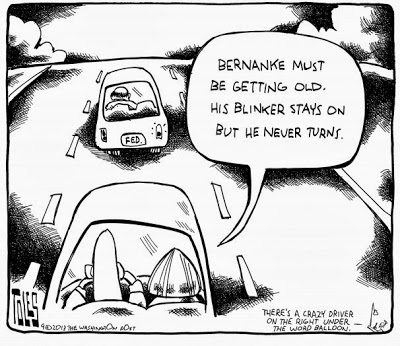
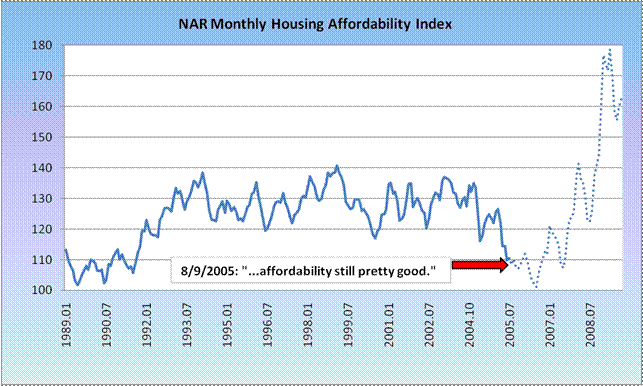
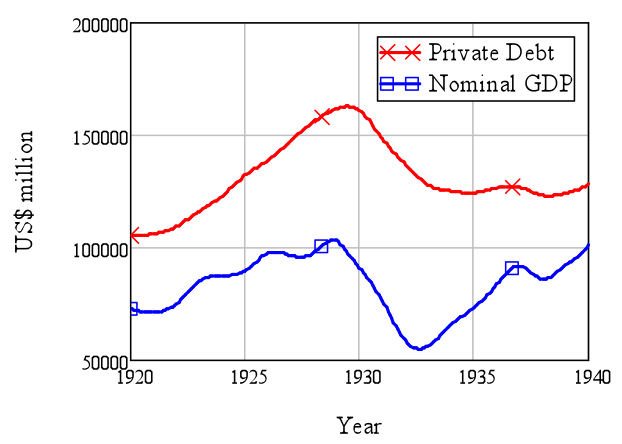
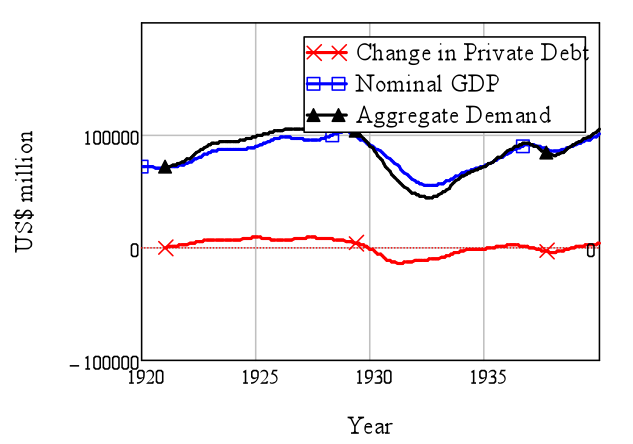
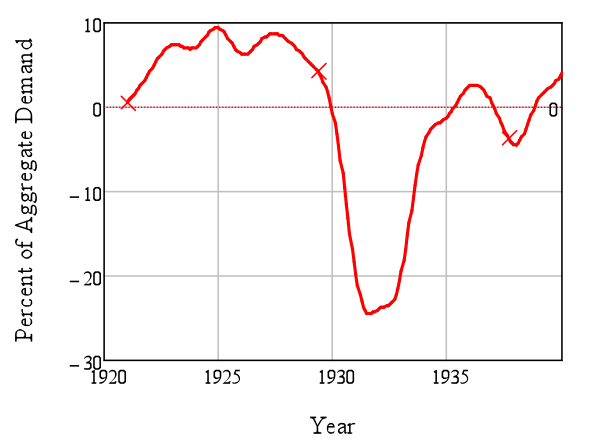
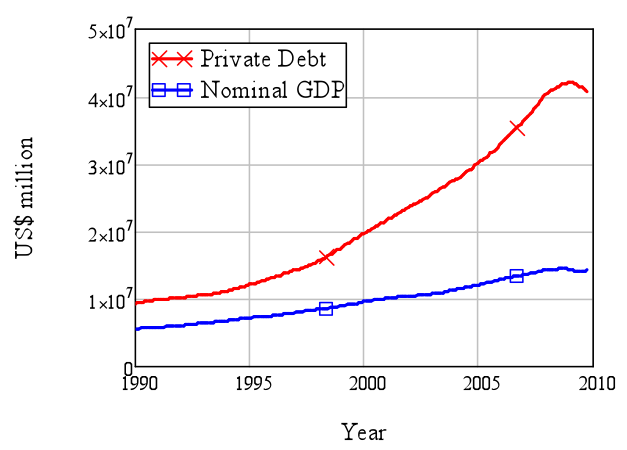
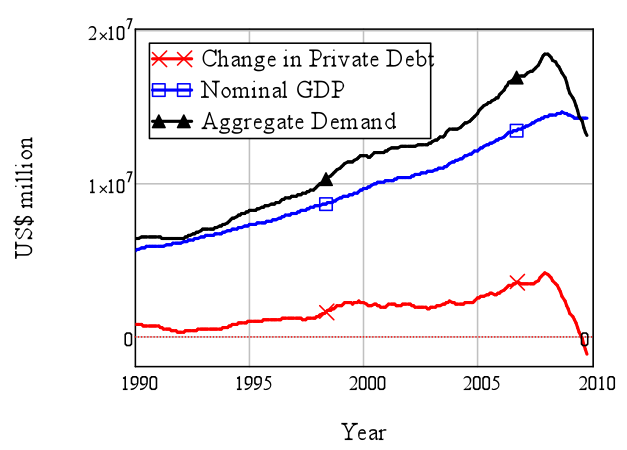
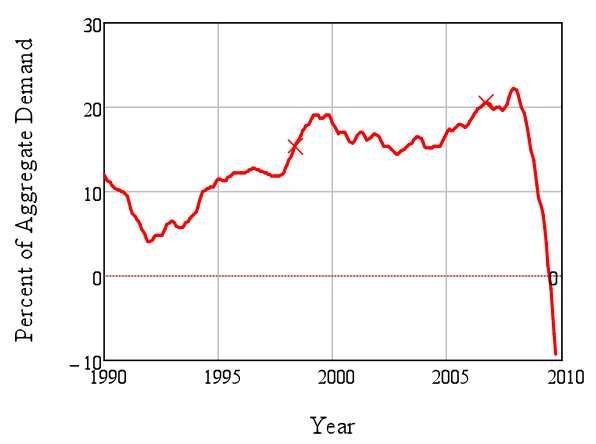


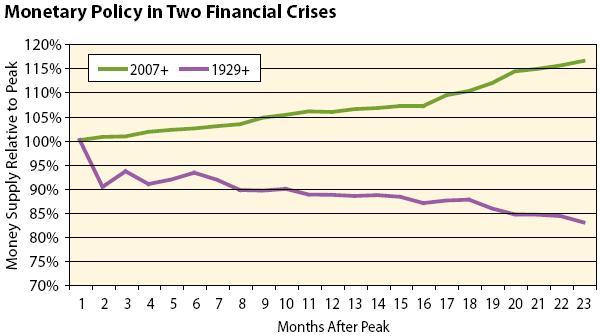


Testimony of Chairman Ben S. Bernanke: July 18, 2007
I don't see the word "bump", but it is testimony on July 19, 2007.
PS: http://web.archive.org is awesome
PPS: Just in case it suddenly disappears from the archive, I've copied it to my blog.
And that testimony does seem to be there:
http://www.federalreserve.gov/newsevents/testimony/bernanke20070718a.htm
Maybe they blew the other copy away because it was a duplicate?
Chairman Ben S. Bernanke
Semiannual Monetary Policy Report to the Congress
Before the Committee on Financial Services, U.S. House of Representatives
July 18, 2007
Chairman Bernanke presented identical testimony before the Committee on Banking, Housing, and Urban Affairs, U.S. Senate, on July 19, 2007