In an angry exchange with
Barack Obama,
Angela Merkel has compared
the snooping practices of the US with those of the Stasi, the ubiquitous and all-powerful secret
police of the communist dictatorship in East
Germany, where she grew up.
The German chancellor also told the US president that America's National Security Agency cannot
be trusted because of the volume of material it had allowed to leak to the whistleblower Edward
Snowden,
according to the New York Times.
Livid after learning from Der Spiegel magazine that the Americans were listening in to
her personal mobile phone, Merkel confronted Obama with the accusation: "This is like the Stasi."
The newspaper also reported that Merkel was particularly angry that, based on the disclosures,
"the NSA clearly couldn't be
trusted with private information, because they let Snowden clean them out."
Snowden is to testify on the NSA scandal to a European parliament inquiry next month, to the
anger of Washington which is pressuring the EU to stop the testimony.
In Brussels, the chairman of the US House select committee on intelligence, Mike Rogers, a Republican,
said his views on the invitation to Snowden were "not fit to print" and that it was "not a great
idea".
Inviting someone "who is wanted in the US and has jeopardised the lives of US soldiers" was beneath
the dignity of the European parliament, he said.
He declined to comment on Merkel's alleged remarks to Obama. In comments to the Guardian, he
referred to the exchange as "a conversation that may or may not have occurred".
Senior Brussels officials say the EU is struggling to come up with a coherent and effective response
to the revelations of mass US and British
surveillance of electronic
communication in Europe,
but that the disclosure that Merkel's mobile had been monitored was a decisive moment.
A draft report by a European parliament inquiry into the affair, being presented on Wednesday
and obtained by the Guardian, says there has to be a discussion about the legality of the NSA's
operations and also of the activities of European intelligence agencies.
The report drafted by Claude Moraes, the British Labour MEP heading the inquiry, says "we have
received substantial evidence that the operations by intelligence services in the US, UK, France
and Germany are in breach of international law and European law".
Rather than resorting to a European response, Berlin has been pursuing a bilateral pact with
the Americans aimed at curbing NSA activities and insisting on a "no-spying pact" between allies.
The NYT reported that Susan Rice, Obama's national security adviser, had told Berlin that there
would be not be a no-espionage agreement, although the Americans had pledged to desist from monitoring
Merkel personally.
A high-ranking German official with knowledge of the talks with the White House told the Guardian
there had been a "useful exchange of views", but confirmed a final agreement was far from being
reached.
The Germans have received assurances that the chancellor's phone was not being monitored and
that the US spy agency is not conducting industrial espionage.
However the official, who spoke on condition of anonymity because of the sensitivity of the talks,
said German and US officials were still in the process of negotiating how any final agreement –
the details of which could remain secret between both governments – would be formalised.
Their discussions, which include talks about so-called confidence building measures, are also
bound-up with wider discussions with the EU regarding special privacy assurances that might be afforded
to its citizens under a future arrangement.
"We want to be assured that not everything that is technically possible will be done," the German
official added.
In Germany, the main government minister dealing with the NSA fallout, Hans-Peter Friedrich,
has fallen victim to a reshuffle in the new coalition unveiled in Berlin at the weekend. Friedrich,
from Bavaria's Christian Social Union, is not seen as an ally of Merkel's and was widely viewed
to have performed less than robustly in the exchanges with the Americans.
His replacement as interior minister, by contrast, is a close ally of Merkel's – her former chief
of staff and former defence minister, Thomas de Maiziere. Additionally, Merkel has brought a former
senior intelligence official into the new coalition.
Alongside De Maiziere at the interior ministry, she has appointed Klaus-Dieter Fritsche, previously
deputy head of the domestic intelligence service, Germany's equivalent of MI5.
For months, leading technology companies have been buffeted by revelations about government spying
on their customers' data, which they believe are undermining confidence in their services.
"Both sides are saying, 'My biggest issue right now is trust,' " said Matthew Prince, co-founder
and chief executive of CloudFlare, an Internet start-up. "If you're on the White House side,
the issue is they're getting beaten up because they're seen as technically incompetent. On the
other side, the tech industry needs the White House right now to give a stern rebuke to the
N.S.A. and put in real procedures to rein in a program that feels like it's out of control."
The meeting of Mr. Obama, Vice President Joseph R. Biden Jr. and 15 executives from the likes
of Apple, Google, Facebook and Yahoo came a week after those companies and other giants, usually
archrivals, united in a public campaign calling for reform in government surveillance practices.
On Monday, a federal district judge ruled that the N.S.A. sweep of data from all Americans' phone
calls
was unconstitutional, a ruling that added import to the discussions.
...Several executives, including Ms. Mayer, the chief executive of Yahoo, expressed concerned
that foreign countries may now decide to prevent all the user data generated by users in a foreign
country from flowing to the United States, the people said. One such law has been proposed in Brazil.
The executives said these laws would significantly hurt their businesses and America's start-up
economy.
...The meeting reflected a shift in the tech sector's once-close relationship with Mr. Obama,
whose 2008 election many industry executives generously supported.
Chuck Woods, ID
I don't see how there can be any trust restored until the administration changes it's outlook
on Edward Snowden. Without the revelations about wholesale spying and illegal data collection
by Snowden we would not even be having this national discussion. President Obama will be on
the wrong side of history if he doesn't recognize the value of this issue. It would be sad if
he is remembered as the president of drones and spying on citizens. Perhaps healthcare will
save him from that. But isn't about time he stood up to the spooks and hawks who pull many of
the levers.
Deregulate_This, Oregon
President Obama meets with these particular tech CEOs? The same ones who claim there are
no CS graduates in America? The same ones who abuse the H-1B visa program and undercut American
wages? The same ones who happily signed on to sell information to the C.I.A. and N.S.A.? (Our
tax dollars pay for access to their data - see previous NYT articles about payouts to tech companies)
I've worked in the tech industry for 15 years and have seen massive layoffs of Americans
while they send jobs overseas. Now, they are being used as Obama's advisers? What could they
possibly advise? "Lower Wages" "Allow us to outsource more" "Allow us to have permanent unpaid
interns" "keep paying us for private user information"?
eric glen
Hopkinton, NH
"The Adminstration told executives that government action related to NSA surveillance would
happen in the new year. . . "
Yeah, and if you like your plan you can keep your plan, period.
This article to some degree depicts our President as somehow an outsider to the NSA workings.
He's the commander in chief. He could have changed the system five years ago if he wanted
to.
Our President has authorized the spying that has gone on and seeks to prosecute Snowden to
the fulll extent of the law. Why, because President Obama believes the government should spy
on us.
If only Snowden were an "undocumented worker", he would be safe from prosecution whatever
his crimes.
AdamOnDemand, Bloomingdale, NJ
Unchecked power to spy is like any other unchecked power: it corrupts, and while it may be
intended for only the best reasons, it won't be used only or even primarily for them for long...
senatordl
new jersey
"The president made clear his belief in an open, free and innovative Internet ". Anyone who
believes that is delusional! this president and his congressional co=conspirators are the worst
thing that has ever happened to the US. the last thing they believe in is something that is
open let alone free. we are no longer free because they take our freedom of choice away on virtually
everything. The worst part is people on the government dole don't see it or don't care. if we
have not lost what we fought for during several wars then this war is even more insidious because
most people are not even aware that it's being waged against them.
Brooklyn Song, Brooklyn
NYT Pick
Facebook and Google are 1) speaking with Obama about how bad the NSA spying is for business,
and b) buying fiber optic cables to evade government spying out their customers (us).
In other words, giant corporations are the good guys now. Brave new world.
rcrogers6, Durham, NC
It's a little late to install a competent IT professional to run the website development
contract - or should I say contracts. The mismanagement began when President Obama eschewed
competent advice and turned the ACA implementation over to the White House staffers who shepherded
it through Congress. This concrete demonstration of the President's lack of any managerial background
and unwillingness to accept expert advice has permeated his presidency and led to the disappointment
of those of us who voted for him - twice.
I cannot imagine anything concerning either of the meeting's subjects that would warrant
that grin or the reciprocating smiles of the apparent sycophants. We will soon see what impact
this president's ignorance and arrogance has had on the fortunes of the Democratic Party in
the 2014 elections. Next time, I will try not to be influenced by a charismatic candidate and
look for one who brings some experience to the table. I honestly had looked forward to change
and a new era in politics. Well, in regard to the Legislative Branch, that's what I got - in
the form of a disaster. The Executive, in lieu of change, has just delivered more of the same
with a soupcon of additional incompetence.
alan, United States
Since it is obvious to even a blind man that the government has no real desire to protect
Americans from illegal spying< I hope Brazil and other nations will pass laws that forces tech
companies to keep their citizens data in their respective countries.
This will costs the tech industries billions of dollars. That is the only way they will get
out of bed with the government. They can cry foul all they want to but it sounds hollows. After
all, AT&T and the other phone companies turned over call records to the government after 911
without a whimper.
Maybe when enough people stop using their services or go with a company that is serious about
users' privacy, Microsoft and the rest will do the right thing.
Nathan an Expat, China
The Internet companies' real concern is loss of overseas markets due to revelations they
were providing voluntary and/or unwitting back door access to their customer data to US intelligence
services. If their overseas clientele and their governments wake up this might lead to a "balkanisation!"
of the Internet -- that translates into loss of market share for the major players. Most amusing
is that major telecommunication companies like CISCO, Juniper and Alcatel who by definition
have to be major players in this activity have managed with the collusion of mainstream media
to keep a low profile on this. No visits to the White House for them because they are fully
in line with these programs and have been for decades. Meanwhile, the US senators advise/warn
foreigners not to buy telecommunication systems from China's Huawei because you know . . .
Jerry, New York
It's nice when the families get together to decide how to divide control over citizens and
their money. God bless them.
Trenton, Washington, D.C.
The tech moguls are creating the devices and application that track the 99 percent's every
move, thought and action--technology they sell to the federal government. They lobby for privatizing
of public services so they can exert even greater control.
And, yeah, if they're not Libertarians feeding at the public trough, they're Democrats.
All it will take is one well-coordinated nationwide terrorist attack and we'll all be in
virtual lock-down via technology created and peddled by these children.
Watch for the false flag.
Jim Michie, Bethesda, Maryland
What amazes me is how and why Barack Obama keeps flashing those toothy smiles. Here is a
man who "gave us hope" and "promised" us so much, but delivered so little, continuing many of
the ugly, dark policies of the Bush regime and adding his own. Among so many betrayals, Obama
has failed to close his gulag, Guantanamo, failed to bring all of our troops home, expanded
his war capabilities, failed to prosecute his felon friends on Wall Street and in the too-big-to-jail
banks, launched a war on both whistleblowers and journalists, worked closely with the for-profit
"health insurance industry" to create a "Frankenstein health care plan" and I could go on and
on and on and on. "Fading trust," you say, New York Times? Shouldn't your headline read, "Tech
Leaders and Obama Find Shared Problem: Lost Public Trust"!
John, Hartford
Reflects a shift? It actually reflects the closeness and interdependence of the relationship
between government the tech industry. At times I wonder who writes these articles, 28 year old
techno whizzes who may know all about IT but very little about the realities of power?
66hawk, Gainesville, VA
This article feel like empty calories to me. The characterization of the meeting is mostly
critical when it seems that the fact that the meeting was held and that an exchange of viewpoints
was accomplished made the meeting a success. I have no doubt that Obama will address some of
the concerns that the tech industry has while still maintaining the ability to protect our nation
from terrorists. The problem of getting people to trust that social media and the internet are
totally secure is probably unsolvable. If you don't want someone to have access to your information,
you certainly don't want to use Facebook.
Pat Choate, Washington, Va.
The expose of the NSA excesses and that Agency's linkages with these corporations is taking
a heavy tool on these companies' foreign-derived bottom line and global reputation. What citizen
or company in any foreign country wants to do business with a corporation that is secretly funneling
their clients' data to US spy agencies.
Big Tech's concern for their profits will result in more pressures for "reforms" at NSA than
anything the Congress, Courts or Administration would ever do on their own.
Steve Fankuchen, Oakland CA
The information Americans gladly give to private companies is more of a threat to individual
well-being and collective democracy than the egregious data collecting of the government. The
real danger is that Apple is much more popular than the government, because people understand
what their iPod does for them but not what the government does for them.
The workings of the government are, compared to that of the big tech corporations, quite
transparent. You may or may not like the influence of the Koch brothers money on politics, but
at least it all plays out in a relatively public arena. Google not so much. And, while our electoral
process is very far from perfect, you have more of an influence on that than you do on corporate
policy. Have you tried voting Tim Cook or Mark Zuckerberg out of office?
What the government is doing now it has done for decades, spying with whatever tools were
available. They may have new tools, but so do those they want to spy on. What is different now
is that there are huge, wealthy corporations whose profit largely come from spying and espionage
i.e. the collection of your info with or without your permission. And to the extent that you
may have become dependent on the internet and these companies, they simply make you an offer
you can't refuse.
Dean Charles Marshall, California
Steve your comment is "spot on". Our deification of technology is beyond absurd. At the end
of the day the Internet has become a vast "sink hole" of distraction where tech companies rake
in billions covertly pimping off our private information in exchange for bits and bits of superfluous
and dubious information we crave, but for reasons we can't explain. Thanks to companies like
Google, Apple and Facebook we've become a nation of techno zombies enamored with the trivial
pursuit.
ronco, San Francisco
Those private companies don't intentionally weaken security and encryption standards in order
to make breaking into encrypted data streams easier. Those companies make a living by ensuring
the integrity of the data that you host with them. One has choices whether to give data to those
companies in order to get services from them or to pay in a more traditional model. When a company
is found to play loosely with data they are sussed out very quickly and very publicly. We don't
have a recourse against the NSA - voting is a very slow process.
While researchers have known about the weaknesses introduced into data encryption standard
algorithms by the NSA, none of them spoke up about it because of the chilling effect it would
have on getting grants for their research.
It is a vicious circle that is not only strengthened by criminal prosecution but also character
assassination and black listing at government levels. There's nothing inherently good or evil
about corporations or their motives but I usually have a choice about where I purchase goods
and services or even build my own company to compete. The fact that we can't trust our government
to do the right thing and haven't been able to have that trust since 9/11 is a problem because
one either has to wait for the voting process to eventually work (a generation?) or just vote
with their feet.
Scientella, palo alto
Spying by the NSA is unconstitutional.
Silicon Valley has changed from a benevolent geek town to run by ruthless, parasitic, dishonest,
money crazed functionaries of the policed state.
Jack O'Hanlon
San Juan Islands
Where was Cisco? If you want to ask some deep questions about a technology company that has
sold billions of dollars worth of IP routing and switching equipment worldwide that now seems
to have engineered back door access for the NSA, Cisco would be the banner carrier.
No subsea system, no terrestrial network can function without Cisco equipment in line somewhere.
When Cisco claims it drives the Internet, it is not kidding.
Ironic in this is the fact that Cisco has lobbied to keep Huawei out of U.S. carrier networks
based on "security issues" that have been discussed in general terms, ie, backdoors that would
allow the Chinese to compromise U.S. communications.
It now seems that Cisco had some direct experience in understanding this sort of activity.
You can't pick off photonic transmissions (the fiber optic cable hacks revealed in the Snowden
documents) unless you can hack the IP routers that send the traffic across the cables. A pure
photonic hack is a futuristic endeavour, one that can be conducted so long as the producer of
all optic routing has built in back door access at the laser level. Not so easy. All optic routing
is called O-O-O, for optical-optical-optical transmission and destination routing of Internet
Protocol traffic.
Bill Appledorf, British Columbia
Give me a break.
Corporate America spies on everyone to personalize the limits of the cognitive sandbox each
consumer wanders in.
The NSA's job is to make sure no one extricates themselves from virtual reality, discovers
the planet Earth, and finds out what global capitalism has been doing to it and the people who
live here.
Information technology and covert intelligence are the public and secret sides of one and
the same coin.
Cisco, Juniper, Alcatel, Huawei and a scant few others build what are called - O-E-O routers,
for optical-electrical-optical transmission. The NSA is hacking the E part of this, with the
vendors' potential help, obviously.
Bruce, San Diego, CA
I believe I have a way to regain the public trust: Give Mr. Snowden permission to re-enter
the US, give him a Presidential pardon and award him the Congressional Gold Metal. Mr. Snowden
maybe labeled a traitor by some in government; if so he is in fine company: Mr. King, Mr. Gandhi,
Mr. Mandela, Mr. Patrick Henry. All of whom have been called "Traitor" and all of whom like
Mr. Snowden shook up the established order for the betterment of society. Some like Mr. King,
Gandhi & Henry paid the ultimate price for their beliefs.
Mr. Snowden has done more to advance the cause of freedom in the US and around the world
than anyone for a long, long time. In the process he has made the "Powers That Be" very uncomfortable.
Well done Sir!
borntorun45, NY
Do you feel that Snowden should be granted a Presidential pardon for cheating on the exam
to obtain employment as a contractor for the NSA in Hawaii with the specific intent of mining
data that he should not have had access to in the first place? Maybe you feel that Snowden should
be pardoned for absconding to Hong Kong with his stolen files - do you find his fleeing the
country of his own accord particularly heroic, proper, or necessary? Or, should he receive a
pardon for then making that intelligence available to people who have profited by the purloined
intelligence by publishing it for all the world to see, jeopardizing America's security and
causing a strain on foreign relations?
Snowden carefully planned his mission, he didn't simply come upon the "leaked files" through
his work in Hawaii - he has admitted to taking the job with Booz Allen specifically to obtain
the files he stole. He was so much more than a whistleblower - he broke into and entered areas
of the NSA he had no legal access to, and he download millions of files. Imagine anyone working
in private business doing such a thing, let alone someone who took an oath of secrecy.
How exactly has "Mr. Snowden... done more to advance the cause of freedom in the US and around
the world"? We are all being watched whenever we use our computers, cell phones, debit cards
- it's the digital age, my friend, and the US government's surveillance of you should be the
least of your worries.
Che Beauchard, Manhattan
Can't the photo shown with this article be used as evidence in a trial for a RICO violation?
Surely the government has become a Racketeer Influenced Corrupt Organization in collusion with
these corporations.
infinityON, NJ
Sorry, I am having a hard time believing that Google and Facebook are concerned about their
users privacy. They are more worried about their bottom lines due to the Snowden revelations.
And we can add in the Obama Administration not being concerned about Americans privacy.
Patrick Dugan, Berkeley, CA
Google's entire business is built on respecting the privacy of their users. Sure they've
misstepped in the past, usually not on purpose, but the presumption that they blatantly disrespect
users and their privacy is uninformed.
Colenso, Cairns
'Try working part time at WalMart for awhile and then tell me that the NSA is your biggest
problem.' ~ paul, CA
I sympathise. Nevertheless, if you are a resident of a US town where there's a Walmart or
some such, you can choose whether or not to work for Wal-Mart Stores Inc or for some other exploitative
US employer. If you don't like it, then you can improve your qualifications or skills, move
to another town or even another country. That's always been the American way.
No one, however, US citizen or non-citizen, resident or non-resident in the USA, has any
direct say whatsoever in what the US National Security Agency decides to do to you. Even the
so-called 'courts' that oversee the NSA admit no litigant to the proceedings.
To take up your challenge, therefore, with the exception of those who live in North Korea
and similar jurisdictions, I say yes - the NSA *is* everyone's biggest problem.
Date of event: Thursday, December 12, 2013 - 12:15pm - 1:45pm
For most Americans, news of NSA's domestic spying program was shocking. But for one group, living
under government surveillance is routine--people in poverty. For families and individuals accessing
the public benefits system, ceding extensive personal and financial information and submitting to
unannounced home visits, fingerprinting or drug testing are the cost of receiving assistance. And
for some policy makers, these intrusions still don't go far enough in regulating who receives these
benefits and how they are used.
Surveillance of poor families raises questions with universal relevance: What are the implications
of having different standards of privacy based on financial status? Under what circumstances can
our privacy be transacted away, and where are the limits? What responsibility do government agencies
have to protect personal information? Is technology keeping our information safer, or putting it
more at risk?
To unpack these questions, New America Foundation's Open Technology Institute, Asset Building
Program, and Breadwinners and Caregivers Program are hosting a discussion to explore the dynamics
of privacy, surveillance and technology in the context of people's lived experiences with poverty
and the public assistance system. Please join us for this timely and vital conversation.
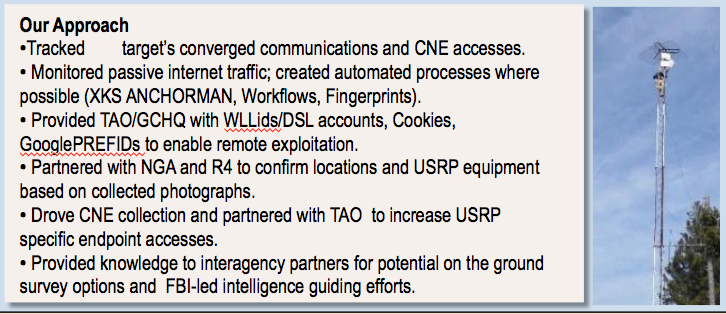
A slide from an internal NSA presentation indicating that the agency uses at least one
Google cookie as a way to identify targets for exploitation. (Washington Post)
The National Security Agency is secretly piggybacking on the tools that enable Internet advertisers
to track consumers, using "cookies" and location data to pinpoint targets for government hacking
and to bolster surveillance.
The
agency's internal presentation slides, provided by former NSA contractor Edward Snowden, show
that when companies follow consumers on the Internet to better serve them advertising, the technique
opens the door for similar tracking by the government. The slides also suggest that the agency is
using these tracking techniques to help identify targets for offensive hacking operations.
For years, privacy advocates have raised concerns about the use of commercial tracking tools
to identify and target consumers with advertisements. The online ad industry has said its practices
are innocuous and benefit consumers by serving them ads that are more likely to be of interest to
them.
The revelation that the NSA is piggybacking on these commercial technologies could shift that
debate, handing privacy advocates a new argument for reining in commercial surveillance.
According to
the documents, the NSA and its British counterpart, GCHQ, are using the small tracking files
or "cookies" that advertising networks place on computers to identify people browsing the Internet.
The intelligence agencies have found particular use for a part of a Google-specific tracking mechanism
known as the "PREF" cookie. These cookies typically don't contain personal information, such as
someone's name or e-mail address, but they do contain numeric codes that enable Web sites to uniquely
identify a person's browser.
In addition to tracking Web visits, this cookie allows NSA to single out an individual's communications
among the sea of Internet data in order to send out software that can hack that person's computer.
The slides say the cookies are used to "enable remote exploitation," although the specific attacks
used by the NSA against targets are not addressed in these
documents.
The NSA's use of cookies isn't a technique for sifting through vast amounts of information to
find suspicious behavior; rather, it lets NSA home in on someone already under suspicion - akin
to when soldiers shine laser pointers on a target to identify it for laser-guided bombs.
Separately, the NSA is also using commercially gathered information to help it locate mobile
devices around the world, the
documents show. Many smartphone apps running on iPhones and Android devices, and the Apple and
Google operating systems themselves, track the location of each device, often without a clear
warning to the phone's owner. This information is more specific than the broader location data
the government is collecting from cellular phone networks, as
reported by the Post last week.
"On a macro level, 'we need to track everyone everywhere for advertising' translates into 'the
government being able to track everyone everywhere,'" says Chris Hoofnagle, a lecturer in residence
at UC Berkeley Law. "It's hard to avoid."
These specific slides do not indicate how the NSA obtains Google PREF cookies or whether the
company cooperates in these programs, but other documents reviewed by the Post indicate that cookie
information is among the data NSA can obtain with a Foreign Intelligence Surveillance Act order.
If the NSA gets the data that way, the companies know and are legally compelled to assist.
The NSA declined to comment on the specific tactics outlined in this story, but an NSA spokesman
sent the Post a statement: "As we've said before, NSA, within its lawful mission to collect foreign
intelligence to protect the United States, uses intelligence tools to understand the intent of foreign
adversaries and prevent them from bringing harm to innocent Americans."
Google declined to comment for this article, but chief executive Larry Page joined the leaders
of other technology companies earlier this week in calling for an end to bulk collection of user
data and for new limits on court-approved surveillance requests. "The security of users' data is
critical, which is why we've invested so much in encryption and fight for transparency around government
requests for information," Page said in a
statement on the coalition's
Web site. "This is undermined by
the apparent wholesale collection of data, in secret and without independent oversight, by many
governments around the world."
How consumers are tracked online
Internet companies store small files called cookies on users' computers to uniquely identify
them for ad-targeting and other purposes across many different Web sites. This advertising-driven
business model pays for many of the services, like e-mail accounts, that consumers have come to
expect to have for free. Yet few are aware of the full extent to which advertisers, services and
Web sites track their activities across the Web and mobile devices. These data collection mechanisms
are invisible to all but the most sophisticated users -- and the tools to opt-out or block them
have limited effectiveness.
Privacy advocates have pushed to create a "Do Not Track" system allowing consumers to opt out
of such tracking. But Jonathan Mayer of Stanford's Center for Internet and Society, who has been
active in that push, says "Do Not Track efforts are stalled out." They ground to a halt when the
Digital Advertising Alliance, a trade group representing online ad companies,
abandoned the effort in September after clashes over the proposed policy. One of the primary
issues of contention was whether consumers would be able to opt out of all tracking, or just
not be served advertisements based on tracking.
Some browsers, such as Apple's Safari, automatically block a type of code known as "third-party
cookies," which are often placed by companies that advertise on the site being visited. Other browsers
such as Mozilla's Firefox are also experimenting with that idea. But such settings won't prevent
users from receiving cookies directly from the primary sites they visit or services they use.
Google's PREF Cookie
Google assigns a unique PREF cookie anytime someone's browser makes a connection to any of
the company's Web properties or services. This can occur when consumers directly use Google services
such as Search or Maps, or when they visit Web sites that contain embedded "widgets" for the company's
social media platform Google Plus. That cookie contains a code that allows Google to uniquely track
users to "personalize
ads" and measure how they use other Google products.
Given the widespread use of Google services and widgets, most Web users are likely to have a
Google PREF cookie even if they've never visited a Google property directly.
That PREF cookie is specifically mentioned in an internal NSA slide, which reference the NSA
using GooglePREFID, their shorthand for the unique numeric identifier contained within Google's
PREF cookie. Special Source Operations (SSO) is an NSA division that works with private companies
to scoop up data as it flows over the Internet's backbone and from technology companies' own systems.
The slide indicates that SSO was sharing information containing "logins, cookies, and GooglePREFID"
with another NSA division called Tailored Access Operations, which engages in offensive hacking
operations. SSO also shares the information with the British intelligence agency GCHQ.
"This shows a link between the sort of tracking that's done by Web sites for analytics and advertising
and NSA exploitation activities," says Ed Felten, a computer scientist at Princeton University.
"By allowing themselves to be tracked for analytic or advertising at least some users are making
themselves more vulnerable to exploitation."
This isn't the first time Google cookies have been highlighted in the NSA's attempts to identify
targets to hack. A presentation released in October by the Guardian called "Tor
Stinks" indicates that the agency was using cookies for DoubleClick.net, Google's third-party
advertising service, in an attempt to identify users of the Internet anonymization tool Tor when
they switched to regular browsing. "It's similar in the sense that you see the use of an unique
ID in the cookie to allow an eavesdropper to connect the activities of a user over time," says Felten.
An
NSA document written in 2008 described gamer communities as under-monitored
and called them a "target-rich communications network" where intelligence targets could "hide
in plain sight".
The games and systems involved include World of Warcraft, Second Life and the Xbox Live
console network, which boasts more than 48 million players.
It's unclear how the agencies accessed gamer data, or how many communications were collected.
The NSA has ensured that it was not monitoring innocent Americans whose identity and nationality
may have been concealed behind their virtual avatar.
The NSA
declined to comment on the surveillance of games. A spokesman for GCHQ
said the agency did not "confirm or deny" the revelations.
JoeWasEre
Calling gamer communities "target-rich" seems like an excuse to trawl a load of data just
because it's there.
Were these examples of WoW, Second Life and Xbox Live chosen because of their popularity?
I'm guessing this is really small scale too(?).
I would have though that Xbox Live was more likely to flag up a load of pro-US warmongering
chatter than anything else. Maybe that brings the bad guys in(?)
Brian Goetz
We know from advertising that combining big data with advanced computer learning algorithms
and processing power can be incredibly effective when it comes to predicting behavior.
The more data you collect over time and the more data points you can map together, the more
accurately you can predict what people are likely to do both on and offline.
Most companies are limited in terms of what they can collect and how it can be pieced together,
but the NSA and GCHQ are not following the same rules it seems.
How dangerous is all this data in aggregate and how well will they be able to predict human
behavior if this is allowed to continue? Appears to have potential as a weapon in many ways
that no government would want to give up.
gruniadreader666
I think the real story here is the security services are wasting money playing games because
nobody in government has the balls to challenge them not even Ed Balls.
I bet MI5 agents are also crawling Birmingham's finest gentlemen's clubs looking for "terrorists"
in the crevices of lovely ladies, hiding out in top class restaurants and scouting football
crowds from the hospitality suit as it has the best view of the crowd apparently.
Breaking news Terrorists may go to see the new Hobbit film so MI6 have sent a crack team
to check it out and have got a man inside to make sure they are given the extra popcorn to aid
their spying.
Dzjebe
American Military Guys spying on my kids playing in their bedroom.
THIS IS BEYOND SICK.
lost alex -> Dzjebe
These games are a public arena. When you go on them, you should treat it just like being
in public. It's just like Twitter. You should know that everyone can see you and what you say.
It's a public space.
HaloNott
How many terrorists have they found?
In this context to whom does the the word 'terrorist' refer to?
What do they do with the redundant information and how much is there?
What are the active spies doing? Is this a paid for recreation-with-work effort?
Was there any screening for this proposal or any proof that it was useful?
In your opinion is there any point to gathering the information?
Did they find anyone other than the credit card fraudsters? How many?
How efficient is this effort?
Does this extend to co-op flash games?
Dowling1981
If you're not doing anything wrong this should not worry you. Just like speed cameras.
monkie Dowling1981
ill be round your house tomorrow first thing to install camera's and microphones in your
bathroom and your children's bedroom(s), after all, i am sure you are not doing anything wrong
in your bathroom, nor are your children in their bedroom....
CompassionateTory
This all just one big game of Pacman.
The NSA & GCHQ are the ghosts.
The Guardian and Wikileaks are the power pellets.
You're the Pacman
ConcernedCitizen24
NSA can track you in real time over Warcraft 2 and Warcraft 3 as well, I believe. There is
an MS data file that is saved to your hard drive. Does WoW and Second Life have these same MS
data files? That is how the data is collected by MS and hence by the NSA, in my opinion. What's
scary is the real time ability for people to somehow track you into anonymous randomized games,
one match after the other.
Thank god I went on official record before this came out.
Autonomouos
Over 1200 game developers have integrated the gamespy api into their titles. The api monitors
real-time gameplay actions and creates profiles on individual gamers. The data is stored in
the cloud indefinitely. Although game developers may deny that they are aware of any use of
this data by the NSA or GCHQ, the data can simply be pulled off the internet by the NSA who
may have technical details on the gamespy messaging formats. It is also likely that there is
some collaboration between gamespy and the NSA.
If you are a gamer, you should expect that all of your actions made in online games have
been logged and stored away for further analysis by the NSA.
monkie
i have a question, the guardian has spent a lot of time reviewing the new xbox, but the reviewers
generally seem to rubbish the idea that the always kinect features can be used to spy on us
or our children, as it is known that companies are required to lie about collaborating with
the NSA and others in the name of national security will the guardian now be more critical of
devices such as these made by companies that are known to collaborate and will the guardian
do a proper investigation into the surveillance capabilities of the new xbox, preferably with
the cooperation of some real computing and security experts.
if i can ask another question, considering the exalted company of journalists joining the
Q&A, it is of course rare to hear from a reported from that famed organisation that gave us
judith miller and the cheerleading of the iraq war, that sat on the story of warrantless wire-tapping
until after the re-election of bush, i wonder if anyone can touch on the subject of trust in
the 4th estate, with the editors of newspapers gatekeeping and redacting the snowden documents
how can we ever know what the depth of these revelations are, how can we begin to attempt to
effect change when it seems that even the so called counterbalance of the state appears to be
doing the bidding of the state.
i play games, it is not really news to me that games are monitored, it is nice to have some
documentary proof but what is really new here, where is the real meat?
CyberGhost_EN
Since most of the famous games are publicly online it doesn't come as a surprise, but it
is shocking! Come on, if Facebook is monitored...
More than 500 renowned authors – including five Nobel laureates - from across the globe have
signed a petition demanding an end to 'mass surveillance'. It follows the revelations over the last
few months of the US and other countries spying.
Their open appeal is called 'A Stand for Democracy in the Digital Age'. Among the signatories
are Nobel laureates Orhan Pamuk, JM Coetzee, Elfriede Jelinek, Günter Grass and Tomas Tranströmer.
Others who signed the letter include Bjork, Umberto Eco, Yann Martel, Ian McEwan and many others.
"WE DEMAND THE RIGHT for all people, as democratic citizens, to determine to what
extent their personal data may be collected, stored and processed, and by whom; to obtain information
on where their data is stored and how it is being used; to obtain the deletion of their data if
it has been illegally collected and stored. WE CALL ON ALL STATES AND CORPORATIONS to respect these
rights," the open appeal read.
It adds that "a person under surveillance is no longer free; a society under surveillance
is no longer a democracy. To maintain any validity, our democratic rights must apply in virtual
as in real space."
The letter also calls for the creation by the UN an International Bill of Digital Rights.
Everyone is invited to sign the open appeal at www.change.org/surveillance
The petition comes in the wake of massive revelations by Edward Snowden that disclosed surveillance
all over the globe carried out by NSA.
In the latest incident, it has been revealed that the NSA and the UK's GCHQ spying agencies collected
players' charts and deployed real-life agents into the World of Warcraft and Second Life online
games.
The move was organized by a group of independent authors who made it possible through personal contacts
and private networks.
Danish writer, Janne Teller, one of the organizers, told the Daily Mail that the authors' community
is "really very worried about mass surveillance" which is "undermining democracy totally."
"I think it's quite significant when you have 560 or so of the greatest contemporary
writers, from all across the world, expressing a very serious concern, because these are people
who always work on the big philosophical questions of life. Hopefully their concern matters to politicians,"
Teller added.
The concern listed by the appeal's organizers is reflected in statistics.
A recent survey by the writers' rights group PEN discovered that 85 percent of its US members are
worried about government surveillance, according to the organization's report.
Twenty-eight percent had also curbed their social media use, while 24 percent are avoiding certain
topics in phone and email conversations.
The
National Security Agency is tracking the location and movements of hundreds of millions of cellphones
outside the United States in an effort to find suspicious travel patterns or coordinated activities
by intelligence targets, according to secret documents leaked by the former N.S.A. contractor Edward
J. Snowden.
To carry out the tracking, the agency collects nearly five billion records on cellphones outside
the United States each day from taps on fiber optic cables and other communication conduits that
carry cellphone traffic, the documents say. Enough of that data is saved to track a small fraction
of the phones over time.
Cellphone calls, text messages and other traffic must be routed through global networks from
the caller or sender to the intended recipient - another cellphone, for example. That routing is
guided by so-called metadata, which acts as a sort of addressing system for the network. The metadata
inevitably contains information about where a call originated, and therefore the location of a cellphone.
In October,
The New York Times reported that the agency carried out a secret test project in 2010 and 2011
to collect large amounts of data on the location of Americans' cellphones inside the United States.
James R. Clapper Jr., the director of national intelligence, confirmed the existence of the test
program but said that it was never put into practice.
tramp writes "The National Security Agency is gathering nearly
5 billion records a day on the whereabouts of cellphones around the world, according to top-secret
documents and interviews with U.S. intelligence officials, enabling the agency to track the movements
of individuals - and map their relationships - in ways that would have been previously unimaginable.
Of course it is 'only metadata' and absolutely not invading privacy if you ask our 'beloved' NSA."
Pretty soon, the argument about whether you have in any given facet of your life a "reasonable expectation
of privacy" may take on a whole new meaning. Also at
Slash BI.
Pretty soon, the argument about whether you have in any given facet of your life a "reasonable
expectation of privacy" may take on a whole new meaning.
No, it absolutely will not. People need to get through their heads that just because your
rights are violated, that doesn't mean expecting them not to be becomes unreasonable. If someone
breaks into your house every day, it doesn't become "reasonable" for them to do so, or unreasonable
for you to expect people to stay out of your house.
The logic espoused by the quoted idea is the same as saying if police were to start strip
searching everyone without cause, it would be reasonable simply because it always happens.
Stop that.
TheNastyInThePasty (2382648)writes: on Thursday December 05, 2013 @12:33PM (#45609445)
"No one forced you to use the train/subway/bus so of course they should be able to search
you" (Already happening)
"No one forced you to drive on public roads so of course they should be able to search you"
(They are working on deploying scanner tech for the roadside right now)
"No one forced you to use public sidewalks so of course they should be able to search you"
Don't underestimate how readily willing humans are to adapt. There are places in the world
where having your house broken into every day has nearly become the norm and people have decided
to adapt to the new situation instead of fighting it.
If you want to fight something like this you have to do it before it becomes the accepted
norm.
The NSA claims it does not collect content on the communications, but rather the 'meta data',
such as the duration of the calls, the telephone numbers of the caller and the call recipient, and
the location of the phone at the time the call was placed.
Before it was known that Norwegian intelligence was collecting the meta data on telephone calls,
as opposed to the NSA, Oslo was criticizing the reports alleging American spying.
"It is unacceptable for allies to engage in intelligence against each other's political leadership,"
Norwegian justice minister Anders Anundsen said in a statement after the report was published on
Tuesday.
Jens Stoltenberg, Norway's prime minister at the time the NSA was reportedly casting its net,
said that he had not been informed of the monitoring when he discussed the situation with senior
US officials after news of the NSA revelations was making headlines in June.
"Gentlemen do not read other gentlemen's mail" sniffed US Secretary of State Henry Stimson in
1929 when told that American cryptographers had broken Japan's naval and diplomatic codes.
Stimson, who later headed the War Department, ordered code-breaking shut down.
Alas, there are not any old-school gentlemen left in Washington these days. Revelations of US
electronic spying by whistleblower Edward Snowden have ignited a furor across Latin America and
now Europe.
This week's uproar was intensified by claims that the US National Security Agency (NSA) had tapped
into the cell phone of German Chancellor Angela Merkel, Europe's most important and influential
leader. Further outrage erupted in France after reports that its leaders and diplomats had been
tapped by NSA's big ears.
To no surprise, President Obama officially denied listening in to Merkel's calls. A US source
sought to lessen the damage by claiming NSA had only tapped her office phone, not her cell phone.
German anger was not assuaged.
Back in the day, French Interior Ministers – notably Nicholas Sarkozy – used to stay up late
poring over wire taps of fellow officials' peccadillos. That was good fun. Today, by contrast, the
NSA and CIA are sweeping up all communications of supposed allies as part of the runaway US national
security state. Call it the Stasi meets Apple's late Steve Jobs.
Last month alone, NSA reportedly sifted through 70 million French phone calls, text and email
under the lame pretext of fighting terrorism. What NSA was really finding were the phone numbers
of prominent Frenchmen's mistresses or boyfriends – very useful for CIA blackmail ops – and important
commercial information. Terrorism is a red herring. NSA's run amok spying, allegedly to combat "terrorism,"
is making a lot of Americans wonder again about the events of 9/11 that triggered the explosion
of America's spy state, restrictive laws, and foreign wars.
Still, one wonders if President Obama knew what his spies were doing. He has little control over
the Pentagon and probably even less over America's mammoth, ever-growing spy state built by former
President George W. Bush that costs over $80 billion per annum. Some 4.8 million Americans now have
secret security clearance and work for the octopod national security state.
Obama would not be the first president not to know what his spooks were up to. But he should
have been this time. Bugging the leaders of America's closest European and Latin American allies
was an incredibly stupid act. Nothing thereby learned could have been worth the damage caused.
US Elint (electronic spying) has humiliated European and Latin leaders and made them and NATO
look like American vassals to be dismissed or disdained.
How can Europe's leaders face their own voters after this shameful episode? Revelations by Snowdon
and Army private Bradley Manning show that Washington treats its NATO allies in the same imperious
manner the old Soviet Union bossed around the Warsaw Pact.
Europe's leaders are under mounting pressure to demonstrate their independence of Uncle Sam by
taking some stern retaliatory action against US interests.
A starting point would be building a brand-new electronic communications architecture for Western
Europe that resists US penetration, and creating a truly independent Europe military capability.
Time for Europe to stop being foot soldiers to America's nuclear knights.
US reputation in Europe and Latin America is now at an all-time low. The next NSA spying scandals
will likely come from the Mideast, India and Pakistan, Canada, South Korea and Japan. Obama may
be remembered as having gotten the world even angrier at the US than predecessor George W. Bush
– quite an accomplishment.
Washington claims "everyone does spying." True enough, but no one is anywhere close to NSA's
giant vacuum cleaner and all-hearing bugs. What the US has been doing is far more than information
gathering against a handful of anti-American militants. It's heavy-duty intimidation. A reminder
that Big Brother is watching and listening.
The deeply corrupt US Congress won't do much to curtail NSA's information theft. Too many of
its members profit from market trades made on the basis of NSA snooping.
The question remains: how come US foreign policy is such a mess considering that Uncle Sam is
listening to everyone's phone and reading their mail?
The US National Security Agency (NSA), in collaboration with the UK government's listening station
GCHQ, has secretly broken into the main communications links that connect Yahoo and Google data
centres around the world, according to interviews with knowledgeable officials and documents obtained
from former NSA contractor Edward Snowden.
Click image above to enlarge graphic
By tapping those links, the agency can collect at will from among hundreds of millions of user
accounts. The NSA does not keep everything it collects, but it keeps a lot.
According to a top-secret document dated 9 January 2013, NSA's acquisitions directorate sends
millions of records every day from Yahoo and Google internal networks to data warehouses at the
agency's Fort Meade headquarters. In the preceding 30 days, the report said, field collectors had
processed and sent back 181,280,466 new records, ranging from "metadata", which indicates who sent
or received emails and when, to content such as text, audio and video.
The NSA's principal tool to exploit the data links is a project called Muscular, operated jointly
with GCHQ. From undisclosed interception points, the NSA and GCHQ are copying entire data flows
across fibre-optic cables that carry information between the Silicon Valley giants.
The infiltration is striking because the NSA, under a separate programme known as Prism, has
front-door access to Google and Yahoo user accounts through a court-approved process.
The Muscular project appears to be an unusually aggressive use of NSA tradecraft against flagship
American companies. The agency has a wide range of tools for high-tech spying, but it has not been
known to use them routinely against US companies.
White House officials and the Office of the Director of National Intelligence, which oversees
the NSA, declined to confirm, deny or explain the agency's infiltration of Google and Yahoo networks
overseas.
In a statement, Google said it was "troubled by allegations of the government intercepting traffic
between our data centres, and we are not aware of this activity".
The company added: "We have long been concerned about the possibility of this kind of snooping,
which is why we continue to extend encryption across more and more Google services and links.".
At Yahoo, a spokeswoman said: "We have strict controls in place to protect the security of our
data centres, and we have not given access to our data centres to the NSA or to any other government
agency."
"The Cold War was a clash of ideologies and empires for the future of the world. Men took drastic
measures to preserve what they had. At the end of the Cold War, the old tactics and measures were not
set aside, but improved upon, and now are no longer restricted for use against the likes of al-Qaeda
but against allies.
At the Cold War's end, the late Ambassador Jeane Kirkpatrick talked hopefully of America becoming
again "a normal country in a normal time." Seems as though the
normal times are never coming back."
Last week, we learned that a high official of the U.S. government turned
200 private phone numbers of 35 friendly foreign leaders, basically the Rolodex of the president,
over to the NSA for tapping and taping. Allied leaders, with whom America works toward common goals,
have for years apparently had their private conversations listened to, transcribed, and passed around.
Angela Merkel has apparently been the subject of phone taps since before she rose to the leadership
of Germany. A victim of the East German Stasi, Ms. Merkel is not amused.
We are told not to be naïve; everyone does it. Spying, not only between enemies but among allies,
is commonplace. But why are we doing this? Is it all really about coping with the terrorist threat?
Or is it because we have the ability to do it, and the more information we have, even stolen surreptitiously
from friends and allies, the better?
... ... ...
In the Nixon White House, there were serious leaks that revealed our secret bombing of Communist
sanctuaries in Cambodia and of our fallback position in the strategic arms talks. Wiretaps were
planted on aides to Henry Kissinger and White House staffers who had no knowledge of what had been
leaked. Relationships were altered, some poisoned for a lifetime.
Why should we not expect a similar reaction among foreign friends who discover their personal
and political secrets have been daily scooped up and filed by their American friends, and found
their way into the president's daily intelligence brief?
The Cold War was a clash of ideologies and empires for the future of the world. Men took drastic
measures to preserve what they had. At the end of the Cold War, the old tactics and measures were
not set aside, but improved upon, and now are no longer restricted for use against the likes of
al-Qaeda but against allies.
At the Cold War's end, the late Ambassador Jeane Kirkpatrick talked hopefully of America
becoming again "a normal country in a normal time." Seems
as though the normal times are never coming back.
I am sure that there are some issues that Merkel might discuss on her phone that would be of
interest to U.S. policy makers, but it is difficult to imagine that anyone rooted in reality would
actually think the operation would be worth the potential risk of exposure. Moreover, aggressive
efforts to learn what allies are doing is not limited to NSA. CIA likewise has a history of running
operations that are highly risky for relatively little actual gain. In the 1970s and 1980s, a number
of European heads of government and political party leaders had their phones and even their residences
bugged by the Agency even though there was little actual need to do so. When certain heads of state
and government would travel, the Agency would attempt to wire their hotel rooms. Nearly every large
CIA station had a technical officer on hand and many had locally recruited telephone company employees
on board as assets. Case Officers overseas routinely collect the phone numbers of foreign diplomats
and officials. Many of the operations were run just because the technical resources existed to do
the tapping. In some cases, a risky operation would be attempted just because it was challenging
and would be viewed positively by Agency senior management. One foreign government conference room
had microphones installed in it, but the information was found to be so high level and exclusive
that actually using it would immediately expose the source, so it was switched off.
There are always arguments being made that the intelligence agencies should "do more." The U.S.
government justified CIA escapades prior to the collapse of the Soviet Union because it feared that
secret maneuvers of European coalition governments had to be monitored lest fraternal communist
parties in Western Europe obtain power and tilt dramatically towards Moscow, but that was a flawed
argument from the start. Only in France did the Confederation Generale du Travail support
introduction of a hard-line Soviet-style regime, while the parties in Italy, Spain, and Portugal
were known to be wary of any strong identification with the Soviet Union. The threat of a communist
takeover of Western Europe was essentially a fantasy spawned by the cold war.
CIA efforts to thwart communist participation in government were frequently successful, but,
in retrospect, many of the schemes concocted on the fly to counter the red menace turned out to
be counterproductive, actually eroding the development of stable democracies in postwar Europe.
In Italy, for example, CIA interfered in elections through the 1970s. The U.S. government's support
of the various unstable coalitions propped up around the Christian Democrats ultimately had a negative
effect by institutionalizing corruption at a level that continues to this day, a classic case of
blowback. It ironically also empowered the communists, making them appear as genuine nationalists
resisting American hegemony.
... ... ...
It should be conceded that the United States government now collects all sorts
of information that has no plausible connection to national security, including the random accumulation
of private information on United States citizens. The Snowden revelations about NSA in particular
reveal a government that engages in massive spying and information collection worldwide, 24/7, just
because it is capable of doing so. The United States has been embarrassed by the recent spying disclosures,
rightly so, but the damage is much greater than that.
No one, friend or foe, can any longer believe that there is some rational process that guides
United States national security initiatives. It is like an unthinking predatory beast that has been
unchained, and now lashing out in all directions with little discrimination or sense of proportion.
If important nations like Germany, France, and Brazil recalibrate their relationships with Washington,
it can only damage America's ability to exercise any foreign policy leadership in a situation where
it actually matters. Though given the kind of decision making we have seen emanating from the White
House over the past twelve years, it is perhaps just as well that that is the case.
I agree with this view...it will, on the margin (which is all that matters), cause a receding
in business at the Googles, Microsofts, Yahoo!s, etc.
I think it's already beginning:
Google's Schmidt's recent article in the WSJ slamming the NSA was a blatant and faux 'we're
not fascists' plea to the people who are quietly adopting Linux O/S, Firefox, Duck Duck Go,
Ghostery, and other techniques to opt out of Google's information gathering abilities and thus
bring a hammer down on their ability to print money.
While earnings are likely not an issue at this point, is this starting to hit on the margin?
Time will tell.
BALTIMORE (WJZ) - A former NSA codebreaker reveals that more than a decade ago, he tried to expose
government spying on every day Americans.
The Maryland man tells Mary Bubala he blew the whistle long before anyone heard of Edward Snowden–but
no one would listen.
WJZ investigates his story and the price he paid.
Sept. 11, 2001 was the day that changed everything. After the attack, the government vowed to
find a more sophisticated way to uncover terrorists' plots.
William Binney was called on to help. A mathematician and codebreaker for decades, Binney commuted
from his home in Severn to the National Security Agency in Fort Meade to work on top secret projects.
"We would map the relationships of everybody in the world," Binney said.
After 9/11, Binney and a small team created a computer program constantly scanning data from
cell phones and emails aimed at finding terrorist activity.
"The idea was how can you look into terabytes of data going by every minute and see what's important
in that data that you need to pull out to look at and analyze to figure out intentions, capabilities
of potential enemies in the world," he said.
But Binney soon became concerned that the government was spying on average Americans.
"The data that was being taken in was all about United States citizens," he said. "They're destroying
our democracy is what they're doing."
Controversy about the tracking program went public earlier this year when another Maryland man,
Edward Snowden, leaked classified documents. However, WJZ has learned Congress may have had a warning
about this years ago. That's when Binney says he first raised concerns his program had been turned
against Americans.
"The government can't admit a mistake," Binney said. "They have to cover up everything."
Binney resigned in protest, and that's when his problems really started.
"That was 2007 when the FBI raided me," he said. "They pushed their way in with guns drawn and
pushed my son out of the way and came upstairs and pointed guns at my wife and me. They took our
computers and all the electronic equipment we had."
The government thinks Binney overstepped the boundaries and possibly put the country at risk
by coming forward and exposing some of the things he thought were wrong.
"I think they're violating the foundation of this country. The thing that makes this country
strong are the rights and freedoms that we have in the Constitution," he said.
But not everybody thinks the government has gone too far. Both Presidents Bush and Obama have
said the program is necessary and doesn't violate citizens' rights. Congressman Dutch Ruppersberger,
a ranking member of the House Intelligence Committee, agrees.
"There's not one incident I know of that there has been a person intentionally trying to
look at anyone's phone calls or emails. Not one," Ruppersberger said.
Binney doesn't buy it.
"I would say he doesn't really know what NSA is doing because he doesn't understand the technology
or what it takes to find terrorists," Binney said.
Binney says he thinks Edward Snowden did a great public service by forcing NSA surveillance into
the spotlight.
Ed Snowden's Posse of Discontent is in full force today...enjoying yet another day off from
looking for a job and contributing to society.
I have tried to get any one of them to provide examples of the fears they have manufactured,
but apparently it takes more than fifty or so idiots to come up with one answer.
They all continue to go off topic, cast dispersions toward me or the government, but never
address the issue of:
"Who has been impacted by the NSA spying - just one concrete example of one US citizen,
their name/location and a link to the story.
But, there isn't one, just like the USG has told them, but they ignore that with even more
distractions.
"There's not one incident I know of that there has been a person intentionally trying to
look at anyone's phone calls or emails. Not one," Ruppersberger said.
The instigators are antagonistic anarchist who try to appeal to the ignorant in an attempt
to convince them of whatever fears they concoct, but none of which can be proven. Their minds
are great at promoting the propaganda of possibilities, but they lack the ability to substantiate
even one shred of reality with an example, facts are, non existent.
These guys have piled on with rants about Obama, a government out of control, the TEA party's
brilliance and dedication to saving America, Obama, Snowden being a hero, Socialism, Nazi's,
Obama, 4th Amendment, 1st Amendment, Marxism, conspiracy theories Ad nausea, false logic, twisted
logic, Obama, anything and everything except one example of someone impacted by the reported
spying.
Fact is, no one person was impacted. Ostensibly we all were, as collateral damage in a program
designed to save these same ungrateful clowns from the enemy that truly hates them. They bemoan
the actions of a government run by their neighbors, their family members, their friends - all
true patriots but all supposedly co-opted by a corrupt government intent on changing the American
way of life. It would be funny if their rants were not so vile and angry - showing the undertow
of distrust for a monster only their collective mind has created. They have let their minds
go so awry, that they can't even be honest with their assessment of someone who is charged with
espionage and continues to release stolen classified documents to further damage US interest,
here and abroad.
"They say even death can't cure an idiot." so my time here is wasted, but neither
my reason or my heart has been changed by their lopsided view of justice. Snowden is a traitor to his country and I can only hope that at some point, Snowden is
brought to justice and tried in a court of law where facts will prove his guilt or innocence
- not the lame brain antics of a small confederation of tiny minds that get together via Twitter
alerts to post their pablum of probability simply to effect discontent.
With that, I have no more time for morons and I hope you all find something better to do
with your time.
And to you Ed Snowden - If I could look you in the eye, I would tell you unequivocally that
I hate what you have done to my country with your naive and presumptuous accusations against
my country. The USA is NOT your country any more. You forfeited that privilege when you made
the decision to steal and flee the country of your birth, to reveal documents that have nothing
to do with protecting US citizen's personal freedoms and everything to do with your naive view
of the world and intent to damage US interest.
You Ed Snowden, betrayed the trust of your country and you are a traitor.
whoodoo
"There's not one incident I know of..." is the classic weakest worthless statement. Something
one would use in a court of law to defend oneself, but not in any way a statement as to the
existence of, or knowledge of by others, the subject matter.
whoodoo
But, things have changed. Binney worked at a time when all the data rushed by and there wasn't
the capacity to store it all. Now, all data can be preserved indefinitely and back searched
so the problem is significantly greater.
Solar
What actual damage, troll? Name something specific.
Yeziam12
Snowden disclosed sources and methods allowing our enemies to change their methods of communicating...it's
been in all the headlines...do you read much in the news or just those that appeal to your arrogant
opinions?
You mad bro? Cause you seem pretty mad based on all the name calling and childish antics...YOU
are a piece work, grow up and try to reach deep and get your little frilly girlie panties out
of a wad.
Now that I have answered your lame brain questions, please give me one example of one US
Citizen who has ever reported being damaged by the NSA spying programs you guys so love to whine
about. Just ONE? Come on you can at least muster up another lie, it's worth a shot. You can
do it McFly, chicken! Chick, chick, chick, CHICKEN!
Bring it you little whiny baby...take a stand. ChIcken!
Yeziam12
ED SNOWDEN IS USED BY HIS PROMOTERS TO CREATE DISSENSION AND DESTABILIZE PUBLIC HARMONY.
SNOWDEN WORKS FOR OUR ENEMIES - GIVING THEM AID AND COMFORT FROM OUR INTELLIGENCE CAPABILITIES
Patrick R > Yeziam12
"SNOWDEN WORKS FOR OUR ENEMIES"
My enemies are those who destroy the Constitution and prose a great danger to the American way
of life....The NSA and other, unaccountable government agencies seem to fit that bill these
days.
Yeziam12 > Patrick R
DISTRACTIONS - OFF POINT. SNOWDEN IS A TRAITOR - PLAIN AND SIMPLE
Patrick R > Yeziam12
I find your support of Big Brother's shredding of the Constitution to be much more traitorous.
Good to know that you are in the minority in these discussions.
oceanluvr30 > Yeziam12
I bet you long for the old USSR. What our government is doing with the NSA would make the
old KGB green with envy.
CB
Snowden is a HERO to liberty loving Americans. Fascist of course will hate him.
Yeziam12 > CB
What has Snowden ever done for his country?
Veteran - NO!
Honorable Service - NO!
American - NO!
Thief - YES!
Traitor - YES!
Shared secrets with the enemy - YES!
Do Snowden's actions seem like a "HERO" to anyone other than his mealy mouth supporters who
are twisting the truth in an attempt to harm the USA?
You might also consider, if they're not Americans, who are they and where do they come from?
What good can become of their hatred for the USA? NONE! THIS IS THE CYBER WAR WE HAVE READ ABOUT!
Patrick R > Yeziam12
Shared secrets with the enemy? The same government you champion sends weapons to our enemies
(Mexican Drug Cartels, Hadji-jihadists, etc.)
Spare me your propaganda.
Yeziam12 > Patrick R
THIS isn't a story about your random baseless fears, but nice try to distract...wanna play
again?
SNOWDEN IS A TRAITOR
Patrick R > Yeziam12
Nice try to defect the real dangers and issues. Arming jihadists is much more of a clear
and present danger than exposing the fact (not the details) that our own government undermines
their own efforts to keep us "secure"
Yeziam12 > Arthur Wyss
Give us one example - a US citizen/place/action/URL that shows someone has been impacted
by what is reportedly a nefarious spying program.
Yeziam12 > Yeziam12
I HAVE BEEN ASKING FOR JUST ONE EXAMPLE ALL NIGHT - IGNORED BY THOSE THAT DOWN-TICK AND MAKE
DISPARAGING REMARKS...BUT NOT ONE EXAMPLE - BECAUSE THERE ARE NONE!
"There's not one incident I know of that there has been a person intentionally trying to
look at anyone's phone calls or emails. Not one," Ruppersberger said.
"There's not one incident I know of that there has been a person intentionally trying to
look at anyone's phone calls or emails. Not one," Ruppersberger said"
How many times does the USG have to answer the same allegations before the juvenile mindset
realizes they can only use distraction to try and avoid the truth.
NO ONE HAS BEEN HARMED BY THE REPORTED NSA SPYING - NO ONE!!!!
Arthur Wyss > Yeziam12
Can you name one person harmed by the Stasi spy operation in East Germany? Of course people
were hurt, but we do not know exactly how many and how because of the secret nature of the secret
police. We do know that Edward Snowden was hurt by NSA spying, but we cannot put our finger
on all the specific cases of things that are done in secret.
Arthur Wyss > Yeziam12
Firstly, FISA only applies to foreign communication. FISA is an acronym for Foreign Intelligence
Surveillance Act. Thanks to Snowden and others we now know that all Americans are being spied
on under the guise of FISA. I can give you 330 million examples of Americans being harmed by
spying by the NSA. The chief justice of the Supreme Court was spied on by the NSA, as were all
Americans. Chief Justice Roberts was publically opposed to ObamaCare, but the NSA had some dirt
on him and he was blackmailed into changing his vote to impose the Affordable Care Act on the
American people. All Americans have already been dramatically effected by NSA spying on Americans
and the evidence is becoming overwhelming that the case with the spying on the Supreme Court
is just the tip of the iceberg. Freedom is rapidly disappearing due to NSA spying, and an Orwellian
state of tyranny is sweeping the land which is absolutely destroying all liberty, freedom and
honesty.
During the latest episode of the Washington farce that has astonished a bemused world, a Chinese
commentator wrote that if the United States cannot be a responsible member of the world system,
perhaps the world should become "de-Americanized" - and separate itself from the rogue state that
is the reigning military power but is losing credibility in other domains.
Was your work for the FBI what made you decide that their practices weren't right?
Absolutely. I had been working for the FBI for 16 years and domestic terrorism for 12 years.
What I understood was that the rules that are designed to protect privacy also help the government
focus on people who are real threats. It works both ways. This idea that we trade our privacy for
more security is just false. Spying on you won't help the government find a terrorist. It's a waste
of resources, a waste of effort that also violates our rights.
A Screening of Al Jazeera's Fault Lines Documentary
Thursday November 14, 2013
4:00 p.m. - 6:00 p.m.
New America Foundation
1899 L Street NW, Suite 400
Washington, DC 20036
On November 14, the New America Foundation's Open Technology Institute will host a special screening
of Al Jazeera Fault Lines documentary, "Collect it All: America's Surveillance State,"
followed by a conversation with the producer, Laila Al-Arian.
The film examines how government surveillance programs impact communities in America, talking
to people at the center of the story, including Glenn Greenwald, a community caught up in New York
City's sweeping surveillance programs, and policy makers in Washington, DC.
After the screening, there will be a discussion on the history and impact of surveillance on
targeted communities within the United States.
Documents released by Edward Snowden show how the NSA broke into the main communication links
connecting Yahoo and Google data centers around the world, enabling it to collect pretty much everything
you've ever done on the Internet. Assuming you're a "foreigner" (wink, wink!).
By tapping those links, the agency has positioned itself to collect at will from among hundreds
of millions of user accounts, many of them belonging to Americans. The NSA does not keep everything
it collects, but it keeps a lot.
In fact, your data ("data" includes both metadata and content, presumably everything you've
ever written, every video and picture you've viewed, every search you've made, for starters) is
already stored away, waiting to be scrutinized at any time by an enterprising young NSA fellow if
they should take an interest in you, for whatever reason. As is the case with most of these
Snowden revelations, the collection of private data is a process already well underway:
According to a top secret accounting dated Jan. 9, 2013, NSA's acquisitions directorate sends
millions of records every day from Yahoo and Google internal networks to data warehouses at
the agency's Fort Meade headquarters.
As
USA Today observes, this newly revealed spying "appears to give government snoops access to
not just contact lists and address books – last week's Snowden revelation – but all e-mail and business
documents, including Google docs which is used by hundreds of thousands of companies."
The tool they are using to steal and collect your private data for future use is known as MUSCULAR.
This tool enables them to dispense with the PRISM infiltration, which requires Court approval under
the Foreign Intelligence Surveillance Act.
The infiltration is especially striking because the NSA, under a separate program known as PRISM,
has front-door access to Google and Yahoo user accounts through a court-approved process.
The MUSCULAR project appears to be an unusually aggressive use of NSA tradecraft against
flagship American companies. The agency is built for high-tech spying, with a wide range of
digital tools, but it has not been known to use them routinely against U.S. companies.
MUSCULAR is purportedly only in use "overseas," which is of course an immense relief, since nothing
we have seen thus far from the NSA would remotely suggest they'd use such a tool domestically.
Intercepting communications overseas has clear advantages for the NSA, with looser restrictions
and less oversight. NSA documents about the effort refer directly to "full take," "bulk access"
and "high volume" operations on Yahoo and Google networks. Such large-scale collection
of Internet content would be illegal in the United States, but the operations take place overseas,
where the NSA is allowed to presume that anyone using a foreign data link is a foreigner.
No one from the "Directorate"
appears ready to discuss this yet. Coming just one day after the head of the Agency dismissed
stories of sweeping up the phone records of millions of Europeans as
"completely false," that's quite understandable.
White House officials and the Office of the Director of National Intelligence, which oversees
the NSA, declined to confirm, deny or explain why the agency infiltrates Google and Yahoo networks
overseas.
One of the more striking documents revealed today is what appears to be a little post-it tab (actually
a slide from an internal NSA presentation, presumably held over coffee and donuts) where some bored
NSA staffer
drew a smiley-face to celebrate the NSA's infiltration of Google's cloud.
In hand-printed letters, the drawing notes that encryption is "added and removed here!" The
artist adds a smiley face, a cheeky celebration of victory over Google security.
None are so hopelessly enslaved, as those who falsely believe they are free. The truth
has been kept from the depth of their minds by masters who rule them with lies. -Johann von
Goethe
mimi
My muscles had a spontaneous reaction
to wanting to punch the MUSCULAR Program's initiators, supporters, developers and founding
fathers in the face.
This comes from a foreigner in the US and a foreigner in Germany and an altogether stupid
idiot like me.
Not that I didn't expect that to be the case anyhow. So, how are foreign correspondence news
and images searches via google collected ... we are all darn foreigners who report on American
affairs to them foreigners in Europe.
so that they can Cyberstalk, downloading porn, spying on our allies but can't stop two morons
with "Grannie's" pressure cooker when one of the morons is already in "The system"......
When the same contractors the NSA uses to spy on us are also working for Bank of America,
Hunton & Williams, and the Chamber of Commerce to attack labor unions, independent, progressive
journalists, and any "left-leaning critics" of Wall Street, it's perfectly clear what the real
agenda is here.
Two years ago, a batch of stolen e-mails revealed a plot by a set of three defense
contractors (Palantir Technologies, Berico Technologies and HBGary Federal) to target activists,
reporters, labor unions and political organizations. The plans- one concocted in concert
with lawyers for the US Chamber of Commerce to sabotage left-leaning critics, like the Center
for American Progress and the SEIU, and a separate proposal to "combat" WikiLeaks and its
supporters, including Glenn Greenwald, on behalf of Bank of America - fell apart after reports
of their existence were published online.
But the episode serves as a reminder that the expanding spy industry could use its
government-backed cybertools to harm ordinary Americans and political dissident groups.
Stwriley
And not intelligent.
I could almost believe in the benevolent oversight of a non-human AI that was designed from
the ground up to "protect and defend". But the NSA's system, even once they figure out all the
problems associated with sifting that much data, isn't an AI or anything like it. It's just
a dumb tool and will likely stay that way for a long time. The real intelligence in action belongs
to the NSA staffers and contractors who are running that tool and making all the decisions,
every one of them human to the core.
And that's what's really scary.
Strategy without tactics is the slowest route to victory, tactics without strategy is the
noise before defeat. Sun Tzu The Art of War
snoopydawg
Why the HELL isn't Congress
Bitching about that excessive abuse of funds? M
Hell no, they have to gut SNAP, WIC, and other programs that he the poor.
God, has there been a less useless Congress then the current crop?
Both sides.
How many BA contractors are getting insider trading info when they listen to corporstions?
Would Congress please do their fucking jobs?
Holder, SEC?
Passing a law that the Constitution doesn't allow does not negate the Constitution, it
negates the law that was passed. Secret courts can't make up secret laws. SORRY FOR THE TYPOS
:)
Selphinea
You think they're not doing their jobs?
They're doing exactly what they were paid to do!
Patriotism is another word for nationalism. Nationalism is another word for bigotry.
snoopydawg
Paid by whom?
When we pay their salary, they are supposed to work for us.
I get that most ofbthem are owned by the corporations.
But I want them to do the job we elected them to do.
Passing a law that the Constitution doesn't allow does not negate the Constitution, it
negates the law that was passed. Secret courts can't make up secret laws. SORRY FOR THE TYPOS
:)
Selphinea
"We"? Who's "we"?
Oh, the poor. Ha ha, you think you're people, how cute.
Patriotism is another word for nationalism. Nationalism is another word for bigotry.
ewhac
"Safe from Terrorism"
So: The NSA has built for itself the ability to comprehensively monitor pretty much the entire
unencrypted Internet, and probably a fair amount of the encrypted traffic as well.
Meanwhile, malware authors and spammers run free because it's "too difficult" for law enforcement
to go after them. Compromised Windows system remain so because it's "too difficult" to identify
the compromised machines and notify their owners to clean them out.
The economic meltdown of 2008, and the economic meltdown of yet-to-come, can't be investigated
much less prosecuted because it's "too difficult" to obtain the necessary evidence to proceed,
even though there was almost certainly collusion across international boundaries. Over phone
lines. Which are all tapped.
Daniel W. Drezner provides a poor man's version
here with a response from Farrell
here.
stevemb
Another Way The NSA Enables Spammers
If the e-mail infrastructure had strong encryption built into it (as should have been done
long ago, but was prevented by NSA-driven obstructionism), the extra computational load of sending
millions of e-mails would be prohibitive for the typical chicken-boner spamhaus. (Legitimate
e-mail lists wouldn't be much affected; even large ones are typically a couple orders of magnitude
smaller than a spam run.)
On the Internet, nobody knows if you're a dog... but everybody knows if you're a jackass.
ewhac
Not the Entire Story
The NSA's influence was certainly part of the equation, but relatively minor at the time
in light of other factors.
One was that there was a strong civil libertarian streak in the people who designed the net
and its protocols. Making the email infrastructure spam-proof would require an authorization
infrastructure ("You have permission"), which would require an authentication infrastructure
("And just who are you, anyway?"). There was widespread sentiment that the authentication component
-- traceably proving to an authority who you were -- would undermine anonymity, which was seen
as valuable.
Another problem is that, at the time, RSA held a patent on public key cryptography, and were
charging usurious amounts for licenses. Pretty Good Privacy (PGP), a public key cryptography
package for end users, had been independently developed and was available, but nobody wanted
to incorporate it commercially because they didn't want to risk a ruinous patent lawsuit from
RSA. The only widespread alternative at the time was 56-bit DES, a symmetric cipher which became
trivially crackable in the late 1990's.
As for the increased computational load that strong crypto would require, modern spamming
doesn't use its own resources, as rogue domains are blacklisted fairly quickly. Rather, they
steal resources by distributing the spam through millions of compromised Windows systems.
bluicebank
I want some results from my loss of civil rights!
Damnit.
Damn you, NSA. If you're going to go all 1984 on us, at least have the competence to ferret
out the spammers and catch the occasional bomb thrower.
I swear to our Simulated Universe Overlords, this is incompetence, pure and simple. Fuckers.
Slightly Wobbly
It looks like a roomful of lawyers
During the SCO-IBM trial someone referred to the IBM legal team as the Nazgul. Pretty apt:
these are not people you want coming after you.
IndyCasella
I don't know where the NSA stops and Google
begins or vice versa.
I doubt they're shocked. They knew about this connection before we did. I think they're all
playing ignorant and outraged for the cameras.
Information is the currency of democracy. ~Thomas Jefferson
CIndyCasella
Google is the NSA dressed up as Grandma from the
looks of things here.
Grandma, what big ears you have! The better to record you, my dear.
Oh, Grandma, what big eyes you have! The better to film you with my dear!
Information is the currency of democracy. ~Thomas Jefferson
lalo456987
The Google business...
of "Cloud computing" is one of the major drivers of their revenue going forward.
This is a big f***ing deal to them, and it pretty much throws the business out the window
if security is meaningless because of unwarranted (and I mean that literally) eavesdropping.
It used to be that emails were like postcards, it now seems that all cloud-based computing
will have to be imagined in the same way: everything stored in a "cloud" is subject to interception
and interpretation by the "postmaster" known as the NSA (and others).
Microsoft and SGI have been building containerized data centers for years. SGI even has solar
powered ones.
And it's not really certain what, exactly that thingy is, some people think it will be a
Google Glass store. That would be pretty funny, great publicity stunt.
Thomas Twinnings
I don't quite understand
If the NSA has access to internet traffic though the "front door", with PRISM, why do
they need a "back door" with MUSCULAR? What do they get with one that they do not get with the
other?
An illusion can never be destroyed directly... SK.
of releasing documents a few at a time. Give officials an opportunity to explain. When they
lie, provide the damning evidence. Wait for officials to respond to that, and follow up with
more damning evidence.
Even if the government does nothing to cut back surveillance, Snowden's disclosures have
altered the way Americans view their government.
lotlizard
There's always been people who argue that
… states / governments / countries should not be judged by the same moral standards as apply
to individuals.
Basically, the idea seems to boil down to a notion that countries who aren't willing to act
like murderous paranoid psychopaths won't survive, or something.
The Dutch kids' chorus Kinderen voor Kinderen wishes all the world's children freedom
from hunger, ignorance, and war. ♥ ♥ ♥ Forget Neo - The One is Minori Urakawa
Deep Harm
The agency issued a nondenial denial
White House officials and the Office of the Director of National Intelligence, which oversees
the NSA, declined to confirm, deny or explain why the agency infiltrates Google and Yahoo networks
overseas, the Post reported.
http://www.latimes.com/...
That's not a non-denial denial
Sandino
That's a 'no comment'. A non-denial-denial is a denial of something that was not the question:
The DNI denied that the NSA has agents reading American's google searches in real time.
During a single day last year, the NSA's Special Source Operations branch collected 444,743 e-mail
address books from Yahoo, 105,068 from Hotmail, 82,857 from Facebook, 33,697 from Gmail
and 22,881 from unspecified other providers, according to an
internal NSA PowerPoint presentation. Those figures, described as a typical daily intake in
the document, correspond to a rate of more than 250 million a year.
Each day, the presentation said, the NSA collects contacts from an estimated 500,000 buddy lists
on live-chat services as well as from the inbox displays of Web-based e-mail accounts.
The collection depends on secret arrangements with foreign telecommunications companies or allied
intelligence services in control of facilities that direct traffic along the Internet's main data
routes.
...The NSA collects hundreds of millions of address books and contact lists from emails and instant
messaging accounts, the
Washington Postreported late Monday, drawing once again from documents leaked by Edward
Snowden.
According to the report, the NSA actively collects and stores "buddy lists" and online address
books from "most major webmail" systems and has been since at least January 2012. The Agency
uses these virtual reams of "metadata-rich" info to create searchable recreations of an individual's
life based on their online connections.
The newly unveiled program expands on the NSA's reach even beyond the already expansive
PRISM and
Xkeyscore programs, which gave the government the ability to access nearly all digital communications.
The Post's report is largely drawn from another matter-of-fact NSA PowerPoint presentation
(linked
here), that describes how the NSA's Special Source Operations (SSO) was able to collect
nearly 450,000 address books per day (or roughly 250 million per year).
...According to the PowerPoint, the program includes data culled from numerous services including
Yahoo, Hotmail, Gmail, and Facebook.
...According to the NSA's analysis of a single day's collection, Yahoo was the most collected
source, followed by Hotmail, Gmail, and Facebook
Those documents, supplied by former NSA contractor Edward Snowden and obtained by the Washington
Post, suggest that the US intelligence agency and its British counterpart have compromised data
passed through the computers of Google and Yahoo, the two biggest companies in the world with regards
to overall Internet traffic, and in turn allowed those country's governments and likely their allies
access to hundreds of millions of user accounts from individuals around the world.
"From undisclosed interception points, the NSA and GCHQ are copying entire data flows across
fiber-optic cables that carry information between the data centers of the Silicon Valley giants,"
the Post's Barton Gellman and Ashkan Soltani reported on Wednesday.
The document providing evidence of such was among the trove of files supplied by Mr. Snowden
and is dated January 9, 2013, making it among the most recent top-secret files attributed to the
30-year-old whistleblower.
Earlier this year, separate documentation supplied by Mr. Snowden disclosed evidence of PRISM, an
NSA-operated program that the intelligence company conducted to target the users of Microsoft, Google,
Yahoo, Facebook, PalTalk, YouTube, Skype, AOL and Apple services. When that program was disclosed
by the Guardian newspaper in June, reporters there said it allowed the NSA to "collect material
including search history, the content of emails, file transfers and live chats" while having
direct access to the companies' servers, at times with the "assistance of communication providers
in the US."
According to the latest leak, the NSA and Britain's Government Communications Headquarters are
conducting similar operations targeting the users of at least two of these companies, although this
time under utmost secrecy.
"The infiltration is especially striking because the NSA, under a separate program known as
PRISM, has front-door access to Google and Yahoo user accounts through a court-approved process,"
the Post noted.
There was a definite "BS" and "AS" order to things at the major
Stop Watching Us rally against government
surveillance in Washington, DC, on Saturday. That's Before Snowden and After Snowden, and though
it doesn't matter really which is which, it helps when charting the evolution of a protest movement,
especially one that seems to be on a speed-of-light trajectory.
Before Snowden activists are those who came up from the trenches and felt virtually ignored – until
now – when they tried to raise alarms over the level of spying and snooping and misuse of the Patriot
Act since it was first passed in 2001. Then there are the After Snowden types, who told Antiwar.com
that Snowden's leaks,
which have provided the most elaborate detail about the government's warrantless data collection
and online surveillance to date, compelled them into action for the first time, enough pack a bag
and head to Washington for the weekend to protest.
What's important is that both sides came together Saturday in a fusion of purpose. But do they
represent a critical mass, or just the beginning of something that may not last beyond tomorrow's
news?
Author and columnist Jim Bovard, who
was on hand, with camera, for the day's activities, reminded us that the last eight years are pockmarked
with lost opportunities for outrage – beginning with the 2005 New York Times expose of the
Bush Administration's warrantless wiretapping program. That story won a Pulitzer, but the paper
held off publishing it until just after the 2004 presidential election, which allowed
President Bush to avoid any painful political retribution at the polls.
Sommer Gentry from Baltimore
The expose, as powerful it was toward building a case against the misuse of government police
powers post-9/11, only succeeded in forcing congress to re-jigger the Foreign Intelligence Surveillance
Act (FISA) to make it legal to spy on Americans, and to make the already suspicious more suspicious.
But mainstream America eventually moved on.
"I hope that same nonsense doesn't repeat itself this time," Bovard said, shaking his head.
But against the blazing backdrop of the sunny October sky, the blue and black signs offering
many thanks to Edward Snowden and demanding an end to massive data mining and online surveillance,
there seemed to be no stopping this movement from claiming that critical mass, at least on Saturday.
"I'm happy to see people raising hell," said Bovard. "These are people who will blog about this,
post to Facebook and Twitter and help build a fire under this."
Corey Sturmer, who had traveled with girlfriend Charlee Eades from North Carolina to protest,
agreed.
Charlee Eades and boyfriend Corey Sturmer traveled from North Carolina for Saturday's protest
"When Snowden came out with this, that's when I knew we had finally captured the collective consciousness.
The collective mindset shifted. People are now generally more aware of it (spying)," he said "(Snowden)
was a big event."
But while people are "aware" of Big Brother, are they any more willing to try and unplug him?
Stop Watching Us is the umbrella
organization that brought together a coalition of some 100 privacy advocates and political activists
as far flung in ideological positioning as the ACLU and the Libertarian Party and Daily Kos
and Freedom Works, to pull off Saturday's rally. A day before, they sent a squadron of representatives
to Capitol Hill to talk directly to their representatives about government overreach and how Snowden's
leaks, translated in a continuing series of news articles by The Guardian and The Washington
Post, have galvanized their constituencies – "the average citizen" - like no other time before.
"Advocates and the public have been ignored for too long," and we "have had to accept that privacy
is dead," announced Khaliah Barnes, administrative law counsel at the Electronic Privacy Information
Center (EPIC), which has been fighting the NSA's collection of so-called "meta data"
in court. Barnes told the crowd that EPIC's court petitions are finally getting a reaction from
the agency, which EPIC interprets as fear. This is progress, considering the silence that pervaded
the early days of the Patriot Act, where the center's protests were often met with silence, and
then scorn.
"First they ignore you, then they make fun of you, then they fight you…then, you win," Barnes
repeated several times for effect.
"By finally having our voices heard we are winning," she said.
Organizers said Saturday that the rally attracted "more than two thousand" attendees. While in
actuality, it looked more like the lower end of that generous estimate, the make-up of the crowd
proved to be more telling than its numbers.
First, there was no sense of major hangover from the antiwar protests of the preceding decade, or
even the more recent Occupy Wall Street encampments. This meant that instead of a rainbow of causes
using the Stop Watching Us event to raise their disparate flags, mostly everyone there stayed on-topic,
under one flag. They included mostly twenty- and thirty-somethings (with a healthy sprinkling of
us older folks) looking like they merely stepped out of their day jobs as parents, students and
professionals to proclaim that yes, they had reached their limits, and they weren't going to take
it anymore.
"Suddenly we, the American people, are the enemy. When did I become the enemy? I don't mean to
shout at you but I'm just getting all fired up," exclaimed Sommer Gentry, who traveled by train
from Baltimore to march. She carried a sign that said, "Get a Warrant," and told Antiwar.com that
she first got interested in how the government was misusing its powers after "the TSA (Transportation
Security Agency) touched me in a way I consider sexual assault" at an airport security checkpoint.
"I really believe these issues are all related."
Aside from a few Halloween-y exceptions, there were no costumes, tie-dyes, feathers or face paint.
Just a lot of pictures of Edward Snowden (who lent
this statement via Moscow to the proceedings), and a general consensus that Washington had gone
too far.
Dakotah Henderson, left, with dad Sam, celebrated his 18th birthday at the rally
Oh yeah, and a lot more mainstream reporters and cameras than are typically seen at these events.
Which was good when speakers like Rep. Justin Amash, a conservative Republican in the U.S House
of Representatives, took the stage in support of the effort.
Eades, who was holding a sign with Sturmer that read, "Truth is Treason in the Empire of Lies,"
said, "writing my senator will do nothing for me, that is why I drove all the way here from Durham,
North Carolina to be here."
She added: "Before the Snowden leaks, we knew, and were suspicious of, these programs for a long
time. Edward Snowden put it out in a global and impactful way. It's having an impact now."
Just take Dakotah Henderson, who traveled from Roanoke, Virginia with dad Sam for the rally. It
was his 18th birthday Saturday. He said the Snowden revelations had sparked his newfound
activism. Government surveillance, he now believes, has become a threat to American democracy.
"I expected Obama to do what he said he would do as a senator (in
2008) and end the illegal warrantless wiretapping. I believe it's important to do what you say,"
he said.
News reports based on the leaks – the most recent, that the NSA had been monitoring the private
calls of some
35 foreign leaders, including Washington's closest allies – have forced the government to respond,
attempting to allay the fears of other governments, citizens, even businesses that feel manipulated
by government authorities. The issue has spawned real debates about the limits of power, over-classification,
and whether or not our rights are being subverted by national security interests. The careers of
journalist-activists Glenn Greenwald and Laura Poitras, who broke the first stories for The Guardian,
have hardly faltered, in fact, they have flourished as a result of their work, catapulting both
into the mainstream and inspiring a
whole new front for their investigative endeavors.
Whether or not this signals a sea change in popular outrage – a critical mass – remains to be
seen. But if the spirit and vigor behind Saturday's protest is any indication, they are at least
halfway there.
Since fugitive leaker Edward Snowden burst on the scene in June, Americans have learned a lot about
all the ways in which their government is watching them. Among the most disturbing:
For seven years, the National Security Agency (NSA) has been collecting detailed phone data
on hundreds of millions of Americans not suspected of anything.
The NSA is harvesting millions of e-mail and instant messaging contact lists. Though the
program is targeted at foreigners, it sweeps in many ordinary Americans,
The Washington Post reported last week.
The NSA is building a
1-million-square-foot
fortress in Utah to hold a massive collection of data. NSA Director Keith Alexander is bent
on sweeping in the whole "haystack to find the needle," while other top intelligence officials
talk of needing "all the dots" in order to connect them.
The problem is, they're not really talking about hay or dots. They're talking about collecting
massive amounts of data on just about everyone in the United States so the government will have
it around in case it's needed.
Until Snowden's revelations made headlines, most lawmakers knew little about these collections.
Now Congress is considering whether to curtail or kill the phone records program - the most expansive
of the initiatives that have been exposed and a test of where to draw the line between what the
government wants and what it actually needs.
In that debate, the burden should be on the NSA to prove that the program's benefits outweigh
its costs, which Alexander has struggled to do.
Initially in June, he testified that the phone database, along with a less intrusive e-mail program
targeting foreign suspects, had helped disrupt "potential terrorist events over 50 times since 9/11."
By July, under skeptical questioning by Senate Judiciary Chairman Patrick Leahy, D-Vt., Alexander's
deputy said the phone data "made
a contribution" in just 12 cases. And at a symposium in Aspen, when asked how often phone data
were the "tip-off" to a plot,
Alexander replied: "I don't have the numbers off the top of my head to break it out like that."
Now supporters of the program have fallen back on what-ifs about 9/11. If intelligence agencies
had phone metadata before 9/11, they argue, it would have revealed one of the terrorists who was
in the U.S. well before the attack. Talk about rewriting history. The tragic flaw before 9/11 was
not lack of data but failure to share what agencies already knew.
Even if today's officials are well-intentioned, which they seem to be, the potential that
such a resource will be abused is significant, particularly if access to it is one day expanded
to the many agencies that would find such tracking useful. The abuses by the FBI under J. Edgar
Hoover are instructive, as are the political manipulations of Richard Nixon.
A number of lawmakers - Democrats and Republicans, left and right - have criticized this program
as too intrusive. Among them are Leahy and conservative Rep. James Sensenbrenner, R-Wis., a key
architect of the 2001 law that carved out broad new powers to prevent terrorism. They would end
the program. Others would add new protections, such as greater judicial oversight.
Choosing between privacy rights and security from terrorism is difficult. But before Americans
are forced to make that choice, the government ought to demonstrate that this intrusive program
has extraordinary value. So far, the administration hasn't even come close.
This program has played a role in stopping roughly a dozen terror plots.
The Senate Intelligence Committee will soon consider legislation to add public reporting requirements
and more court review.
The NSA call-records program is legal and subject to extensive congressional and judicial
oversight. Above all, the program has been effective in helping to prevent terrorist plots against
the U.S. and our allies. Congress should adopt reforms to improve transparency and privacy protections,
but I believe the program should continue.
The call-records program is not surveillance. It does not collect the content of any communication,
nor do the records include names or locations. The NSA only collects the type of information found
on a telephone bill: phone numbers of calls placed and received, the time of the calls and duration.
The Supreme Court has held this "metadata" is not protected under the Fourth Amendment.
This program helps "connect the dots" - the main failure of our intelligence before 9/11. Former
FBI director Robert Mueller and Director of National Intelligence James Clapper testified that if
this program existed before 9/11, it likely would have identified the presence inside the U.S. of
hijacker Khalid al-Mihdhar.
The NSA uses these records to identify connections between known and suspected terrorists (as
well as terror conspirators and supporters). The overwhelming majority of records are never reviewed
before being destroyed, but it is necessary for the NSA to obtain "the haystack" of records in order
to find the terrorist "needle."
Only a strictly limited number of NSA analysts (among the thousands of professionals at the agency)
may search the phone records database and only after articulating a specific reason that must be
approved by a senior official. Those decisions are reviewed regularly by the Justice Department,
Congress and the Foreign Intelligence Surveillance Act (FISA) Court, which imposes strict privacy
protections.
To be effective, the NSA must be able to conduct these queries quickly, without regard to which
phone carrier a terrorist or conspirator uses. And the records must be available for a few years
- longer than phone companies need them for billing purposes.
Since its inception, this program has played a role in stopping roughly a dozen terror plots
and identifying terrorism supporters in the U.S. Given the threats we face from al-Qaeda and others,
we need all legal tools at our disposal.
The Senate Intelligence Committee will soon consider legislation to add public reporting requirements
and more court review, and to codify existing procedures into law. I hope this will restore public
confidence to a program that continues to protect the homeland from terrorism.
Sen. Dianne Feinstein, D-Calif., is chairman of the Senate Intelligence Committee.
The U.S. National Security Agency is collecting online address books from Yahoo, Hotmail, Facebook,
Gmail and other providers in order to map human relationships, The Washington Post reported Tuesday.
Former NSA contractor Edward Snowden supplied the newspaper with documents showing how the NSA
gathers email contact lists and "buddy lists" from chat programs. The address book data is used
to map the connection and latent connections between individuals.
On a typical day, the NSA collects about 500,000 buddy lists and inboxes (which seems to refer
to address books), according to the documents. But the number is also sometimes higher. On one representative
day mentioned in the documents, the NSA gathered 444,743 Yahoo address books, 105,068 Hotmail contact
lists and 82,857 address books from Facebook, 33,697 from Gmail and 22,881 from other providers
for a total of 689,246.
While address books usually contain email addresses and contact details, some of them can also
contain physical address information, phone numbers and full names. The NSA collects buddy lists
because they frequently contain data such as parts of messages, according to the document.
The information is collected in bulk at key Internet access points controlled by foreign telecommunications
companies and allied intelligence services and the documents show that at least 18 collection points
are used.
All of the data collection takes place outside of U.S. territory, but contact lists of U.S. citizens
also cross the international collection points because their email could be sent via non-U.S. points.
Email originating in the U.S. can also cross NSA collection points when citizens are abroad or traveling.
Two senior U.S. intelligence officials granted anonymity to speak to the Post declined to say
how many address books of U.S. citizens have been collected by the NSA, but did not dispute that
the number is likely to be in the millions or tens of millions, the paper reported.
The NSA collects the data abroad because neither Congress or the U.S. Foreign Intelligence Surveillance
Court has authorized the collection. Such data collection would be illegal if carried out from the
U.S., according to the newspaper's sources.
Encryption can protect against the siphoning of contact lists, but is not used by all providers.
Yahoo, which seems to be the biggest NSA target, does not encrypt its webmail service by default,
but it said it would turn on encryption by default in January following the revelations, according
to the Post. But even when encryption is used in webmail, third-party clients may transmit information
unencrypted, making the data vulnerable to snooping, it added.
The new revelations follow a series of disclosures from documents provided to news media by Snowden
that have revealed, among other things, the NSA's efforts to defeat online encryption, its broad
access to Verizon customer data and a program in which it is collecting data on users of Internet
services provided by Microsoft, Google, Facebook, Yahoo and others.
News media that Snowden has provided documents to have said that there are more revelations to
come.
The US government is using foreign technology companies and intelligence agencies to collect
hundreds of millions of address books and friend lists around the world, including those of millions
of Americans, in an end run around US privacy laws, according to a Washington Post report.
The Post article,
published Monday and based on documents leaked by former National Security Agency contractor
Edward Snowden, says the NSA uses a collection program to intercept contact lists from email and
instant messaging services – including major companies like Yahoo, Google, Facebook, and Microsoft
– as they are transmitted through international servers. The aggregated lists, which the Post calls
"a sizable fraction of the world's e-mail and instant messaging accounts," is then analyzed by the
NSA to map relationships and search for connections with specific foreign intelligence targets.
The program relies on intercepting the data as it is transmitted across borders, taking advantage
of the fact that many major service providers operate servers abroad in order to balance their workload.
And rather than accessing corporate servers directly, the program instead grabs data as it is synced
between the servers and clients – a procedure that happens whenever users log in or compose a message.
That data is nominally a list of names of contacts, but can also include real world information
such as street addresses, phone numbers, family and business information, and the first few lines
of messages.
Because of the way it culls data, the program in theory does not run afoul of restrictions set
by the Foreign Intelligence Surveillance Act, or FISA, which governs such data collection in the
US and on American targets. Instead, the program is subject only to executive branch oversight and
presidential authority.
However, the Post notes that the program is not "technically able to restrict its intake to contact
lists belonging to specified foreign intelligence targets," according to an anonymous US official.
When information passes through "the overseas collection apparatus," the official added,
"the assumption is you're not a U.S. person."
In practice, data from Americans is collected in large volumes - in part because they live
and work overseas, but also because data crosses international boundaries even when its American
owners stay at home. Large technology companies, including Google and Facebook, maintain data
centers around the world to balance loads on their servers and work around outages.
A senior U.S. intelligence official said the privacy of Americans is protected, despite mass
collection, because "we have checks and balances built into our tools."
NSA analysts, he said, may not search within the contacts database or distribute information
from it unless they can "make the case that something in there is a valid foreign intelligence
target in and of itself."
British technology news site The Register reports that in a speech Mr. Snowden gave last week,
but was only published Monday by Democracy Now, he
criticizes the volume of data that the US is collecting, and appears to be citing, at least
in part, the program revealed by the Post report.
"These [surveillance] programs don't make us more safe. They hurt our economy. They hurt
our country. They limit our ability to speak and think and to live and be creative, to have
relationships, to associate freely," said Snowden, who has been
accused of aiding terrorists and America's enemies....
Snowden said: "There's a far cry between legal programs, legitimate spying, legitimate law
enforcement, where it's targeted, it's based on reasonable suspicion and individualized suspicion
and warranted action, and sort of dragnet mass surveillance that puts entire populations under
sort of an eye that sees everything, even when it's not needed."
And Alex Wilhelm asks in a story for IT news and commentary site TechCrunch, "if the NSA is willing
to accept data from foreign intelligence agencies that it is not able to collect [under FISA restrictions],
why not in other cases as well?"
If the NSA won't respect the constraints that are put in place on its actions for a reason,
and will instead shirk its responsibilities and find a way to get all the data it could ever
desire, then we have even less reason to trust its constant petitions that it follows the law,
and is the only thing keeping the United States safe from conflagration.
The Post includes comments from Microsoft, Google, Facebook, and Yahoo, all of which deny knowledge
of and voluntary participation in the US program. The Post notes that according to the documents
provided by Snowden, Yahoo sees a disproportionate share of the data the US collects, perhaps due
to the fact that it has yet to encrypt all its users' communications. (In contrast, Google was the
first to encrypt all its user messages, starting in 2010.) A Yahoo spokesperson told the Post that
the company would begin encrypting all email communications in January.
Every new revelation of NSA surveillance is a new affront to basic privacy, and goes far further
than anyone had dared to imagine. Every time, the White House is there to defend it.
So when the New York Times
revealed
over the weekend that the NSA has for the past 3 years been using its wholesale data collection
from American citizens to construct elaborate maps of "social connections," it was only a matter
of time before the White House
shrugged it off as perfectly legal and reasonable.
The program is about as unreasonable as it gets, with the agency using metadata, GPS locations
and voter records from ordinary Americans to figure out who is friends with who, and connecting
people indirectly to others of "intelligence interest."
It's sort of a George Orwell meets six degrees of Kevin Bacon program, and is exactly the sort
of obscene, grand scale privacy violation that the administration had repeatedly assured Americans
the NSA would never think of doing.
But now that the cat is out of the bag, the story has changed, and White House spokesman Jay
Carney, while refusing to discuss the specifics of the program, insisted that finding out who you
might currently know, or conceivably meet from a friend of a friend, is a vital national security
interest.
While the White House has at times expressed support for the "dialogue" ongoing with respect
to the NSA's abuse of privacy, they likewise seem outraged by every new leak, saying that informing
the public of just how violated they are is itself a major crime.
Since 2010, the
National Security Agency has been exploiting its huge collections of data to create sophisticated
graphs of some Americans' social connections that can identify their associates, their locations
at certain times, their traveling companions and other personal information, according to newly
disclosed documents and interviews with officials.
The spy agency began allowing the analysis of phone call and e-mail logs in November 2010
to examine Americans' networks of associations for foreign intelligence purposes after N.S.A.
officials lifted restrictions on the practice, according to documents provided by Edward J. Snowden,
the former N.S.A. contractor.
The policy shift was intended to help the agency "discover and track" connections between intelligence
targets overseas and people in the United States, according to an N.S.A. memorandum from January
2011. The agency was authorized to conduct "large-scale graph analysis on very large sets of communications
metadata without having to check foreignness" of every e-mail address, phone number or other
identifier, the document said. Because of concerns about infringing on the privacy of American
citizens, the computer analysis of such data had previously been permitted only for foreigners.
The agency can augment the communications data with material from public, commercial and other
sources, including bank codes, insurance information, Facebook profiles, passenger manifests, voter
registration rolls and GPS location information, as well as property records and unspecified tax
data, according to the documents. They do not indicate any restrictions on the use of such "enrichment"
data, and several former senior Obama administration officials said the agency drew on it for both
Americans and foreigners.
N.S.A. officials declined to say how many Americans have been caught up in the effort, including
people involved in no wrongdoing. The documents do not describe what has resulted from the scrutiny,
which links phone numbers and e-mails in a "contact chain" tied directly or indirectly to a person
or organization overseas that is of foreign intelligence interest.
The new disclosures add to the growing body of knowledge in recent months about the N.S.A.'s
access to and use of private information concerning Americans, prompting lawmakers in Washington
to call for reining in the agency and President Obama to order an examination of its surveillance
policies. Almost everything about the agency's operations is hidden, and the decision to revise
the limits concerning Americans was made in secret, without review by the nation's intelligence
court or any public debate. As far back as 2006, a Justice Department memo warned of the potential
for the "misuse" of such information without adequate safeguards.
An agency spokeswoman, asked about the analyses of Americans' data, said, "All data queries must
include a foreign intelligence justification, period."
"All of N.S.A.'s work has a foreign intelligence purpose," the spokeswoman added. "Our activities
are centered on counterterrorism, counterproliferation and cybersecurity."
The legal underpinning of the policy change, she said, was a 1979 Supreme Court ruling that Americans
could have no expectation of privacy about what numbers they had called. Based on that ruling, the
Justice Department and the Pentagon decided that it was permissible to create contact chains using
Americans' "metadata," which includes the timing, location and other details of calls and e-mails,
but not their content. The agency is not required to seek warrants for the analyses from the Foreign
Intelligence Surveillance Court.
N.S.A. officials declined to identify which phone and e-mail databases are used to create the
social network diagrams, and the documents provided by Mr. Snowden do not specify them. The agency
did say that the large database of Americans' domestic phone call records, which was revealed by
Mr. Snowden in June and caused bipartisan alarm in Washington, was excluded. (N.S.A. officials have
previously acknowledged that the agency has done limited analysis in that database, collected under
provisions of the
Patriot Act, exclusively for people who might be linked to terrorism suspects.)
But the agency has multiple collection programs and databases, the former officials said, adding
that the social networking analyses relied on both domestic and international metadata. They spoke
only on the condition of anonymity because the information was classified.
The NSA may be collecting everything happening on Earth, but they're certainly not preventing
terrorism. For example, the Times Square bomber was discovered by a nearby street vendors. The shoe
bomber was discovered and stopped by passengers on the plane -- despite the fact that his father
pre-warned our 'intelligence' community that his son was a terrorist threat.
American intelligence is clearly an oxymoron. Collecting everything does nothing more than create
a larger haystack for the NSA morons to comb through. This is not rocket science, eh?
Stop the NSA. What they're doing is not only a waste of time and money. It's destroying the U.S.
constitution.
Basically - we are entitled to know everything about you and you are not entitled to
know anything about us. For security reasons we will not tell you whether or not this is working,
nor are you entitled to know how many billions of your tax dollars we are spending on this.
"Just trust us..."
Steve Fankuchen
Oakland CA
NYT Pick
Why anyone ever thought any of what they did online was private has always been a
mystery to me. But, then again, I am a dinosaur, veteran of earlier versions of the same sort of
activity.
Unfortunately, what people, especially young ones, don't seem to get is that as odious and unconstitutional
as government spying on Americans is, there is at least some accountability there. The reality is
that individuals (whether you want to call them whistle blowers, hackers, traitors, or patriots)
in the government have access to and can release information whenever they want. (Snowden is an
excellent example.)
Worse, corporations have no real accountability for their actions regarding the amassing and
release of data, and if you think Mark Zuckerberg and Sheryl Sandberg can be voted out of office,
let alone go to jail, you have been doing way too much drugs. (Here one might consider the banks
as a somewhat parallel example.)
I expect it will take a generation or two coming of age with this reality before people start
changing their online behavior. Once the technology is there, laws are only effective at the margins.
A comic strip many years ago (it may have been Pogo) had two kids talking on tin can phones.
A third has his off to the side, connected to their line. One of the two says to the other, "Who's
he?" To which the other replies, "Oh, he works for the government."
Tin can phones? Yes, I am dating myself.
migflyboy
osaka
NYT Pick
There is government theater for public consumption (CSPAN) and there is control by those
who pull the levers behind the scenes.
Agencies like the NSA are beyond review and control by elected officials. They can simply lie
to Congress as is the current practice.
The only way to constrain the activities of such agencies is to reduce or withdraw funding. They
know this and have proven strategies in place to head off moves in that direction.
Times have changed. Sadly, it seems the ideals of the founding fathers, embodied in the Constitution
and in particular the Bill of Rights, are no match for the ambitions of people who manage to gain
control of a superpower with 330 million citizens.
springtown
west coast
NYT Pick
This latest revelation is both incredibly vindicating and disturbing. We have refused
to use Facebook for years, we knew the privacy implications of social networking were huge even
before the NSA spying was exposed. The social pressures to have a Facebook account are huge. We've
experienced pressure to have FB accounts by employers, friends and family members. We've had to
specifically ask friends NOT to post photos of events at our home (or of us) on their Facebook pages
when they visit. We've also seen a loss of connection with family members who now only communicate
exclusively on Facebook and don't want to be bothered with communicating with anyone else outside
that platform. We've also seen marriages of friends end due to affairs conducted on Facebook and
petty family squabbles made worse because of the drama there. Now everyone is up in arms about the
spying on social networks. We've been warning everyone about this for years and have been viewed
by a lot of our friends and family as paranoid crackpots.
Dotconnector
New York
NYT Pick
Perhaps the most telling exchange of Thursday's Senate Intelligence Committee hearing
was when Sen. Udall asked Gen. Alexander, "Is it the goal of the N.S.A. to collect the phone records
of all Americans?"
And the general responded:
"Yes, I believe it is in the nation's best interest to put all the phone records into a lockbox
that we could search when the nation needs to do it. Yes."
Think about that for a moment.
And who would have the key to the "lockbox"? None other than Gen. Alexander himself. The translation
of his operative phrase "when the nation needs to do it" sounds suspiciously like "when I need to
do it." As in "l'etat, c'est moi."
Heading the N.S.A. is the closest thing this nation has to absolute power -- power to abuse our
constitutional rights. With no transparency. And virtually no accountability, other than what so
far has been laughable congressional "oversight."
Gen. Alexander has had that power for more than eight years. Too long. And we see the results.
It's high time for the president to nominate someone else, with a maximum six-year term, and for
We the People to start recapturing our civil liberties from a surveillance state that has gotten
out of control.
We've somehow allowed "The End Justifies the Means" to become our national motto, but it's beneath
us.
manapp99Eagle ColoradoNYT Pick
Mark Zuckerberg and Sheryl Sandberg cannot take the information they gather and mistakenly imprison
a person. The government can. Huge difference.
Gary B
NY USA
"Metadata can be very revealing," said Orin S. Kerr, a law professor at George Washington University.
"Knowing things like the number someone just dialed or the location of the person's cellphone is
going to allow to assemble a picture of what someone is up to. It's the digital equivalent of tailing
a suspect."
So now every single American is a suspect to the NSA.
Virginia
Verified
Keeping us safe is a pretext. The aim of the massive security state is to have control over the
people. And it's in the interest of private industry to maintain bloated surveillance programs when
70 percent of the intelligence budget is outsourced.
"This executive fiat of 2001 violated not just the fourth amendment, but also Fisa rules at the
time, which made it a felony – carrying a penalty of $10,000 and five years in prison for each and
every instance. The supposed oversight, combined with enabling legislation – the Fisa court, the
congressional committees – is all a KABUKI DANCE, predicated on the national security claim that
we need to 'find a threat.'
"The reality is, they just want it all, period.
"To an NSA with these unwarranted powers, we're all potentially guilty; we're all potential suspects
until we prove otherwise. That is what happens when the government has all the data.
"The NSA is wiring the world; they want to own internet. I didn't want to be part of the dark
blanket that covers the world, and Edward Snowden didn't either.
"What Edward Snowden has done is an amazingly brave and courageous act of civil disobedience."
Norman Pollack, East Lansing, Michigan
How can the US claim democratic status and have the NSA in its midst, not only present, but fully
legitimated--surveillance a creeping CANCER which denies the foundations of civil liberties, privacy,
respect for the law, the inalienable rights of the individual? Yet POTUS chants the mantra of "Exceptionalism"
and we all nod snugly in obedience.
America under Obama is going down the wrong road. This is not an isolated operation but is integrally
related to surveillance itself, Espionage Act prosecutions, and the rejection of government transparency.
Even NSA budget requests are secret. This National-Security State is making a mockery of the Constitution
and Bill of Rights, and no one seems to care, itself symptomatic of creeping totalitarianism.
We see multiple collection programs and databases; contact chaining; social network graphing;
the abomination called Mainway; development of a portrait of the individual; on and on through the
miasmal swamp of gut-fascist tactics and techniques--for what purpose? The more we strip away individual
rights, the closer we come to a moral vacuum of nihilism--ripe for dictatorship, militarism, whatever
most reproduces the political-structural EVILS of the 20th century, rather than seek the light,
and meet the challenges of freedom.
Abolish NSA and the FISA Court, but that just for starters. Obama will go down in history for
the militarization of American capitalism and utter negation of civil liberties. Shame on the whole
lot.
Jacques
New York
I keep saying it and it's still true. Spying on everyone has nothing to do with national security
and everything to do with paranoia. No amount of information is ever enough to satisfy paranoia
and everything is subject to suspicion. Why should we, as a supposedly free country, live with this?
Does being "free" not mean that we, the people, get to decide and not the generals or security industry?
And can you just imagine how much they would hate to read this comment??? The idea of "the people"
having a say terrifies them.
Kenarmy
Columbia, mo
What many people do not understand is that the NSA's approach potentially produces surveillance
on all Americans, linking them to people they do not know. The concept that all Americans (even
everyone on earth) are linked by 6 degrees of separation was proposed 50 years ago, and basically
confirmed by an article in Scientific American a decade ago ("E-mail Study Corroborates Six Degrees
of Separation," August 8, 2003). Probably every innocent American is somehow linked to at least
one potential terrorist by about 6 degrees of separation. Thus what happened to Brandon Mayfield,
the Portland, OR lawyer falsely accused of terrorist, could happen to any of us.
Martha ShelleyPortland OR
What ticks me off even more than the invasion of my privacy is that my tax dollars are being used for
the purpose. The government spends billions to spy on everyone, here and abroad, but doesn't have enough
money to provide food stamps to the destitute or fix the infrastructure. And none of this spying has
resulted in the foiling of a terrorist plot. In fact, the last few foiled "terrorist plots" I heard
of were engineered by the FBI--finding some hapless, angry young Muslim and pretending to provide him
with a bomb, then arresting him. This serves as an excuse for even more spying.
Between NSA and the drone program, our government is creating millions of enemies around the world.\
jrdNY
When the authors here write, rather remarkably (and clairvoyantly), that "the spy agency, led by
Gen. Keith B. Alexander, an unabashed advocate for more weapons in the hunt for information about the
nation's adversaries", they both flatter the subject and exceed their own knowledge by a large measure.
Gen. Alexander's actual motives for pursuing universal surveillance can't be known; his apparent
mania and his lies to the public about what the NSA is doing could have any number of causes: his character,
his political convictions, his prejudices, ignorance, his understand of civilian society and his conception
of the world order and the U.S. place in it.
In a word, Gen. Alexander's behavior is best regarded as pathological, like everyone else's. Indeed,
the General has already given ample evidence that he is not reliable on factual questions, has extreme
political views and indulges in magical thinking.
Dotconnector
New York
NYT Pick
Perhaps the most telling exchange of Thursday's Senate Intelligence Committee hearing
was when Sen. Udall asked Gen. Alexander, "Is it the goal of the N.S.A. to collect the phone records
of all Americans?"
And the general responded:
"Yes, I believe it is in the nation's best interest to put all the phone records into a lockbox
that we could search when the nation needs to do it. Yes."
Think about that for a moment.
And who would have the key to the "lockbox"? None other than Gen. Alexander himself. The translation
of his operative phrase "when the nation needs to do it" sounds suspiciously like "when I need to
do it." As in "l'etat, c'est moi."
Heading the N.S.A. is the closest thing this nation has to absolute power -- power to abuse our
constitutional rights. With no transparency. And virtually no accountability, other than what so
far has been laughable congressional "oversight."
Gen. Alexander has had that power for more than eight years. Too long. And we see the results.
It's high time for the president to nominate someone else, with a maximum six-year term, and for
We the People to start recapturing our civil liberties from a surveillance state that has gotten
out of control.
We've somehow allowed "The End Justifies the Means" to become our national motto, but it's beneath
us.
N.S.A. Tracks Social Network Activities of U.S. Citizens
By JAMES RISEN and LAURA POITRAS
The analysis of phone call and e-mail logs for foreign intelligence purposes adds to the
growing body of knowledge about the agency's access to private information, prompting concern
from lawmakers.
N.S.A. Examines Social Networks of U.S. Citizens
By JAMES RISEN and LAURA POITRAS
WASHINGTON - Since 2010, the National Security Agency has been exploiting its huge collections
of data to create sophisticated graphs of some Americans' social connections that can identify
their associates, their locations at certain times, their traveling companions and other personal
information, according to newly disclosed documents and interviews with officials.
The spy agency began allowing the analysis of phone call and e-mail logs in November 2010
to examine Americans' networks of associations for foreign intelligence purposes after N.S.A.
officials lifted restrictions on the practice, according to documents provided by Edward J.
Snowden, the former N.S.A. contractor.
The policy shift was intended to help the agency "discover and track" connections between
intelligence targets overseas and people in the United States, according to an N.S.A. memorandum
from January 2011. The agency was authorized to conduct "large-scale graph analysis on very
large sets of communications metadata without having to check foreignness" of every e-mail address,
phone number or other identifier, the document said. Because of concerns about infringing on
the privacy of American citizens, the computer analysis of such data had previously been permitted
only for foreigners.
The agency can augment the communications data with material from public, commercial and
other sources, including bank codes, insurance information, Facebook profiles, passenger manifests,
voter registration rolls and GPS location information, as well as property records and unspecified
tax data, according to the documents. They do not indicate any restrictions on the use of such
"enrichment" data, and several former senior Obama administration officials said the agency
drew on it for both Americans and foreigners.
N.S.A. officials declined to say how many Americans have been caught up in the effort, including
people involved in no wrongdoing. The documents do not describe what has resulted from the scrutiny,
which links phone numbers and e-mails in a "contact chain" tied directly or indirectly to a
person or organization overseas that is of foreign intelligence interest.
The new disclosures add to the growing body of knowledge in recent months about the N.S.A.'s
access to and use of private information concerning Americans, prompting lawmakers in Washington
to call for reining in the agency and President Obama to order an examination of its surveillance
policies. Almost everything about the agency's operations is hidden, and the decision to revise
the limits concerning Americans was made in secret, without review by the nation's intelligence
court or any public debate. As far back as 2006, a Justice Department memo warned of the potential
for the "misuse" of such information without adequate safeguards.
An agency spokeswoman, asked about the analyses of Americans' data, said, "All data queries
must include a foreign intelligence justification, period."
"All of N.S.A.'s work has a foreign intelligence purpose," the spokeswoman added. "Our activities
are centered on counterterrorism, counterproliferation and cybersecurity."
The legal underpinning of the policy change, she said, was a 1979 Supreme Court ruling that
Americans could have no expectation of privacy about what numbers they had called. Based on
that ruling, the Justice Department and the Pentagon decided that it was permissible to create
contact chains using Americans' "metadata," which includes the timing, location and other details
of calls and e-mails, but not their content. The agency is not required to seek warrants for
the analyses from the Foreign Intelligence Surveillance Court.
N.S.A. officials declined to identify which phone and e-mail databases are used to create
the social network diagrams, and the documents provided by Mr. Snowden do not specify them.
The agency did say that the large database of Americans' domestic phone call records, which
was revealed by Mr. Snowden in June and caused bipartisan alarm in Washington, was excluded.
(N.S.A. officials have previously acknowledged that the agency has done limited analysis in
that database, collected under provisions of the Patriot Act, exclusively for people who might
be linked to terrorism suspects.)
But the agency has multiple collection programs and databases, the former officials said,
adding that the social networking analyses relied on both domestic and international metadata.
They spoke only on the condition of anonymity because the information was classified.
The concerns in the United States since Mr. Snowden's revelations have largely focused on
the scope of the agency's collection of the private data of Americans and the potential for
abuse. But the new documents provide a rare window into what the N.S.A. actually does with the
information it gathers.
A series of agency PowerPoint presentations and memos describe how the N.S.A. has been able
to develop software and other tools - one document cited a new generation of programs that "revolutionize"
data collection and analysis - to unlock as many secrets about individuals as possible.
The spy agency, led by Gen. Keith B. Alexander, an unabashed advocate for more weapons in
the hunt for information about the nation's adversaries, clearly views its collections of metadata
as one of its most powerful resources. N.S.A. analysts can exploit that information to develop
a portrait of an individual, one that is perhaps more complete and predictive of behavior than
could be obtained by listening to phone conversations or reading e-mails, experts say.
Phone and e-mail logs, for example, allow analysts to identify people's friends and associates,
detect where they were at a certain time, acquire clues to religious or political affiliations,
and pick up sensitive information like regular calls to a psychiatrist's office, late-night
messages to an extramarital partner or exchanges with a fellow plotter.
"Metadata can be very revealing," said Orin S. Kerr, a law professor at George Washington
University. "Knowing things like the number someone just dialed or the location of the person's
cellphone is going to allow to assemble a picture of what someone is up to. It's the digital
equivalent of tailing a suspect."
The N.S.A. had been pushing for more than a decade to obtain the rule change allowing the
analysis of Americans' phone and e-mail data. Intelligence officials had been frustrated that
they had to stop when a contact chain hit a telephone number or e-mail address believed to be
used by an American, even though it might yield valuable intelligence primarily concerning a
foreigner who was overseas, according to documents previously disclosed by Mr. Snowden. N.S.A.
officials also wanted to employ the agency's advanced computer analysis tools to sift through
its huge databases with much greater efficiency.
The agency had asked for the new power as early as 1999, the documents show, but had been
initially rebuffed because it was not permitted under rules of the Foreign Intelligence Surveillance
Court that were intended to protect the privacy of Americans.
A 2009 draft of an N.S.A. inspector general's report suggests that contact chaining and analysis
may have been done on Americans' communications data under the Bush administration's program
of wiretapping without warrants, which began after the Sept. 11 attacks to detect terrorist
activities and skirted the existing laws governing electronic surveillance.
In 2006, months after the wiretapping program was disclosed by The New York Times, the N.S.A.'s
acting general counsel wrote a letter to a senior Justice Department official, which was also
leaked by Mr. Snowden, formally asking for permission to perform the analysis on American phone
and e-mail data. A Justice Department memo to the attorney general noted that the "misuse" of
such information "could raise serious concerns," and said the N.S.A. promised to impose safeguards,
including regular audits, on the metadata program. In 2008, the Bush administration gave its
approval.
A new policy that year, detailed in "Defense Supplemental Procedures Governing Communications
Metadata Analysis," authorized by Defense Secretary Robert M. Gates and Attorney General Michael
B. Mukasey, said that since the Supreme Court had ruled that metadata was not constitutionally
protected, N.S.A. analysts could use such information "without regard to the nationality or
location of the communicants," according to an internal N.S.A. description of the policy.
After that decision, which was previously reported by The Guardian, the N.S.A. performed
the social network graphing in a pilot project for 1 ½ years "to great benefit," according to
the 2011 memo. It was put in place in November 2010 in "Sigint Management Directive 424" (sigint
refers to signals intelligence).
In the 2011 memo explaining the shift, N.S.A. analysts were told that they could trace the
contacts of Americans as long as they cited a foreign intelligence justification. That could
include anything from ties to terrorism, weapons proliferation, international drug smuggling
or espionage to conversations with a foreign diplomat or a political figure.
Analysts were warned to follow existing "minimization rules," which prohibit the N.S.A. from
sharing with other agencies names and other details of Americans whose communications are collected,
unless they are necessary to understand foreign intelligence reports or there is evidence of
a crime. The agency is required to obtain a warrant from the intelligence court to target a
"U.S. person" - a citizen or legal resident - for actual eavesdropping.
The N.S.A. documents show that one of the main tools used for chaining phone numbers and
e-mail addresses has the code name Mainway. It is a repository into which vast amounts of data
flow daily from the agency's fiber-optic cables, corporate partners and foreign computer networks
that have been hacked.
The documents show that significant amounts of information from the United States go into
Mainway. An internal N.S.A. bulletin, for example, noted that in 2011 Mainway was taking in
700 million phone records per day. In August 2011, it began receiving an additional 1.1 billion
cellphone records daily from an unnamed American service provider under Section 702 of the 2008
FISA Amendments Act, which allows for the collection of the data of Americans if at least one
end of the communication is believed to be foreign.
The overall volume of metadata collected by the N.S.A. is reflected in the agency's secret
2013 budget request to Congress. The budget document, disclosed by Mr. Snowden, shows that the
agency is pouring money and manpower into creating a metadata repository capable of taking in
20 billion "record events" daily and making them available to N.S.A. analysts within 60 minutes....
The Blorch said in reply to anne...
The program could be a digital public good if only a wider audience was granted access to
the data.
anne said in reply to The Blorch...
The program could be a digital public good if only a wider audience was granted access
to the data.
[ We have a fundamental right to privacy, or so I have supposed, and I do not think that
right vanishes as we become technically adept. A court may limit the right to privacy of a specific
person, when there is a public safety issue involved, but that should be a matter of due and
specific process. ]
The Blorch said in reply to anne...
A court may limit the right to privacy of a specific person, when there is a public safety...
[ And just the opposite for the government. Their right to secrecy is enhanced when safety
is an issue.]
anne said in reply to The Blorch...
The right to privacy of ordinary people has been repeatedly and massively infringed by the
government at the cost of Constitutional guarantees and given such guarantees this is intolerable.
im1dc said in reply to anne...
"We have a fundamental right to privacy"
Where exactly does it say in the US Constitution and its Amendments that Americans have a
fundamental right to privacy in our public dealings, i.e., social networks?
Kievite said in reply to anne...
Anne,
The situation is probably much worse and is rapidly deteriorating as new datacenters come
online and new methods of analysis are developed.
In a way, this is a blowback from Iraq invasion as those methods were first tested against
Iraq insurgents.
The article does not mention your credit card transactions and transaction as Internet retailers
such as Amazon, but they are even more revealing.
In essence, any of us is like a bug under the microscope...
The only antidote is the huge volume of the "rich media" data, but metadata are pretty compact
and can be stored for the life of the person.
That creates a whole new, unheard in history level of control of citizens by the government.
The level that has no precedents.
In a way any Android phone or iPhone as well as your Gmail/Hotmail/Yahoo accounts are like
full-time Stasi agents that are watching your every step.
Adding insult to the injury many of us are willing to spy on ourselves, creating vanity pages
on Facebook and putting personal information as well as our friends information in it; sending
emails were none is required or posting in the blogs ;-)
Since 2010 for all US citizens who have a foreign correspondent.
September 28, 2013 | NYT
Since 2010, the National Security Agency has been exploiting its huge collections of data
to create sophisticated graphs of some Americans' social connections that can identify their associates,
their locations at certain times, their traveling companions and other personal information,
according to newly disclosed documents and interviews with officials.
The spy agency began allowing the analysis of phone call and e-mail logs in November 2010
to examine Americans' networks of associations for foreign intelligence purposes after N.S.A. officials
lifted restrictions on the practice, according to documents provided by Edward J. Snowden, the former
N.S.A. contractor.
The policy shift was intended to help the agency "discover and track" connections between intelligence
targets overseas and people in the United States, according to an N.S.A. memorandum from January
2011. The agency was authorized to conduct "large-scale graph analysis on very large sets of communications
metadata without having to check foreignness" of every e-mail address, phone number or other identifier,
the document said. Because of concerns about infringing on the privacy of American citizens, the
computer analysis of such data had previously been permitted only for foreigners.
The agency can augment the communications data with material from public, commercial and
other sources, including bank codes, insurance information, Facebook profiles, passenger manifests,
voter registration rolls and GPS location information, as well as property records and unspecified
tax data, according to the documents. They do not indicate any restrictions on the use of such
"enrichment" data, and several former senior Obama administration officials said the agency drew
on it for both Americans and foreigners.
N.S.A. officials declined to say how many Americans have been caught up in the effort, including
people involved in no wrongdoing. The documents do not describe what has resulted from the scrutiny,
which links phone numbers and e-mails in a "contact chain" tied directly or indirectly to a
person or organization overseas that is of foreign intelligence interest.
The new disclosures add to the growing body of knowledge in recent months about the N.S.A.'s
access to and use of private information concerning Americans, prompting lawmakers in Washington
to call for reining in the agency and President Obama to order an examination of its surveillance
policies. Almost everything about the agency's operations is hidden, and the decision to revise
the limits concerning Americans was made in secret, without review by the nation's intelligence
court or any public debate. As far back as 2006, a Justice Department memo warned of the potential
for the "misuse" of such information without adequate safeguards.
An agency spokeswoman, asked about the analyses of Americans' data, said, "All data queries must
include a foreign intelligence justification, period."
"All of N.S.A.'s work has a foreign intelligence purpose," the spokeswoman added. "Our activities
are centered on counterterrorism, counterproliferation and cybersecurity."
The legal underpinning of the policy change, she said, was a 1979 Supreme Court ruling that
Americans could have no expectation of privacy about what numbers they had called. Based
on that ruling, the Justice Department and the Pentagon decided that it was permissible to create
contact chains using Americans' "metadata," which includes the timing, location and other details
of calls and e-mails, but not their content. The agency is not required to seek warrants for the
analyses from the Foreign Intelligence Surveillance Court.
N.S.A. officials declined to identify which phone and e-mail databases are used to create the
social network diagrams, and the documents provided by Mr. Snowden do not specify them. The agency
did say that the large database of Americans' domestic phone call records, which was revealed by
Mr. Snowden in June and caused bipartisan alarm in Washington, was excluded. (N.S.A. officials have
previously acknowledged that the agency has done limited analysis in that database, collected under
provisions of the Patriot Act, exclusively for people who might be linked to terrorism suspects.)
But the agency has multiple collection programs and databases, the former officials said, adding
that the social networking analyses relied on both domestic and international metadata. They spoke
only on the condition of anonymity because the information was classified.
The concerns in the United States since Mr. Snowden's revelations have largely focused on the
scope of the agency's collection of the private data of Americans and the potential for abuse. But
the new documents provide a rare window into what the N.S.A. actually does with the information
it gathers.
A series of agency PowerPoint presentations and memos describe how the N.S.A. has been able to
develop software and other tools - one document cited a new generation of programs that "revolutionize"
data collection and analysis - to unlock as many secrets about individuals as possible.
The spy agency, led by Gen. Keith B. Alexander, an unabashed advocate for more weapons in
the hunt for information about the nation's adversaries, clearly views its collections of metadata
as one of its most powerful resources. N.S.A. analysts can exploit that information to develop
a portrait of an individual, one that is perhaps more complete and predictive of behavior than could
be obtained by listening to phone conversations or reading e-mails, experts say.
Phone and e-mail logs, for example, allow analysts to identify people's friends and associates,
detect where they were at a certain time, acquire clues to religious or political affiliations,
and pick up sensitive information like regular calls to a psychiatrist's office, late-night messages
to an extramarital partner or exchanges with a fellow plotter.
"Metadata can be very revealing," said Orin S. Kerr, a law professor at George Washington University.
"Knowing things like the number someone just dialed or the location of the person's cellphone is
going to allow to assemble a picture of what someone is up to. It's the digital equivalent of tailing
a suspect."
The N.S.A. had been pushing for more than a decade to obtain the rule change allowing the analysis
of Americans' phone and e-mail data. Intelligence officials had been frustrated that they had to
stop when a contact chain hit a telephone number or e-mail address believed to be used by an American,
even though it might yield valuable intelligence primarily concerning a foreigner who was overseas,
according to documents previously disclosed by Mr. Snowden. N.S.A. officials also wanted to employ
the agency's advanced computer analysis tools to sift through its huge databases with much greater
efficiency.
The agency had asked for the new power as early as 1999, the documents show, but had been initially
rebuffed because it was not permitted under rules of the Foreign Intelligence Surveillance Court
that were intended to protect the privacy of Americans.
A 2009 draft of an N.S.A. inspector general's report suggests that contact chaining and analysis
may have been done on Americans' communications data under the Bush administration's program of
wiretapping without warrants, which began after the Sept. 11 attacks to detect terrorist activities
and skirted the existing laws governing electronic surveillance.
In 2006, months after the wiretapping program was disclosed by The New York Times, the N.S.A.'s
acting general counsel wrote a letter to a senior Justice Department official, which was also leaked
by Mr. Snowden, formally asking for permission to perform the analysis on American phone and e-mail
data. A Justice Department memo to the attorney general noted that the "misuse" of such information
"could raise serious concerns," and said the N.S.A. promised to impose safeguards, including regular
audits, on the metadata program. In 2008, the Bush administration gave its approval.
A new policy that year, detailed in "Defense Supplemental Procedures Governing Communications
Metadata Analysis," authorized by Defense Secretary Robert M. Gates and Attorney General Michael
B. Mukasey, said that since the Supreme Court had ruled that metadata was not constitutionally protected,
N.S.A. analysts could use such information "without regard to the nationality or location of the
communicants," according to an internal N.S.A. description of the policy.
After that decision, which was previously reported by The Guardian, the N.S.A. performed the
social network graphing in a pilot project for 1 ½ years "to great benefit," according to the 2011
memo. It was put in place in November 2010 in "Sigint Management Directive 424" (sigint refers to
signals intelligence).
In the 2011 memo explaining the shift, N.S.A. analysts were told that they could trace the
contacts of Americans as long as they cited a foreign intelligence justification. That could
include anything from ties to terrorism, weapons proliferation, international drug smuggling or
espionage to conversations with a foreign diplomat or a political figure.
Analysts were warned to follow existing "minimization rules," which prohibit the N.S.A. from
sharing with other agencies names and other details of Americans whose communications are collected,
unless they are necessary to understand foreign intelligence reports or there is evidence of a crime.
The agency is required to obtain a warrant from the intelligence court to target a "U.S. person"
- a citizen or legal resident - for actual eavesdropping.
The N.S.A. documents show that one of the main tools used for chaining phone numbers and e-mail
addresses has the code name Mainway. It is a repository into which vast amounts of data flow daily
from the agency's fiber-optic cables, corporate partners and foreign computer networks that have
been hacked.
The documents show that significant amounts of information from the United States go into Mainway.
An internal N.S.A. bulletin, for example, noted that in 2011 Mainway was taking in 700 million phone
records per day. In August 2011, it began receiving an additional 1.1 billion cellphone records
daily from an unnamed American service provider under Section 702 of the 2008 FISA Amendments Act,
which allows for the collection of the data of Americans if at least one end of the communication
is believed to be foreign.
The overall volume of metadata collected by the N.S.A. is reflected in the agency's secret 2013
budget request to Congress. The budget document, disclosed by Mr. Snowden, shows that the agency
is pouring money and manpower into creating a metadata repository capable of taking in 20 billion
"record events" daily and making them available to N.S.A. analysts within 60 minutes....
"Not having encryption on the web today is a matter of life and death," is how one member of
the Internet Engineering Task Force - IETF (the so-called architects of the web) described the current
situation. As
the FT reports, the IETF have started to fight back against US and UK snooping programs by drawing
up an ambitious plan to defend traffic over the world wide web against mass surveillance. The proposal
is a system in which all communication between websites and browsers would be shielded by encryption.
While the plan is at an early stage, it has the potential to transform a large part of the
internet and make it more difficult for governments, companies and criminals to eavesdrop on people
as they browse the web. "There has been a complete change in how people perceive the world,"
since Snowden exposed the NSA's massive surveillance efforts, and while "not a silver bullet," the
chief technologist at security firm RSA notes, "anything that improves trust in this digital world
is a noble aim."
The National Security Agency has admitted that some of its analysts deliberately abused its surveillance
systems, with one analyst disciplined for using NSA resources to track a former spouse.
The agency said Friday it had found "very rare instances of wilful violations of NSA's authorities"
as officials briefed reporters that various agents had used the NSA's controversial data monitoring
capabilities to spy on love interests.
"NSA takes very seriously allegations of misconduct, and co-operates fully with any investigations
– responding as appropriate," the NSA said in a statement. "NSA has zero tolerance for willful violations
of the agency's authorities."
stevetyphoon
For fucks sake, they just don't get it do they? The whole bloody thing is an abuse of state
power which has no real precedence . To make out that one analyst tracking his ex is an abuse
is taking the piss on a massive scale.
averageworkingjoe
It's cretinous waste of money unless spying on the populace is a goal.
Power and control is the goal, achieved under the guise of protecting the public from
terror in what ever form it takes. The Global free market has been shown to be a Ponsi
scheme for corporate powers, workers rights eroded as Globalization allows exploitation of resources.
The population is drip fed propaganda, dumb down to accept whatever it is told. The
"war on Terror" has gifted the Global elite almost totalitarian control on a scale never seen
in times of peace, yet, at the same time, gifting corporations public funding, in massive amounts,
to "protect" the state and it's populations.
It's the neo-conservative version of 1984 made real.
try to protest or organise any form of descent and you'll see the power they now have.
Zhubajie bedfont
Most terrorists arrested in the US turn out to be FBI employees.
JonDess
NSA has zero tolerance for willful violations of the agency's authorities.
that's not what I have a problem with - I have a problem with the mass interception of any
electronic communication by the NSA and GCHQ - with no knowing what, how many, how often my
e-mails have been recorded, stored etc - in fact I do not have any right to any expectation
of privacy at all, that is what pisses me off!
deekin
Quite honestly it just doesn't matter that the NSA have taken abusers to task over love interest
infringements. What does matter is that there is a system in place, without democratic supervision,
to totally undermine dissent to our political masters. Extremely dangerous.
Wrenniegray
"Every move you make..."
Creepy as this is, and it's beyond creepy--think of all the financial/business information
NSA employees and contractors could abuse.
Time to pull the plug on this wholesale scooping up of all our data.
jonwilde
It really fucks me off that Sting, of all people, was right about this all along
DustmanBill
Who cares?
Sounds the NSA are putting out this sort of propaganda to try and convince the world that
they slap the pee pees of some of their unruly staff.
Not good enough, I'm afraid.
ReturnOfTheKing
We saw how the police have used their powers during the miners strike, Hillsborough , hand
in glove with News International, plus framing the minister at Downing St and Thomlimsons death.
They have acted on occasion like a private army. Corrupted by power. The NSA and GCHQ are closed
'communities ' with far more power. Their misuse and corruption will be an even greater threat
to those they are supposed to be protecting.
WarRocketAjax
data monitoring for amorous purposes.
That makes it sound almost cute and romantic. Whereas these people are fucking creeps abusing
their power to illegally stalk the unwitting targets of their 'amorous' interests.
I once knew a woman in this country who suffered something similar from a police officer
and funnily enough she didn't find it even remotely romantic, especially when after rejecting
him it turned nasty. With the powers available to him he damn near ruined her life, now imagine
what one of these goons could do to you if they had it in for you.
fickleposter
The National In-Security Agency has zero credibility. Its latest line is that Snowden - a
single analyst out of the 1 million or so with access to this information - used 'sophisticated
efforts' to cover his tracks! How poor and inadequate must the NSA's internal controls be that
a single analyst can cover up their tracks? Are there no audit trails, authorisation procedures,
tired access controls? How is it possible that a single analyst can access data and cover up
their tracks in the world's spy agency? From the article:
the National Security Agency have been frustrated by Snowden's sophisticated efforts to cover
his digital trail by deleting or bypassing electronic logs, government officials told The Associated
Press. Such logs would have showed what information Snowden viewed or downloaded.
So a single person can access data and then edit monitoring and control systems so that all
tracks of their access is wiped. This is a scandal in itself.
To NSA peeping toms: when in a hole, stop digging.
MelFarrellSr -> fickleposter
Here's the thing about the NSA, the GCHQ, Yahoo, Google, Microsoft, et al...
We all have to stop commenting as if the NSA and the GCHQ are in this thing on their own;
the reality is that no one was supposed to know one iota about any of these programs; the NSA
and the GCHQ began and put in place the structure that would allow all internet service providers,
and indeed all corporations using the net, the ability to track and profile each and every user
on the planet, whether they be using the net, texting, cell, and landline.
We all now know that Google, Yahoo, and the rest, likely including major retailers, and
perhaps not so major retailers, are all getting paid by the United States government, hundreds
of millions of dollars of taxpayer money, our money, to profile 24/7 each and every one of us...,
they know how we think, our desires, our sexual preferences, our religious persuasion, what
we spend, etc.; make no mistake about it, they know it all, and what they don't currently have,
they will very soon…
These agencies and indeed all those who are paid by them, will be engaged over the next few
weeks in a unified program of "perception management" meaning that they will together come up
with an all-encompassing plan that will include the release of all manner of statements attesting
to the enforcement of several different disciplinary actions against whomever for "illegal"
breaches of policy...
They may even bring criminal actions against a few poor unfortunate souls who had no idea
they would be sacrificed as one part of the "perception management" game.
Has anyone wondered why, to date, no one in power has really come out and suggested that
the program must be curtailed to limit its application to terrorism and terrorist types?
Here's why; I was fortunate recently to have given an education on how networks such as Prism,
really work, aside from the rudimentary details given in many publications. They cannot, and
will not, stop monitoring even one individuals activity, because to do so will eventually cause
loss of the ability to effectively monitor as many as 2.5 Million individuals.
Remember the "Two to Three Hop" scenario, which the idiot in one of the hearings inadvertently
spoke of; therein lies the answer. If the average person called 40 unique people, three-hop
analysis would allow the government to mine the records of 2.5 million Americans Do the math;
Internet usage in the United States as of June 30, 2012 reached a total of over 245,000,000
million…
We should never forget how the Internet began, and who developed it, the United States Armed
Forces; initially it was known as Arpanet, see excerpt and link below…
"The Internet may fairly be regarded as a never-ending worldwide conversation." - Supreme
Court Judge statement on considering first amendment rights for Internet users.
"On a cold war kind of day, in swinging 1969, work began on the ARPAnet, grandfather
to the Internet. Designed as a computer version of the nuclear bomb shelter, ARPAnet protected
the flow of information between military installations by creating a network of geographically
separated computers that could exchange information via a newly developed protocol (rule
for how computers interact) called NCP (Network Control Protocol)."
There is no government anywhere on the planet that will give up any part of the program…,
not without one hell of a fight...
Incidentally, they do hope and believe that everyone will come to the same conclusion; they
will keep all of us at bay for however long it takes; they have the money, they have the time,
and they economically control all of us...
Pretty good bet they win...
GraGraGra
The public may be slow to worry about civil liberties issues. But now they will start to
realise that all their financial details, their passwords, their on-line monetary security is
being intercepted and stored. And nobody will be able to prove which individuals doing the surveillance
might choose to abuse that information.
If that doesn't ring alarm bells nothing will.
EbbTide64
Have they checked how much insider trading is going on, using information gained by snooping?
How about blackmail? Or industrial espionage? Are the authorities monitoring all the bank accounts,
emails, phone calls, etc. of every single person with access to any or all of this data?
If there was ever a system which is open to abuses, it is one which collates all the private
digital data of the whole world.
7. Compatibility of an 'ECHELON' type communications interception system with Union
law
7.1. Preliminary considerations
7.2. Compatibility of an intelligence system with Union law
7.2.1. Compatibility with EC law
7.2.2. Compatibility with other EU law
7.3. The question of compatibility in the event of misuse of the system for industrial
espionage
7.4. Conclusion
EntropyNow
The NSA is out of control, it is time to pull the plug. It has removed all privacy, nothing
is private and even the microphones in our mobile phones can be activated remotely and conversations
recorded. The NSA is potentially the biggest blackmailing machine in human history.
Our politicians will be top of the list for vulnerability to blackmail. The NSA is in violation
of basic international human rights laws: the right to a private life. destroying any illusion
of democracy. This is corpocracy not democracy and it has to go.
muttley79 -> EntropyNow
The NSA is out of control, it is time to pull the plug.
I fear it is too late. The NSA apparently employs over 35,000 NSA employees.......
DEA,FBI,CIA,State, county and city police. etc... this is a free for all.. Can
you see the American government putting this kind of a number of people out of a job? Would
they even dare to try?
EntropyNow -> StrawBear
The fact that they snoop on us all constantly, that's the problem. I agree that the indiscriminate
surveillance is a problem. However, with such vast powers in the hands of private contractors,
without robust legal oversight, it is wide open to abuse and interpretation. I believe we need
to pull the plug and start again, with robust, independent, legal oversight, which respects
fundamental international human rights laws In the US, the NDAA is a law which gives the government
the right to indefinitely detain US citizens, without due process, without a trial, if they
are suspected to be associated with 'terrorists'. Now define 'terrorism'?
Section 1021b is particularly worrying, concerning "substantial support." It is wide open
to interpretation and abuse, which could criminalize dissent and even investigative journalism.
See Guardian's excellent article by
Naomi Wolf, 17 May 2012::
As Judge Forrest pointed out:
"An individual could run the risk of substantially supporting or directly supporting
an associated force without even being aware that he or she was doing so. In the face of
what could be indeterminate military detention, due process requires more."
In an
excellent episode of Breaking the Set Feb 7 2013 Tangerine Bolen (Founder and Director,
Revolutiontruth) stated that 'Occupy London' was designated a 'terrorist group" officially.
There are independent journalists and civil liberty activists being targeted by private cyber
security firms, which are contractors for the DOD, they are being harassed and intimidated,
threatening free speech and liberty for everyone, everywhere. As Naomi Wolf concludes:
"This darkness is so dangerous not least because a new Department of Homeland Security
document trove, released in response to a FOIA request filed by Michael Moore and the National
Lawyers' Guild, proves in exhaustive detail that the DHS and its "fusion centers" coordinated
with local police (as I argued here, to initial disbelief), the violent crackdown against
Occupy last fall. You have to put these pieces of evidence together: the government cannot
be trusted with powers to detain indefinitely any US citizen – even though Obama promised
he would not misuse these powers – because the United States government is already coordinating
a surveillance and policing war against its citizens, designed to suppress their peaceful
assembly and criticism of its corporate allies."
ThamesUrchin
Perhaps the NSA would like to issue a statement about lawyer-client confidentially, as
much confidential information passes via email these days, and is clearly open to the official
gaze of the NSA and "rogues" within the system.
This does not only concern matrimonial "love interest" cases but all civil and most criminal
cases. Unless, this loop-hole is closed, and rapidily then our entire legal system and system
of justice is open to abuse, particularly where NSA employees can use that information for more
overt political or financial gain.
OnSecondThoughts -> carlitoontour
Focus says they have admitted to a "handful" of cases. The same point, near enough, is made
in the
WSJ..
The stupid thing is that these were low-level analysts who were caught. They should have
known that their activities are automatically logged; it's just, as Snowden said, the useless
lazy managers hardly ever bother to read the report.
Now the sysadmins, like Snowden himself, can bypass the whole logging process. So nobody
in the agency has the slightest idea of really how much misbehaviour there's been.
If you're really lucky they'll just be sniggering over your emails in the break room. If
you're unlucky . . . there's no knowing how much mischief has been done to the country -- and
I don't mean by Snowden.
icurahuman2
Don't worry about some rogue agent checking on his ex, what about sensitive information that
would affect a stock or bond share? What about selling some foreign product design kept in the
cloud to a U.S. competitor? TRUST NO-ONE - especially U.S. servers and cloud services!!!
Icarusty
These guys are just going through the motions, responding to every outrageous revelation
with standard procedure.
Truth be told, they don't give a shit about the fallout. Why?
Because they're America.
Hoorah
carlitoontour
The german FOCUS - www.focus.de - about LOVEINT - Missusing the Surveillance tools.
The so called LOVEINT is the NSA intern "nickname" for snooping on the own partners. But
there are only a "few cases" where NSA employees used their power of snooping on their partner......
Welcome Stasi - each NSA employee is willing to do everything against everybody.
It seems to me that potential terrorist threats come in two sorts: the highly organised and
funded groups that could commit catastrophic destruction, and the local schmucks that are really
just old-fashioned losers-with-a-grudge adopting an empowering ideology.
The first group would be immensely cautious with their communications, and fall outside this
sort of surveillance. The second group, if Boston and Woolwich are any evidence, are not effectively
detected by these measures.
It appears very clear to me that this is runaway state power, predictably and transparently
deflected with cries of "terrorism". And, perhaps most worrying, that definition of terrorism
is now as wide as the state requires. Anything that embarrasses or exposes the evils of our
states, including rendition, torture, and all manner of appalling injustice, is classified as
a matter of 'national security', which must not be exposed lest it aid the enemy.
I know Orwell's name gets tossed around too much... but Jesus! I really hope we're not bovine
enough to walk serenely into this future.
blackfirscharlie
Zero tolerance for abuse-hahahahahahahahahahahahaha Believe that and you will believe anything.
The incipient paranoia of the ruling groups in the USA has a historical precedence, given the
time of the McCarthy witch hunts.
If they believe their wealth and privilege may be threatened, they will act accordingly and,
usually, illegally.
FrenchScouse
More than abuse from the state, I always feared abuse by rogue agents using their information
for blackmail purpose (for financial or political gain) or industrial spying on behalf a third
party. This disclosure makes it, in my mind, more and more possible.
General_Hercules
...The NSA's infrastructure wasn't built to fight Al Qaeda. It has a far greater purpose,
one of which is to keep the USA as the last superpower and moral authority for the rest of the
time humanity has in this world.
All this muck is hurting bad. Obama is having a tough time from all sides. All the moralists
think he is a villain doing everything he promised to change. All the secret society members
think he is a clown who has spilled out every secret that was painstakingly put together over
decades....
BleakAcreBite
I think abuses of such power are almost inevitable. Using the resources to spy on loved ones
is bad enough but what concerns me is the potential for blackmail.
The Wall Street Journal also said anonymous officials had admitted that NSA analysts
had abused their positions to monitor love interests. It said the practice is infrequent
but "common enough to garner its own spycraft label: LOVEINT".
Could this sound any more Orwellian?
IainGlasgow
This is where the "nothing to hide nothing to fear" argument collapses.
This is just a case of someone inappropriately checking up on a former spouse and is fairly
benign compared to other possible abuses of power. If surveillance is allowed to grow it will
only be a matter of time before a celebrity stalker or a sexual predator - a rapist or a paedophile
is able to slip through the NSA's employee vetting procedures and build for themselves detailed
profiles of their intended victims. This kind of misuse of intelligence resources needs to be
considered treason and carry a mandatory life sentence.
martinusher
If you look into the history of the Gestapo you find that it was mostly an intelligence gathering
operation. It collected meticulous records on 'people of interest' and by collating those records
it was able to determine who was likely to be in what dissident organization and so where to
focus their operational part -- the leather trenchcoat heavies, the 'enhanced questioning' (yes...the
term was in use back then) and generally who to terrorize. Their impact much larger than their
establishment because like a huge Panopticon everyone was capable of being observed but nobody
knew exactly when they were being looked at.
Now I'm not expecting the NSA to turn into the Gestapo (although curiously enough we seem
to have similar 'preventative detention' statues on the books these days) but the parallel should
indicate the potential for abuse. The Gestapo's capabilities were relatively limited because
they lived in a pre-communications era -- as was remarked only yesterday laws formulated just
30 years ago designed to manage privacy are woefully out of date. The fact is that we've allowed
an overarching security state to grow up, notionally to protect the Homeland from subversive
elements but actually to keep the population under control. The fact that the way it describes
itself and its threats could with minimal editing could be lifted from a 1930s era German newsreel
is, again, purely coincidence. (OK -- instead of "International Jewry" we've got "International
Islam" but if you allow for that the parallels are striking.)
fickleposter
Another scandal is that Booz Allen - the firm Snowden worked for - gets 99% of its revenues
from the public's purse, and yet the CEO of Booz Allen gets a tax payer funded salary of $5million,
with a 47% pay raise in the past year! This is a real welfare whore, this level of remuneration
must make him the highest paid public 'servant'. US taxes being used to spy on law abiding private
citizens and create 'profit' for firms reliant on the taxpayer's teat.
This is exactly the kind of corporate/state relationship Mussolini had in mind when he said:
"Fascism should more appropriately be called Corporatism because it is a merger of state and
corporate power"
And Booz-Allen is owned by that private equity/LBO firm, the Carlyle Group, founded by an
ex-CIA type and a Wall Streeter. No surprise there!
geoffreydegalles -> sgtdoom
To add fuel to the flames:- One of Assange's persecutors, Carl Bildt, Sweden's Minister for
Foreign Affairs, is a Board Member and the Senior International Advisor of Booz Allen Hamilton
Holdings, Snowden's former employer, also a Board Member and the S.I.A. of Akin Gump Global
Solutions, a data-capture company. Not so surprisingly, perhaps, Condolezza Rice is a Board
Member of both companies, and both she and Bildt like to spend their vacations in Aspen seeing
as they are both Board Members of the Aspen Institute. All this is scandalous and sucks real
bad. Does Minister Bildt receive a nice big fat salary from BAHH in the USA and declare it to
the tax-man back in Sweden?
fresher
Of course they did. Accepting human nature as what it is we can also assume they were tempted
to use it to get money - e.g. checking out what people in the know have to say about share tips;
to spy on lovers / mistresses; to get the upper hand in negotiations (custody of children; home
sales); to help out influential friends / colleagues etc etc.....
I'm sure what they are owning up to now is merely the tip of the iceberg.
PariahCarefree
I wonder what banks think about all of this as their online customers' account details can't
be considered secure now.
InoWis1 -> PariahCarefree
We have not heard YET........... have the banks been receiving same payments? Ya'al have
to be cray to think thoughs yellow bellies didn't fold first. If their was/is a dollar on the
table they took it. Them pigs then passed it back with the ink removed. !!
sgtdoom
Thanks for the article, but let us be realistic and not fall for the usual story of this
being a discrete event (all the latest surveillance, that is). This dates back to the founding
of the Financial-Intelligence-Complex during and in the aftermath of World War II, by the Wall
Streeters for their super-rich bosses, the Rockefellers, Morgans, du Ponts, Mellons, Harrimans
(now Mortimers), etc.
And it always ...... always translates to financial intel for their use and abuse:
This is the senior story to the subset of the illegal surveillance by them:
The NSA is out of control and the voters in my country are going have to get rid of as many
house and senate members as possible. They used 9-11 Attacks to go hog wild with their illegal
spying. We can not hold the NSA's feet to the fire, but we can sure dump the members of the
oversight committees. By the way, more and more Americans are reading The Guardian because the
majority of the American news companies are utterly
Reddick_Michael
Hmm, they could get your passwords and log into ALL of your accounts. Check. Delete evidence
you intended to use in court. Check. Determine when your not home and break in. Check. Block
all of your legal strategies. Check. Completely screw your life up. Check. Try to set
you up because you might one day prove it happened. Check. Blick your every attempt to out them.
Check. Make you "appear "crazy" because wh
"Federal law requires the US government to reimburse providers for costs incurred to respond
to compulsory legal process imposed by the government. We have requested reimbursement consistent
with this law."
Asked about the reimbursement of costs relating to compliance with Fisa court certifications,
Facebook responded by saying it had "never received any compensation in connection with responding
to a government data request".
Google did not answer any of the specific questions put to it, and provided only a general statement
denying it had joined Prism or any other surveillance program. It added: "We await the US government's
response to our petition to publish more national security request data, which will show that our
compliance with American national security laws falls far short of the wild claims still being made
in the press today."
Microsoft declined to give a response on the record.
The responses further expose the gap between how the NSA describes the operation of its Prism
collection program and what the companies themselves say.
Prism operates under section 702 of the Fisa Amendments Act, which authorizes the NSA to target
without a warrant the communications of foreign nationals believed to be not on US soil.
But Snowden's revelations have shown that US emails and calls are collected in large quantities
in the course of these 702 operations, either deliberately because the individual has been in contact
with a foreign intelligence target or inadvertently because the NSA is unable to separate out purely
domestic communications.
... ... ...
The Guardian informed the White House, the NSA and the office of the director of national intelligence
that it planned to publish the documents and asked whether the spy agency routinely covered all
the costs of the Prism providers and what the annual cost was to the US.
The NSA declined to comment beyond requesting the redaction of the name of an individual staffer
in one of the documents.
UPDATE: After publication, Microsoft issued a statement to the Guardian on Friday afternoon.
A spokesperson for Microsoft, which seeks reimbursement from the government on a case-by-case
basis, said: "Microsoft only complies with court orders because it is legally ordered to, not because
it is reimbursed for the work. We could have a more informed discussion of these issues if providers
could share additional information, including aggregate statistics on the number of any national
security orders they may receive."
What is privacy? Why should we want to hold onto it? Why is it important, necessary, precious?
Is it just some prissy relic of the pretechnological past?
We talk about this now because of Edward Snowden, the National Security Agency revelations, and
new fears that we are operating, all of us, within what has become or is becoming a massive surveillance
state. They log your calls here, they can listen in, they can read your emails. They keep the data
in mammoth machines that contain a huge collection of information about you and yours. This of course
is in pursuit of a laudable goal, security in the age of terror.
Is it excessive? It certainly appears to be. Does that matter? Yes. Among other reasons: The
end of the expectation that citizens' communications are and will remain private will probably change
us as a people, and a country.
***
Among the pertinent definitions of privacy from the Oxford English Dictionary: "freedom from
disturbance or intrusion," "intended only for the use of a particular person or persons," belonging
to "the property of a particular person." Also: "confidential, not to be disclosed to others." Among
others, the OED quotes the playwright Arthur Miller, describing the McCarthy era: "Conscience was
no longer a private matter but one of state administration."
Privacy is connected to personhood. It has to do with intimate things-the innards of your head
and heart, the workings of your mind-and the boundary between those things and the world outside.
A loss of the expectation of privacy in communications is a loss of something personal and intimate,
and it will have broader implications. That is the view of Nat Hentoff, the great journalist and
civil libertarian. He is 88 now and on fire on the issue of privacy. "The media has awakened," he
told me. "Congress has awakened, to some extent." Both are beginning to realize "that there are
particular constitutional liberty rights that [Americans] have that distinguish them from all other
people, and one of them is privacy."
Mr. Hentoff sees excessive government surveillance as violative of the Fourth Amendment, which
protects "the right of the people to be secure in their persons, houses, papers, and effects, against
unreasonable searches and seizures" and requires that warrants be issued only "upon probable cause
. . . particularly describing the place to be searched, and the persons or things to be seized."
But Mr. Hentoff sees the surveillance state as a threat to free speech, too. About a year ago
he went up to Harvard to speak to a class. He asked, he recalled: "How many of you realize the connection
between what's happening with the Fourth Amendment with the First Amendment?" He told the students
that if citizens don't have basic privacies-firm protections against the search and seizure of your
private communications, for instance-they will be left feeling "threatened." This will make citizens
increasingly concerned "about what they say, and they do, and they think." It will have the effect
of constricting freedom of expression. Americans will become careful about what they say that can
be misunderstood or misinterpreted, and then too careful about what they say that can be understood.
The inevitable end of surveillance is self-censorship.
All of a sudden, the room became quiet. "These were bright kids, interested, concerned, but they
hadn't made an obvious connection about who we are as a people." We are "free citizens in a self-governing
republic."
Mr. Hentoff once asked Justice William Brennan "a schoolboy's question": What is the most important
amendment to the Constitution? "Brennan said the First Amendment, because all the other ones come
from that. If you don't have free speech you have to be afraid, you lack a vital part of what it
is to be a human being who is free to be who you want to be." Your own growth as a person will in
time be constricted, because we come to know ourselves by our thoughts.
He wonders if Americans know who they are compared to what the Constitution says they are.
Mr. Hentoff's second point: An entrenched surveillance state will change and distort the balance
that allows free government to function successfully. Broad and intrusive surveillance will, definitively,
put government in charge. But a republic only works, Mr. Hentoff notes, if public officials know
that they-and the government itself-answer to the citizens. It doesn't work, and is distorted, if
the citizens must answer to the government. And that will happen more and more if the government
knows-and you know-that the government has something, or some things, on you. "The bad thing is
you no longer have the one thing we're supposed to have as Americans living in a self-governing
republic," Mr. Hentoff said. "The people we elect are not your bosses, they are responsible to us."
They must answer to us. But if they increasingly control our privacy, "suddenly they're in charge
if they know what you're thinking."
This is a shift in the democratic dynamic. "If we don't have free speech then what can we do
if the people who govern us have no respect for us, may indeed make life difficult for us, and in
fact belittle us?"
If massive surveillance continues and grows, could it change the national character? "Yes, because
it will change free speech."
What of those who say, "I have nothing to fear, I don't do anything wrong"? Mr. Hentoff suggests
that's a false sense of security. "When you have this amount of privacy invasion put into these
huge data banks, who knows what will come out?" Or can be made to come out through misunderstanding
the data, or finagling, or mischief of one sort or another. "People say, 'Well I've done nothing
wrong so why should I worry?' But that's too easy a way to get out of what is in our history-constant
attempts to try to change who we are as Americans." Asked about those attempts, he mentions the
Alien and Sedition Acts of 1798, the Red Scare of the 1920s and the McCarthy era. Those times and
incidents, he says, were more than specific scandals or news stories, they were attempts to change
our nature as a people.
What of those who say they don't care what the federal government does as long as it keeps us
safe? The threat of terrorism is real, Mr. Hentoff acknowledges. Al Qaeda is still here, its networks
are growing. But you have to be careful about who's running U.S. intelligence and U.S. security,
and they have to be fully versed in and obey constitutional guarantees.
"There has to be somebody supervising them who knows what's right. . . . Terrorism is not
going to go away. But we need someone in charge of the whole apparatus who has read the Constitution."
Advances in technology constantly up the ability of what government can do. Its technological
expertise will only become deeper and broader.
"They think they're getting to how you think. The technology is such that with the masses
of databases, then privacy will get even weaker."
Mr. Hentoff notes that J. Edgar Hoover didn't have all this technology. "He would be so envious
of what NSA can do."
Nerdfest writes "Bruce Schneier writes in The Atlantic: 'Bluntly: The
government has commandeered the Internet. Most of the largest Internet companies provide information
to the NSA, betraying their users. Some, as we've learned, fight and lose. Others cooperate, either
out of patriotism or because they believe it's easier that way. I have one message to the executives
of those companies: fight.'"
OutOnARock
so now its the.....
NSAnet?
So we were right in the 90s when we thought Facebook was a CIA front?
Trash cans tracking MACs.....FBI turning on my mic......1984 is only going to be 30 odd years
late......
JestersGrind(2549938) writes: on Monday
August 12, 2013 @04:29PM (#44545689)
Actually, he is. He believes that what they are doing is unconstitutional.
Re:Al Gore wants the Internet back (Score:4, Informative)
Introduced a number of bills that provided funding to the development of the Internet. And
as said by Vint Cerf and Bob Kahn:
as far back as the 1970s, Congressman Gore promoted the idea of high speed telecommunications
as an engine for both economic growth and the improvement of our educational system.
He was the first elected official to grasp the potential of computer communications to have
a broader impact than just improving the conduct of science and scholarship [...] the
Internet, as we know it today, was not deployed until 1983. When the Internet was still
in the early stages of its deployment, Congressman Gore provided intellectual leadership
by helping create the vision of the potential benefits of high speed computing and communication.
The very pioneers of the Internet have acknowledged his contributions despite all the maligment
he gets from the neckbeard crowd.
Anonymous Coward
It's much worse than that. (Score:5, Interesting)
Drop this idea of the "government" as some evil alien entity with unknown motives. The issue
here is that the NSA is being a bunch of assbags to internet companies.. At the behest of other
companies. In this case, security services contractors. Why does everyone forget the warnings
about the Military Industrial Complex? This is the Security Industrial Complex and we're throwing
away our freedoms so some slimy fucks can make a buck. There is a reason most of our "generals"
are desk jockeys whose' primary job is shuffling papers and securing funding.
Some say never attribute to malice what could be explained by incompetence. I say never attribute
to incompetence what can be explained by greed.
elucido
Re:It's much worse than that. (Score:3)
Drop this idea of the "government" as some evil alien entity with unknown motives. The
issue here is that the NSA is being a bunch of assbags to internet companies.. At the behest
of other companies. In this case, security services contractors. Why does everyone forget
the warnings about the Military Industrial Complex? This is the Security Industrial Complex
and we're throwing away our freedoms so some slimy fucks can make a buck. There is a reason
most of our "generals" are desk jockeys whose' primary job is shuffling papers and securing
funding.
Some say never attribute to malice what could be explained by incompetence. I say never attribute
to incompetence what can be explained by greed.
The point is there is still no way to defend yourself against a pissed off or curious
NSA. if the NSA is pissed off you're done. If they are curious they'll learn everything
about everything, including all about your life, your friends and family. There is nothing you
can do to defend yourself against an agency that knows everything you do. What are you supposed
to do? Tell them no and hope they play nice?
As a result everyone cooperates with any government agency. If you're in China or Russia
you're not going to fight the FSB or the Chinese communist party. If you're in the USA you're
not going to fight the NSA. But at least in the USA you have some rights and the NSA cannot
legally spy on you, if you're in a foreign country then the NSA can legally spy on you and not
only can you not fight the NSA but the NSA can use everything you ever did to convince you to
cooperate.
So how exactly is it realistic for anyone not to cooperate with agencies that have so much
power? You can cooperate or be destroyed trying to fight. The destruction of your business,
but possibly of your personal life as well, most people aren't going to risk it.
s.petry
Re:It's much worse than that. (Score:2)
Drop this idea of the "government" as some evil alien entity with unknown motives.
I don't think people blame Government, I believe they blame Politicians. To deny that politicians
are having a huge hand in how things are playing out is lunacy. Look at the long list of Senators
and Congressmen in both parties that want Snowden dead for leaking details of spying.
Why does everyone forget the warnings about the Military Industrial Complex?
Remember JFK's words regarding the MIC? The people he was warning us about have been running
the USA since he was assassinated. As with above, you can't deny the Politician's involvement
in the MIC or Government agencies working to subvert our Government. The NSA is funded, directed,
managed, and utilized by the Politicians in power.
Some say never attribute to malice what could be explained by incompetence. I say never
attribute to incompetence what can be explained by greed.
Excusing the politicians with fallacy is not helpful. The building is on fire and we must
put the fire out. Arson investigators can't search a burning house!
Marrow
They have defiled the Internet (Score:2)
Basically if you are offering any products or services over the Internet now you are
baiting your customers into being spied upon. Every email you send is inviting the recipient
to reply and be spied upon. Its not just about what you do. Its about what others on the net
do in response.
Every action you take condoning the use of this medium is tricking other people to use it
too.
They haven't just usurped the Internet. They have contaminated it. They have defiled it.
xxxJonBoyxxx
Re:No WE must Fight (Score:4, Insightful)
>> Go to public meeting when the ELECTED Congressmen/women who write these laws.
Question then send a clear message change it or be removed from office.
Recently, the Tea Party folks tried this and the Occupy folks tried this. Result?
Universal derision from major media, and specific derision from the opposite party's political
leaders. Almost no changes to the insulated agencies or policies that ticked off ordinary people
in the first place.
GodfatherofSoul
Classic dragnetting problem (Score:5, Insightful)
When you're focused on sucking in everything, you're not focusing on analyzing anything.
Somehow, we didn't have the resources available to keep the Boston bombers under surveillance,
but we have the resources to keep 300+ million innocent citizens under watch.
Laxori666
Re:Classic dragnetting problem (Score:5, Interesting)
Yes, but if they have a target they can analyze the data with respect to that target. If
you get on their radar they can pull up & analyze everything they have on you. And it's cheap
to store massive amounts of data. What it comes down to is the government will have supreme
power over anybody they don't like... which is not a good thing.
elucido
Re:Classic dragnetting problem (Score:2)
Yes, but if they have a target they can analyze the data with respect to that target. If
you get on their radar they can pull up & analyze everything they have on you. And it's cheap
to store massive amounts of data. What it comes down to is the government will have supreme
power over anybody they don't like... which is not a good thing.
They should just analyze every bit of information they receive. I don't have a problem with
the NSA collecting information about me. My problem is what they could be intending to do with
it. They are saving our lives forever in the databases and storing it forever, and often there
are leaks like with Snowden. So if Snowden can leak all this, what happens to all the stuff
the NSA has on us over the years? Could someday someone at the NSA decide to go rogue and leak
it all?
ClassicASP
So its come to this...... (Score:3, Informative)
We might as well just throw in the towel and go back to using kite string with styrofoam
cups to communicate (kidding). Seriously though, all the "fighting" in the world doesn't stand
a chance against the almighty dollar. Anyone who fights can either be forced to cooperate or
else probably be bought-off. Since clearly after all that CISPA protesting the govt just went
ahead and did it anyway, that pretty much says loud and clear weather or not they have any interest
in what the public has to say in the matter. So the only solution I can think of is that we
gotta find an alternative; something decentralized that can't be easily bottlenecked and used
as a point-of-origin to intercept and track what is supposed to be private. Global wireless
mesh networking is the only alternative I can think of, but for as many times as I've brought
it up, someone always shoots the idea down and insists its not possible (just like going to
the moon used to be "not possible", right?).
sl4shd0rk
One in 20 million (Score:5, Insightful)
Those are your chances of being a victim [reason.com]. 230 deaths a year is the justification
for all the tax dollars, trampled rights and illegal activity.
SoTerrified
Re:One in 20 million (Score:4, Insightful)
This right here. Rights are being trampled, billions of dollars are being spent by TSA, NSA,
and other 3 letter organizations to protect the average American from something (terrorist attack)
that is less likely to kill you than spider bites or shark attacks and FAR less likely to kill
you than driving a car or standing on a ladder. Even if you agree with the mission, surely it's
obvious the money is being misspent. (Or, more likely, being funnelled off to make a select
few very rich.) It's clear we need to bring this all out into the light and stop spending billions
behind the scenes on a 'hush hush, you don't have the clearance to know' way.
jythie
Re:Bruce Schneier (Score:4, Interesting)
While historically true, just like pieces of land over the centuries the internet has changed
hands several times. Who originally built it is a footnote but not of all that much importance
at this point, esp since after the alphabet soup it went through decades of primarily being
shaped by academics and researchers, then decades of being shaped by private enterprise. Even
if they had a historical claim to the 'internet' it could be argued they lost it a long time
ago and what exists today is only abstractly connected to 'their' internet.
Gr8Apes
Re:The Atlantic (Score:5, Insightful)
by (679165) on Monday August 12, 2013 @04:22PM (#44545617)
More seriously, Bruce is relatively respected, certainly more than any 3 letter agency at
the moment. And moreover, having actually read the article, he's right. That's exactly what's
happening. No foreign or multinational will use US based servers and services from here on out,
or very very few naive ones will. People in the US are looking to use non US servers. That alone
is a telling statement.
elucido
Do you think that will make any difference? (Score:5, Interesting)
So they wont use US based servers and services? So where are they going to go? Any country
they go to will have a government with a 3 letter agency spying on the servers and services
and passing it to the NSA.
Not only that but the NSA could use other means to spy on multinationals and turn them into
NSA friendly multinationals.
lgw
Re:Do you think that will make any difference? (Score:4, Insightful)
As far as we actually know, the US is now behind the curve in protecting it's citizens from
same-government spying. Well, maybe in the middle of the pack compared to European countries,
but still not good. Of course, it may well be that those other countries just haven't had their
scandals yet, but based on the evidence available it almost makes some sense.
But ultimately it fails - the NSA is supposed to be blocked from spying on US citizens, but
is chartered to spy on the citizens of other nations. Moving data to where it's not commingled
with US citizen data should mean more NSA spying, not less. Unless of course you believe the
NSA is so obsessed with spying internally it's forgotten about its actual charter - which I
can no longer dismiss as tinfoil hattery.
0111 1110
Re:"Fight" - Yeah, Right (Score:2)
by (518466) on Monday August 12, 2013 @06:19PM (#44546765)
Three, I thought we hated the big bad corporations. Now we want them to fight our battles
with the government we generally side with against them?
Are you actually trying to argue that our government is an enemy of corporate power? Half
the time politicians end up with a cushy overpaid job with one of them when they leave public
office. They aren't enemies. The corporations couldn't even exist in their current form without
the government to protect them from liability, from individual responsibility. Corporations
and the government are the best of friends.
In
what is as close to saying 'trust us, we're from the government,' as it gets; President
Obama's traitor-identifying, blame-pointing, cover-your-assing speech on Friday has done nothing
to end the supposedly "critical NSA counter-terrorism tool," from being used on American citizens.
People of America should be relieved, as the President stated unequivocally that he is
"comfortable that the program is not being abused." If only American citizens were able
to see all the moving pieces, Obama implied, they would say "you know what? These [government] folks
are following the law," but because the program remains classified, it remains impossible
to know what is really going on.
Reassuring rhetoric aside, as
the AP notes, Obama offered these inspiring words regarding the ongoing concerns that law-abiding
citizens may still have beyond his assurances: "I would be worried too, if I weren't inside
the government." Another teleprompter-less glimpse of what he really thinks?
Perhaps; but for now, the NSA will continue to sweep phone records of all Americans with
the possibility of creating similar databases of credit card transactions, hotel records, and Internet
searches.
'Persona remains committed to privacy: Gmail users can sign into sites with Persona, but
Google can't track which sites they sign into,' Mozilla Pesrona engineer Dan Callahan promises."
Too much information. Our instincts for privacy evolved in tribal societies where walls didn't
exist. No wonder we are hopeless oversharers
... ... ...
More recently, Edward Snowden's revelations about the panoptic scope of government surveillance
have raised the hoary spectre of 'Big Brother'. But what Prism's fancy PowerPoint decks and self-aggrandising
logo suggest to me is not so much an implacable, omniscient overseer as a bunch of suits in shabby
cubicles trying to persuade each other they're still relevant. After all, there's little need for
state surveillance when we're doing such a good job of spying on ourselves. Big Brother isn't watching
us; he's taking selfies and posting them on Instagram like everyone else. And he probably hasn't
given a second thought to what might happen to that picture of him posing with a joint.
Walls are a relatively recent innovation. Members of pre-modern societies happily coexisted
while carrying out almost all of their lives in public view
Stone's story is hardly unique. Earlier this year, an Aeroflot air hostess was fired from her
job after a picture she had taken of herself giving the finger to a cabin full of passengers circulated
on Twitter. She had originally posted it to her profile on a Russian social networking site without,
presumably, envisaging it becoming a global news story. Every day, embarrassments are endured, jobs
lost and individuals endangered because of unforeseen consequences triggered by a tweet or a status
update. Despite the many anxious articles about the latest change to Facebook's privacy settings,
we just don't seem to be able to get our heads around the idea that when we post our private life,
we publish it.
At the beginning of this year, Facebook launched the drably named 'Graph Search', a search engine
that allows you to crawl through the data in everyone else's profiles. Days after it went live,
a tech-savvy Londoner called Tom Scott started a blog in which he posted details of searches that
he had performed using the new service. By putting together imaginative combinations of 'likes'
and profile settings he managed to turn up 'Married people who like prostitutes', 'Single women
nearby who like to get drunk', and 'Islamic men who are interested in other men and live in Tehran'
(where homosexuality is illegal).
Scott was careful to erase names from the screenshots he posted online: he didn't want to land
anyone in trouble with employers, or predatory sociopaths, or agents of repressive regimes, or all
three at once. But his findings served as a reminder that many Facebook users are standing in
their bedroom naked without realising there's a crowd outside the window. Facebook says that
as long as users are given the full range of privacy options, they can be relied on to figure them
out. Privacy campaigners want Facebook and others to be clearer and more upfront with users about
who can view their personal data. Both agree that users deserve to be given control over their choices.
... ... ...
We might be particularly prone to disclosing private information to a well-designed digital interface,
making an unconscious and often unwise association between ease-of-use and safety. For example,
a now-defunct website called Grouphug.us solicited anonymous confessions. The original format of
the site was a masterpiece of bad font design: it used light grey text on a dark grey background,
making it very hard to read. Then, in 2008, the site had a revamp, and a new, easier-to-read black
font against a white background was adopted. The cognitive scientists Adam Alter and Danny Oppenheimer
gathered a random sample of 500 confessions from either side of the change. They found that the
confessions submitted after the redesign were generally far more revealing than those submitted
before: instead of minor peccadilloes, people admitted to major crimes. (Facebook employs some of
the best web designers in the world.)
This is not the only way our deeply embedded real-world instincts can backfire online. Take our
rather noble instinct for reciprocity: returning a favour. If I reveal personal information to you,
you're more likely to reveal something to me. This works reasonably well when you can see my face
and make a judgment about how likely I am to betray your confidence, but on Facebook it's harder
to tell if I'm trustworthy. Loewenstein found that people were much readier to answer probing questions
if they were told that others had already answered them. This kind of rule-of-thumb - when in doubt,
do what everyone else is doing - works pretty well when it comes to things such as what foods to
avoid, but it's not so reliable on the internet. As James Grimmelmann, director of the intellectual
property programme at the University of Maryland, puts it in his article 'Facebook and the Social
Dynamics of Privacy' (2008):
'When our friends all jump off the Facebook privacy bridge, we do too.'
Giving people more control over their privacy choices won't solve these deeper problems. Indeed,
Loewenstein found evidence for a 'control paradox'. Just as many people mistakenly think that driving
is safer than flying because they feel they have more control over it, so giving people more privacy
settings to fiddle with makes them worry less about what they actually divulge.
Then again, perhaps none of this matters. Facebook's founder Mark Zuckerberg is not the only
tech person to suggest that privacy is an anachronistic social convention about which younger generations
care little. And it's certainly true that for most of human existence, most people have got by with
very little private space, as I found when I spoke to John L Locke, professor of linguistics at
Ohio University and the author of Eavesdropping: An Intimate History (2010). Locke told me
that internal walls are a relatively recent innovation. There are many anthropological reports of
pre-modern societies whose members happily coexisted while carrying out almost all of their lives
in public view.
You might argue, then, that the internet is simply taking us back to something like a state of
nature. However, hunter-gatherer societies never had to worry about invisible strangers; not to
mention nosy governments, rapacious corporations or HR bosses. And even in the most open cultures,
there are usually rituals of withdrawal from the arena. 'People have always sought refuge from the
public gaze,' Locke said, citing the work of Paul Fejos, a Hungarian-born anthropologist who, in
the 1940s, studied the Yagua people of Northern Peru, who lived in houses of up to 50 people. There
were no partitions, but inhabitants could achieve privacy any time they wanted by simply turning
away. 'No one in the house,' wrote Fejos, 'will look upon, or observe, one who is in private facing
the wall, no matter how urgently he may wish to talk to him.'
The need for privacy remains, but the means to meet it - our privacy instincts - are
no longer fit for purpose
... ... ...
Over time, we will probably get smarter about online sharing. But right now, we're pretty
stupid about it. Perhaps this is because, at some primal level, we don't really believe in
the internet. Humans evolved their instinct for privacy in a world where words and acts disappeared
the moment they were spoken or made. Our brains are barely getting used to the idea that our thoughts
or actions can be written down or photographed, let alone take on a free-floating, indestructible
life of their own. Until we catch up, we'll continue to overshare.
A long-serving New York Times journalist who recently left his post was clearing his desk
when he came across an internal memo from 1983 on computer policy. It said that while computers
could be used to communicate, they should never be used for indiscreet or potentially embarrassing
messages: 'We have typewriters for that.' Thirty years later, and the Kremlin's security agency
has concluded that TheNew YorkTimes IT department was on to something: it
recently put in an order for electric typewriters. An agency source told Russia's Izvestiya
newspaper that, following the WikiLeaks and Snowden scandals, and the bugging of the Russian prime
minister Dmitry Medvedev at the G20 summit in London, 'it has been decided to expand the practice
of creating paper documents'.
Its invention enabled us to capture and store our thoughts and memories but, today, the best
thing about paper is that it can be shredded.
HTTPS is pretty secure. It certainly makes things harder for the NSA. We shouldn't get hung
up on whether protection mechanisms are perfect. Every little bit helps.
But it's also important to remember that there are potential vulnerabilities all over the
place in computer systems, and that spies and thieves spend their time trying to find new places
to attack. On a simple level: Using HTTPS in your browser doesn't mean your email is encrypted.
Another big one is that the NSA can, according to several reports, enter any Windows machine
through its back door to steal data, plant spyware, etc. HTTPS is out of the picture in that
case, and the NSA can easily break Microsoft's own encryption because Microsoft told them how.
Report Share this comment on Twitter Share this comment on Facebook
There's no way the US surveillance state will ever back down. It's impossible now. This means
that if you really care about your privacy, you have to learn how to protect it yourself. This
takes effort:
Linux - a open source operating system.
Thunderbird + Enigmail with 4096 bit keys (meta data will still be available).
Firefox - trustworthy, unlike IE and Google Chrome and Safari et al.
Jitsi for video chats.
Bitmessage (still in beta, looks promising though - P2P mail).
Pidgin with GnuPG Plugin.
I mention Linux because if you use a proprietary operating system, you leave yourself open
to side-attacks, so everything else you do can be compromised.
All these things take effort. It should be very obvious by now Western governments are not
going to reverse the total surveillance agenda. If privacy is really that important to you,
then you need to make an effort to protect it.
Stephanie White
This is really critical, need-to-know information for all of us. Now that Clapper has said
there have been transgressions, I think it only a matter of time before there are adjustments
within the NSA (and with the law) to make everything (appear to be) copacetic.
However, I think the problem...the thing that really contributes to the problem's intractability,
are the involved interests, i.e. the people who profit from such a system. I don't
think we've really seen that, yet. Is there a way to get at that information? I imagine
the complexity/intersection of the network of interests is mind-boggling.
Andras Donaszi-Ivanov
How come the international community (e.g. every F-ing country in the world) NOT up rioting
about the US reading every single freaking email between foreigners (aka."the rest of the world")?
How is this not an issue? It just boggles my mind. Report Share this comment on Twitter Share
this comment on Facebook
andrewjs -> Andras Donaszi-Ivanov
Because they're doing it as well.
bivvyfox
This is scandalous. Anyone with basic security clearance can tap any computer. This could
easily be mis-used by one of many employees -
A. to steal secrets and sell them on . This is very hard to trace!
B. to stalk people, or get secrets of people they don't like personally and dob
them in.
It's annoying that we CANNOT do anything about it. Other than work on paper and give up technology!
It's annoying that because this was not public it was not accountable. I doubt they have many
systems in place to check for abuse by staff. They just want to nail terrorists. More safe guards
needs to go to the people! We need to be told more about this and the safeguards, and anyone
lying about it should not be let off because they were trying to get terrorists. Fair enough
going after terrorists, but in my opinion this is a mess they created by evading Iraq and drone
attacks in Packistan.
They paid an informant to get info saving Iraq had weapons of mass destruction - when they
didn't. The guy simply wanted payment and made something up! And drone attacks in civilian areas
killing innocents often, is only helping fuel more terrorists. They are having to all lengths
to stop terrorists including spying on all of us and invading our rights to privacy. It's about
this a new tactic was started, a re-think of this whole mess they created.
BStroszek
Acknowledging what he called "a number of compliance problems", Clapper attributed them to
"human error" or "highly sophisticated technology issues" rather than "bad faith".
Excuses, excuses. Clapper is simply incapable of telling the truth or coming clean, even
when he knows everyone else knows that he is lying. Mythomaniac/compulsive liar/pathological
liar/congenital liar - take your pick.. It must be force of habit.
Interesting to read the 2008 Feb copy of XKeyscore. Now what does the 2013 version do more?
All https are belongs to NSA?
yermelai
So moraly wrong! So ineffective against terrorism (did nothing to spot the Tsarnayevs)! Such
a waste of money at a tiime when people need jobs!
And a crime against the environment as server farms around the world now consume as much
energy as if they were the 5th largest country in the world!
Anna Apanasewicz
How did Orwell know?
Bluestone -> Anna Apanasewicz
It's all part and parcel of the nature of human beings. Documentation of observed behaviour
for thousands of years. This latest flavour is just a variation brought on by a change in
social interaction brought about by a technological development.
Technology enables. Then it's a question of what we refrain from.
SaveRMiddle
It all screams of only one thing......A government with civil unrest concerns as the magnitude
of America's inequality gap continues to grow rather silently like an unacknowledged/downplayed
disease.
BuddyChrist
The NSA documents assert that by 2008, 300 terrorists had been captured using intelligence
from XKeyscore.
1- Let's be seeing the evidence of that then. None you say?
2- That's particularly funny as due to laws such as the Patriot Act - as one can now
be labeled 'a terrorist' for simply wearing a jaunty hat or going to knitting group on wednesdays.
Pathetic justification for what is in effect a New Nazi spy machine.
M Zaki
And Americans think they live in a democracy. The USA is a Police State, catering to the
corporations and the wealthy. And just because you get to choose between two dictators (chosen
by and from the wealthy) every four years, doesn't mean you have a democracy.
nationalbar
"Mike Rogers, the Republican chairman of the House intelligence committee, said of Snowden's
assertion: "He's lying. It's impossible for him to do what he was saying he could do.""
Looks like it is Mike Rogers, the republican chairman of the house intelligence committee,
who is doing the lying. Oh, and by the way, "His wife, Kristi Clemens Rogers, was previously
President and CEO of Aegis LLC, a contractor to the United States Department of State for intelligence-based
and physical security services." "Aegis LLC is a U.S. company and a member of the worldwide
Aegis Group which is based in London with overseas offices in Afghanistan, Iraq and Bahrain.
"
It is Snowden who will go down in history as the real hero here.
usawatching -> nationalbar
"It is Snowden who will go down in history as the real hero here."....I fear you are correct
and that Snowden did us a favor and will be pilloried for it.
I understand the need to protect us from terrorists, but not if our own government becomes
one of the terrorists. this is very much like the IRS scandal, showing government gone crazy
with its own power and size.
InoWis1
Release List of Keywords Used to Monitor Social Networking Sites
Maybe we should ALL put these on the end of every email.... that would keep-em busy
Witness in Senate J hearings: "The devil is in the details." Baloney. The devil is in collect
all with no oversight.
Ousamequin
"I, sitting at my desk," said Snowden, could "wiretap anyone, from you or your accountant,
to a federal judge or even the president, if I had a personal email".
While I am not sure what the significance of this is, this is very, very similar to at least
one of capabilities that a fictional NSA whistleblower revealed in Episode 8 of LAST YEAR'S
first series of Aaron Sorkin's The Newsroom. That fictional three minute exchange referenced
other capabilities of Prism and Boundless Informant using the fictional program name of Global
Clarity (a name rather eerily similar in its Orwellian double speak to the names of the actual
programs themselves).
what about that silly show 'person of interest' where it pretty much says 'you are
being watched''..etc and tries to make a framing spin that even though 'i' created this they
were only using it to stop terrorist but did not care to stop 'crime'.. so the author of the
system and his 'muscle' for hire work together and tap into the system through backdoors..
the show got boring after a few times as it is the same thing each time. I imagine this could
just have been a way of softening or justifying this in the back of peoples' minds. It is a
good thing. Hell, the military has a hollywood branch and they push for control of scripts,
give free hardware or assistance for movies that push their agenda.
I still think there are way too many police and lawyer type shows since returning to the
states 2008. I left in 2000 and came back and it seems like there are 5 to 10 types of these
security shows on all day (csi, law and order, etc...) Csi even has different cities, haha!
I am sure this is just another security meme to mass convince that these are servants of justice
not the reality of what it really is and what you see each day.
fnchips
I want my privacy back!!
So I canceled facebook - never use Google anymore - never Twitter - hardly e-mail - All what's
left - I have to stop posting on the blogs of the Surveillance State -(the Internet!)
But thank you Glenn - at least I know where Mona gets all her information from! (just joking
- buddy!) Report Share this comment on Twitter Share this comment on Facebook
hh999922 -> fnchips
do you still use the internet at all?
if so, they're monitoring you every time you type an address in.
freedaa
As an avid Internet user since the mid 90s, I am beginning to fear the future. Will we all
need to use VPN, personalised HPPS or full encryption to maintain some semblance of privacy?
Or do we need to use the following statement on the top of our browsers -
"Abandon all hope, ye who enter here."
Maybe Dante had some serious vision.
zangdook
Sorry if I'm being slow, but where are they sucking up this data from? Are they tapping into
undersea cables, or is it just things which pass through the USA and close allies? I'm guessing
it's absolutely everything they can possibly get their hands on.
Davey01 -> zangdook
Look at PRISM and Boundless Informant documents and slides. If you have your own email server
they would not be able to read those emails. If you have your own web server they will not be
able to log in as described above. Hence they push your reliance on cloud and 3rd party services.
boilingriver -> zangdook
look at glens article ...How nsa is still harvesting your online data.( On December 31, 2012,
an SSO official wrote that ShellTrumpet had just "processed its One Trillionth metadata record)
wordsdontmatter -> Davey01
actually i felt it revealed the dumb down nature of their audience or the training lap dogs
in the info session. I mean these people actually doing this things, as well, as those doing
drone strikes or torturing people are the ones actually doing these things. They do not want
critical thinkers, or someone who has even been in jail or has bad credit or has a streak of
resistance to authority because those people are hard to mentally dominate and control. I am
sure this is why they put so many people in jail as they are threats to this time of social
dominance.
MrSammler
A top secret National Security Agency program allows analysts to search with no prior authorization
through vast databases containing emails, online chats and the browsing histories of millions
of individuals, according to documents provided by whistleblower Edward Snowden.
Google Search will also do the job. Report Share this comment on Twitter Share this comment
on Facebook
Maybe I'll buy a typewriter also. Back to good old snail mail....
I'm just thankful they cannot see me!
evenharpier -> evenharpier
Spencer Ackerman @attackerman 4m Deputy Attorney General Cole referred to needing "all"
Americans phone data for investigations which IIRC think is 1st explicit reference. Retweeted
by Julian Sanchez
toombsie
So according to this document, people overseas can never discuss Osama bin Laden (the most
famous terrorist in history) because to even do so may draw the attention of the NSA. Normal
people bring up Osama bin Laden all the time -- my dad makes jokes about him.
Just crazy they think they can victimize everyone in the world with this technology and pry
into everyone's private conversations as they continually compile larger and larger Kill Lists
rather than addressing the root problem of terrorism -- which is people hate us because of our
foreign policy. Change our foreign policy, stop being an empire projecting power all over the
world, murdering people as we please with no repercussions, and maybe the victims of US aggression
will change their feelings about America.
Tiger184
Yet over 1 million people here illegally in the USA have been conveniently "lost" by Homeland
Security. They can't find them they claim. Guess the time that was supposed to be spent tracking
these illegals was spent by snooping on innocent Americans. How illegal is that?!
LostintheUS
Excellent. Thank you, Glenn and thank you Edward Snowden.
The curtain is pulled back.
Wendell Berry wrote: "The more tightly you try to control the center, the more chaos rages
at the periphery". Time for the periphery to rage.
And just think, schools are being closed, Americans are going hungry and cold and our tax
dollars are paying for this.
CharlesSedley
Missing in this entire brouhaha is that our privacy is being violated not only by the government
(NSA) but by corporations outside of government control.
Snowden was an employee of a corporation, Booz Allen, not the NSA, Booz Allen is 100% owned
by the Carlyle Group.
I still wonder if Americans would be on board with the NSA if one asked them the simple question.
"Are you comfortable with the fact that your national secrets are in the hands of a company*
that was recently owned by the bin Laden Group?"
*The Carlyle Group
bushwhacked CharlesSedley
It didn't seem to bother Americans that one of George W. Bush's first business ventures was
financed by the bin Ladens.
They elected the cretin to the Presidency twice -- once before 9/11, once after.
ID614495
Your average citizen of any country will probably not have any dangerous data etc. worth
searching. The issue is if people are looking at extremist sites whether sexual or terrorist,
it is they who should be worried. The media "The Fourth Estate "in western democracies do behave
at times like a twin headed monster. Challenging when it suits them but alarming their readership
at other times. Spying has existed for centuries, after all Sir Francis Walsingham, Elizabeth
1st spymaster set the template for spies, yet he also secured England's stability.
Espionage, electronically or whatever is a necessity of a stable & secure democracy. Report
Share this comment on Twitter Share this comment on Facebook
JimTheFish ID614495
That's naive in the extreme. To put it kindly.
The issue is if people are looking at extremist sites whether sexual or terrorist,
it is they who should be worried
Not in the slightest. There are also 'enemies of the state', as well as those who are just
plain considered slightly dubious by those in power. 'Wrongdoers' at various times in history
have included gays, blacks, homosexuals, Jews, communists. You'd be stupid in the extreme to
think that spy networks throughout history haven't also been used as an instrument of subjugation
against its own people -- or against considered 'the enemy within'.
Those who would give up essential liberty to purchase a little temporary safety deserve
neither liberty nor safety (Ben Franklin)
RicardoFloresMagon
From the presentation:
Show me all the VPN startups in Country X, and give me the data so I can decrypt and
discover the users
* These events are easily browsable in XKEYSCORE
Holy. Shit.
RicardoFloresMagon -> Rastafori
you didn't really believe in Tor did you? They'd never build a system that they couldn't
themselves hack.
You are mistaken.
1. This is not about Tor, this is about VPN providers. Different thing. Think StrongVPN,
proXPN, Ipredator, WiTopia, PureVPN, VyprVPN, etc.
2. Tor is open source software. While the Navy had a hand in its development, it is maintained
by people like Jake Applebaum and a whole bunch of volunteers, who are on the frontline in the
fight against surveillance. Any dodgy stuff the navy would have put in would have been found.
Tor's vulnerability comes from the limited number of exit nodes, and the likelihood that
the govt. owns a good portion of them, which would allow them to see decrypted traffic. But
Tor's architecture makes it impossible (OK, let's say, really really hard) to trace back where
it originally came from.
diddoit
'A Surveillance Society?' (HC 58-I) Home Affairs Committee's conclusions and recommendations
include:
In the design of its policies and systems for collecting data, the Government should
adopt a principle of data minimisation: it should collect only what is essential, to be
stored only for as long as is necessary.
The Government should give proper consideration to the risks associated with excessive
surveillance. Loss of privacy through excessive surveillance erodes trust between the
individual and the Government and can change the nature of the relationship between citizen
and state. The report sets out a series of ground rules for Government and its agencies
to build and preserve trust.
The Government should make full use of technical means of protecting personal information
and preventing unwarranted monitoring of individuals' activities.
The Government should carry out rigorous risk analysis of any proposal to establish
major new databases or other systems for collecting data, take full responsibility for protecting
personal information, and ensure that its policies and procedures in relation to data collection
and storage are as transparent as possible.
Many Politicians are sensible , the problem is, they're ignored by the executive.
ChicagoDaveM
NSA's XKeystore can just as easily p0wn any browser they want. If they haven't built that
they can easily.
How the NSA Could Hack (Almost) Any Browser
A little trick called 'packet injection'
The feds can theoretically use your computer against you to mount an almost untraceable
attack - by butting in on your electronic conversation.
This technique, known as "packet injection," works because, absent cryptographic protection,
a software client can not distinguish an attacker's reply from a legitimate reply. So all
an electronic wiretapper needs to do is examine the traffic, determine that it meets some
criteria and inject his own response timed to arrive first.
Most famously, the "Great Firewall of China" uses this technique. It simply watches all
requests and, when it discovers that a client desires banned content, the Great Firewall
injects a reply which the client interprets as ending the connection.
So, speculatively, what could an agency like the National Security Agency, with an avowed
interest in offensive tools, an arsenal of exploits, the budget to simply buy exploits from
willing sellers and subject to allegations of widespread hacking do with a global network
of wiretaps? Why, attack practically any Web browser on the planet, whenever they want.
All the NSA needs to do is provide its analyst with a point-and-click tool and modify
their wiretaps appropriately. After identifying the computer of a target, the global wiretaps
could simply watch for any Web traffic from that computer. When the victim's browser requests
a script from somewhere on the Web, the odds are good it will pass by the wiretaps. When
a wiretap sees such a request, it injects a malicious reply, using a zero-day attack to
ensure that the victim gets compromised.
If the attack itself only resides in memory, it would hardly leave a trace on the victim's
computer, as memory resident attacks disappear when the computer is reset. Normally, this
would represent a significant limitation, but with the ability to so easily infect browsers,
a hypothetical attacker could easily reinfect their victims.
A sophisticated network monitor might detect injected packets based on race-conditions
(after all, the real reply still arrives, it simply arrives late). But since the Internet
is messy, such race conditions might not always occur and, even if they do occur, may simply
indicate a bug rather than an attack. Even more sophisticated taps could also block the
legitimate reply, eliminating this anomaly.
Detecting the attack payload itself is also a very hard problem. There are a couple of
companies developing products which attempt to detect zero-day attacks, but overall this
represents areas of active research and development.
Finally, even if a victim detects an attack, attributing such an attack to a particular
intelligence agency is also difficult. The NSA and its U.K. friends in the GCHQ can build
this. And they aren't the only ones: any country with sufficient Internet transit passing
through or near their borders might deploy such a system. Germany and France probably have
enough network visibility to build something like this on their own soil.
Other countries would need to deploy out-of-country wiretaps, as Russia and particularly
China are less used for transit, while Israel's native reach is probably limited to Middle
Eastern targets. Of course, any country that wants to attack their own citizens this way
can simply buy an off-the-shelf tool for a few million dollars (Google translate).
Again, I know of no evidence that the NSA or any other intelligence agency has built
or is using such universal attack tools. But as we are now all bystanders in what appears
to be an escalating espionage conflict, we may need to consider the Internet itself hostile
to our traffic. Universal encryption of our messages does more than protect us from spies,
it protects us from attack.
Finally, the electronic spooks need to understand that difficult to detect and attribute
does not mean impossible. With public revelations of both NSA and Chinese hacking on the
global radar, as well as commercial malware, private companies and researchers are focusing
considerable talent on detecting nation-state hacking.
Nicholas Weaver (@ncweaver) is a researcher at the International Computer Science
Institute in Berkeley and a visiting researcher at the University of California, San Diego.
His opinions and speculations are his own.
hh999922 -> ChicagoDaveM
this is all vastly too complex.
why would they bother hacking your computer, when they can simply read off all the http
and smtp requests you send from it, which go through their servers?
they'd know what you're reading, who you're emailing, etc.. and where you are from your IP
address. all the intelligence they'll need.
if they need to read something on your computer, they'd not hack. they'd simply stove your
door down at 6am and take it.
MarkLloydBaker
If NSA officials continue to claim that they're only storing metadata then, in addition to
pointing to Glenn's article, someone needs to publicly ask them:
Then what is Bluffdale for?
Twenty trillion phone call records (metadata) could literally be crammed into a single PC
with a big RAID (array of hard disks). Ten such PCs in a rack would occupy 4-6 square ft. of
floor space. The million square ft. Bluffdale facility sure as hell ain't for storing metadata!
JCDavis -> MarkLloydBaker
Exactly. The present system in the US and UK once had a 3 day buffer for technical reasons,
but with the new storage facilities this can be increased to years, so that with a search warrant
(or not), they can search back in time to see everything we ever did online and everything we
backed up to the cloud, including revisions and deletions.
paulzak
Completely unacceptable. Makes me want to begin searching on all manner of subjects I'm not
actually all that interested in to gum up the works. That, no doubt would earn me a visit from
a pair of nice agents as happened with the guy in Germany who invited Facebook friends to walk
the fence line of an NSA facility.
pontpromenade
Question for the technically savvy and/or more careful readers of the article:
Doesn't the NSA system require them to hack into (or get permission to use) ISP and/or website/social
network server logs? Report Share this comment on Twitter Share this comment on Facebook
BobJanova -> pontpromenade
I think it is intercepting packets in transit so it doesn't need to go digging in logs. It
needs permission to place surveillance on major Internet routers but I think it's well established
that they do that already. Report Share this comment on Twitter Share this comment on Facebook
toffer9 -> pontpromenade
Additionally, if you mentioned the word 'permission' to the NSA, they would laugh in your
face (before having you put in an underground cell).
ALostIguana
OK. That's creepy. Metadata to build associations is one thing. Actually data-mining the
activities and content of messages is quite another.
itsmerob
If i click recommend on an anti NSA comment, will the NSA log this and the U.S/U.K governments
deem me to be a terrorist, potential terrorist, terrorist sympathizer, someone who is a potential
threat, politically unreliable or potential troublemaker? Perhaps this whole spying story
serves governments because people will be very careful what they say. In effect, silencing dissent.
GM Potts -> itsmerob
Exactly, self-censorship from fear.
I am so afraid that I listen to you, Your sun glassed protectors they do that to you. It's
their ways to detain, their ways to disgrace, Their knee in your balls and their fist in your
face. Yes and long live the state by whoever it's made, Sir, I didn't see nothing, I was just
getting home late.
- L Cohen
Birbir
The biggest hypocrites on the planet. The American Dream where your every keystroke,email
and phone and life in general is being monitored everyday.
The despicable drone meisters who will wage war on the whole world wide web and world.
Just plain evil.
The American Dream they say.
McStep
the nsa is collecting MY internet data? what an absolute waste of the US taxpayer's money...
stevecube
And with this power will come the corruption... We are entering an age when citizens might
be targeted for 'thought crimes'; Posting to sites like 'The Guardian' could be interpreted
as 'aiding the enemy'. This nebulous grey zone is a scary new world and as the US spirals into
further decay one ponders which citizens it will be rounding up first -- and for what. The captains
of Americas industry and halls of power have turned their backs on the fundamentals of their
constitution and have convinced themselves that the fascist state that now prevails is all about
protecting their security. Sad, sad, sad...
Even sadder, the apathy of the average American at the wholesale removal of their fundamental
rights. Things will only get worse....
Budanevey
Presumably this software can report the details of everyone who's downloaded a pirated copy
of 'Dexter' and invoice or fine them?
So why the need for SOPA, PIPA, COICA, and ACTA? Or were these legislative proposals intended
to monetise full-take activities by the partner-states and provide political and legal cover
for their secret surveillance of the Internet?
It seems to me that there has been years of elaborate lying and deception going on by politicians
and parliaments, including use of taxpayers money and the involvement of businesses and probably
banks, whilst Big Brother has been built in the background.
FrewdenBisholme
Sorry, but I'm embarrassed how technically illiterate the drawing of conclusions from the
evidence is in this article.
I don't want to be surveyed any more than you do. But to fight this sort of intrusion you
really have to be careful and precise.
The presentation shown explains some (very unclear) capability or other to do with HTTP.
In then says they're interested in HTTP because that's the protocol most typical Web activity
uses. It does not say they can search all HTTP activity for any typical user!
Without knowing what the "sessions" are shown in the first slide, the scope of this capability
is totally unknown.
This is so overblown. It's really no better than a press release story where the journo laps
up all the claims some company makes about their products!
RealEscapist -> FrewdenBisholme
I can clear that up for you very easily.
Back in the late 90's and early 21st, there was a similar program (that is actually probably
what we know as PRISM now) which was set up in AT&T labs in Atlanta. It searched for Keywords.
Well, people were so offended that there was a mass movement (thank you 4Chan) to spam the internet
with use of the keyword in chats and websites so as to render tons of garbage data to that system.
The govmt (supposedly) had to shut that system down because it was no longer useful. That's
probably how Prism came about.
The way they did it then and do it now is that when you fire off data to a website, a DNS
server has to translate your command to an IP address and any other commands that are in that
URL are then transferred to the webserver at the target. He who controls the DNS server
controls unfettered access to all of your browser activities, and the DNS logs show who connected
from where at what time. The relationship is easy to assemble from there.
Atlanta continues to be one of the largest DNS server farms in the USA. And as you know,
most DNS servers are in the demesne of the US in general. Add to it that most are owned by AT&T,
Verizon, etc....and there you have it.
In the PPT (other than the use of Linux which doesn't surprise me), there are three slides that
I find interesting.
Slide 6: "Where is".
This slide boasts of server locations across the world.
Assuming each dot represents a server location (it's unclear whether these are access
locations or snarfing points), The UK and (oddly) central America are well covered.
The few in Africa interest me because a few weeks ago I was talking to a friend who is
in the data centre chiller business. He had seen a summary request for chiller services
for a 5,000 rack data centre build in an African country and did I know who it was for?
Of course, I didn't. But I joked that perhaps the NSA was doing extraordinary rendition
of data to different jurisdictions with lax legal constraints just like outsourcing torture.
Now I'm not sure it was a joke.
Slide 17: "Show all the VPN startups in Country X"
The slide also boasts that the system can decrypt the data and that no other system
"performs this on raw unselected bulk traffic".
We have got used to believing that VPN is the ubiquitous secure way to do business to
business transactions and connectivity.
This slide is proof that the NSA is capturing much more commercially damaging data
than tracking somebody using an anonymous proxy.
This is very dangerous: one leak of the data and global commerce could be disrupted in
a tidal wave of confidentiality breaches.
It also implies that they are sniffing the data at a very low level (I think). To catch
a VPN session as it fires up requires capturing the initial, open, connection. To decrypt
implies they have a way to capture the require key and cert exchanges.
Security absolutely depends on absolute trust of the layers further down the ISO layer
and the hardware. This one slide implies that everyones cable modem could, actually,
be a spy in the room.
Slide 24 "Show me all the exploitable machines in country X"
This smells of bot network stuff. This would also imply that cooperation with
Microsoft may be on more than Outlook encryption, and around the operating system.
There is precedent for this. One of my mentors in my computer youth (in the early 80's)
was a defector from what was then an "iron curtain" country. Before he got out his job was,
as a computer scientist, testing hardware from the west. He discovered changed microcode
on a mainframe on at least one occasion that did some subtly naughty stuff.
This change can only have been made by the manufacturer with the US governments connivance
-- there were very strict export controls on computers at the time and the reason the receiver
was suspicious in the first place because this computer was recent model exported with less
than usual massive paperwork delay.
And no, it wasn't a bug.
This leads me to ponder how many counterfeit copies of Windows the US government distributes
abroad :)
RicardoFloresMagon -> rustyschwinnToo
I agree with your points, especially the last two, about slides 17 and 24.
We kind-a knew already that the NSA would and could exploit, being the biggest buyer on the
zero-day market, Stuxnet, etc. and if the Chinese can industrialize their hacking, so certainly
can the NSA. The Shodan-like search engine the presentation talks about just makes this real
easy, and I reckon they'll have a Metasploit-like tool as well, botnets, as you say, and command
& control interfaces that are user-friendly, and likely dont require a lot of technical skills.
(Even if the interfaces in the PPT themselves look straight from the 90s)
The VPN bit has shook me to the core.
JoGrimond
The tracking that the Guardian chooses to permit (and for the most part pays for) on this
page includes:
Google+1
Linked In
Twitter Badge
Criteo
Google Adsense
Foresee Results
Optimisely
Real Media
Netratings Site Census
Comscore Beacon
Chartbeat
Revenue Science
I do not know who 'DoNotTrackMe' fail to block over and above this. I don't much care.
Davey01 -> JoGrimond
They also use Jquery - API libraries from Google which are easily hosted on individual servers.
Webmasters know this. ;)
eNgett -> JoGrimond
I see all these too, but DoNotTrackMe is working for me on this page.
JoGrimond -> eNgett
I was perhaps unclear. DoNotTrackMe says it is blocking all these, and I have no reason to
doubt it. However, we cannot know what DoNotTrackMe is allowing without telling us. God help
the poor NSA staffer tasked with monitoring CiF - if there is one.
I am white, male, middle aged, and suburban. Perhaps if I were younger, black, and urban
I might get hassled by the police on a regular basis. For this, they would need no intelligence
tools at all, it would be enough for them to see me on the street.
If that happened, just maybe I would be tempted to ask them why they did not collate information
on people who really might be up to no good.
marbleflat
A top secret National Security Agency program allows analysts to search with no prior authorization
through vast databases containing emails, online chats and the browsing histories of millions
of individuals, according to documents provided by whistleblower Edward Snowden. So they could
nail all the spammers, phishing scammers and 419 artists in no time if they wanted to, yes?
Maybe the government isn't afraid of terrorists. Maybe they are afraid of the great unwashed
finally get fed up with the crumbs from the table.
tkachev -> gc131
revolution? in the USA? not a chance. The great unwashed are - to lift James Howard Kunstler's
best line from the past week -
lounging in an air-conditioned trailer engrossed in the televised adventures of Kim Kardashian
and her celebrated vagina while feasting on a KFC 10-piece bundle and a 32 oz Mountain Dew.
Carogat
The scary thing is that this is only the beginning of the Orwellian nightmare. The power
of the state to control and manipulate eventually leads to the final words of 1984: He had won
the victory over himself. He loved big brother.
tkachev -> Carogat
The scary thing is that this is only the beginning of the Orwellian nightmare.
no, by now we're well into the closing chapters. The vast majority of Americans have long
since learnt to love big brother otherwise there'd be trouble in the streets. there isn't. and
there won't be. everything is thoroughly sewn up
thedongerneedfood
#2013goldenturdawardnominee
Pelosi is asked about her "no" vote on the Amash amendment. She makes the argument that
she opposes surveillance but this wasn't the appropriate time to vote against it.
"I don't want anybody to misunderstand a vote against the Amash amendment," she says.
She's putting together a letter to be signed by representatives who voted both "no" and
"yes"
"We voted on both sides of that resolution but we stand together in our concerns about
how the megadata collection is conducted," Pelosi says.
Except they don't stand together in the sense of voting together.
And if they did vote together, it would be for Pelosi's "against surveillance but not right
now," whatever that means.
lids
I am imagining William Hague's head getting shinier and redder as the truth continues to
leak out, relentlessly showing us all that GCHQ and NSA have stripped away every last thread
of privacy from every last citizen in the UK and still Hague tries to deny it.
I am also very interested in Snowden explaining where the security stuff ends and where the
motivation to pursue tax begins. For me, security is merely a side issue here, this is about
very much more than national security.
Kboyko
Ho-ho-ho. What a nice surprise :)) Nobody knew about that :)))
What really makes me screwed - I do not see "credit card number" search field :))) I bet
it was censored :)), or accessible with Apple-Backspace key :))))
Keppoch
I do not understand the surprise that people are feeling! I understand the disgust. The technology
exists so the spooks will use it just because they can. Before email all Telex traffic was routinely
scanned.
jDeepS
On the slides (center top) it says:
TOP SECRET//COMINT//REL TO USA, AUS, CAN, GBR, NZL
Does this mean these countries are also using the same system? Report Share this comment
on Twitter Share this comment on Facebook
lids jDeepS
These are the countries in the premier league of shared intel. The super secret stuff is
probably shared between UK and US. Report Share this comment on Twitter Share this comment on
Facebook
lids lids
Forgot to add these were also the countries guilty of intelligence "groupthink" in the run
up to GW2 with the associated politicisation of intelligence and false claims of weapons of
mass destruction.
A month ago, I noted that after Ron Wyden and Mark Udall criticized Keith Alexander for suggesting
the NSA could not deliberately search the records of specific Americans, the NSA Director withdrew
the white sheet implying such a claim.
The latest report from Glenn Greenwald, describing how XKeyscore allows analysts - with no court
review or other oversight - to review already collected information by indexing on metadata.
The purpose of XKeyscore is to allow analysts to search the metadataas well as the content
of emails and other internet activity, such as browser history, even when there is no known
email account (a "selector" in NSA parlance) associated with the individual being targeted.
Analysts can also search by name, telephone number, IP address, keywords, the language in
which the internet activity was conducted or the type of browser used.
One document notes that this is because "strong selection [search by email address] itself
gives us only a very limited capability" because "a large amount of time spent on the web
is performing actions that are anonymous."
... ... ...
slide entitled "plug-ins" in a December 2012 document describes the various fields of information
that can be searched. It includes "every email address seen in a session by both username and
domain", "every phone number seen in a session (eg address book entries or signature block)"
and user activity – "the webmail and chat activity to include username, buddylist, machine specific
cookies etc".
[snip]
One document, a top secret 2010 guide describing the training received by NSA analysts for
general surveillance under the Fisa Amendments Act of 2008, explains that analysts can begin
surveillance on anyone by clicking a few simple pull-down menus designed to provide both legal
and targeting justifications. Once options on the pull-down menus are selected, their target
is marked for electronic surveillance and the analyst is able to review the content of their
communications
Clark Hilldale on July 31, 2013 at 10:42 am said:
From the Greenwald piece:
An NSA tool called DNI Presenter, used to read the content of stored emails, also enables
an analyst using XKeyscore to read the content of Facebook chats or private messages.
An analyst can monitor such Facebook chats by entering the Facebook user name and a date
range into a simple search screen.
On Facebook, the company that threatens the wrath of god upon anyone violating their TOS.
Also, the program name XKeyscore sounds like it might generate some type of score for everybody
along the lines of a credit score which might aim to rank folks in terms of dangerousness, subversiveness,
or plain salaciousness.
Clark Hilldale
From p.15 of slideshow:
● How do I find a cell of terrorists that has no connection to known strong-selectors?
● Answer: Look for anomalous events
● E.g. Someone whose language is out of place for the region they are in
● Someone who is using encryption
● Someone searching the web for suspicious stuff
Sounds like a pretty wide driftnet…
grayslady
For me, after reading that drop-down menu of rationales for why it was "okay" to spy on a
person's activity (i.e., we think the person is outside the U.S.), the key quote of Greenwald's
article was this one:
"Some searches conducted by NSA analysts are periodically reviewed by their supervisors within
the NSA. "It's very rare to be questioned on our searches," Snowden told the Guardian in June,
"and even when we are, it's usually along the lines of: 'let's bulk up the justification'.""
Clark Hilldale
@JohnT:
Wonder what they consider suspicious?
Probably the universe of things that a typical cleared, authoritarian follower IC employee
might find suspicious would be extensive.
Lefty665
@TarheelDem: I'm not sure you understand the scope. The three hop searches are conducted
on data they already have. Those searches do not gather much data, they are selecting among
the bits and bytes (yottas of them) that have already been collected, saved, and are being added
to 24/7.
What I was wondering about was what sources in addition to all voice, email, web traffic,
blog entries, financial and public records are being collected?
For example, is your car reporting your location, is it squawking what you say? Is the mic
on your phone, land or cell, your tablet, or your computer a bug? Same with cameras on those
devices. Are the contents of your hard drive being collected? None of those things are terribly
hard to do if you have national technical means at your disposal, or beyond consideration if
you have been assigned a mission.
How far has data collection gone? What are the plans for data that is not currently collected,
if any? Is it like an overdue book and the librarian is on the way to retrieve it? That would
be my guess.
Assign the spooks a mission and they want all the data they can get. Always have, always
will.
The issue is that Duhbya turned the NSA from foreign collection to domestic. Hayden
rolled over and complied. Alexander moved the decimal point on what they were able to collect.
BO has done his best to hide it all, or to put a legal face on what got out. A supine congress
has been a willing accessory to shredding the constitution.
We owe Snowden a huge debt. Understanding how profoundly we've been had is essential to calculating
the size of that debt.
Snoopdido
The AP reports on today's SJC hearing – With 3 'hops,' NSA gets millions of phone records
– http://hosted.ap.org/dynamic/stories/U/US_NSA_SURVEILLANCE?SITE=AP&SECTION=HOME&TEMPLATE=DEFAULT&CTIME=2013-07-31-16-48-15
"So what has been described as a discrete program, to go after people who would cause us
harm, when you look at the reach of this program, it envelopes a substantial number of Americans,"
said Sen. Dick Durbin of Illinois, the No. 2 Democrat in the Senate.
John Inglis, the NSA's deputy director, conceded the point but said NSA officials "try to
be judicious" about conducting hop analysis.
"And so while, theoretically, 40 times 40 times 40 gets you to a large number, that's not
typically what takes place," he said. "We have to compare the theory to the practice."
Such reassurances have done little to quell the sharp criticism from both parties over the
once-secret program."
Bill Michtom
@Lefty665: Time for having a Enemy of the State viewing party.
Finally, Sean Gallagher brought us an interesting breakdown of some testimony heard before the
House Judiciary Committee this week. In that audience, National Security Agency Deputy Director
Chris Inglis said that the NSA's probing of data in search of terrorist activity extended "two
to three hops" away from suspected terrorists. Gallagher's article,
You may already be a winner in NSA's "three-degrees" surveillance sweepstakes!, explores
the practical implications of what it means to be "three hops" from a terrorist.
... ... ...
And
chocobochicken provided a decent speculative answer to achbed's concern:
"The flip side is that the NSA has a productivity-based interest in keeping their surveillance
scope manageable, or else monitoring a hypothetical 50 percent of the national population
might well require the other 50 percent in human resources to sift through all the content.
So I imagine there are algorithms developed to maximize the potential relevance of those
second and third hops, narrowing the likelihood of false positives more than this article seems
to suggest.
But as long as these programs are hidden from public accountability, it's a moot point anyway,
because we have no way to tell that these systems aren't being misused or abused."
An 80 minute documentary makes the case for data access and privacy rights.
Filmmaker Cullen Hoback adeptly uses a combination of cutesy animation, archival footage, and
even guerilla journalism to make a movie that's informative, frightening, and compelling to watch.
Hyrax Films provided Ars with an advanced copy-it opened in New York earlier this month, and is
currently being screened this weekend in Denver. In late July and early August, TACMA will
screen in tech hubs San Francisco and San Jose, as well as Phoenix, Portland, Dallas, Richmond (Virginia),
Toronto, and San Diego.
"One says that you're totally anonymous, the other says 'when necessary,' you're not."
Within the first 10 minutes of the film, Hoback reminds us of the halcyon days of the late 1990s
commercial Web, when startups rose and fell and a real digital privacy policy in America was bubbling
beneath the surface. In early 2001, over a dozen privacy bills were introduced in Congress. But
after Sept 11, 2001, the narrator (Hoback himself) intones: "all privacy legislation was either
killed or abandoned and the PATRIOT Act was, of course, initiated." The film deftly reminds us that
this was the initial seed that gave rise to National Security Agency's blanket telephony metadata
collection program. (A Congressional vote to shut down that program was
defeated by a slim margin just this past week.)
Upon your first visit to Google, Google sends a "cookie" to your computer. A cookie is a
file that identifies you as a unique user. Google uses cookies to track user trends and patterns
to better understand our user base and to improve the quality of our service. Google may also
choose to use cookies to store user preferences. A cookie can tell us, "This is the same computer
that visited Google two days ago," but it cannot tell us, "This person is Joe Smith" or even,
"This person lives in the United States."
But then, Google made a fundamental change to that policy in December 2001.
Upon your first visit to Google, Google sends a "cookie" to your computer. A cookie is a
piece of data that identifies you as a unique user. Google uses cookies to improve the quality
of our service and to understand our user base more. Google does this by storing user preferences
in cookies and by tracking user trends and patterns of how people search. Google will not disclose
its cookies to third parties except as required by a valid legal process such as a search warrant,
subpoena, statute, or court order.
Again, the narrator reminds us that this is a very important difference: "One says that you're
totally anonymous, the other says 'when necessary,' you're not."
Enlarge / Filmmaker Cullen Hoback (left) interviewed Max Schrems, an Austrian law student and
activist, in Vienna.
Hoback then transitions from talking about Google's privacy policies, to how Facebook has
forcibly shifted "social norms" for how and what people share online. The film visits Max Schrems,
who has been a thorn in Facebook's side, particularly in Europe, for a few years now.
Schrems shows Hoback, in his Vienna apartment, with the 1,222 pages of his own data that he compelled
Facebook to share with him in 2011. With a few keystrokes, Schrems demonstrates how easy it is to
search his own data in the PDF that Facebook provided, showing anytime the word "sex" shows up in
his entire data file.
"If you hit the 'remove' button, it just means that it's been flagged as deleted-you hide
it, actually from yourself. But anyone at Facebook or any government agency who wants to look
at it later, can still retrieve it and get it back," Schrems says. "It's not actually gone, it's
still there."
"Mark Zuckerberg smiled at me."
Another civil rights advocate that the film quotes from liberally-and who's shown up on the
pages of Ars just as much-is Chris Soghoian,
now a privacy researcher at the American Civil Liberties Union.
Early on in the film, Soghoian reminds us of the proposed
Total Information Awareness program, which was publicly killed, but nearly all of which was
shifted over to black operations programs to be run by the NSA and other intelligence agencies.
Even Barrett Brown, the self-proclaimed spokesperson for Anonymous, gets a few minutes of screen
time-presumably before getting
arrested in September 2012. (He currently faces a slew of
federal criminal charges.)
The film closes with Hoback staking out Mark Zuckerberg's house in Palo Alto (which he found
with some easy Googling). When Zuck does finally emerge, Hoback approaches him, tells him that he's
tried to get an interview through the normal PR channels, but hasn't received any response. Zuck
sees the camera, and tells Hoback to stop filming-but what he doesn't realize is that Hoback has
a hidden camera in his glasses.
Mark loosens up after he thinks we've stopped recording. And you see that? That right there.
That's a smile. Mark Zuckerberg smiled at me. And you know why? Because he thought I'd stopped
recording. And he was relieved. Imagine what a relief it would be if all of these companies,
and the government, stopped recording everything that we do.
"It's like data slavery."
After watching the film, I called Hoback-currently on tour with his film-and asked him how his
own behavior had changed after making the film.
"I always imagine that I'm having a conversation with whoever I'm having a conversation with,
and the NSA," he told Ars. "It absolutely [changes my behavior.] It changes how I communicate in
phone conversation or what I text. it's frustrating that anything that I do can be logged as a time
machine-that's a frightening concept. I use
Ghostery and Disconnect, and
Firefox with cookies turned off, and
DuckDuckGo."
As Hoback continues to show the film around North America, he hopes to see more European-style
data protection principles implemented in the United States.
"I think the film is about building awareness," he said. "It's about taking people on the same
journey that I went through: taking users to understand the implications of what they're using,
then you can open up new opportunities for innovation. There's not a big market for encryption-services
that put encryption and privacy at the forefront, these things haven't done well. I think there's
room for growth in that field."
Finally, Hoback questioned why the United States doesn't have a concept of habeas data enshrined
into our law, as is the case in many other countries.
"Why is that data property of the company?" he asked. "Why isn't it the property of the individual?
It's like data slavery. You don't have the right to lend it, it's just taken from you. If we
don't have access, and then it's a lack of control-it dis-empowers you. Why is data not a right?
These services only exist if users continue to use them."
Unfortunately as it stands I think we're trapped on Facebook, on Google, it's hard to get your
data off of them. It's impossible. In order to have some sort of say in all of this, the government
needs to step in and say that the Fourth Amendment matters online. How do you make that happen?
How do you make the Constitution apply in this space? It's not impossible. It's perfectly doable,
[companies and the government] just don't want to do it."
"Ultimately I hope that [my film] supports a movement and relationship to what Snowden has
done ... We need shifts in the PATRIOT Act, and all of that is a trickle down of one simple
premise: that the Constitution applies online-the next step is data access and data control."
Terms and Conditions May Apply is currently being
screened across North America over the coming
weeks, but Cullen Hoback is
encouraging
groups and individuals to hold their own screening, as well.
The revelations about the National Security Agency's (NSA) broad monitoring of traffic and access
to the data of cloud providers spurred by the actions of former NSA contractor Edward Snowden may
or may not have hurt national security, depending on who you ask. But according to a
recent
survey by the industry organization Cloud Security Alliance (CSA), the exposure of NSA's PRISM
program is having a very real impact on the bottom line of US cloud service providers in the form
of lost overseas customers.
Concerns about NSA surveillance are hardly new. The PATRIOT Act's "Enhanced Surveillance" provisions
have raised privacy concerns about using US service providers since it was passed. The allowance
for warrantless access to traffic to and from "protected computers," the overly broad definition
of what exactly a protected computer is, and provisions for access to business records and metadata
about customers left many concerned that the FBI and NSA could gain access to their corporate data
just by asking cloud providers nicely for it.
Revelations about the NSA's collection of phone call metadata from telecom companies in 2006
offered more evidence for those concerns.
Two years ago, I was interviewing the CIO of a major Canadian healthcare organization for a story
on cloud computing, and asked if he had considered using US cloud providers or software-as-a-service.
He said that he couldn't even begin to consider those because of concerns because of Canadian patient
privacy laws-not just because of differences between US and Canadian laws, but because of the assumption
that NSA would gain access to patient records as they crossed the border.
At the time, the concern might have sounded a bit paranoid. But now that those concerns have
been validated by the details revealed by Snowden, US cloud providers are losing existing customers
from outside the US, according to the CSA study. The survey of members of the organization found
that 10 percent of non-US member companies had cancelled contracts with US providers as a result
of revelations about PRISM.
The PRISM revelations are also making it harder for US companies to get new business abroad.
Of the non-US respondents to the survey, 56 percent are now less likely to consider doing business
with a US service provider. And 36 percent of respondents from US companies said that the Snowden
"incident" was making it harder for them to do business overseas.
Concerns about government access to cloud data weren't limited
to the US alone. Information about the NSA's collaboration with foreign intelligence organizations
to provide data on their citizens has also spooked cloud customers about their own countries' surveillance
programs. Of all those surveyed, 47 percent rated the process by which their governments obtained
user information for terrorist and criminal investigations as poor, with little or no transparency.
The survey suggests that giving cloud providers the ability to provide transparency to customers
over government access to data could undo some of the damage done by the PRISM revelations. Ninety-one
percent of respondents said that companies should be allowed to publish information about their
responses to subpoenas and FISA warrants.
The Canadian CIO clearly was misinformed. The NSA would not capture the records when
they crossed the border. The US government has privately approached every US based cloud
provider and made it clear they interpreted the Patriot Act as applying to any IT system
their company touches, even if those systems are hosted entirely offshore / outside US borders.
It was also made clear the Patriot Act applied even when the seizure of such records is
illegal in the jurisdiction in which the data physically resides. It is clear some kind
of pressure was brought to bear, threats of repercussions, if the companies failed to comply
with the US Governments requests; otherwise why would corporations comply with requests
that are a) not in their business interest and b) counter to local country governance compliance.
It comes down to who has a bigger stick (even though they may be speaking very softly indeed)
I work for a major Canadian health care technology provider. I wouldn't be surprised
if it was the one mentioned in the article. We are setting up a Canadian cloud for an application
that is already deployed and used by millions in the US, but could not be used by Canadians
because of privacy laws. I'm not sure this decision by Canadian lawmakers has anything to
do with the NSA. I think it's just the same concern everyone has regarding health care data
privacy. We're not loathe to host in the US per se, we're loathe to host anywhere we can't
prosecute breaches of privacy easily.
Or maybe I'm completely wrong and I owe my job to NSA's overreach. In that case, thanks!
DNI Office Asks Why People Trust Facebook More Than the Government
Daniel_Stuckey writes
General Counsel of the Office of the Director of National Intelligence Robert S. Litt explained
that our expectation of privacy isn't legally recognized by the Supreme Court once we've offered
it to a third party.
Thus, sifting through third party data
doesn't qualify 'on a constitutional level' as invasive to our personal privacy. This he brought
to an interesting point about volunteered personal data, and social media habits. Our willingness
to give our information to companies and social networking websites is baffling to the ODNI.
'Why is it that people are willing to expose large quantities of information to private parties
but don't want the Government to have the same information?,' he asked."
... ... ...
While Snowden's leaks have provoked Jimmy Carter into labeling this government a sham,
and void of a functioning democracy, Litt presented how these wide data collection programs are
in fact valued by our government, have legal justification, and all the necessary parameters.
Litt, echoing the president and his boss James Clapper, explained thusly:
"We do not use our foreign intelligence collection capabilities to steal the trade secrets
of foreign companies in order to give American companies a competitive advantage. We do not
indiscriminately sweep up and store the contents of the communications of Americans, or of the
citizenry of any country. We do not use our intelligence collection for the purpose of repressing
the citizens of any country because of their political, religious or other beliefs. We collect
metadata-information about communications-more broadly than we collect the actual content of
communications, because it is less intrusive than collecting content and in fact can provide
us information that helps us more narrowly focus our collection of content on appropriate targets.
But it simply is not true that the United States Government is listening to everything said
by every citizen of any country."
It's great that the U.S. government behaves better than corporations on privacy-too bad it trusts/subcontracts
corporations to deal with that privacy-but it's an uncomfortable thing to even be in a position
of having to compare the two. This is the point Litt misses, and it's not a fine one.
Facebook founder Mark Zuckerberg secretly filmed for 'horror film' Facebook founder Mark Zuckerberg
was secretly filmed with spy glasses for Terms and Conditions May Apply, a documentary that investigates
internet privacy. Facebook CEO Mark Zuckerberg poses at his office in Palo Alto, Calif Facebook
founder Mark Zuckerberg has been caught on camera by a pair of spy glasses Photo: AP By Alice Vincent,
Entertainment writer, online 10:39AM BST 19 Jul 2013 Comments4 Comments The director secretly filmed
Mark Zuckerberg for his forthcoming film about internet security and privacy. Filmmaker Cullen Hoback
approached the Facebook founder for his documentary Terms and Conditions May Apply.
Hoback told AFP that he questioned Zuckerberg with a video camera outside the entrepreneur's
Califonian home. He asked Zuckerberg: "Do you still think privacy is dead? What are your real thoughts
on privacy?" Zuckerberg asked Hoback to stop filming, and he promptly switched off his video camera,
causing Zuckerberg to relax and invite the filmmaker to contact Facebook's PR team. However, Hoback
was wearing spy glasses which continued to film the exchange.
Hoback said his main motivation was to turn the experience on to Zuckerberg: "I just wanted him
to say, 'Look, I don't want you to record me,' and I wanted to say, 'Look, I don't want you to record
us'".
The scene is part of Terms and Conditions, which refers to the agreements online users accept
when using services and apps like Facebook. Hoback questions the amount of data requested and stored
by online giants and who is sharing and collecting this information.
He said: "I think the craziest thing about this whole experience is that I didn't realise I was
making a horror film". The statistics Hoback has found are worrying: it would take the typical internet
user 180 hours to read all the terms and conditions attached to their favourite websites.
You can tell when a powerful new technology, like tracking people as they shop, is coming of
age. It starts trying to persuade people it is a force for good, and it broadens its reach and capabilities.
Take the the observation and data collection techniques used by online retailers that are now moving
into the physical world.
Cellphone signals, special apps and our movements tracked by software-enhanced cameras in stores
are the equivalent of the tracking cookies in Internet browsers. Most people don't seem to mind
being tracked online, if the low percentage of people who disable cookies is any indication. (Studies
suggest the number is below 10 percent.) Offline tracking, though, still seems to be a concern.
Nordstrom discontinued using one mobile phone tracking system, produced by Euclid Analytics, after
shoppers complained. That may be because the systems are new, and some people see more harm than
benefit from the surveillance.
Euclid Analytics' tools show how rich the data from tracking people's behaviors can be.Euclid
Analytics' tools show how rich the data from tracking people's behaviors can be.
On Tuesday, several companies involved in offline tracking announced that they would be working
with a Washington-based research group, the Future of Privacy Forum, to develop a series of "best
practices" for privacy controls for what it called "retail location analytics," or tracking.
Euclid was among the sponsors, along with WirelessWerx, Mexia Interactive and ShopperTrak.
The Future of Privacy Forum is primarily supported by corporations, with extensive financing
from the technology sector. According to Jules Polonetsky, its director and co-chairman, the organization
also has an advisory board that includes "chief privacy officers, privacy academics and privacy
advocates."
On Thursday, Euclid also announced it was producing a series of analytics tools for specialty
retailers, which it said would help stores make better decisions about things like operating hours
and inventory. The product, which is primarily a comparison tool, also shows how rich the data from
tracking people online can be.
"We're offering benchmarking, so we can say 'Your customer capture rate is 8 percent, and this
week the average for your sector is 10 percent,'" said Will Smith, the chief executive of Euclid.
"The question is not whether something is good or bad, but what something means."
Mr. Smith would not provide specifics, but said his company's product was now in hundreds of
malls across the United States, and had captured information on thousands of shoppers at dozens
of retailers. "We can tell if someone has visited multiple outlets of a store on the same day, which
indicates they couldn't find the product they wanted at the first one," he said. "You can assume
a lot of others went to a competitor."
Mr. Smith emphasized that the data Euclid supplied to retailers was made anonymous and delivered
in aggregated forms, which he said made it unsuited to personally identifying customers. But the
data gathered by the company, which Mr. Smith founded with the former head of Google Analytics,
can be used to determine things like whether a Starbucks' customer with a loyalty card stays longer
at the coffee shop, or how often a store is acquiring repeat shoppers.
Over time, it is likely that at least some customers will accept tracking, particularly if offered
incentives like free mall parking in exchange for visiting a specific store. "People became used
to Web analytics," Mr. Smith said, "Amazon's customer experience is 10 times better because of the
data it gathers on people. Shorter lines and good in-store service can also come from data."
Okay. Let's look at Snowden's brief history as reported by The Guardian. Are there any holes?
Is the Pope Catholic?
In 2003, at age 19, without a high school diploma, Snowden enlists in the Army. He begins a training
program to join the Special Forces. At what point after enlistment can a new soldier start this
elite training program?
Snowden breaks both legs in an exercise. He's discharged from the Army. Is that automatic? How
about healing and then resuming service?
If he was accepted in the Special Forces training program because he had special computer skills,
then why discharge him simply because he broke both legs?
"Sorry, Ed, but with two broken legs we just don't think you can hack into terrorist data anymore.
You were good, but not now. Try Walmart. They always have openings."
Circa 2003, Snowden gets a job as a security guard for an NSA facility at the University of Maryland.
He specifically wanted to work for NSA? It was just a generic job opening he found out about?
Snowden shifts jobs. Boom. He's now in the CIA, in IT. He has no high school diploma. He's a
young computer genius.
In 2007, Snowden is sent to Geneva. He's only 23 years old. The CIA gives him diplomatic cover
there. He's put in charge of maintaining computer-network security. Major job. Obviously,
he has access to a wide range of classified documents. Sound a little odd? He's just a kid. Maybe
he has his GED. Otherwise, he still doesn't have a high school diploma.
... ... ...
In 2009, Snowden leaves the CIA. Why? Presumably because he's disillusioned. It should noted
here that Snowden claimed he could do very heavy damage to the entire US intelligence community
in 2008, but decided to wait because he thought Obama, just coming into the presidency, might keep
his "transparency" promise.
... ... ...
If you buy that without further inquiry, I have condos for sale on the dark side of the moon.
In 2009, Snowden leaves the CIA and goes to work in the private sector. Dell, Booze Allen Hamilton.
In this latter job, Snowden is assigned to work at the NSA.
He's an outsider, but, again, he claims to have so much access to so much sensitive NSA data
that he can take down the whole US intelligence network in a single day. The. Whole. US. Intelligence.
Network.
This is Ed Snowden's sketchy legend. It's all red flags, alarm bells, sirens, flashing lights.
... ... ...
"Let's see. We have a new guy coming to work for us here at NSA today? Oh, whiz kid. Ed Snowden.
Outside contractor. Booz Allen. He's not really a full-time employee of the NSA. Twenty-nine years
old. No high school diploma. Has a GED. He worked for the CIA and quit. Hmm. Why did he quit? Oh,
never mind, who cares? No problem.
"Tell you what. Let's give this kid access to our most sensitive data. Sure. Why not? Everything.
That stuff we keep behind 986 walls? Where you have to pledge the life of your first-born against
the possibility you'll go rogue? Let Snowden see it all. Sure. What the hell. I'm feeling charitable.
He seems like a nice kid."
NSA is the most awesome spying agency ever devised in this world. If you cross the street in
Podunk, Anywhere, USA, to buy an ice cream soda, on a Tuesday afternoon in July, they know.
Beware of hindsight bias and after the fact rationalization.
Especially in a case where so many participants, has so strong incentives to keep their actions
and machinations hidden from view.
Maybe in 20 years time, enough information will have "leaked" out into the public domain
in the form of memoirs, articles and research projects, not least Snowdens own intentions at
each point of decision, that will make it possible to analyze and evaluate the sequence of events
now playing out before us.
Barbara Brown
July 13, 2013 at 12:48 pm
I do not know what he did wrong. Politicians sporadically have been saying this for 40 years,
from Muskie to Kemp. Kemp detested what the spied on said and did. I hate my mind being messed
with like this.
ltr
July 13, 2013 at 1:13 pm
I stringly suggest paying attention to the substantive reports on the policies of the NSA
that are coming from Glenn Greenwald and other Guardian reporters. The focus on and criticism
of the decisions of Edward Snowden are not important.
The issue is the nature of American democracy.
ltr
July 13, 2013 at 1:15 pm
That should be "strongly" suggest…
Gerard Pierce
July 13, 2013 at 1:15 pm
I think you give Snowden too little credit. His planning may not have been perfect, but he
has done a great job of improvising under completely unpredictable circumstances.
Staying in Russia and allowing the situation to remain ambiguous has kept the overall issue
alive. Anything else would have turned the whole fiasco into yesterdays news.
The United States has stepped on a critical part of its own anatomy several times and doesn't
seem to have learned from the experience.
A number of countries lack the courage to tell the US to take a flying leap, but until Snowden
actually arrives at one of the countries that have offered asylum, the issue remains active
news.
The longer the issue remains active, the more opportunity there is for the US to make another
stupid choice. Little by little the propaganda has failed. We still love the underdog, and more
and more people are moviong to Snowden's side.
At some point, Snowden might offer to return to the US with the issue of bail and admissible
evidence negotiated in advance. This would leave the US government wondering whether they could
find 12 people who would find him guilty.
ltr
July 13, 2013 at 1:29 pm
Sorry Yves, I find this a sadly disappointing essay. Chaning the focus from what is important
and speculating needlessly and to me unconvincingly. Oh well.
MsExPat
July 13, 2013 at 4:07 pm
Disagree. The continuing political intrigue and diplomatic fallout from the Snowden saga
is as important a story as the content of his laptops–I'd argue even more so. I mean, who, really,
was surprised to learn–doh!–that the NSA has been sucking up our private information for a decade
or more? However I was astonished by what happened to Evo Morales' Air Force One last week.
Thanks to Snowden, we have learned quite a bit about the magnitude of the Obama administration's
foreign policy arrogance, not to mention the ham-handedness and presumptiveness of the US DOJ
(so cock-sure of themselves they can't bother to correctly fill out the extradition forms for
Ireland and Hong Kong!).
Most fascinating for me is how Snowden's playing (and not badly, all things considered!)
on the shifting contemporary chessboard of global politics and power. On one level, he's an
"enemy" of the (sputtering) Nation-State, but he's also a citizen of the post-national corporate
world (Booz Allen, ex-pat life, global whistleblowing), and his allies and potential allies
include countries but also post-national institutions–Wikileaks, the UN and the international
human rights community. Not to mention that the location he most comforably lives and works
in isn't a nation-state or a globalized corporate sphere, but the Internet. (If the Digital
World issued passports and granted asylum, Snowden would be set.)
Corporations exploit the angles of this landscape for profit, and jack the rules so nobody
else can get in the game. Snowden's marvelous subversion is that he's showing an individual,
a lone wolf, can play too, maneuvering in the spaces between (beyond?) borders. His options
right now, as Yves points out, aren't great. But like Bonnie and Clyde in the Depression, he's
still on the lam and the Feds can't get him! It's a small thing, yet it makes me want to cheer.
◦ LucyLulu
July 13, 2013 at 6:17 pm
I think you underestimate the impact of Snowden's NSA revelations. I don't think everyone
was aware of the extent of the surveillance state. In fact, I think most were not.
In addition, I think it has brought a global level of awareness to the issue. While friendly
governments may be complicit and/or unwilling to take action, based on the comments I've read,
the citizens of those countries are outraged (more so than Americans). You have the Kremlin
reverting to typewriters since the NSA leaks, thus some of the news was unknown to them. Stories
about Russell Tice, former NSA whistleblower (link posted by Bev previously, on BoilingFrogsPost.com)
and Barrett Brown, journalist currently jailed for posting link to private security contractor
leak (link to story below) are getting renewed coverage after being largely ignored in the past.
I think there will be growing backlash from large American IT companies as losses of their
international clients to foreign firms over privacy concerns mount.
It remains yet to be seen how much increased transparency, oversight, and reining in the
revelations will bring. The level of complicity, acceptance of "war on terror" propaganda by
the American people, and rubber-stamping by secret courts, DiFi, Rogers, and friends in DC is
disheartening.
However, the Administration/intelligence community at minimum will slow the pace of their
ever-growing expansion of its surveillance network, knowing there will be some who will be watching
them, credibility of sources will not be dismissed as in the past, and foreign media will print
the stories if US media are unwilling (also issue for whistleblowers like Tice who have no physical
evidence).
Considering that trust is of grave economic importance to Silicon Valley, the US government
should not want to reach that point.
You got your tenses wrong. 'The US government should not have wanted to reach that point".
The Rubicon has been crossed – one more step in the surprisingly rapid decline of US power and
influence.
Josh G.
Dr. Hilarius @ 52:
"It appears, however, that classification now exists to carry out policy without need
for debate or approval by us unwashed citizens. Dissent is equated with terrorism. "
A case in point: the deputy director of the Tennessee Department of Environment and Conservation
recently told a gathering of citizens that if they complained to the agency about poor water
quality and the complaints turned out to be unfounded, "that can be considered under Homeland
Security an act of terrorism".
transporter_ii writes "So what does it cost the government to snoop on us? Paid for by U.S.
tax dollars, and with little scrutiny,
surveillance fees charged by phone companies can vary wildly. For example, AT&T, imposes a $325
'activation fee' for each wiretap and $10 a day to maintain it. Smaller carriers Cricket and U.S.
Cellular charge only about $250 per wiretap. But snoop on a Verizon customer? That costs the government
$775 for the first month and $500 each month after that, according to industry disclosures made
last year to Congressman Edward Markey."
It's funny. I wrote this in 2006 and originally posted it to Slashdot. Turns out, it was
a fairly prophetic piece. It got posted to Slashnot, google finance picked it up, and listed
it as a blog post under AT&T's stock!
-=-=-=-=
AT&T Introduces Privacy+ Tier for Consumers and an NSA Turbo-Speed Tier for the government,
at Market-Leading Prices
Wednesday April 26, 6:00 am ET
For $24.95 a month extra, the new Privacy+ Tier offers consumers the ability to feed all
data to the NSA at the slowest speeds available. However, for an extra $28.95 per month, per
customer, the NSA can override the Privacy+ Tier and spy on Americans at Speeds of up to 6.0
Megabits per Second
SAN ANTONIO--(BUSINESS WIRE)--April 26, 2006--AT&T Inc. (NYSE:T - News) today announced a
new, higher-privacy tier for its AT&T Yahoo!® High Speed Internet service that meets consumers'
growing outrage for allowing the NSA full availability to its backbone. At the same time, it
announced a new NSA Turbo-Speed Tier that, for a fee, allows the government to override the
newly introduced Privacy+ Tier.
Beginning Monday, May 1, new residential customers who order AT&T Yahoo! High Speed Internet
service online through www.att.com can purchase the Privacy+ Tier -- offering data to the NSA
at speeds sometimes as slow as 56k. (other monthly charges and a 12-month term commitment apply).
Effective today, the new Privacy+ Tier is available for $24.99, when it is ordered with a qualifying
service bundle. Existing AT&T Yahoo! High Speed Internet customers can upgrade to the Privacy+
service through the company's Web site and take advantage of the current pricing promotion beginning
Monday.
"Consumers are craving greater privacy, and now with the AT&T Privacy+ service, they can
at least get the satisfaction that the government is going to get their private data at the
slowest speeds possible; "Consumers could easily get more privacy from a company that doesn't
offer the NSA a fat pipe right onto its backbone, but with the incredible amount of money that
the government paid us for that pipe, we just couldn't pass it up. The new Privacy+ Tier, tips
the scales back just a little bit in favor of the consumer," said Scott Helbing, chief marketing
officer-AT&T Consumer.
Also effective Monday, May 1, the NSA can sign up for the new NSA Turbo-Speed Tier, which
for an extra $28.95 per month, per customer, allows the government to override the newly created
Privacy+ Tier. "The NSA is craving greater speed to American's private communications, and now
with the NSA Turbo-Speed Tier, they can at least get the satisfaction that they can resume domestic
spying at the highest speeds possible; "The NSA will be hard-pressed to find this speed at a
better price, for a full 12 months, from one of our leading competitors," said Scott Helbing,
chief marketing officer-AT&T Consumer.
AT&T Yahoo! High Speed Internet also announced that with the NSA paying an undisclosed, but
very large amount of money for access to its backbone data, and with a higher than expected
demand from consumers, that it has decided to ask popular web sites, such as Google and eBay
to also pay a monthly fee to insure a speedy deliver of all consumer data to these web sites.
In that regard, AT&T Yahoo introduced the new Extortion-racket Tier.
Also, in a move that is sure to stun Wall Street, AT&T has announced that they will soon
enter the "garbage collection" business.
About the New AT&T
AT&T Inc. is one of the world's largest telecommunications holding companies and is the largest
in the United States. Operating globally under the AT&T brand, AT&T companies are recognized
as the leading worldwide providers of IP-based communications services to business and as leading
U.S. providers of high-speed DSL Internet, local and long distance voice, and directory publishing
and advertising services. AT&T Inc. holds a 60 percent ownership interest in Cingular Wireless,
which is the No. 1 U.S. wireless services provider with 55.8 million wireless customers. Additional
information about AT&T Inc. and AT&T products and services is available at www.att.com.
You will also be charged a monthly FUSF (Federal Universal Service Fund) cost recovery fee
to help cover charges from our data transport supplier pursuant to state and federal telecom
regulations. This fee is not a tax or government required charge.
This must be Skypes business model then. Well do you think Microsoft develops all these backdoors
and supplies them for free? No way! The company was never worth $7 billion on it's disclosed
revenue, it must have had some other value to Microsoft.
Next big elephant in the room, IS WINDOW BACKDOORED. I mean beyond the NSA certificate, has
Microsoft sent down updates that are really NSA spy packages?
How much of Silicon valleys business is a subsidy from the US Gov in the form of a pay-to-spy?
f00zbll
Sweet Jesus (Score:1)
I'll sell my phone records to the NSA any day as long as I get the same fee. That would pay
for my cell phone bill with extra to go to my kids college fund.
A shockingly on-target forecast of where we're going/crashing with our dependence on telecommunication,
June 26, 2013
I was 11 yrs old when Ray Bradbury's now famous science fiction novel was published in 1953.
I could have read it years ago but didn't because it was "science fiction." I'm reading it now
because it's suddenly being talked about as an astonishingly prescient description of a world
we seem to be actually entering ever more deeply every day. Bradbury's "world" doesn't allow
books and people fear face-to-face interaction or any form of true intimacy.
They settle for infotainment provided by the "government" and utterly superficial interaction
with the few people who are actually part of their "lives."
In short Bradbury's science fiction is becoming our reality. We text, email, facebook, skype,
and "connect" by mobile phone as we rush through life unable or unwilling to devote the time
to really focus on anyone or anything.
When I began teaching three years ago,
I was required to teach this book. Having never read it before, I began reading it just before
our winter break. As I soaked up the story of the book, I realized my students were already
living it. They begged me daily, "Ms. Hill, why do we have to read this stupid book? Can't
we just watch the movie?" As I got deeper and deeper into the book, I grew increasingly
depressed about the future of the world.
Then I realized: Bradbury has given me a picture of what might be, if we are not careful.
His book written nearly fifty years ago peers just twenty minutes into the future now. Technological
developments he had no name for then are very real today. For example, his seashell radio is
clearly the walkman many of us see pressed in the ears of teenagers daily. TV screens are growing
larger and larger and flat screens with HDTV are on the market now. The next step is clearly
the full wall television of Mildred's parlor. Robot dogs like Aibo are just a hop skip and a
jump away from the dreaded hound.
But this is a future preventable. Maybe. But if popular culture is constantly valued above
thoughtful consideration and education, we'll march right into a land of burning books and intellectualism
on the run.
Bradbury's book made me feel defiant. They could never take my books from me. They could
burn me with them if they want, but that's what it'll take before I give up my freedom to think
for myself.
And as for my students, they remind me every day what an uphill battle I have been sent to
fight.
Finally, journalists have started criticizing in earnest the leviathans of Silicon Valley, notably
Google, now the world's third-largest company in market value. The new round of discussion began
even before the revelations that the tech giants were routinely sharing our data with the National
Security Agency, or maybe merging with it. Simultaneously another set of journalists, apparently
unaware that the weather has changed, is still sneering at San Francisco, my hometown, for not lying
down and loving Silicon Valley's looming presence.
The criticism of Silicon Valley is long overdue and some of the critiques are both thoughtful
and scathing. The New Yorker, for example, has explored how start-ups are undermining the purpose
of education at Stanford University, addressed the Valley's messianic delusions and political meddling,
and considered Apple's massive tax avoidance.
The New York Times recently published an opinion piece that startled me, especially when I checked
the byline. WikiLeaks founder Julian Assange, the fugitive in the Ecuadorean Embassy in London,
focused on The New Digital Age, a book by top Google executives Eric Schmidt and Jared Cohen that
to him exemplifies the melding of the technology corporation and the state.
It is, he claimed, a startlingly clear and provocative blueprint for technocratic imperialism,
from two of our leading "witch doctors who construct a new idiom for United States global power
in the twenty-first century." He added, "This idiom reflects the ever closer union between the
State Department and Silicon Valley."
What do the US government and Silicon Valley already have in common? Above all, they want to
remain opaque while making the rest of us entirely transparent through the capture of our data.
What is arising is simply a new form of government, involving vast entities with the reach and power
of government and little accountability to anyone.
Google, the company with the motto "Don't be evil", is rapidly becoming an empire. Not an empire
of territory, as was Rome or the Soviet Union, but an empire controlling our access to data and
our data itself. Antitrust lawsuits proliferating around the company demonstrate its quest for monopoly
control over information in the information age.
Its search engine has become indispensable for most of us, and as Google critic and media professor
Siva Vaidhyanathan puts it in his 2012 book The Googlization of Everything,
"We now allow Google to determine what is important, relevant, and true on the Web and
in the world. We trust and believe that Google acts in our best interest. But we have surrendered
control over the values, methods, and processes that make sense of our information ecosystem."
And that's just the search engine.
About three-quarters of a billion people use Gmail, which conveniently gives Google access
to the content of their communications (scanned in such a way that they can target ads at you).
Google tried and failed to claim proprietary control of digital versions of every book ever published;
librarians and publishers fought back on that one. As the New York Times reported last fall, Paul
Aiken, executive director of the Authors Guild, summed the situation up this way: "Google continues
to profit from its use of millions of copyright-protected books without regard to authors' rights,
and our class-action lawsuit on behalf of US authors continues."
The nonprofit Consumer Watchdog wrote to the attorney general on June 12th urging him "to block
Google's just announced $1 billion acquisition of Waze, developers of a mobile mapping application,
on antitrust grounds... Google already dominates the online mapping business with Google Maps. The
Internet giant was able to muscle its way to dominance by unfairly favoring its own service ahead
of such competitors as Mapquest in its online search results. Now with the proposed Waze acquisition,
the Internet giant would remove the most viable competitor to Google Maps in the mobile space. Moreover
it will allow Google access to even more data about online activity in a way that will increase
its dominant position on the Internet."
The company seems to be cornering the online mapping business, seems in fact to be cornering
so many things that eventually they may have us cornered.
In Europe, there's an antitrust lawsuit over Google's Android phone apps. In many ways, you can
map Google's rise by the litter of antitrust lawsuits it crushed en route. By the way, Google bought
Motorola. You know it owns YouTube, right? That makes Google possessor of the second and third most
visited Websites on earth. (Facebook is first, and two more of the top six are also in Silicon Valley.)
Imagine that it's 1913 and the post office, the phone company, the public library, printing houses,
the US Geological Survey mapping operations, movie houses, and all atlases are largely controlled
by a secretive corporation unaccountable to the public. Jump a century and see that in the online
world that's more or less where we are. A New York venture capitalist wrote that Google is trying
to take over "the entire fucking Internet" and asked the question of the day: "Who will stop Google?"
As a consequence of the
PRISM
scandal many users are worried about the protection of their privacy, and how safely service providers
handle their data.
It seems that if you are not a USA citizen, the government and its agencies have
less restrictions in regard to what data they can monitor. If you are a citizen of the USA,
there seem to be more restrictions on how they can access your data.
Generally it is likely that the agencies get quicker access to companies based in the USA. In
other countries legal hurdles will prevent a quick and direct access to a user's data.
While reliable information is hardly available, not only
big companies like Facebook, Sykpe, Google, Twitter, AOL, Microsoft, Apple, Yahoo, etc. are
affected by PRISM, but probably as well many smaller service providers including the ones offering
messaging apps and services.
Thus, most messaging app providers from the USA could well be affected by PRISM. And just to
remember, some of them often
haven't had a history of being secure.
Overall, from a privacy perspective this can be worrying. It is not that the normal user has
something to hide, but that her content and data might be monitored and stored somewhere without
her knowledge.
The Internet is intrinsically a global business and social landscape. Yet up until now American
companies have overwhelmingly dominated it. They have done so with astonishing innovation and technical
achievement. Apple, Facebook, Google, Microsoft, Skype, Yahoo, and YouTube-all companies said to
be participating in PRISM-are the world's most important digital platforms for communications and
information. The economic and political benefits both to the U.S. and to the world of this domination
are obvious. Not only are they by far the world's most valuable set of businesses for investors;
they have created extraordinary value for their users by fostering an openness and landscape for
free expression and dialogue that is unprecedented.
... ... ...
The largest group of people likely to care about the NSA's intrusions are non-American customers
of U.S. Internet companies. Facebook alone has more than one billion of them. Google completely
dominates search in most of the world, with its market share across Europe significantly exceeding
90%. And its YouTube distributes citizen videos worldwide. It will be hard now to ever again assure
users of these services that their behavior or opinions can be protected from the U.S. government.
Some reports on the NSA surveillance suggest that the court orders given these companies can be
as broad as forcing them to turn over all traffic to and from a specific country.
... ... ...
While these services have not seemed very American, of course they are. In many countries Facebook
is not perceived to be an American service at all, since it operates completely in the local language.
Now being American becomes potentially a concrete commercial and political disadvantage. To be an
American service is now to be a tool for U.S. surveillance.
... ... ...
Does Obama want Facebook et al. just to be seen as tools of American power? That is certainly
not the way the average user in Bolivia sees it. They see it as a tool of their own personal power,
and they don't want governments interfering with that.
The global influence and long-term commercial success of U.S. Internet companies may depend on
how Obama handles this from now on. Unfortunately, to undo the damage he has caused he may have
to completely disavow the program, which seems highly unlikely.
Don't believe there are not alternatives to the U.S. Net collossi. Companies worldwide are already
relentlessly working on them. The second largest search service worldwide is China's Baidu, with
more than 8% of searches globally at the end of last year, according to ComScore. Russia's Yandex
is at close to 3%, more than Microsoft's own search product. In social networking, China's Tencent
has had a stunning recent success with its WeChat product, which by some counts has over 450 million
users worldwide, including many tens of millions outside China. Most major Chinese Internet companies
have global ambitions.
... ... ...
It's easy to see why leaders in Washington presume Chinese networking equipment company Huawei
must be spying on us through its products. Apparently in their eyes it makes perfect sense to take
advantage of any domestic asset to achieve geopolitical aims. Of course, they think, Huawei and
the Chinese government would be doing that. We do. Obama and the NSA now seem determined to give
Facebook, Google, and the other American Internet companies the same reputation internationally
that Huawei has here. Huawei, incidentally, recently decided to forsake the giant U.S. market because
of the condemnations of politicians, despite little evidence of actual espionage. This may foreshadow
the experience of American companies elsewhere.
"The reality is all these great American [Internet] companies are global companies," says Kirkpatrick,
author of "The Facebook Effect" and founder and CEO of Techonomy. "They have to be extremely conscious
of the way they are perceived globally. They will be perceived more now than before as instruments
of U.S. policy and the U.S. government. That is potentially very problematic."
More specifically, companies like Facebook (FB)
and Google (GOOG) could face
"dramatically slower global growth" as a result of their cooperation with the NSA program, Kirkpatrick
writes in a recent LinkedIn (LNKD)
column.
That may explain why Google, as well as Facebook and Microsoft (MSFT)
according to The New York Times, are asking the US. government for permission to disclose information
about the size and scope of the national security requests they received from the NSA. Google even
made public a letter by its chief legal officer to NSA officials.
Kirkpatrick says he's already hearing about some backlash against U.S.-based cloud computing.
"There's a business concern," says Kirkpatrick. "If businesses are all moving to the cloud, which
we would generally argue is the case, then many foreign customers who already are having a lot of
reservations about U.S.-based cloud computing will have more reservations."
NSA Director Army General Keith Alexander defended the agency before a Senate committee on Wednesday,
saying the agency's surveillance programs have prevented dozens of terrorist attacks (he did not
provide specific examples). Watch the video above to see the debate that erupts between Kirkpatrick
and The Daily Ticker's Lauren Lyster and Henry Blodget.
George
Only an idiot would put anything on the cloud. I have never used the cloud for just this
very reason. Assume any thing transmitted electronicly is seen by someone else.
Jim
I'm about two clicks from kissing facebook GOODBYE !!~~
Right now, the NSA is building a data collection center out in Utah that is so massive that it
is hard to describe with words. It is going to cost 40 million dollars a year just to provide the
energy needed to run it. According to a 2012 Wired article entitled "The
NSA Is Building the Country's Biggest Spy Center (Watch What You Say)", this data center will
contain "the complete contents of private emails, cell phone calls, and Google searches" in addition
to "parking receipts, travel itineraries, bookstore purchases" and anything else that the NSA decides
to collect...
Under construction by contractors with top-secret clearances, the blandly named Utah Data Center
is being built for the National Security Agency. A project of immense secrecy, it is the final piece
in a complex puzzle assembled over the past decade. Its purpose: to intercept, decipher, analyze,
and store vast swaths of the world's communications as they zap down from satellites and zip through
the underground and undersea cables of international, foreign, and domestic networks. The heavily
fortified $2 billion center should be up and running in September 2013. Flowing through its servers
and routers and stored in near-bottomless databases will be all forms of communication, including
the complete contents of private emails, cell phone calls, and Google searches, as well as all sorts
of personal data trails-parking receipts, travel itineraries, bookstore purchases, and other digital
"pocket litter." It is, in some measure, the realization of the "total information awareness" program
created during the first term of the Bush administration-an effort that was killed by Congress in
2003 after it caused an outcry over its potential for invading Americans' privacy.
The goal is to know as much about everyone on the planet as possible.
And the NSA does not keep this information to itself. As an article in
USA
Today recently reported, the NSA shares the data that it collects with other government
agencies "as a matter of practice"...
As a matter of practice, the NSA regularly shares its information - known as "product" in
intelligence circles - with other intelligence groups.
So when the NSA collects information about you, there is a very good chance that the FBI, the
CIA, the Department of Homeland Security and the IRS will have access to it as well.
But the U.S. government is not the only one collecting data on American citizens. Guess who else
has been collecting massive amounts of data on the American people?
The tremendous volume of data involved make "direct connection" method the most efficient. In this
case you mailbox is already filtered off spam, which is a problem if you intercept the traffic on the
router. So it is logical to assume that efforts were concentrated on "black room" capabilities. Still
in a way there is no privacy left. As one user noted "This is so crazy, the have all your private pictures
and videos... It's like the NSA entering your house for no reason, searching for images and dvd's in
your cupboard while you're at work...."
An earlier WaPo article mentioned that "Intelligence analysts are typically taught to chain
through contacts two "hops" out from their target." So let's say that each target has 100 people
in their chain (not particularly large if you think of the number of contacts the average person
has in their address book, or are friends with on Facebook, etc.). So they would collect from
the target, each of the target's 100 associates, and then each of the associates of those 100
people. That would put ...
DBentonSmith:
Long Story Short : The system diagrammed in these latest slides enables pretty much 100%
complete electronic communications capture of any target that a systems operator chooses
, which (by their protocols) could be anyone .
Because . . . at the risk of using a double negative . . . NOBODY does NOT qualify , if the
SysOps feels more than half sure about a thing that is always a little more than half probable
..
For example : posting a comment to an Al Jazeera article written by a journalis...See More
vanax
There is no mechanism in place for that, which makes it unaccountable. All we get is a promise
that the monarch will not abuse the self-given right to spy on you 24/7, whether what you type
or your so-called "metadata" which, often, tells them more about yourself. You'd be surprised
if not chagrinned and outraged.
ReadMoreTrollope
This is quite a good interview with Pulitzer-winning journalist Chris Hedges.
"[...] what they have done is divert attention to that kind of a mini-soap opera that is
now taking place, as Snowden leaps from Hong Kong to Moscow, to ostensibly Cuba, Ecuador. They
knew we saw the same thing happening to Julian Assange, the founder of WikiLeaks, to Bradley
Manning, who exposed war crimes and is now on trial in military court in Maryland. It's a ver...
Ben Ponwrote:
This is why companies use Blackberry (encrypted messages)! I know, UK's and American secret
services hate it!
PS. Terrorism is only an excuse, PRISM is used for economic purposes and interests. Example
Boeing versus Airbus "procurement, business deals". Americans cheat, these practices are
worse than Chineese espionage and censorship together.
kulabocca9
This is incorrect, BBM has a global encryption key accessible by law enforcement
The American public is fed with information it only suppose to know. I am really surprised
of the lack of news. You neighter will any news on that in the UK. (Not surprisingly.)
"Attacks from America: NSA Spied on European Union Offices"
There are many more. Mostly saying "Meltdown of the rule of law" or "Meltdown of
the consititutional state". It goes that far that European politicians suggest to stop all negotations
regarding new treaties, freez...See More
LukeVAwrote:
Is this what they are doing with phone call records?
$20M a year is very cheap, considering the potential value of the information that can be
collected. I have no issue that the US government utilizes all legal tools and means to get
a grip what is going on around the world. Businesses do that every day, called Market Intelligence.
The most troubling aspect of this leak is that there seems to be no checks and balances in the
process. We do not want to create monsters like Hoover, who collected embarrassing personal
secrets of politicians and used...See More
factcheck411
If you believe this only cost $20mil a year, I have a bridge to sell you. They were paying
one junior analyst 200k per year to sit around and play with it. Time that by dozens of analysts
in every city in the world. If there are only 2,000 analysts, that alone is $400 mil. We are
probably paying tens of thousands of people to sit around and play with this data.
robb63
It reminds me of trash collection. You put it out for collection and once on the curb it
is no longer your trash. Same for posting on social networks, e-mails, etc. Once its out there
..........
jdLaughead:
ECHELON HAS BEEN AROUND FOREVER, AND "Planning Tool for Resource Integration, Synchronization,
and Management," IS JUST ANOTHER LEVEL. If you want to see pictures of their operation, just
put Echelon in your browser and brose by Image. What is nasty is the British Spy on the Americans,
and the Americans Spy on the British, because it is against the Constitution for Americans to
spy on Americans.
Chris Rileywrote:
The kid deserves the Medal of Freedom. He did something that not one Senator Congressmen
or Justice would do, as we well have been wondering about all along. A Secret Government beyond
what we send to Washington to represent us and the Constitution that they are to abide by in
representing us. When your Congressmen and Senators have to sign a sheet of paper that says
" anything within this environment concerns national safety" If you reliese this information
to the General Public, you will be pr...See More
Perciwrote:
This is hardly the top secret intelligence the government makes it out to be. Every one of
those companies has people who know about the program and they are not government intelligence
employees or contractors.
milleniumguyresponds:
Indeed.
A schoolgirl secret... At best!
pupwrote:
Technically the CEOs of the big 9 are not lying. The NSA and others do not nor would they
want "direct access to the servers" as each one says in the public statements in unison. That
makes the work far far too hard for all involved. What they really want to do (and there is
some speculation here, but I believe I am correct with this assessment) is simply tap the network
communications between the border gateway network device and the same at the first hop into
the service ISP. This way all ...
Tomwewrote:
I am shocked, shocked that a government would use technology to keep tabs on its citizenry.
Wonder if VISA, Mastercard, and American Excess are also government agencies with those in the
PRISM timeline?
Name 777:
If we saw these types of articles in 1980 then we would have thought there were talking about
China, East Germany, or the Soviet Union. We would be railing against those countries and screaming
that they are suppressing their citizens. But here we are today, talking about this in the United
States of America.
BM85250:
Why does the media have the right to publish a presentation clearly marked TOP SECRET//SI//ORCON//NOFORN?
ThinkingForMyself:
Basically because of the First Ammendment. Publication of the documents is legally allowed
in the United States because the publisher did not solicit the documents. The following has
a good discussion based on publishing the WikiLeaks dumps. http://www.bloomberg.com/news/2010-07-28/wikileaks...
utopia27:
The US has no "official secrets act". In the UK this would be a crime, because they made
it one. In the US, classification of documents is only binding if you've taken an oath.
I don't have citation, but I'd imagine that a US "official secrets act" would violate the
1st amendment.
Carl F.:
One of the most important things that these slides reveal is the volume of data available
for NSA interception -- upto to 10 TERA-bits per second -- and how little can actually
be done with that, even with the most powerful computers in the world.
The sun would go dark before the NSA could extract meaningful information about EVERY person
whose transmissions they're examining.
The NSA has to have some clear idea who/what their targets are, and mine for what additional
information they can develop abo...See More
hamiltonbustresponds:
They are not looking at everybody--they HAVE everybody's info and if someone seems interesting
to them they can take a look at their data.
Hildy J:
If this is what they will admit to, be assured that what they aren't admitting to is bigger,
much bigger. A reasonable assumption is that any communication you make which is digitized has
been and will continue to be intercepted and scanned by software or people.
As long as the Patriot Act exists, this will exist.
pihto999:
They are not admitting to anything. These are supposedly secret slides that were leaked to
the press. We will see how this thing plays out.
Tired_of_Politicians:
Think about the annoyance with Google. Search for a product then your browser starts showing
that product line. Kind of creepy. Now, the US govt can go beyond that. Your research, your
interests, medical searches are all stored. You are being profiled. I recall we could not
profile people, discriminatory, etc. But that is exactly is what is going on without our knowledge.
Oh they say, there are safeguards in the system. Sure, like Holder shopping for a judge to go
along with the Rosen i...
asdf song:
This is so crazy, the have all your private pictures and videos...
It's like the NSA entering your house for no reason, searching for images and dvd's in your
cupboard while you're at work....
tommym1
That was my first reaction. Now, upon learning a bit more, I wonder if we're being naive
in even thinking that our e-lives were ever truly private. I mean, come on! If you want to keep
a secret, whisper it in someone's ear (and hope they can keep it!) 1984 was written in 1948,
and happened years ago. Who are we kidding. PLUS MAYBE, just MAYBE, some of this snooping has
actually protected us. The takeaway: let's not be naive - let's just try to make sure that the
NSA isn't a collection of power-freaks, semi-smart collegiate and idiots.
AZWarrior
First, one does have to begrudgingly admire the technology used here. World class thinking,
albeit for extra - Constitutional purposes. Why we can't apply this type of effort to our real
problems alludes me. But enough of that. PRISM is a manifestation of our government's fear of
the American people. As the political elite strives to gain and hold power, surely the lessons
of so many "Arab Spring" type of velvet revolutions (and not so velvet revolutions) can't have
escaped it's notice. Along with this set of programs, there are on going replacements of our
senior military leaders with those who are "politically reliable". This fear may be founded
on the very real example of todays actions of the Egyptian Military, who last night issued an
ultimatum to the government to stop the in fighting and the working against the will of the
people, or they will "provide leadership and a road map" to return Egypt to a Democratic Constitutional
form of government. The mistake in this plan is that the administration doesn't understand the
history or ethos of the US military. Our younger officers and NCOs run the day to day operations
of our military, not the Generals. They would not follow orders that would cause them to stand
against large numbers of American citizens, especially on American soil. Interesting time are
ahead it would appear.
While it's widely believed that Blackberry is the 'most secure mobile platform on earth', it
seems that by Research In Motion's own statements, that isn't true.
"The PIN encryption key is a Triple DES 168-bit key that a BlackBerry® device uses to encrypt
BlackBerry® Messenger messages that it sends to other devices and to authenticate and decrypt
BlackBerry Messenger messages that it receives from other devices. If a BlackBerry device user
knows the PIN of another device, the user can send a BlackBerry Messenger message to the device.
Before a user can send a BlackBerry Messenger message, the user must invite the recipient to
add the user to the recipient's contact list.
"By default, each device uses the same global PIN encryption key, which Research In Motion
adds to the device during the manufacturing process. The global PIN encryption key permits every
device to authenticate and decrypt every BlackBerry Messenger message that the device receives.
Because all devices share the same global PIN encryption key, there is a limit to how effectively
BlackBerry Messenger messages are encrypted. BlackBerry Messenger messages are not considered
as confidential as email messages that are sent from the BlackBerry® Enterprise Server,
which use BlackBerry transport layer encryption. Encryption using the global PIN encryption
key is sometimes referred to as "scrambling".
In other words, every single Blackberry device uses the exact same 'secret' PIN to encrypt Blackberry
Messenger messages. Whoever has that PIN can easily decrypt anyone's BBM messages. While RIM says
that they only provide that PIN when required by law enforcement (like the fiasco in India a few
years ago) the fact of the matter is that there is a backdoor in the BBM system and, if there's
a backdoor, it can be exploited by anyone who knows how.
Remember when President Obama wanted to keep his Blackberry and RIM said they would have to 'harden'
it to make it more secure? One of the things they likely did was change this global PIN to be unique
to only his device.
Lastly, it seems email sent over the Blackberry Enterprise Server is much more secure as it is
more heavily encrypted. But, as is usually the case, if you didn't encrypt it yourself and you don't
control the keys, you can't guarantee anything.
>> one interesting thing to keep track of is how the public feels about all of this. you have
folks pointing to fairly recent polls from not that long ago showing that not only do they support
what president obama has done in terms of national security , overall that they prefer a tradeoff
they feel more secure and they trust the government knows what it is doing in terms of counterterrorism
stuff and willing to give up some of their own privacy and civil liberties as a tradeoff. the question
is you are hearing outrage from rand paul and some of his counterparts on the level asking similar
questions. the question he is whether that is going to is a conversation that will trickle down
answer a sense of outrage and the public feels the same way. we are are in a sort now folks raved
some questions or essentially accustomed to giving private companies information about where we
are every time of the day. i think certainly something to watch in the week ahead.
A 2008 paper by Arindrajit Dube, Ethan Kaplan, and Suresh Naidu (hat tip MS) found evidence that
the CIA and/or members of the Executive branch either disclosed or acted on information about top-secret
authorizations of coups. Stocks in "highly exposed" firms rose more in the pre-coup authorization
phase than they did when the coup was actually launched.
Here's how the dataset was developed:
We selected our sample of coups on the following basis: (1.) a CIA timeline of events or a secondary
timeline based upon an original CIA document existed, (2.) the coup contained secret planning events
including at least one covert authorization of a coup attempt by a national intelligence agency
and/or a head of state, and (3.) the coup authorization was against a government which nationalized
property of at least one sufficiently exposed multinational firm with publicly traded shares.
Out of this, the authors found four coup attempts that met their criteria: the ouster of Muhammed
Mossadegh in Iran in 1953, two programs in Guatemala in 1952 and 1954 that eventually removed Jacobo
Arbenz Guzman; the unsuccessful effort to topple Castro in 1961, and an operation that began in
Chile in 1970 and culminated in overthrow of Salvador Allende. Then they chose companies:
We apply 3 criteria to select our sample of companies. First, a company must be publicly traded,
so that we can observe a stock price. Secondly, the company must be "well-connected", in terms of
being linked to the CIA. Finally, the company should be highly exposed to political changes in the
affected country, in the sense that a large fraction of a company's assets are in that country.
They used these criteria to devise two samples (based on different definitions of "highly exposed")
and tested both.
Their conclusions:
Covert operations organized and abetted by foreign governments have played a sub- stantial role
in the political and economic development of poorer countries around the world. We look at CIA-backed
coups against governments which had nationalized a considerable amount of foreign investment. Using
an event-study methodology, we find that private information regarding coup authorizations and planning
by the U.S. government increased the stock prices of expropriated multinationals that stood to benefit
from the regime change. The presence of these abnormal returns suggests that there were leaks from
the CIA or others in the executive branch of government to asset traders or that government officials
with access to this information themselves traded upon it. Consistent with theories of asset price
determination under private information, this information took some time to be fully reflected in
the stock price. Moreover, the evidence we find suggests that coup authorization information was
only present in large, politically connected companies which were also highly exposed.
We find that coup authorizations, on net, contributed more to stock price rises of highly exposed
and well connected companies than the coup events themselves. These price changes reflect sizeable
shifts in beliefs about the probability of coup occurrence.
Our results are robust across countries, except Cuba, as well as to a variety of controls for
alternate sources of information, including public events and newspaper articles. The anomalous
results for Cuba are consistent with the information leaks and inad- equate organization that surrounded
that particular coup attempt.
Now sports fans, given the fact that there's reason to believe that people in the intelligence
with access to privileged information weren't above leaking it to people who could take advantage
of it, why should we expect things to be different now? And given what has already been revealed
about the NSA's data gathering, if you were a clever trader and had access to this information,
how would you mine it? How would you go about finding patterns or events to exploit?
Selected Comments
Hugo Stiglitz :
I've been hoping this topic would come up here. I've been wondering this for a long time,
well before the Snowden "revelations" (if we can call confirmation of what we knew or suspected
a revelation). The ability to intercept, store and data mine all electronic communications obviously
would have a value – value that is unimaginably high – for anyone looking to manipulate markets
and steal from the unsuspecting rubes who depend on them, which is pretty much everyone.
What I find amazing when I've brought this up before is the level of disbelief. As if no
one in the national "security" world could possibly be a thief. I cannot comprehend that level
of naïveté.
armchair :
How crazy does it sound to say that no one with access to this information would ever give
in to the temptation to front run mergers, to sell it to insider traders, etc?
ex-white shoe atty :
a sizeable chunk of big M&A are handled literally by a few handfuls of law firm partners
and MS/GS/ML rainmakers.
tap (metadata is all you need) the phone lines/email of these 40 people and their admin.
assistants, you'll have the info to make a fortune.
diptherio :
On the "we already knew what Snowden leaked" meme: I don't think this is accurate. Sure,
many of us suspected that intel agencies were gathering vast amounts of information, but suspicion
isn't proof. Also, there's been a good bit besides just the fact of NSA data-collection that
Snowden's released. Cyber attacks on over-seas civilian targets, for instance.
Hugo Stiglitz :
That was not meant in anyway to diminish what Mr. Snowden has done. He has done his nation
and the world a great service IMHO, and will pay dearly for his actions unless there is a paradigm
shift in how the US operates – not bloody likely. But based on statements by Senators Udall
and Wyden, the fact that they were building a massive data storage and data mining facility,
and the hardware that was installed at key points in the telecom infrastructure not long after
911, with full cooperation from the corporations that owned, it was pretty easy to deduce what
they were doing. That said, having confirmation is invaluable, as well as disclosures of the
degree of cooperation given by other (non-telecom) companies was new, though again, in many
corners that too was assumed.
Plus there is plenty more to come, and I hope this has the intended effect, though I am not
optimistic on that given how easy it is to manipulate opinion in the US (another confounding
fact when one considers the mountains of evidence that Americans have been and are lied to all
the time by media and a government with a decades long history of abuses of power).
Banger :
The proof for malfeasance in the intel community is astonishingly large–anyone who did not
assume NSA is doing what Snowden claims and much more is not aware of the character and history
of the American intel community. What NSA is doing is almost trivial in comparison to what it
has done in the past and is doing in many other areas and it's not like they've done a great
job at keeping it secret other than keeping it out of the mainstream media which acts as a virtual
arm of the intel community.
charles sereno :
The link between finance and intel, especially during the founding period during and after
WW II, has been well documented.
Susan the other :
And then there were those amazingly prescient traders who dumped all that airline stock just
the day before 911. But hey, that could have been for other reasons so that is a conspiracy
theory. Yes it is. I'm disappointed these guys only came up with 4 coups that fit their hypothesis.
Did the stock market take off when JFK was killed?
Gregg Barak :
Makes a lot of sense. I suspect many folks reading naked capitalism have read David Ignatius's
Bloodmoney (2011), if not do so. The price winning Washington Post jouralist who has covered
the Middle East and the CIA for many years, spells these "fictional" realities out for all to
comprehend the infinite possibilites.
Also read my award winning book–http://www.amazon.com/Theft-Nation-Looting-Regulatory-Colluding/dp/1442207795
Theft of a Nation: Wall Street Looting and Federal Regulatory Colluding (2012). Link above.
nonclassical :
..Susan-it was much, much more involved than "dumping stock"-there were "puts" placed on
United and American Airlines to FAIL-follow Paul Tioxin's further documentation on Alan "Buzzy"
Krongard-and Krongard's history, inside various banks-CIA-Deutche Bank where 911 "puts" were
placed, and further involvement with Eric Prince-Blackwater…
Klassy! :
I've always wondered about the shorting and more specifically, why there wasn't too much
said. In fact, the dearth of words on the subject led me to believe that it was just a rumour
swirling around the events.
Actually, my original thought was that OBL because I just always think war is about profiting
and this fit my narrative. I was making facts fit my conclusion.
from Mexico :
For those who buy into Adam Smith's fairy tale about how markets operate independently
of political power, the state's instruments of violence (the police and the military), I have
a nice piece of oceanfront property in Arizona I'm sure you interest you.
jrs :
There is unlikely to be any systems free of this, short perhaps of various anarchists utopias.
I guess all we can ask is the system throw us a few crumbs at least?
from Mexico :
Don't get me wrong. I'm not at all suggesting surrender or defeat. What I'm suggesting is
what Reinhold Niebuhr explained in The Irony of American History:
In fairly honest democracies they [the industrial classes] saw the possibility of organizing
both economic and political power to match that of the more privileged classes…
The American labor movement…was a pragmatic movement, born of the necessity of setting organized
power against organized power in a technical society. Gradually it became conscious of the fact
that economic power does try to bend government to its own ends [as opposed to what Adam Smith's
fairy tales would have us believe]. It has, therefore, decided to challenge a combination of
political and economic power with a like combination of its own…
If we've passed the Rubicon and the "fairly honest democracy" which Niebuhr spoke of no longer
exists, then what other option is there besides revolution? As Sydney Smith so eloquently put
it:
From what motive but fear, I should like to know, have all the improvements in our constitution
proceeded? If I say, Give this people what they ask because it is just, do you think I should
get ten people to listen to me? The only way to make the mass of humanity see the beauty of
justice is by showing them in pretty plain terms the consequences of injustice.
sd :
Dianne Feinstein is married to Richard Blum. Just saying.
Stella Doem :
Wasn't the housing bubble designed by the CIA?
Banger :
Sounds like a joke but it may have some truth in it. The CIA's origins are from the intel
services of banks and has kept its connections with Wall Street since then as would make sense
since the CIA is part of the power structure. For some in the RE and financial community the
bubble was planned.
Hugo Stiglitz :
People laughed at the tinfoil hat theory about selling cocaine to fund the Contras too. There
are plenty of sociopaths in the intelligence world.
Hugo Stiglitz :
not to mention arms to Iran, that was rather cute
Systemic Disorder :
The financial bubble was not "planned" - to suppose so is to assume that capitalism is a
stable system built around rational planning, and we've had more than enough crashes to tell
us otherwise.
Insiders can certainly take advantage of the ups and downs, and do so, but that is not
the same as planning all of it ahead of time. Capitalism is far too unstable for anybody
to "plan" a boom or a bust ahead of time. Rather, these are the natural cycles of an unstable
system.
But it does make sense for the CIA to be acting on inside information. After all, the
reigning neoliberal mantra is that government should be run like a business…
Banger :
Well I know for certain that "some" market insiders knew they were in a bubble and did plan
on feeding that bubble until it burst–hoping to get out of it what the could–by "planning" I
don't mean a bunch of them sat down and said let's crash the market in 08 what they did plan
was how to feed the bubble and when not to feed it and the timing thereof. Conspiracy is
now a much more interesting art than it once was–it is accomplished often through signals not
words or written documents. The insiders knew the market would crash and there are stories
around that some knew it was close and pushed the market out a window just in time (for them)
which may or may not be true.
The stakes on WS are way, way, way too high for things to be left entirely to chance–everyone
wants to manipulate the market, particularly then when regulators did not care at all.
jake chase :
I always found it amusing that a large number of people believed in the 'honesty' of the
financial markets. Of course they are manipulated, and gamed, but stocks, for example, have
to go either up or down, so anyone choosing to play even without inside information still has
a chance to get things right, and one of the best reasons to watch chart patterns and volume
is to get a sense of what those having inside information may be doing.
Meanwhile, those doing conventional research and worrying about earnings would probably get
more out of tracking baseball scores.
Carla :
My god, a lot of ordinary people in Cleveland, OH, knew it was a real estate bubble. House
prices here went up from super-low to double or triple super-low. This "nobody knew" talk never
fails to amaze regular people with common sense.
They didn't leave me a choice :
>implying capitalism is a force of nature
> implying booms and busts are not meticulously designed, built and then performed by banksters
There is absolutely nothing "natural" about booms and busts, it's all built into the system,
and can easily be controlled from the top. Need a boom? Give easy credit. Need a bust? Withdraw
said easy credit.
Great depressions (like the one we have now) are what happens when the boom-bust mechanism
can no longer perform like it did. When private debt grows too big to sustain.
In any case, claiming these are just "natural cycles" or somesuch implies that it's out of
human control. Out of control of individuals perhaps, but not the banking cabal.
bdy :
It seemed timed for the election. Remember the crash was predicated by that crazy surge in
oil prices in the summer of '08. Commodities were through the roof and all the back and forth
was "peak oil!" no, "speculators!"
A guy on NPR (just as NPR was going right wing) said that a gallon of gas in my tank had
exchanged hands fifty-something times before I bought it, and that over half of oil transactions
were made on the International Commodities Exchange – a dark market where a handful big, big
players play.
Overleveraged folks miss a couple house payments so they can keep driving to work. Boom,
Paulson is threatening martial law to senators (who hear from the same suits that put them in
the "pornographic return" portfolios that Hank knows his shit). They cut him a check for
$700B when that still seemed like a lot of money, and a structure for funnelling umpteen trillion
into god knows where hits the Bushies in the ass on their way out the door. CT rules.
Stella Doem :
Then there's Tom Donilon, whose work at Fanny Mayhem helped make people homeless and broke
while making a smaller number of other people enourmously wealthy, he's the Nat'l Security Advisor.
Tokai Tuna :
Brookings supports imperial war, by virtue of aggression. It was no surprise to see this
NGOs role in housing, as much as in state security affairs. DeMarco's mouse like twitching before
the purveyors of real estate violence says it all to the serfs: "You don't matter. We set you
up to fail, we'll do it again"
Schofield :
As Darwin might say if he was alive today:-
"There goes that group selection again!"
rob :
In Mike Ruppert's book"Crossing the Rubicon".He had highlighted the insider trading scenerios
for 9-11.
There were several. involving "shorting" american airlines,and other air services, as well as
some insurance companies.The most memorable was dealing with Deutsche Banks A.B. Brown unit.They
seemed to have taken advantage of 9-11.By stock trades that morning. The head of the unit at
the time was "buzzy" Krongard. An ex,high ranking CIA executive.
harposox :
Ruppert also detailed the deep historical connections between the CIA and Wall Street, and
explained exactly how the insiders front-run the stock market via a computerized system called
"ECHELON."
Rubicon really was a monumental piece of journalism, certainly opened my eyes to how the
real world functions…
Paul Tioxon :
BETHESDA, Md., Aug. 9 /PRNewswire/ - Iridium Satellite is pleased to announce that Alvin
B. ("Buzzy") Krongard has joined its Board of Directors. Buzzy Krongard is the former Chief
Executive Officer and Chairman of the Board of Alex.Brown Incorporated, the nation's oldest
investment banking firm. In addition, Krongard served as Vice Chairman of the Board of Bankers
Trust, in addition to holding other financial industry posts. He also served as Counselor to
the Director of the U.S. Central Intelligence Agency (CIA), then as Executive Director of the
CIA from 2001 to 2004.
Iridium, as the only provider of truly global satellite voice and data communications, helps
government organizations and businesses around the world communicate where there are no other
forms of communication available. Iridium is the only mobile satellite communications service
that provides complete pole-to-pole coverage of the earth, making it ideal for remote and backup
communications. As such, Iridium has experienced substantial business growth in providing services
for mission critical communications, as well as for response to natural and manmade disasters.
Iridium is tapping top-level counsel as it expands its Board. The company announced its appointment
of Tom Ridge, Former Director of the U.S. Department of Homeland Security, to its Board in June.
"Iridium is at a pivotal point in growing its business and expanding its services," said
Dan A. Colussy, CEO and Chairman, Iridium Satellite. "With Buzzy's deep knowledge base in investment
banking and his unmatched experience with the intelligence community, we look forward to his
direction as we expand our financial resources and further serve our important customer base."
The Iridium network is designed for communications typical in sectors including intelligence,
homeland security, defense, government, emergency response, maritime and aviation. Only Iridium
allows for switching and routing of mobile satellite communications in space, making it independent
of land-based infrastructure, as well as making it secure, unlike other satellite communications
networks. As such, Iridium enables primary and backup communications for mission-critical operations
as well as manmade and natural disasters, where terrestrial, cell and radio towers can be decimated.
"I look forward to sharing my investment banking background, as well as my insight into
the communications needs of the intelligence community, as an Iridium Board member," said
Mr. Krongard. "I am impressed with the unique aspects of the Iridium network and the power
it brings to bear on the Global War On Terrorism (GWOT), homeland defense and other related
operations. Iridium has an important customer base to serve and I am pleased to assist."
During Mr. Krongard's 29-year private sector career, he served as Chief Executive Officer
and Chairman of the Board of Alex.Brown Incorporated, as well as Vice Chairman of the Board
of Bankers Trust. Mr. Krongard also served as Counselor to the Director of the CIA, then Executive
Director of the CIA. The Executive Director is the third ranking position within the CIA and
functions as the chief operating officer of the Agency. Krongard received an A.B. degree with
honors from Princeton University and a Juris Doctor degree with honors from the University of
Maryland School of Law. He served three years of active duty as an infantry officer with the
U.S. Marine Corps.
About Iridium Satellite
Iridium Satellite LLC (http://www.iridium.com) is the only provider of truly global satellite
voice and data solutions with complete coverage of the earth (including oceans, airways and
Polar Regions). Iridium delivers essential communications services to and from remote areas
where no other form of communication is available. The Iridium constellation consists of 66
low- earth orbiting (LEO), cross-linked satellites and has multiple in-orbit spares. The constellation
operates as a fully meshed network and is the largest commercial satellite constellation in
the world. The Iridium service is ideally suited for industries such as maritime, aviation,
government/military, emergency/humanitarian services, mining, forestry, oil and gas, heavy equipment,
transportation and utilities. Iridium provides service to the U.S. Department of Defense. The
company also designs, builds and sells its services, products and solutions through a worldwide
network of more than 100 partners.
To attract new customers, Iridium will register users who have purchased satellite phones
abroad and now use them in Russia illegally. According to Glushko, there are about 20,000 to
30,000 such users in the country.
Iridium officially ceased operations in Russia in 2000 after it went bankrupt.
Until recently, Globalstar has been the only provider of satellite phone services in Russia,
Izvestiya reported.
The main consumers of satellite phone services in the country are currently insurgents in
the North Caucasus, according to law enforcement agencies and the Defense Ministry. Satellite
phones have traditionally been used in Russia by those who wanted to avoid being tracked.
Iridium will have to either register or block illegal subscribers in Russia by July, according
to Izvestiya.
It links investment banking, CIA insider and exclusive listening post opportunities doesn't
it?
Thanks Paul Tioxon
Tokai Tuna :
Private Equity | Revolving Door May 30, 2013, 7:23 am
Petraeus Back in Spotlight, via Wall St.
By MARK MAZZETTI
Kohlberg Kravis Roberts announced on Thursday that it had hired David H. Petraeus, a retired
four-star general and former director of the Central Intelligence Agency, as chairman of
the new KKR Global Institute.
The institute will focus on economic forecasts, communications, public policy and emerging
markets.
Paul Tioxon :
Thank you for taking the time to read the material. This is an instance of the 3rd ranking
CIA Exec, with investment banking background, going onto the board of directors of a significant
global satellite telecom in 2009.
By 2013, Russia, which had outlawed such satcom phone service, invites this particular company
to legally operate within its territory. The majority of the existing Russian customer based,
20-30k, are "insurgents in the North Caucasus, according to law enforcement agencies and the
Defense Ministry. Satellite phones have traditionally been used in Russia by those who wanted
to avoid being tracked".
The Russians have invited what is a thinly disguised CIA front to operate the only legit
satcom phone service. So, if you have nothing to hide, sign up. If u r caught with an illegal
phone it's gulag time for Vladimir.
Paul Tioxon :
The background on Iridium is that a $6Bil set of 66 satellites offering state of the art
global phone service that is unhackable goes belly up. It is bought up for $25Mil by some obscure
company with oblique ties to you know who, the agency that shall remain nameless.
Fast forward to today and the board of directors includes the above mentioned from 3rd in
charge of the CIA. If you go to the link, you will see the primary users are DoD and extraction
industries that operate in remote areas e.g. oil platforms at sea, timber stands in the Amazon,
rare earth mines in Afghanistan. Not to mention many exploration of said extractables. So, if
you have thousands of biz customers all over the world who find diamond or gold mines in a secret
location, yr satellite phone system with GPS will know all and hear all, from people who are
being sold a secure line that only physically exists in outer space beyond the reach of wire
taps or hackers.
Unless the company running it is backdoored right into the you know who. You do know who
you know who is, don't you?
Oh Gee, another Banker, General, White House Fellow and wanna be US Senator at Iridium.
___________________________________________________________
Iridium Communications Adds Retired Gen. to Board
By SpaceNews Staff | Nov. 9, 2009
"Retired U.S. Army Brig. Gen. Peter M. Dawkins, a paratrooper, Rhodes Scholar and Heisman
Trophy-winning football player turned investment banker, joins the board of directors of Iridium
Communications Inc., the Bethesda, Md.-based mobile satellite communications firm announced
Nov. 2.
Iridium Chief Executive Officer Matt Desch said Dawkins is a "proven leader in business and
the military" who "brings outstanding credentials to Iridium."
A 1959 graduate of West Point Military Academy, Dawkins served 24 years in the Army, commanding
a company in the 82nd Airborne Division, leading a battalion in Korea, and commanding a brigade
in the 101st Airborne Division. Following his retirement from the military, he launched his
career in investment banking at Lehman Brothers.
Prior to founding his current firm, Shining Star Capital LLC, Dawkins was the vice chairman
of Citigroup Private Bank.
Dawkins is no stranger to politics. He has been a White House fellow, served as military
assistant to the U.S. deputy secretary of defense, and in 1988 ran for the U.S. Senate from
New Jersey, losing to incumbent Frank Lautenberg, a Democrat, in the general election. He was
also Vice-Chairman of Bain and Company."
With direct ties to the CIA and Pentagon and the White House, do you think that would be
useful to investment bankers who seem to hire him after absolutely no finance experience but
only tons of information that is closely held by the military and White House?
The relevance of this reply was to provide an instance that corroborates the coupling of
the intelligence community and Wall St. High level government employees with no banking experience
get into finance at the highest levels upon retiring and are strategically placed, such as these
2 are, at a critical communication choke point. Such advantageous positioning to know what and
with whom others are communicating, at the highest level of business places you at the proverbial
commanding heights of capitalism.
jake chase :
He was one heck of a running back in 1959, and nothing hit him in 24 years in the army, either.
I'd like to see Reggie Bush pull that off.
nonclassical :
..you need to know the history of Alan "Buzzy" Krongard:
FTW, October 9, 2001 – Although uniformly ignored by the mainstream U.S. media, there is
abundant and clear evidence that a number of transactions in financial markets indicated specific
(criminal) foreknowledge of the September 11 attacks on the World Trade Center and the Pentagon.
In the case of at least one of these trades - which has left a $2.5 million prize unclaimed
- the firm used to place the "put options" on United Airlines stock was, until 1998, managed
by the man who is now in the number three Executive Director position at the Central Intelligence
Agency.
Until 1997 A.B. "Buzzy" Krongard had been Chairman of the investment bank A.B. Brown. A.B.
Brown was acquired by Banker's Trust in 1997. Krongard then became, as part of the merger, Vice
Chairman of Banker's Trust-AB Brown, one of 20 major U.S. banks named by Senator Carl Levin
this year as being connected to money laundering.
Krongard's last position at Banker's Trust (BT) was to oversee "private client relations."
In this capacity he had direct hands-on relations with some of the wealthiest people in the
world in a kind of specialized banking operation that has been identified by the U.S. Senate
and other investigators as being closely connected to the laundering of drug money.
Krongard (re?) joined the CIA in 1998 as counsel to CIA Director George Tenet. He was promoted
to CIA Executive Director by President Bush in March of this year. BT was acquired by Deutsche
Bank in 1999. The combined firm is the single largest bank in Europe. And, as we shall see,
Deutsche Bank played several key roles in events connected to the September 11 attacks.
THE SCOPE OF KNOWN INSIDER TRADING
Before looking further into these relationships it is necessary to look at the insider trading
information that is being ignored by Reuters, The New York Times and other mass media. It is
well documented that the CIA has long monitored such trades – in real time – as potential warnings
of terrorist attacks and other economic moves contrary to U.S. interests. Previous stories in
FTW have specifically highlighted the use of Promis software to monitor such trades.
It is necessary to understand only two key financial terms to understand the significance
of these trades, "selling short" and "put options".
"Selling Short" is the borrowing of stock, selling it at current market prices, but not being
required to actually produce the stock for some time. If the stock falls precipitously after
the short contract is entered, the seller can then fulfill the contract by buying the stock
after the price has fallen and complete the contract at the pre-crash price. These contracts
often have a window of as long as four months.
"Put Options," are contracts giving the buyer the option to sell stocks at a later date.
Purchased at nominal prices of, for example, $1.00 per share, they are sold in blocks of 100
shares. If exercised, they give the holder the option of selling selected stocks at a future
date at a price set when the contract is issued. Thus, for an investment of $10,000 it might
be possible to tie up 10,000 shares of United or American Airlines at $100 per share, and the
seller of the option is then obligated to buy them if the option is executed. If the stock has
fallen to $50 when the contract matures, the holder of the option can purchase the shares for
$50 and immediately sell them for $100 – regardless of where the market then stands. A call
option is the reverse of a put option, which is, in effect, a derivatives bet that the stock
price will go up.
A September 21 story by the Israeli Herzliyya International Policy Institute for Counterterrorism,
entitled "Black Tuesday: The World's Largest Insider Trading Scam?" documented the following
trades connected to the September 11 attacks:
- Between September 6 and 7, the Chicago Board Options Exchange saw purchases of 4,744 put
options on United Airlines, but only 396 call options. Assuming that 4,000 of the options were
bought by people with advance knowledge of the imminent attacks, these "insiders" would have
profited by almost $5 million.
- On September 10, 4,516 put options on American Airlines were bought on the Chicago exchange,
compared to only 748 calls. Again, there was no news at that point to justify this imbalance;
Again, assuming that 4,000 of these options trades represent "insiders," they would represent
a gain of about $4 million.
- [The levels of put options purchased above were more than six times higher than normal.]
- No similar trading in other airlines occurred on the Chicago exchange in the days immediately
preceding Black Tuesday.
jake chase :
Well, for every buyer there's a seller. Before swallowing this hook, line and sinker,
you just might want to look at the stock's trading history leading up to 9-11. Just saying.
Jackson Bane :
The NSA and CIAs retail fronts can be considered TBTF Banks. In 2010, HBGary Federal and
Berico Technologies (basically companies that are contracted to do spook work) outlined a plan
to attack Wikileaks. They acted upon a request from Hunton and Williams, a law firm working
for Bank of America, as suggested by the DOJ. So yes, controlling markets includes front running
them.
Banger :
History of American intel shows it's origins are, in part, in the intel operations of Wall
Street banks. It is entirely logical that the covert ops people are connected to Wall Street
and have been since the beginning.
rob :
There was also an interesting 60 minutes program that aired in the nineties about the "echelon"
program. As well as the FBI's "carnivore" program. Back then these were both doing what the
hooplah is talking about now.One person they spoke to(Who was a whistleblower at the time) specifically
said that the system was rife with abuse in the sense of corporate espionage. One corporation
spying on another.As well as domestic spying,except that he said any instance of domestic spying
just needed counterparties in other countries, so as to provide cover, legally. Considering
the five participating countries, that was no problem. "escelon", was built to collect all electronic
data in the world. Todays revalations are its grandkids, no doubt.
Historically, the CIA is run by "wall st". Not in a legal sense. But the cia was created
by and run by people who themselves, their families, and or partners families have perennially
been scions of wall st. It is safe to say, the cia works for wall st. first. America after that…
Banger :
That's the point I've been making. We need to understand the full reach of the American security
services which are all very closely linked in the power-relations of this country. I suggest
that one of the reasons Wall Street is immune from prosecution has something to do with those
who are not just pointing money at politicians but also those who are pointing guns at them.
That's why I have said for a long time that true reform is impossible in this country and
that we do not live in a republic or a democracy but an oligarchy that is unassailable–this
has been the case since 1963.
Katie :
why do you pick 1963 specifically?
nobody :
Some people think that, in 1963, the oligarchy was being credibly assailed. Try
adding this:
Then pour in James Douglass's book, and Russ Baker's. Shake and stir.
schemp :
Likely referring to the assassination of JFK, when the financial/intelligence/military
state asserted their full control.
Not that things weren't well underway before then. Eisenhower's Military-Industrial complex
speech was in 1961, just for starters.
Massinissa :
Considering that the ENTIRE PURPOSE on both Mossadeq's and Arbenz's overthrow was to benefit
very specific businesses (a couple oil companies in Mossadeq's case, and the United Fruit Company,
now known as Chiquita, in Arbenz's), its not really surprising that some insiders were able
to act on information.
But I say, this is an absolutely completely wonderful study.
I left out Chile, because it was more about scaring the living daylights out of other countries/giving
a testing ground to Milton Friedman than really about any specific economic interests, so the
revelation that insiders were aware of that one as well is in my mind particularly juicy.
nobody :
"Chile…was more about scaring the living daylights out of other countries/giving a testing
ground to Milton Friedman than really about any specific economic interests."
Some have suggested otherwise:
"According to CIA head William Colby's testimony, the CIA tried - with $8 million-to change
the election results in Chile when it seemed a Marxist, Allende, would win.
American corporations didn't like Allende because he stood for nationalization of Anaconda
Copper and other businesses. Anaconda Copper owed a quarter of a billion dollars to a group
of banks led by Chase Manhattan, whose chairman is David Rockefeller, Nelson's brother. Now
we are catching on to the meaning of 'national interest'."
Ah, the 'N' word, Nationalization. Amazing that all three of these great men were deposed
for that same sin against American empire.
citizendave :
This is probably going to sound foily.
They could use insider trading info to enhance a black ops investment portfolio.
They would accept funding from Congress to hide the fact that they don't need funding from Congress.
True or not, it would make a good plot for a speculative fiction novel.
NSA has an R&D and manufacturing campus adjacent to Fort Meade. By mutual agreement the high
profits paid to the defense contractors could in reality be creative accounting to disguise
equity shares. Or a portion of profits could be set aside so that the agency could fund off-book
R&D. Or some other scenario of defenestration of government oversight.
EricT :
Not really, they tried drug selling before with the contras, insider trading wouldn't involve
as many people and would be easier to keep hidden, considering that most people couldn't even
tell you what the actual insider trading law is nor have a good understanding on how it impacts
the overall markets.
Roger Bigod :
Unconvincing. There's too any other sources for leaks - briefing papers for the President,
possibly the State Department, the coup plotters in the target country;
The NSA data is a bonanza for trading. M&A activity would show up in emails involving
law firms and investment banks, physical locations of executives, working hours of staffs. It's
interesting that the Brits have data collection similar to NSA and exchange information. For
every idealist like Snowden, there's probably several industrious nerds with better judgment
and thriving offshore accounts.
There's a great glossy Grade B flick here. Sort of a "Chinatown" or "LA Confidential" for
our times.
Sluggeaux :
C'mon, people! Connect the dots. Booz, Allen, Hamilton rakes in close to 6 Billion dollars
in congressionally-mandated (and often no-bid) revenue every year, banking profits on that revenue
of a quarter Billion dollars, gathering your information on behalf of the NSA.
Booz, a private company with access to all that information, is a division of the Carlyle
Group, the third largest private equity leveraged buyout player in the world. You don't think
that they're using all that information for their own purposes?
"Forget it Jake. It's Chinatown."
Yves Smith :
You really aren't engaging adequately with the study findings and methodology. There are
a lot of coup plots underway at any point in time, and you can bet they all claim and to a degree
do have US backing.
If someone invested in every one, they would not show the kind of excess returns shown in
this study. The authors found the trigger date, which was the classified authorization of the
coup. There's a hell of a lot of planning before and after coups, both ones that don't get backing
and ones that do. This shows a significant appreciation around a critical trigger date.
Roger Bigod :
My mistake. I thought their claim was that the CIA leaked to the traders, but they do mention
the possibility of other channels for the leak.
They were careful to get the exact ate of the formal decision, which is about the best they
could do with only 3 or 4 examples.
profoundlogic :
if it looks like a duck…
Alxschn :
I think it's important to not be too attached to greed or profit motive as an explanation
for these and other similar findings. Of course they're involved, but in general I think the
primary driver is a desire to expand influence and control through hegemonic means. The
profit-maximizing transnational corporation is a primary "weapon" of hegemonic war, and when
it's used in these cases and in others, it will seem as though the pursuit of profits will have
been the primary driver of events but in reality it's a second-order effect of a strategic geopolitical
decision to destabilize a country, install a leader who will play ball and privatize, and then
send in these extremely connected corporations to gain control of key resources and infrastructure
– things that in previous ages could only have been accomplished through costly military campaigns
and occupations. Focusing only on the profits and the greed aspect distracts from being able
to find the signal in the noise. There is no separation of economic and foreign policy at
the highest levels. In fact modern economic policy is almost certainly born from early-
to mid- century foreign/military strategy (with the ascent of certain economic ideologies being
a second-order consequence to justify/cover for the them.)
Banger :
Great points! Indeed there is also no separation between economics and politics–we aren't
arguing about economic philosophies in this country at all, but who gets what privileges.
Hugo Stiglitz :
Very good point. But as Snowden pointed out, individuals could initiate data grabs. So
there are certainly people taking advantage.
from Mexico :
But you don't explain the process by which the thirst for power comes to trump material interests.
Where does this insatiable appetite for power come from?
There are various theories and explanations. Here's Hannah Arendt's:
[I]n backward regions without industries and political organization, the so-called laws
of capitalism were actually allowed to create realities. The bourgeoisie's empty desire
to have money beget money as men beget men had remained an ugly dream so long as money had
to go the long way of investment in production; not money had begotten money, but men had
made things and money. The secret of the new happy fulfillment was precisely that economic
laws no longer stood in the way of the greed of the owning classes. Money could finally
beget money because power, with complete disregard for all laws – economic as well as ethical
– could appropriate wealth. …
The state-employed administrators of violence soon formed a new class within the nations
and, although their field of activity was far away from the mother country, wielded an important
influence on the body politic at home. Since they were actually nothing but functionaries
of violence they could only think in terms of power politics. They were the first who, as
a class and supported by their everyday experience, would claim that power is the essence
of every political structure.
The new feature of this imperialist political philosophy is not the predominant place
it gave violence, nor the discovery that power is one of the basic political realities.
Violence has always been the ultima ratio in political action and power has always been
the visible expression of rule and government. But neither had ever before been the conscious
aim of the body politic or the ultimate goal of any definite policy. For power left to itself
can achieve nothing but more power, and violence administered for power's (and not for law's)
sake turns into a destructive principle that will not stop until there is nothing left to
violate.
–HANNAH ARENDT, The Origins of Totalitarianism
Banger :
Not sure what Arendt is saying here – but the idea that power can get nothing but more power
is not right in my view. Power brings status and the ability, in men, to attract what a man
might thing is a better class of trophy wife or mistress. In my experience, power is very much
about status and the ability to attract sexual partners an amazingly broad spectrum, ideologically,
of women are attracted to powerful men. Also, power buys you, to an extent, security for you
and yours–with power you can command people with guns and other equipment to assure youre little
empire and those of your friends are protected.
from Mexico :
Banger said:
Power brings status and the ability, in men, to attract what a man might thing is
a better class of trophy wife or mistress.
There are no more basic material drives - drives of the body or of the flesh - than food
and sex.
So you've just circled back around to what is known as the cultural-materialist theory. But
as Azar Gatt notes in War in Human Civilization,
At a more fundamental level, as with other theoretical 'systems'…the cultural materialists
never seriously explained, never felt that there was a need to explain, their central argument:
why was it that the quest for material gains was the overriding motive of human action?
This was simply postulated as a fact of life, the way things were… Furthermore, the predominance
of the materialist argument necessitated that all other possible motives would be somehow explained
away as secondary, derivative, or disguises for the material motive… [T]he materialist argument
often called for elaborate intellectual acrobatics, which in extreme cases made cultural materialism
famous for the most contrived explanatory stories.
Banger :
Good thoughts–actually if we are looking at real motivation human being's default setting
is compassion as social and neuro-science seems to be telling us. We want to connect and love
and celebrate joyfully–that's who we really are. At some point fear overcame that our natural
tendency to be cool and be hip.
from Mexico :
Humans seem to have all sorts of drives and motivations that do not enhance fitness. On one
end of the spectrum, as Gat explains, some humans are willing to engage in the extremely high-risk
activities of violence and war for nothing more than rank, status, prestige, honour and esteem,
things which convey precious little material benefit in many social circumstances.
On the other end of the spectrum are compassion and empathy, and the "deep sense of fairness
and concern for justice that is extended even toward strangers" that Joan B. Silk speaks of.
And just as with much of violence and war-making, it is difficult to see how these are adaptive.
If one is to hew to a purely materialist or naturalist position, then one must develop theories
to explain how these sentiments came about by purely material mechanisms, and cannot fall back
on "the will of man" or "the will of God" explanations invoked by the humanists and religionists.
jake chase :
I don't think Arendt knows what she is saying either. Her books remind me of what Truman
Capote said about Jack Kerouac: that isn't writing, it's typing!
citizendave :
Good points. The money is not the end, it is a means to an end. Despite our opinions
about the hyper-inflated defense budget, the defense intelligence agencies believe the cause
of national defense is noble. It's easy to imagine being frustrated with Congressional intransigence.
The fate of the nation is at stake (in their PoV). If you can't persuade Congress to fund your
bleeding-edge machinery R&D, then maybe you can go into business for yourself, to do what you
believe needs to be done. Breaking the law for a good cause! After all, the Founders were law-breakers
- they constituted a new government, with a new set of laws. Of course, those who preferred
the rule of the British Monarch were out of luck under the new regime. Perhaps we will learn
to stop worrying and love the new security state.
Phrase :
… " "The real money is elsewhere - in, for instance, foreign policy itself. You probably
thought foreign policy was about dealing with threats to "national security," spreading democracy,
ensuring peace, and whatever other lying slogans they throw around like a moldy, decaying, putrid
corpse. The State's foreign policy efforts are unquestionably devoted to maintaining the
U.S.'s advantages - but the advantages they are most concerned about are access to markets and,
that's right, making huge amounts of money. Despite the unending propaganda to the contrary,
they aren't terribly concerned with dire threats to our national well-being, for the simple
reason that there aren't any:" … Arthur Silber … from "Follow the Money: The Secret Heart of
the Secret State. The Deeper Revelations of the Snowden Revelations" by Chris Floyd …
from Mexico :
Phrase :
The State's foreign policy efforts are unquestionably devoted to maintaining the U.S.'s
advantages.
Here, let me fix that for you:
The State's foreign policy efforts are unquestionably devoted to maintaining the transnational
0.01%'s advantages.
Phrase :
@ from Mexico: … Your correction is appreciated and hopefully also the author of the quote,
… Arthur Silber would indorse fully. … I was not familiar with his writing or his blog (powerofnarrative.blogspot.co.uk)
until Paul Craig Roberts referenced the Global Research Article mentioned above. … Mr. Silber's
words take exception to Snowden's revelations being further vetted by The Guardian's investigative
journalism liability guidelines. His blog articulates his nuances for such concerns in a refreshingly
blunt honest manner. IMHO … There is certainly much to consider -- … best regards … phrase …
http://www.globalresearch.ca/follow-the-money-the-secret-heart-of-the-secret-state-the-deeper-implications-of-the-snowden-revelations/5340132
Katie :
Agree.
Yonatan :
Were the strange share deals that took place around 9/11 (the justification for the coup
against US democracy) ever satisfactorily explained?
Generalfeldmarschall von Hindenburg :
This is where trolls post apoplectic rants about how dare you propagate your kooky theories
here. After all, the …intelligence agencies…proved it was some lone nuts with box knives?
Upright clean thinking people shouldn't entertain such notions. It's a disservice to the
sainted 3000 &c
Hugo Stiglitz :
I've never read a satisfactory explanation of that and have never heard of any real investigation.
But that does not mean there wasn't one.
Banger :
Frankly, nothing about 9/11 has been explained. We were given a story which we had
to accept and we were told that the details and loose threads cannot be discussed and even wondering
about them makes you a "conspiracy theorist" and therefor mentally unstable. This mentality
is current across the political spectrum, to be sure, but it focused mainly on the left–where
in Daily Kos and many other places discussion on evidence that calls into question any of the
government assertions was banned. As I've said many times, without confronting the issue of
the 60s assassination and 9/11 the left is no better than being the official opposition left
run by the Stasi in East Germany.
nonclassical :
Yes-there's been a COVER-UP…towit-building 7, 5 excuses for destruction of, 5 Pentagon cameras
and one convenience store, removed-video available of Pentagon strike shortly after strike,
before facade fell….testimony of "families of 911 victims" and all other testimony at "911 Commission"
completely secret….
Sibel Edmonds, FBI translator, gag order…..Colleen Rowley, Minnesota FBI who quit when computer
linking terrorist cells-U.S. was disallowed access till after 911….."Able-Danger"…..Alan "Buzzy"
Krongard-"put options" placed upon United-American Airlines…..etc, etc….
I appreciate this article and the discussion thread. But can someone here explain the status
of the Dube, Kaplan, Naidu article. Has it been published somewhere after an anonymous peer
review?
Yves Smith :
Could you try using Google?
It's been cited 36 times, which is vastly higher than most financial economics papers.
I used that version linked to because it's otherwise paywalled. It ran in the Quarterly Journal,
an Oxford publication. I infer it was released pre its formal publication, which I've seen more
than occasionally.
This sounds so very, very plausible to me. The NSA and the CIA have all of this information
that will push stock prices around, and can actually be the instruments of the events that push
stock prices around, particularly in the case of the CIA whose actions influencing events in
foreign lands and involvement in regime changes directly affect policies in those lands that
impact the fortunes of US corporations.
It's a very old game: consult Major General Smedley Butler's War Is A Racket for some earlier
episodes, as well as an overview of the game as she was played back in the day. Well worth the
read: http://www.ratical.org/ratville/CAH/warisaracket.html For more info on the man and his
deeds, see the wiki entry: http://en.wikipedia.org/wiki/Smedley_Butler ). Oh, and despite the
pooh poohing, the Business Plot was the real deal. The 1%ers learned from that debacle, and
refined their approach.
On top of the obvious connections between these arbiters of information and events and Wall
Street and banks, they themselves may have lots and lots of skin in the game in the form of
massive, unaccountable black funds that can be invested to make them substantially independent
at need from appropriations from Congress when they have something they want to do with complete
impunity and secrecy. Money under the mattress, so to speak. Recall the long suspected role
of the CIA in illicit drugs, which are a fabulous source of revenue in their own right. (As
a minor example, remember the drug running operations of the Contras to fund operations, coupled
with the sales of weaponry to Iran to serve the same goal, all run with the connivance of Oliver
North, Caspar Weinberger, and George Bush (the Vice-President at the time, but formerly Director
of the CIA).
The possibilities are endless. In general terms, those things that can generate fabulous
amounts of money are twofold:
1) Information asymmetry – when some group is in possession of knowledge not available
to the average Joe;
2) The ability to shape events secretly – with the knowledge of the actions being
taken confined to a small group – in a direction favorable to those positioned to take advantage
of these developments through foreknowledge.
These two things are found, in spades, in the intelligence community and in the action wing
of this same community. No, they don't always get it right, nor do their ventures always go
as planned; but the margins on which they operate make these little setbacks mere trifles by
way of comparison to the number of times things go their way, and the ROI is very favorable.
Banger :
Markets and insider trading is a very fertile area of speculation. I think that when the
stakes are as high as they are today–when we see the extraordinary riches that accrue to those
that are the biggest speculators we have to wonder about the information they are acting on.
I suggest to you that the major players are allowed to trade based on insider information exchanged
in informal settings by "made men" and/or conveyed through signals that resemble contract bridge.
Whatever it is I'm 100% certain that insider trading is a central component of the today's market
system. Those who get caught are players who have stepped on somebodies toes. I say this as
someone familiar with smaller scale criminal behavior–the cops and DA have favorite drug dealers
who are allowed to survive in exchange for favors of one kind or another–those that are ultimately
busted by the cops or the DEA are people who, politically, have not accumulated enough force–cops
usually know what's what on the street through informants–they choose to act against those who
are easy to nail and who are not paying them off in whatever currency the authorities are looking
for whether it is information or valuables or favors-it's a very complex world whose laws, in
my view, apply on the larger scale world. I know very little about that world but it seems to
operate along similar lines as the old "street" I had accidentally landed in long ago and was
fortunate to get out of fairly quickly.
Hugo Stiglitz :
You echo what many small investors think, everything is rigged in favor of the big players,
so why bother. If I'm going to piss away my salary it might as well be at a decent pub.
Banger :
Some day traders do very well–they train themselves to look for patterns and often find,
through trial and error, opportunities to exploit the market in a certain niche. So a smart
investor can win in the markets–you can see the patterns of buy and sell and recognize a strategy
by a big player or group of players that day–you ride with it and guess, from past performance,
when that group of traders bails and you bail too. I've seen guys do that–I think it's kind
of a waste of time and boring but other fairly smart people seem to make a small living doing
it.
jake chase :
Boring and anxiety provoking too. Did it for several years and made a small fortune. Of course,
I started with a large fortune.
nobody :
Ultimately, the lines all connect, and the game is the game, whether on the "street" or the
Street.
David Simon seems to have a fairly good grasp on these truths, and The Wire does pretty well
at showing how things really work, and how the laws that are actually operative scale across
institutions, from the gang on the corner, to the gang in blue, to the gangs running the ports,
to the gangs in City Hall, to the gangs in the law offices.
Dave Chappelle understands these truths pretty well, too:
The information asymmetries and the secrecy - hence the opportunity for profit - persist,
whether the operations are a "success" or not.
One might wonder where the true incentives lie.
Hugo Stiglitz :
I've wondered also about individuals at Google, and for that matter, Bloomberg. These are
companies situated where a clever individual might devise some real time data mining algorithms
to time trades and so forth. Just access to Google Finance search data would be valuable.
nick b :
I don't think you need to speculate anymore:
http://www.guardian.co.uk/media/2013/may/10/bloomberg-goldman-sachs-spying-terminals
annie :
snowden is essentially saying that if he had such access it follows that hundreds/thousands
of (paid) informers/spies have/have had such access.
mk :
didn't he (or someone) say a million spies had access to this info?
allcoppedout :
There doesn't seem to be much written directly on this topic. It is clear our intelligence
services are involved in finance and markets – Mitchell's 'Carbon Democracy' is a good introduction
on the control of oil's supply networks and keeping the price and margins up historically and
under current McJihad (hence the Iraq War may have been about keeping prices up not securing
supply).
Finance has long links with conquest and piracy – think of the prices Cortez and his men
had to pay for supplies in their plunder, and the Enigma machine was invented to transmit commercial
information from Asia to Europe in code. Over half the CIA's current activity is now 'private',
so there is plenty of opportunity for leaks or inside use of information before we need to think
of intelligence operatives as other than rather decent coves like James Bond.
Given our captured politicians all now act on the basis that votes are delivered 'on the
economy stupid' it is hard to imagine any of them resisting the use of our agencies to make
money or determine which cronies get it. Indeed, if markets were free and fair, having the massive
costs of US military and covert intelligence services would surely put one at a huge commercial
disadvantage unless … simples!
Lots of former intelligence operatives end up working for banksters or establishment companies
suggesting a back-scratching network.
One can easily imagine how direct dealing in the market knowing details of a coup, or, say,
a mining company able to operate where others can't because you are covertly paying local troops
would be very lucrative in funding more covert action or personal bank accounts. The article
has a clever methodology, but I suspect most of the money 'made' by our covert services and
people networked to them is made off market in coerced fire-sales, arms and construction contracts,
drugs and minerals.
I have written a (bad) novel on this topic. Perhaps the most interesting aspect of the writing
process was the discovery of how much that I invented had already happened. Ivy League alumni
fund, Mayfair hedge fund, Rwandan army involvement via CIA/MI6 in the Tivus, dead Africans …
all true before the last page was typed.
EricT :
I find it interesting that no one has looked into the existence of connections between
K-street and the private intelligence establishment. When you are mining all communications,
including those of government officials, the knowledge to a lobbyist would be invaluable in
trying to affect legislation.
NotTimothyGeithner :
But retired baseball player, Roger Clemens, may have lied to Congress about steroid usage.
What is more important? The integrity of baseball stats or the well being of the American financial
system?
Banger :
Well, there are all kinds of connections in all kinds of places I can name but "no one" who
can get published in the mainstream media can afford to look into it if they value their careers
(or their lives). Only people off the mainstream grid (off the reservation as we use to say
in Washington) look into such things deeply.
This I'm sure of: the intelligence community is into everything from Wall Street, K Street
to organized crime–they are part of the power-elite and play the power game that the mainstream
media does not cover.
Butch In Waukegan :
Generals go from the military to the boardroom to appearing as analysts on TV; congressmen
go from their elected jobs to K street; business people go from corporations to regulatory agencies
and back around to the corporate world.
This is the age of "grab yours while you can." What makes anyone believe that spooks, high
and low, are any different?
nonclassical :
you mean THESE "generals", all tied to defense industries??:
"Hidden behind appearance of objectivity, is a Pentagon information apparatus that has used
those analysts in a campaign to generate favorable news coverage of the administration's wartime
performance, an examination by The New York Times has found.
The effort, which began with the buildup to the Iraq war and continues to this day, has sought
to exploit ideological and military allegiances, and also a powerful financial dynamic: Most
of the analysts have ties to military contractors vested in the very war policies they are asked
to assess on air.
Those business relationships are hardly ever disclosed to the viewers, and sometimes not
even to the networks themselves. But collectively, the men on the plane and several dozen other
military analysts represent more than 150 military contractors either as lobbyists, senior executives,
board members or consultants. The companies include defense heavyweights, but also scores of
smaller companies, all part of a vast assemblage of contractors scrambling for hundreds of billions
in military business generated by the administration's war on terror. It is a furious competition,
one in which inside information and easy access to senior officials are highly prized.
Records and interviews show how the Bush administration has used its control over access
and information in an effort to transform the analysts into a kind of media Trojan horse - an
instrument intended to shape terrorism coverage from inside the major TV and radio networks.
Analysts have been wooed in hundreds of private briefings with senior military leaders, including
officials with significant influence over contracting and budget matters, records show. They
have been taken on tours of Iraq and given access to classified intelligence. They have been
briefed by officials from the White House, State Department and Justice Department, including
Mr. Cheney, Alberto R. Gonzales and Stephen J. Hadley.
In turn, members of this group have echoed administration talking points, sometimes even
when they suspected the information was false or inflated. Some analysts acknowledge they suppressed
doubts because they feared jeopardizing their access.
A few expressed regret for participating in what they regarded as an effort to dupe the American
public with propaganda dressed as independent military analysis.
"It was them saying, 'We need to stick our hands up your back and move your mouth for you,'
" Robert S. Bevelacqua, a retired Green Beret and former Fox News analyst, said.
Kenneth Allard, a former NBC military analyst who has taught information warfare at the National
Defense University, said the campaign amounted to a sophisticated information operation. "This
was a coherent, active policy," he said.
As conditions in Iraq deteriorated, Mr. Allard recalled, he saw a yawning gap between what
analysts were told in private briefings and what subsequent inquiries and books later revealed…"
Lambert Strether :
Front-running the market is an improvement over dealing coke wholesale, I suppose, if one
must have a black budget.
Any speculation about what the NSA's financial "Air America" might look like? The corporate
structure? Off-shore or on-shore? Principals? Deniability? A public-private partnership?
And so forth.
nonclassical :
…not "pubic-private", but "surveillance", as private industry rushes to create miniaturized
drone surveillance before public awareness of…
Butch In Waukegan :
See Eavesdropping on the Planet (CounterPunch) on the related issue of spooks and industrial
espionage.
German security experts discovered several years ago that ECHELON was engaged in heavy commercial
spying in Europe. Victims included such German firms as the wind generator manufacturer Enercon.
In 1998, Enercon developed what it thought was a secret invention, enabling it to generate electricity
from wind power at a far cheaper rate than before. However, when the company tried to market
its invention in the United States, it was confronted by its American rival, Kenetech, which
announced that it had already patented a near-identical development. Kenetech then brought a
court order against Enercon to ban the sale of its equipment in the US. In a rare public disclosure,
an NSA employee, who refused to be named, agreed to appear in silhouette on German television
to reveal how he had stolen Enercon's secrets by tapping the telephone and computer link lines
that ran between Enercon's research laboratory and its production unit some 12 miles away. Detailed
plans of the company's invention were then passed on to Kenetech.
Lambert Strether :
That's odd. We have an IP case in links today about a wind company (Sinovel) except Chinese
not German. One might wonder whether there is an intel subtext here as well.
papicek :
Since 70% of those working in NSA programs are contractors, the pertinent question is probably
more like: How much is Booz Allen frontrunning markets?
Which is what happens when you ditch the public ethic, people.
wendy davis :
To the theme of organized weakening of states by IMF and other loans, defaults leading to
austerity and corporatization of publicly owned infrastrucure, etc. was John Perkins' 'Confessions
of an Economic Hit Man'.
I understand how it works, it was a lame attempt at humor.
For the reason you cite, I am persuaded that No Such Agency looks at only a small subset
of what is intercepted and stored, for a relatively few pre-existing targets of interest.
My instinct tells me we are a long way from developing the machinery and human resources
that could effectively analyze the entire daily data-set to develop new targets of interest.
The AI is easily distracted by keywords found in ordinary speech, while subtle plain language
battle codes cannot be distinguished from ordinary speech. (And as for NSA de-cryption
of our communications, "impossible" just takes a bit longer.)
While I'm at it, we should not require any more whistle blowers to risk their lives and livelihoods
by spilling the beans. The central question for our society is whether or not we can tolerate
total intercept of all electronic communications, without violation of our Constitutional right
to be secure in our persons and papers. The new definition of "collection", according to Director
of Nat'l Intel Clapper, is the point at which they look at the recorded data. That currently
makes sense to me. By their requirements, it is unreasonable to force them to wait to get a
warrant before putting the technology in place to do the intercept (think "wiretap": aligator
clips on the telephone relay at the phone company Central Office). And it would be helpful if
they could look at past communications of a target of interest, rather than to begin to record
after getting the warrant. They want to be able to use the warrant to look at the data. I'm
thinking about equating un-examined intercepted communications data with stored video security
camera info. The problem will be to insure arms-length isolation of the stored data from unauthorized
access.
Eventually we will need to think about AI machinery sophisticated enough to pull together
all available information about every individual, like consumer purchase history, browser history,
mailing lists, etc., which will begin to suggest that "the flowers should bloom next Tuesday"
is an indication of an as-yet undetected plot to do criminal mischief. And won't that put a
chill on free speech!
Butch in Waukegan :
12:59 pm
On the other hand, they have to keep their 30,000+ employees busy, and "terrorists" are a
scarce commodity.
citizendave :
Remember that their reach and primary mission is global, so they would naturally want to
be able to intercept and store all electronic communications world wide. The US daily data-set
is doubtless very big, but the global bit haul must be considerably larger. At this stage of
evolution of the machinery and work force, I'm betting that paying any attention to ordinary
Americans is like 'squirrel!'
leveymg :
This has been going on as long as there have been markets, particularly for public debt and
bonds.
Here's an article on the use of dirty-tricks and false flag terrorist operations by the Czar's
secret police during the period from the Prusso-Russian War until the outbreak of World War
One. The Okhrana pioneered the manipulation of values for state bonds on the Paris Bourse: http://www.dailykos.com/story/2006/11/15/271437/-The-History-of-Political-Dirty-Tricks-Pt-1-The-Okhrana-and-the-Paris-Bourse
frosty zoom :
this is very reminiscent of the business dealings of the Army of the Guardians of the
Islamic Revolution in iran.
(how about a special shout out to the folks at the nsa etc! hi guys!)
Seal :
AND check out the DoD's Office of Special Brokerage Services
Lambert Strether :
Let's not be foily. After all, the OSBS was merely handling long-term investment on behalf
of the Iraqi people (see also here for more interesting links).
Is it possible AIG was bailed out because a global insurance company has ties that people
don't want disturbed by bankruptcy and selling off business units?
Lambert Strether :
Hmm. I have a vague memory of "counter-parties" being shouted rather a lot when AIG was going
pear-shaped. And of course the NSA's fake storefront would have to be somebody's counter-party,
I would think. Then there's the idea that for a brief period in the GFC the only liquidity that
existed was provided by organized crime (granted, for a restrictive definition of "organized
crime," but you see what I mean).
harposox :
Michael Ruppert discussed AIG on his website "From the Wilderness" during his pre-"Rubicon"
days.
His take was that AIG has been an integral player in the intelligence game, sort
of a pre-cursor to what we now know as the CIA, and that they played a major role in intelligence
operations during WWII: ("The seemingly mundane insurance business is, in fact, one of the primary
weapons of intelligence gathering around the world.")
He also wrote that AIG was a major operator in the global drug trade, in two important ways:
first, in transport (AIG-insured affiliates owned a large fleet of C-130 transport aircraft);
and secondly, in the money laundering game (using "reinsurance" as a vehicle for funnelling
dirty money around the globe). Skip to the section labeled "Deconstructing AIG" (the rest of
the article is, unfortunately, a bit of a mess):
Wasn't that sort of a key point of the CIA, insider access for Wall Street and the Corporatocracy
from which Dulles and others emerged to essentially found and run the agency?
The Power Principle
scraping_by :
And from an entirely different direction, in the late 1990′s and early 2000′s Tom Clancy's
Jack Ryan universe novels had a private CIA/NSA/Black Ops company, the Campus, funded by Hendley
Associates, investment bankers who financed their operations from frontrunning on captured intelligence.
Clancy's fictional spooks ran around thwarting Islamic terrorism, Asian imperialism, doing 'reconnaissance
by fire' and all the other dering-do that so captures the imagination of the innocent cowards
and bombastic weaklings in the Administration, Congress, and the Chamber of Commerce. See The
Teeth of the Tiger (2003).
Or, from Tom Clancy is not really a different direction, is it?
Some commentators have pounced on Snowden's disclosures to denounce the role of private contractors
in the world of government and national security, arguing that such work is best left to public
servants. But their criticism misses the point.
It is no longer possible to determine the difference between employees of the U.S. National
Security Agency (NSA) or the Central Intelligence Agency (CIA) and the employees of companies such
as Booz Allen, who have integrated to the extent that they slip from one role in industry to
another in government, cross-promoting each other and self-dealing in ways that make the fabled
revolving door redundant, if not completely disorienting.
To best understand this tale, one must first turn to R. James Woolsey, a former director of CIA,
who appeared before the U.S. Congress in the summer of 2004 to promote the idea of integrating U.S.
domestic and foreign spying efforts to track "terrorists".
One month later, he appeared on MSNBC television, where he spoke of the urgent need to create
a new U.S. intelligence czar to help expand the post-9/11 national surveillance apparatus.
On neither occasion did Woolsey mention that he was employed as senior vice president for global
strategic security at Booz Allen, a job he held from 2002 to 2008.
In a prescient suggestion of what Snowden would later reveal, Woolsey went on to discuss expanding
surveillance to cover domestic, as well as foreign sources.
"One source will be our vulnerability assessments, based on our own judgments about weak links
in our society's networks that can be exploited by terrorists," he said. "A second source will be
domestic intelligence. How to deal with such information is an extraordinarily difficult issue in
our free society."
In late July 2004, Woolsey appeared on MSNBC's "Hardball", a news-talk show hosted by Chris Matthews,
and told Matthews that the federal government needed a new high-level office – a director of national
intelligence – to straddle domestic and foreign intelligence. Until then, the director of the CIA
served as the head of the entire U.S. intelligence community.
Both these suggestions would lead to influential jobs and lucrative sources of income for Woolsey's
employer and colleagues.
The Director of National Intelligence
Fast forward to 2007. Vice Admiral Michael McConnell (retired), Booz Allen's then-senior vice
president of policy, transformation, homeland security and intelligence analytics,
was hired as the second czar
of the new "Office of the Director of National Intelligence" which was coincidentally located
just three kilometers from the company's corporate headquarters.
Upon retiring as DNI, McConnell returned to
Booz Allen in 2009, where
he serves as vice chairman to this day. In August 2010, Lieutenant General James Clapper (retired),
a former vice president for military intelligence at Booz Allen from 1997 to 1998,
was hired as the fourth intelligence czar, a job he has held ever since. Indeed, one-time
Booz Allen executives have
filled the position five of the eight years of its existence.
When these two men took charge of the national-security state, they helped expand and privatize
it as never before.
McConnell, for example, asked Congress to alter the Foreign Intelligence Surveillance Act to
allow the NSA to spy on foreigners without a warrant if they were using Internet technology that
routed through the United States.
Snowden's job at Booz Allen's offices in Hawaii was to maintain the NSA's information technology
systems. While he did not specify his precise connection to Prism, he told the South China Morning
Post newspaper that the NSA hacked "network backbones – like huge Internet routers, basically –
that give us access to the communications of hundreds of thousands of computers without having to
hack every single one".
Indeed Woolsey had argued in favor of such surveillance following the disclosure of the NSA's
warrantless wiretapping by the New York Times in December 2005.
"Unlike
the Cold War, our intelligence requirements are not just overseas," he told a Senate Judiciary
Committee hearing on the NSA in February 2006. "Courts are not designed to deal with fast-moving
battlefield electronic mapping in which an al Qaeda or a Hezbollah computer might be captured which
contains a large number of email addresses and phone numbers which would have to be checked out
very promptly."
Propaganda PuppetsRoger Cressey, a senior vice president for cybersecurity
and counter-terrorism at
Booz Allen who is
also a paid commentator for NBC News, went on air multiple times to explain how the government
would pursue the Boston Marathon case in April 2013. "We always need to understand there
are priority targets the counter-terrorism community is always looking at," he told the
TV station.
Cressey took a position "on one of the most
controversial aspects of the government response to Boston that completely reflects the
views of the government agencies – such as the FBI and the CIA – that their companies
ultimately serve," wrote Tim Shorrock, author of Spies for Hire, on Salon. "Their views,
in turn, convinces NBC hosts of the wisdom of the policy, a stance which could easily sway
an uncertain public about the legitimacy of the new face of state power that has emerged
in the post-9/11 period. That is influence, yet it is not fully disclosed by NBC."
This was not the first time that Cressey had been caught at this when speaking to NBC
News. Cressey failed to disclose that his former employer – Good Harbor Consulting - had
been paid for advice by the government of Yemen, when he went on air to criticize democracy
protests in Yemen in March 2011. (Cressey has just been hired by
Booz Allen at the
time)
Exactly what Booz Allen does
for the NSA's electronic surveillance system revealed by Snowden is classified, but one can make
an educated guess from similar contracts it has in this field – a
quarter of the company's $5.86 billion in annual income comes from intelligence agencies.
Booz Allen also won a chunk of the Pentagon's infamous Total Information Awareness contract in
2001 to collect information on potential terrorists in America from phone records, credit card receipts
and other databases – a controversial program defunded by Congress in 2003 but whose spirit survived
in Prism and other initiatives disclosed by Snowden.
The CIA pays a Booz Allen
team led by William Wansley, a former U.S. Army intelligence officer, for "strategic and business
planning" for its National Clandestine Service, which conducts covert operations and recruits foreign
spies.
The company also provides a 120-person team, headed by a former U.S. Navy cryptology lieutenant
commander and Booz Allen senior
executive adviser Pamela Lentz, to support the National Reconnaissance Organization, the Pentagon
agency that manages the nation's military spy satellites.
Last month, the U.S. Navy picked
Booz Allen as part of a consortium
to work on yet another billion-dollar project for "a new generation of intelligence, surveillance
and combat operations".
How does Booz Allen wins
these contracts? Well, in addition to its connections with the DNI, the company boasts that half
of its 25,000 employees are cleared for "top secret-sensitive compartmented intelligence" - one
of the highest possible security ratings. (One third of the 1.4 million people with such clearances
work for the private sector.)
A key figure at Booz Allen
is Ralph Shrader, current chairman, CEO and president, who came to the company in 1974 after working
at two telecommunications companies – RCA, where he served in the company's government communications
system division and Western Union, where he was national director of advanced systems planning.
In the 1970s, RCA and Western Union both took part in a
secret surveillance program known as Minaret, where they agreed to give the NSA all their clients'
incoming and outgoing U.S. telephone calls and telegrams.
In an interview with the Financial Times in 1998, Shrader noted that the most relevant background
for his new position of chief executive at
Booz Allen was his experience
working for telecommunications clients and doing classified military work for the US government.
Caught for Shoddy Work
How much value for money is the government getting? A review of some of Booz Allen's public contracts
suggests that much of this work has been of poor quality.
In February 2012, the U.S. Air Force
suspended Booz Allen from seeking government contracts after it discovered that Joselito Meneses,
a former deputy chief of information technology for the air force,
had given Booz Allen a
hard drive with confidential information about a competitor's contracting on the first day that
he went to work for the company in San Antonio, Texas.
"Booz Allen did not uncover indications and signals of broader systemic ethical issues within
the firm,"
wrote
the U.S. Air Force legal counsel. "These events caused the Air Force to have serious concerns
regarding the responsibility of Booz Allen, specifically, its San Antonio office, including its
business integrity and honesty, compliance with government contracting requirements, and the adequacy
of its ethics program."
It should be noted that Booz
Allen reacted swiftly to the government investigation of the conflict of interest. In April
that year, the
Air Force lifted the suspension – but only after
Booz Allen had accepted responsibility
for the incident and
fired Meneses, as well as agreeing to pay the air force $65,000 and reinforce the firm's ethics
policy.
Not everybody was convinced about the new regime. "Unethical behavior brought on by the revolving
door created problems for Booz Allen, but now the revolving door may have come to the rescue,"
wrote Scott Amey of the Project on Government Oversight, noting that noting that Del Eulberg,
vice-president of the Booz Allen's San Antonio office had served as chief engineer in the Air Force.
"It couldn't hurt having (former Air Force people). Booz is likely exhaling a sigh of relief
as it has received billions of dollars in air force contracts over the years."
That very month, Booz Allen
was hired to build a $10 million "Enhanced Secured Network" (ESN) for the U.S. Federal Communications
Commission. An audit of the project released by the U.S. Government Accountability Office this past
February showed that it was full of holes.
Nor was this the first time
Booz Allen had been caught overbilling. In 2006, the company was one of four consulting firms
that settled with the U.S. Department of Justice for fiddling expenses on an industrial scale. Booz
Allen's share of the $15 million settlement of a
lawsuit under
the False Claims Act was more than $3.3 million.
Incidentally, both the NASA and the Air Force incidents were brought to light by a company whistleblower
who informed the government.
Investigate Booz Allen, Not Edward Snowden
When Snowden revealed the extent of the U.S. national surveillance program earlier this month,
he was denounced immediately by
Booz Allen and their former
associates who called for an investigation of his leaks.
"For me, it is literally – not figuratively – literally gut-wrenching to see this happen because
of the huge, grave damage it does to our intelligence capabilities," Clapper told
NBC News's Andrea Mitchell. "This is someone who, for whatever reason, has chosen to violate
a sacred trust for this country. I think we all feel profoundly offended by that."
"News reports that this individual has claimed to have leaked classified information are shocking,
and if accurate, this action represents a grave violation of the code of conduct and core values
of our firm," Booz Allen said
in a press statement.
Yet instead of shooting the messenger, Edward Snowden, it might be worth
investigating Shrader and his company's core values in the same way that the CIA and NSA were scrutinized
for Minaret in the 1970s by the United States Senate Select Committee to Study Governmental Operations
with Respect to Intelligence Activities, chaired by Frank Church of Idaho in 1975.
Congress would also do well to investigate Clapper, Booz Allen's other famous former employee,
for possible perjury
when he replied: "No, sir" to Senator Ron Wyden of Oregon in March, when asked: "Does the NSA
collect any type of data at all on millions or hundreds of millions of Americans?"
Snowden referred to the Frankenstein
the NSA and its private contractors have created as an "architecture
of oppression" in his exclusive interview with Glenn Greenwald and Laura Poitras in The
Guardian.
"Digital Blackwater," as
AlterNet's Tom Hintze pointed out, is but a tiny piece of the "architecture of oppression."
The architecture also includes the use of undercover officers, agent provocateurs, and paramilitary-style
policing of protests, to name a few.
"[E]ven if you're not doing anything wrong you're being watched and recorded. You simply
have to eventually fall under suspicion from somebody even by a wrong call,"
Snowden told Greenwald. "And then they can use this system to go back in time and scrutinize
every decision you've ever made, every friend you've ever discussed something with. And attack
you on that basis to sort to derive suspicion from an innocent life and paint anyone in the
context of a wrongdoer."
Kerstin Barba
And attack you on that basis to sort to derive suspicion from an innocent life and paint
anyone in the context of a wrongdoer.
Valerianus
With regard to deriving suspicion from innocent actions, _The Gulag Archipelago_ is mandatory
reading for a glimpse of how a totalitarian regime can do just that.
Posted by samzenpus
on Monday June 24, 2013 @09:41AM
from the please-forget-about-that-other-stuff dept.
An anonymous reader writes "The National Security Agency has declassified an eye-opening pre-history
of computers used for code-breaking between the 1930s and 1960s. The 344 page report, entitled
It Wasn't
All Magic: The Early Struggle to Automate Cryptanalysis (pdf), it is available on the Government
Attic web site. Government Attic has also just posted a somewhat less declassified NSA compendium
from 1993: A Collection of Writings on
Traffic Analysis. (pdf)"
ibwolf
Re:Pay no attention (Score:5, Insightful)
Pay no attention to the man in the Russian airport.
No, they want you to pay attention to him, to this, to ANYTHING except for what they (the
US government and the NSA in particular) are actually doing with regards to you personal liberties.
That is what they are trying to distract you from thinking about.
Anonymous Coward
First pwned! (Score:5, Funny)
Am I crazy for opening a PDF from the NSA?
egcagrac0
Re:First pwned! (Score:5, Informative)
Not if you did it in a VM running a LiveCD...
Anonymous Coward
More Secret History (Score:2, Informative)
How about Bush's blackmail scheme where he used the NSA to try to obtain material to blackmail
UN ambassadors into voting for invading Iraq. Most of the media treated that like it was secret...
stewsters
PDFS (Score:5, Funny)
Hey you guys who are talking about Snowden, download this PDF with some cool additional code!
Don't worry about it. I promise we didn't buy exploits from Adobe or Microsoft!
gl4ss
Re:PDFS (Score:4, Interesting)
Hey you guys who are talking about Snowden, download this PDF with some cool additional
code! Don't worry about it. I promise we didn't buy exploits from Adobe or Microsoft!
Why buy what you can get for free?
If you don't use up the budget you don't get more next year. Especially if your working at
an agency that can't be measured for efficiency in any way.
Anonymous Coward
The Puzzle Palace (Score:1)
There's a relatively old book about the NSA and SIGINT written by a journalist who studied
publicly available materials using Tom Clancy's MO, that you can buy at Barnes and Noble or
Amazon.com. I remember reading it and thinking it was more like "what it's like to work at the
NSA" than an expose, though. Still, IIRC the author and publisher had to square off with the
NSA to get it in print.
flyingfsck
Re:Broken Link (Score:4, Funny)
Got it for you. It is called stuxnet-prehistory.pdf.exe
The debate over the U.S. government's monitoring of digital communications suggests that
Americans are willing to allow it as long as it is genuinely targeted at terrorists. What they fail
to realize is that the surveillance systems are best suited for gathering information on law-abiding
citizens.
People concerned with online privacy tend to calm down when told that the government can record
their calls or read their e-mail only under special circumstances and with proper court orders.
The assumption is that they have nothing to worry about unless they are terrorists or correspond
with the wrong people.
The infrastructure set up by the National Security Agency, however, may only be good for gathering
information on the stupidest, lowest-ranking of terrorists. The Prism surveillance program focuses
on access to the servers of America's largest Internet companies, which support such popular services
as Skype, Gmail and iCloud. These are not the services that truly dangerous elements typically use.
In a January 2012
report titled "Jihadism on the Web: A Breeding Ground for Jihad in the Modern Age," the Dutch
General Intelligence and Security Service drew a convincing picture of an Islamist Web underground
centered around "core forums." These websites are part of the Deep Web, or Undernet, the multitude
of online resources not indexed by commonly used search engines.
No Data The Netherlands' security service, which couldn't find recent data on the size of the
Undernet, cited a 2003 study from the University of California at Berkeley as the "latest available
scientific assessment." The study found that just 0.2 percent of the Internet could be searched.
The rest remained inscrutable and has probably grown since. In 2010, Google Inc. said it had indexed
just 0.004 percent of the information on the Internet.
Websites aimed at attracting traffic do their best to get noticed, paying to tailor their content
to the real or perceived requirements of search engines such as Google. Terrorists have no such
ambitions. They prefer to lurk in the dark recesses of the Undernet.
"People who radicalise under the influence of jihadist websites often go through a number of
stages," the Dutch report said. "Their virtual activities increasingly shift to the invisible Web,
their security awareness increases and their activities become more conspiratorial."
Radicals who initially stand out on the "surface" Web quickly meet people, online or offline,
who drag them deeper into the Web underground. "For many, finally finding the jihadist core forums
feels like a warm bath after their virtual wanderings," the report said.
When information filters to the surface Web from the core forums, it's often by accident. Organizations
such as al-Qaeda use the forums to distribute propaganda videos, which careless participants or
their friends might post on social networks or YouTube.
Communication on the core forums is often encrypted. In 2012, a French court found nuclear physicist
Adlene Hicheur guilty of, among other things, conspiring to commit an act of terror for distributing
and using software called Asrar al-Mujahideen, or Mujahideen Secrets. The program employed various
cutting-edge encryption methods, including variable stealth ciphers and RSA 2,048-bit keys.
The NSA's Prism, according to a classified PowerPoint presentation
published by the Guardian, provides access to the systems of Microsoft Corp. (and therefore
Skype), Facebook Inc., Google, Apple Inc. and other U.S. Internet giants. Either these companies
have provided "master keys" to decrypt their traffic - - which they deny -- or the NSA has somehow
found other means.
Traditional Means Even complete access to these servers brings U.S. authorities no closer to
the core forums. These must be infiltrated by more traditional intelligence means, such as using
agents posing as jihadists or by informants within terrorist organizations.
Similarly, monitoring phone calls is hardly the way to catch terrorists. They're generally not
dumb enough to use Verizon. Granted, Russia's special services managed to kill Chechen separatist
leader Dzhokhar Dudayev with a missile that homed in on his satellite-phone signal. That was in
1996. Modern-day terrorists are generally more aware of the available technology.
At best, the recent revelations concerning Prism and telephone surveillance might deter potential
recruits to terrorist causes from using the most visible parts of the Internet. Beyond that, the
government's efforts are much more dangerous to civil liberties than they are to al-Qaeda and other
organizations like it.
(Leonid Bershidsky is an editor and novelist based in Moscow. The opinions expressed are his
own.)
To contact the writer of this article: Leonid Bershidsky at [email protected].
bob
They do not have reliable interpreter to translate in real time the terrorist plots and therefore,
the surveillance is for the regular English speakers.
RationalReader
This article should be welcomed by the intelligence services, as they are being informed
that there is another place to look for terrorist communications and information. Had they known
that only 0.2% of the internet was searchable by GOOGLE, they might have done something more
sophisticated. They might have even investigated the Undernet. Why didn't they think of that
before?
Really, people, could they be so dimwitted to think that the monitoring that has been recently
exposed is the most synoptic and intrusive efforts that should be employed? I would seriously
hope that their efforts are far broader and more sophisticated than what has been revealed by
this individual who probably had access to a very limited subset of the information-gathering
capacity.
countermeasures
Highly encrypted (2048 bit) VPN's, trusted digital certificates and a host of other forms
of protection have been available to US individuals, commercial, financial interests and state/local
governments for almost 5 years BUT nobody would ever admit that there was a problem to keep
their information protected. . . albeit from their own government. For those that fear their
information will be compromised, may I suggest that you go back to writing? It is very difficult
to hack a pen.
Tommy Jonq
The propaganda machine is doing a great job of obscuring Snowden's actual revelation: everyone
already knew that the government has been spying on Americans since before J Edgar Hoover. What
Snowden revealed is that PRIVATE COMPANIES like Booz Allen, and their employees, LIKE SNOWDEN,
can access any information about any American any time without ANY OVERSIGHT.
Using, BTW, computers and software paid for by American taxpayers. PRISM isn't even an NSA
program. The data mined is sold to lots of parties, including the NSA, CIA, and FBI, but also
to other PRIVATE COMPANIES, domestic and foreign. Banks. Insurance companies.
The NSA and other "security" agencies don't even do their own security checks-private contractors
like Blackwater/Craft "clear" OTHER PRIVATE CONTRACTORS like Booz Allen.
Ironically, police and other government agencies can't actually use the information to arrest
you for say, selling drugs or child pornography via email without respecting your 4th and 5th
amendment rights. But Booz Allen can sell that information, or someone's membership on a gay
dating website, or whatever, to anyone they choose. Or use it to blackmail anyone they choose.
Including employees of NSA, FBI, DHS, CIA, Congress .
tim miller
errr...I'm not sure you understand how gov contractors work. Save yourself some heartache,
or at least focus it towards a real issue, do some research before getting worked up.
Big Wig
So the solution is to do nothing and just sit back let freedom reign. Until we're bombed.
jmquillian
You really need to get a grip. They're not supermen. Do they want to kill Americans - as
many as possible, anywhere or any time? Yes, of course. But look at the record of actual results
from all our extraordinary efforts. What apprehensions on planes have occurred have been due
to passenger actions - not the ridiculous TSA, who seem to regard elderly whites and handicapped
children in wheel chairs as the most dangerous travelers in the air. The Russians gave our security
organizations the Tsarnaev brothers, and we still couldn't "find" them. This is all theater
- expensive, unconstitutional theater. And it will ultimately be used against Americans who
have nothing to do with terrorism.
ES71
The solution is to do the right thing ( monitor the Undernet, i.e. private nets set up by
terrorists), not the easy thing and then pat yoruself on the back. Only people who have no thing
to hide use Skype and Gmail and such because everyone knows they are hacked all the time, not
just by the governments but by cyber criminal rings.
MartinCoady
Like airport security, the activities in question only affect law abiding citizens. In the
case of airport security, however, the degree to which one's privacy is invaded is obvious and
the activity can be defended as window-dressing, something designed to make us feel safer.
In the case of the NSA, the activity has been a closely held secret from its true targets:
U. S. citizens.
PeterRetief
I find the facts stated a bit suspicious, the underweb? I am pretty sure that most correspondence
goes through well known mail relays - its not my day job to know such stuff but it would make
more sense to me. On an aside note, gathering of seemingly unrelated information is what intelligence
gathering does and has always done it certainly is not going to stop. That is why they call
it a "private service" rather than a "public service"
mikeb666
I was listening to all this and realized something. I am not sure anyone else has, because
I have not heard it mentioned, and yet it seemed important. The NSA claimed it was not gathering
information on US citizens, but that does not exclude allies from doing it and sharing that
information. British intelligance has the same capability as US intelligence, they may even
have redundent connected systems. So Britian gathers data on Americans and America gathers information
on Britians and both claim their hand are clean (grey area). There could be others involved.
Most assuredly the Isrealies, the Germans, possibly the French, Spain, Brazil, Australia, all
playing a shell game of information. Any way thats how I'd do it.
Greenspan
Remember Goodfellas? The leader of that mob clan never used phones, he used face to face
communications only, and he covered his mouth to prevent lip reading. The events of the story
took place 50 years ago--so even then people knew about constant government surveillance. Terrorists,
at least those that pose serious danger, are doing the same, I would have to think. Nobody in
that racket is stupid enough to be "on the grid."
That said, the US brought this on itself. Terrorist demands are clear and simple: get out
of our countries and lands, stop supporting Zionism, and leave us alone, and all this stuff
will stop. This is all the fault of US foreign policy--which is to get up in the grill of everyone.
AvangionQ
Logic dictates that if its true that only 0.2% of the internet can be searched, then surveillance
programs are only effective at finding information on those not trained and trying to hide said
passed information ... which is the majority of our citizenry ... if the so-called undernet
networks, including the subset of which that are terrorist networks, use encryption protocols
strong enough that they can't be cracked (and that's a genie that can never be bottled again),
the balance between privacy concerns and catching the next would be terrorist truly seem oddly
weighted ...
bubba_shawn
Knowing that, then why are so many politicians on both sides of the isle are defending Prism
as a necessary tool for combating terrorism?
Are concerned Americans right about the federal government is filled with American public
employees who want to spy upon their neighbors?
Ernie Lynch:
Because it provides jobs in their district and enhances their nation security credentials.
Only the gullible believe that the National Security apparatus protects the American citizen.
Duane McDonald
Politicians practice Politics, so they say and do the things that attract the most votes
and financial support, rational logical things have no part in their actions.
Britain's spy agency GCHQ has
secretly gained access to the network of cables which carry the world's phone calls and
internet traffic and
has started to process vast streams of sensitive personal information which it is sharing with its
American partner, the National Security Agency (NSA).
The sheer scale of the agency's ambition is reflected in the titles of its two principal components:
Mastering the Internet and Global Telecoms Exploitation, aimed at scooping up
as much online and telephone traffic as possible. This is all being carried out without any form
of public acknowledgement or debate.
One key innovation has been GCHQ's ability to tap into and store huge volumes of data drawn from
fibre-optic cables for up to 30 days so that it can be sifted and analysed. That operation, codenamed
Tempora, has been running for some 18 months.
GCHQ and the NSA are consequently able to access and process vast quantities of communications
between entirely innocent people, as well as targeted suspects.
This includes recordings of phone calls, the content of email messages, entries on Facebook and
the history of any internet user's access to websites – all of which is deemed legal, even though
the warrant system was supposed to limit interception to a specified range of targets.
The existence of the programme has been disclosed in documents shown to the Guardian by the NSA
whistleblower Edward Snowden as part of his attempt to expose what he has called "the largest programme
of suspicionless surveillance in human history".
"It's not just a US problem. The UK has a huge dog in this fight," Snowden told the Guardian.
"They [GCHQ] are worse than the US."
However, on Friday a source with knowledge of intelligence argued that the data was collected
legally under a system of safeguards, and had provided material that had led to significant breakthroughs
in detecting and preventing serious crime.
Britain's technical capacity to tap into the cables that carry the world's communications – referred
to in the documents as special source exploitation – has made GCHQ an intelligence superpower.
By 2010, two years after the project was first trialled, it was able to boast it had the "biggest
internet access" of any member of the Five Eyes electronic eavesdropping alliance, comprising the
US, UK, Canada, Australia and New Zealand.
UK officials could also claim GCHQ "produces larger amounts of metadata than NSA". (Metadata
describes basic information on who has been contacting whom, without detailing the content.)
By May last year 300 analysts from GCHQ, and 250 from the NSA, had been assigned to sift through
the flood of data.
The Americans were given guidelines for its use, but were told in legal briefings by GCHQ lawyers:
"We have a light oversight regime compared with the US".
When it came to judging the necessity and proportionality of what they were allowed to look for,
would-be American users were told it was "your call".
The Guardian understands that a total of 850,000 NSA employees and US private contractors with
top secret clearance had access to GCHQ databases.
The documents reveal that by last year GCHQ was handling 600m "telephone events" each day, had
tapped more than 200 fibre-optic cables and was able to process data from at least 46 of them at
a time.
Lichtenstein
Innocent until proven guilty, they said.
StrummeredLichtenstein
I think they're working under the premise that everyone is guilty until proven innocent,
after lengthy surveillance.......A bit like the Stasi.
RoboScribe2000
The thing that surprises me most about this is that everyone is surprised that the internet
is being used to spy on us. After all, who invented the internet?
grauniadreader101
That's not the issue. The point is the scale of it, the fact that it is being done in a blanket
manner, without any democratic safeguards or supervision. Yes, many of us figured it was going
on, but now we not only know for sure, we also know the extent of it. The question is, now that
we are all suspects, what do we want to do about it?
KingofRomania
Jeez, spy on millions of people and record billions of messages just to thwart 8 potential
terrorists.
Here's an idea - quit spying and we the people will take the f--king risk of a few nutjobs
doing something crazy, okay? I'd rather have a couple of loons do something stupid than western
governments turn into 1984 Orwellian monsters.
newlaplandes
So rather than warn British people and businesses not to use x, y and z internet company
because they're compromised by foreign governments the UK government gets in on the act in a
big way, too?
That's nice. Whose side are they on?
Strummered
This is absolutely massive -
..."It's not just a US problem. The UK has a huge dog in this fight," Snowden told the Guardian.
"They [GCHQ] are worse than the US.".... Or even 'better' as GCHQ might say
zacmcd
Time to encrypt every text with Wickr (iOS) or TextSecure (Android).
TeaJunkie
But using a VPN or encryption is now likely to get you watched http://arstechnica.com/tech-policy/2013/06/use-of-tor-and-e-mail-crypto-could-increase-chances-that-nsa-keeps-your-data/
You'll become one of the 'needles' that they're looking for.
MarcE
This really is not that much of a surprise. If the Guardian journos had done a bit more research
the may have stumbled across the very freely available information that the US built the submarine
USS Jimmy Carter specifically to tap into undersea fibre optic cables.
British spy agency collects and stores vast quantities of global email messages, Facebook
posts, internet histories and calls, and shares them with NSA, latest documents from Edward
Snowden reveal
My PRIVATE messages, emails, telephone calls are private, who in the government told GCHQ
they could spy on me and hand over my private correspondence to a foreign power? Find out Who
is responsible and hold them to account according to the law!
cardigansinbound
William Hague has got some explaining to do.
I'm sure if hes done nothing wrong he has nothing to worry about.
Clarianacardigansinbound
So why doesn't he come clean about the night he spent in a hotel with that male assistant?
If he has a right to know our business, we have a right to know his.
JingleheimerFinncardigansinbound
Hague is a liar.
BluestoneJingleheimerFinn
Hague is a politician.
That means he is a liar by default.
Their interests are not ours. They will obscure their actions through deceit so they can
get away with them. They hide behind secrecy while demanding that we do not have any. They have
their own agenda, different to the one stated in supposedly free and open democratic elections.
This country is not a democracy. GCHQ's activities underline this.
indrossi
Ok. Really. Enough talk. Something has to be done this. Might I suggest: Shut GCHQ down immediately.
Prosecute our governments, who have lied to and colluded against the people they are meant to
represent. End our relationships with tech manufacturers and digital content systems. Our democracies
are becoming corporate slave states, mass surveillance and total control over an economic system
that exploits everyone bar a privileged few. This has to end.
Amergin007indrossi
Jack London's novel 'The Iron Heel' is available online. Please read it.
Jordon Pepperall
Given this ability, I take it Internet based paedophile sex rings and child pornography users
could have been arrested within the past 18 months but wouldn't have for the sake of keeping
the whole thing a secret?
DerfelCadarn
The Guardian understands that a total of 850,000 NSA employees and US private contractors
with top secret clearance had access to GCHQ databases.
northsylvaniaDerfelCadarn
According to NPR (American public television)
No. Not a misprint, though most of them are private contractors rather than government employees.
It's alright, as William Hauge says, if your not doing anything wrong, your have nothing
to fear.
It was true in Germany in the '30's & it's true now.
Wackedsteaks
What are the two eyes and three eyes partner countries?
TechnicalEphemeraWackedsteaks
UK, USA
Australia, New Zealand and Canada.
It is an axis of evil. We have unaccountable power dictated by corporations. Even if we vote
out the government the secret state will remain.
Eisenhower saw it coming, but we let the bastards in.
MysteryRepeats2
You will know the truth... and the truth will make you paranoid.
londonnites123rollercoasteryouth
Most organised crime, terrorists, paedophiles use ip blocking devices, and machines which
disperse the signal, so one minute it appears in one country, then another, then another. They
use machines which can not only give proxy servers, but scramble what is being spoken, or images
being shared, so anyone spying on them is left with a lot of "white noise".
It is virtually impossible to spy on sophisticated criminal networks, for when they transmit
signals, they use sophisticated machinery both to block where they are, and pay for transactions
in virtual currency such as bitcoin.
Authorities rely on word of mouth to crack paedophile rings, criminal and terror networks,
usually paid informants.
They can easily spy on you or me, unless you use one of the various incripting, and ip blocking
devices on sale. I watched a documentary awhile back on it,
That is why the Government cannot crack paedophile rings, or sophisticated terror or criminal
rings, and only have occasional success. Most criminals leave virtually no online footprint.
They operate in something known as the Deep Web or hidden internet. 90% of internet traffic
happens in the deep web, far more than on google, yahoo, or any other engine. The Government
however cannot access the data transferred on the deep web.
I believe the documentary said they use web crallers to access the deep web. They explained
the most common type of machine used to access the deep web, but I cannot for the life of me
remember what it was called.
I only know once connected to the deep web, with one of these machines, you can only be rumbled
if someone informs on you.
bargepoledTeaJunkie
fuck this for a game of soldiers. time to go deep web me thinks. going to spend the weekend
deleting my online presence.
moodymonk
There is nothing to be surprised about it, we are living in Orwellian times unfortunately
and definitely it is going to get worst.
bargepoled
"Now I will tell you the answer to my question. It is this. The Party seeks power entirely
for its own sake. We are not interested in the good of others; we are interested solely in power,
pure power. What pure power means you will understand presently. We are different from the oligarchies
of the past in that we know what we are doing. All the others, even those who resembled ourselves,
were cowards and hypocrites. The German Nazis and the Russian Communists came very close to
us in their methods, but they never had the courage to recognize their own motives.
They pretended, perhaps they even believed, that they had seized power unwillingly and for
a limited time, and that just around the corner there lay a paradise where human beings would
be free and equal.
We are not like that. We know what no one ever seizes power with the intention of relinquishing
it. Power is not a means; it is an end. One does not establish a dictatorship in order to safeguard
a revolution; one makes the revolution in order to establish the dictatorship. The object of
persecution is persecution. The object of torture is torture. The object of power is power.
Now you begin to understand me."
― George Orwell, 1984
CiaranGoggins
WE KNOW! With all due respect to Guardian journalists this is not news! You live in an Orwellian
state and sleep walked into a Germany 1933 moment - police states are easier to build than to dismantle!
jtobscure
Silly Osama bin Laden. If only, instead of conspiring to fly planes into buildings, he had
conspired to tap civilian communications for his own uses and abuses, Western governments wouldn't
have assassinated him--they would have hired him and told him to have fun. Terrorists, you need
only pick the right sort of crime and the UK and US governments will be right there beside you.
amities
Nascent totalitarianism to fight an ambiguous enemy. If people are taking steps to remain
'anonymous' on the Internet, do we even live in a democracy anymore. How is that any different
from censoring oneself in order to not anger those in power?
DasInternaut
I hate to have to say this, but they've probably had the capability to do this for over 20
years. The how was explained by a lecturer on my degree course. Doing it unnoticed would a skilled
task though. GCHQ and the NSA will have needed permission from the cable's owners as doing it
on a large scale would need planning and service outages.
Kucinich2016
I used to be adamantly opposed to this data collection but now I know better. It is keeping
us safe from terrorism. The Government knows what is best for us. There are dangerous enemies
out there and the Gov. knows how to combat them. We have to trust our Gov. It loves us and would
never do anything to harm us. Gov. Bless!
Scott McMahon
Blanket Surveillance - this is what the Stasi and other Eastern Bloc countries did.. Now
basically our own Govt and Security forces are acting like old Stalinists... I grew up in the
80s, during the Cold War, and we got fed the propaganda that we just didn't *do* that sort of
thing in the wonderful 'free democratic west', that was what those 'nasty' countries behind
the "Iron Curtain" did....
MonaHol
So, in America NSA officials and the Obama Administration are busy assuring us that no Americans
are having their emails read and their telephone calls listened to in violation of our 4th Amendment.
But as many have suspected, the easy work-around for this is to have the UK intercept and give
them the emails and calls.
Our government pays no attention to the privacy of non-Americans, and the UK makes sure our
4th Amendment protections are eviscerated. What a lovely arrangement.
markierMonaHol
it's a "special" relationship
TonyF12
For many months we have quite rightly been taking journalists to court and dragging media
executives to hearings over bugging cellphones illegally to make a story. Yet taxpayers fund
this mammoth industrial-scale GCHQ programme with impunity and with immunity, and with no accountability
to us. It operates with no democratic supervision nor answerability, and Cameron must act to
bring this operation back under control. This is a bigger scandal than the CQC, and that is
saying something.
Kaitain
UK officials could also claim GCHQ "produces larger amounts of metadata than NSA"
Rule Britannia! Makes you proud of the old bulldog spirit. (Wipes tear away from eye.)
Bluthner
Put aside for a moment the huge problem of personal privacy here, and consider how much money
a greedy amoral person with access to this sort of thing could make merely mining it for commercially
valuable, which is to say, inside information. There are hundreds of thousands of small bits
of information every hour that if a greedy person got hold of them, even a week or a day or
even an hour before he was legally allowed to do so, that person could make himself, or other
people, astonishingly rich.
Do you trust everyone at GCHQ, or everyone at the NSA for that matter, to be so honest that
you believe that kind of thing isn't going on?
EugeneKaufmann
The terrorists won! Now our country is becoming more like theirs by the day.
Since 1997 the government has launched an unprecedented assault on our most basic rights.
Under the false pretext of protecting the public, both Labour and coservative have pawned off
our fundamental freedoms, turning britain into a mass surveillance state which now boasts the
largest number of CCTV cameras in the world. Even extensions to pre-charge detention mean that
suspects can be locked up for longer in Brigtain than in Zimbabwe.
All together now (Chorus): "If you've nothing to hide you've got nothing to be afraid of....."
(Stalin, Hitler, Mussolini, Franco, Mugabe, etc., etc.)
walkingon
I learned early on in the internet, when writing a email consider it to be the same as sending
the information on a postcard - there for everyone to read.
If you need privacy use a 10 minute email service via an encrypted proxy server.
... ... ...
Proxy server from spotflux.com
Goodle disposable mail - and pick one eg www.guerrillamail.com
PS. Sorry for the security breach; there seems to be a fault in my encryption device.
PoeticProfessor
Look at the Guardian today to see how police powers, perhaps initially with the best, though
deluded, intent, can be perverted beyond all reason or oversight. Now we see the extent to which
ordinary people and businesses are being watched, through direct cable intercepts.
How can European companies route Internet traffic through the UK knowing that UK and NSA
can and will exploit commercial data for nothing more than financial gain? All intercontinental
diplomatic traffic will be intercepted as a matter of course.
Given that RIPA can apply only to targetted individuals, I would love to know how the convictions
claimed were discovered by these means - as any intercept of those individuals prior to being
identified would be illegal. And what are the filter parameters? Shall we take a wild guess
and say they are more than likely racially based?
Snotmee
Well if the terrorists didn't already know that none of their communications are secret,
they certainly know it now.
From a different angle : If the Intelligence Agencies have so much information, why aren't
they having more success against organised crime and terrorism?
If you write or say something that someone within big brother flags, your name will go into
the Pensky File, and you will go under surveillance until our Assistant Manager of Compliance
removes your name from the File.
if you have any concerns, please contact our Assistant Manager of Compliance, Mr. George
Costanza.
TallyHoGazehound
Ah, good? At least now the rest of the world being surveilled doesn't have to point their
fingers at just Americans and say they're tired of hearing about the protections afforded to
US citizens being violated by the NSA. They can be equally disparaging of the UK, Canada, Australia
and New Zealand's citizens, as well.
Given what we know about the unholy alliance of Silicon Valley and the NSA, and given what
we know about globalized economies and austerity, and given the uneasiness that many feel with
regard to climate, and now, given the revelations about the Five Eyes electronic eavesdropping
alliance I am prompted to think again about the political trilemma described by Dani Rodrick.
Deep down, the [Greek] crisis is yet another manifestation of what I call "the political
trilemma of the world economy": economic globalization, political democracy, and the nation-state
are mutually irreconcilable. We can have at most two at one time. Democracy is compatible
with national sovereignty only if we restrict globalization. If we push for globalization
while retaining the nation-state, we must jettison democracy. And if we want democracy along
with globalization, we must shove the nation-state aside and strive for greater international
governance.
It would not be unreasonable to imagine that our respective governments - not wishing to
lose their hold on their own "quality of life" - have chosen the pair they'd prefer - globalization
while retaining the nation-state - and have created the means to insure that circumstance is
the one that will prevail.
allyHoGazehoundKaraWhoHasQuestions
Maybe The Guardian's sources are more accurate, but that number is very close to what was
reported about a year ago by the Washington Post.
The Post investigation uncovered what amounts to an alternative geography of the United
States, a Top Secret America created since 9/11 that is hidden from public view, lacking
in thorough oversight and so unwieldy that its effectiveness is impossible to determine.
It is also a system in which contractors are playing an ever more important role. The
Post estimates that out of 854,000 people with top-secret clearances, 265,000 are contractors.
There is no better example of the government's dependency on them than at the CIA, the one
place in government that exists to do things overseas that no other U.S. agency is allowed
to do. - Priest and Arkin; Top Secret America [emphasis mine]
SuccessCase
OK. This is a question I don't think has been properly explored yet.
Most are in agreement Obama is singularly failing with every pre-election policy he held
that is contrary to the wishes of the military and the spy agencies.
Given the extent to which surveillance powers are growing unchecked, how can we be sure Obama
is not acting out of fear of his own spy agencies or out of coercion?
Bear in mind, as the Snowden revelations have underlined, we are now living in the Big Brother
panopticon. Indeed the capability of the spy agencies is so great, they have technology and
data feeds perfectly capable of executing queries such as "list all married men who made a telephone
calls to a female who was not the wife of the caller, between the hours of 11pm and 4am". They
can uncover dirt, with ease, on any number of family and friends.
I have no clue. I am not one for melodramatics. Obama may be (and I think probably is) breaking
his campaign promises because he wants to. But it strikes me as an extremely unhealthy state
of affairs when the voting public have no way of knowing if the enforcer agencies of state have
grown to be a real and active democracy subverting and corrupting cancer, yet know the possibility
of corruption and missteps is growing stronger with every passing day.
Obama has done nothing to reassure the voters. It's all empty words of assurance in the face
of an inexorable logic and we can have no idea if our enforcer agency overlords are making a
bid for power.
Is it really good enough that we should just take this on trust? What happened to a government
by the people for the people?
[Jun 19, 2013] Federation Council to ask U.S. Internet companies about protection of Russian users'
data
The Federation Council information society development commission will hold a special meeting
on June 19 to discuss leaks of personal data of users of major Internet companies, Izvestiasaid on Tuesday.
Representatives of Western companies, the Federal Security Service, the Interior Ministry, the
Foreign Ministry and the Federal Service for Supervision of Communications, Information Technology
and Communications (Roskomnadzor) have been invited to attend the meeting, the newspaper said.
Federation Council member Ruslan Gattarov proposed the discussion. He said he had been addressed
by a number of Internet users concerned about the U.S. security services' PRISM project, which envisaged
access to personal data of citizens who had accounts on renowned online servers.
In the opinion of Gattarov, Western Internet giants have breached
the rights of their Russian clients and the Russian constitution by cooperating with the CIA and
the NSA.
Interview is very interesting, you should listen to it in full...
Q: Did Edward Snowden do the right thing in going public?
William Binney: We tried to stay for the better part of seven years inside the government
trying to get the government to recognize the unconstitutional, illegal activity that they were
doing and openly admit that and devise certain ways that would be constitutionally and legally acceptable
to achieve the ends they were really after. And that just failed totally because no one in Congress
or - we couldn't get anybody in the courts, and certainly the Department of Justice and inspector
general's office didn't pay any attention to it. And all of the efforts we made just produced no
change whatsoever. All it did was continue to get worse and expand.
... ... ...
Thomas Drake: He's an American who has been exposed to some incredible information regarding
the deepest secrets of the United States government. And we are seeing the initial outlines and
contours of a very systemic, very broad, a Leviathan surveillance state and much of it is in violation
of the fundamental basis for our own country - in fact, the very reason we even had our own American
Revolution. And the Fourth Amendment for all intents and purposes was revoked after 9/11
Binney: Ever since ... 1997-1998 ... those terrorists have known that we've been monitoring
all of these communications all along. So they have already adjusted to the fact that we are doing
that. So the fact that it is published in the U.S. news that we're doing that, has no effect on
them whatsoever. They have already adjusted to that.
Radack: This comes up every time there's a leak. ... In Tom's case, Tom was accused of
literally the blood of soldiers would be on his hands because he created damage. I think the exact
words were, "When the NSA goes dark, soldiers die." And that had nothing to do with Tom's disclosure
at all, but it was part of the fear mongering that generally goes with why we should keep these
things secret.
Q: What did you learn from the document - the Verizon warrant issued by the Foreign Intelligence
Surveillance Court - that Snowden leaked?
Drake: It's an extraordinary order. I mean, it's the first time we've publicly seen an
actual, secret, surveillance-court order. I don't really want to call it "foreign intelligence"
(court) anymore, because I think it's just become a surveillance court, OK? And we are all foreigners
now. By virtue of that order, every single phone record that Verizon has is turned over each and
every day to NSA.
There is no probable cause. There is no indication of any kind of counterterrorism investigation
or operation. It's simply: "Give us the data." ...
There's really two other factors here in the order that you could get at. One is that the FBI
requesting the data. And two, the order directs Verizon to pass all that data to NSA, not the FBI.
... ... ...
Binney: But when it comes to these data, the massive data information collecting on U.S.
citizens and everything in the world they can, I guess the real problem comes with trust. That's
really the issue. The government is asking for us to trust them.
It's not just the trust that you have to have in the government. It's the trust you have to have
in the government employees, (that) they won't go in the database - they can see if their wife is
cheating with the neighbor or something like that. You have to have all the trust of all the
contractors who are parts of a contracting company who are looking at maybe other competitive bids
or other competitors outside their - in their same area of business. And they might want to use
that data for industrial intelligence gathering and use that against other companies in other countries
even. So they can even go into a base and do some industrial espionage. So there is a lot of trust
all around and the government, most importantly, the government has no way to check anything that
those people are doing.
Revelations about the
National Security
Agency's vast intelligence gathering operations may have been the best thing to happen to lesser
known search engine DuckDuckGo. VentureBeat reports that the obscure search engine, which bills
itself as an escape from
Google's data-tracking search engine,, has been having its best-ever week of traffic after visitors
conducted a record 2.35 million searches on Wednesday. While this is obviously still a far cry from
typical Google or Bing traffic, it's still an impressive leap for a search engine that has handled
fewer than 1.5 million daily queries throughout most of 2013. DuckDuckGo founder Gabriel Weinberg
tells VentureBeat that he believes "the surveillance story is paramount right now, and people are
talking about it" and that "DuckDuckGo users are telling their friends and family about the private
alternatives."
Apple cofounder Steve Wozniak had a quick
chat with
FayerWayer earlier this week, and the site asked him about a wide range of topics,
including the new look of iOS 7 and the recent
revelations about the
NSA's PRISM surveillance
program. Wozniak's most interesting comments, though, were about how
cloud computing is slowly eroding the concept of owning content that we pay for, which in turn
leaves us with less freedom than we used to have.
"Nowadays in the digital world you can hardly own anything anymore," he said. "It's all these
subscriptions… and you've already agreed that every right in the world belongs to them and you've
got no rights. And if you've put it on the cloud, you don't own it. You've signed away all the
rights to it. If it disappears, if they decide deliberately that they don't like you and they
cut that off, you've lost all the photographs of your life… When we grew up ownership was what
made America different than Russia."
Sales for dystopian classics such as George Orwell's "1984" and Aldous Huxley's "Brave New World"
have been strong since news broke last week that the U.S. government had vast surveillance programs
targeting phones and Internet records.
Several editions of Orwell's "1984," about an all-seeing government, were among Amazon.com's
top 200 sellers as of Wednesday morning. Huxley's story of a mindless future ranked No. 210 and
was out of stock.
A perennial favorite of futuristic horror, Ray Bradbury's "Fahrenheit 451," was ranked No. 75.
The PRISM system is only a single piece of the NSA's vast surveillance infrastructure. Indeed,
following a classified counter-terrorism briefing Wednesday after the NSA leaks, some lawmakers
suggested the recent disclosures had barely scratched the surface of the NSA's spy efforts. "I don't
know if there are other leaks,"
said Rep. Loretta Sanchez, D-Calif. "But I will tell you that I believe it's the tip of
the iceberg."
The sanctum sanctorumof TAO is its ultramodern operations center at Fort Meade called
the Remote Operations Center (ROC), which is where the unit's 600 or so military and civilian computer
hackers (they themselves CNE operators) work in rotating shifts 24 hours a day, seven days a week.
These operators spend their days (or nights) searching the ether for computers systems and supporting
telecommunications networks being utilized by, for example, foreign terrorists to pass messages
to their members or sympathizers. Once these computers have been identified and located, the computer
hackers working in the ROC break into the targeted computer systems electronically using special
software designed by TAO's own corps of software designers and engineers specifically for this purpose,
download the contents of the computers' hard drives, and place software implants or other devices
called "buggies" inside the computers' operating systems, which allows TAO intercept operators at
Fort Meade to continuously monitor the email and/or text-messaging traffic coming in and out of
the computers or hand-held devices.
TAO's work would not be possible without the team of gifted computer scientists and software
engineers belonging to the Data Network Technologies Branch, who develop the sophisticated computer
software that allows the unit's operators to perform their intelligence collection mission. A separate
unitwithin TAO called the Telecommunications Network Technologies Branch (TNT) develops
the techniques that allow TAO's hackers to covertly gain access to targeted computer systems and
telecommunications networks without being detected. Meanwhile, TAO's Mission Infrastructure Technologies
Branch develops and builds the sensitive computer and telecommunications monitoring hardware and
support infrastructure that keeps the effort up and running.
TAO even has its own small clandestine intelligence-gathering unit called the Access Technologies
Operations Branch, which includes personnel seconded by the CIA and the FBI, who perform what are
described as "off-net operations," which is a polite way of saying that they arrange for CIA agents
to surreptitiously plant eavesdropping devices on computers and/or telecommunications systems overseas
so that TAO's hackers can remotely access them from Fort Meade.
It is important to note that TAO is not supposed to work against domestic targets in the United
States or its possessions. This is the responsibility of the FBI, which is the sole U.S. intelligence
agency chartered for domestic telecommunications surveillance. But in light of information about
wider NSA snooping, one has to prudently be concerned about whether TAO is able to perform its mission
of collecting foreign intelligence without accessing communications originating in or transiting
through the United States.
Since its creation in 1997, TAO has garnered a reputation for producing some of the best intelligence
available to the U.S. intelligence community not only about China, but also on foreign terrorist
groups, espionage activities being conducted against the United States by foreign governments, ballistic
missile and weapons of mass destruction developments around the globe, and the latest political,
military, and economic developments around the globe.
According to a former NSA official, by 2007 TAO's 600 intercept operators were secretly tapping
into thousands of foreign computer systems and accessing password-protected computer hard drives
and emails of targets around the world. As detailed in my 2009 history of NSA, The Secret Sentry,
this highly classified intercept program, known at the time as Stumpcursor, proved to be critically
important during the U.S. Army's 2007 "surge" in Iraq, where it was credited with single-handedly
identifying and locating over 100 Iraqi and al Qaeda insurgent cells in and around Baghdad. That
same year, sources report that TAO was given an award for producing particularly important intelligence
information about whether Iran was trying to build an atomic bomb.
Microsoft Corp. (MSFT), the
world's largest software company, provides intelligence agencies with information about bugs in
its popular software before it publicly releases a fix, according to two people familiar with the
process. That information can be used to protect government computers and to access the computers
of terrorists or military foes.
Redmond, Washington-based Microsoft
(MSFT) and other software or Internet security companies have been aware that this type of early
alert allowed the U.S. to exploit vulnerabilities in software sold to foreign governments, according
to two U.S. officials. Microsoft doesn't ask and can't be told how the government uses such tip-offs,
said the officials, who asked not to be identified because the matter is confidential.
Frank Shaw, a spokesman
for Microsoft, said those releases occur in cooperation with multiple agencies and are designed
to give government "an early start" on risk assessment and mitigation.
In an e-mailed statement, Shaw said there are "several programs" through which such information
is passed to the government, and named two which are public, run by Microsoft and for defensive
purposes.
Willing Cooperation
Some U.S. telecommunications companies willingly provide intelligence agencies with access to
facilities and data offshore that would require a judge's order if it were done in the U.S., one
of the four people said.
In these cases, no oversight is necessary under the Foreign Intelligence Surveillance Act, and
companies are providing the information voluntarily.
The extensive cooperation between commercial companies and intelligence agencies is legal
and reaches deeply into many aspects of everyday life, though little of it is scrutinized by
more than a small number of lawyers, company leaders and spies. Company executives are motivated
by a desire to help the national defense as well as to help their own companies, said the people,
who are familiar with the agreements.
Most of the arrangements are so sensitive that only a handful of people in a company know of
them, and they are sometimes brokered directly between chief executive officers and the heads of
the U.S.'s major spy agencies, the people familiar with those programs said.
... ... ...
Committing Officer
If necessary, a company executive, known as a "committing officer," is given documents that guarantee
immunity from civil actions resulting from the transfer of data. The companies are provided with
regular updates, which may include the broad parameters of how that information is used.
Intel Corp. (INTC)'s McAfee unit, which makes Internet security software, regularly cooperates
with the NSA, FBI and the CIA, for example, and is a valuable partner because of its broad view
of malicious Internet traffic, including espionage operations by foreign powers, according to one
of the four people, who is familiar with the arrangement.
Such a relationship would start with an approach to McAfee's chief executive, who would then
clear specific individuals to work with investigators or provide the requested data, the person
said. The public would be surprised at how much help the government seeks, the person said.
McAfee firewalls collect information on hackers who use legitimate servers to do their work,
and the company data can be used to pinpoint where attacks begin. The company also has knowledge
of the architecture of information networks worldwide, which may be useful to spy agencies who tap
into them, the person said.
McAfee's Data
McAfee (MFE)'s data and analysis doesn't include information on individuals, said Michael Fey,
the company's worldwide chief technology officer.
"We do not share any type of personal information with our government agency partners," Fey said
in an e-mailed statement. "McAfee's function is to provide security technology, education, and threat
intelligence to governments. This threat intelligence includes trending data on emerging new threats,
cyber-attack patterns and vector activity, as well as analysis on the integrity of software, system
vulnerabilities, and hacker group activity."
In exchange, leaders of companies are showered with attention and information by the agencies
to help maintain the relationship, the person said.
In other cases, companies are given quick warnings about threats that could affect their bottom
line, including serious Internet attacks and who is behind them.
... ... ...
The information provided by Snowden also exposed a secret NSA program known as Blarney. As the
program was described in the Washington
Post (WPO), the agency gathers metadata on computers and devices that are used to send e-mails
or browse the Internet through principal data routes, known as a backbone.
... ... ...
Metadata
That metadata includes which version of the operating system, browser and Java software are
being used on millions of devices around the world, information that U.S. spy agencies could
use to infiltrate those computers or phones and spy on their users.
"It's highly offensive information," said Glenn Chisholm, the former chief information officer
for Telstra Corp (TLS)., one
of Australia's largest telecommunications
companies, contrasting it to defensive information used to protect computers rather than infiltrate
them.
According to Snowden's information, Blarney's purpose is "to gain access and exploit foreign
intelligence," the Post said.
It's unclear whether U.S. Internet service providers gave information to the NSA as part of Blarney,
and if so, whether the transfer of that data required a judge's order.
... ... ...
Einstein 3
U.S telecommunications, Internet, power companies and others provide U.S. intelligence agencies
with details of their systems' architecture or equipment schematics so the agencies can analyze
potential vulnerabilities.
"It's natural behavior for governments to want to know about the country's critical infrastructure,"
said Chisholm, chief security officer at Irvine, California-based Cylance Inc.
Even strictly defensive systems can have unintended consequences for privacy. Einstein 3, a costly
program originally developed by the NSA, is meant to protect government systems from hackers. The
program, which has been made public and is being installed, will closely analyze the billions of
e-mails sent to government computers every year to see if they contain spy tools or malicious software.
Einstein 3 could also expose the private content of the e-mails under certain circumstances,
according to a person familiar with the system, who asked not to be named because he wasn't authorized
to discuss the matter.
AT&T, Verizon
Before they agreed to install the system on their networks, some of the five major Internet companies
-- AT&T Inc. (T), Verizon Communications Inc (VZ)., Sprint Nextel Corp. (S), Level 3 Communications
Inc (LVLT). and CenturyLink Inc (CTL). -- asked for guarantees that they wouldn't be held liable
under U.S. wiretap laws. Those companies that asked received a letter signed by the U.S. attorney
general indicating such exposure didn't meet the legal definition of a wiretap and granting them
immunity from civil lawsuits, the person said.
When
Edward Snowden leaked the
news about PRISM, we thought it was just 9 U.S. companies that were sharing customers' data
with the National Security Agency (NSA). Now it looks like literally thousands of technology, finance,
and manufacturing firms are working with the NSA, CIA, FBI, and branches of the U.S. military.
According to a
new report by Bloomberg, these thousands of companies are granting sensitive data on equipment,
specifications, zero-day bugs, and yes, private customer information to U.S. national security agencies
and are in return receiving benefits like early access to classified information.
Those companies reportedly include Microsoft, Intel, McAfee, AT&T, Verizon, Level 3 Communications,
and more.
... ... ...
There have long been rumors of a Windows backdoor allowing government agents
access to computers running
Windows, which Microsoft has always denied. But those backdoors might not even be necessary
if companies like Microsoft and McAfee provide government agencies early access to zero-day exploits
that allow official hackers to infiltrate other nations' computer systems … and American ones.
And it's becoming increasingly clear that the U.S. calling out China for hacking overseas is
the pot calling the kettle black. Or the dirty cop calling the thief a criminal.
Wouldn't it be ironic if the largest shadowy international hacking organization is probably right
here at home.
Re: As usual, Woz proves to be the guy who knows. (Score:4, Insightful)
by on Thursday June 13, 2013 @06:37PM (#44001833)
> The people I know who lived under the Soviet regime vehemently disagree with such revisionism.
I was raised in Soviet Union and live in Russia. And I must say that Black Parrot is quite
right.
Emigration from Soviet Union and from Russia was/is driven by various factors. People who
emigrate tend to rationalize their choices, sometimes in really twisted way. Well, you really
need to find a way to tell yourself that the leaving of your fatherland was justified, to live
in peace with yourself. If you want to learn something about Soviet Regime, I'm afraid that
an average Soviet (and Russian) emigrant is a wrong person to rely on.
I'm no apologist of USSR, but I must say that you western people have a really bizzare view
of it that hasn't got much to do with reality.
MacTO
Re:As usual, Woz proves to be the guy who knows. (Score:2)
I agree with what you say, however the propaganda of America about American's greatness and
the propaganda of America about the Soviet Union's tyranny were also far from the truth.
The two nations were closer than the American government would ever admit to, although nowhere
near as close as the paranoid elements of society would claim.
The sad reality is that both nations were stuck in a paranoid mentality during the cold war.
This resulted in a reduction of civil liberties. The situation was far worse under the Soviet
regime, but the American government often committed acts that it claimed were the domain of
communists and that had no place in their own free society.
We see something similar happening today, only in the name of terrorism.
girlintraining
For all its flaws and mistakes the U.S. was nothing like the Soviets, not even close,
not even now.
Can you provide an example of something that the Soviets did that the United States has not
done?
While you're formulating your answer, consider that the United States is the only country
to nuke another country. We used our own prisoners and citizens as guinnea pigs to conduct experiments
in nuclear, biological, and chemical warfare. We engaged in propaganda in the extreme, rewriting
our pledge of allegiance to include "under god" and printed the same on our money as a propaganda
war against "godless communism." We engaged in witch hunts, like McCarthy appearing before Congress
to say he "held in his hands" a list of known communist co-conspirators. We publicly executed
Julius and Ethel Rosenberg in 1953, and it wasn't until just a few years ago, in 2008, that
the transcripts from a court case widely panned at the time as a "witch hunt" revealed major
inconsistencies in the testimony of key witnesses against them. That same year, the government
continued to trumpet that a 98 year old man, on his deathbed, recanted and said that the Rosenbergs
were spies... but the press quietly buried what he said right after: That the principle charge
against them, the reason they were executed -- passing secrets about how to build the atom bomb,
they were innocent of. They had only passed on low value information that was already duplicated
elsewhere... mostly hand-drawn sketches.
So I'm not sure your claim that the USSR and the USA were significantly different in their
propaganda campaigns... In fact, I would argue they were more or less the same, both in substance
and quantity. But I'd be happy to entertain any significant act that you feel the USSR undertook
that didn't have a parallel from the USA.
some old guy
USA - USSR + Russian Federation = NWO (Score:4, Insightful)
The old Party oligarchs in Russia gave up on the disfunctional Marxist police state in favor
of an overtly fascist police state so they could 1) become as wealthy as Western oligarchs,
2) flaunt it like Western oligarchs, and 3) give the masses a few more consumer shinies to keep
them fairly passive, all with a nice facade of democracy.
Yeltsin set the stage, and Putin has made it a tour de force in how to re-brand oppression.
"There is no such thing as a former Chekist", as Uncle Boris likes to say.
Russian has become more like the USA, and the USA becomes more like Russia.
New World Order, anyone?
fahrbot-bot
Re:Russia? Please... they were amateurs. (Score:4, Insightful)
Given the ruthless efficiency with which the PRISM system collected communications, I'd compare
it more closely to the former East German (DDR) Stasi [wikipedia.org]
Technically, if you believe the NSA has no direct access, the ISPs and Telcos actually collected
the information and sent the NSA copies. [ So when James Clapper, was asked, "Does the NSA collect
any type of data at all on millions or hundreds of millions of Americans?" and he responded,
"No" he wasn't technically lying to Congress... ]
BlueStrat
Re:Russia? Please... they were amateurs. (Score:5, Interesting)
by (756137) on Thursday June 13, 2013 @07:54PM (#44002379)
Technically, if you believe the NSA has no direct access,...
You mean, exist in a reality where there are no secret NSA rooms mirroring all the data from
major carriers?
No. Clapper is a lying POS that needs to spend many decades (his remaining life) inside a
super-max cell.
And he's far from the only one in this government (from both political parties) that belongs
in a prison cell for the rest of their lives, and many executed for their crimes against all
US citizens of all political/religious/ideological stripes and the betrayal of their Oaths of
Office to protect and defend the US Constitution that have been highlighted by the string of
scandals and revelations of late, and their outright lies under oath in response to questions.
This is not a (R) or (D) issue. They don't even bother keeping promises to their own Party's
constituents unless it fits their agendas. They lie and betray everyone while defying and destroying
the Rule of Law and constantly seeking to further restrict and redefine individual liberty and
Constitutional Rights.
They see themselves as our masters and ALL of us as serfs. History demonstrates repeatedly
that this is what happens when a government and those running it gain too much power relative
to the people.
The current US government no longer operates with the will of the governed as expressed by
the restrictions placed upon it, and therefore is no longer a legitimate government.
Strat
fuzzyfuzzyfungus
Re: Russia? Please... they were amateurs. (Score:4, Interesting)
Given the ruthless efficiency with which the PRISM system collected communications, I'd
compare it more closely to the former East German (DDR) Stasi [wikipedia.org]
The Stasi were more competent than average; but what arguably makes the 'in capitalist
America' system cleverer is how it can function as a (relatively) inexpensive appendage of free
market incentives that already exist.
So much useful data gets generated, and sometimes compiled, purely for the convenience of
self-sustaining private sector actors (the phone company routing calls to the correct cell and
billing you, your credit card issuer keeping accounts in order, your ISP shepherding the little
packets about, advertising weasels scrutinizing your behavior to try to sell you stuff, Everything
Facebook, people 'checking in' to random shit on foursquare, etc, etc.) You don't need to bother
with the (impressive; but rather unsustainably expensive) 'more than 10% of the population
acting as at least part-time informants' business. You just copy the data that the private
sector generates automatically!
Now, copying, storage, and analysis aren't free, by any means; but it's a hell of a lot cheaper
than having to gather the data yourself and then pay for storage and analysis. Plus (solving
a second problem that commies always had trouble with) your intelligence apparatus doubles as
your consumer-goods R&D and focus grouping apparatus, since large parts of it are shared between
marketing weasels and spooks, so you don't run into those embarrassing bare shelves and unfashionable
lifestyles...
Yes. The idea of a burn phone is a very old one now. If you think that the NSA doesn't
have contingencies to deal with that, you are mistaken.
Honestly, unless you really do expect to be doing something illegal, the NSA doesn't
have the resources to actually analyze the material they get from everyone for all possible
illegal permutations. Unless you have reason to believe you are being targeted, the very
fact that you use a burn phone regularly is probably more likely to set off red flags than just
your normal use of a possibly monitored phone.
Think about it this way. The use of burn phones is an inconvenience that most people won't
bother with. If you are willing to put up with that inconvenience, you are in a relatively small
group of people who are either refusers, or people doing illegal stuff. If I were the NSA,
I'd be more interested in you as an evader, rather than less. And if they do happen to be able
to track burn phones, you've just promoted yourself from Potential Terrorist, Second Class to
Potential Terrorist, First Class.
When it comes to panopticons, what you really need to do is learn how to hide in plain sight.
The U.S. government is more like Sauron than God. They see everything, but only if they're looking
at it.
Charliemopps
Re:Disposable cell phone (Score:5, Insightful)
they have an $80 billion per year budget. That's $255 for every Man woman and child living
in this country. They certainly can track every single one of us. Especially considering the
Majority of US Citizens aren't even old enough to use a phone or the internet yet.
ugen
And talk to who? (Score:4)
Once you jump through all those loops, who will you be talking to? And if such a
person exists, he probably already knows what you are going to say, so why bother calling? :)
wbr1
Umm (Score:4, Interesting)
How about Ubuntu Touch? Linux core, can run VPN, TOR all the other goodies, and being OSS
and linux you are free to investigate code and roll you own solutions on top of it.
chihowa
Re: Windows mobile 6.5 (Score:3)
Bullshit. There's nothing in the Android OS which phones home or anywhere else. Yes, there
are some applications which do it, but you can shut those off. And if you're extra paranoid
just go install a custom ROM and don't run the spyware applications.
That's absolutely false. If Google Apps are installed on the phone (any stock Android, not
AOSP or Cyanogenmod (though you can install gapps)), then background programs will make
constant connections to Google. GTALK_ASYNC_CONN_com.android.gsf.gtalkservice.AndroidEndpoint
will wake the phone periodically to phone home (despite the name, it's not normal GTalk service,
as it persists even if Talk is logged out or completely disabled). If you have "Wi-Fi & mobile network location enabled", a service will periodically wake your
phone and send Google the surrounding wifi access points, the surrounding cell towers, and sometimes
will turn on GPS and send your location.
These are stock Android OS components that phone home. Maybe you use different definitions
for "OS" or "phone home", but there is certainly something to be concerned about in Android.
Previous claims of FISA court oversight, for whatever that would be worth, over the
NSA's program of collecting meta-data on phone calls made within the United States is not true,
according to Senate Intelligence Committee chair Sen. Dianne Feinstein (D – CA)
Feinstein told reporters today that the NSA agent needs to only believe they have a
"reasonable
cause to believe" someone is connected to terrorism to search through the database for phone
numbers that person called.
Theoretically, they could get a court order for additional data on the calls, and authorization
to specifically listen in to the calls themselves, but given the huge amount of "meta-data"
the NSA is now known to possess, the particulars of phone calls are likely to be rarely of serious
interest.
FISA court oversight amounts to little to no protection at any rate,
since the court has rubber stamped 100 percent of the requests it has been given over the past
year, many of those requests broad culls of data covering millions of Americans.
Watch the video above to see whether Newman thinks customers of big tech companies are likely
to boycott their email accounts or social media sites.
Brian
"...so secret that the companies aren't even to acknowledge that they've received an order"
So what happens if the companies refuse to comply? Do they get taken to court? If so, is it
a "secret court" (otherwise the orders are public record). Does the executive administration
think its above the law and can just issue order that are never subject to judicial review?
What happened to checks and balances - the reason we have 3 branches of government, right?
Nom
The USG will give Google permission to tell half truths to deceive and reassure the public.
Every system is prone to corruption. Surveillance is massively prone to it both in how the information
is used and sold to third parties, and in how the taxpayer is massively overcharged for useless
and harmful programs. Only genuine transparency, requiring complete exposure of searches and
seizures every five years with no immunity from prosecution for abuse.
It is difficult to see how the Obama administration, which declared an end to its predecessor's
"war on terror", can indefinitely justify the invasive intelligence techniques that the Bush administration
began and which the current White House has, if anything, expanded.
... ... ...
So the US intelligence community now confronts a degree of scrutiny it has not faced in four
decades. Beginning with the Patriot Act after the 9/11 attacks, US defence and security agencies
have been accustomed to an understanding public, fearful of more and worse terrorism, willing to
give the secret government a wide berth in the name of protecting the citizenry. This may no longer
be the case.
One of the issues certain to now be questioned is how the Pentagon has spent countless billions
of dollars in recent years on outsourcing contractors such as
Booz
Allen Hamilton, a company that will likely be the poster child for misconduct in intelligence
as Halliburton was in contracting over the Iraq war.
The public is right to wonder about both the ethics and efficiency of ostensibly private companies
that are wholly dependent on defence contracts while being run by retired top officials of the agencies
that provide the contracts.
The writer is a professor at the US Naval War College and a former National Security Agency
analyst. Any opinions expressed are his own.
Revelations about
US
surveillance of the global internet – and the part played by some of the biggest American internet
companies in facilitating it – have stirred angst around the world.
Far from being seen as the guardian of a free and open online medium, the US has been painted as
an oppressor, cynically using its privileged position to spy on foreign nationals. The result, warn
analysts, could well be an acceleration of a process that has been under way for some time as other
countries ringfence their networks to protect their citizens' data and limit the flow of information.
"It is difficult to imagine the internet not becoming more compartmentalised and Balkanised,"
says Rebecca MacKinnon, an expert on online censorship. "Ten years from now, we will look back on
the free and open internet" with nostalgia, she adds.
At the most obvious level, the secret data-collection efforts being conducted by the US National
Security Agency threaten to give would-be censors of the
internet in authoritarian countries rhetorical cover as they put their own stamp on their local
networks.
But the distrust of the US that the disclosures are generating in the democratic world,
including
in Europe, are also likely to have an impact. From the operation of a nation's telecoms infrastructure
to the regulation of the emerging cloud computing industry, changes in the architecture of networks
as countries seek more control look set to cause a sea change in the broader internet.
Fears about privacy intrusions are forging new and unpredictable coalitions between politicians
on the left, such as
Mark
Udall, a Democratic senator from Colorado, and the libertarian right, such as Rand Paul, the
Republican senator from Kentucky. The risk for President Barack Obama is that if he does not take
this opportunity to try to build confidence in what the intelligence services are doing, he could
face a second term of further leaks and growing recriminations that will overwhelm his legacy. As
the president put it in a May speech about terrorism: "We must define the nature and scope of this
struggle or else it will define us."
Mr Snowden has revealed details about two top-secret surveillance programmes that he hopes will
start to shift the debate. First, a leaked court order showed that the NSA has been collecting the
phone records of millions of Americans who are business customers of Verizon. Second, documents
claimed the NSA operates a programme that allows it to siphon off large volumes of data, including
emails and photos, from the servers of nine big technology companies.
The government has admitted the first disclosure but says that the nature of the programme is
misunderstood. The database stores only numbers, not names, officials say. Rather than listening
to calls, the intelligence services use the "metadata" from the call records to look for a terror
suspects' connections.
Mike Rogers, chairman of the House intelligence committee, said that it was too expensive for
the telephone companies to keep all the details of call records so they were stored at the NSA.
To access any specific part of the database, the intelligence services needed a warrant based on
a genuine national security threat, he said.
The second charge is less clear. Reports indicated that the NSA was using a computer program
called Prism to swallow large chunks of data directly from Google, Yahoo and other companies in
a manner that goes well beyond anything covered by federal court warrants.
In a Guardian interview, Mr Snowden described an almost casual illegality at the NSA. "Sitting
at my desk, I had the authorities to wiretap anyone, from you or your accountant, to a federal judge
or even the president," he said.
... ... ...
Some experts say that the dispute over the legality of Prism obscures the reality that court
orders permit the NSA to monitor far more than had been understood, including near real-time
access to email traffic. A former intelligence official said that a court order under the Foreign
Intelligence Surveillance Act (Fisa) could allow monitoring for a period of several months. "This
is much more than the companies periodically handing over emails," he said.
... ... ...
Many Americans would also be surprised to learn that the government is pre-emptively collecting
their phone records in secret, especially as the data collection almost certainly does not end there.
A Department of Justice official admitted in 2011 that the law used to justify the Verizon warrant
had also been used to obtain drivers license, car rental, hotel and credit card records.
The NSA now has more tools to make sense of the growing volume of information it collects. It
is building a $2bn, 1m square foot facility in the Utah desert to store the data.
Suav | June 12 11:22pm
That the government tend to gather all information amenable to processing is hardly a news.
We wouldn't have much in our museums and archives otherwise. First significant example from
what we tend to call modern era would probably be Joseph Fouché.
Competition between the state and individual goes on and it probably can be defined in intersecting
planes: How much government knows about us as "populus"; governed people and how much we know
about ourselves as a society, a nation, a "demos" (bizarre how the tension between Roman – statist
approach and Greek – democratic approach persists through millennia). How much government, through
its agencies, knows about us as individuals and how much each of us knows about oneself. How
big change of our very being can government bring about using information at their disposal
and how big influence every separate person enjoys over own self. I want to argue that in all
three we are witnessing a dramatic swing of balance to the situation not seen since deep Middle
Ages. One can dwell on this topic for a while, but even before there is deeper analysis and
thorough process of investigation takes place (which I sincerely hope for) there is one thing
that some of us do and all of us, without exception, should. (Although I count myself guilty
of not doing enough in this matter)
We have to know "what they know". Everyone has to take an assumption that all that he says,
does and is thinking is registered somewhere. One can call it a practical conservation of information
rule. We should store all our phone (?) conversations, all our e-mails, we should apply GPS
stamps to our photographs. We should track ourselves. It is the simplest, the cheapest and the
most effective way to wrestle back control over oneself. (Let me do something that depends on
me as there is still enough things going on that don't seem to depend on anybody) There is a
huge market for mobile phone applications, hence, there is an army of talented, creative and
efficient programmers out there. We can easily create demand for programmes that would analyse
our lives for us. I, personally, know some Yuppies who do exactly that. Benefits are enormous.
We can easily organise our lives better. We can be forewarned about which influences are we
malleable to and to which we respond in a stubborn, contrariwise way. We can determine our "soft
spots", our vulnerabilities and try to mend them if we can. We can think of ways of insulating
ourselves from some and exposing more to others. Even if the efforts seem mostly vain, we still
would be better off knowing from which side the nudge may come and when it is more likely to
be a punch.
There is more to be done on a cruder level of graining. It is an old obsession of all security
forces to typify the subjects. With both perceptive and executive power so much enhanced we
might suppose a huge amount of research being done there. Recently announced UK's "new class
structure" closed up by "Precariat" seems to be a tip of an iceberg of underlying structuring.
We should be able to place ourselves on this map (oriented graph?) of society with no less accuracy.
This would allow us to search more easily for people whom we have enough in common with to form
friendships and alliances more easily. We are entitled to other types of knowledge too. We should
know relations between formal membership (work, interests, political affiliations) and other
types of social classifications. It is of paramount importance to every one of us to see clearly
where we stand in society and what is the tension between our own image and that which society
through different levels of aggregation projects upon us (Lobachevsky ratio).
Our freedom was always formed in tension between social and individual. Our closest circle,
spouse, children, parents, friends, co-workers define most of it enhancing in some ways and
limiting in others. We are being constantly redefined by belonging to wider groups, although
to some, who seem to, throughout their all life cycle, flow in one ensemble, it is hardly noticeable.
National and super national structures play a much greater role in this process now but it does
not make us totally helpless. We should take enough effort not to loose control over our own
destiny.
P.S. This short sketch draws on some assumptions. These are – most of the people who engage
in those procedures profess limited practical determinism (we know more which gives us the right
to decide about more)
Since around 70' we witness diminishing returns in science as well as an effect of shorter
horizon. Human understanding of nature does not move forward as fast as through the last 500
years. More importantly there are no new breakthrough on the horizon. It is akin to ancient
Egypt of Pharaoh and Middle Ages Europe. This is the most important factor determining strategy
of "running away" as less efficient than "kicking downhill".
Understandably I declare myself as a believer in indeterminism (in the least on practical level,
but rather on philosophical one) and would like to oppose any sort of remnant beliefs in predestination.
Gary Struthers | June 12 7:55pm
The law is specific about types of communication that are private: 1st class mail, phone calls
from a land line, lawyer/client etc. Prince Charles taught us mobile calls are fair game because
they use public airwaves. Internet traffic over the public network isn't private either for
the same reason.
What's shocking to me is that people are surprised the government is taking
advantage of all the information people give away.
rewiredhogdog | June 12 3:01pm
Who voted for the spies in the NSA and the CIA as our duly elected representatives and our trusted
guardians to interpret the civil liberties guaranteed by the Constitution? Growing up in the
Sixties, I am experiencing historical deja vu. But the stakes are much higher this time around
for America. As William Burroughs, the beat writer, observed way back then, in a functioning
police state the citizens will never actually see the police spying on them. With Prism and
Boundless Informant we are there. Daniel Ellsberg, who leaked of the Pentagon Papers. wrote
a guest column in The Guardian. It's entitled "The United Stasi of America." stasi referring
to the state police in communist East Germany that spied on its citizens before the fall of
the Berlin Wall.
It's uncanny how much back then resembles right now., and I mean more than just Edward Snowden
filling in for Daniel Ellsberg. During the administrations of LBJ and Richard Nixon, the CIA
had its Phoenix Program in the Vietnam War. It targeted for assassination VC cadres and guerrillas
in South Vietnam. Presidents Bush and Obama have their drone program against suspected terrorists..
It's just an updated, high-tech version of the Phoenix program in the age of the Internet. Richard
Nixon had his secret bombing in Cambodia. President Obama has violated the national sovereignty
of many more nations with his drone program than President Nixon ever did while in office. LBJ
and Nixon sicced the FBI and the CIA on the anti-war protesters and journalists: Obama goes
after AP reporters and James Rosen, who was a designated as a "co-conspirator" in a DOJ indictment.
Now David Brooks and Thomas Friedman have written columns about Edward Snowden attacking
his character and patriotism. The New York Times that fought the government in court to publish
the Pentagon Papers leaked by Daniel Ellsberg. If this isn't deja vu, I don't know what is.
We are way beyond just introducing legislation to redress grievances. We passed that point long
ago in the long war of terror. Although I served as a medical corpsman in Vietnam, I actually
feel like an old and cynical German veteran from the First World War living in the Weimar Republic.
But the revolution will NOT be televised this time around as it was during the Vietnam War
era. It will be a silent coup d'etat brought to you without commercial interruptions by the
national security state and the military/industrial complex. Then they can get back to fighting
perpetual wars for perpetual peace.
www.icaact.org
Kel Murdock | June 12 1:26am
We must also consider that included in that wide sweep of data collection and algorithmic search
for connections are the records of all of our elected representatives. Properly utilized
that could make for very pliant public officials in the hands of the security services.
now what | June 11 9:50pm
you can't regulate fear
Michael McPhillips | June 11 9:19pm
We should also know whether the intelligence agencies use neuro-feedback technologies on targeted
individuals, suspects, or prisoners, without their knowledge or permission. If administration
officials have clearance to target those against war, climate change, gay marriage/rights, or
other political or ideological issues that pose no threat to anyone but are directed against
policies favored by government that would prefer no opposition because of commitments already
given and though harmful to the country or its people, is unwilling to change them, freedom
of speech would be being restricted punitively and unlawfully.
While I sympathize NYT readers reaction to this incident (see below), I think it is somewhat naive.
They forget that they are living under neoliberal regime.
Senator Ron Wyden of Oregon, a Democrat whose questioning prompted Mr. Clapper's statement in
March, stepped up his criticism of how intelligence officials portrayed the surveillance programs
and called for public hearings to address the disclosures. "The American people have the right to
expect straight answers from the intelligence leadership to the questions asked by their representatives,"
he said in a statement.
And Representative Brad Sherman, Democrat of California, said he had come away from a closed-door
briefing by intelligence officials for House members believing that the N.S.A. had too much latitude
and too little oversight.
"Right now we have a situation where the executive branch is getting a billion records a day,
and we're told they will not query that data except pursuant to very clear standards," Mr. Sherman
said. "But we don't have the courts making sure that those standards are always followed."
Many lawmakers trained their sights on Edward J. Snowden, the intelligence contractor who leaked
classified documents to The Guardian and The Washington Post. Mr. Boehner called him a traitor.
Mr. McConnell told reporters: "Given the scope of these programs, it's understandable that many
would be concerned about issues related to privacy. But what's difficult to understand is the motivation
of somebody who intentionally would seek to warn the nation's enemies of lawful programs created
to protect the American people. And I hope that he is prosecuted to the fullest extent of the law."
The comments of the Senate leaders showed a coordinated effort to squelch any legislative move
to rein in the surveillance programs. Mr. Reid took the unusual step of publicly slapping back at
fellow senators - including senior Democrats - who have suggested that most lawmakers have been
kept in the dark about the issue.
"For senators to complain that they didn't know this was happening, we had many, many meetings
that have been both classified and unclassified that members have been invited to," Mr. Reid said.
"They shouldn't come and say, 'I wasn't aware of this,' because they've had every opportunity."
Among lawmakers who have expressed concerns in the past, however, the issues have not been laid
to rest. When reporters pressed Mr. Wyden on whether Mr. Clapper
had lied to him, he stopped short of making that accusation, but made his discontent clear.
"The president has said - correctly, in my view - that strong Congressional oversight is absolutely
essential in this area," he said. "It's not possible for the Congress to do the kind of vigorous
oversight that the president spoke about if you can't get straight answers."
At the March Senate hearing, Mr. Wyden asked Mr. Clapper, "Does the N.S.A. collect any type
of data at all on millions or hundreds of millions of Americans?"
"No, sir," Mr. Clapper replied. "Not wittingly."
Howie Lisnoff, Massachusetts
While the U.S. seeks to maintain its empire, it must keep a tight lid on any dissent
at home. It must also create an environment of fear here.
Michael S Wappingers Falls, NY
There is a long history of lying to Congress and the public - particularly about illegal
activities. The ethos of the intelligence services is to keep their secrets from everyone.
The ethics of these services includes ignoring the law if it stands in the way. Now this is
well known and covered over with meaningless things like claimed congressional oversight (a
joke) and special courts (rubber stamps).
This deception may be necessary to run an effective intelligence service but self regulation
usually ends up papering over mistakes and poor results. Nobody has ever effectively run any
of these agencies - most go rogue eventually.
vrob90, Atlanta
I'm not sure that it's a good thing to tip toe around an honest characterization of Mr. Clapper's
testimony on this subject. I watched it and listened to his response to the Senator's question.
His answer was unambiguous and, as we now know, an outright lie.
Frankly, it's shocking that a high government official can commit perjury before Congress
and lie to the public and not be required to resign, not to mention face a grand jury. What
a sorry episode.
Tom, Pennsylvania
NYT Pick..
I didn't vote for President Obama. For numerous reasons, I think he is a terrible president.
Having said that, on this issue he has my FULL support. I disagree with the description of his
staff misleading the American public. KEEP US SAFE! Whatever it takes. They are called "national
security secrets" for a reason. I don't need to know, I don't want to know, just keep my family
and I safe. The kid that leaked all of this information - LOCK HIM UP and throw away the key.
ScottW, Chapel Hill, NC
At the March Senate hearing, Sen. Wyden asked Mr. Clapper, "Does the N.S.A. collect any type
of data at all on millions or hundreds of millions of Americans?"
"No, sir," Mr. Clapper replied. "Not wittingly."
And now you know the reason Feinstein hates Snowden, for it is his disclosure that exposed
Clapper's lie to the American people. Without Snowden, the lie would have never been revealed.
Since Feinstein knew about the Verizon order, she is a co-conspirator in Clapper's lying. This
weekend, she tried and make nonsensical excuses for Clapper, like he did not know what the word
"collect" meant. Clapper and Feinstein could not even get their alibis straight, as Clapper
claimed he was trying to tell the least untruth. The man understood the question and lied, but
now we are supposed to believe everything he says. Sorry, it doesn't work that way, and Clapper
should understand that full well.
It is amazing how the government propaganda machine can so easily lead many Americans by
the nose to view the person who exposed Clapper's lie as evil, while giving Clapper and Feinstein
a free pass. Had Feinstein and Obama made the surveillance program transparent years ago, Snowden
would not have been forced to expose the lie. And for those who think he should have reported
the lie some other way, who should he have reported it to--NSA, FBI, CIA, Booz Allen, Feinstein,
a Congressmen not briefed on the program. Clapper needs to resign and be prosecuted for lying
to Congress.
LY: St. Petersburg, FL
W.A. Spitzer: Our government has just been forced to admit to us that it not only
lied to us, the people, but it lied to Congress to prevent our elected officials from knowing
the truth and acting to protect us.
And you seriously believe them when they say that they aren't collecting our names and connecting
them to our phone records, or that they really would not do so without a court order, or that
if they bothered with a court order at this point that our courts aren't corrupt too and really
would require probable cause at this point?
Because if you do believe one word they say at this point, I've got a bridge I'd like to
sell you.
I don't trust our government anymore at all.
I have not felt this betrayed since Watergate.
I helped form one of the 1st Impeach Nixon committees in Chicago's Hyde Park and when Nixon
resigned I really hoped that that was the last of a government that trampled on the Constitution
with abandon. Then we got Bush, now we have Obama. And to this Yellow Dog Democrat, I don't
see much difference between Bush and Obama at this point.
I am sickened by our government. It just makes me sick.
James California
As Benjamin Franklin said: "Those who would give up Essential Liberty to purchase a little
Temporary Safety, deserve neither Liberty nor Safety."
William M. Palmer, Esq. Boston
NYT Pick..
Clearly, NSA was gathering personal data on millions of Americans. Clearly, it was doing
so wittingly - that is, knowing what it was doing. In short: Clapper made a false statement
under oath to Congress, which is a federal crime. He deceived the public as to the nature
and scope of NSA's activities - which, of course, keeps the public from questioning the legitimacy
of its government's actions.
Clapper's was a self-protective comment designed to shield his institution from scrutiny
and debate. In my view, that he won't be prosecuted is a shame, as if Congress doesn't demand
that it be told the truth, it cannot conduct effective oversight on behalf of the American people.
That Congress isn't collectively outraged shows that the general political calculation is that
it is more important to be seen as tough on terrorism than as ensuring that we have honest and
open government.
Nick Metrowsky, Longmont Colorado
One can spin this anyway they want to but when all said and done the American people were
lied to. On top of the lies is political rhetoric and finger pointing. A whistleblower uncovered
the mess and he is being called a traitor. Yes, he is a traitor; a traitor to the Congress and
the Executive Branch. In his one simple act he showed to the world that the so called "beacon
of democracy, rights and freedom" is nothing more than a sham. While the politicians in
Washington preach the American way is the right way; behind the scenes our government is almost
as dirty as some of the nations our politicians scold and ridicule.
During the Watergate hearings, the phrase "Credibility Gap" was one way to describe the Nixon
administration. So, what do we call something when our current and previous president, and so
called "representatives", effectively lied to the American people so many times that nothing
that comes forth from Washington can be taken at face value? I called it a "Credibility
Trench". A trench so wide, deep and encompassing, that it make Watergate look like a small gully
in comparison.
What will happen next? If we live in a nation which upholds the Constitution, there will
be full disclosure and monitoring programs dismantled, resignations and prosecutions. if our
Constitution is a facade, then the politicians will cling to power by any means possible; including
force, if necessary.
History will eventually show which path was taken; let's hope it was the right path.
W.A. Spitzer Faywood, New Mexico
If a warrant is required to connect the phone records to names, is the NSA really collecting
personal data on millions of Americans? It doesn't become "personal" data until a name is attached;
and if that requires going before a court with probable cause to get a warrant .... .
Wakan, Sacramento CA
Whatever you write on this comment page is being monitored, disregard what you may have heard
from the Obama Administration.
Moreover, as the ACLU
notes,
"Fusion Centers" – a hybrid of military, intelligence agency, police and private corporations set
up in centers throughout the country,
and run by the Department of Justice and Department of Homeland Security – allow big businesses
like Boeing to get access to classified information which gives them an unfair advantage
over smaller competitors:
Participation in fusion centers might give Boeing access to the trade secrets or security
vulnerabilities of competing companies, or might give it an advantage in competing for government
contracts. Expecting a Boeing analyst to distinguish between information that represents
a security risk to Boeing and information that represents a business risk may be too much to
ask.
A 2008 Department of Homeland Security Privacy Office
review
of fusion centers concluded that they presented risks to privacy because of ambiguous lines of authority,
rules and oversight, the participation of the military and private sector,
data mining, excessive secrecy, inaccurate or incomplete information and the dangers of mission
creep.
The Senate Permanent Subcommittee on Investigations
found in 2012 that fusion centers spy on citizens, produce 'shoddy' work unrelated to terrorism
or real threats:
"The Subcommittee investigation found that DHS-assigned detailees to the fusion centers forwarded
'intelligence' of uneven quality – oftentimes shoddy, rarely timely, sometimes endangering citizens'
civil liberties and Privacy Act protections, occasionally taken from already-published public
sources, and more often than not unrelated to terrorism."
Under the FBI's Infraguard program, businesses sometimes receive intel even
before elected officials.
And a security expert says that all Occupy Wall Street protesters had their cellphone information
logged by the government.
In essence, big banks and giant corporations are seen as being part of"critical infrastructure"
and "key resources" … so the government protects them. That creates a dynamic where
the government will do quite a bit to protect the big boys against any real or imagined threats
… whether from activists or even smaller competitors. (Remember that the government has completely
propped up the big banks, even though
they went bankrupt due to stupid gambles.)
And given that some
70%of the national intelligence budget is spent on private sector contractors. that
millions of private contractors have clearance to view information gathered by spy agencies
– including kids like 29 year old spying whistleblower Edward Snowden, who explained that he
had the power to spy onanyone in the
country – and that information gained by the NSA by spying on Americans is being shared with
agencies in
other countries, at least some of the confidential information is undoubtedly leaking into
private hands for profit, without the government's knowledge or consent.
When even Zee Germans are staring open-mouthed at what they call "American-style Stasi methods"
you know things have got a little out of hand. As
Reuters reports, German outrage over a U.S. Internet spying program has broken out ahead of
a visit by Barack Obama, with ministers demanding the president provide a full explanation when
he lands in Berlin next week and one official likening the tactics to those of the East German Stasi.
"The more a society monitors, controls and observes its citizens, the less free it is,"
Merkel's Justice Minister exclaimed, adding, "the suspicion of excessive surveillance of communication
is so alarming that it cannot be ignored." While Obama has defended it as a "modest encroachment"
on privacy and reassured Americans that no one is listening to their phone calls, the Germans reflect
"I thought this era had ended when the DDR fell."
German Chancellor Angela Merkel's spokesman has said she will raise the issue with
Obama in talks next Wednesday, potentially casting a cloud over a visit that was designed
to celebrate U.S.-German ties on the 50th anniversary John F. Kennedy's famous "Ich bin ein
Berliner" speech.
Government surveillance is an extremely sensitive topic in Germany, where
memories of the dreaded Stasi secret police and its extensive network of informants
are still fresh in the minds of many citizens.
...
"The more a society monitors, controls and observes its citizens, the less free it
is," she said.
"The suspicion of excessive surveillance of communication is so alarming that it
cannot be ignored. For that reason, openness and clarification by the U.S. administration
itself is paramount at this point. All facts must be put on the table."
Markus Ferber, a member of Merkel's Bavarian sister party who sits in the European Parliament,
went further, accusing Washington of using "American-style Stasi methods".
"I thought this era had ended when the DDR fell," he said, using the German
initials for the failed German Democratic Republic.
...
Obama has defended it as a "modest encroachment" on privacy and reassured
Americans that no one is listening to their phone calls.
...
Peter Schaar, the German official with responsibility for data privacy, said this was
grounds for "massive concern" in Europe.
"The problem is that we Europeans are not protected from what appears to be a very
comprehensive surveillance program," he told the Handelsblatt newspaper. "Neither European
nor German rules apply here, and American laws only protect Americans."
Last week we saw dramatic new evidence of illegal government surveillance of our telephone calls,
and of the National Security Agency's deep penetration into American companies such as Facebook
and Microsoft to spy on us. The media seemed shocked.
Many of us are not so surprised.
Some of us were arguing back in 2001 with the introduction of the so-called PATRIOT Act that
it would pave the way for massive US government surveillance-not targeting terrorists but rather
aimed against American citizens. We were told we must accept this temporary measure to provide government
the tools to catch those responsible for 9/11. That was nearly twelve years and at least four wars
ago.
We should know by now that when it comes to government power-grabs, we never go back to the status
quo even when the "crisis" has passed. That part of our freedom and civil liberties once lost is
never regained. How many times did the PATRIOT Act need renewed? How many times did FISA authority
need expanded? Why did we have to pass a law to grant immunity to companies who hand over our personal
information to the government?
It was all a build-up of the government's capacity to monitor us.
The reaction of some in Congress and the Administration to last week's leak was predictable.
Knee-jerk defenders of the police state such as Senator Lindsey Graham declared that he was "glad"
the government was collecting Verizon phone records-including his own-because the government needs
to know what the enemy is up to. Those who take an oath to defend the Constitution from its enemies
both foreign and domestic should worry about such statements.
House Intelligence Committee Chairman Mike Rogers tells us of the tremendous benefits of this
Big Brother-like program. He promises us that domestic terrorism plots were thwarted, but he cannot
tell us about them because they are classified. I am a bit skeptical, however. In April, the New
York Times reported that most of these domestic plots were actually elaborate sting operations developed
and pushed by the FBI. According to the Times report, "of the 22 most frightening plans for attacks
since 9/11 on American soil, 14 were developed in sting operations."
Even if Chairman Rogers is right, though, and the program caught someone up to no good, we have
to ask ourselves whether even such a result justifies trashing the Constitution. Here is what I
said on the floor of the House when the PATRIOT Act was up for renewal back in 2011:
"If you want to be perfectly safe from child abuse and wife beating, the government could
put a camera in every one of our houses and our bedrooms, and maybe there would be somebody
made safer this way, but what would you be giving up? Perfect safety is not the purpose of government.
What we want from government is to enforce the law to protect our liberties."
What most undermines the claims of the Administration and its defenders about this surveillance
program is the process itself. First the government listens in on all of our telephone calls without
a warrant and then if it finds something it goes to a FISA court and get an illegal approval for
what it has already done! This turns the rule of law and due process on its head.
The government does not need to know more about what we are doing. We need to know more about
what the government is doing. We need to turn the cameras on the police and on the government, not
the other way around. We should be thankful for writers like Glenn Greenwald, who broke last week's
story, for taking risks to let us know what the government is doing. There are calls for the persecution
of Greenwald and the other whistle-blowers and reporters. They should be defended, as their work
defends our freedom.
But given the threat of terrorism and the national security mandates from Congress, the intelligence
community had little choice. In a briefing presentation several years ago, the ODNI estimated that
70 percent of the intelligence community's secret budget goes to contractors such as Booz Allen
Hamilton.
"We Can't Spy . . . If We Can't Buy!" the briefing said.
The former director of naval intelligence, retired Rear Adm. Thomas A. Brooks, said in a report
in 2007 that private contractors had become a crucial part of the nation's intelligence infrastructure.
"The extensive use of contractor personnel to augment military intelligence operations is now
an established fact of life. . . . It is apparent that contractors are a permanent part of the intelligence
landscape," he said.
Since Sept. 11, more than 30 secure complexes have been constructed to accommodate top-secret
intelligence work in the Washington area. They occupy the equivalent of almost three Pentagons,
about 17 million square feet.
An examination by The Post in 2010 found that 1,931 private companies work on programs related
to counterterrorism, homeland security and intelligence in about 10,000 locations across the country.
SeriousLee:
The American public demands a reduction in federal workers.
The American public is silent on contractors (other than the misplaced belief that they represent
"private" enterprise).
The American public has no idea what they're paying for -- and no idea how little oversight
is in place.
milleniumguy
Contractors are supposed to be "temporary". And that is the reason Booze Allen charges triple
what a government employee at the same level would cost.
The reality is "temporary contractors" have an habit to become permanent, as the government
keeps renewing their contract every year, paying triple what they would pay a government employee...
A big joke to make it look like there are fewer employees on the rolls of the government.
They all raise questions that go beyond the ideological differences over the size and cost of
government that have come to define the two political parties,
In a different way, each of the controversies stirs misgivings--sometimes dismissed as paranoia--that
the most ardent liberals and conservatives have long held about Washington's power and reach.
And the scandals - or pseudoscandals, depending on one's point of view - land at a time when
polls show the public's trust in the federal government
at or near all-time lows.
"All of those things fit together as almost a patchwork quilt of too much, too far, and too intrusive,"
said Democratic pollster Peter Hart. "It's not bringing people together. It's uniting in outrage."
So the NSA is collecting information about my location as well as who I've called?
It appears so. Cellphones make calls using the closest tower. So if the NSA knows you made a
call using a specific tower, they can safely assume you were near that tower at the time of the
call. The accuracy of this information varies. In urban areas, tower information can pin down your
location to a specific city block or even a specific building. In rural areas, it might only identify
your location within a mile or two.
The National Security Agency has obtained direct access to the systems of Google, Facebook,
Apple and other US
internet giants, according
to a top secret document obtained by the Guardian.
The NSA access is part of a previously undisclosed program called
Prism, which allows officials
to collect material including search history, the content of emails, file transfers and live chats,
the document says.
The Guardian has verified the authenticity of the document, a 41-slide PowerPoint presentation
– classified as top secret with no distribution to foreign allies – which was apparently used to
train intelligence operatives on the capabilities of the program. The document claims "collection
directly from the servers" of major US service providers.
Although the presentation claims the program is run with the assistance of the companies, all
those who responded to a Guardian request for comment on Thursday denied knowledge of any such program.
In a statement, Google said: "Google cares deeply about the security of our users' data. We disclose
user data to government in accordance with the law, and we review all such requests carefully. From
time to time, people allege that we have created a government 'back door' into our systems, but
Google does not have a back door for the government to access private user data."
Several senior tech executives insisted that they had no knowledge of Prism or of any similar
scheme. They said they would never have been involved in such a program. "If they are doing this,
they are doing it without our knowledge," one said.
An Apple spokesman said it had "never heard" of Prism.
The NSA access was enabled by changes to US surveillance law introduced under President Bush
and renewed under Obama in December 2012.
The program facilitates extensive, in-depth surveillance on live communications and stored information.
The law allows for the targeting of any customers of participating firms who live outside the US,
or those Americans whose communications include people outside the US.
It also opens the possibility of communications made entirely within the US being collected without
warrants.
Disclosure of the Prism program follows a leak to the Guardian on Wednesday of a top-secret court
order compelling telecoms
provider Verizon to turn over the telephone records of millions of US customers.
The participation of the internet companies in Prism will add to the debate, ignited by the Verizon
revelation, about the scale of surveillance by the intelligence services. Unlike the collection
of those call records, this surveillance can include the content of communications and not just
the metadata.
Some of the world's largest internet brands are claimed to be part of the information-sharing
program since its introduction in 2007.
Microsoft – which is
currently running an advertising campaign with the slogan "Your
privacy is our priority" –
was the first, with collection beginning in December 2007.
It was followed by Yahoo in 2008; Google, Facebook and PalTalk in 2009; YouTube in 2010; Skype
and AOL in 2011; and finally Apple, which joined the program in 2012. The program is continuing
to expand, with other providers due to come online.
Collectively, the companies cover the vast majority of online email, search, video and communications
networks.
The extent and nature of the data collected from each company varies.
Companies are legally obliged to comply with requests for users' communications under US law,
but the Prism program allows the intelligence services direct access to the companies' servers.
The NSA document notes the operations have "assistance of communications providers in the US".
The revelation also supports concerns raised by several US senators during the renewal of the
Fisa Amendments Act in December 2012, who warned about the scale of surveillance the law might enable,
and shortcomings in the safeguards it introduces.
When the FAA was first enacted, defenders of the statute argued that a significant check on abuse
would be the NSA's inability to obtain electronic communications without the consent of the telecom
and internet companies that control the data. But the Prism program renders that consent unnecessary,
as it allows the agency to directly and unilaterally seize the communications off the companies'
servers.
A chart prepared by the NSA, contained within the top-secret document obtained by the Guardian,
underscores the breadth of the data it is able to obtain: email, video and voice chat, videos, photos,
voice-over-IP (Skype, for example) chats, file transfers, social networking details, and more.
The document is recent, dating to April 2013. Such a leak is extremely rare in the history of
the NSA, which prides itself on maintaining a high level of secrecy.
The Prism program allows the NSA, the world's largest surveillance organisation, to obtain targeted
communications without having to request them from the service providers and without having to obtain
individual court orders.
With this program, the NSA is able to reach directly into the servers of the participating companies
and obtain both stored communications as well as perform real-time collection on targeted users.
The presentation claims Prism was introduced to overcome what the NSA regarded as shortcomings
of Fisa warrants in tracking suspected foreign terrorists. It noted that the US has a "home-field
advantage" due to housing much of the internet's architecture. But the presentation claimed "Fisa
constraints restricted our home-field advantage" because Fisa required individual warrants and confirmations
that both the sender and receiver of a communication were outside the US.
"Fisa was broken because it provided privacy protections to people who were not entitled to them,"
the presentation claimed. "It took a Fisa court order to collect on foreigners overseas who were
communicating with other foreigners overseas simply because the government was collecting off a
wire in the United States. There
were too many email accounts to be practical to seek Fisas for all."
The new measures introduced in the FAA redefines "electronic surveillance" to exclude anyone
"reasonably believed" to be outside the USA – a technical change which reduces the bar to initiating
surveillance.
The act also gives the director of national intelligence and the attorney general power to permit
obtaining intelligence information, and indemnifies internet companies against any actions arising
as a result of co-operating with authorities' requests.
In short, where previously the NSA needed individual authorisations, and confirmation that all
parties were outside the USA, they now need only reasonable suspicion that one of the parties was
outside the country at the time of the records were collected by the NSA.
The document also shows the FBI acts as an intermediary between other agencies and the tech
companies, and stresses its reliance on the participation of US internet firms, claiming "access
is 100% dependent on ISP provisioning".
In the document, the NSA hails the Prism program as "one of the most valuable, unique and
productive accesses for NSA".
It boasts of what it calls "strong growth" in its use of the Prism program to obtain communications.
The document highlights the number of obtained communications increased in 2012 by 248% for Skype
– leading the notes to remark there was "exponential growth in Skype reporting; looks like the word
is getting out about our capability against Skype". There was also a 131% increase in requests
for Facebook data, and 63% for Google.
The NSA document indicates that it is planning to add Dropbox as a PRISM provider. The agency
also seeks, in its words, to "expand collection services from existing providers".
The revelations echo fears raised on the Senate floor last year during the expedited debate on
the renewal of the FAA powers which underpin the PRISM program, which occurred just days before
the act expired.
Senator Christopher Coons of Delaware specifically warned that the secrecy surrounding the various
surveillance programs meant there was no way to know if safeguards within the act were working.
"The problem is: we here in the Senate and the citizens we represent don't know how well
any of these safeguards actually work," he said.
"The law doesn't forbid purely domestic information from being collected. We know that at
least one Fisa court has ruled that the surveillance program violated the law. Why? Those who
know can't say and average Americans can't know."
Other senators also raised concerns. Senator Ron Wyden of Oregon attempted, without success,
to find out any information on how many phone calls or emails had been intercepted under the program.
When the law was enacted, defenders of the FAA argued that a significant check on abuse would
be the NSA's inability to obtain electronic communications without the consent of the telecom and
internet companies that control the data. But the Prism program renders that consent unnecessary,
as it allows the agency to directly and unilaterally seize the communications off the companies'
servers.
When the NSA reviews a communication it believes merits further investigation, it issues what
it calls a "report". According to the NSA, "over 2,000 Prism-based reports" are now issued every
month. There were 24,005 in 2012, a 27% increase on the previous year.
In total, more than 77,000 intelligence reports have cited the PRISM program.
Jameel Jaffer, director of the ACLU's Center for Democracy, that it was astonishing the NSA would
even ask technology companies to grant direct access to user data.
"It's shocking enough just that the NSA is asking companies to do this," he said. "The NSA
is part of the military. The military has been granted unprecedented access to civilian communications.
"This is unprecedented militarisation of domestic communications infrastructure.
That's profoundly troubling to anyone who is concerned about that separation."
A senior administration official said in a statement:
"The Guardian and Washington Post articles refer to collection of communications pursuant
to Section 702 of the Foreign Intelligence Surveillance Act. This law does not allow the
targeting of any US citizen or of any person located within the United States.
"The program is subject to oversight by the Foreign Intelligence Surveillance Court, the
Executive Branch, and Congress. It involves extensive procedures, specifically approved by the
court, to ensure that only non-US persons outside the US are targeted, and that minimize the
acquisition, retention and dissemination of incidentally acquired information about US persons.
"This program was recently reauthorized by Congress after extensive hearings and debate.
"Information collected under this program is among the most important and valuable intelligence
information we collect, and is used to protect our nation from a wide variety of threats.
"The Government may only use Section 702 to acquire foreign intelligence information, which
is specifically, and narrowly, defined in the Foreign Intelligence Surveillance Act. This requirement
applies across the board, regardless of the nationality of the target."
Additional reporting by James Ball and Dominic Rushe
longpete
@scopey - And of course, all this spying on us means that there's no way anyone could
mount a revolution any more. Revolution = terrorism nowadays.
The rich pay the politicians (our representatives, but their pals) to use our taxes (they
don't pay any) to install laws and technology in the name of the fight against terrorism, with
the principal objective of making sure we can't change anything about the way they run the world.
TimJag
@randandan - you have to remember that the one thing the government and the military are
really good at is being really inept. It's impossible to have secret operations, someone always
blows the cover, always! Almost everything hegemonic governments do is poorly conceived, unwieldy
and fails in it's objectives., but in the mean time they don't half do a lot of damage. If you
want to look for terrorist then look no further that you governments. They are truly useless.
ROFLMFAO
@scopey - For those of us in the developed world life is probably better now than it's
even been. The problem is that we have become complacent and simply expect things to continue
improving.
Nobody really knows what's around the corner, what we do however know is that the people
who run the show have more control over our existence now than ever before. They just haven't
seen reason to exert it yet.
neuronmaker
@wobinidan - During the 1970's special branch held over 150 pieces of information on over
a million people in Britain - they targeted political and trade union activists, and labour
Party members, as they were defined as radicals and a danger to the security of Britain.
This fact was exposed by the ABC trial, where journalists - were taken to court for publishing
MI5/MI6 agents names, and exposing their possible criminality.
The ABC trial was a well documented exposure of the state who were collecting data, with
a specific ideology, and using it to spy of the citizens of Britain.
What was done?
Nothing.
AhBrightWings
@timecop -
Get used to it. This apparently is how the world works today.
Get used to this?
"It's shocking enough just that the NSA is asking companies to do this," he said. "The
NSA is part of the military. The military has been granted unprecedented access to civilian
communications.
"This is unprecedented militarisation of domestic communications infrastructure. That's
profoundly troubling to anyone who is concerned about that separation."
Let's ask the Chileans, Salvadoreans, Iraqis, Iranians, Russians, and East Germans (among
many others) how that worked out for them. Too often, when the line between the military and
civilian world becomes blurred --on any front but especially the communications one --people
end up dying very unpleasant deaths.
Canamerica
@timecop - The Tea Party was targeted for good reason. All those fraudulent front groups
are sucking up tax dollars to fund political campaigns and claiming their activity is 'social
welfare'. What's not to target and why are why all these so-called anti-tax groups such fucking
leeches? You can be sure they'll continue to be targeted (because they should be), except the
IRS will be less ham-handed with their internal memos.
splat64
@timecop - as George Carlin tried to point out to Americans...if you think you have rights....you
don't...You have no rights...only temporary priviledges that can be, and are, revoked whenever
power requires it...you doubt it?...one example : ask the Japanese 'Americans' what happened
to their rights under internment....you have rights in America if you do what you are told...just
like every other 'democracy'.....I bet you thought the soviet union was dead?....wall street
is laughing at all of you...they have rights you don't.
slother
@StopGMO:
These same technologies are also capable of delivering a huge amount of good in the world.
Efficient traffic systems, minimal food wastage, protection of health that intervenes before
your nervous system reports a pain, access to the highest levels of education from the poorest
spots on the planet. The possibilities are staggering. It's a brave new world and we need to
find a consensus of what is and is not acceptable, new norms need to develop. But you have to
recognise it's more complicated than "all new technology is bad".
Tingler
@wobinidan - one of the tricks is to deny the existence of a project until its too old for
anyone to care. They then say
"yes we did that, but we stopped 20 years ago".
Meanwhile the project continues. This happened with illegal/non-consented chemical and biological
weapons testing on humans (soldiers) at Porton Down - they would say "we did that, but only
to a few in the 50s" a few years later "we did that but stopped in the 60s", then later "we
did that but stopped in the 70s" I'll leave you to work out if they ever stopped testing on
people without their consent.
Anyway, it's for this reason I think the graphic is bollocks. Google etc will have an open
door approach (as we all have whether we like it or not) to the spooks and this will predate
the rollout of prism technology. If spooks i would have wanted to be on top of emergent trends
like the growth of the Internet. Prism will just be a formalisation of the spooks previous...exploits.
During ww2 western governments learned the power of eavesdropping and they have been using
it ever since against politicians, politicos, even non politicos, for corporate espionage, and
occasionally to catch the odd terrorist.
Prism or no, you can guarantee that if states want to listen then they can do. What
you CANT do Is have any confidence that the people trawling your data or listening in have enough
brains to know what they're listening to. Because the nature of the work and the vetting process
means the people employed tend to be low intelligence, prejudiced, propaganda filled OCD types.
00000010
Neo-Liberalism has resulted in there being no center ground in politics.
Your new home, that gulag, is over there. Get used to it.
Mark of the wild west
@timecop - Just keep all internet dealings on a very simple level... The spyware isn't going
to be turned off just because people are bothered by it as there is no real opposition.
MASS
@StopGMO - I guess governments and 'tech giants' have little on no interest in individuals
(unless it sells?) but have a great interest in the collective, the way it moves and the way
it can be moved. If the data they can collect - legally or illegally - can be turned into viable
information then they don't really give a shit whether or not individuals or small sections
of the public (and we are small!) like it. The government (Politicians & Civil Servants) have
been bought & paid for in so many different ways that they are impotent to protest.
timecop
@Drewv -
Why was this not an issue when it was just right wing groups that were targeted? Selective
outrage is worthless if you refuse to defend identical rights of your political opponents. Divide
and conquer, and all of you seem to give up when it is somebody else's rights in jeopardy. The
opposition has been anything but massive, and since Tea Party opposition to the administration
was effectively neutered prior to the past election, opposition by left wing groups has been
little more than pointless posturing.
I'm not impressed.
timecop
@Douglas Mortimer -
@timecop - no ...we will fight it...this isnt how it works and people like you who accept
it are part of the problem..you are probably the type of person who would call anyone who
broke this years ago (like alex jones) conspiracy theorists...well news for you this is
a conspiracy fact ...well done to the guardian for exposing it!
It was broken years ago, and it doesn't tale alex jones devotees to understand what the
government has been up to.
The Wall Street Journal / 2008:
According to current and former intelligence officials, the spy agency [i.e., the NSA]
now monitors huge volumes of records of domestic emails and Internet searches as well as
bank transfers, credit-card transactions, travel and telephone records. The NSA receives
this so-called "transactional" data from other agencies or private companies, and its sophisticated
software programs analyze the various transactions for suspicious patterns. Then they spit
out leads to be explored by counterterrorism programs across the U.S. government, such as
the NSA's own Terrorist Surveillance Program, formed to intercept phone calls and emails
between the U.S. and overseas without a judge's approval when a link to al Qaeda is suspected
People only seem to get upset when their personal privacy has been violated. The Bill of
Rights was written to ensure that your political opponents share the same rights as you.
stopthewars
@wobinidan - The US is abusing the fact that much of the global hardware infrastructure of
the Internet passes through its territory. For example, messages sent from Latin America to
other parts of the world pass through the US. This makes it very easy for the NSA to spy on
this traffic.
The rest of the world needs to take action to change this Internet dependency on the US.
The NSA may claim that Prism is not used domestically but as MI5 whistelblower Annie Machon
points out, the NSA and GCHQ share information and do favours for each other. If the NSA wants
to intercept a domestic target (it is legally dubious for it to do so), it only needs to ask
GCHQ (which is not legally constrained) to do it for it and pass on the info and vice versa.
NZTaniwha
@Gegenbeispiel - I don't think it matters very much which country you store your data
in. The internet's fattest tubes all intersect in various places in the USA. Getting data
from Australia to Argentina without that data passing through a single US wire is possible,
but the routing system isn't set up to make that something you can control.
Each packet of data you send out gets to it's destination by hopping from provider to provider.
At each provider, the routers can only pass a packet on to whichever of their neighbours is
closest to your destination. No single router or other device has a map of the internet and
can determine in advance a preferred route. It's just a very fast and clever type of pass-the-parcel.
Changes could be made to allow you to specify a route that doesn't touch a US server, but
it would require establishing a standard and then having that implemented in the millions of
routers that the internet runs on. It may even be a lot simpler than that, I haven't worked
with routers for 15 years. There might be a good business opportunity in providing encrypted
VPNs that are guaranteed somehow to never use US wires. But the fact is, the entire internet
infrastructure is so US-centric that it will take many years to rearchitect it to be properly
international.
Gegenbeispiel
@NZTaniwha - you're right about packet transmission, of course. But packets can be (and with
https, ssh and similar are) encrypted. I suspect the rumours about a recent NSA decryption breakthrough
are intimidatory disinformation - while they may have the processing power to force-decrypt
(code break) a few selected communications I doubt they can do it wholesale to everything that
is encrypted.
So the real vulnerability is at the servers which store unencrypted data, such as webmail
servers used by both interlocutors without [by definition unencrypted] smtp. Once you use smtp,
the ordinary email [totally unencrypted] protocol, you emails are less confidential than an
old-fashioned postcard, without the advantage of a glossy naughty photo on one side - unless
you encrypt the text with PGP or similar.
Routing outside the US doesn't solve the problem - the NSA has very good legal and "illegal"
listening facilities. They, with the US Navy, are rumoured to be very skilled at tapping undersea
cables at almost any depth. The only solution is, apparently, very strong encryption and [unencrypted]
data media physically inaccessible to the NSA.
TimJag
@TerryCollmann - I'm kind of jelous of them really - it makes the random horrors of the world
make more sense, doesn't it?
The trouble is that when you look at the way the world really works you realise that no one
really has any answers, every success humans have is built on thousands of sometimes horrific
accidents. Humans need narrative to survive, all of our moral codes and ideas about life are
based on the narratives we are told as children, and for very good reason - they build social
cohesion and keep us safe, but the world really contains no narrative, things go wrong in unexpected
ways and we don't like so we look for some great evil plan behind it, these guys like conspiracy
theories because they make it simple. The government did it to make us comply.
In the mean time you get another bunch of nuts who think that it is their job to make you
comply, so you get people in the NSA doing stupid stuff that almost always goes wrong. I'd recommend
meditation for everyone 30 minutes a day and you start to realise what's really going on - the
plants are growing and the air is moving - that's about it really
Dirk Wright
@AhBrightWings - We've been subjected to ever greater central control since the American
Civil War, and it's been supported by the Prussian school system we adopted. They have not heeded
Ben Franklin's statement ""They who can give up essential liberty to obtain a little temporary
safety deserve neither liberty nor safety." Our fantastic experiment in self government has
essentially failed.
Romberry
@Andrei Cazacu - Yeah...no. In Orwell's dystopia, the people all knew they were being watched.
The watching (and the memory hole history control, and the changing reasons/pronouncements of
gov't) had just become commonplace matter of fact for the people. Only a few (like Winston Smith)
used their minds to think about what it all meant. (Of course anyone who was aware was eventually
introduced to Room 101, but that's for another discussion.)
The idea is that we become habituated to surveillance and control, and that habituation/familiarity
allows the nightmare dystopia to become obscured from our minds. It becomes familiar. It just
is. And like anything that just is, most people -- sheep -- stop thinking about it and what
it means.
Government has used Orwell's 1984 as a roadmap. People should look at that map and be warned
of what waits at the end
Andrei Cazacu
But my (poorly made) point was that Orwell wrote specifically about 20th century fascism
and communism. Society today is not Orwellian in that sense. 1984 shows a completely hermetic
society with very little access to information. Today we have too much, some might say. I prefer
to see it as having enough information to not buy into official lies. We have the means to overcome
the situation, Winston did not.
I didn't accuse anyone of 'bleating,' and I'd have to take it back if I had. I simply made
the point that we know so much more than we need to take action, I would love to see it happen.
Granted that I don't see a clear course of action myself just yet.
marxmarv
@fickleposter 06 June 2013 11:33pm.
Or, the "terrorism" thing is all just a ruse, and it's really about stopping challenges to
the system of aristocrat-mediated political power and financial supremacy.
marxmarv
@TristanJakobHoff 06 June 2013 11:50pm. Get cifFix for Firefox.
Never underestimate traffic analysis as an effective screening tool. There isn't
anyone watching you, perhaps, but we now know there is always a machine watching you to see
whether you should have a person watching you.
CrypticMirror
@ThinkOrDie -
One thing's for certain, bye bye Google homepage. Hello Bing.
Bing is from Microsoft, you know the very first company to sign up. Switching from Google
to Bing is like deciding you'd rather be stung by a Japanese hornet than a regular wasp.
StealthKitten
@Slimby - You don't think they're gonna get people to read it, do you? They've built a data
centre in Utah, with thousands of cubic feet of data storage machines, its own 65 megawatt powerplant,
fast computers to datamine the trasffic it collects - which is supposed to be everything that
goes through the internet.
"William Binney was a senior NSA crypto-mathematician largely responsible for automating
the agency's worldwide eavesdropping network. A tall man with strands of black hair across
the front of his scalp and dark, determined eyes behind thick-rimmed glasses, the 68-year-old
spent nearly four decades breaking codes and finding new ways to channel billions of private
phone calls and email messages from around the world into the NSA's bulging databases. As
chief and one of the two cofounders of the agency's Signals Intelligence Automation Research
Center, Binney and his team designed much of the infrastructure that's still likely used
to intercept international and foreign communications.
Sitting in a restaurant not far from NSA headquarters, the place where he spent nearly
40 years of his life, Binney held his thumb and forefinger close together. "We are, like,
that far from a turnkey totalitarian state," he says."
marxmarv
@Slimby:
You would probably treat this more seriously if you took a moment to consider just how much
can be learned from just a set of a few billion {originating_station, answering_station,
call_time, call_length, call_state} tuples per day.
It can broadly reveal the nature of your contacts -- day job, moonlighting customer,
mistress, pro domme, fellow activist etc. -- and reveal tight-knit circles of friends, fellows
of a fraternal order, journalists' contacts, cricket clubs, cricket clubs that are front businesses,
etc.
I believe the USG is far more worried about those activists than
terrorists right now. If they actually feared terrorism enough to stop it, they
wouldn't be provoking people on a daily basis in SW Asia and Africa.
blueba
Don't forget that there is all sorts of powerful soft/hardware out there which can switch
on the camera and mic on your computer without your knowledge.
The CIA has stated that they want and intend to get EVERYTHING all electronic and voice data
everywhere. For them the holey grail is real time data so they can read your grandma's receipt
for napalm as she types it. Uh oh, I used a bad word there will be a knock on the door soon.
According to European data protection law every individual has the right to get a
copy of all personal data a company holds about him (right to access). This law is applicable
to Facebook too. Every user with a residence outside of the US and Canada has a contract
with "Facebook Ireland Limited", based in Dublin, Ireland and has a right to access therefore.
(Again: Anyone outside of the US or Canada has the right to access!)
@Derek Seymour - What they're doing is building the world's largest data centre with its
own power station, to harvest all the info flowing through the entire internet (seriously!)
and then using software tools such as Palantir and Riot to identify patterns of communications
between people, build up graphs of interactions/communciations/transactions, and generally go
for what was termed - in the Bush era - "Total Information Awareness".
@zbzdhbafr - Well it's at least possible that non-US companies will be less cooperative.
Also, its easier for authorities to get one email provider (for example) with ten million subscribers
to cooperate then a hundred email providers with ten thousand subscribers each to all cooperate.
I'll just have to try and find better alternatives to their services. I'm happy enough without
social networking sites, and there are potentially decent alternatives to Google/Yahoo search
in the form of DuckDuckGo and StartPage. Microsoft and Apple can be avoided pretty much completely
by using free software, possibly Skype can be replaced with free software too. Basically avoiding
anything described as "cloud something" is a good idea. Some of it's handy but none of it has
proved indispensable for me.
Its easy enough to do this in my private life, unfortunately lots of businesses, universities
etc. have migrated to Google for email and other services.
marxmarv
@zbzdhbafr
That's actually a really good question, which could reveal something about the intended use
of the system. We'd need to know whether tiny full-service business telcos are also under sealed
orders to forward all metadata.
If they aren't, that suggests that it's acceptable to the system design to miss a few people
here and there, which suggests that they are trawling for activists and dissidents, not terrorists.
That would explain all the pro-Obama instigation in comment areas around the Internet, and also
explain why strictly domestic communications aren't being specifically excluded as the law would
ordinarily provide.
marxmarv
@TimBrog 06 June 2013 11:25pm.
That would be silly. That file is probably watermarked six ways to Sunday. Posting the entire
file would quite effectively compromise the source by turning a few server-days of correlating
and a few staff-weeks of investigation and case-building into a few minutes with a hex editor
and a date with a rubber hose.
rrheard
@MonaHol - I'm holding onto the yearly donation to Glenn's work this year until I see if
he needs it for bail after writing this article. : )
But seriously, if they can go after Assange, Manning, Kirakaou and other whistleblowers,
a Fox reporter and the handful of other reporters . . . there's no reason to think they might
not take a run at Glenn for this one.
So I'm hoping they don't but holding onto my spare cash in case it's needed to spring GG
from the pokey.
GerardArduaine
This really is extraordinary. Internet data, telephone data. Throw in cctv cameras, satellite
imaging, credit card data and, unless you live underground with no telecoms (eating food you
bought with cash, wearing a balaclava), the government can follow every move you make.
DeleteThisPost
@GreenKnighht 06 June 2013 11:26pm.
The sad thing is, many Americans will discount and ignore this without reading it.
You know nothing. Most Americans are pissed out this, not ignoring it. And it's all over
the news here.
And the companies, I'd always feared US companies were this unreliable, but this takes the
cake.
And those US companies you feared were unreliable were complying with the law, and were no
doubt unhappy about it. As much as you Brits love government, you should at least see how complying
with the law isn't something that is usually discretionary.
Try to keep the blame where it belongs.
marxmarv
@joepubliq 06 June 2013 11:27pm.
I notice there are a lot of smart-answers out there making wisecracks about the incompetence
of the government. I find myself half wondering whether this is not so exceptionally important
that they are using their Abraxas tool to introduce doubt and uncertainty into online conversations.
Or, put another way: there is no (+1, Funny) moderation here. Your efforts may be misdirected.
"And they aren't protecting the people. They are protecting an Economy--corporations & profits.
In which case, it makes perfect sense that the People would be seen as the enemy."
FINALLY. Good to hear I'm not the only one who saw that pattern in the past 4.5 years.
I do have to concur with longpete -- changing the player won't change the script much.
Szophee
@wobinidan -
The only surprising thing about this is that it took the media this long to report it
Some have recently suggested we might start hearing more critical stories about Obama's infringements
on civil liberties, as the press themselves have just found themselves a target for the first
time:
Apparently the Associated Press and Fox News recently found themselves on the business
end of the Obama Administration's hostility toward journalists. The AP learned the Justice
Department searched troves of their phone records. Meantime, Fox News' James Rosen had his
personal email account scoured by the DOJ and he's being called an "aider and abettor" and
"co-conspirator" in a criminal case regarding classified document leaks.
So now, all of a magical sudden, the news media in this country seem to be waking up.
After years of either promoting or ignoring George W. Bush's, then Obama's constant infringements
on the civil liberties of average Americans, the media suddenly think it's a scandal now
that they're the butt of it. But while the AP and Fox News aren't the first, they've never
caused a stir about the U.S. government's abuse of journalists until it hit them in the
face.
tomedinburgh
Giving the intelligence agencies direct access is a better approach than what is proposed
in Britain where the ISPs are supposed to hold data on users communications for years that the
government can then ask to see.
If communications data needs to be collected to protect against terrorism it is far safer
inside an organisation like NSA or GCHQ with secure systems and cleared staff than on servers
run by an ISP.
CrypticMirror
@tomedinburgh - And that was the opinion from Langley and Quantico.
This actually makes the UK fudge look like a good idea.
Oh and please stop waving the word "terrorism" around like a flag that justifies any and
every abuse of power and privacy. It is scaring fewer and fewer people by the day. I'd rather
take my chances with the terrorists than the government, any government
junren65
@CrypticMirror - GCHQ is in the UK. The NSA is not at Langley or Quantico. Two terrorist
attacks recently occurred in the U.S. and the UK. I am pretty sure those killed didn't consider
it either a waving flag or safety among the terrorists who killed them. Report Share this comment
on Twitter Share this comment on Facebook
marxmarv
@junren65 07 June 2013 2:37am.
Wow, call logs going to them for *years* and they still couldn't stop it.
Malfunctioning systems are quickly replaced when they fail to meet their actual objective,
which in government often differs from the stated objective. Therefore, one can generally
infer the actual intent of a system by assuming that a surviving system is providing desirable
functions to those who decided to create it. For example, PPACA = handout for the financial
sector; health care delivery was never a primary aim hence the striking lack of attention in
getting that part of it right. The mandate sure got nailed down quickly, though!
So, it's presumed that one of the purposes of the loose association standard for these general
warrants is to enable just the broad traffic capture and analysis that has been going on for
seven years. To what end? I have no idea.
SuburbanHomeboy
@junren65 - and in both cases, the perpetrators were already known to the security services.
This means that the kind of blanket surveillance that we now know is being carried out was
pretty much useless at preventing these attacks.
Indeed, one of the UK perpetrators was pursued by our security services to work for them,
ffs.
Andy12345
@tomedinburgh - The problem is that they're collecting it in the first place. The UK plan
was in a way better because there were firm time limits on how long it had to be kept and no
company would keep that much data for free unless they had to. Also since they'd have to ask
to see the data any mining they did and the scale of it would quickly become obvious.
What's far worse about this is the indiscriminate hoovering up of data. Sure there are protections
on it today, for US citizens, in theory. Mostly just because they couldn't use it in a legal
case against you. That doesn't mean they can't use the data to confirm or even develop suspicions
then find other ways to prove them. It doesn't mean they can't use the data extra-judicially
against 'foreign threats' to anything broadly defined as 'national security'. It also doesn't
mean the rules on how they can use the data won't change in 5, 10 or more years time all the
while they're quietly collecting everything they can lay their hands on.
marxmarv
@GerardArduaine 06 June 2013 11:28pm.
Where are Anonymous when you need them?
On Twitter, but I haven't checked since earlier this week. Report Share this comment on Twitter
Share this comment on Facebook
SpacemanYeah
@GerardArduaine - Cracking passwords over the net is in fact very difficult and usually takes
a very long time. The genius hacker concept is unfortunately just media hype and is analogous
to suggesting bankers are that talented with the markets that they are worth $$. Most thing
known to anonymous are known by most anti-hacking security employees who have all read the same
thing.
Guardian journalists who perpetuate myths like "hacker breaks internet" make us all think
anonymous can do way more than they can. Although I admit, its not science fiction the genius
hacker concept is possible just he's not likely to have such grand and idealist social morals
as well.
LeDingue
@tdlx
And it made how much difference to stopping the Boston Bombers?
ZERO
Dictionary of Doublespeak
Terrorism defn. n. any political activity, dissent, protest or non-compliance that official
goons, spooks or thugs don't like the look of. Can include association by an otherwise compliant
citizen with someone that official goons, spooks or thugs don't like the look of. Association
can include being in the near vicinity of said terrorists.
AhBrightWings
@tdlx -
And it made how much difference to stopping 9/11* ?
ZERO
Yet still we'll here screeching about "Keeping us safe!" and "Think of the children!"
What's the incline on our learning curve?
ZERO
-------------- *The FBI had data on every single hijacker but was so busy spying on so many
people it didn't know what it had...too much noise
tsubaki
The best thing about this is not only are the US spying on their own citizens, there is a
quite a good chance that this system allows the Russians, the Israelis, the Chinese and everyone
else who has demonstrated the ability to get agents inside the US security services to spy on
US citizens as well.
Well done Dubya and Barrack!
GreenKnighht
INDUSTRIAL ESPIONAGE
This makes Chinese industrial espionage look like a note on the back of a napkin, whereas
the US industrial espionage is every library in North America.
Think of all the non-US national secrets and corporate secrets the US government has obtained
by having secret access to private accounts of foreign nationals passing through servers and
networks owned by US companies and their foreign subsidiaries.
We worry about the Chinese.
But it is the USA that is doing 99% of the snooping apparently.
1ToughCookie
@GreenKnighht - This article isn't about that. It may happen (the Germans kicked the NSA
out in the 1990s because of concerns about possible industrial espionage and the E.U. has long
had concerns about Echelon), but this story is about personal data.
pyq6
All in the name of saving lives, we're told--as countless numbers die every day from poor
nutrition, smoking, lack of adequate health care, car accidents, homelessness, you name it.
The truth is, there is big money to be made for our corporations in implementing a police state,
while actually improving human lives means only profit lost to taxation. No system isn't permanent,
and this will all end badly. I just can't decide if I'd rather live to see the violent backlash,
or live out the rest of my days in impotent but peaceful frustration.
gunnison
The real question, I suppose, is whether this confirmation of what many marginalized and
demonized commentators have been saying for years will produce anything more substantive and
effective than a few days/weeks/months of outrage in comment threads like this.
I'd like to think it will energize larger numbers of the populace into some kind of sustained
activism to reclaim the power which, according to the Constitution is rightfully theirs. I'd
like to think that, but I'm not at all sure that's where this will go.
One thing for sure, without a shitstorm of sustained protest committed to the long haul,
nothing will change. Well, strike that, because yes it will change - it will get worse.
We're about to find out if people really give a shit, or if they can continue to be distracted
by kittens and celebrity side-boobs.
markbeckett
@gunnison -
In my opinion, the US population (for the most part) couldn't give a toss about this as long
as they can go to the mall, eat junk food, and live in houses they cannot afford. It's capitalism,
it's perfect, what could go wrong?
icurahuman2
This isn't news to me, or anyone else who has been watching - for at least a decade.
I cringe everytime I see a "log in using your Google or Facebook or Yahoo account" (take
heed Guardian).
The ultimate aim of U.S. intelligence is to have a record and profile of everyone on the
planet who uses a phone or the internet.With the rise of computing power this massive storage
of information has made it more viable as time has passed. Those massive ultra-secret ,multi-billion
dollar complexes being built right now in the U.S. (in various locales easily pinpointed) are
obviously a part of this world-wide blanket surveillance. Do you think our non-U.S. allied governments
would object?
You can bet my profile in their data-base leads with the first designation Hostile because
my online rants over the years are typically anti-American, at least in their opinion.
dbmee
Hardly a surprise, but brilliant work to find the evidence.
Amongst other things, this neatly explains why Ryan Fogle's instructions to his would-be
Russian agent included communications via gmail - NSA could monitor activity/logins associated
with the account.
"Ad targeting in Gmail is fully automated, and no humans read your email or Google " - hands
up, those who still believe that? Report Share this comment on Twitter Share this comment on
Facebook
DeleteThisPost
@dbmee 06 June 2013 11:36pm.
" Ad targeting in Gmail is fully automated, and no humans read your email or Google " - hands
up, those who still believe that?
Well, I certainly believe the first part. Do you really think that employees of Google read
my email to determine which ad to place at the top of the page? If they are then they are doing
a piss poor job of it, because not one ad I've seen has anything to do with the content of my
emails.
However, they do relate quite a bit to my location and search requests. I don't see why you
think a computer can't do that. Report Share this comment on Twitter Share this comment on Facebook
dbmee
@DeleteThisPost - Perhaps I should have been clearer: of course I don't believe for one moment
that Google employee's are gawking at every individuals email in order to place adverts, or
anything else.
My point is this: gmail content is already trawled through automatically - Google says this
is simply for the targeted advertising, nothing else.
That in itself is troubling enough for a lot of people - that their private correspondence
would be analysed for any reason, by any third party.
The very same keyword/phrase search methodology could/would be utilised by intelligence gathering
organisations, or by Google at their behest.
Based on these leaks - it appears that if one were to say the wrong words and a (human!)
third party may just wind up reading your mail.
ArthurMometer
The USA is a police state. Anybody who thinks it'll get better is welcome to buy a bridge
from me -- I'll even grant a discount.
Obama is a puppet who's WTB -- worse than Bush. Kerry, his secretary of state, is DTB --
dumber than Bush
The largest debtor nation in history has no future except to keep losing wars because it
must use its armaments before they become obsolete. Then it'll default on its sovereign debt
American voters are sheep who elect halfwits. Both political parties are corrupt, wedded
as they are to pouring taxpayer funds into megabanks' coffers Report Share this comment on Twitter
Share this comment on Facebook
DeleteThisPost
@ArthurMometer 06 June 2013 11:37pm.
I'm not any happier with this story than the next American, but you really need to read
some history before you start tossing around the term police state.
Because I don't think you have any idea what actual police states have looked like in the
past.
p.s. By the way, as far as I know no one in the US has ever been arrested for making
"offensive" comments on Facebook or predicting the outcome of a trial on their Twitter account,
or been in a long-term relationship with an undercover cop who eventually disappeared into the
night without an explanation.
By your reasoning it is the UK that is a police state.
OirishMartin
@ShatnersFinestHour -
Possibly one of the worst abuses of human rights in the developed world since the fall of
East Germany and you are whinging about the graphics? Priorities in order, are they?
I'm whinging about what little has been presented to back this powerpoint presentation up
so far, other than "it's genuine, no really".
Again, little different from any crank site I could care to mention. Until that changes,
I'm not taking it especially seriously.
And really, one of the worst human rights abuses? They read your email, not hauled you off
to the gulag. Get your own priorities in order first.
zukileisure
oh and I'd like to give a warm welcome to our friends in the clandestine services listening
in.. how are we doing this evening.. working hard keeping us safe. ? Report Share this comment
on Twitter Share this comment on Facebook
IanCPurdie
@zukileisure -
Internationally?
They're all having a mutually satisfying, international congress at a monster "mass debate".
Christ you only have to read the drivel exchanged between so called "intelligence" agencies
discussing Julian Assange and WikiLeaks.
I'm convinced they're like most of the kids over at Google, all just out of university, know
nothing, no real world experience, green as grass and bloody wet behind the ears. Report Share
this comment on Twitter Share this comment on Facebook
herodot
@IanCPurdie - Those "kids" remind me of the character in Graham Greene's classic Vietnam
novel "The Quiet American" - typical small town nice kid, clean-cut, dead earnest in his "mission"
to bring "democracy" to still unfortunate countries that never heard about it, dangerous in
his inocence , and ends up planting a bomb in a popular cafe in war-torn Saigon - still convinced
that he did the right thing for his country.
polytechnic
Am I paranoid or does all this the have a last-days-of-Rome feel about it: wealth is being
accumulated by the wealthiest; we are on the brink of environmental disaster; raw materials
for the production of energy and for manufacturing are becoming scarcer; our governments are
collecting more and more data about how we live our lives in a way that Stalin could only have
dreamed of; and dissenters whistleblowers and journalists are being dealt with by said governments
in an increasingly authoritarian manner (particularly the US, but where they lead...).
I honestly believe that Western capitalism as we know it is in decline and something new
and sinister is about to take its place, something more akin to the Chinese system, but with
a veneer of democracy. Or do I sound like David Icke.
Ahzeld
EFF showed in 2005? that ATT had a splitter going off from their company to the govt. All
communications went to the govt. as well as to where they were intended. (This info thanks to
a whistleblower.) The govt. tended the room but ATT had complete knowledge that this was happening.
The likelihood of Mr. "if you don't have something to hide, you don't have to worry" (google)
or for that matter for most of the tech companies not co-operating is 0.00% (IMO). They don't
have a back door. That's for the servants (costumers). The govt. uses the main entrance.
Here's a phrase that speaks volumes to me: "There were too many email accounts to be practical
to seek Fisas for all." This isn't a description of law enforcement. It's a description of mass
surveillance.
Equally creepy is Feinstein telling people how much they should learn to love govt. surveillance
and the stripping of our lawful rights. The administration and its toadies are in full back-fill
mode. They need to make certain people know this is for their own good. I'm hoping people will
reject this propaganda and start telling this govt. NO!
I cannot thank enough the people who got this story and the others out.
Onemore Fakefbpage
I've worked in the financial services industry for 20 years, in the software trade. I currently
work as an information security engineer.
In the past, I designed a system for storing & analyzing all the credit card transactions
for North America, for the last 6 months, for one of the top 3 credit card companies. I also
worked on a Business Intelligence process, related to targeted mailings (the envelope stuffers
you got in yrou envelope, with the credit card bill).
HAVING phone information for everyone in the US is like a farmer looking out at a 20 acre
pasture. Somewhere, there is/may be a single blade of grass that is coated with poison. It will
kill the cow that eats it, if he turns his cattle out into the field.
Do you think he cares about every single blade of grass ? Sure, he can see them. But given
a dozen lifetime & he wouldn't have the time to inspect every single one.
Having all the information means NOTHING, without the means and the motivation to inspect
it. What it needs is some OTHER piece of information, such as an overheard conversation about
a planned bombing. THAT would potentially lead to scanning the data, for all phone calls made
to.from the person overheard talking about the attack.
Once the crime has been committed, it's too late to start gathering data then.
ThoreauHD
@Onemore Fakefbpage - Have you heard of the Magna Carta or Western Civilization? The US Constitution?
Bill of Rights?
I am also in your field, and if you don't see what's coming, then you have been in the financial
sector too long. The people with that data aren't processing CC xactions cutie pie. They have
guns, prisons, and a Communist Dictator as their leader.
heycarl
@Onemore Fakefbpage -
This. ^^^^^^
I work in IT, and just because archiving happens, it does not mean that there is some little
nerd listening/reading to your every call/email/IM.
Think about it...hundreds of millions of people post and call every day.
You would need a workforce of 200000 people to dig into each trace!
Unless you are guilty of a crime...you are nothing more than paranoid.
WarRocketAjax
@Onemore Fakefbpage -
Once the crime has been committed, it's too late to start gathering data then.
Yet curiously gathering evidence after the crime has been commited has been the traditional
method of dealing with criminal behaviour for over a century and we seem to have got along just
fine.
Having all the information means NOTHING, without the means and the motivation to inspect
it.
And what if those motivations change? You presume your government will always be either benevolent
or competent. Are you comfortable having such a wealth of stored data available in perpetuity
to whomever may potentialy wish to misuse it in the future? Report Share this comment on Twitter
Share this comment on Facebook
markbeckett
@Onemore Fakefbpage -
I do believe that the NSA is way beyond what even the financial sector in "security" matters
Searching via Google v.s. the database and methods the government has is completely different.
Unless proven otherwise, at this point I assume the government has vast records of all of
our data; every bit of it. Besides your calling records they more than likely have all our financial
records, driver's license, social security, tax records, travel records and any data we have
been foolish enough to share with any internet company. I would assume they have every
bit of information that ever touches a computer somewhere.
Why does Google endlessly insist I give them my phone number to tie to my Gmail account (which
I have always refused by the way)?
The NSA is collecting data at the source. If I was the NSA, I would be identifying the data
as it is created and sorting it in real time rather than later.
The NSA has tools you do not have, i.e. face recognition software.
It appears that all the internet companies, telcos, banks, etc… are cooperating 100%
with the government and have surrendered all customer data or have willingly looked the other
way so that they have a plausible case of deniability.
... ... ...
diane :
Searching via Google v.s. the database and methods the government has is completely different.
Exactly, the point of connection for computers inside of one's residence is predominantly
a phone line, and the point of connection while outside the home is predominantly a mobile phone,
one's workplace, or a library (many of which now assign permanent computer use 'pin' numbers
to the person's library card.
And then there is the facial, voice, and print recognition, which was, as usual, introduced
via the publically traded corporations and larger, family owned, non-traded corporations.
And that's not even to mention the social security numbers attached to what's being swept
up.
diane :
Lastly, I believe it is highly inappropriate to post a picture of someone who does not at
all expect to have such an intimate (shared among presumed friends) picture of themselves highlighted
(the photo of Kathryn, above), regarding an international issue about someone else with her
name, especially without the one who posted it providing a close up photo of themselves, if
they actually believe that is okay.
As bad as Newspapers are, they used to have to ask permission to put someone in such a spotlight,
without their knowledge.
reslez :
You seem to be under the misimpression that anyone who matters cares about individual privacy.
Peons have no privacy (and should get used to it). As for we peons, yes it is very bad and
wrong of us to dare turn the spotlight on anyone else. We might invade the privacy of someone
who matters!
borkman :
Puhleeze.
I've worked with companies seeking funding for state of the art face recognition techoloogy.
Its false positive and negative rate is high with oridinary pictures.
You need dead on (face straight at the camera) images to do well with nothing interfering
with the capture of the key measurement points.
reslez :
Yes, since commercial-grade algorithms are currently somewhat bad at facial recognition,
we should stop worrying about this topic completely. Set aside the fact that, at first, algorithms
were also somewhat bad at text recognition until CAPTCHA came along and gave them a financial
incentive to get really good at it. So good that many humans now have trouble passing CAPTCHA
challenges. So good that police cruisers are now routinely equipped with devices that record
all license plates in their vicinity.
Since we know that technology never improves and there is no financial incentive from the
government to improve these facial recognition algorithms, we should run along and not worry
our pretty little heads about them. Our overlords have only the best intentions (to profit from
and control us).
sgt_doom :
Excellent points, Joe, most excellent and cogent points.
The American gov't, along with China, Iran and many others (officially at least 160 gov'ts)
purchased the state of the art automated intelligence platform, the Trovicor Monitoring Center,
which is able to access healthcare databases, DNA databases, intercept telephoney, email on
the fly and allow editing and continued transmission, deep packet inspection and a host of other
intrusion software, while automatically dispatching the appropriate teams (kidnap, wiretapping
or kill) upon receipt of specific information.
I suspect we're not even seeing the highest smallest tip of that submerged iceberg of penetration.
pdlane :
The author either has a short memory or purposely ignores facts: But,, it is nothing new
and has been going on in one form or another since the NSA was created back in 1949.
In October 2003 AT&T technician Mark Klein discovered newly installed NSA data-mining
equipment in a "secret room" at a company facility in San Francisco. No one knows how far
back in time this sweeping has been going on, but we do know that it expanded under Bush/Cheney
with the Patriot Act.
carol :
"Why doesn't any corporate tool ever go to jail?"
Well, apart from the CEO of a company that refused to spy for the NSA post 'patriot' act,
as I read in the comment section here yesterday.
In the current Prism situation, the only one going to jail will be the whistleblower
Mark P. :
June 8, 2013 at 8:01 pm
[1] It is happening at all the other carriers.
Overall, sixty-seventy percent of the world's electronic communications go through Anglo-American
routing stations and is scooped up by the intelligence services of those countries.
[2] You should also pay closer attention to the role of Amdocs, the largest phone-billing
services company in the world and ultimately based in Israel, although they've covered
their tracks on that since 2006, which was the last time media and sheeple got excited about
communication surveillance –
"Amdocs Limited is a provider of software and services for communications, media and entertainment
industry service providers. The company develops, implements and manages software and services
for business support systems (BSS), including billing, customer relationship management (CRM),
and for operations support systems (OSS). Amdocs is the market leader in Telecommunication Billing
Services which forms the major strength of the company. Its products consist of software developed
to provide customer experience systems functionality for service providers. The software systems
support the customer lifecycle: revenue management, customer management, service and resource
management and service delivery.
"Its traditional clients are telecommunications "Tier-1″ and "Tier-2″ providers such
as AT&T, BT Group, Sprint, T-Mobile, Vodafone, Bell Canada, Telus, Rogers Communications,
Telekom Austria, Cellcom, Comcast, DirecTV, Elisa Oyj, TeliaSonera and O2-Ireland.
The company also offers outsourced customer service and data center operations. Headquartered
in Chesterfield, Missouri, Amdocs has more than 20,000 employees and serves customers in
more than fifty countries (the Registered office of the company is in the Island of Guernsey).
"
Lambert Strether :
June 8, 2013 at 8:43 pm
@Mark P. We "don't know it" in the sense that this is the only court [sic!!!] order we have
and it applies to Verizon only. Personally, I think it's extremely likely they're all doing
it, but I wouldn't claim to know that. (Remember, we have a secret [quasi-]legal regimen; even
if we do know they were doing it in 2006, we don't know they're doing it now.)
I'd also argue that one reason to be precise in our claims is to encourage further whistleblowers
to come forward, and more leaking to be done.
washunate :
More than suspect. The Guardian author, who bizarrely doesn't seem to be named in this post,
is Glenn Greenwald, one of the foremost critics of the Bush/Obama spying regime. Back in 2008
he was all over the first go round of FISA amendments and Obama's support of spying and telecom
immunity. The Obots have been attacking Greenwald for years for speaking out about this.
handgrip :
RT interviews William Binney NSA "stellar wind" whisleblower.
What this seems to boil down to is that they can't put you on their radar using massive amounts
of dirty data. But if for any reason, you get on their radar, they can focus in on what they
need and violate your privacy pretty thoroughly. Although not necessarily much more effectively
or efficiently than traditional police Red Squads. Also, their incompetence can cut both ways.
I see no guarantee that the day won't come when they decide to harass, for example, everyone
they have cell phone records of you calling frequently. So your poor mechanic gets dragged in
too. These are after all the folks who have drones shooting at first responders and then at
the funerals that result.
diptherio :
Interesting article. The scenario presented is plausible, but the issue for me is still,
now that NSA has all this data on all of us, it can be used in a "sanely-scoped" way for whatever
the PTB decide. This is a rather disturbing thought for activists, who have already been
targeted and infiltrated by the gov't. I imagine there is no warrant required to sift through
data that your agency has already collected, is there? And isn't that a convenient way to get
around those pesky 4th amendment protections…
I read with interest the information regarding semantic impedance. It lends support to my
practice of using pseudonyms on-line whenever possible and fudging on demographic questions
(Hulu and facebook both think I'm Latino, which makes for a more amusing ad experience).
But I have to say, this endnote is total BS:
NOTE: American voters bear responsibility for the loss of civil liberties by not voting leadership
into office that would repeal the Patriot Act.
Well, here in MT we elected Jon Tester, largely on the basis of his firm opposition to the
PATRIOT Act and his promises to "work hard to restore our Constitutional liberties." Of course,
once elected he shut the hell up about the PATRIOT Act and then went and voted for the NDAA
with it's expansion of Presidential fiat to the whole world and everyone on it. Blaming the
"American voters" for a rigged political system is some pretty low, and downright ignorant,
bullshit, imnsho. If voting could change anything (fundamental), it would be illegal…didn't
this dude get the memo?
The revelation that the National Security Agency (NSA), America's eavesdropping organisation,
had asked mobile phone
operator Verizon for phone information relating to millions of customers highlights the growing
importance of "communications data" in intelligence and forensics work.
Critical to an understanding of these techniques, which have been in use by the NSA on a large
scale since 2005, and which the British security authorities would like to employ on the same scale,
is that these methods do not in the main relate to what is being said, simply to the details of
communications such as which phone number was called by a particular subscriber and for how long.
It was in Iraq, acting in support of the secret Joint Special Operations Command, that the NSA
started to record the details of every phone call made in the country. They did not have enough
translators to listen to the vast majority of these calls or to assess their possible value, that
was not the point.
What they found was that within months their bulk database of call details would allow them to
break open terrorist networks with dramatic speed.
Landing by helicopter to raid a target, teams from Delta Force or the SAS would find telephones,
sometimes prized from the hands of dead men dressed in suicide vests.
The number might never have been registered before as one of interest, but within seconds NSA
experts could discover every call made on it for months before, mapping the dead bomber's connections
with other individuals. This was only possible because of the blanket recording of all call details.
The use of what special operators in Iraq referred to simply as "the database" quickly grew so
refined that software was developed to map networks (spotting that some numbers relevant to only
one member, for example, might be family members) and that a portable, laptop-sized, terminal tapping
into it started to be carried on raids.
By 2006 teams of special operators using the terminal could hit one member of an al-Qaeda cell,
and hunched over the computer in a half destroyed Iraqi house, find other members through the database,
fix the location of these phones and perform a "bounce on", jumping back into their helicopters
to raid the next target.
Seeing the extraordinary effects of these techniques in the field, the NSA sought to apply them
to domestic communications from 2006 onwards. Since the recording of this data does not include
the content of the conversations, it can be extended to US citizens more easily and does not require
a warrant.
It soon became apparent to people at the eavesdropping organisation that collecting information
on this scale, relating to tens of millions of calls each day, and then keeping it for months or
even years would require a vast new data centre to store the information.
So it began work on its $2bn Utah facility, where a ribbon cutting ceremony was held this week.
British intelligence people working in Iraq with the UK special operators (the task forces codenamed
Black, Knight, and Spartan) saw these techniques and were duly impressed. They too wanted to apply
them in the domestic counter-terrorist or criminal arenas.
It had in fact been the practise for many years (since the 1984 Telecommunications Act, for example)
for British operators to keep customers' "billing information" for access by the government and
for this to be possible without the same level of legal proof or suspicion as eavesdropping on the
calls themselves.
The moves to put broad categories of "communications data" into the so called "snoopers' charter"
represents an evolution of this.
I believe NSA surveillance powers (the dream of any left or right wing dictator) at this
point have become an existential challenge to American freedom!
Andrew
The US has a written Constitution, the Fourth amendment to which requires not just judicial
approval but probable cause for search and seizure. Since there can be no "probable cause" for
mass surveillance, it violates the Constitution, and is thus illegal.
anna
There is nothing stopping the "authorities" to go from monitoring to whom calls are made
to looking at the content of the calls themselves. It's more than likely that this is already
happening. Since one knows certain people in these agencies, one observes that they are not
always the sort of people one would trust. In other words, who is to determine who is trustworthy
enough to have info.
blitzkrieg11
This makes complete sense and is not a snooper's charter. You are not spying on communications,
you are observing communications networks. Most of us just phone Aunt Molly, or bro & sis
& a few friends, so what have we got to worry about.
Dan
So these people would find some likely looking chap, kill him, get his phone number, work
out who he had been speaking to, get back in the helicopter and go and kill them too.
No judge, no jury, no trial, just some error-filled database that convicts and sentences
you based on a supposed link between two phones.
Presumably, this is what our "security services" would like to introduce here?
Siren Song
But remember one thing, people voluntarily post reams of personal data about themselves on
sites like facebook or willingly give out data to companies when signing up for loyalty programmes
etc etc. Data companies mine info and buy and sell your details all the time to target you with
advertising and the like, why is this a surprise then that governments are watching you closely?
David M
Seems like a pretty good use of data to me. It's minimally invasive, but seems like a powerful
analytical tool for dealing with an ongoing and sophisticated threat. If you're going to complain
about big brother, are you prepared not to complain if one of your friends or family members
is killed because security agencies were not allowed to use such tools? Can't have it both ways.
Leading Edge Boomer
To continue: Data mining techniques can identify "strongly connected nodes" in a graph
with numbers as nodes, and metadata on links pointing to other nodes. If a known bad guy is
known as node in a subset, the other nodes deserve interest. Tons of harmless subsets are already
pruned away. A node in a subset that is a foreign number draws more initial interest. All speculation
of course.
Neil Kitson
Does Mark Urban do public relations for the NSA? The possibility that this data collection
is illegal and unconstitutional seems of no interest. The usefulness of such data collection
was demonstrated in Iraq.
Total information awareness?, Understanding Society: I'm finding myself increasingly distressed
at this week's revelations about government surveillance of citizens' communications and Internet
activity. First was the revelation in the Guardian of a wholesale FISA court order
to Verizon to provide all customer "meta-data" for a three-month period -- and the clarification
that this order is simply a renewal of orders that have been in place since 2007. (One would
certainly assume that there are similar orders for other communications providers.) And commentators
are now spelling out how comprehensive this data is about each of us -- who we call, who those
people call, when, where, … This comprehensive data collection permits the mother of all social
network analysis projects -- to reconstruct the widening circles of persons with whom
person X is associated. This is its value from an intelligence point of view; but it
is also a dark, brooding risk to the constitutional rights and liberties of all of us.
Second is the even more shocking disclosure -- also in the Guardian -- of an NSA
program called PRISM that claims (based on the secret powerpoint training document published
by the Guardian) to have reached agreements with the major Internet companies to permit
direct government access to their servers, without the intermediary of warrants and requests
for specific information. (The companies have denied knowledge of such a program; but it's hard
to see how the Guardian document could be a simple fake.) And the document claims that
the program gives the intelligence agencies direct access to users' emails, videos, chats, search
histories, and other forms of Internet activity.
Among the political rights that we hold most basic are the rights of political expression
and association. It doesn't matter much if a government agency is able to work out the network
graph of people with whom I am associated around the project of youth soccer in my neighborhood.
But if I were an Occupy Wall Street organizer, I would be VERY concerned about the fact that
government is able to work out the full graph of my associates, their associates, and times
and place of communication. At the least this fact has a chilling effect on political organization
and protest -- both of which are constitutionally protected rights of US citizens. At the worst
it makes possible police intervention and suppression based on the "intelligence" that is gathered.
And the activities of the FBI in the 1960s against legal Civil Rights organizations make it
clear that agencies are fully capable of undertaking actions in excess of their legal mandate.
For that matter, the rogue activities of an IRS office with respect to the tax-exempt status
of conservative political organizations illustrates the same point in the same news cycle!
The whole point of a constitution is to express clearly and publicly what rights citizens
have, and to place bright-line limits on the scope of government action. But the revelations
of this week make one doubt whether a constitutional limitation has any meaning anymore. These
data collection and surveillance programs are wrapped in tight secrecy -- providers are not
permitted to make public the requests that have been presented to them. So the public has no
legitimate way of knowing what kind of information collection, surveillance, and intelligence
activity is being undertaken with respect to their activities. In the name of homeland security,
the evidence says that government is prepared to transgress what we thought of as "rights" with
abandon, and with massive force. (The NSA data center under construction in Utah gives some
sense of the massiveness of these data collection efforts.)
We are assured by government spokespersons that appropriate safeguards are in place to ensure
and preserve the constitutional rights of all of us. But there are two problems with those assurances,
both having to do with secrecy. Citizens are not provided with any account by government about
how these programs are designed to work, and what safeguards are incorporated. And citizens
are prevented from knowing what the exercise and effects of these programs are -- by the prohibition
against telecom providers of giving any public information about the nature of requests that
are being made under these programs. So secrecy prevents the very possibility of citizen knowledge
and believable judicial oversight. By design there is no transparency about these crucial new
tools and data collection methods.
All of this makes one think that the science and technology of encryption is politically
crucial in the Internet age, for preserving some of our most basic rights of legal political
activity. Being able to securely encrypt one's communications so only the intended recipients
can gain access to them sounds like a crucial right of self-protection against the surveillance
state. And being able to anonymize one's location and IP address -- through services like TOR
router systems -- also seems like an important ability that everyone ought to consider making
use of. Voice services like Skype seem to be fully compromised -- Microsoft, the owner of Skype,
was the first company to accept the PRISM program, according to the secret powerpoint. But perhaps
new Internet-based voice technologies using "trust no one" encryption and TOR routers will return
the balance to the user. Intelligence and law enforcement agencies sometimes suggest that only
people with something to hide would use an anonymizer in their interactions on the Web. But
given the MASSIVE personalized data collection that government is engaged in, it would seem
that every citizen has an interest in preserving his or her privacy to whatever extent possible.
Privacy is an important human value in general; and it is a crucial value when it comes to the
exercise of our constitutional rights of expression and association.
Government has surely overstepped through creation of these programs of data collection and
surveillance; and it is hard to see how to put the genie back in the bottle. One step would
be the creation of much more stringent legal limits on the data collection capacity of agencies
like NSA (and commercial agencies, for that matter). But how can we trust that those limits
will be respected by agencies that are accustomed to working in the dark?
anne said...
I'm finding myself increasingly distressed at this week's revelations about government surveillance
of citizens' communications and Internet activity....
-- Dan Little
[ Truly distressing. ]
GeorgeK said...
I'm shocked that your shocked; everyone I know has always assumed that this level of intrusion
was SOP.
"With all its contradictions, I suppose there's an objective right on our side. That is,
in Europe. Over here as far as I am concerned, it's the imperialism tossup. Either we louse
up Asia or Japan does."
"There's an osmosis in war, call it what you will, but the victors always tend to assume
the trappings of the lower. We might easily go fascist after we win."
The Naked and the Dead
By Norman Mailer
anne said in reply to anne...
Correcting:
"There's an osmosis in war, call it what you will, but the victors always tend to assume
the trappings of the loser. We might easily go fascist after we win."
russ feingold was the only senator to oppose USA PATRIOT act.
per senate record,
"I am also very troubled by the broad expansion of Government power under the Foreign Intelligence
Surveillance Act, known as FISA. When Congress passed FISA in 1978, it granted to the executive
branch the power to conduct surveillance in foreign intelligence investigations without having
to meet the rigorous probable cause standard under the fourth amendment that is required for
criminal investigations. There is a lower threshold for obtaining a wiretap order from the FISA
court because the FBI is not investigating a crime, it is investigating foreign intelligence
activities. But the law currently requires that intelligence gathering be the primary purpose
of the investigation in order for this much lower standard to apply.
"The bill changes that requirement. The Government now will only have to show that intelligence
is a ''significant purpose'' of the investigation. So even if the primary purpose is a criminal
investigation, the heightened protections of the fourth amendment will not apply.
"It seems obvious that with this lower standard, the FBI will be able to try to use FISA
as much as it can. And, of course, with terrorism investigations, that won't be difficult because
the terrorists are apparently sponsored or at least supported by foreign governments. So this
means the fourth amendment rights will be significantly curtailed in many investigations of
terrorist acts.
"The significance of the breakdown of the distinction between intelligence and criminal investigations
becomes apparent when you see other expansions of Government power under FISA in this bill."
GeorgeK said...
During his first Senate run in 08 Jon Tester's Republican opponent accused Jon of wanting
to amend the Patriot Act, Tester replied he didn't want to amend it he wanted to repeal the
Patriot Act. A hour later he received a call from DC telling him not to mention the Patriot
Act again.
Both sides of the aisle.
Fred C. Dobbs said...
(On 'Total Information Awareness', which is all about
knowing what you know & knowing what you don't know.)
Too Much Information - Hendrik Hertzberg - Dec 9, 2002 - The NYer
The Information Awareness Office plays it so weird that one can't help suspecting that somebody
on its staff might be putting us on. The Information Awareness Office's official seal features
an occult pyramid topped with mystic all-seeing eye, like the one on the dollar bill. Its official
motto is "Scientia Est Potentia," which doesn't mean "science has a lot of potential." It means
"knowledge is power." And its official mission is to "imagine, develop, apply, integrate, demonstrate
and transition information technologies, components and prototype, closed-loop, information
systems that will counter asymmetric threats by achieving total information awareness."
The phrase "total information awareness" is creepy enough to merit a place alongside "USA
Patriot Act" and "Department of Homeland Security," but it is not the Information Awareness
Office's only gift to the language. The "example technologies" which the Office intends to develop
include "entity extraction from natural language text," "biologically inspired algorithms for
agent control," and "truth maintenance." One of the Office's thirteen subdivisions, the Human
Identification at a Distance (HumanID) program, is letting contracts not only for "Face Recognition"
and "Iris Recognition" but also for "Gait Recognition." ...
The Information Awareness Office (IAO) was established by the Defense Advanced Research Projects
Agency (DARPA) in January 2002 to bring together several DARPA projects focused on applying
surveillance and information technology to track and monitor terrorists and other asymmetric
threats to U.S. national security, by achieving Total Information Awareness (TIA).
Following public criticism that the development and deployment of this technology could potentially
lead to a mass surveillance system, the IAO was defunded by Congress in 2003. However, several
IAO projects continued to be funded, and merely run under different names. ... (Wikipedia)
Fred C. Dobbs said in reply to Fred C. Dobbs...
Total Information Awareness: The Sequel - May 17, 2013
Hendrik Hertzberg - The NYer
(Too be fair, the goals of Prism are no doubt
far less ambitious than 'Total Information
Awareness', at least for starters.
More like 'Minority Report'.)
"One of the Office's thirteen subdivisions, the Human Identification at a Distance (HumanID)
program, is letting contracts not only for "Face Recognition" and "Iris Recognition" but also
for "Gait Recognition."
If they haven't already developed gait recognition, it's probably not worth bothering with.
They can just wait another few years and buy the technology from the private sector, just as
they are no doubt already doing with face and iris.
hix said...
Its not just scary, its plain dumb, even seen detached from broader societal norm and
stability questions.
.
We foreigners, are surveiled since decades anyway and our stupid governments, in their irrational
obedience to the social constructed hegemon, have never challenge the US. When a new MP by accident
speaks up, the old guards soon reign him in and socialice him into obedience. Must be over a
million people now that are occupied collecting and "analysing" that data, with nothing positive
to show for it. Those military analysts are about as usefull as stock market analysts, just
that they are much more, paid less in exhange for their soul and steal peoples life as opposed
to their money.
"This comprehensive data collection permits the mother of all social network analysis projects
-- to reconstruct the widening circles of persons with whom person X is associated. This is
its value from an intelligence point of view"
Nope, no value, just noise, "analysed" by people who cant even speak Arabic, boom drone dead,
more often than not the wrong guy, plus a couple of hundred cultateral damaged death. Surprise,
more people hate Americans for good reaon. Much value in that.
hix said in reply to hix...
On an additional note, when you overhear people working hand in hand with such analysts who
appear to be outsourced to some private subcontractor debate their credit card debt, that is
really scary...
This has been going on for some time. This has been public for some time. Anyone who has
been caught by surprise by this has had their eyes closed, their fingers in their ears.
What I find disturbing is Dan Little's shock. And, perhaps due to well over a dozen falsified
Republican 'scandals' -- in series no less -- my knee jerk reaction is to suspect that this
shock is feigned.
--
The problem here is being misunderstood. The issue is not NSA spying. The issue is corporate
spying. The problem is that we have given corporations the right to gather information on us
in ways that clearly violate the constitution. This is justified under the generic principle
"The constitution only applies to the government." Never mind that corporations, especially
large ones, are effectively micro-governments.
This rampant corporate spying has created a giant loophole for the government to exploit.
But the governments exploitation of that loophole is only a fragment of the potential abuse.
Because it is not just governments that can abuse people.
"This has been going on for some time. This has been public for some time. Anyone who has
been caught by surprise by this has had their eyes closed, their fingers in their ears.
What I find disturbing is Dan Little's shock. And, perhaps due to well over a dozen falsified
Republican 'scandals' -- in series no less -- my knee jerk reaction is to suspect that this
shock is feigned."
[Correction. We knew the overarch of the programs going on, but not the nuances. Those programs
you link to vary from those made public this week; which is part of the problem, no one really
knows with any level precision what the government is doing. The problem is not the programs
per se, it's that they operate in the shadows, and, more importantly, since 9/11 we have seen
major increases in government surveillance programs in the name of national security, coupled
with the explosion of technology. These twin phenomena have left the law in the dust, and we
have not been able to have a coherent conversation about whether such programs are necessary,
lawful, and so forth, as well as the overall direction of our foreign policy and the like. For
one reason or another, those attempting to raise these issues have been shouted down as being
unpatriotic, endangering national security, or some other jingoistic garbage.]
Fred C. Dobbs said...
Obama (as Senator) sponsored a bill that would have made the Verizon order illegal - TheHill.com
President Obama co-sponsored legislation when he was a member of the Senate that would have
banned the mass collection of phone records that his administration is now engaged in.
The SAFE Act, introduced by former Sen. Larry Craig (R-Idaho), would have amended the Patriot
Act to require that the government have "specific and articulable facts" to show that a person
is an "agent of a foreign power" before seizing their phone records.
The bill was referred to the Judiciary Committee in 2005, but never received a vote. It had
15 co-sponsors in all, including then-Sens. John Kerry (D-Mass.) and Chuck Hagel (R-Neb.), who
are now members of Obama's Cabinet. ...
(You may remember Larry Craig, whose Senate career was ended by snooping. I guess the problem
here is that Nobody Likes Snooping, it just isn't illegal.)
Yes, and Obama once threatened to filibuster the FISA Amendments Act of 2008. Then, later,
he changed his mind.
That was, for me, a rather memorable point of contention during the 2008 election.
-- The FISA Amendments Act of 2008, amongst other things, granted retroactive immunity to
the corporations that had assisted the government's warrantless spying program. --
I think this whole bluster over it is ridiculous. What they are getting access to is just
connections - who is talking to whom. And it's filtered by warrants. Even if it's not, who could
possibly care?
Does anyone wonder if the phone companies used to keep records of who called whom? Uh, yeah.
They did. For one thing, that is how they billed you. So of course. And law enforcement, etc.
had access to that.
This is exactly the same thing - just pulled off and centralized, because it's not reasonable
to expect companies to keep all that for the internet, and cell providers aren't keeping that
info either.
Anyone who thinks what the do on the internet is secret is an idiot. And skype? You've got
to be kidding.
save_the_rustbelt said...
Your financial and credit information is already being captured by commercial interests,
and is accessible to many other commercial and governmental interests, including employers and
potential employers.
Your medical information is quickly becoming fair game for the government and for insurance
interests. States are selling "de-identified" information already.
"how can we trust that those limits will be respected by agencies that are accustomed to
working in the dark?"
Let's change the laws and then not fund these agencies. Things DID get better in the seventies
and eighties and nineties.
bakho said...
Everyone gets up in arms about the BigBad Government doing exactly what Big Business does
day in and day out with more harm to the average person. STR is correct. Anyone who thinks
electron communication is private is delusional. The worst privacy offenders are Business
including the press (although only Rupert seems to have been caught).
It matters what is done with the data. In the past, police and other agencies have collected
flawed data and passed it on to potential employers in ways that blackballed people from being
hired. There was a huge lawsuit about this involving the auto companies in the 60s and 70s.
Now companies want you to "Friend" them on Facebook before they will hire. This behavior is
far more intrusive than whatever it is that NSA is doing. But NSA gets all the outrage and BigBusiness
abuses are met with silence.
Second Best said...
Osama bin Laden prevailed through Dubya, the perfect dimwit braggert of a cowboy to bait
into two failed wars with 9-11, after which everyone became a suspect, used by Dubya to suppress
his own people with a police state on grounds they had nothing to hide.
Much of it succeeded through private sector components of homeland security specifically
designed to use powers of investigation not legal for use by government.
There will be no pullback of the complete matrix mapping of personal communications in the
US at all levels whether public or private. It was the plan all along in plain view. The boiled
frogs were served and eaten long ago.
I am puzzled that anybody as smart and knowledgeable as Mark is surprised by any of this.
I don't know the details of the Patriot Act, but from everything I know, this is all well within
the parameters of that law. Furthermore, it is of course illegal for telecom providers to disclose
the contents or even the existence of government subpoenas of this kind of information. Given
that, the only rational course is to assume that all your electronic communications are subject
to monitoring to some extent. I believe that Obama is less likely to abuse this authority than
was Bush, but there aren't any legal constraints so far as I can tell.
Leading Edge Boomer said...
We've only had dull news (tornados, wildfires, buildings falling down, mass shootings, etc.),
so this "scandal" will have to suffice to energize the talking heads. There are a few things
to note:
---This began in 2005 in Iraq, where analyzing who called whom, etc., was stunningly successful
at identifying groups of bad guys there (US ran the phone system).
---It was expanded into calls involving US citizens and international calls starting in 2006.
---The big breaking "news" is yet another (illegal) leak, this time of a classified FISA court
document that extends the order to Verizon for another three months.
---You can be sure that all telecoms have been subject to the same requirements for some years.
---I learned of this in the mainstream press in 2006, and I have no access to classified information.
Why didn't everyone already know?
"But if I were an Occupy Wall Street organizer, I would be VERY concerned about the fact
that government is able to work out the full graph of my associates, their associates, and times
and place of communication."
My assumption is that not only can the government do this, but that Google could too, if
they really wanted to. Again, I think that Google is less likely to abuse this capability than
most other companies would, but sooner or later this information will become available to entities
who wish to use it against you, whether it be governments, private companies or individuals.
President Barack Obama defended his administration's security policies on Friday after reports
revealing the sweeping nature of surveillance of Americans' phone and Internet activity.
Government surveillance and secret warrants are not new in the United States, particularly in
the years since the September 11, 2001, attacks. Following are some key milestones in the history
of surveillance in the country:
1919 - The U.S. Department of State quietly approves the creation of the Cipher Bureau, also
known as the "Black Chamber." The Black Chamber is a precursor to the modern-day National Security
Agency. It was the United States' first peacetime federal intelligence agency.
1945 - The United States creates Project SHAMROCK, a large-scale spying operation designed to
gather all telegraphic data going in and out of the United States. The project, which began without
court authorization, is terminated after lawmakers begin investigating it in 1975.
1952 - President Harry Truman secretly issues a directive to create the National Security Agency,
which allows the Defense Department to consolidate surveillance activities after World War II.
1972 - The U.S. Supreme Court rules that Fourth Amendment protections against unreasonable searches
and seizures applies to surveillance for domestic threats. The case, the United States v. U.S. District
Court, established the precedent that warrants were needed to authorize electronic spying, even
if a domestic threat was involved.
1976 - Inspired by the Watergate scandal, Senator Frank Church leads a select committee to investigate
federal intelligence operations. Its report, released in 1976, detailed widespread spying at home
and abroad, and concluded that "intelligence agencies have undermined the constitutional rights
of citizens." The Senate Select Committee on Intelligence was created as a check on U.S. surveillance
activities.
1978 - Senator Church's report also results in Congress passing the Foreign Intelligence Surveillance
Act of 1978 (FISA). It sets up the Foreign Intelligence Surveillance Court (FISC) to consider requests
for secret warrants for domestic spying.
2001 - FISA resurfaces in the news after the September 11 attacks on the United States. Soon
after the attacks, President George W. Bush signs off on a secret NSA domestic spying program. In
October, Congress passes the USA PATRIOT Act, a sweeping law designed to bolster U.S. counterterrorism
efforts that expands domestic surveillance capabilities.
2003 - In September, Congress votes to shut down the Pentagon Information Awareness Office, host
of the proposed Total Information Awareness Program, after public outcry that the computer surveillance
program could lead to mass surveillance.
2005 - A flurry of attention hits the government's domestic surveillance program when the extent
of President George W. Bush's NSA spying policy is revealed by the New York Times. The investigation
exposes the agency's massive, warrantless, tapping of telephones and emails.
2006 - In February, USA Today reports that the NSA had worked with telecommunications companies
including AT&T and Sprint in its warrantless eavesdropping program. Three months later the newspaper
reveals that the agency had been secretly collecting tens of millions of phone records from companies
including Verizon.
2007 - Congress passes the Protect America Act, which amends FISA and expands the government's
warrantless eavesdropping authority by lowering warrant requirements.
2008 - In the final months of his presidency, Bush oversees passage of further amendments to
FISA, giving telecommunications companies immunity if they cooperate with NSA wiretapping. Then-Senator
Barack Obama voted for the bill, breaking from his Democratic base.
2012 - The issue of domestic spying largely falls out of headlines during Obama's first years
in office, but reappears in 2012 when the Director of National Intelligence authorizes Oregon Senator
Ron Wyden to reveal that procedures of the government's surveillance program had been found "unreasonable
under the Fourth Amendment" at least once by FISC.
2013 - Obama defends the government's surveillance programs following media reports that federal
authorities had gained access to personal emails and files through the servers of major technology
companies, and that the NSA had been reviewing phone records provided by major telecommunications
corporations. Obama says the programs were overseen by federal judges and by Congress.
(Reporting by Gabriel Debenedetti; Editing by Karey Van Hall and David Brunnstrom)
Please note that that includes three letters agencies staff themselves. And that in a bad news for
the USA, but good news for China.
"It seems that the government wants to know everywhere we go, everyone we know, and everything
we think," says Reed Hundt, who sits on several corporate boards and was commissioner of the Federal
Communications Commission from 1993 to 1997. "The law says you're innocent until proved guilty.
Data mining is based on the opposite principle."
Americans have mixed feelings about their private data getting into corporate or government hands,
but they have much stronger views about something else that makes this whole flap a huge problem
for the Obama administration: They don't trust the government. That's why the uproar is likely to
continue and perhaps even jeopardize legitimate efforts to thwart terrorists.
A momentous change
One of the most momentous changes of modern times has been a sharp drop in
Americans'
confidence in institutions. In the mid 1980s, for instance, 40% of Americans said they had confidence
in Congress, according to Gallup. That's now at a near-record low of 13%. Confidence in the presidency
has fallen from 72% in 1991 to 37%.
A separate poll by Pew found that 53% of Americans say the federal government threatens their
personal freedom, the highest number in the 18 years Pew has been asking the question.
Exclusive: UK security agency GCHQ gaining information from world's biggest internet firms through
US-run Prism programme
The UK's electronic eavesdropping and security agency, GCHQ, has been secretly gathering intelligence
from the world's biggest
internet companies through a covertly run operation set up by America's top spy agency, documents
obtained by the Guardian reveal.
The documents show that GCHQ, based in Cheltenham, has had access
to the system since at least June 2010, and generated 197 intelligence reports from it last year.
The US-run programme, called Prism, would appear to allow GCHQ to circumvent the formal legal
process required to seek personal material such as emails, photos and videos from an internet company
based outside the UK.
The use of Prism raises ethical and legal issues about such direct access to potentially millions
of internet users, as well as questions about which British ministers knew of the programme.
In a statement to the Guardian, GCHQ, insisted it "takes its obligations under the law very seriously".
The details of GCHQ's use of Prism are set out in documents prepared for senior analysts working
at America's National Security Agency, the biggest eavesdropping organisation in the world.
Dated April this year, the papers describe the remarkable scope of a previously undisclosed "snooping"
operation which gave the NSA and
the FBI easy access to the systems of nine of the world's biggest internet companies. The group
includes Google, Facebook, Microsoft, Apple, Yahoo and Skype.
The documents, which appear in the form of a 41-page PowerPoint presentation, suggest the firms
co-operated with the Prism programme. Technology companies denied knowledge of Prism, with Google
insisting it "does not have a back door for the government to access private user data". But the
companies acknowledged that they complied with legal orders.
The existence of Prism, though, is not in doubt.
Thanks to changes to US surveillance law introduced under President George W Bush and renewed
under Barack Obama in December 2012, Prism was established in December 2007 to provide in-depth
surveillance on live communications and stored information about foreigners overseas.
The law allows for the targeting of any customers of participating firms who live outside the
US, or those Americans whose communications include people outside the US.
The documents make clear the NSA has been able to obtain unilaterally both stored communications
as well as real-time collection of raw data for the last six years, without the knowledge of users,
who would assume their correspondence was private.
The NSA describes Prism as "one of the most valuable, unique and productive accesses" of intelligence,
and boasts the service has been made available to spy organisations from other countries, including
GCHQ.
It says the British agency generated 197 intelligence reports from Prism in the year to May 2012
– marking a 137% increase in the number of reports generated from the year before. Intelligence
reports from GCHQ are normally passed to MI5 and MI6.
The documents underline that "special programmes for GCHQ exist for focused Prism processing",
suggesting the agency has been able to receive material from a bespoke part of the programme to
suit British interests.
Unless GCHQ has stopped using Prism, the agency has accessed information from the programme for
at least three years. It is not mentioned in the latest report from the Interception of Communications
Commissioner Office, which scrutinises the way the UK's three security agencies use the laws covering
the interception and retention of data.
Asked to comment on its use of Prism, GCHQ said it "takes its obligations under the law very
seriously. Our work is carried out in accordance with a strict legal and policy framework which
ensures that our activities are authorised, necessary and proportionate, and that there is rigorous
oversight, including from the secretary of state, the interception and intelligence services commissioners
and the intelligence and security committee".
The agency refused to be drawn on how long it had been using Prism, how many intelligence reports
it had gleaned from it, or which ministers knew it was being used.
A GCHQ spokesperson added: "We do not comment on intelligence matters."
The existence and use of Prism reflects concern within the intelligence community about access
it has to material held by internet service providers.
Many of the web giants are based in the US and are beyond the jurisdiction of British laws. Very
often, the UK agencies have to go through a formal legal process to request information from service
providers.
Because the UK has a mutual legal assistance treaty with America, GCHQ can make an application
through the US department of justice, which will make the approach on its behalf.
Though the process is used extensively – almost 3,000 requests were made to Google alone last
year – it is time consuming. Prism would appear to give GCHQ a chance to bypass the procedure.
In its statement about Prism, Google said it "cares deeply about the security of our users' data.
We disclose user data to government in accordance with the law, and we review all such requests
carefully. From time to time, people allege that we have created a government 'back door' into our
systems, but Google does not have a back door for the government to access private user data".
Several senior tech executives insisted they had no knowledge of Prism or of any similar scheme.
They said they would never have been involved in such a programme.
"If they are doing this, they are doing it without our knowledge," one said. An Apple spokesman
said it had "never heard" of Prism.
In a statement confirming the existence of Prism, James Clapper, the director of national intelligence
in the US, said: "Information collected under this programme is among the most important and valuable
intelligence information we collect, and is used to protect our nation from a wide variety of threats."
A senior US administration official said: "The programme is subject to oversight by the foreign
intelligence surveillance court, the executive branch, and Congress. It involves extensive procedures,
specifically approved by the court, to ensure that only non-US persons outside the US are targeted,
and that minimise the acquisition, retention and dissemination of incidentally acquired information
about US persons."
The Internet U.N. Realizes Internet Surveillance Chills Free Speech
Posted by Soulskill on Tuesday June 04, 2013 @06:38PM from the last-horse-finally-crosses-the-finish-line
dept.
An anonymous reader writes
"The Electronic Frontier Foundation reports that the United Nations has
finally come to the realization that there is a direct relationship between government surveillance
online and citizens' freedom of expression.
The report (PDF) says, 'The right to privacy is often understood as an essential requirement
for the realization of the right to freedom of expression. Undue interference with individuals'
privacy can both directly and indirectly limit the free development and exchange of ideas. An infringement
upon one right can be both the cause and consequence of an infringement upon the other.' The EFF
adds, 'La Rue's landmark report could not come at a better time. The explosion of online expression
we've seen in the past decade is now being followed by an explosion of communications surveillance.
For many, the Internet and mobile telephony are no longer platforms where private communication
is shielded from governments knowing when, where, and with whom a communication has occurred.'"
SuperKendall
Not the monitoring, it's the ACTION that matters (Score:5, Interesting)
It doesn't matter how much or who monitors you.
What matters is what actions are taken from the monitoring - if any.
Given that monitoring is impossible to prevent or really limit, all efforts should be made
in shaming those taking bad ACTIONS based upon collected data.
canadiannomad
Re:Not the monitoring, it's the ACTION that matter (Score:5, Insightful)
all efforts should be made in shaming those taking bad ACTIONS based upon collected data.
To heck with *shaming* people who take bad actions with collected data need to be *punished*.
And pretty severely at that.
CmdrEdem
Re:Not the monitoring, it's the ACTION that matter (Score:5, Interesting)
"Information is power." This is not strictly true, but information multiplies actions` effectiveness.
The more information someone has about anyone makes easier to manipulate the victim without
anyone`s knowledge. Always keep that in mind.
Internet makes totalitarian methods seductive and courts are very weak deterrent. So the balance
is a death of privacy. In a way Internet is KGB dream which materialized. For example, Google, Facebook,
LinkedIn, Yahoo all try to position themselves (and by extension the US government) as intermediaries
for your communications. Its not inconceivable that any post you made for the last ten years is still
stored somewhere and in necessary all your posts can be data mined. The same in probably true for any
email that crossed the border. Remember the fight about PGP usage.
"THE New Digital Age" is a startlingly clear and provocative blueprint for technocratic imperialism,
from two of its leading witch doctors, Eric Schmidt and Jared Cohen, who construct a new idiom for
United States global power in the 21st century. This idiom reflects the ever closer union between
the State Department and Silicon Valley, as personified by Mr. Schmidt, the executive chairman
of
Google, and Mr. Cohen, a former adviser to Condoleezza Rice and Hillary Clinton who is now director
of Google Ideas.
The authors met in occupied Baghdad in 2009, when the book was conceived. Strolling among the
ruins, the two became excited that consumer technology was transforming a society flattened by United
States military occupation. They decided the tech industry could be a powerful agent of American
foreign policy.
The book proselytizes the role of technology in reshaping the world's people and nations
into likenesses of the world's dominant superpower, whether they want to be reshaped or not.
The prose is terse, the argument confident and the wisdom - banal. But this isn't a book designed
to be read. It is a major declaration designed to foster alliances.
"The New Digital Age" is, beyond anything else, an attempt by Google to position itself as America's
geopolitical visionary - the one company that can answer the question "Where should America go?"
It is not surprising that a respectable cast of the world's most famous warmongers has been
trotted out to give its stamp of approval to this enticement to Western soft power. The acknowledgments
give pride of place to Henry Kissinger, who along with Tony Blair and the former C.I.A. director
Michael Hayden provided advance praise for the book.
In the book the authors happily take up the white geek's burden. A liberal sprinkling of convenient,
hypothetical dark-skinned worthies appear: Congolese fisherwomen, graphic designers in Botswana,
anticorruption activists in San Salvador and illiterate Masai cattle herders in the Serengeti are
all obediently summoned to demonstrate the progressive properties of Google phones jacked into the
informational supply chain of the Western empire.
The authors offer an expertly banalized version of tomorrow's world: the gadgetry of decades
hence is predicted to be much like what we have right now - only cooler. "Progress" is driven
by the inexorable spread of American consumer technology over the surface of the earth. Already,
every day, another million or so Google-run mobile devices are activated. Google will interpose
itself, and hence the United States government, between the communications of every human being
not in China (naughty China). Commodities just become more marvelous; young, urban professionals
sleep, work and shop with greater ease and comfort; democracy is insidiously subverted by technologies
of surveillance, and control is enthusiastically rebranded as "participation"; and our present world
order of systematized domination, intimidation and oppression continues, unmentioned, unafflicted
or only faintly perturbed.
The authors are sour about the Egyptian triumph of 2011. They dismiss the Egyptian youth witheringly,
claiming that "the mix of activism and arrogance in young people is universal." Digitally inspired
mobs mean revolutions will be "easier to start" but "harder to finish." Because of the absence of
strong leaders, the result, or so Mr. Kissinger tells the authors, will be coalition governments
that descend into autocracies. They say there will be "no more springs" (but China is on the ropes).
The authors fantasize about the future of "well resourced" revolutionary groups. A new
"crop of consultants" will "use data to build and fine-tune a political figure."
"His" speeches (the future isn't all that different) and writing will be fed "through complex
feature-extraction and trend-analysis software suites" while "mapping his brain function," and other
"sophisticated diagnostics" will be used to "assess the weak parts of his political repertoire."
The book mirrors State Department institutional taboos and obsessions. It avoids meaningful
criticism of Israel and Saudi Arabia. It pretends, quite extraordinarily, that the Latin American
sovereignty movement, which has liberated so many from United States-backed plutocracies and dictatorships
over the last 30 years, never happened. Referring instead to the region's "aging leaders," the book
can't see Latin America for Cuba. And, of course, the book frets theatrically over Washington's
favorite bogeymen: North Korea and Iran.
Google, which started out as an expression of independent Californian graduate student culture
- a decent, humane and playful culture - has, as it encountered the big, bad world, thrown its lot
in with traditional Washington power elements, from the State Department to the National Security
Agency.
Despite accounting for an infinitesimal fraction of violent deaths globally, terrorism is a favorite
brand in United States policy circles. This is a fetish that must also be catered to, and so "The
Future of Terrorism" gets a whole chapter. The future of terrorism, we learn, is cyberterrorism.
A session of indulgent scaremongering follows, including a breathless disaster-movie scenario, wherein
cyberterrorists take control of American air-traffic control systems and send planes crashing into
buildings, shutting down power grids and launching nuclear weapons. The authors then tar activists
who engage in digital sit-ins with the same brush.
I have a very different perspective. The advance of information technology epitomized by
Google heralds the death of privacy for most people and shifts the world toward authoritarianism.
This is the principal thesis in my book, "Cypherpunks." But while Mr. Schmidt and Mr. Cohen tell
us that the death of privacy will aid governments in "repressive autocracies" in "targeting their
citizens," they also say governments in "open" democracies will see it as "a gift" enabling them
to "better respond to citizen and customer concerns." In reality, the erosion of individual privacy
in the West and the attendant centralization of power make abuses inevitable, moving the "good"
societies closer to the "bad" ones.
The section on "repressive autocracies" describes, disapprovingly, various repressive surveillance
measures: legislation to insert back doors into software to enable spying on citizens, monitoring
of social networks and the collection of intelligence on entire populations. All of these are already
in widespread use in the United States. In fact, some of those measures - like the push to require
every social-network profile to be linked to a real name - were spearheaded by Google itself.
THE writing is on the wall, but the authors cannot see it. They borrow from William Dobson the
idea that the media, in an autocracy, "allows for an opposition press as long as regime opponents
understand where the unspoken limits are." But these trends are beginning to emerge in the United
States. No one doubts the chilling effects of the investigations into The Associated Press and Fox's
James Rosen. But there has been little analysis of Google's role in complying with the Rosen subpoena.
I have personal experience of these trends.
The Department of Justice admitted in March that it was in its third year of a continuing
criminal investigation
of WikiLeaks. Court testimony states that its targets include "the founders, owners, or managers
of WikiLeaks." One alleged source, Bradley Manning, faces a 12-week trial beginning tomorrow, with
24 prosecution witnesses expected to testify in secret.
This book is a balefully seminal work in which neither author has the language to see, much less
to express, the titanic centralizing evil they are constructing. "What Lockheed Martin
was to the 20th century," they tell us, "technology and cybersecurity companies will be to the 21st."
Without even understanding how, they have updated and seamlessly implemented George Orwell's
prophecy. If you want a vision of the future, imagine Washington-backed Google Glasses strapped
onto vacant human faces - forever. Zealots of the cult of consumer technology will find little to
inspire them here, not that they ever seem to need it. But this is essential reading for anyone
caught up in the struggle for the future, in view of one simple imperative: Know your enemy.
Julian Assange is the editor in chief of WikiLeaks and author of "Cypherpunks:
Freedom and the Future of the Internet."
Those that study history have no doubt how the ruling elite operate, or the methods they
use to control the populace. It is today no different from how it was three thousand years ago.
The psychology of those that find themselves 'in charge' is an assumption that they are "god's
chosen". Even today, in the USA, more than 50% of senior US politicians state that 'god' has
given them their power to rule over others.
Of course, the reality of the so-called ruling elites is one of being prepared to do whatever
it takes to keep power, and wherever possible, to grow that power and pass it on to later generations
of their same family/group. America, for instance, is on the verge of getting a second Clinton
or a third Bush as supreme ruler.
How do you control the masses? How do you keep the mob on a leash? How do you persuade the
populace, year after year, to dedicate their lives to enriching and empowering the same tiny
minority?
learn what the mob is thinking, in as close to real-time as possible
find the best ways to manipulate the opinions of the mob, especially their long term
beliefs and aspirations
ensure the mob only ever hears control messages from the elites that rule them. Ensure
the mob is trained to disregard messages from other sources
give the mob 'bread and circuses'. Let the mob feel self-empowered by participation
in useless trivial events like organized religion, organized team sports, and harmless forms
of self expression
exterminate or co-opt any emerging grass roots movements that could grown and threaten
the power bases of the elites.
Only a complete fool would fail to understand where Google fits with the above goals. The
dream of computerized intelligence gathering on the general population began before the age
of the electronic computer. When 'electronic brains' first appeared, the elites were massively
disappointed with the end results of unthinkably expensive attempts to use computers to spy
on the populace. Perversely, the fiction of powerful computers doing incredible things spread
like wild-fire through the consciousness of ordinary people in the 50s and 60s, but as we know
the reality was far different.
The original Google project was predicated on the availability of vast amounts of cheap commodity
hard-drive storage and processing power. It looked at the NSA desire to spy on the entire Human
population from a very different POV. It also took account of the fact that official government
IT projects (even when secret) would always fall prey to mega-corruption and complete-incompetence
as a consequence. The psychology of successful IT ambitions was being made apparent by the incredible
growth of the Internet.
Google gives people useful/entertaining/addicting toys like search, Youtube, Gmail and Android.
Each of these toys monitors, and encourages users to provide ever greater amounts of information
about themselves to monitor.
Google also provides the infrastructure (hardware and software models) that are used by the
intelligence agencies of the 'West' to store and mine the information they gather. These are
shadow-Google installations, built and run by people directly employed by intelligence agencies
like the NSA, but based on current designs used by Google itself.
Google, as you should know, makes a lot of money from mining its data and using the results
for advertising. What few of you realize is that this business is a deliberate side-effect of
Google researching and developing mining algorithms for the NSA.
Today, when you vote Republican or Democrat in the USA, you get exactly the same mid/long
term policies, and exactly the same program of rolling wars. In the UK, you can vote Labour,
Liberal or Conservative, but still experience the exact agenda Tony Blair laid down for the
UK when that monster first rose to visible power. The elites don't even have to bother maintaining
even the illusion of a choice, largely thanks to Google.
The people that run Google think that they are superior to you, and therefore their will
matters, and you will does not. I hate to tell you this, but the crud that desires to rule over
others always has this attitude. And when you do nothing but lay down and accept the abuse,
this abusive attitude grows exponentially.
degeneratemonkey
He's wrong. The technocratic imperialism part is accurate, in a sense.
Nope, wrong. (Score:3)
The notion that it is centered around a specific culture confined to a specific nation-state
is not. He seems to be blinded by his disdain for America, when in fact his alleged adversaries
are politically ambivalent outside of their concern for policy that impacts their own state-independent
agenda.
AmiMoJo
Re: who cares
He is clearly more than that or the media would not feel the need to smear him like this.
The "witch doctors" quote is taken completely out of context. All he is saying is that some
companies are rushing ahead with new tech like Google Glass and Streetview and telling us everything
is fine and its good for us.
plopez (54068) writes: on Monday June 03, 2013 @10:15AM (#43895765)
Re: who cares
he fact the book was endorsed by Kissenger is enough for me. The man is an authoritarian
nightmare; he helped craft the concept of the unitary executive, bombed neutral nations into
the dirt, and overthrew legally elected governments to name just a few things. If Kissenger
likes it it smells like imperialism to me.
Anonymous Coward
Re:who cares (Score:5, Insightful)
> Assange's knee-jerk reaction is to presume the worst, and hidden, motives for anything
related to American interests and motives.
Why the fuck are you Americans so paranoid? You have all the guns you want, a massive military
yet you're still so utterly shit scared that everyone's out to get you. For all the talk of
"If I someone tried to attack me, I'd shoot them because I'm a hard scary person" in your country
you don't have cry like a bunch of pussies each time someone talks bad of you and you don't
half seem unable to consider how you might use your own physical form to defend yourselves if
your guns were taken away as if the idea of punching someone attempting to attack you is too
much for your feeble existences.
There's no doubt his organisation's biggest leak was embarrassing to the US but he leaked
things about plenty of other countries prior to that. The only way he's started to focus on
the US is in the way that it's been turned into a self-fulfilling prophecy where paranoid Americans
like yourself and your government have cried "He's out to get us!" and attacked him in the media
and so forth, to which he responds and points out the hypocrisy of your country and your countrymen
which you then cry "He's out to get us!" again and so the cycle repeats.
He's not out to get you beyond the fact that your country and it's people have made it an
us vs. him thing such that the media always asks about that US complaining against him such
that another feedback loop commences about "how he's always on about the US because he just
mentioned us! (even though he was asked about us and was just answering the question)" type
scenario.
If he has started to pursue the US specifically then that's entirely you're nation's own
doing. He only gives a toss about transparency and corruption and if you want him to focus on
exposing that in other countries then you know what? Just shut up, and give it up with your
attempt at extraordinary rendition via Sweden on trumped up rape charges against him so he can
get on with exactly that.
Runaway1956
Re:who cares
Please, don't forget that Julian became something of a minor hero, when his leaks concerned
mostly Arab nations that we disapproved of, or approved of very little. It wasn't until Manning's
stuff was published that Julian became "Public Enemy #xx". Congress critters and the White House
gave him praise, even if it was faint, as long as he seemed to be focusing on Arab nations.
How quickly the tables turned when we became the focus of attention!
Crashmarik
Re:who cares (Score:5, Funny)
Why the fuck are you Americans so paranoid? You have all the guns you want, a massive military
yet you're still so utterly shit scared that everyone's out to get you. For all the talk of
"If someone tried to attack me, I'd shoot them because I'm a hard scary person" in your country
I am a hard scary person, but it looks like someone needs a hug.
Anonymous Coward
Re:who cares
... to presume the worst, and hidden, motives for anything related to American interests
and motives. In this way he's like Chomsky...
Have you read any Chomsky? Chomsky explictly refrains from discussing the motives of American
foreign policy. This is because, he says, it is impossible to determine what the actual motives
behind any particular decision are, to try and do so would just be speculation. Instead, he
confines himself to pointing discrepancies between what the govt. and the media say US foreign
policy is doing, or trying to do, and what they are actually doing, or trying to do.
He makes this disclaimer prominently in many, if not all of his books (on foreign policy
and media hegemony).
Anonymous Coward
For what it's worth, Schmidt has virtually disappeared inside Google (I work there). Once
Larry took over Eric's influence - never actually high at the best of times - appears to have
dropped to somewhere near absolute zero. He rarely appears in internal events anymore and doesn't
seem to have any impact on priorities or staffing decisions. He was always something of a caretaker
leader even in the years he was CEO ... the real drive and product direction was always coming
from back seat driving by L&S.
Assange's article makes him sound like he's been locked up in that embassy for too long,
to be honest. Schmidt and Cohen may well have an unhealthily close relationship with the US
Government, but as neither of them are in charge any more it makes little difference. The idea
that "Google is trying to position itself as America's geopolitical visionary" is silly. I can't
imagine anything that must interest Page less than geopolitics.
sholto writes "An aggressive expansion strategy by LinkedIn has backfired spectacularly amid
accusations of identity fraud. Users complained the social network sent unrequested invites from
their accounts to contacts and complete strangers, often with embarrassing results. One man claimed
LinkedIn sent an invite from his account
to an ex-girlfriend he broke up with 12 years ago who had moved state, changed her surname and
her email address. ... 'This ex-girlfriend's Linked in profile has exactly ONE contact, ME. My wife
keeps getting messages asking 'would you like to link to (her)? You have 1 contact in common!,'
wrote Michael Caputo, a literary agent from Massachussetts."
schneidafunk
How is this not considered criminal activity? Could LinkedIn just be the target of a spoofing
campaign? I have a hard time believing they could be so stupid.
i kan reed
My previous employer made me get a linkedin account. It is the single most spammy thing I've
ever signed up for. "Do you know former employee of customer of previous previous employer?"
Fuck. Off.
SuperBanana
maybe you could try turning off email notification
Second hit for "linkedin email preferences." You're on Slashdot, and you don't know how to
do this?
Email notifications can be added, changed, or stopped in the Email Preferences section of
the Settings page [...] The following options are available:
Individual Email Daily Digest Email Weekly Digest Email No Email
gaudior
I have no trouble believing this
LinkedIn has always seemed shady to me. I joined a few years ago, and got inundated with
requests from people who seemed to do nothing with their time but offer to show me how to accumulate
linked-in followers. My ex and I were simultaneously suggested to each other as contacts, probably
because we still share some friends in common. Neither of us requested anything. I think the
whole thing is just another social-media wank-fest, like twitter or google+.
Raistlin77
Re:Fraud
Linkedin is exactly like the business culture it was meant to serve.
Sleazy, smarmy, greedy, dishonest, sycophantic, treacherous, fraudulent. Simply the core
values of global business.
obarel:
Re:People are using the address book feature (Score:4, Insightful)
I'm pretty sure you're right.
I hardly pay attention to most of what I read online, especially when I'm on LinkedIn (I'm
trying not to look at adverts, so I miss the content as well).
I found myself once entering my LinkedIn password into some "password" input box, which,
as I wasn't paying much attention, I thought was LinkedIn's "your session has expired". However,
it rejected the password, which made me look again. I was entering my password into the "we've
got your email address, now just give us the password" box. As I have different passwords for
different things, no problem. But I'm sure that some people use the same password for everything,
and suddenly LinkedIn sends an email to every contact on their gmail account.
DeBaas
Re:Been wondering myself.
Those are probably not from Linkedin. Spammers are sending mail that looks linkedin in now
as well. Gmail seems very good in separating real Linkedin and spam looking like Linkedin.
My issue with Linkedin is that I keep on getting spam from them with an offer for a free
month of premium access. Note to Linkedin: if I have to supply credit card details: IT AIN'T
FREE!!
Quirkz
Always been aggravating
They've always been aggressive and aggravating, as far as I'm concerned. When a family member
signed up with them I got a request. And another. And another. And they kept coming. I finally
followed a link and told them to shut up and stop bothering me, but then another associate signed
up and it started all over again. I can understand one invite, but they sent far more than was
warranted, or could be considered reasonable or polite. I refuse to use them, not just because
of the grudge, but also because I don't want them spamming friends or family based on my registration.
jtara:
The usual sloppy reporting
While I find the constant barrage of "do you know" messages annoying, it's pretty clear to
me what they are: a message from LinkedIn (NOT the person you might or might not know) asking
if you might know this person, and sugesting that you invite THEM.
Once you click through on one of these, you get the standard LinkedIn invitation request.
You are asked to make a selection as to how you know this person. If you check "I don't know
this person", then you need to know their email address in order to complete the invitation.
AS WITH ANY Linked-In invitation.
The annoying messages are NOT invitations, though, you AREN'T automatically connected by
responding to them (the other person would have to approve) and they AREN'T sent from the other
person's account. It's pretty clear they are sent by LinkedIn, trying to drum-up more connections.
Sydin
Linkedin is no better than Facebook
Both of them are hungry for all the personal data they can get their hands on, so that they
can turn around and sell anything to you, and sell you to anything. The problem is that while
I'm completely in control of my choice to have a Facebook account (read: I don't have a facebook
account), my most recent employer requires me to have a LinkedIn profile. Moreover, a lot of
tech firms won't even consider you if they can't find you on LinkedIn. It's a horrible site,
but unfortunately everybody expects you to play the game.
nblender
My question is how necessary is LI these days?
I still don't have a LI account (nor facebook nor twitter, nor g+)... I'm being told that
being on LinkedIn is more or less obligatory if I want to have a reasonable chance of not being
ignored by a hiring manager or HR drone. I'm being told this by colleagues and friends, a few
of whom are hiring managers. I've been operating under the assumption that my reputation is
enough to get me hired (as has been the case for at least 25 years) but what I'm hearing now
is that if I don't show up on LinkedIn, my resume gets tossed.. I'm offended by the very idea
and like to console myself that I probably don't want to work for anyone who filters resumes
this way...
Unfortunately, I'm approaching my sunset years and may not be able to afford to restrict
my employment opportunities should I suddenly find myself unemployed.
Sir Holo
LinkedIn is Creepier than Facebook (Score:4, Interesting)
I've had a LinkedIn account for a decade or so. During most of that time, it was just a place
to post my CV details, and to "link" to other professionals that I know. No longer.
Now, when I go to LinkedIn, they suggest numerous people as "People You May Know." Fine,
let's take a look:
* my psychiatrist (who even knows that I have one!?!) * the guy who painted my condo five
years ago * an ex-roommate from 11 years ago * an acupuncturist who I used three times, in another
city, eight years ago * a casual acquaintance from 10 years ago (who may have sent me an invite)
* someone whose only connection to me is a one-time dance, and is a "FB friend." No emails between
us * a guy I shared an office with, but who was a jerk, so we never exchanged emails * a guy
who formerly lived in my condo complex * a guy who was the grad-school advisor of a former workplace
colleague, but whom I never socialized with * a researcher at another lab, who I have only ever
talked to once, and have never emailed * a years-ago dance instructor whom I only ever contacted
twice, via phone * a guy whom I co-authored a single scientific paper with years ago, and emailed
only once * various students who have taken my courses * a woman who worked at the same company
I worked at, but whom I never had an email contact with (outside of the company's proprietary
and encrypted Lotus Notes system) * a former program manager at a lab I formerly worked at,
10 years ago, whom I only interacted with in person (no email) * another guy I co-authored a
journal article with, but never contacted by email outside my former employer's encrypted LotusNotes
email system * my former accountant * a former frat brother, from 15 years ago, whom I have
never emailed * various program managers at national funding agencies whom I have contacted
in the past via phone/email * several former colleagues that I never emailed, but had only verbal
contact with, from a lab 12 years ago * a professor whom I emailed only once, 12 years ago regarding
a postdoc position, but never met * the son of a former colleague, who I ever only heard about
in lunch conversation, and never interacted with * a roommate from 10 years ago * a prof I took
an undergrad course from 19 years ago * lots of profs and researchers whom I know professionally
and personally, but whom I have never emailed * plus lots of false hits...
Very creepy, and really, in a couple of cases violating HIPPA regulations through their disclosure
of who-knows-whom.
Where are they mining? People's email address books, certainly. But probably also my bank,
author lists on publications, speaker lists at conferences, and perhaps people who simply look
up my profile.
Too creepy. I will soon cancel my LinkedIn account, and just make a website bearing my name
(I already own the domain), so that people can find me without all of this creepy gray-zone
crap.
It tells users how Google promised
not to track Safari users, but tracked them without their permission and used this data to serve
them advertisement.
Lastly, it tells how Google was fined $22.5 million for this
and suggests users to try the more privacy oriented Bing search engine."
drinkypoo:
MS DID get caught, sniffing peoples google sear
What is the difference between what Bing did and what google does?
The difference is that Microsoft has spying technology built right into the browser,
it's called compatibility view updates, and their search suggestion system. With Google
you have to choose to be tracked.
fredgiblet:
DuckDuckGo's entire advertising strategy is based off of privacy.
Cinder6
I started using DuckDuckGo exclusively just a couple days ago. So far I'm liking it a
lot--search results seem just as good as Google's, if not better in some cases. With that
said, I actually miss Google's Instant search in Chrome. On the other hand, the bang keywords
are nice on those rare occasions I'm not using Chrome (for the uninitiated, adding "!amazon",
for example, opens the Amazon.com search result page for your query).
symbolset
Yahoo!'s boss came from Google. She's not a Google tool, but she did used to date one:
Larry Page. Depending on how that ended they may she may be more open to a mutually beneficial
relationship than the old boss. Or she may want to kill Google. Or maybe both, depending
on the lunar calendar. Who knows? She's knocked up right now and so not as susceptible to
lunacy as young owners of her gender usually are.
Oh, God am I going to get hate for this post. It's humor folks. Laugh a little. If we
can't enjoy the human condition and find it funny, what have we got?
SuperKendall:
Just because Google does stupid shit does not mean Microsoft does not also deserve to
be called out for doing stupid shit.
But we can note when Google is worse.
Google's G+ integration includes G+ results being promoted in the search stream.
Microsoft's Facebook integration does not alter your search results.
And G+ is sucking a lot more of your personal information (including search habits) into
Google. At least with Microsoft there remains some division between what Facebook gets and
what Microsoft gets.
As the "single most powerful tool for population control," the CIA's "Facebook program" has dramatically
reduced the agency's costs - at least according to the latest "report" from the satirical mag
The Onion.
Perhaps inspired by a recent
interview
with WikiLeaks founder Julian Assange, who called Facebook "the most appalling spy machine that
has ever been invented," The Onion's
videofires a number of arrows in Facebook's direction - with hilarious results.
In the video, Facebook founder Mark Zuckerberg is dubbed "The Overlord" and is shown
receiving a "medal of intelligence commendation" for his work with the CIA's Facebook program.
The Onion also takes a jab at FarmVille (which is responsible for "pacifying"
as much as 85 million people after unemployment rates rose), Twitter (which is called useless as
far as data gathering goes), and Foursquare (which is said to have been created by Al Qaeda).
Check out the video below and tell us in the comments what you think.
Petraeus says that web-connected gadgets will 'transform' the art of spying - allowing spies
to monitor people automatically without planting bugs, breaking and entering or even donning
a tuxedo to infiltrate a dinner party.
'Transformational' is an overused word, but I do believe it properly
applies to these technologies,' said Petraeus.
'Particularly to their effect on clandestine tradecraft. Items of interest will be located,
identified, monitored, and remotely controlled through technologies such as radio-frequency identification,
sensor networks, tiny embedded servers, and energy harvesters - all connected to the next-generation
internet using abundant, low-cost, and high-power computing.'
Petraeus was speaking to a venture capital firm about new technologies which aim to add processors
and web connections to previously 'dumb' home appliances such as fridges, ovens and lighting systems.
This week, one of the world's biggest chip companies, ARM, has unveiled a new processor built
to work inside 'connected' white goods.
The ARM chips are smaller, lower-powered and far cheaper than previous processors - and designed
to add the internet to almost every kind of electrical appliance.
It's a concept described as the 'internet of things'.
WikiLeaks founder Julian Assange says Facebook, Google, and Yahoo are actually tools for the
U.S. intelligence community.
Speaking to Russian news site RT in an
interview
published yesterday, Assange was especially critical of the world's top social network. He reportedly
said that the information Facebook houses is a potential boon for the U.S. government if it tries
to build up a dossier on users.
"Facebook in particular is the most appalling spying machine that has ever been invented," Assange
said in the interview, which was videotaped and published on the site. "Here we have the world's
most comprehensive database about people, their relationships, their names, their addresses, their
locations and the communications with each other, their relatives, all sitting within the United
States, all accessible to U.S. intelligence."
If that's the case, it might surprise some that WikiLeaks has its very own Facebook
page. In fact, last year,
when WikiLeaks released a controversial batch of confidential documents--putting Assange on the
run--Facebook refused
to shut down that page. The company said at the time that the page did not "violate our content
standards nor have we encountered any material posted on the page that violates our policies."
Facebook's response stood in stark contrast to the treatment of WikiLeaks by many other companies
in the U.S. last year. Several firms,
including PayPal,
blocked the company's accounts.
But Assange didn't just stop at Facebook. He also told RT that in addition to the world's largest
social network, Google and Yahoo "have built-in interfaces for U.S. intelligence."
"It's not a matter of serving a subpoena," he told RT. "They have an interface that they have
developed for U.S. intelligence to use."
Surprisingly, Assange didn't mention Twitter, another major social network with which his organization
has run into trouble.
Earlier this year,
the U.S. Justice Department sent a court order to Twitter, requesting the social network deliver
information from accounts of activists that allegedly had ties to WikiLeaks. In March, the Justice
Department was granted
access to those accounts following a judge's ruling in favor of the seizure. Last month, the
Justice Department said that complaints over its desire to obtain Twitter information is "absurd,"
and its actions are quite common in criminal investigations.
However, the Justice Department didn't secure a search warrant for access to the information.
Instead, it obtained a 2703(d) order, allowing investigators to secure online records that are "relevant
and material to an ongoing criminal investigation."
For U.S. intelligence, getting information from Facebook is much easier, Assange said in the
interview. He reportedly told RT that the U.S. intelligence community's use of "legal and political
pressure" on Facebook is enough for it get what it wants.
"Everyone should understand that when they add their friends to Facebook, they are doing free
work for United States intelligence agencies in building this database for them," Assange said,
according to the RT interview.
For its part, Facebook disagrees with Assange's sentiment. In a written statement to CNET, a
Facebook spokesman said that it does only what's legal--and nothing more.
"We don't respond to pressure, we respond to compulsory legal process," the spokesman told CNET.
"There has never been a time we have been pressured to turn over data [and] we fight every time
we believe the legal process is insufficient. The legal standards for compelling a company to turn
over data are determined by the laws of the country, and we respect that standard."
"The
government is increasingly monitoring Facebook, Twitter and other social networking sites for tax
delinquents, copyright infringers and political protesters."
So ominously began an
editorial
in Sunday's New York Times.
Those with accounts at such websites should pay attention, for according to the Times, and other
sources, Big Brother is watching you:
The Wall Street Journal reported this summer that state revenue agents have been searching
for tax scofflaws by mining information on MySpace and Facebook. In October, the F.B.I.
searched the New York home of a man suspected of helping coordinate protests at the Group of
20 meeting in Pittsburgh by sending out messages over Twitter.
The Boston Globe
reported on this matter in January:
In an informal survey of 14 departments in this area, officials in half of them said they
use social networking websites such as Facebook and MySpace in detective work - particularly
in investigations involving young people.
America's spy agencies want to read your blog posts, keep track of your Twitter updates
- even check out your book reviews on Amazon.
In-Q-Tel, the investment arm of the CIA
and the wider intelligence community, is putting cash into
Visible Technologies,
a software firm that specializes in monitoring social media.
It's part of a larger movement within the spy services to get better at using "open
source intelligence" - information that's publicly available, but often hidden in the flood
of TV shows, newspaper articles, blog posts, online videos and radio reports generated every
day.
The Times continued:
This month the Electronic Frontier Foundation and the Samuelson Law, Technology and Public Policy
Clinic at the University of California, Berkeley, School of Law sued the Department of Defense,
the C.I.A. and other federal agencies under the Freedom of Information Act to learn more about
their use of social networking sites.
The suit seeks to uncover what guidelines these agencies have about this activity, including
information about whether agents are permitted to use fake identities or to engage in subterfuge,
such as tricking people into accepting Facebook friend requests.
Privacy law was largely created in the pre-Internet age, and new rules are needed to keep
up with the ways people communicate today. Much of what occurs online, like blog posting, is
intended to be an open declaration to the world, and law enforcement is within its rights to
read and act on what is written. Other kinds of communication, particularly in a closed network,
may come with an expectation of privacy. If government agents are joining social networks
under false pretenses to spy without a court order, for example, that might be crossing a line.
Scary stuff indeed.
So be careful with your next Tweet or Facebook status, for you never know who's watching.
On the other hand, it will be interesting to see how Obama-loving media follow this story.
After all, the press were constantly bashing the Bush White House concerning electronic surveillance
designed to protect the nation from terrorist attacks.
The Times might be pleased with itself by publishing an editorial on this subject in its opinion
section, but under the previous administration, this would have resulted in a front page story with
thousands of words.
The Times published a
piece in its Business section last November that touched on this very subject:
Propelled by new technologies and the Internet's steady incursion into every nook and cranny
of life, collective intelligence offers powerful capabilities, from improving the efficiency
of advertising to giving community groups new ways to organize.
But even its practitioners acknowledge that, if misused, collective intelligence tools could
create an Orwellian future on a level Big Brother could only dream of.
Collective intelligence could make it possible for insurance companies, for example, to use
behavioral data to covertly identify people suffering from a particular disease and deny them
insurance coverage. Similarly, the government or law enforcement agencies could identify members
of a protest group by tracking social networks revealed by the new technology. "There are so
many uses for this technology - from marketing to war fighting - that I can't imagine it not
pervading our lives in just the next few years," says Steve Steinberg, a computer scientist
who works for an investment firm in New York.
In a widely read Web posting, he argued that there were significant chances that it would
be misused, "This is one of the most significant technology trends I have seen in years; it
may also be one of the most pernicious."
Twelve months later, and under a new supposedly more open administration, such fears are being
realized.
Will the monitoring of social networking sites by government agencies produce similar outrage
with a Democrat in the White House?
Summary: The Feds have training courses on gathering information on social networks,
identifying relationships, chasing the bad guys and going undercover, according to documents obtained
by the Electronic Frontier Foundation. The biggest surprise: That this would surprise anyone.
The Federal Bureau of Investigation and Internal Revenue Service have training
courses on gathering information on social networks, identifying relationships, chasing the bad
guys and going undercover, according to documents
obtained by the Electronic Frontier Foundation. The biggest surprise: Social networking users
are surprised by any of this government activity.
Looking at the headlines about the government's
documents on how to use social networking and it's surprising that
anyone thinks this is a
big deal. Undercover
Feds on Facebook? Gasp! IRS using social networking to piece together a few facts that illustrate
you lied about your taxes? Oooh.
Give me a break. Why wouldn't the Feds use these tools? They'd be idiots if they didn't. Repeat
after me:
Privacy is a bit of a joke online and you willingly give it up.
People share everything on social networks (lunch, vacation plans, whereabouts, drivel no
one cares about).
This information is increasingly public.
Let's face it; folks are broadcasting everything from the breakfast they eat to their bowel movements
to when and where they are on vacation. They use services that track every movement they make (willingly!)
on Foursquare and Google Latitude. Why wouldn't an FBI agent chasing a perp get into some idiot's
network so he can track him everywhere? It's called efficiency people.
WikiLeaks founder Julian Assange blasted the mainstream media, Washington, banks and the Internet
itself as he addressed journalists in Hong Kong on Monday via videolink from house arrest in England.
The Internet itself had become "the most significant surveillance machine that we have ever seen,"
Assange said in reference to the amount of information people give about themselves online. (photo:
Andrew Winning, Reuters) Fresh from accepting a top award for journalism from the prestigious Walkley
Foundation in his native Australia on Sunday, Assange spoke to the News World Summit in Hong Kong
before keeping a regular appointment with the police.
He defended his right to call himself a journalist and said WikiLeaks' next "battle" would be
to ensure that the Internet does not turn into a vast surveillance tool for governments and corporations.
"Of course I'm a goddamn journalist," he responded with affected frustration when a moderator
of the conference asked if he was a member of the profession.
He said his written record spoke for itself and argued that the only
reason people kept asking him if he was a journalist was because the United States' government wanted
to silence him.
"The United States government does not want legal protection for us," he said, referring to a
US Justice Department investigation into his whistle-blower website for releasing secret diplomatic
and military documents.
The former hacker criticized journalists and the mainstream media for becoming
too cozy with the powerful and secretive organizations they were supposed
to be holding to account.
In a 40-minute address, he also accused credit card companies such as Visa and MasterCard of
illegally cutting WikiLeaks off from funding under a secret deal with the White House.
"Issues that should be decided in open court are being decided in back rooms in Washington,"
he said.
The Internet itself had become "the most significant surveillance machine that we have ever
seen," Assange said in reference to the amount of information people give about themselves
online.
"It's not an age of transparency at all ... the amount of secret information is more than ever
before," he said, adding that information flows in but is not flowing out of governments and other
powerful organizations.
"I see that really is our big battle. The technology gives and the technology takes away," he
added.
The anti-secrecy activist then help up a handwritten sign from an aide telling him to "stop"
talking or he would be late for a mandatory appointment with police.
Assange, 40, is under house arrest in England pending the outcome of a Swedish extradition request
over claims of rape and sexual assault made by two women. He says he is the victim of a smear campaign.
On one hand, there really isn't anything about social network data that is all that unusual.
Social network analysts do use a specialized language for describing the structure and contents
of the sets of observations that they use. But, network data can also be described and understood
using the ideas and concepts of more familiar methods, like cross-sectional survey research.
On the other hand, the data sets that social network analysts develop usually end up looking
quite different from the conventional rectangular data array so familiar to survey researchers and
statistical analysts. The differences are quite important because they lead us to look at our data
in a different way -- and even lead us to think differently about how to apply statistics.
"Conventional" social science data consist of a rectangular array of measurements. The rows of
the array are the cases, or subjects, or observations. The columns consist of scores (quantitative
or qualitative) on attributes, or variables, or measures. A simple example is shown as figure 1.1.
Each cell of the array then describes the score of some actor (row) on some attribute (column).
In some cases, there may be a third dimension to these arrays, representing panels of observations
or multiple groups.
LAST week, Facebook filed documents with the government that will allow it to sell shares of
stock to the public. It is estimated to be worth at least $75 billion. But unlike other big-ticket
corporations, it doesn't have an inventory of widgets or gadgets, cars or phones. Facebook's inventory
consists of personal data - yours and mine.
Facebook makes money by selling ad space to companies that want to reach us. Advertisers choose
key words or details - like relationship status, location, activities, favorite books and
employment - and then Facebook runs the ads for the targeted subset of its 845 million users.
If you indicate that you like cupcakes, live in a certain neighborhood and have invited friends
over, expect an ad from a nearby bakery to appear on your page. The magnitude of online information
Facebook has available about each of us for targeted marketing is stunning. In Europe, laws
give people the right to know what data companies have about them, but that is not the case in the
United States.
Facebook made $3.2 billion in advertising revenue last year, 85 percent of its total revenue.
Yet Facebook's inventory of data and its revenue from advertising are small potatoes compared to
some others. Google took in more than 10 times as much, with an estimated $36.5 billion in advertising
revenue in 2011, by analyzing what people sent over Gmail and what they searched on the Web, and
then using that data to sell ads. Hundreds of other companies have also staked claims on people's
online data by depositing software called cookies or other tracking mechanisms on people's computers
and in their browsers. If you've mentioned anxiety in an e-mail, done a Google search for "stress"
or started using an online medical diary that lets you monitor your mood, expect ads for medications
and services to treat your anxiety.
Ads that pop up on your screen might seem useful, or at worst, a nuisance. But they are much
more than that. The bits and bytes about your life can easily be used against you. Whether you can
obtain a job, credit or insurance can be based on your digital doppelgänger - and you may never
know why you've been turned down.
Material mined online has been used against people battling for child custody or defending themselves
in criminal cases. LexisNexis has a product called Accurint for Law Enforcement, which gives government
agents information about what people do on social networks. The Internal Revenue Service searches
Facebook and MySpace for evidence of tax evaders' income and whereabouts, and United States Citizenship
and Immigration Services has been known to scrutinize photos and posts to confirm family relationships
or weed out sham marriages. Employers sometimes decide whether to hire people based on their online
profiles, with one study indicating that 70 percent of recruiters and human resource professionals
in the United States have rejected candidates based on data found online. A company called Spokeo
gathers online data for employers, the public and anyone else who wants it. The company even posts
ads urging "HR Recruiters - Click Here Now!" and asking women to submit their boyfriends' e-mail
addresses for an analysis of their online photos and activities to learn "Is He Cheating on You?"
Stereotyping is alive and well in data aggregation. Your application for credit could be declined
not on the basis of your own finances or credit history, but
on
the basis of aggregate data - what other people whose likes and dislikes are similar to yours
have done. If guitar players or divorcing couples are more likely to renege on their credit-card
bills, then the fact that you've looked at guitar ads or sent an e-mail to a divorce lawyer might
cause a data aggregator to classify you as less credit-worthy. When an Atlanta man returned from
his honeymoon, he found that his credit limit had been lowered to $3,800 from $10,800. The switch
was not based on anything he had done but on aggregate data. A letter from the company told him,
"Other customers who have used their card at establishments where you recently shopped have a poor
repayment history with American Express."
Even though laws allow people to challenge false information in credit reports, there are no
laws that require data aggregators to reveal what they know about you. If I've Googled "diabetes"
for a friend or "date rape drugs" for a mystery I'm writing, data aggregators assume those searches
reflect my own health and proclivities. Because no laws regulate what types of data these aggregators
can collect, they make their own rules.
In 2007 and 2008, the online advertising company NebuAd contracted with six Internet service
providers to install hardware on their networks that monitored users' Internet activities and transmitted
that data to NebuAd's servers for analysis and use in marketing. For an average of six months, NebuAd
copied every e-mail, Web search or purchase that some 400,000 people sent over the Internet. Other
companies, like Healthline Networks Inc., have in-house limits on which private information they
will collect. Healthline does not use information about people's searches related to H.I.V., impotence
or eating disorders to target ads to people, but it will use information about bipolar disorder,
overactive bladder and anxiety, which can be as stigmatizing as the topics on its privacy-protected
list.
In the 1970s, a professor of communication studies at Northwestern University named John McKnight
popularized the term "redlining" to describe the failure of banks, insurers and other institutions
to offer their services to inner city neighborhoods. The term came from the practice of
bank officials who drew a red line on a map to indicate where they wouldn't invest. But use of the
term expanded to cover a wide array of racially discriminatory practices, such as not offering home
loans to African-Americans, even those who were wealthy or middle class.
Now the map used in redlining is not a geographic map, but the map of your travels across the
Web. The term Weblining describes the practice of denying people opportunities based on their digital
selves. You might be refused health insurance based on a Google search you did about a medical condition.
You might be shown a credit card with a lower credit limit, not because of your credit history,
but because of your race, sex or ZIP code or the types of Web sites you visit.
Data aggregation has social implications as well. When young people in poor neighborhoods are
bombarded with advertisements for trade schools, will they be more likely than others their age
to forgo college? And when women are shown articles about celebrities rather than stock market trends,
will they be less likely to develop financial savvy? Advertisers are drawing new redlines, limiting
people to the roles society expects them to play.
Data aggregators' practices conflict with what people say they want. A 2008 Consumer Reports
poll of 2,000 people found that 93 percent thought Internet companies should always ask for permission
before using personal information, and 72 percent wanted the right to opt out of online tracking.
A study by Princeton Survey Research Associates in 2009 using a random sample of 1,000 people found
that 69 percent thought that the United States should adopt a law giving people the right to learn
everything a Web site knows about them. We need a do-not-track law, similar to the do-not-call one.
Now it's not just about whether my dinner will be interrupted by a telemarketer. It's about whether
my dreams will be dashed by the collection of bits and bytes over which I have no control and for
which companies are currently unaccountable.
Lori Andrews is a
law professor at Chicago-Kent College of Law and the author of "I Know Who You Are and
I Saw What You Did: Social Networks and the Death of Privacy."
A version of this op-ed appeared in print on February 5, 2012, on page SR7
of the New York edition with the headline: Facebook Is Using You.
If last year's launch of Google+ was the search giant's first shot in the social wars, consider
the new Search plus Your World product its Blitzkrieg.
Launched Tuesday, Google's new Search+ initiative integrates results
culled from your Google+ social network connections into Google search queries, a major step into
providing relevant social content into the company's namesake product.
When you search for a term - say, "Netflix," for example - the new product will serve up private
and public instances of "Netflix" pulled from people you're connected with on Google+, including
photos, links and status updates. In addition, relevant Google+ profiles, personalities and brand
pages will also be folded into results.
So a search for Netflix could yield the official site, a news story about the company, a link
to a friend from Google+ talking about Netflx, and the like. Further, all of these results are tailored
specifically to those friends in your network, so each person's results will be personalized and
completely different.
It's a huge move for Google, a company which made its bilions indexing web pages with its advanced
algorithms. The company's origins are rooted in text-based search, using Larry Page's now-famous
"Page Rank" system to create a hierarchy of relevancy for when users entered search queries. Over
the years, search progressed: Google added video, images, its Instant product, and the like. The
early Oughts gave rise to an age of search, so much so that "Googling" was deemed a verb in our
official English lexicon.
But as the decade progressed, another phenomenon began to take over - social. Facebook grew from
a small site created in Mark Zuckerberg's Harvard dorm room to a global presence, now boasting over
800 million users. Twitter sees millions of tweets pass through its pipes monthly. Social network
LinkedIn is one of the most watched companies in the Valley. And social gaming giant Zynga just
filed a multi-billion-dollar IPO in December.
And as users flocked to the platform, a different kind of search evolved. It was a search based
on items which users didn't even know they wanted. Facebook begat "likes,"
a way of notifying others that you like (or are at the very least interested in) something. 'Likes'
spread fast, and liking became another way to find new and relevant content from friends.
And as Facebook widened its reach over time, Google fell further and further behind.
"One of the signals that we haven't take as much advantage of as we should have is that all of
[our search results] were written by people," said Jack Menzel, director of search product management,
in an interview at the Consumer Electronics Show (CES). "And you, the searcher, are a unique person,
looking for info specifically relevant to you."
So the introduction of Google's new Search+ additions ultimately serve a twofold purpose: First,
Google is using the strength of its insanely popular search product to bolster its fledgling social
network. As of today, Google+ has a user base somewhere in the tens
of millions - far behind that of Facebook. Considering the millions upon millions
of search queries entered every single day, and the implications of folding Google+ information
into those results, it's a easy way to leverage the power of Google's existing properties into beefing
up its young one.
Second, it provides Google with an entire cache of new information
relevance. Google and Facebook made headlines last year after Google alluded to issues
with indexing Facebook users' individual profile data for Google's search results. In vague terms,
Google search seemed limited in how much Facebook data it was privy to. And in an age where social
sharing has grown far more relevant than ever before, that's a huge chunk of pertinent information.
So Google has decided to go within for that data. User posts and data can now be searched for
relevant content, and served up to individuals. While it's nowhere near as extensive as Facebook's
treasure trove of personal data, it's a fine start for Google's push into social.
The new products could, however, yield a number of problems for Google. For instance, if a user
searches for a recent New York Times article using Google and search results yield both
the article itself and a post from a Google+ friend who shared the article, the user may click on
the friend's shared result, possibly read the headline and not end up going to the publisher's site,
instead sticking inside of the Google+ environment. That means fewer clicks for The New York
Times, and few ad dollars in the long run.
Further, Google has never had much luck in the realm of privacy, and adding personal results
to search queries could cause user upheaval. Privacy scares and Google aren't strangers.
And Mark Zuckerberg's social network could reportedly face a fine if auditors uncover any breaches
of data protection law in an investigation planned for the next ten days.
"I was given a CD with all of the information about friend requests I had ignored, people I had
'defriended', even messages I had deleted. Facebook had kept it all. The scary thing was, with a
simple 'Ctrl+F' search function on the computer, I could search for terms and key words. I found
it was possible to build up a picture of who I am, what I like, who I might vote for," said Mr Schrems.
He added: "There is a lot of data in there which is personal, which people might want to delete
at some point but which Facebook is keeping hold of. And, since it is held in the USA, Europeans
do not have the same sort of protection as they might have at home. They are subject to American
laws like the Patriot Act, which could mean their data is released without their consent."
Mr Schrems, who has set up a website for his campaign called
'Europe versus Facebook',
said he was confident of winning on "at least a few of the counts".
Facebook said it provided Mr Schrems with "all of the information required in response to his
request". A spokesman added that some of the data requests would have required Facebook to give
away the "secrets" of how its algorithms work.
She said the requests covered "a range of other things that are not personal information, including
Facebook's proprietary fraud protection measures, and 'any other analytical procedure that Facebook
runs'. This is clearly not personal data, and Irish data protection law rightly places some valuable
and reasonable limits on the data that has to be provided".
The spokeswoman said: "The allegations are false. For example, we enable you to send emails to
your friends, inviting them to join Facebook. We keep the invitees' email address and name to let
you know when they join the service.
"Also, as part of offering people messaging services, we enable people to delete messages they
receive from their inbox and messages they send from their sent folder. However, people can't delete
a message they send from the recipient's inbox or a message you receive from the sender's sent folder,"
the spokeswoman added.
Facebook is a data collection agency masquerading as a social site
Nearly half of Americans believe that popular social-networking site Facebook is merely a passing
fad, a new study suggests.
A poll conducted by the Associated Press and CNBC found that 46% of respondents think Facebook
will fade away as new platforms come along in the future. However, about 43% believe the site will
likely be successful for the long haul.
The
study was conducted among 1,000 Americans ages 18 and over, with a margin of error of 3.9%.
The survey comes as Facebook readies for its initial public offering later this week. The company
confirmed on Tuesday that
shares
will be priced between $34 and $38, with the company's valuation at more than $100 billion.
For a Web site, it could hardly look less exciting. Its pages are heavy with text, much of it
a flat blue, and there are few photos and absolutely no videos.
But LinkedIn, the social network for professionals, is dull by design. Unlike
Facebook and
MySpace, the site is aimed at career-minded, white-collar workers, people who join more for
the networking than the social.
Now, in the midst of Silicon Valley's recession-proof enthusiasm for community-oriented Web sites,
the most boring of the social networks is finally grabbing the spotlight.
On Wednesday, LinkedIn will announce that it has raised $53 million in capital, primarily from
Bain Capital Ventures, a Boston-based private equity firm. The new financing round values the company
at $1 billion. That heady valuation is more than the $580 million that the
News Corporation paid for MySpace in 2005, but less than the $15 billion value assigned to Facebook
last year when
Microsoft bought a minority stake.
LinkedIn's investment round delays a rumored initial public offering, which would have finally
tested the public market's interest in social networking.
"What we didn't want is to have the distraction of being public and to be worried by quarterly
performance," said Dan Nye, the buttoned-down chief executive of LinkedIn, who would not be caught
dead in the Birkenstocks and rumpled T-shirts favored by MySpace and Facebook employees.
LinkedIn, which says it is already profitable, will use the investment to make acquisitions and
expand its overseas operations.
"We want to create a broad and critical business tool that is used by tens of millions of business
professionals every day to make them better at what they do," Mr. Nye said.
The average age of a LinkedIn user is 41, the point in life where people are less likely to build
their digital identities around dates, parties and photos of revelry.
LinkedIn gives professionals, even the most hopeless wallflower, a painless way to follow the
advice of every career counselor: build a network. Users maintain online résumés, establish links
with colleagues and business acquaintances and then expand their networks to the contacts of their
contacts. The service also helps them search for experts who can help them solve daily business
problems.
The four-year-old site is decidedly antisocial: only last fall, after what executives describe
as a year of intense debate, did the company ask members to add photos to their profiles.
That business-only-please strategy appears to be paying off. The number of people using LinkedIn,
based in Mountain View, Calif., tripled in May over the previous year, according to Nielsen Online.
At 23 million members, LinkedIn remains far smaller than Facebook and MySpace, each with 115 million
members, but it is growing considerably faster.
LinkedIn also has a more diversified approach to making money than its entertainment-oriented
rivals, which are struggling to bring in ad dollars and keep up with inflated expectations for increased
revenue.
LinkedIn will get only a quarter of its projected $100 million in revenue this year from ads.
(It places ads from companies like Microsoft and
Southwest Airlines on profile pages.) Other moneymakers include premium subscriptions, which
let users directly contact any user on the site instead of requiring an introduction from another
member.
A third source of revenue is recruitment tools that companies can use to find people who may
not even be actively looking for new jobs. Companies pay to search for candidates with specific
skills, and each day, they get new prospects as people who fit their criteria join LinkedIn.
LinkedIn is set to undergo a radical shift in strategy to find other sources of revenue. Instead
of catering primarily to individual white-collar workers, the site will soon introduce new services
aimed at companies. It is a risky move that could alienate members who prefer to use the networking
site to network - without their bosses peering over their shoulders.
One new product, Company Groups, automatically gathers all the employees from a company who use
LinkedIn into a single, private Web forum. Employees can pose questions to each other, and share
and discuss news articles about their industry.
Soon, LinkedIn plans to add additional features, like a group calendar, and let independent developers
contribute their own programs that will allow employees to collaborate on projects.
The idea is to let firms exploit their employees' social connections, institutional memories
and special skills - knowledge that large, geographically dispersed companies often have a difficult
time obtaining.
For example, in a test of the feature by AKQA, a digital ad agency in San Francisco, an employee
based in Amsterdam recently asked her 350 colleagues on LinkedIn if the firm had done any previous
work for television production companies. Executives in San Francisco, New York and London promptly
responded to the query.
"This is a collected, protected space for employees to talk to each other and reference outside
information," said Reid Hoffman, LinkedIn's founder and chairman.
Becoming even more corporate is something of a gamble for LinkedIn. Many companies might resist
the idea of confidential corporate information circulating on LinkedIn's servers - and perhaps being
exposed to former employees who are included in the group because they have not updated their LinkedIn
résumés. (LinkedIn says every member of a company group can remove people whom they identify as
former workers or interlopers.)
Diffusing the purpose of the site might also repel some users.
"It will be extraordinarily challenging to simultaneously serve as a corporate tool and yet promote
the 'brand of me' in an emerging free-agent nation," said Keith Rabois, a former LinkedIn executive
who is now vice president at Slide, a maker of applications for social networks.
Jeffrey Glass, a partner at Bain Capital, says his firm invested in LinkedIn primarily because
it is now becoming popular enough to introduce these kinds of products to companies and other organizations,
like universities.
"This is a powerful tool because inside the corporation, there are massive bodies of knowledge
and relationships between individuals that the corporation has been unable to take advantage of
until now," he said.
The new services could help LinkedIn fend off some new competition. Microsoft, long covetous
of rapidly growing social-networking properties, is internally testing a service called TownSquare
that allows employees of a company to follow one another's activities on the corporate network.
Executives at Facebook, meanwhile, have recently said that they see networking tools for professionals
as a primary avenue of growth. The site recently added networking to the list of options that new
users select when they are asked to specify what they intend to do on the site.
Mr. Hoffman was an early investor in Facebook and says he does not want to disparage the competition.
But he said that most members of Facebook who are older than 30 use it for entertainment, like playing
Scrabulous, a version of Scrabble - not for doing their jobs.
"Scrabulous is not work, and it does not enable you to be an effective professional," he said.
Critics say people could accidentally share too much information
Digital rights groups and bloggers have heaped criticism on Facebook's changed privacy policy.
Critics said the changes were unwelcome and "nudged" people towards sharing updates with the
wider web and made them findable via search engines.
The changes were introduced on 9 December via a pop-up that asked users to update privacy settings.
Facebook said the changes help members manage updates they wanted to share, not trick them into
revealing too much.
"Facebook is nudging the settings toward the 'disclose everything'
position," said Marc Rotenberg, executive director of the US Electronic Privacy Information
Center (Epic). "That's not fair from the privacy perspective."
Epic said it was analysing the changes to see if they amounted to trickery.
Control reduction
In a statement, the Electronic Frontier Foundation said: "These new 'privacy' changes are clearly
intended to push Facebook users to publicly share even more information than before. "
It added: "Even worse, the changes will actually reduce the amount of control that users have
over some of their personal data."
Facebook began testing the privacy changes during mid-2009 before introducing them site-wide.
The changes let people decide who should see updates, whether all 350 million Facebook members should
see them, and if they should be viewable across the web.
Barry Schnitt, a Facebook spokesman, said users could avoid revealing some information to non-friends
by leaving gender and location fields blank.
He said the changes to privacy made it easier to tune the audience for an update or status change
so default settings of openness should have less impact.
"Any suggestion that we're trying to trick them into something would work against any goal that
we have," said Mr Schnitt.
Facebook would encourage people to be more open with their updates because, he said, that was
in line with "the way the world is moving".
Assessing the changes, privacy campaigners criticised a decision to make Facebook users' gender
and location viewable by everyone.
Jason Kincaid, writing on the Tech Crunch news blog, said some of the changes were made to make
Facebook more palatable to search sites such as Bing and Google.
Blogger Marshall Kirkpatrick was worried that the default setting for privacy was to make everything
visible to everyone.
"This is not what Facebook users signed up for," he wrote. "It's
not about privacy at all, it's about increasing traffic and the visibility of activity on the site."
He also criticised the fact that the pop-up message that greets members asking them to change
their privacy settings was different depending on how engaged that person was with Facebook.
He said Facebook was "maddeningly unclear" about the effect of the changes.
Many users left comments on the official Facebook blog criticising the changes. Some said they
had edited their profiles and reduced their use of the social site to hide information they do not
want widely spread either by accident or design.
The Last but not LeastTechnology is dominated by
two types of people: those who understand what they do not manage and those who manage what they do not understand ~Archibald Putt.
Ph.D
FAIR USE NOTICEThis site contains
copyrighted material the use of which has not always been specifically
authorized by the copyright owner. We are making such material available
to advance understanding of computer science, IT technology, economic, scientific, and social
issues. We believe this constitutes a 'fair use' of any such
copyrighted material as provided by section 107 of the US Copyright Law according to which
such material can be distributed without profit exclusively for research and educational purposes.
This is a Spartan WHYFF (We Help You For Free)
site written by people for whom English is not a native language. Grammar and spelling errors should
be expected. The site contain some broken links as it develops like a living tree...
You can use PayPal to to buy a cup of coffee for authors
of this site
Disclaimer:
The statements, views and opinions presented on this web page are those of the author (or
referenced source) and are
not endorsed by, nor do they necessarily reflect, the opinions of the Softpanorama society.We do not warrant the correctness
of the information provided or its fitness for any purpose. The site uses AdSense so you need to be aware of Google privacy policy. You you do not want to be
tracked by Google please disable Javascript for this site. This site is perfectly usable without
Javascript.


In what is as close to saying 'trust us, we're from the government,' as it gets; President Obama's traitor-identifying, blame-pointing, cover-your-assing speech on Friday has done nothing to end the supposedly "critical NSA counter-terrorism tool," from being used on American citizens. People of America should be relieved, as the President stated unequivocally that he is "comfortable that the program is not being abused." If only American citizens were able to see all the moving pieces, Obama implied, they would say "you know what? These [government] folks are following the law," but because the program remains classified, it remains impossible to know what is really going on.
"The government is increasingly monitoring Facebook, Twitter and other social networking sites for tax delinquents, copyright infringers and political protesters."